Tag: Coercive Control

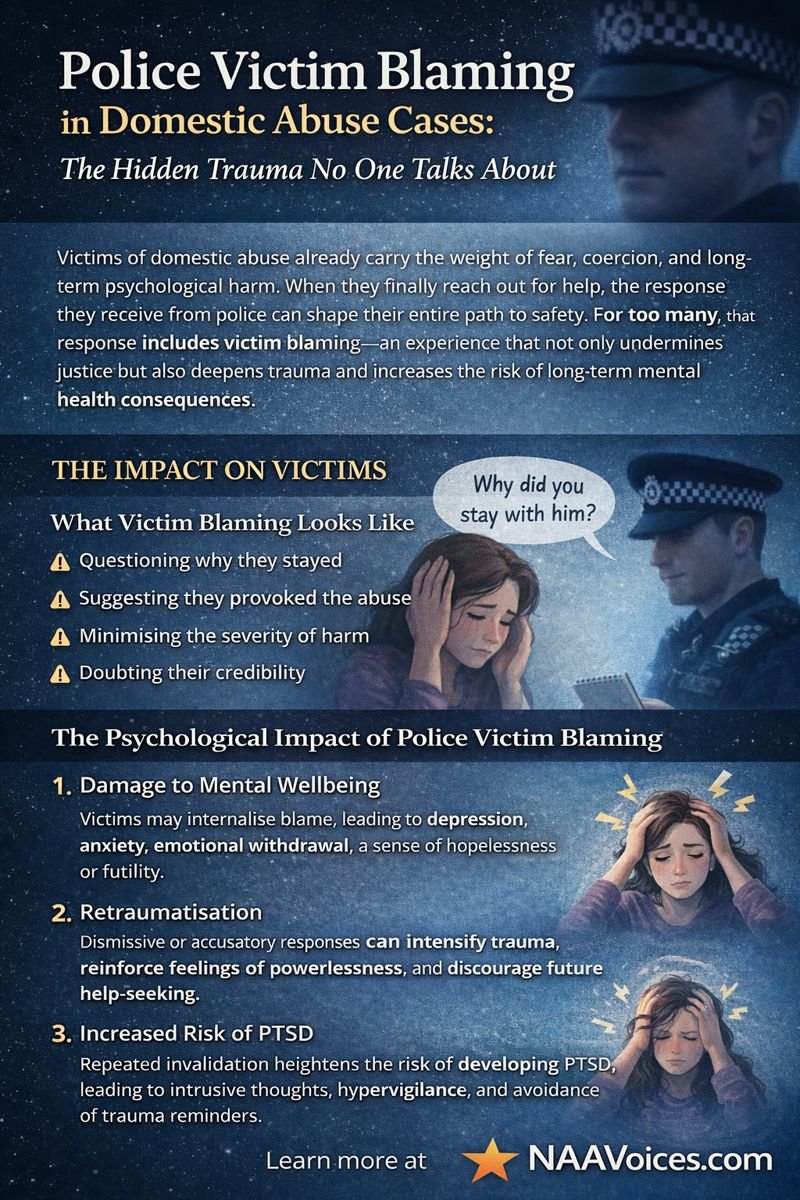
  • Police Victim Blaming in Domestic Abuse Cases: The Hidden Trauma No One Talks About

    Police Victim Blaming in Domestic Abuse Cases: The Hidden Trauma No One Talks About

    NAAVoices was not created from certainty, but from lived experience and professional insight. As I migrate earlier work from the original platform, this post has been reviewed and approved for transfer. It remains true to its original context, with only minor clarity edits where needed. Some moments do not require rewriting to remain honest.

    When Victims Are Blamed by the Systems Meant to Protect Them

    Victims of domestic abuse already carry enough.

    Fear. Shame. Confusion. Hypervigilance. The constant work of surviving someone else’s control while trying to make sense of what has happened to them.

    So when someone finally reaches out for help, the response matters.

    It can be the beginning of safety.

    Or it can become another wound.

    One of the most damaging responses a victim can receive is victim-blaming, especially from police. It does not always sound obvious. Sometimes it is subtle. Sometimes it comes dressed as professional questioning. Sometimes it appears in what is not recorded, what is minimised, or what is treated as less important than the perpetrator’s version of events.

    But the impact is real.

    And for victims of domestic abuse, it can be devastating.

    What Victim-Blaming Looks Like

    Victim-blaming happens when responsibility for abuse is shifted away from the person causing harm and placed, directly or indirectly, onto the person who has been harmed.

    In domestic abuse cases, this can sound like:

    Why did you stay?
    Why did you go back?
    Why did you not report it sooner?
    Why did you let the children see it?
    Are you sure it was that bad?
    Could this just be a relationship breakdown?
    Is this really about contact?

    These questions may be framed as fact-finding, but when asked without an understanding of coercive control, they can reinforce the exact messages the abuser has spent years embedding.

    That it was your fault.

    That you should have stopped it.

    That you are exaggerating.

    That you are the problem.

    For someone already conditioned by abuse, those messages do not land lightly.

    They go straight into the wound.

    Why It Causes So Much Harm

    Domestic abuse is rarely a single incident. It is often a pattern of control, fear, manipulation, degradation and psychological harm.

    By the time many victims speak to police, they may already be exhausted. They may doubt themselves. They may struggle to explain events in a neat, chronological order. They may appear calm when they are traumatised, or emotional when they are being honest.

    None of that means they are unreliable.

    It means they are human.

    When police respond with disbelief, minimisation or blame, the victim is forced to relive the abuse while also defending their right to be believed.

    That is retraumatisation.

    And it is not a minor side effect of poor communication.

    It can change the course of someone’s recovery.

    Retraumatisation Is Not Just Emotional

    People often talk about trauma as if it is only distress.

    It is not.

    Trauma lives in the body.

    It can look like panic, shaking, dizziness, nausea, chest pain, insomnia, flashbacks, dissociation, intrusive thoughts, memory fragmentation, emotional shutdown or complete collapse after appearing calm.

    A victim may sit through a police interview, answer questions, sign statements and look composed.

    Then fall apart afterwards.

    That does not mean they were fine.

    It means they were surviving the interaction.

    When police victim-blame, dismiss or mishandle disclosures, they can deepen that trauma. They can make the victim less likely to seek help again. They can also make the victim feel less safe than they did before they reported.

    That is institutional harm.

    The Link With PTSD

    Repeatedly having to disclose abuse, defend your credibility and correct inaccurate records can contribute to long-term psychological harm.

    For some victims, this becomes part of the trauma itself.

    PTSD can involve flashbacks, nightmares, hypervigilance, avoidance, intrusive thoughts, panic, emotional numbness and a constant sense of threat.

    For victims of domestic abuse, these symptoms can be intensified when the systems meant to protect them become another source of fear.

    It is not only what the perpetrator did.

    It is what happens afterwards.

    The disbelief.
    The poor recording.
    The minimisation.
    The handovers.
    The repeated retelling.
    The feeling that your own life is being interpreted by people who have not understood it.

    That is why police responses matter so much.

    What the Law and Guidance Already Recognise

    The Domestic Abuse Act 2021 gives a statutory definition of domestic abuse and recognises that abuse can include emotional, controlling, coercive and economic abuse.

    That matters because domestic abuse is not limited to physical violence.

    The NPCC and CPS Joint Justice Plan set out the need to improve the criminal justice response to domestic abuse, including better training, stronger accountability and improved support for victims.

    The Independent Office for Police Conduct has also issued guidance on ending victim-blaming, recognising that language, assumptions and professional attitudes can cause real harm.

    So the issue is not that nobody knows victim-blaming exists.

    The issue is whether those principles are being applied in practice.

    Because guidance means very little if victims are still leaving police interactions feeling blamed, disbelieved, unsafe or responsible for the abuse committed against them.

    What Needs to Change

    Police officers need proper trauma-informed training.

    Not tick-box training.

    Not a short online module that gets forgotten.

    Real training on coercive control, post-separation abuse, trauma responses, child safeguarding, perpetrator tactics and the harm caused by victim-blaming language.

    They need to understand that victims do not always present in the way people expect.

    Some cry.
    Some freeze.
    Some talk too much.
    Some cannot speak at all.
    Some sound detached.
    Some arrive with folders, timelines and evidence because they have already learned that if they do not create the record themselves, no one else will.

    None of those responses should be used against them.

    Police forces also need stronger accountability when officers fail to record crimes properly, minimise disclosures, or allow personal bias to influence safeguarding decisions.

    A victim should not have to become their own investigator just to prove they told the truth.

    Belief Is Not Bias

    Believing victims does not mean abandoning evidence.

    It does not mean ignoring due process.

    It means starting from a place of professional curiosity rather than suspicion.

    It means asking better questions.

    What has made it hard to leave?
    What control is still continuing?
    What are the children seeing, hearing or experiencing?
    What does the perpetrator gain from this version of events?
    What risks increase now the relationship has ended?
    What has already been disclosed, and has it been properly recorded?

    That is not bias.

    That is competent safeguarding.

    The Cost of Getting It Wrong

    When police blame victims, minimise abuse or fail to act, the harm does not end with that interaction.

    It follows the victim into family court.
    Into safeguarding meetings.
    Into mental health appointments.
    Into work.
    Into parenting.
    Into sleep.
    Into every attempt to rebuild a life.

    Poor police responses can strengthen the perpetrator’s position and weaken the victim’s credibility. They can leave children exposed to further harm. They can make the victim feel that telling the truth was not only pointless, but dangerous.

    That should concern everyone.

    Because domestic abuse victims do not need perfect systems.

    They need systems that do not make the abuse worse.

    A Survivor-Centred Response

    A survivor-centred response does not require grand gestures.

    It requires officers to listen properly.
    Record accurately.
    Avoid assumptions.
    Understand coercive control.
    Recognise trauma.
    Take children’s experiences seriously.
    Challenge perpetrator narratives.
    And remember that the person in front of them may have used every last bit of strength they had just to speak.

    Victim-blaming is not harmless.

    It is not just poor wording.

    It is not just a difficult conversation handled badly.

    It can retraumatise victims, damage mental health, obstruct justice and reinforce the control they were trying to escape.

    Victims of domestic abuse deserve to be met with dignity, belief and professional competence.

    Not blame.

    Not disbelief.

    Not another system they have to survive.

    Further Support

    If you are navigating police misconduct, victim-blaming, negligence or failures in duty of care, I have created a dedicated NAAVoices resource to help explain the process and your options:

    Police Misconduct Guide – NAAVoices.com

    You are not the problem for needing protection.

    You are not difficult for asking to be heard.

    And you are not responsible for the abuse someone else chose to inflict.

    Further Support

    For guidance on recognising and reporting police misconduct, refer to my dedicated resource. It covers topics such as victim-blaming, negligence, and breaches of duty of care. Police Misconduct Guide – NAAVoices.com

    My Lived Experience: A Personal Journey Through Trauma and Recovery
  • A Year Ago Today: The Disclosure That Changed Everything

    A Year Ago Today: The Disclosure That Changed Everything

    NAAVoices was not created from certainty, but from lived experience and professional insight. As I migrate earlier work from the original platform, this post has been reviewed and approved for transfer. It remains true to its original context, with only minor clarity edits where needed. Some moments do not require rewriting to remain honest.

    One Year Since I Told the Truth

    A year ago today, almost to the hour, I disclosed four years of domestic abuse to a West Mercia Police officer.

    I also disclosed child abuse, common assault, drug distribution, fraud and harassment.

    I told the truth.

    I expected protection.

    What followed changed everything.

    Instead of acting properly, recording what needed to be recorded, and protecting my children and me, that officer allowed his own views to shape what happened next. His response was not neutral. It was not safe. It carried assumptions about fathers’ rights into a situation where my children and I needed safeguarding.

    The consequences of that have never stopped unfolding.

    One Year Later

    Today, I received an updated court report based on open police disclosure.

    Reading it felt like being dragged back to the beginning.

    The police appear to have disclosed only one NFA relating to a non-molestation breach. What was missing mattered even more. There was no proper record that my children had disclosed abuse a year ago today.

    A year.

    And still, the record does not reflect what was said.

    Still, the harm is being carried forward.

    Still, the gaps left by that officer are shaping decisions about my children’s safety.

    There is so much more I could write about the months it took to evidence what had happened. The missing records. The failures to act. The attempts to challenge what should never have needed challenging in the first place.

    But tonight, the clearest truth is this.

    The actions of one officer placed my children and me at further risk, and I am still living with the consequences.

    Reading It at Work

    I was at work when I read the report.

    That detail matters, because trauma does not wait for a private room. It does not check whether you are in uniform, whether you have patients to see, whether you are expected to keep functioning.

    It lands where it lands.

    Tonight was also the final lecture of the first year of my master’s module. I had been doing well. Really well. I had fought hard to stay focused, to keep learning, to keep being the version of myself that still had a future beyond all of this.

    But tonight, I could not cope.

    It is one thing to have your life controlled by the person who abused you.

    It is another thing to have that control extended by the actions of someone who was supposed to protect you.

    The Layby

    I had to drive.

    I have not felt like that for a long time, but tonight I drove back to the layby I ended up in when Sergeant Smith was arrested.

    Back then, I would drive around for hours because I no longer felt safe in my own home. I would sit in places where nobody needed anything from me, where I did not have to explain, where I could just exist for a while.

    Tonight felt similar.

    Except this time, it was not my home that felt unsafe.

    It was me.

    My mind.

    My ability to keep carrying the weight of what his actions had created.

    I stood next to the gate and felt the wind hit my face.

    The stars were out.

    I used to look up and believe John and my grandad were somewhere up there. I am not religious, but I have always believed that the people you have loved and lost are still there somehow. Watching. Holding something you cannot hold for yourself.

    There were huge stars tonight.

    Maybe I needed to see them.

    Maybe I needed to remember that I am still here.

    The Question That Will Not Leave

    What gave a police officer the right to cause this much damage?

    What gave him the right to take my disclosure, my children’s safety, and four years of abuse, and filter it through his own bias?

    What gave him the right to leave gaps that I am still falling through a year later?

    Because that is what this feels like.

    Not one mistake.

    Not one bad day.

    A failure that became a chain reaction.

    A disclosure that should have led to protection became the beginning of another fight. A fight to be believed. A fight to correct the record. A fight to prove that what happened to us happened at all.

    And I am tired.

    Tired in a way sleep does not fix.

    Tired of carrying the consequences of decisions I did not make.
    Tired of trying to repair damage I did not cause.
    Tired of being expected to function inside systems that keep reopening the wound and calling it process.

    A year ago, I told the truth.

    Tonight, I am still living with what happened because the person listening did not do what he should have done.

    And that is the part I cannot make peace with.

  • Police Contact, Again — When the Aftermath Spoke Louder Than the Meeting

    Police Contact, Again — When the Aftermath Spoke Louder Than the Meeting

    NAAVoices was not created from certainty, but from lived experience and professional insight. As I migrate earlier work from the original platform, this post has been reviewed and approved for transfer. It remains true to its original context, with only minor clarity edits where needed. Some moments do not require rewriting to remain honest.

    Officer Eleven

    My new investigating officer turned up today with a colleague.

    And this woman felt different.

    That does not mean I trust the police. I do not. Not after everything that has happened. But there was something calmer about her. Something that did not immediately feel loaded with assumptions before I had even opened my mouth.

    That alone was a shift.

    Before They Arrived

    The morning was chaos.

    I was trying to manage the nerves, the anxiety and the panic, while also attempting to keep myself busy with the bathroom. I have finally started doing it up after waiting for the house remortgage to be sorted before putting any money into the property.

    Of course, after demanding that I resolve everything within 56 days, he is now refusing to sign.

    So I am still paying more than £600 a month more than I should be.

    Because apparently the financial abuse needed another chapter.

    After laying the flooring, I pulled up my police document. I have recently converted it into a PowerPoint presentation. It is now seventy-six slides long and still does not cover half of what has happened.

    That tells you everything.

    It is taking some doing. Not just practically, but emotionally. Every slide is another reminder of something I should never have had to document myself.

    The Panic Before the Knock

    The anxiety about who she might bring with her became overwhelming.

    One of her colleagues had previously been involved in the so-called investigation into the child abuse and did nothing meaningful with it. That alone was enough to send me into a spiral.

    But that is another post.

    Before they arrived, I sat crying for well over an hour. Proper panic. The kind that takes over your whole body and leaves no space for rational thought.

    Usually, if I see or interact with the police, I am written off for days afterwards.

    So I expected the same.

    I expected to be left confused.
    I expected to be left questioning myself.
    I expected to be left feeling degraded.

    But that is not what happened.

    The Meeting

    They came in.

    I spoke too fast. I veered off in too many directions. I probably made very little sense at points.

    But she listened.

    More importantly, when they left, I was not left feeling gaslit.

    I did not hear a lie.
    I did not hear victim blaming.
    I did not hear snide references to my mental health.
    I did not feel like my trauma was being used to undermine my credibility.

    Just honesty.

    And I respect that.

    I have never asked the police to dress things up. I have never needed flowers painted over the facts, or bows tied around the truth.

    I can handle difficult information.

    What I cannot handle is dishonesty from people whose job is supposed to be upholding the law and protecting the public.

    All I have ever wanted is the truth.

    To give it.

    And to receive it.

    Officer Eleven

    It is close to midnight now, and I have admitted defeat.

    I have taken a lorazepam.

    I do not take daily medication. No antidepressants. No regular anti-anxiety medication. Just this, when the CPTSD becomes too much and my body will not come down on its own.

    Tonight, the distress is not really about the officers who came today.

    It is about remembering how badly others before them have handled this.

    I am now on officer eleven.

    That is face-to-face.

    That does not include the ones over the phone.

    Out of those eleven, only two have treated me with real dignity and respect. Both had more experience than the rest put together.

    Maybe today makes three and four.

    I hope so.

    Cautious Hope

    Today was positive.

    I need to say that carefully, because positive does not mean safe. It does not undo what came before. It does not repair the damage or restore trust overnight.

    But it was different.

    And right now, different matters.

    For once, I was not left feeling smaller after police contact.

    I was not left doubting what I had said.
    I was not left feeling punished for speaking.
    I was not left carrying someone else’s dishonesty on top of my own trauma.

    That is not a small thing.

    Time will tell whether this becomes another disappointment or the start of something more honest.

    But today, for the first time in a long time, I did not feel completely crushed by the system after it left my house.

    And that is worth recording.

    Disclaimer: This account reflects my personal experience and perceptions at the time; six months later, my assessment of honesty changed again following review of the organisation’s own records.

  • Returning to Work with PTSD: When a Place of Safety No Longer Feels Safe

    Returning to Work with PTSD: When a Place of Safety No Longer Feels Safe

    Reflection — Two Years On

    Original entry, 10 September 2024, written during active trauma

    The entry that follows was written during a period of active trauma, while the abuse and its consequences were still ongoing. At the time, I was attempting to survive, parent, work and make sense of events that kept unfolding. I did not yet have the neurological framework to fully understand what was happening to my mind and body.

    During that period, I was studying the neuroscience module of my postgraduate certificate. One lecture in particular focused on neuroplasticity and the neurological impact of trauma. Through neuroimaging and clinical evidence, it became clearer to me that PTSD is not a personal failure or a weakness of character. It is a trauma-related condition that can profoundly affect the nervous system, particularly when someone is repeatedly exposed to threat or forced to relive harm.

    That understanding mattered.

    For a long time, I carried responsibility that did not belong to me. I questioned my decisions, my resilience and my capacity to cope. I told myself I should have left sooner, should have handled things differently, should have been stronger.

    What the science helped me understand was that the injury did not arise from leaving too late. It came from the abuse itself, and from being repeatedly pulled back into it through systems that failed to protect us.

    I had left. I was no longer living with him.

    What followed was not something I chose, and it was not something my children deserved.

    The neurological changes I live with are the consequence of sustained harm and re-traumatisation. Those who caused that harm made choices. Systems and individuals who failed to intervene also made choices. The injury that resulted is not mine to own in terms of blame, even though I am the one who has had to live with its effects.

    This reflection is not a correction of the entry that follows.

    It is context.

    The original post remains close to how it was written. It reflects the reality of that moment, before I had the same insight and understanding I have now. It was written before science helped me make some sense of what had happened to me.

    Within the Two Years On series, entries are presented as they were lived, alongside the understanding that came later.

    The words that follow are not evidence of failure.

    They are evidence of injury.

    And of survival.

    Returning to Work with PTSD

    (Original entry — 10TH September 2024) (written during active trauma)

    PTSD is often described as a mental health condition. Living with it, however, has felt more like a traumatic injury to my nervous system than an illness I simply developed.

    I learned about this recently, and it left me with questions I cannot easily answer.

    Does this mean I have to endure it forever?

    Will it worsen if the abuse and re-traumatisation continue?

    Research increasingly shows that PTSD and traumatic brain injury can share overlapping neurological consequences following trauma. Global estimates suggest that around 1.1% of the population experiences PTSD within a 12-month period. Approximately 69 million people worldwide sustain a traumatic brain injury each year.

    The neuroimaging below illustrates how PTSD and TBI can differ and overlap in brain perfusion patterns.

    Trauma alters neural pathways involved in threat detection, memory and emotional regulation. These changes are adaptive during danger. However, they can become destabilising when safety is delayed or denied.

    Figure 3. Brain SPECT Images of Healthy, PTSD, TBI and PTSD co-morbid with TBI perfusion patterns.
    Source: Amen et al. (2015). Functional neuroimaging distinguishes posttraumatic stress disorder from traumatic brain injury in focused and large community datasets. PLOS ONE, 10(7), e0129659.


    Top row: surface scans with threshold set at 55%, showing the top 45% of brain perfusion.
    Bottom row: active scans where blue = 55%, red = 85%, and white = 93%.

    • Healthy brain: Full, even, symmetrical perfusion with the most active area in the cerebellum.
    • Classic PTSD: Increased perfusion in the anterior cingulate, basal ganglia, and thalamus.
    • Classic TBI: Multiple areas of low perfusion visible on surface scans.
    • PTSD + TBI: Displays both increased perfusion patterns associated with PTSD and low‑perfusion areas associated with TBI.

    I struggled to wear my uniform

    I Struggled to Wear My Uniform

    With the children back in school and my return to work approaching, I thought it would be sensible to spend some time reacclimatising.

    To get used to the environment again.

    To be around people.

    I struggled to wear my uniform.

    I felt disconnected from the proud, compassionate nurse I once was.

    The ongoing attacks on my character through the court process had deeply shaken my sense of self. It became difficult to protect my identity and continue fighting when so much of who I was felt under question.

    I questioned my strength.

    I questioned who I was.

    I arrived early, completed the routine checks and went straight to my room.

    The grip PTSD can have on the mind is profound. I expected relief when returning to a place that had felt safe for so long. Instead, it felt foreign.

    The warmth had gone.

    There were memories, but not the ones I had expected.

    The comforting memories were gone.

    There had been days when I went home thinking about patients. I would check in because I knew people had a lot to manage. There were times I knew I had made a difference. Work had been the place where I could be myself, where I felt free, and where I found respite from the hell I was living at home.

    Instead, the photograph a colleague had encouraged me to keep was still on my shelf. We had covered part of it with another image so that only my child and I remained.

    I could not even look at it.

    When I tried to pick it up, my hands shook so badly that I dropped it. It smashed across my desk.

    The room was full of memories.

    Trauma does not stop at the outside world. It invades even the spaces that once felt safe.

    Haunted by My Sanctuary

    I avoided reception.

    Everyone had been kind, but I was petrified of being asked how I was. I could not keep the emotion away, and crying in a shared workspace was not something I could cope with.

    My nursing team had already been supportive through a difficult period. I did not want to cause more worry.

    It was nearing a year since I left him, and the impact of what we had lived through had touched every aspect of our lives.

    The continuation of it made me feel worse than I did when I left. I had believed leaving would end his control. Now I knew how far he would go, and I could not see an end in sight.

    My colleagues came in individually to catch up, give me a hug and see how I was.

    I wish there had been a cure.

    A way to wave a wand and make it all stop.

    A way to be me again.

    We all have “our” rooms, even if we are not meant to call them that. I had decorated my noticeboard after twelve months because I was certain this was the right place for me.

    I could not stop thinking about how to change the room.

    I kept staring at the same wall. The same view. The same space connected to days when my private life was unstable and I was still trying to work, think and function.

    The chest pain.

    The stress.

    The fear.

    Unless you have lived through something like this, it is difficult to understand the depth of damage it causes.

    One thing I do know is that people in healthcare care.

    Even when they do not fully understand, they care.

    That compassion had not been reflected by many other agencies involved.

    Flashbacks and Intrusive Thoughts

    Flashbacks and intrusive thoughts are particularly prominent in complex PTSD. I hope I reach a point where these experiences ease, where I can close my eyes without fearing what I might see.

    I spoke to my manager about moving my desk.

    A different view might help. However, it was not practical. It would affect the layout of the room and how safely I could work within it.

    He was thoughtful and busy, but he still tried to think of ways we might change the space.

    I suspect he could hear the struggle in my voice and knew I would not say exactly why.

    Normally, I would share anything new with the team. That day, despite knowing I needed a drink, I could not even face going out to get one.

    My work mum asked if I wanted a cup of tea, and I went with her.

    I knew I had to find the strength to return, but where that strength would come from was beyond me.

    Constraints Beyond Choice

    He continued to control the mortgage and still had not signed the deed. I was paying over £600 more each month, and it could take weeks to resolve.

    Going to half-pay was not an option when I needed to provide for the children.

    I completed my flu vaccination training and deliberately avoided anything connected to the police or court. I was trying to find a connection beyond the constant protection of the children, but it felt almost impossible.

    Even reviewing evidence to safeguard them brought further trauma.

    Everything felt overwhelming. Silent and deafening at the same time.

    I think those who live with PTSD will recognise that contradiction.

    My manager found it amusing that I needed to update my safeguarding training. He knew I could probably recite Working Together to Safeguard Children by heart.

    The sole focus of the previous ten months had been safeguarding my own children, yet no one had afforded them the same level of protection.

    I had a few wobbles.

    A few cries.

    I hoped to manage six hours, but I could not.

    At lunch, I felt jumpy. Although I knew I was safe in theory, my body did not believe it.

    It is surreal to feel empty and hypervigilant at the same time.

    Small talk felt pointless, but I still cared deeply about my colleagues. Normally, I would be full of ideas and support.

    I did not want them to know how far away I felt inside.

    I am beginning to realise it is not my team who are the odd ones.

    It is the wider world.

    When empathy and compassion feel rare, those who still carry them matter.

    The Blog as a Safe Space

    I contacted CMHT and called my GP.

    I was not on regular medication, only medication for acute trauma responses, but I had run out and was worried about how I would manage the following day.

    One colleague had become a close friend. She and my work mum provided character references for court. I could not read them at the time.

    It was clear that I had changed, despite my attempts to fight through.

    I hated being seen differently, yet part of me was relieved they could not see inside my head.

    This blog became my safest space. The only place I could be honest without causing worry to those I care about.

    The next day, I had to meet CAFCASS.

    I was terrified they would see only the broken version of me, not the person I was before the abuse became too much.

    I did not want to be broken.

    I knew I could not live freely while he continued to exert control, and I feared what he would do next.

    I had not been able to process what I had lived through because it had not stopped.

    I knew there was still part of me inside.

    I did not know whether I would ever fully come back.

    The Real Hug

    That evening, my youngest asked their middle brother for a “real hug.”

    Watching them climb out of bed to embrace stirred something in me.

    These moments, small and fleeting, are what I cling to.

    They remind me of what things once felt like.

    They remind me of what is still worth holding on to.

    This reflection is shared as lived experience to support domestic abuse awareness, trauma-informed understanding and the normalisation of mental health support. It is not intended as clinical advice or a comment on any individual patient, colleague or workplace. Identifying details have been limited where appropriate to protect privacy and maintain professional boundaries. The purpose of sharing this is advocacy, reflection and reducing stigma around trauma, domestic abuse and seeking help.

    My Lived Experience: A Personal Journey Through Trauma and Recovery
  • The Day Everything Changed: Family Court, Coercive Control, and the Cost of Seeking Protection

    The Day Everything Changed: Family Court, Coercive Control, and the Cost of Seeking Protection

    NAAVoices was not created from certainty, but from lived experience and professional insight. As I migrate earlier work from the original platform, this post has been reviewed and approved for transfer. It remains true to its original context, with only minor clarity edits where needed. Some moments do not require rewriting to remain honest.

    Family Court, Coercive Control and the Cost of Seeking Protection

    The Email That Undid Me

    30 August 2024

    On 16 July 2024, I attended the fifth hearing in the child arrangements proceedings concerning my son.

    I have tried repeatedly to write about what happened that day, but I have struggled to find the words. The hearing ended several weeks ago, yet its impact has not.

    In the days beforehand, I took my youngest son away for two nights. A local family who barely knew us showed us extraordinary kindness and gave us somewhere peaceful to stay.

    For two days, I could breathe.

    As I drove home, I cried because I knew I was returning to the court proceedings, an unresolved police investigation and the continuing reality that leaving the relationship had not brought an end to the fear or control.

    The Fifth Hearing

    The hearing took place remotely because my ex had failed to attend the previous hearing in May.

    I joined from work, in my nursing uniform, between patients.

    My solicitor was unhappy that I was not attending the court building in person. However, I was already struggling significantly and was doing everything possible to remain functional, continue working and care for my children.

    From my first meeting with my solicitor, I had been clear that I wanted a Section 7 report.

    I wanted an independent professional to assess my child’s welfare and long-term safety.

    When I was asked whether I really wanted somebody appointed to my child, my answer was clear.

    Yes.

    Absolutely yes.

    Because he is my child.

    Despite the language that had been used towards me, the control I had experienced and the repeated attempts to make me feel less entitled to protect him, he remained my child.

    I needed somebody independent to examine the circumstances properly.

    Eventually, Cafcass and the court directed that a Section 7 report should be completed.

    That should have felt like a relief.

    Instead, I left the hearing feeling as though I had become irrelevant.

    My other children appeared irrelevant. The wider history appeared irrelevant. The safeguarding concerns I had tried to raise felt minimised, disputed or missed.

    Allegations Made and Withdrawn

    During the hearing, my ex made allegations to Cafcass concerning two members of my family.

    Almost in the same breath, he retracted them.

    The allegations were withdrawn, but they had still been spoken and heard.

    That was what disturbed me.

    A suggestion could be introduced and then withdrawn moments later, yet the impression created by it could remain.

    Meanwhile, I felt that every word I used had to be carefully measured because anything unclear, emotional or poorly expressed could be recorded and relied upon long afterwards.

    He could make an allegation and retract it almost immediately.

    I did not feel I could afford one misplaced sentence.

    The Wider Context

    This was not happening without a wider history.

    Before I left, I had experienced his misuse of alcohol and drugs directly. In 2022, he had also been disqualified from driving following an alcohol-related driving offence.

    At the January hearing, the court IDVA made a comment suggesting that his decision to shave his head completely bald might have been connected to concerns about concealing evidence of alcohol or drug use.

    That was the IDVA’s observation. It was not a finding made by the court, and I cannot state with certainty why he had shaved his head.

    However, the comment remained in my mind because substance misuse was not an abstract concern to me. It formed part of the behaviour and instability I had experienced before leaving.

    Against that background, I found it difficult to watch him continue to present himself solely as the injured and vulnerable party.

    He was on police bail at the time.

    In the hearing, he cried and presented himself as the devastated, wronged father.

    Years earlier, before an assessment appointment, he had messaged me saying that he knew what to say because it was not his “first rodeo.”

    I still have that message.

    By July 2024, I recognised patterns in the way he presented information and emotion.

    I could not know what he was privately thinking or feeling, but I knew what I had experienced behind closed doors. I also knew how different that experience was from the version of him being presented to professionals.

    Being Seen as the Difficult One

    This is my life, not a performance.

    I cannot separate myself from the fear, history and consequences long enough to deliver everything as a neat, emotionally controlled account.

    That is part of what people do not understand about hearings involving domestic abuse.

    A person who appears composed and delivers a clear account may be regarded as credible.

    A traumatised person may appear anxious, defensive, frustrated or overwhelmed.

    One may be seen as reasonable.

    The other may be seen as difficult.

    I know because I felt as though I had become the difficult one.

    My Own Representation

    What I had not expected was to feel unsafe with my own legal representation.

    My recollection is that my solicitor told me I did not “present” as a victim and that his barrister would rip me apart in the witness box.

    That sentence has stayed with me.

    How exactly is a victim supposed to present?

    Broken enough to be believed, but not so broken that they are dismissed?

    Calm enough to appear credible, but not so calm that their trauma is questioned?

    Emotional enough to demonstrate harm, but not so emotional that they are labelled unstable, hostile or unreasonable?

    There is no safe way to present once somebody has already decided what a victim should look like.

    When I have said that the abuse continued through the legal process, people have sometimes misunderstood who I meant.

    I need to be clear.

    I am talking about the impact of my own representation.

    Not his.

    The person I had relied upon to represent me had become another reason I felt frightened, exposed and unheard.

    Practice Direction 12J

    I had asked for Practice Direction 12J and the domestic abuse concerns to be properly considered.

    I also wanted the court to consider whether a fact-finding hearing was required before longer-term decisions about contact were made.

    I did not believe those issues were being placed before the court in the way I had requested.

    I eventually asked to speak to Cafcass alone because I no longer trusted that the safeguarding concerns would otherwise be clearly communicated.

    Since the hearing, I have been trying to find another solicitor.

    I am frightened by what can happen when somebody representing a victim does not appear to understand the dynamics of domestic abuse or the way legal proceedings can continue the impact of control after separation.

    It does not feel like a simple disagreement about legal strategy.

    It feels as though important parts of my case are being lost before they have been properly heard.

    The Police Investigation

    At the same time, I am still trying to understand what is happening with the police investigation.

    My fourth investigating officer told me that the case was with the Crown Prosecution Service for a charging decision.

    I was later told that it had “met the threshold” for further investigation, which appeared to mean that it had not been sent to the CPS in the way I had previously understood.

    Eight months after leaving, and after four investigating officers, I still cannot obtain a clear account of where the case stands.

    Professional Standards have also been involved regarding the conduct of one officer.

    I am therefore trying to navigate family court proceedings while dealing with an unresolved police investigation and concerns about the conduct of some of the people who were supposed to protect me.

    When the Order Arrived

    When the court order arrived, I could barely process it.

    What I managed to read felt inappropriate and deeply upsetting.

    I felt that my character had been presented through a version of events that reflected his narrative rather than the reality I had experienced.

    I still have not been able to read all of it.

    Following the order, I received correspondence requesting the first update under the arrangements that had been made.

    The email arrived late on a Friday afternoon.

    Of course it did.

    By then, I had already left work and had not been able to return.

    The hearing had broken something in me, and opening that email showed me how close to the surface the trauma remained.

    There he was.

    A photograph.

    His face.

    His eyes.

    The man whose abuse still lives in my body.

    The man whose control I am still trying to escape.

    The man I avoid looking at in photographs, even where those photographs remain on my son’s wall.

    I had to telephone a friend.

    I became lightheaded.

    I could not stand properly.

    I could not breathe properly.

    It felt as though everything I had been trying to recover from had suddenly been placed directly in front of me again.

    Trauma Is Physical

    This is the part people do not always understand about trauma.

    It is not simply a memory.

    It is physical.

    It is immediate.

    One photograph, one email or one unexpected reminder can put your body back into the danger before your mind has had time to understand what is happening.

    It was not just a photograph.

    It was a trigger.

    A reminder.

    A threat without words.

    I kept asking myself why I was being sent photographs of him.

    Why was I looking at a photograph of him in a suit when I had sold my belongings and my children’s toys to pay debts he had left behind?

    Why was I looking at that image when he had accused me of financial control?

    There had been a point when I struggled to afford food for my children, yet there he was, presented in a way that felt completely removed from the reality I had lived.

    The worst part was his eyes.

    His eyes haunt me.

    That may sound dramatic to somebody who has not experienced trauma.

    Those who have will understand exactly what I mean.

    The Cost of Coping

    The Community Mental Health Team prescribed Lorazepam because of the trauma associated with the police investigation and the ongoing court proceedings.

    I took it for the first time after receiving that email.

    I cried.

    Not because I judge medication.

    Medication can be necessary, and there should be no shame in needing it.

    I cried because I realised that I now needed medication to cope with harm that other people had caused.

    To cope with an email.

    To cope with seeing his face.

    To cope with the fact that he could still reach into my life through legal proceedings, correspondence, photographs and court orders.

    Is this what my life has become?

    Needing medication simply to tolerate the impact of a process that is supposed to protect children and victims of abuse?

    Facing October

    I am supposed to face him again in October.

    I am frightened.

    I am petrified of what it will do to me.

    I am frightened that I will be there alone, trying to hold myself together while attempting to communicate the safeguarding concerns through a system that is supposed to protect my child.

    He appears able to present himself calmly and persuasively.

    I am trying to explain events that have left me traumatised and physically unwell.

    I know what happened behind closed doors.

    I know what the children experienced.

    I know what it cost me to leave.

    But knowing the truth and being able to make other people understand it are not the same thing.

    What Will This Mean?

    I do not know what the final decision will mean.

    What will it mean for my child?

    What will it mean for me?

    What will it mean for the next fourteen years of my life?

    This is not only about one hearing or one court order.

    It is about the reality of post-separation abuse when the relationship has ended but the fear and control have not.

    It is about family court becoming another route through which harm can continue when domestic abuse is not properly understood.

    It is about being expected to remain calm, reasonable and functional while trying to explain experiences that have left you frightened and physically unwell.

    Tonight, I do not feel strong.

    I feel frightened.

    I feel trapped.

    I feel exhausted by the fact that leaving him was not the end of his control.

    It was only the beginning of trying to prove it.

  • Avoidance and Invalidation — The Twin Costs of Not Being Allowed to Feel

    Avoidance and Invalidation — The Twin Costs of Not Being Allowed to Feel

    NAAVoices was not created from certainty, but from lived experience and professional insight. As I migrate earlier work from the original platform, this post has been reviewed and approved for transfer. It remains true to its original context, with only minor clarity edits where needed. Some moments do not require rewriting to remain honest.

    Avoidance, Honestly Defined

    Avoidance is easy to judge when you are looking at it from the outside.

    People call it denial. Running away. Burying your head in the sand. Refusing to deal with things.

    But that is not what it feels like when you are the one living it.

    Avoidance is not always weakness. It is not laziness. It is not a character flaw. Sometimes it is what happens when your mind and body learn, over time, that feeling too much is dangerous. That speaking is dangerous. That reacting honestly is dangerous. So instead, you push things down. You stay busy. You distract yourself. You numb out. You tell yourself you will deal with it later, when things are calmer, when you are stronger, when life gives you room to breathe.

    The problem is, later does not always come.

    What protects you in the moment can quietly trap you over time. Avoidance can get you through the day. It can help you function when the truth feels too heavy to carry. But it does not make the pain disappear. It just asks your body to hold it for longer.

    And the body does hold it.

    I know that now in a way I wish I did not.

    I live with the cost of it every day. Years of swallowed emotion. Years of pretending I was coping better than I was. Years of trying to stay composed, stay useful, stay needed, stay upright, while so much inside me was never given space to land. Four years of pain that never really had anywhere safe to go. Four years of being hurt, dismissed, frightened, invalidated, and still having to carry on.

    Those feelings do not just vanish because no one makes room for them. They settle somewhere. In your chest. In your stomach. In your sleep. In the constant tension in your body. In the exhaustion that never quite lifts. In the way your nervous system starts reacting before your mind has even caught up.

    That is the part people do not always see.

    Avoidance is not the absence of feeling. It is often the result of feeling too much, for too long, with nowhere safe to put it.

    And insight does not magically fix that. Understanding yourself does not suddenly make it easy to face the things you have spent years surviving. Sometimes it just means you can finally see the damage more clearly.

    Facing things is still hard. It is still painful. It is still exhausting.

    But eventually it stops being optional.

    Eventually, you realise the things you are trying not to feel are shaping your life anyway.

    Invalidation, Quietly Defined

    Invalidation can be hard to explain because it does not always look cruel from the outside.

    Sometimes it is obvious. Sometimes it is being told you are overreacting, being too sensitive, making a fuss, taking things the wrong way. Sometimes it is someone directly dismissing what you feel as though it does not matter.

    But often it is much quieter than that.

    It is the tone that tells you your feelings are inconvenient.
    It is the quick change of subject when you finally say something real.
    It is being “reassured” in a way that leaves no room for your actual experience.
    It is someone explaining your own pain back to you in a way that makes it smaller, neater, easier for them to sit with.
    It is being encouraged to move on before you have even been allowed to feel what happened.

    That is what makes invalidation so damaging. It does not always sound harsh. Sometimes it sounds reasonable. Calm. Practical. Well-meaning, even.

    But the impact is the same.

    You are left questioning yourself. Wondering whether you are too much. Whether your feelings are too big. Whether your reactions are wrong. Whether you are somehow the problem for being hurt by what hurt you.

    That kind of damage settles deeply, especially when it happens over and over again.

    Because after a while, you stop needing other people to dismiss your feelings. You start doing it for them. You get there first. You shrink your own experience before anyone else has the chance. You explain it away. Minimise it. Silence it. You become fluent in making your pain more acceptable to other people.

    And that is a heartbreaking way to live.

    Not all invalidation is deliberate. I know that.

    Some people genuinely do not know how to sit with another person’s emotions. Some were never taught that validating someone is not the same as agreeing with everything they say. Some people panic in the face of pain and rush to fix, soften, tidy, or redirect because they cannot tolerate the discomfort of simply witnessing it. Some people are so exhausted themselves that they have nothing left to offer.

    That may explain it.

    But it does not undo the harm.

    Intent matters, yes. But impact matters too. And being repeatedly left feeling unseen, doubted, or emotionally unsafe changes you, whether or not the other person meant it to.

    Holding the Line

    What I have learned, slowly and painfully, is that my feelings are not the problem.

    They are not an inconvenience. They are not a nuisance to be managed. They are not proof that I am weak, difficult, dramatic, or broken.

    They are information.

    They are my body and mind telling the truth about what I have lived through.

    They are the evidence of what something cost me.

    And other people’s discomfort with my feelings does not make those feelings less real. It does not make them less valid. It does not make me wrong for having them.

    I think when you have lived for years in environments where your feelings were dismissed, minimised, twisted, or ignored, you can start to lose touch with that. You start to believe that keeping the peace matters more than being honest. That staying quiet is safer than being real. That being easy to deal with is the same as being okay.

    It isn’t.

    There is a difference between surviving by shutting things down and actually healing. A huge difference.

    And I am no longer willing to keep abandoning myself just because other people find emotion uncomfortable.

    I refuse to keep treating my pain like an inconvenience.
    I refuse to keep apologising for having real human reactions to real human harm.
    I refuse to let years of being made to feel invisible convince me that I am still invisible now.

    The echo of those four years is still there. I feel that. Some days more than others.

    But I am learning, slowly, that not being allowed to feel is its own kind of damage.

    And I am done helping it silence me.

  • Professional Standards, Signed Statements, and the Aftermath You Do Not See

    Professional Standards, Signed Statements, and the Aftermath You Do Not See

    NAAVoices was not created from certainty, but from lived experience and professional insight. As I migrate earlier work from the original platform, this post has been reviewed and approved for transfer. It remains true to its original context, with only minor clarity edits where needed. Some moments do not require rewriting to remain honest.

    An Unusually Calm Morning

    Usually, anything involving police contact is there in my body before my mind has even caught up.

    The dread starts early. My chest tightens. My thoughts begin racing ahead of me. I rehearse everything that could go wrong before I have even properly started the day.

    But this morning was different.

    There was no panic. No spiralling. No crushing sense that I might fall apart before I even got there.

    Just a kind of quiet.

    Not peace exactly, but something close enough to feel unfamiliar.

    The night before, I had been awake all night drafting and finalising a document on Misconduct in Public Office relating to PC Rolls. Printed, organised, ready to go.

    It was one of those documents built out of pure necessity. The kind you create when you have been left carrying too much for too long, and the only way to cope is to force some sort of order onto the chaos.

    What made it more complicated was that this was not the first time I had done something like that.

    Back in July, I had already created a similar document to examine, for my own sake, whether there was any truth in what they were trying to imply about Sergeant Smith. I needed to test it properly against the guidance, the standards, the facts, and everything they seemed to be leaning on.

    I needed to know whether there was something there that I was somehow missing.

    There was not.

    And because there was not, I refused to hand that document over.

    That mattered to me. It still does.

    By then, I already knew how easily words could be lifted, reshaped and slotted into narratives that do not reflect the truth. I was not going to hand over something that could be used to support an allegation I did not believe in.

    So the document I took with me that morning, the one I did agree to share with DC Jackie from Professional Standards, was the one about PC Rolls.

    Not the officer she was investigating.

    Meeting Away From the Station

    We met at a Costa near the station rather than inside it.

    That mattered too.

    I had no confidence that my body would cope with the station building itself. Sometimes trauma is not dramatic from the outside. Sometimes it is just knowing exactly which doors your nervous system cannot walk through without paying for it later.

    I arrived early, bought a drink and sat waiting with that rare steadiness I usually only find at work, when I slip into professional mode and hold myself together because I have no choice.

    And that was part of what felt so strange.

    Sitting there, I could tell that under different circumstances, in a different life, I probably would have got on well with Jackie. She felt easy to talk to. Warm. Human.

    But that is where it becomes complicated.

    Because once you have been pinned into the role of “victim”, even ordinary human connection can start to feel risky.

    You find yourself wondering whether being treated like a person will later be twisted into something else. Whether kindness will be questioned. Whether simple decency will be made to look suspicious.

    That does something to you.

    It makes you cautious in places where you should be able to exhale.

    The Conversation

    I am not someone who rushes conversations, and I did not rush this one either.

    I spoke to Jackie about the previous day. The fifth handover. The fresh set of officers. The sleepless night that followed. That awful, familiar feeling of being dragged back to the beginning all over again.

    She was under no obligation to sit and absorb any of that. It was not the formal purpose of the meeting.

    But she listened anyway.

    I wanted her to understand that the damage is not only in the original harm.

    It is in the repeating.

    The retelling.

    The constant reopening.

    The way systems can make you bleed from the same wound over and over and still call it procedure.

    We also spoke about the software I had used to organise the evidence. It had worked well. Far better than the chaos I had been left to live inside.

    It did what should have been done properly from the start.

    It put things in order.
    It made patterns visible.
    It made the chronology make sense.

    I kept thinking how different all of this might have been if the case had been documented properly at the beginning. How much might have been prevented. How much trust might not have been lost.

    Jackie asked more than once if she could have a copy of the document I had prepared.

    I had not expected to say yes.

    But again, that is why the distinction matters so much.

    The document I gave her was the one on PC Rolls. It reflected where I believed the scrutiny should have been directed. It was grounded in guidance, police conduct standards, and the failures that had shaped what happened to my children and me.

    The July document about Sergeant Smith was different.

    I had created that one only to check for myself whether there was any substance in what they were trying to suggest.

    There was not.

    Because of that, I refused to hand it over.

    That refusal mattered because it was one of the few places I still had control. One of the few moments where I could say no.

    No, I am not helping you build something I do not believe is true.

    But the PC Rolls document was different.

    I did not share it because I suddenly trusted the process. I shared it because if that document made someone stop and properly look at what had happened, then maybe some purpose could still come from the work and pain that had gone into it.

    The scale of it seemed to land with her too.

    Equality Act references.
    Police codes of conduct.
    Home Office guidance.
    Layer after layer of material that I had had to pull together because no one else had done it for me.

    Because that is what happens when systems fail you for long enough.

    You end up becoming your own researcher, your own organiser, your own advocate, your own witness.

    Jackie clearly had empathy. You could feel that.

    And I do not imagine her role is an easy one.

    Being Heard Without Being Rewritten

    Jackie had brought a statement for me to sign.

    That mattered more than it should have had to.

    Unlike the statement produced in the children’s case, this one had not been rewritten into someone else’s version of me. It had not been flattened into language that sounded more convenient, more polished, more like them than me.

    It still sounded like my voice.

    It still felt like my words.

    That should not feel remarkable.

    But after everything else, it did.

    We spoke briefly about what would happen next. Jackie said that if the CPS took the matter forward, it was unlikely I would be called.

    I could not ignore the meaning sitting underneath that.

    My account did not fit the version of events they appeared to be working from. That has been one of the strangest, most unsettling parts of all of this.

    The feeling of being pushed to the edge of something that happened to me, as though I am just another witness passing through rather than the person whose life sits at the centre of it.

    Jackie stayed professional throughout. She offered me a direct line of contact if I heard nothing more on either the Misconduct in Public Office issue or the coercive control complaint.

    I appreciated that.

    But appreciation is not the same as trust.

    And trauma knows the difference.

    The Thirty Minutes That Broke the Calm

    I left that meeting feeling as steady as I had when I arrived.

    For about thirty minutes.

    Then it all caught up with me.

    That is the part people do not see.

    The bit after.
    The drop.
    The crash.

    The moment your body realises it is no longer being held upright by pure force of will.

    I had held it together in the meeting. I had spoken clearly. Sat calmly. Signed what needed signing. Probably looked, from the outside, perfectly composed.

    But the body keeps score.

    The drive. The music one of the children had on in the car. The emotional comedown from holding myself so tightly in place.

    All of it landed at once.

    My tolerance disappeared.

    I went straight back to the same few songs I loop when I need to regulate. The ones I cling to when I can feel myself slipping.

    This time, they did not hold me.

    I had to pull over because the dizziness had tipped into that frightening space where you know you are no longer safe to keep driving.

    Not tired.

    Not emotional.

    Unsafe.

    And none of that was about Jackie personally.

    It was not about one conversation in one café.

    It was about what that conversation represented. The reliving. The cumulative weight. The reality of how much my life has changed, and how much I have changed, because of what started this and everything that followed.

    Some harm does not happen in the room.

    Some of it arrives afterwards, when you are in the car, trying to get through an ordinary journey, and your body suddenly reminds you that none of this was ordinary at all.

    On Being the Reluctant Victim of an Investigation I Never Asked For

    I hope the CPS make a decision soon on the Misconduct in Public Office case.

    Not because I think a decision will suddenly make any of this feel fair, but because sometimes you just need one door to close.

    Even badly.

    Even imperfectly.

    You just need it to stop standing open in front of you.

    I expect it will end up at a gross misconduct hearing.

    I even asked whether I could be invited, given that I am apparently the unwilling victim of this implied abuse.

    And that still does not sit right with me.

    Not remotely.

    In November, four years of disclosed abuse was not enough for me to be treated as a victim.

    Four years.

    Four years of harm, fear, coercion and trying to be heard.

    That was not enough.

    But now I am expected to accept that I am the victim of Sergeant Smith, the one officer who actually treated me like a human being.

    I cannot accept that, because it is not true.

    That is not what happened.

    The truth is far messier than the version that fits neatly inside professional processes. Sergeant Smith saw a person where others had seen a problem, a case, a complication or something to move along.

    He stepped into a situation long after others should have acted.

    And now it feels as though that humanity is the very thing being picked apart.

    There is something deeply difficult to sit with in that.

    The idea that someone could lose a forty-year service history for recognising the person in front of them, for treating me with dignity after earlier failures had already stripped so much away, is incredibly hard to sit with.

    I do not know how I will get through court if it comes to that.

    I say that honestly.

    I will somehow have to stand in that environment, under all that weight, and hope my body does not give out beneath the pressure.

    And I imagine Sergeant Smith probably regrets ever opening the complaint I had originally submitted.

    Probably regrets knocking on my door at all.

    That thought sits heavily too, because none of this should have unfolded the way it has.

    People always like to tidy things up afterwards.

    They say, why did you do this?
    Or he should have done that instead.
    Or you could have done it differently.

    As though there was ever some clean, perfect route through a situation like this.

    As though trauma leaves you with the luxury of calm strategy.

    As though any of us were moving around this in ideal conditions.

    Looking back, part of me wishes Sergeant Smith had never got involved.

    Not because he did something wrong.

    But because maybe then neither of us would have ended up here, being used in a process that feels less about truth and more about moving scrutiny to somewhere safer, somewhere easier, somewhere more convenient.

    I did not ask for this investigation.

    I did not ask to be made the centre of a version of events that does not reflect what happened.

    And I certainly did not ask for the part people never see afterwards.

    The shaking after the meeting.
    The looped music.
    The pulled-over car.
    The body that no longer handles stress the way it used to.
    The effort of looking functional while something inside you is still splintering.

    That is the aftermath people miss.

    The meeting is one hour.
    The statement is a few pages.
    The signature takes seconds.

    But the fallout comes home with you.

    And sometimes it stays long after everyone else has walked away.

    This is PTSD.

    My Lived Experience: A Personal Journey Through Trauma and Recovery
  • At the Starting Line, Again — The Cost of Being Passed from Officer to Officer

    At the Starting Line, Again — The Cost of Being Passed from Officer to Officer

    NAAVoices was not created from certainty, but from lived experience and professional insight. As I migrate earlier work from the original platform, this post has been reviewed and approved for transfer. It remains true to its original context, with only minor clarity edits where needed. Some moments do not require rewriting to remain honest.

    Two Years On — Reflection

    Reading this back now, I can see the pattern far more clearly than I could then. At the time, I only knew that I was exhausted, frightened, and falling apart. Now I can name it for what it was: the slow, cumulative damage of being passed from officer to officer, team to team, having to reopen the same wounds every single time.

    People talk about re-traumatisation like it is an unfortunate side effect. It isn’t. Not when the system keeps making you start again from the beginning. Not when every handover means retelling the worst parts of your life to strangers and hoping this time somebody will actually understand.

    Content warning: descriptions of trauma response, hypervigilance, and distress connected to police contact.

    Back at the Starting Line

    I cannot shake the feeling that I am right back at the starting line.

    Back at the beginning of a fight I never asked for, and one that still does not seem to have an end.

    I do not know how much fight I have left in me. So much of me has already been worn down. It took everything to speak in the first place, and even that now feels like it has been pulled apart, reframed and handed back to me as something else.

    The police have my files. My words. My evidence. Pieces of my life.

    And I do not trust that any of it will come back to me whole.

    The Fifth Set of Officers

    I saw another new set of officers this morning.

    The fifth.

    I thought I would be okay. I told myself it was just another meeting. But there is nothing simple about sitting down again and dragging yourself back through things that nearly broke you the first time.

    My body reacted before my mind had a chance.

    The dread.
    The panic.
    The tight chest.
    The feeling that my skin does not fit properly.

    It was all there again.

    The officers seemed pleasant enough, which somehow made it harder. The male officer had once worked at the same hospital as me. You would think familiarity might ease things slightly.

    It did not.

    It made me feel more exposed.

    When they knocked, I only opened the door part of the way. I still do not know whether that was intentional or just panic. The female officer seemed to sense my hesitation and gently asked if they could come in. By then, I had already stepped back.

    Cleaning Before They Arrived

    They arrived earlier than I expected.

    I had woken with the kind of anxiety that turns into frantic movement, as though keeping busy might stop the fear from catching up with me.

    So I cleaned.

    I scrubbed the kitchen. Emptied and cleaned the fridge. Swept the floor. Rushed through the bedroom and bathroom. Put washing on. Wiped every surface. Hung laundry outside. Mopped. Hoovered.

    All in less than an hour.

    I told myself it would help me feel more in control.

    It did not.

    By the time they sat down, I was on the sofa with my laptop, shaking.

    I messaged a friend, hoping it might steady me. It helped a little, but the loneliness still sat there. That awful feeling that no matter how many people care, some parts of this are still only yours to carry.

    And underneath it all, life still had to keep moving.

    The day still had to be managed.
    The children still needed me.
    Everything still continued, no matter how shattered I felt.

    What You Cannot Un-Give

    By then, I had handed files over to two separate offices.

    Pages and pages of my life.

    Evidence. Records. Disclosures. Things that had cost me dearly to gather and organise.

    And still, I had no real sense of whether anyone had properly read them, understood them or kept them in order.

    Some things had been picked out. Some things had clearly been framed in certain ways. And I was not there when that happened.

    That helplessness is hard to explain unless you have lived it.

    The feeling of your own life being handled by other people, sorted and interpreted by strangers, while you are left outside the process.

    I keep wondering what real change any of this can bring. Whether everything I poured myself into, all the documenting, all the evidence, all the attempts to make sense of what happened, will simply disappear into another file.

    By that point, my trust in the police had gone.

    The Envelope

    While looking through folders today, I found an envelope I had forgotten about.

    Inside was my will, and a letter I had written months earlier to the officer who is now the subject of an investigation I never asked for.

    I could not bring myself to read it again.

    I did not need to.

    I remembered the state I had been in when I wrote it.

    I had once emailed myself a copy from my work computer, during a rare moment when my head felt steadier. I found that email too, but I still did not open it.

    When they were going through the files, I handed it over.

    There is something deeply unsettling about giving away pieces of your life that you can never fully take back. Once they are out of your hands, they are no longer just yours. They become part of a process. Part of a file. Part of someone else’s interpretation.

    And I kept thinking about the first officer.

    The one I had originally tried to disclose everything to.

    I remember myself then, speaking too fast, tripping over my words, apologising over and over while trying to explain what had been happening.

    Apologising.

    As if I needed to make myself smaller while telling the truth.

    As if I had to soften my own pain to make it easier for someone else to hear.

    That still stays with me.

    Music, Driving and Holding It Together

    When things get bad, I use music to regulate.

    I know from the outside it probably looks strange. The same song on repeat, over and over. But it is not really a preference.

    It is survival.

    After the officers left, we drove for several hours to stay with family overnight.

    The drive was awful.

    I cried behind my sunglasses for most of it. Silent crying. The kind where you are trying to keep your breathing steady so the children do not worry, while feeling like you might fall apart at any second.

    I tried to sing along to the music because sometimes it gives my brain something to hold onto.

    That day, it barely touched it.

    I kept being pulled in and out of flashbacks while trying to stay present enough to keep driving.

    My middle son sat in the front beside me with his headphones on, like he often does. He knows what PTSD looks like. He knows my triggers. He has watched what this has done to me in real time.

    He has watched my trust in the police disappear piece by piece.

    At one point, he rested his head on my shoulder while I was driving.

    There was something heartbreakingly tender about that.

    Your child trying, in the only way he can, to comfort you while you are still trying to be the one holding everything together.

    Explaining the Coping

    On the way, I messaged my grandma to explain that I might need music in my ears while we were there.

    I did not want her to think I was being rude. I just needed her to understand that sometimes music is the only way I can drown out the memories and thoughts racing through my mind.

    Other times, when everything becomes too much, I need silence.

    Complete silence.

    I do not know whether that is good or bad. I only know that both are part of how I am trying to survive.

    The people close to us can feel it. They know when things are not right, and that creates tension around everyone. The children had a lovely day with their grandma, but I struggled with patience and tolerance.

    I hate that.

    I used to love visiting her. It was one of the places I felt happiest and most at home.

    Now, nothing feels the same.

    Nearly Three in the Morning

    We are staying in a lovely Airbnb with fairy lights around the room. The kind of place that should feel peaceful.

    But it is nearly three in the morning and I cannot sleep.

    Tomorrow, I have to travel to sign further documentation connected to the ongoing investigation.

    It is a lot to cope with.

    I wish I could talk to someone about how I feel, but I am finding it hard to trust people’s motives now. I have never tried to use anyone for personal gain, but after everything that has happened, I find myself questioning who is genuine, who wants something, and who might take advantage of my vulnerability.

    My mind keeps racing.

    On the way here, I kept remembering the day I learned that the first officer I disclosed the abuse to had given a talk about fathers’ rights at my son’s nursery.

    I was already unwell at pick-up, with palpitations and chest pain. By the time I got home, I could barely stand.

    My sister had to collect my son. My two older children helped me crawl across the landing and into bed.

    I took cardiac medication and, honestly, in that moment I did not care much what happened next.

    I just remember crawling.

    That is the image that stayed.

    Not strength.
    Not resilience.
    Not the polished version of survival people like to talk about.

    Just me, crawling, because my body had finally had enough.

    And the thought going round and round in my head was this:

    No matter what I do, something else finds me.

    What Changed, and What Was Taken Back

    Then in March, something changed.

    Someone finally listened.

    Someone understood post-separation abuse. Someone did not look at me and decide I was just a woman trying to alienate her ex-partner. Someone recognised what I had been trying to say all along.

    More than that, they acted.

    For a moment, it felt like maybe I was not losing my mind. Maybe I had not imagined the gaps, the failures, the things that should have happened and did not.

    And then that support was taken away.

    Now I feel like I am back where I was in December.

    Eight months later, sitting in front of another team of officers, trying to explain the same danger, the same harm and the same reality.

    I did not create this cycle.

    I did not choose it.

    I have just been the one forced to live inside it.

    My Lived Experience: A Personal Journey Through Trauma and Recovery
  • Learning to Recognise and Manage Triggers of Post-Traumatic Stress Disorder Resulting from Coercive Control

    Learning to Recognise and Manage Triggers of Post-Traumatic Stress Disorder Resulting from Coercive Control

    Two Years Later

    Two years on, I’m sharing this entry exactly as it was written. I’ve only updated pronouns and images for accuracy and copyright reasons, because my branding has changed and my child deserves to be represented correctly. But the words themselves remain untouched.

    I won’t rewrite the emotions, the chaos, or the fear I was living in at the time. This post captures the reality of trauma as it unfolded — before I had the language for PTSD, before I understood my nervous system, before I knew how deeply coercive control had shaped my responses. It’s uncomfortable to read back, but it’s honest. And honesty matters.

    This is a record of what survival looked like in real time. It’s also a marker of how far I’ve come.


    Content Warning: Mentions of coercive control, trauma, PTSD symptoms, and distress.

    Forty-Eight Hours Without Sleep

    I have not slept for forty-eight hours.

    The panic, anxiety and flashbacks are crippling me. I feel completely overwhelmed by the police investigation into gross misconduct and grooming, and by everything surrounding it. The incompetence, the failures, the constant need to explain and evidence everything again. It is adding to something I am already struggling to survive.

    On top of that, I am terrified that my ex’s bail conditions may be removed.

    I tried to break the stress by painting ceramics with a friend. I tried gardening. I tried keeping busy because sitting still feels impossible. My body is completely wired from anxiety, but all it has really done is leave me exhausted and in pain.

    The Solicitors’ Office, and a Dress That Still Mattered

    Today I had to speak to the mortgage company and then go to my ex’s solicitors to collect gifts for my child.

    It was brutal.

    He is on police bail with restrictions preventing him from contacting me or the children directly or indirectly. Yet I am still placed in the position of collecting gifts and watching my child open them, because I have to put my child first.

    That is the part people do not see.

    You can be falling apart inside and still have to protect your child’s experience of the world. Still trying not to let your trauma become their burden. Still trying to make something feel normal for them, even when none of it is normal.

    My little one wanted to wear the Elsa dress, so they did. In the middle of all the chaos, fear and triggers, I still wanted them to have that moment of freedom and joy.

    But attending that office massively triggered me.

    It felt like walking into a place connected to the continuation of the abuse. At times, it feels as though the process is allowing further psychological harm, particularly where allegations are being repeated despite evidence I believe contradicts them.

    I have no faith in the justice system anymore.

    Paperwork, Debt, and the Cost of Leaving

    When I got home, I needed to print mortgage documents.

    That pulled me straight back into the memory of being pressured into a 50/50 split that left me with even more financial burden.

    Throughout our relationship, he never held a job. He spent beyond his means. He lied about money. I ended up paying off thousands of pounds of his debts.

    When we got together, he already had significant debt and had lied about his living situation. He told me he was staying with family. I later realised how much had been hidden.

    I covered everything.

    The deposit.
    The mortgage.
    The household costs.
    The debts.
    The consequences.

    I worked so hard to get back on my feet. Now I am being forced to pay him a large sum again, just to remove his financial control from me and allow me to remortgage.

    It has all become too much.

    Trying to Be Heard

    I phoned Victim Support and gave them extensive documentation about the police failures and how they have directly impacted my children and me.

    I also sent my statement to Professional Standards.

    I know it may not be what the investigating officer hoped for, but I cannot bring myself to throw him under the bus. Not when the reality is far more complicated than that. Not when he was the only one who actually tried to act.

    I have also received an email from the officer investigating coercive control. She is coming on Sunday.

    But I have no faith left.

    I feel like he will get away with it all. He got away with abusing his ex for ten years because nobody believed her. I am terrified the same thing is happening again.

    The Night I Cannot Close My Eyes

    I feel very alone.

    The thought of living under his control for years to come, and having to face him in court again, is terrifying. Speaking to Victim Support left me with palpitations while I was still on the call.

    I miss work, but I am not ready to go back.

    I could not speak to a close friend tonight. It felt pointless. I resigned myself to the idea that it is easier to face this alone, then regretted telling them I had gone to sleep.

    I cannot sleep.

    I cannot close my eyes.

    I ended up texting my sister in the middle of the night. I tried calling Victim Support twice, but both times I was cut off after thirty minutes because the demand was so high.

    Tonight I am struggling with a kind of internal pain I cannot properly describe.

    Crippling pain.

    The kind I did not know before I accepted the reality and impact of the abuse I had lived through for so long.

    So many psychological triggers are firing at once. All of them are connected to him. All of them are connected to what might happen next.

    The thought of enduring his control for the next fourteen years is not something I can mentally cope with. He has never cared about the damage his actions cause.

    I am waiting for support from CMHT, but I know that may take time.

    And I am terrified.

    Terrified of spiralling back into the dark place I was in on 15 April.

    The Ongoing Impact

    This is the ongoing impact of coercive control within the family court system.

    It is not just the relationship.
    It is not just the separation.
    It is not just the abuse itself.

    It is the way control continues afterwards through solicitors, mortgage documents, bail conditions, court hearings, accusations, handovers, gifts, paperwork and silence.

    It is the way you are expected to keep functioning while every part of your life is still being pulled through the same system that has already failed to protect you.

    And somehow, you are still expected to hold it all together.

    My Lived Experience: A Personal Journey Through Trauma and Recovery
  • Nursing Love!

    Nursing Love!

    NAAVoices was not created from certainty, but from lived experience and professional insight. As I migrate earlier work from the original platform, this post has been reviewed and approved for transfer. It remains true to its original context, with only minor clarity edits where needed. Some moments do not require rewriting to remain honest.

    Home Nursing Visits today for Flu vaccines 😊This morning was a little different, I arrived to work to prep for my flu clinic for the housebound. Nice to see patients in the comfort of their own homes, although some incredibly sad situations. We are told not to take our shoes off due to Infection control but some of these houses are so beautiful it would be so rude not to. I am lucky to work with such beautiful people, one of our sectaries came along for administration support, really enjoy chatting to her. She has older children, and we had a good natter about what the world is like now. I love the unpredictability of being a nurse, today was in and out to vaccinate, I know I sometimes end up taking to much time with patients but that is ok, I came back to clinic with a list of requests and jobs I needed to follow up on. Being able to go that extra mile and save them the time of waiting in a queue to request, or things that they would not have bothered asking about until it become to late makes how hard I have worked worth it.