Category: Founder’s Archive

This category contains posts automatically imported from the founder’s original blog, preserving the personal journey, reflections, and lived experiences that shaped the creation of NAAVoices.com.

  • When the Police Came Knocking: A Personal Journey Through Fear and Recovery

    When the Police Came Knocking: A Personal Journey Through Fear and Recovery

    NAAVoices was not created from certainty, but from lived experience and professional insight. As I migrate earlier work from the original platform, this post has been reviewed and approved for transfer. It remains true to its original context, with only minor clarity edits where needed. Some moments do not require rewriting to remain honest.

    29 December 2024 — 11.45pm

    “I don’t want to be labelled as resilient or strong, nor do I want to bear the weight of those expectations. I simply want to be myself — to live freely, unshackled by the burdens of the past and the control others seek to impose on my future.”

    I finally managed to get up off the floor. Shaking and crying. Feeling the weight of everything that had happened.

    The emotional turmoil had been overwhelming. I took a deep breath, trying to regain some control.

    Just when I thought I might find a moment of peace, there was an unexpected knock at the door.

    At first, I hesitated. Thought it might be another delivery — so many Temu orders arriving before Christmas.

    But the uncertainty had me on edge. I always check through the peephole now. It was dark outside. Impossible to see who was there.

    After a moment of internal debate, I opened the door just a crack.

    Standing there was a police officer.

    My heart sank.

    When Police Arrive at Your Door

    I could barely form words. The panic rose within me.

    The officer asked about CCTV footage and mentioned a crash. A wave of anxiety washed over me.

    This CCTV had been installed to protect my children and me — a safeguard in a year already riddled with trauma. Yet the very presence of police — an authority I’d come to associate with harm rather than safety — sent me spiralling.

    I struggled to speak. My voice stuttered through my response. I managed to tell him I had PTSD linked to my experiences with the police. And still, at that moment, I found myself apologising.

    Sorry for my condition.

    Sorry that I couldn’t help.

    Why was I saying sorry?

    I didn’t recognise this officer. Yet here I was, feeling the need to explain my pain and fear, as if I owed him an apology for the damage done to my neuroplasticity by a colleague from the same station.

    The Panic Attack

    When I finally closed the door, I sank to my knees.

    Gasping. The tears released. The shaking returned. The familiar onset of a panic attack.

    It was as if my body was trying to process a flood of emotions that had been building for over a year.

    Once I managed to settle, I sat on the floor and let my thoughts swirl. I knew I had to articulate what had just happened. It was all I had left after a year of feeling trapped in my own mind.

    Why I Keep Speaking Out

    I realise the importance of speaking out.

    My experiences are valid. Sharing them is a crucial step towards healing.

    I still have a long way to go. But acknowledging my feelings and confronting the past is a step in the right direction. The journey to reclaim my voice and my peace is fraught with challenges. I know that.

    But each moment of honesty brings me closer to understanding. Closer to healing.

    The Ongoing Corruption

    Then I sat down to work on my website. A million thoughts racing through my mind.

    I needed answers about how information had been leaked to my ex. How he’d been able to provide specifics to his barrister that falsely represented witness statements I knew to be factually inaccurate.

    How had he always been a step ahead?

    It doesn’t take much to connect the dots. But with everything else going on, it’s no surprise there’s more corruption.

    After being given the details of two other officers to contact, I couldn’t face it.

    I was already on my knees answering the door to a police officer about the CCTV. When I checked — the bloody CCTV wasn’t even plugged in.

    Due to the haunting memories, I had to move out of the main bedroom where it’s located.

    The teenager clearly thought the Xbox was a priority.

    I’ve been awake all night, running through it all.

    I Just Want My Life Back

    I haven’t felt such intense trauma for a long time.

    I did ring the CMHT line to talk it through.

    I just want my life back.

    I don’t want to fear the police. I don’t want to spend nights on end reading guidance — hoping it will prevent situations like this from happening to others.

    The police haven’t adhered to anything with me and my children.

    If I were to contact them now, I would not want to relive what I’ve been through with officers 20 and 21.

    I just want to live my life again. Free from control.

    I know that sharing my story is just one piece of that puzzle.

    If you’ve experienced something similar — know that you’re not alone. And it’s okay to seek help.

    My Lived Experience: A Personal Journey Through Trauma and Recovery

  • Big Hearts: A Four-Year-Old, a Stranger, and a 60-Mile Round Trip

    Big Hearts: A Four-Year-Old, a Stranger, and a 60-Mile Round Trip

    Today, my youngest and I ventured into Telford shopping centre for a bit of shopping. As we made our way to the car park pay station near Primark, we encountered a gentleman sitting on the floor, drawing with a tin out for donations.

    I rarely carry cash — only my card — but seeing him there, I immediately checked. My little one asked about his drawings. Children have a unique way of seeing the world, and my son sees no harm in others.

    Over the past year, I’ve realised that despite what others may project about who I am, he has been shielded from the true events and the behaviours of others. He has always been my priority, and I have protected him from the harsh reality that not everyone is kind, considerate of others’ wellbeing, or capable of causing harm.

    This year has truly highlighted how hard life can be, and what I would have given to change even one aspect of what was happening. Life can take unexpected turns, making it difficult for some to find a way out of their circumstances.

    We met ‘Sketch,’ who shared a bit of his story with us. He had been through a lot, especially during COVID when he ended up in intensive care. His life took a downward turn from there. He had even written his experiences in a book but felt his handwriting wasn’t good enough to share.

    That hit close to home. When I wrote over 40,000 words about the abuse I had endured, no one listened or cared. A police officer told me I didn’t even need to provide a statement. Journaling became the thing that helped me find closure and process what had happened. Sitting there with Sketch, I realised how many of us feel that our lives and experiences simply don’t matter to others.

    It’s something I’ve made it a point to change — at work and in my daily life. I let people know that they do matter, that their stories matter. That need to affirm others perhaps stems from my intense desire to protect my children and fight for them, despite my ex manipulating others the way he had manipulated me for years.

    Listening to people’s stories is vital, because so many endure hardships in silence.

    It’s not realistic to help every person you come across, especially financially, but I felt for him. He had commented on his handwriting, and I knew that converting it into text was something I could do without much effort — something that might actually help him. I offered to do it if he ever decided to share his story and gave him my website email address.

    Sketch shared his journey of finding solace in drawing, a heartfelt way he copes with his challenges. As my little one carefully looked through Sketch’s pictures, he eagerly searched his bag for a drawing he wanted to share with him.

    I felt compelled to ask Sketch if I could write about him in my blog, highlighting the importance of instilling kindness and empathy in my children. To my joy, he agreed to a photo.

    Initially, he appeared a bit reserved, but by the time we left, a warm smile lit up his face. It was a beautiful reminder of the connection we can create through understanding and compassion.

    On the way back to the car, my son said something that melted my heart: “Mummy, I have a big heart, like you.” This brought tears to my eyes, especially after a teacher recently told me he was like his older brothers. I was incredibly proud to hear that.

    Before the youngest’s dad came into my life, my older boys were amazing kids who saw no harm in others and cared unconditionally about the people around them. Ten years ago, my middle son, at the same age my little one is now, had asked to buy water for a homeless man we encountered on the street. Sadly, they have since witnessed and experienced the harm that others can cause, and that is something I will never forgive myself for.

    Just a year ago, my little one was struggling with his emotions while living in an environment I wouldn’t wish on anyone. He rarely showed me much empathy. One of his ‘long’ memories with his dad is of him shouting at me because he wanted to play with his toys in the room I was cleaning. For a three-year-old to have that as a ‘happy long’ memory speaks volumes about the kind of behaviour he saw as acceptable. But today, he demonstrated profound empathy and understanding, showing how far he’s come.

    Once back in the car, I rummaged through our belongings to find something for Sketch. I found an old jumper of my teenage son’s and my little one’s drawing pad. I turned around, and my little one eagerly grabbed a toy train to give as well.

    As we returned to find Sketch, my son expressed his pride in being kind, suggesting we give him his pennies from his bag. It’s unsettling what he remembers — like how an act of kindness wasn’t the norm. He said, “Daddy has a bad heart. I don’t want to shout at you.” I reassured him that he indeed has a big heart, one capable of kindness and love.

    When we found Sketch again, my son proudly showed him the elephant he had drawn in the sketch pad, declaring it was for him. He also playfully pointed out his “dirty hands” — a charming reminder that, at four years old, such things are just part of life. The train was a gift for Sketch to play with while he wasn’t drawing.

    We chatted on our way back to the car, and just as we were leaving, Sketch ran after us with stickers he had found, eager to share them with my son. It was a little reminder that those who have so little often give what they can — not just in material possessions, but in time, energy, and effort, often to their own detriment.

    In the car, my little one suggested we get Sketch a house and some dinner.

    We returned after running our errands, only to find that he had left the car park.

    Today, I felt a swell of pride for my young man, but also for myself. I’ve chosen not to let the actions of others deter my desire to help those in need. Life may throw challenges our way, but moments like these remind us of the power of kindness and the importance of teaching our children to care for others.

    Since arriving home, my little one has put together a bag of things all on his own: popcorn, which he insisted on cooking himself, baby wipes for Sketch’s dirty hands after drawing, and snacks. But the most beautiful part is that he has drawn and cut out about a million hearts, colouring them in for Sketch.

    It looks like we’ll be making another 60-mile round trip tomorrow. Because I want this boy to know that even if we can’t find Sketch in the same spot, the effort, care, and compassion he has shown at the age of four is beyond anything many others would or could show. And I am unbelievably proud of him.


    Shout out to Sketch: Your resilience and creativity are truly inspiring. Despite all you’ve been through, you’ve shown that there is still room for kindness and generosity. It’s a powerful reminder for us all to care for one another and not judge others, because we never know where life might take us.

  • The Cost of Speaking Truth: A Year That Changed Everything

    The Cost of Speaking Truth: A Year That Changed Everything

    December 27, 2024

    I found myself thinking about the past year this morning, and what might come next. It’s been nearly seven months since Professional Standards and Anti‑Corruption turned up at my workplace. I had no idea what was coming, and I certainly didn’t expect my life to be turned upside down all over again.

    It only strengthened my belief that the police are anything but incorruptible.

    West Mercia Police took my voice, dismissed my reality, and violated the sanctity of the abuse we had endured. They stripped me of everything, driving me to the precipice of survival.

    But when you’ve endured the wrath of the devil and watched officers meant to protect instead protect him, leaking confidential information to further his power, you stop fearing anything.

    This isn’t just my story. It’s a pattern of systemic negligence, a failure of duty, a breach of safeguarding, and a disregard for the rights enshrined in our laws and professional codes. I’m still here, not because I was supported, but because I had children to protect.

    The Beginning of the End

    The First Report – November 21st, 2023

    I spent eighteen days, from November 21st to December 9th, 2023, waiting for PC Timothy Rolls to contact me after disclosing 4½ years of coercive controlling behaviour, harassment, fraud, drug cultivation, and assault. But worst of all, I’d disclosed child abuse and common assault inflicted on my child. At that point, I knew only what had happened to my 11-year-old.

    That night, following his advice, I filled in court applications detailing what had been disclosed. I should have recognised the incompetence when he forgot to take the laptop and I had to go downstairs in the middle of the night for him to return and collect it.

    I believed him when he said I wouldn’t need to give a statement because I’d told him everything. My 11-year-old believed it too. My family believed it.

    But I heard nothing.

    What I Got Instead of Justice

    Just advice. Advice on contact centres. Stories about what he would have done if he’d attended certain incidents:

    March 7th, 2023: When my 2½-year-old had to be collected and my ex was passed out drunk, head on the chair. He’d been trusted with his child for the first time since June 2022, just a few hours after nursery. The child was naked, running around the house with doors open, when the family arrived to retrieve them. PC Rolls said he would have arrested him for “endangering a minor.”

    Earlier incident: When I sped home from work because my ex was passed out with our 10-month-old, both covered in what I thought was faeces (it was chocolate). My 8-year-old had picked the baby up out of the road and cared for their sibling while I raced from work.

    Two well-documented incidents. But they apparently didn’t need acting on. Nor did the 60+ texts and emails sent that day alone, with threats that I was “taking his life.”

    The Character Assassination Begins

    Instead of investigating the abuse, PC Rolls brought up my history: an incident from 6+ years ago with my ex-husband when our eldest autistic son refused to leave school with him. School had called me, and when I arrived, my ex’s girlfriend screamed at me in the playground, witnessed by teachers who called the police.

    Yet this playground incident was somehow relevant to compare my character, while I sat disclosing abuse in a nursing uniform, not having slept all night, knowing I couldn’t let my patients down because I was the only nurse in all day. I went to work despite being homeless with three kids, having just disclosed abuse.

    There was no reference to the multiple documented histories on West Mercia’s files that linked to coercive control. Five incidents, if I remember correctly.

    The Summary That Says Everything

    To summarise what I disclosed on November 21st, 2023:

    • 4½ years of coercive controlling behaviour
    • Child abuse (multiple children)
    • Harassment
    • Fraud
    • Drug distribution and cultivation (with text messages as evidence)
    • Historic child abuse
    • Common assault

    What I received: advice on contact centres and an email two days later with a crime reference number for “a domestic.”

    Unlike my ex, I had NO criminal record, no experience dealing with the police on this front, except when he threatened suicide every five minutes and vanished, or drink-drove, or disappeared, or refused to hand my baby over when drunk.

    I HEARD NOTHING!

    Homelessness and Desperation

    December 2023: Living the Nightmare

    By December 7th, I had:

    • A non-molestation order application in place
    • Referrals to MARAC
    • Three homeless children

    Meanwhile, the perpetrator pleaded his sob story, and everyone around him fell for it, despite years of washing their hands of him, not wanting him back, knowing him.

    My three children are STILL being supported for what he put them through. At that time, they were:

    • Petrified
    • Carrying screwdrivers to school
    • Not sleeping
    • Living in fear

    I had NO IDEA that nothing was being done. IDVAs and solicitors constantly asked for updates on the police case. I had no update because I was still waiting.

    The Financial Abuse No One Mentions

    Money was everything to him, or rather, faking who he was. He hadn’t paid a penny toward our house in four years. My contributions: £160,000. His: £41,000.

    Throughout 2023 alone, I was coerced into spending £13,700 on his demands, not counting the three years before or the two cars I bought him outright, or the fancy watch I found on my credit card statement. I didn’t even know I’d paid for that one. Not to mention thousands of his debts I paid off.

    He still can’t pay child maintenance on time, despite using it as a manipulation tool to blackmail me into staying. “£7 a fucking week,” he repeated when I begged him to go. I didn’t want his money: £7 per week! I spent more than that on his junk food each day.

    The Second Report and False Hope

    December 7th, 2023 – Trying Again

    While at work, one of my two IDVAs phoned: “Enough is enough, report it again!”

    I did. This time to a young, inexperienced officer, PC Lewis Finch. Maybe, I thought, just one rotten egg in the bunch.

    PC Finch seemed nice. Over the next two weeks, my faith started to grow. He came out again, got forms signed for the abuse of my child. My 11-year-old disclosed everything for the second time to a police officer. We headed to the station to sign the forms.

    The case was reopened on December 10th, 2023. THIS WAS THE SECOND REPORT OF THE SAME ABUSE. THE FIRST WAS ALREADY CRIME-REFERENCED WITH COERCIVE CONTROL.

    PC Rolls had done nothing. He’d NFA’d it (no further action, closed), with no reference to the child abuse disclosed, no reference to anything. NO DASH risk assessment completed for our family. No referral to organisations meant to help and support my children and me.

    The Evidence I Handed Over

    Within 10 days, I sent PC Finch:

    • Hundreds of documents
    • Videos
    • Audio recordings
    • Statements provided to family court by family members
    • Statements written and witnessed by my children’s teachers

    December 21st, 2023 – When Hope Died

    PC Rolls arrived on my doorstep with PC Finch. He was the young officer’s police mentor.

    That’s when the lies got worse.

    There was “no evidence” in six months of text messages and WhatsApps. That’s the ONLY evidence CPS will consider, I was told. Another Father’s Rights speech. Advice on drug hair strand testing.

    PC Finch looked up at PC Rolls, then at the floor, before confirming the lie.

    Doing Their Job for Them

    The PTSD Reality

    The thing about surviving daily with PTSD is that I relive every single detail:

    • Every interaction with every officer
    • How they were sitting
    • Where their hands were
    • The positioning of their feet
    • The look on their faces, their eyes
    • The way they spoke, how they moved
    • Words they used
    • The feelings I felt
    • The movements in them
    • The collapse on the floor after

    I’m haunted by it.

    Creating My Own Investigation

    By January 2024, after PC Rolls said “there’s a difference between a bad relationship and abuse,” I began my own investigation.

    NO SHIT!

    I wouldn’t wish narcissistic abuse on anyone, but I think it often happens: You live through it, and tell me that’s just a bad relationship.

    You’ll be threatened with suicide if you dare say anything against them. You live with constant psychological torment, fear of going home daily, knowing you have to get to your kids but petrified of what’s to come.

    My 77-Page Investigation

    I had my reality and life invalidated by people supposedly meant to protect me. I couldn’t sleep or eat, losing multiple stones over two months. I spent every night doing it myself. No one had investigated. I had to know whether they were right or if what I’d lived was abuse.

    The timelining happened, resulting in a 77-page statement on coercive controlling behaviour. I learnt everything about CPS guidance, legislation that the following officers didn’t even know existed.

    I HAD TO, because I had to understand the “why.”

    I printed all the evidence I’d sent PC Finch from the day we met. I went through four years of WhatsApp messages between us (he had four different phones, making it difficult). I highlighted different colours for each category of abuse and timeline-d everything from the beginning.

    What I Cross-Referenced

    My statement was cross-referenced with:

    • WhatsApp chats between his family and me
    • Messages between my family members about their concerns
    • Messages from his ex’s family to my family (despite not knowing me) warning them very early on
    • Audio recordings
    • Documents and images
    • Bank statements
    • Emails
    • Police call-outs from the past
    • Medical history: after 34 years with no mental health history, I’d seen my GP about stress at home
    • An 18-month cardiac history starting after rushing home to find him passed out with the kids
    • Parts of his medical history confirm some things (not all, that was to come)

    The Continued Betrayal

    By Late January 2024

    I’d faced five breaches of the non-molestation order. Not acted on.

    PC Rolls took it upon himself to give my nursery manager the third Father’s Rights speech, quoting information that was ONLY shared with my ex and me.

    PC Finch – The Betrayal That Broke Me

    This broke me. I’d trusted this young officer. I could see early on that he was likely young and had subtle traits reminding me of myself and my eldest son.

    But even he hadn’t reported the child abuse to my middle son. By this point, the kids were sleeping with hammers. Friends, family, and I were removing knives and hammers from their rooms. They were scared. Both had been referred for mental health support.

    HE DIDN’T EVEN RECORD IT, despite my coercive control case being “insufficient evidence” in six months of texts and WhatsApps (which is incorrect), and I wasn’t allowed to provide a statement.

    But my son deserved so much more.

    January 10th, 2024 – The Subject Access Revelation

    I spoke to the NSPCC about the other children. They told me I had to chase it or they would step in. So I did. I was informed that the additional information would be passed to CID.

    The SUBJECT ACCESS REQUEST proved mass neglect of duty:

    PC FINCH DOCUMENTED CHILD ABUSE AND HANDED IT OVER 3 MINUTES AFTER EMAILING ME, INFORMING ME HE WOULD SEND THE ADDITIONAL INFORMATION.

    January 10th, 2024. A traumatised 11-year-old waited all that time for NOTHING. The crime had NEVER been passed on. Every day, he asked when his ABE (interview) would be.

    November 21st, 2023, I reported that! NO ONE had investigated anything from disclosure for an 11-year-old!

    These officers have kids. I wouldn’t wish the pain of looking into a child’s eyes filled with fear yet refusing to show weakness because they’ve been traumatised for so long. Then there’s the 13-year-old who cut his wrists not long before finally getting help, believing he’d be safe once police were involved and their abuser arrested.

    This was done to my children. Innocent kids who’d done nothing wrong.

    Fighting Through Hell

    The Daily Battle

    I fought with every ounce of strength I had left. Colleagues and friends became increasingly worried, but I couldn’t find words to share my torment. I was:

    • Overwhelmed
    • Barely functioning as a parent
    • Feeling like I was drowning in a constant fight-or-flight
    • Living a reality I didn’t want and couldn’t understand

    The very people meant to protect me were continuing the hell I’d found strength to escape. I was bombarded with harassment. My child went missing while police officers attended, then made comments, making it clear they’d met my ex.

    I was drowning in debt from items he’d stolen, selling my kids’ toys and everything I owned to pay off the finance on items he stole. I had to focus on understanding it all while trying to keep my life together.

    Why I Couldn’t Give Up

    There were many days I almost gave up. But I couldn’t. The kids deserved more. They’d already lost 4½ years.

    4½ years I was denied being a mum, not only to the two who practically lived in their rooms but also to the beautiful child he “owned.”

    What they lived through: I never wanted them to feel as I had.

    MY CHILDREN did NOT deserve to live through this.

    The Arrest That Shouldn’t Have Happened

    Seven months ago, a situation turned my life upside down once again. A sergeant, who was falsely accused, along with me as a victim, is still awaiting a decision about charges. The arrival of anti-corruption and professional standards at my workplace to investigate anonymous reports surrounding his conduct made a significant impact.

    How he was arrested, a well-respected officer who’d dedicated over 38 years to the police, is beyond me. He was punished for seemingly trying to fix the problems his colleagues caused.

    False Reports and Familiar Patterns

    Five months before meeting him, I’d had a similar experience when false reports were made against my nursing registration. Fortunately, those reports were deemed malicious and recognised for what they were: an attempt to discredit my character. However, my standing and reputation for caring for others suppressed my ex’s need to cause further harm, and the situation was resolved.

    “Witch Hunt”: The Words That Echoed

    The day the sergeant was arrested, a colleague with connections in the police—thankfully not from the same force—reached out to a friend to explain what had happened. One of the first words out of her friend’s mouth was “witch hunt.”

    Another Officer, Another Letdown

    As the investigation into coercive control progressed, my case was handed over to another West Mercia police officer—the fifth one I was supposed to trust to investigate what had allegedly happened on four previous occasions. My current officer didn’t even inform me about this transfer, which added to my uncertainty.

    This change occurred just a day before I was forced to take sick leave to protect not only my mental health but also that of my children and my nursing registration.

    Silence, Avoidance, and Escalating Anxiety

    The investigating officer didn’t keep me informed or even pass over 3 of the crimes my ex had been bailed for, which only made my anxiety worse.

    Losing My Safe Space

    Although my patients and workplace had provided me with a much-needed sanctuary, and the ability to protect and help others felt like my only escape from the hell I was living in—both at the hands of my ex and the police—it all became too overwhelming.

    The safety of my children and myself was being jeopardised, and I no longer felt secure in my own town. This fear made it impossible for me to even drive into town, let alone shop or take my friends out.

    The Fear That Never Left

    The fear I continue to experience surrounding the police officer who should have been arrested for his actions is profound.

    Leaks, Lies, and Legal Consequences

    As the months passed, I lost count of how many officers I spoke to, and leaks continued, leading to serious consequences. One incident involved a police officer giving false information to my ex, which was then used in family court. The court accepted the information without hesitation, underscoring the extent of the manipulation, mainly because it could have originated only from the police.

    Despite the diligent efforts of one of the few remaining individuals with a sense of integrity to uncover the source of the leak, progress soon stagnated once again.

    Civilian Statement Taker: A Flawed Process

    It was later revealed that the officer named in the report was actually a civilian statement taker, tasked with gathering witness accounts. If the information presented to family court was indeed accurate, it raises serious concerns regarding the credibility of his statements.

    The witnesses, who’d observed the abuse for many years, failed to include crucial details that were ultimately used to weaken the protective measures for my children. This discrepancy not only questions the integrity of the process but also highlights the urgent need for a thorough re-evaluation of the evidence presented.

    Meeting the Sergeant: A Turning Point

    The day I met the sergeant, he came to discuss my conduct complaint after his PC tried to intimidate a witness and breached my human rights by disclosing confidential information and failing to act on criminal offences. Coincidentally, in the process he’d also tried to intimidate a competitor of his wife’s business.

    This, along with other incidents, breached the code of ethics and policing, and discriminated against my protective factors under the Equality Act.

    No Respect Left for the Uniform

    The sergeant wasn’t just met with my complaint; he was met with my four years of abuse. This time, I had no respect for the uniform, given the previous harm inflicted on me. With my sister beside me, I confronted him with brutal honesty about his PC’s actions.

    Now, I dread to think what PC ****’s wife endures at home, seeing similarities between him and my ex.

    Control, Manipulation, and the Junior Officer

    As the year continued, and the police seemed to protect this officer, I firmly believe he was the source of the anonymous complaints about the sergeant. He likely asserted control over his junior, who became my second investigating officer.

    I know that young officer lied to my face, but what upset me more was seeing him unable to answer my question without looking at his mentor, eventually staring at the floor whilst providing a false answer. I don’t blame him for what followed or the discoveries from the subject access, as I believe he was vulnerable to the controlling nature of the man who caused all this.

    This Was Never About Me

    This was never about me; it was about my children, teaching them that I would protect and advocate for them just as I do for my patients. Victims like me were put at risk because the focus wasn’t on protecting the victim but the accused.

    After enduring twelve months of stress, I became increasingly sure that those who hadn’t caused harm would be blamed. Given the lack of answers and the protection of PC ****, I imagine if the sergeant is charged, he’ll be one person providing a statement for the prosecution.

    However, heaven and earth will need to move before anyone keeps me off the stand for the defence, even if that means standing outside and shouting this from the top of my lungs or handing out Book 2. The first three chapters are a testimony to what that officer put me through, and that was just the start, before I knew he’d acted with such malice.

    Misconduct, Malice, and the Attempt to Shift Blame

    I’d already experienced one of the officers attempting to divert the original conduct complaint regarding the officer who’d failed in his duty, acted with malice, and caused unprecedented harm to the children and me by providing fathers’ rights speeches, breaching confidentiality and in my opinion and on review of the CPS guidance surrounding Misconduct in Public Office, used his position of power to inflict harm to a victim.

    It became increasingly clear that everything I’d endured and all the failures in disclosure were about to be blamed on this officer. This was the reality on the morning I raised the conduct complaint after PC **** acted with malice for the third time!

    Twelve Months On: The Damage Is Done

    I don’t know if he’s safe, well, still sane, or as damaged as I’ve been by the same people. However, what I do know is that 12 months on, the damage is irreparable. The sick and disturbing accusations he’s faced are beyond humane.

    For someone who didn’t commit the suggested crime, it’s deeply troubling when there’s a clear trail of corruption within the force. Clearly, advocating for others and doing one’s job is frowned upon.

    If Doing Your Job Is Criminal, Arrest Me Too

    If treating someone of equal rank and mindset fairly and causing them no harm is considered criminal, then they need to arrest not only me but also multiple others who’ve simply done their jobs.

    Unlike other aspects of the multidisciplinary team (MDT) I work with, where there’s a clear distinction, I viewed him as a professional. If I’d ever perceived his uniform as his identity, I would have been having panic attacks and shaking in a corner or possibly fainting under the table, much like I do whenever the police are mentioned, including at my workplace.

    Finding Solace in Nature

    Amidst the overwhelming harm and feelings of being unsafe in my town, I often sought refuge in nature. In the midst of chaos, the outdoors became my sanctuary.

    Feeling trapped at home and haunted by memories, I found peace in the natural world. My son and I would watch the sun rise and set, allowing the beauty of nature to calm us. It was during these moments that I realised how much I needed that sense of peace to cope with everything.

    It wasn’t until I started my master’s programme and learnt about different therapies, including the “Walk and Talk” initiative in Sheffield, that I understood why I was drawn to nature. Whilst I often wanted to talk and get support, I also needed grounding. Nature provided that for me.

    Whenever I felt anxious, I would escape outside to clear my mind. Traditional therapies usually rely on structured settings and professionals to help, but nature’s always available and free. It offers a space for reflection and growth, which has proved essential to my healing journey.

    As I continue to deal with the challenges of my past and the uncertainty of my future, I am thankful for the calm that nature provides, reminding me of my inner strength and resilience.

    Looking Forward

    This year has been a year of betrayal, systemic failure, and profound loss. But it has also been a year of survival, of learning that I am stronger than the forces that tried to break me.

    The police didn’t even document or record the abuse, leaving my children to suffer for months after disclosure. I won’t allow their pain to be repeated. I won’t accept that I failed them.

    My best friend was right: it’s not like it used to be. They’re all corrupt.

    But that is a story for another night.

  • The Heartache of Time Lost: A Journey Through Isolation and Healing

    The Heartache of Time Lost: A Journey Through Isolation and Healing

    NAAVoices was not created from certainty, but from lived experience and professional insight. As I migrate earlier work from the original platform, this post has been reviewed and approved for transfer. It remains true to its original context, with only minor clarity edits where needed. Some moments do not require rewriting to remain honest.

    The Heartache of Time Lost: A Journey Through Isolation and Healing

    One of the deepest sources of sadness in my life has been reflecting on the years I lost—years stolen by isolation, coercion, and fear. The distance that grew between the people who meant the most to me and me felt like a chasm I could never cross. Slowly, I withdrew from those I loved, terrified of what might be said or done in their presence. Terrified of the consequences. Terrified that the blame would always land on me.

    Among all the losses, the separation from my grandmother has been the most painful. Losing those years with her feels like losing something irreplaceable. She wasn’t just my grandma; she was one of my closest friends.

    Before my relationship with my ex, I chose to live with her for a year so she wouldn’t be alone after my step‑granddad passed away—a truly remarkable man. We had cared for him together during his final year, watching his pain slowly fade. It was her second time losing a partner, having been widowed in her 50s by my beloved granddad. I couldn’t leave her alone when my older children’s father was posted hundreds of miles away. He understood, and he supported that decision just weeks before our eldest was born.

    When I eventually moved to be with my ex‑husband, I didn’t go a single day without speaking to her—often more than once—for nine years. I visited monthly despite the distance. The bond she shared with my older children was something I treasured deeply.

    Her connection with my eldest was especially beautiful. He didn’t always want to be around people, but if I said the word “Grandma,” he’d be in the car before I’d even grabbed my keys. The joy on his face when they were together was unmistakable.

    But everything changed when doubt was planted early in my relationship. My ex accused both her and me of being unreasonable simply because I asked him not to smoke around her due to her respiratory issues.

    Caught in a cycle of narcissistic abuse, he only contacted her when he wanted something. He exaggerated his abilities, worked cash‑in‑hand, and pretended he was “on top of everything.” He offered to help with her house renovations, but when she tried to pay him for the work he’d been so eager to do, everything shifted.

    He ruined her home. He couldn’t deliver on the promises he’d made or the expertise he claimed to have. As soon as she paid him, he bought himself a £400 coat instead of contributing to her bills. He accused her of having “too high standards” and insisted he was doing her a favour. That “favour” cost her over a thousand pounds—and thousands more to fix the damage. Eventually, she told him she needed someone else to help because she was worried about being away from the baby and me for too long.

    I didn’t learn the truth until my aunt contacted me. She sent photos of the shoddy work—nothing like the staged images he’d been sending me of himself “working hard.” And the problems didn’t stop there. His “rolls” smelled suspicious, and I later understood why.

    My bank card was being used without my consent. He spent far more on coffee than anyone reasonably could. The smell of alcohol on him when he came home was another red flag. Yet he insisted it was all in my head. He claimed my grandmother was “too demanding” and that she was “using him,” just like he said my family had used me.

    A divide formed. I could only call her in private because he’d make cruel comments whenever I spoke to her.

    The punishment for visiting her became unbearable. For four years, every visit ended with anger, accusations, and abuse—fuelled by alcohol and later drugs. By 2023, I felt completely trapped. I couldn’t visit anyone or go anywhere without being accused of “snatching his child.”

    The last visit before I left him was a nightmare. He harassed me relentlessly, demanding I return home because he was intoxicated and convinced I was “taking his son.” I pulled over to call my GP, but he wanted me to give up my own appointment—one I’d booked for cardiac symptoms, so he could seek help again. I couldn’t sacrifice my health. I was barely coping.

    The isolation didn’t end when I left. I’m not the same person I once was. The grief and guilt of the time lost still weigh heavily, especially knowing my youngest barely knew her.

    Today, as we left her house, I had a moment of weakness. I cried on the drive home, overwhelmed by memories of everything we lost. But a year on, something has shifted. The boys smiled again. Their spirit is returning. Their bond with her is healing.

    We played dominoes together, and for the first time in years, no one punished me for wanting to reconnect with my own family.

    He may have dragged me into darkness, but I am free now—free from the fear of walking into a home not knowing who I’d meet. Free from the punishment. Free from the silence.

    I’m finding my way back to myself, one day at a time.

  • The Heartache of Time Lost: A Journey Through Isolation and Healing

    The Heartache of Time Lost: A Journey Through Isolation and Healing

    NAAVoices was not created from certainty, but from lived experience and professional insight. As I migrate earlier work from the original platform, this post has been reviewed and approved for transfer. It remains true to its original context, with only minor clarity edits where needed. Some moments do not require rewriting to remain honest.

    One of the deepest sorrows I carry is the sense of time lost.

    Years that slipped away while I was cut off from the people who mattered most. Isolation didn’t arrive all at once. It crept in, a quiet narrowing of my world until the people I loved were on the other side of a chasm I felt powerless to cross.

    I began to pull away because I was afraid. Afraid of what might be said or done in front of my family, afraid of the blame that would always land on me when something went wrong. I stopped visiting, stopped calling as often, and watched relationships fray while I tried to keep everyone safe.

    The Loss That Hurts Most

    The hardest loss has been my grandmother. Losing those years with her feels like a theft of something irreplaceable. She was more than a relative — she was one of my closest friends. I chose to live with her for a year after my step-granddad died so she wouldn’t be alone. We had shared the last months of his life together; we understood grief and the quiet work of care.

    For nine years after that, I spoke to her almost every day and visited monthly despite the distance. She had a special bond with my eldest — the kind of connection that lit up both their faces. Those moments are what I miss most.

    How Things Changed

    Everything shifted after I met my ex. Small tensions became wedges. When I asked him not to smoke around my grandmother because of her breathing problems, he framed it as unreasonable. He reached out to her only when it suited him, offered help he never followed through on, and presented himself as more capable than he was.

    When she paid him to do work on her home, he failed to deliver. He spent money on himself instead of contributing to her bills. The work was shoddy; the cost ballooned. Photos my aunt later sent showed the truth — the mess he’d made. I discovered my bank card had been used without my consent. I noticed the smell of alcohol and, later, the signs of drug use. Each discovery was met with gaslighting: it was all in my head, she was too demanding, I was the problem.

    He controlled contact. I could only call my grandmother in private because he would make cutting remarks whenever I spoke to her. Visiting her became a punishment; every return home risked his anger and abuse. Over four years I never visited without coming back to confrontation, and by 2023 I felt trapped — unable to see anyone without being accused of “snatching his child.”

    The Breaking Point

    The last visit before I left was the worst. I was harassed and pressured to come home because he claimed I’d taken his son. I pulled over to call my GP about cardiac symptoms, and he demanded I cancel the appointment so he could get help. I couldn’t give up my health. I couldn’t keep sacrificing myself.

    Leaving was terrifying and necessary. The isolation has lingered since I left. I am not the same person I was. The guilt of missed time — especially with my youngest, who barely knew her grandmother — is heavy.

    Small Freedoms and Slow Repair

    There are moments of light now. A year on, the boys are smiling again. We played dominoes together; for the first time in a long time, no one punished me for wanting to reconnect with my family. Those small, ordinary joys feel enormous after so much fear.

    He may have pushed me into darkness, but I am free. I will never again walk into a home wondering who I will meet or what I will have to endure. I am finding my way back to myself, slowly, one day at a time.

    Time stolen is still time mourned. But time reclaimed — even in small pieces — becomes the work of healing.

    The loss of years with the people I love is a grief I carry, but it does not define the whole of me. I am rebuilding connection, protecting my health, and choosing presence over fear. If you recognise this story in your own life, know that reclaiming small freedoms matters. You do not have to stay where you are unsafe.

  • And Then She Was Gone

    And Then She Was Gone

    NAAVoices was not created from certainty, but from lived experience and professional insight. As I migrate earlier work from the original platform, this post has been reviewed and approved for transfer. It remains true to its original context, with only minor clarity edits where needed. Some moments do not require rewriting to remain honest.

    This post forms part of my Two Years Forward series

    After a Year of Retelling: Losing the One Who Listened

    After twelve months of reliving the abuse to nineteen different police officers, I lost the second one who didn’t lie to my face, send misleading emails, or cause further harm.

    Jackie from Professional Standards was that officer.

    She was a rare exception in a system that too often fails victims, someone who understood how harm is inflicted, how power is misused, and how easily people are broken by processes that claim to protect them.

    I will always be grateful to Jackie for raising concerns and speaking up, even when the organisation around her appeared indifferent to the impact on victims.

    It is heartbreaking that officers who genuinely understand coercive control, trauma, and accountability are the exception rather than the norm.

    The Exhaustion of Recounting Trauma

    When you are living inside trauma, isolation becomes suffocating. The emotions are relentless, the weight unmanageable. Confronting abuse is harrowing enough — but being required to retell it again and again to investigators becomes its own form of harm.

    That was my reality.

    I explained what had happened to my children and me to nineteen different officers in person. Nineteen retellings. Each one required reopening wounds that had never been allowed to close. It was exhausting, destabilising, and dehumanising.

    Very few appeared to understand coercive control. Even fewer understood the legislation designed to protect victims and children.

    Those rights were meant to protect me and my three children. If they had been applied properly, my children would have been safeguarded. Instead, protection felt like an afterthought.

    Incompetence, Bias, and the Cost of Negligence

    When I first sought help, I was met with a disheartening mix of incompetence and personal bias. I was given little more than signposting, while the officer who took my initial report failed to correctly record or act on the crimes I disclosed.

    That failure caused further harm.

    It compounded the trauma I was already carrying and set in motion a cascade of consequences that never should have occurred.

    *21/12/23 – PC R + PC ***********


    Competent Officer Number 1 Arrested

    Each retelling felt like reopening a fresh wound. After the police caused further harm through inaction, the system turned on the one officer who had tried to repair the damage left by a colleague’s failures. I often think about him now, and wonder whether he, too, has been deeply harmed by the same system.

    Finding a Haven — Then Losing It

    I endured six gruelling months before finding one other officer out of nineteen I could genuinely trust.

    Jackie came from an unexpected place: Professional Standards. She was investigating anonymous claims that I had been groomed; a misconduct-in-public-office inquiry. Her involvement felt like a lifeline at a time when everything else had collapsed.

    She didn’t pretend to have all the answers. She listened. She cared not just about the process, but also about the impact on the children and on me. For months, she offered a fragile sense of safety.

    But that refuge was never secure.

    The last officer who acted on what she and others uncovered now faces serious consequences for doing his job. That reality left me afraid, not just for Jackie, but for anyone within the system who dares to speak up, particularly when power and influence sit on the other side.

    I remain profoundly thankful to Jackie. Her integrity and humanity stood in stark contrast to so much of what I experienced elsewhere.

    Fear, Systemic Failure, and the Fight to Be Heard

    The failures I witnessed and lived through have permanently altered my understanding of safety and justice. The trust I once placed in institutions meant to protect victims has been deeply compromised.

    I live with the fear that these patterns continue unchecked.

    Some days I wonder whether I will ever feel safe again — in my home, the county I grew up in, or the town where my children attend school. That sense of threat does not fade easily.

    And yet, I hold onto this: I met two officers who genuinely cared. Two people within a broken system who tried to do the right thing.

    Sharing my story is not about revenge.
    It is about survival.

    It is an act of defiance against silence; against the systems that rely on victims becoming so exhausted they can no longer continue.

    This was never just about me.
    It has always been about protecting those who are lost, isolated, and vulnerable.

    You Are Not Alone

    Your voice matters.

    Even in the darkest moments, there are people who care; people who will listen, even when institutions will not. It is okay to seek help. It is okay to trust carefully. It is okay to lean on others when the weight becomes too much.

    I will always advocate for my children and for others navigating similar harm. My journey has been shaped by loss, fear, and injustice, but it also carries the possibility of healing, growth, and safety.

    If you are reading this and wondering whether anyone will hear you:
    you are not alone.

    — Sister Laura

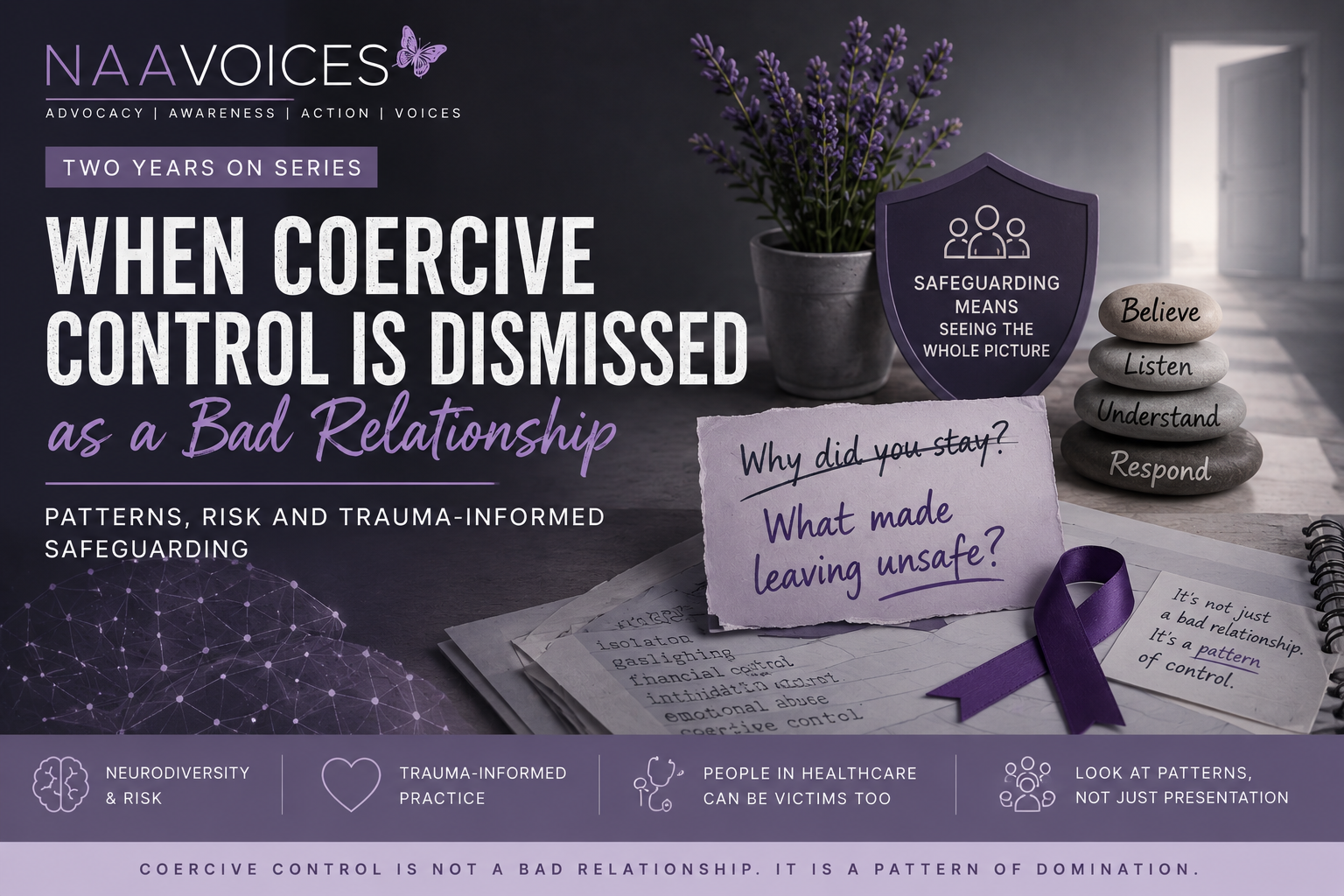
  • When Coercive Control Enters the Courtroom

    When Coercive Control Enters the Courtroom

    This account is shared in the exercise of my right to freedom of expression. It reflects my lived experience, understanding, and perceptions at the time. It does not seek to identify or name any individual, nor to assert findings of fact or legal conclusions. It is written solely to describe personal impact and experience, not to attribute legal or criminal responsibility.

    This account is shared in the exercise of my right to freedom of expression. It reflects my lived experience, understanding, and perceptions at the time. It does not seek to identify or name any individual, nor to assert findings of fact or legal conclusions. It is written solely to describe personal impact and experience, not to attribute legal or criminal responsibility.

    When the System Sees Performance, Not Risk

    Originally written: 16 December 2024
    Transferred to NAAVoices as part of the Two Years On series

    This is my personal account of what happened, as I experienced and understood it at the time.

    This piece took time to write when it was first published. It has taken even longer to revisit.

    I am now two years on from the day I left. This account forms part of a wider series examining how abuse can continue after separation through family court proceedings, legal correspondence, financial pressure, delay, silence and the repeated reshaping of a narrative.

    I have approached this piece carefully because the hearing did not stand alone as one difficult day. With distance, I can see it as part of a much longer pattern.

    Some hearings will be written about in time. Others remain too close to the surface. Trauma does not unfold neatly, and revisiting certain moments still carries a physical and emotional cost.

    This is not about withholding the truth.

    It is about telling it without losing myself in the process.

    What I understand now is that coercive control did not end when I left. It adapted. It moved through paperwork, allegations, professional language, delay and systems.

    By the sixth hearing, the same narrative that had appeared in the original non-molestation proceedings was being copied and carried forward.

    He was repositioning himself as the victim.

    I knew the pattern.

    I knew what was happening.

    But inside that courtroom, knowing did not give me the power to stop it.

    Before I Reached the Doors

    Attending family court while still living with the effects of coercive control was one of the most difficult experiences of my life.

    Before I entered the building, I was on my knees outside.

    My heart rate was over 140. I was dizzy, shaking and barely able to stand. The distress had been building for weeks, but it peaked before I reached the doors.

    Taking lorazepam to get through a legal process was something I had never imagined I would need.

    I do not say that with shame. Medication can be necessary, and nobody should be judged for needing it.

    I say it because people need to understand the physical reality of trauma.

    Walking into a courtroom with somebody who has harmed you is not a neutral act.

    It is a physiological event.

    Your body remembers what your mind is trying to manage.

    Nothing about it is “just a hearing.”

    In the weeks beforehand, I was still waiting for the police Protection of Vulnerable People team to return and take a further statement. They had attended only the previous month in relation to the coercive-control investigation.

    As far as I understood, that investigation remained active.

    I had also recently provided police with further material concerning harassment after separation.

    I entered the hearing believing that I might soon be asked to sit through further interviews about abuse I had already spent months trying to explain.

    I was preparing for family court while bracing myself for more police processes.

    Trauma does not pause while systems catch up.

    It accumulates.

    I Did Not Go Alone

    My friend came with me.

    She is the woman I trained as a nurse with, my child’s godmother and one of the few people I trust to recognise when I am not okay, even when I cannot say it.

    I was genuinely frightened that the stress could trigger a serious medical event. I needed somebody beside me who would know what to do if my body gave out.

    Before we reached the building, my legs went.

    My vision flashed.

    Inside court, I sat taking ECG recordings on my watch while experiencing crushing chest pain and blurred vision.

    I did not know whether what I was experiencing was cardiac, neurological, trauma-related or all three.

    That uncertainty intensified the fear.

    But I also knew I could not allow him to see how severely his presence affected me.

    That was part of surviving the room.

    I had to sit near the person whose behaviour had affected me and my children, control every visible reaction and appear calm enough to be considered credible.

    The better I concealed my trauma, the easier it became for the court to miss it.

    The Position Statement

    I could not read his position statement myself.

    By then, every new document felt like another route through which the abuse could reach me. Each submission appeared to contain another allegation, another distortion or another attempt to reverse what had happened.

    I sent the statement to a friend and asked her to read it aloud.

    That was not avoidance.

    It was survival.

    As she read it, the wording felt immediately familiar.

    The narrative had been copied from the original non-molestation proceedings.

    The same themes had been lifted from earlier documents and carried into the current case as though repetition itself established their truth.

    He was again presenting himself as the victim.

    My actions were stripped of context.

    My safeguarding concerns became hostility.

    My documentation became obsession.

    My fear became instability.

    My attempts to protect my child became evidence that I was unreasonable or obstructive.

    Material that had already been answered, disputed or overtaken by later events was repeated as though none of that had happened.

    That is how a record can be reshaped.

    An allegation appears in one document.

    It is copied into another.

    It is then referred to as part of the procedural history.

    Eventually, the repetition begins to resemble corroboration.

    But repetition is not evidence.

    Copying an allegation from the original non-molestation proceedings into later family court documents does not make it true.

    It simply gives the same allegation another place in the record.

    I Knew the Game

    Throughout the proceedings, he presented himself as the person who had been harmed.

    The magistrates saw a man sitting in tears.

    What they could not see was that I recognised this presentation.

    I had lived with it for years.

    I knew how his distress could move attention away from his behaviour and towards what other people had allegedly done to him.

    I knew how quickly he could become the injured party when questions were raised about his own conduct.

    I knew how sympathy could be secured before the wider pattern was understood.

    Other professionals and educational settings had previously been involved for long enough to see that the tears were not always the end of the interaction.

    They had seen what could follow.

    The magistrates had only a short hearing in which to assess us.

    They saw his tears.

    They saw me trying not to react.

    They did not see the years that had taught me what those moments could mean.

    That was the cruelty of the situation.

    I knew the pattern unfolding in front of me, but I was powerless to stop it.

    If I challenged it too forcefully, I risked appearing hostile.

    If I became visibly distressed, I risked appearing unstable.

    If I documented the contradictions, I risked appearing obsessed.

    If I remained calm, the impact of the abuse disappeared from view.

    There was no safe response.

    I knew the game.

    But I could not prove the game simply by saying, “This is what he does.”

    Allegations, Reversal and Powerlessness

    The position statement did more than repeat earlier material.

    It reinforced a complete reversal of victim and offender.

    He was no longer being presented as the person whose conduct had caused concern.

    He was being presented as the person needing protection from me.

    I understood what was happening.

    The original non-molestation narrative was being copied, repeated and reinforced through new proceedings, while the context explaining my behaviour was progressively removed.

    My distress was presented without its cause.

    My attempts to evidence patterns were presented without the events that made documentation necessary.

    My fear was presented without the history that created it.

    That was the trap.

    I was expected to disprove a performance while remaining calm enough not to confirm the version of me the performance was designed to create.

    Knowing that the roles were being reversed did not mean I had the authority to stop it.

    I could see the narrative being rebuilt around me.

    I could see him becoming the victim within the official record.

    I could also see that every attempt I made to challenge it risked becoming further evidence against me.

    Information From the Police Investigation

    The most alarming part of the hearing concerned information connected to the ongoing coercive-control investigation.

    His bail restrictions had been removed because there had been no direct contact.

    That did not mean the investigation had concluded.

    My understanding was that further investigation remained outstanding.

    Inside court, that distinction did not feel properly recognised.

    His barrister referred to the coercive-control case and suggested that it was going nowhere.

    A specific number of witness statements was mentioned, together with an alleged assessment of how many supported my account.

    I had not been formally given that information.

    I was the person who had reported the abuse.

    Yet the other side appeared to know the precise number of statements held within the investigation and what somebody connected to that investigation had allegedly concluded about them.

    At one point, a person was referred to in a way that appeared to give the impression that he was a police officer.

    My understanding was that he was a civilian statement taker.

    That distinction mattered.

    The way the information was presented gave it an authority and finality that I did not believe it should have carried.

    My watch showed my heart rate pass 160 and then drop sharply.

    I remained seated.

    I did not know whether the information was accurate, misunderstood, selectively presented or disclosed improperly.

    What I knew was that I had not received the same explanation.

    I could not understand how information connected to my own police report appeared to be available to the other party before it had been properly explained to me.

    I also could not challenge it effectively because I did not know precisely what the police themselves had concluded.

    The information from the police investigation was placed alongside allegations copied from the original non-molestation proceedings.

    Together, they reinforced the same distorted narrative:

    He was the victim.

    I was the aggressor.

    My attempts to explain the wider history were evidence of instability rather than evidence of what I had survived.

    Seeking Answers

    Following the hearing, I contacted Professional Standards.

    I needed to understand where the information had come from, who had accessed it and how it had reached the family proceedings.

    There had also been reference to a misconduct-in-public-office investigation involving a sergeant, presented in a way that appeared to connect that matter negatively to me.

    My understanding was different.

    That investigation existed independently of me. My later contact with Professional Standards concerned how information connected to my case appeared to be circulating.

    At the time, I did not receive a clear explanation.

    My understanding is that a name was passed for anti-corruption checks.

    But the immediate uncertainty remained.

    I had reported abuse to the police.

    I was still waiting for clarity about my own investigation.

    Yet inside family court, the other side appeared able to discuss specific information that had not been formally explained to me.

    The uncertainty itself became part of the trauma.

    When a Pattern Becomes a Series of “Complaints”

    With a change in solicitor and limited context carried forward from earlier hearings, it felt as though I was being presented as somebody who complained about everyone.

    The implication was that the common factor was me.

    But what looked like separate complaints to somebody reading a file cold was, from my perspective, a pattern of interconnected failures and concerns.

    I was not raising unrelated grievances.

    I was trying to explain what was happening across police processes, family proceedings, safeguarding decisions, financial arrangements and post-separation conduct.

    A pattern I could document was being broken into separate incidents.

    Once separated from one another, each incident became easier to dismiss.

    The wider structure disappeared.

    I did not feel I had a meaningful opportunity to present the evidence connecting those events.

    That is how a truthful account can be overshadowed.

    Not necessarily by being disproved.

    Sometimes it is overshadowed because it is never allowed to exist as a complete account.

    The Name for It

    At the time, I did not fully understand the term DARVO:

    Deny, Attack, Reverse Victim and Offender.

    I understand it now.

    The behaviour is denied.

    The person reporting it is attacked.

    The person accused then presents himself as the true victim.

    In a professional setting, this reversal can be extraordinarily effective.

    The person using it may appear calm, organised and persuasive.

    The traumatised person may appear anxious, defensive, physically unwell or overwhelmed.

    The courtroom sees the behaviour occurring during the hearing.

    It may not see the history that produced it.

    A calm person is not automatically safe.

    A distressed person is not automatically unreliable.

    But I felt that his presentation was treated as credibility, while my trauma was treated as evidence against me.

    I wish I had known the term DARVO at the first hearing.

    I wish I had understood that what felt chaotic and cruel followed a recognised pattern.

    But even knowing the name would not necessarily have given me the power to stop it.

    Naming a mechanism is not the same as persuading a system to recognise it.

    My Mental Health Became Evidence Against Me

    My mental health was raised during the hearing.

    It did not feel as though it was discussed as the predictable consequence of prolonged abuse, fear, repeated exposure and re-traumatisation.

    It felt as though it was being used to question my reliability.

    I was asked whether a GP had diagnosed me.

    No.

    A psychologist had assessed me and diagnosed post-traumatic stress disorder.

    I found myself having to evidence my weight loss and PTSD while his narrative was given room to land.

    I had lost approximately six stone.

    I had experienced severe anxiety, dissociation, hair loss, physical symptoms and an inability to regulate my body when exposed to reminders of the abuse.

    Those symptoms did not prove that I was unreliable.

    They demonstrated the cost of what I had experienced.

    But when trauma becomes visible, attention can shift from what happened to the way the injured person presents.

    The harm moves into the background.

    The traumatised person becomes the problem.

    That is not trauma-informed safeguarding.

    It is a fundamental misreading of trauma.

    Better Representation, but an Existing Record

    By this hearing, I had changed solicitors.

    My new solicitor was supportive and instructed a prepared, skilled and deeply professional barrister.

    For the first time, I felt that somebody representing me could see the pattern I had been trying to explain.

    That mattered enormously.

    She warned me that seeking a fact-finding hearing would now be difficult, particularly because of how the earlier proceedings had developed.

    Some of the damage had already been done.

    The allegations and assumptions repeated through earlier hearings were already embedded in the procedural history.

    That is the danger when claims are allowed to pass forward without being properly tested.

    They become part of the record.

    Later representatives must then work within a narrative created before the evidence has been fully examined.

    What mattered to me was that my barrister saw it.

    Like others who took time to examine the evidence, she appeared dismayed by what had unfolded during the previous twelve months.

    She remained professional.

    But she was also human.

    That mattered.

    How Control Survives Separation

    Coercive control does not always stop when a relationship ends.

    Sometimes it adapts.

    In legal settings, it can appear through narrative control, selective detail, official-sounding language, professional name-dropping, allegations carried from one document into another and using process itself as leverage.

    It is not always loud.

    It can appear calm, organised and reasonable.

    Meanwhile, the person who has been harmed may look anxious, dysregulated, physically unwell or difficult because their body is reacting to trauma.

    The courtroom sees behaviour in the room.

    It may not see the history that created it.

    That is why trauma-informed practice matters in family court.

    Not to remove scrutiny.

    Not to accept every account without question.

    But to recognise that presentation is not the same as risk.

    The task should be to investigate the pattern, not reward the most convincing performance.

    When the Hearing Ended

    During the hearing, I remained seated.

    I remained quiet.

    I tried to appear composed.

    The magistrates saw me sitting in the room.

    They did not see what it cost me to stay there.

    When the hearing ended, my body gave up.

    Outside the courtroom, I was physically sick from the stress.

    I could not regulate my breathing.

    My vision was filled with stars.

    My best friend knelt beside me, held my hair back, tried to keep me conscious and helped me interpret the ECG recordings I had taken.

    The magistrates did not see that.

    They did not see me on my knees before I entered the building.

    They did not see the crushing chest pain or blurred vision.

    They did not see the collapse that followed.

    They saw the controlled part.

    They did not see the cost of controlling it.

    My friend saw something else.

    As he left, she saw him look towards her and smirk.

    I did not see it myself, so I can only record what she witnessed and later told me.

    But she had watched me vomit from stress.

    She had tried to help me breathe.

    She had seen what staying in that courtroom had cost me.

    The magistrates had not.

    Other people can maintain a façade.

    I cannot.

    My body tells the truth whether I want it to or not.

    The Control Running Alongside Court

    The coercive control did not stop at the courtroom doors.

    It ran alongside the proceedings.

    He had pushed for the mortgage to be resolved and for me to pay him out within a short timescale.

    I progressed matters much faster than expected.

    After that, delays followed.

    He was difficult for me and the solicitors to contact, and the signing process continued for months. He eventually signed shortly before the hearing, following repeated chasing.

    From July to December, I was paying more than £600 extra each month on the mortgage.

    That was financially crippling.

    Child maintenance was also inconsistent.

    I did not rely on it, but I claimed it because I needed to understand whether the financial control would continue after separation.

    It did.

    The Child Maintenance Service later moved the arrangement to collect and pay because payments were not arriving consistently.

    Delay can be control.

    Silence can be control.

    Financial instability can be control.

    When children are involved, they experience the consequences too.

    There were also inconsistencies regarding where he was living.

    The address declared in court did not appear to correspond with information provided elsewhere.

    My understanding was that safeguarding checks may have been undertaken at an address where he was not actually residing.

    That mattered because safeguarding checks are only meaningful when they assess the environment in which the child will actually spend time.

    If the wrong address is checked, risk may be missed.

    Once again, the burden fell upon me to identify the inconsistency and explain why it mattered.

    What the Courtroom Did Not See

    The courtroom saw prepared documents, professional submissions and behaviour within a controlled environment.

    It saw a man sitting in tears.

    It saw me sitting quietly.

    It did not see the years that had taught me to recognise the pattern.

    It did not see the alcohol and drug misuse I had experienced before leaving.

    It did not see the alcohol-related driving disqualification in 2022.

    It did not see the full police evidence.

    It did not see the years of financial pressure, instability and fear.

    It did not see the physical collapse outside the courtroom.

    It did not see how allegations from the original non-molestation proceedings had been copied into later documents until familiarity began to resemble truth.

    It did not see how powerless I felt while watching that happen.

    It saw how two people presented in a professional room.

    That is not the same as understanding risk.

    What I Cannot Make Peace With

    This was one of the hardest days of my life.

    Looking back, it still is.

    At no point did I feel properly heard.

    I looked emotionally numb and detached.

    In reality, I was in an absolute state.

    I genuinely believed that I might enter the building and not walk out again.

    What haunts me is how easily somebody with a long-established pattern of behaviour can appear credible in a professional setting while the traumatised person is left appearing unstable, defensive or difficult.

    I knew what I was watching.

    I knew the roles were being reversed.

    I knew the same allegations were being copied from the original non-molestation proceedings and carried into a new process.

    I knew the tears did not tell the whole story.

    I knew the game.

    But I had no safe way to expose it.

    Every possible response carried a risk.

    If I challenged him, I looked hostile.

    If I became distressed, I looked unstable.

    If I produced more evidence, I looked obsessed.

    If I said nothing, his narrative remained unchallenged.

    That is the powerlessness I still cannot make peace with.

    My evidence was not disproved.

    I did not feel it was properly heard.

    My children and I left the process feeling invalidated again.

    I did not feel there had been meaningful recognition of risk.

    I did not feel there had been a genuine sense of safeguarding.

    I did not feel the impact on us had been understood.

    I was left fighting to stay upright while the focus appeared to move further away from the children’s safety.

    That is the part I cannot accept.

    The lead-up was difficult.

    The hearing was traumatic.

    The aftermath was brutal.

    Through all of it, the one thing that should have remained central felt barely protected:

    My children, particularly the child we shared.

    Why I Started Writing

    That week, I founded the original website, NurseAgainstAbuse.co.uk.

    I did not create it because I had all the answers.

    I created it because I needed somewhere to put the truth.

    I needed somewhere to explain what coercive control can look like after separation.

    I needed to show how trauma can be misunderstood by police, courts and other professionals.

    I needed to advocate for people who are described as emotional, unstable, hostile, difficult or obstructive when they are actually trying to survive and protect their children.

    That website eventually became part of the wider journey leading to NAAVoices.

    Looking back, it was not simply advocacy.

    It was survival.

    It was my attempt to create something useful from an experience that was still harming me.

    Final Reflection

    This is my personal account of events as I experienced and understood them.

    It is not legal advice.

    It is not written to speak for every survivor, and it is not an attack upon the family court as a whole.

    It is written to show what can happen when coercive control continues through systems that do not fully recognise it.

    Post-separation abuse does not always look like abuse to the people watching.

    Sometimes it looks like paperwork.

    Sometimes it looks like delay.

    Sometimes it looks like unpaid maintenance or unsigned documents.

    Sometimes it looks like allegations copied from one set of proceedings into another.

    Sometimes it looks like information connected to a police investigation appearing in family court before the person who reported the abuse understands how it got there.

    Sometimes it looks like calm words spoken in a professional room.

    Sometimes it looks like a man in tears being accepted as the victim.

    And sometimes it looks like a woman who recognises the entire pattern but cannot expose it without being portrayed as the problem.

    Sometimes it looks like a victim on her knees outside court, forcing herself to stand before anybody sees.

    Safeguarding cannot depend upon who appears most composed.

    Presentation is not proof.

    Distress is not dishonesty.

    Repetition is not evidence.

    Recognising coercive control does not always give a victim the power to stop it.

    And a traumatised person should not become the problem simply because her body can no longer hide what has happened to her.

    Domestic Abuse Helpline (run by Refuge) can be reached on 0808 2000 247. For mental health support, you can call Samaritans free on 116 123 at any time.

  • 🕊️ Truth Always Finds a Way: Lessons from History

    🕊️ Truth Always Finds a Way: Lessons from History

    Across every era, people in power have tried to bury truth beneath fear, manipulation, and carefully crafted narratives. Yet history shows us something steady and reassuring: truth is persistent. It resurfaces even when silenced. It outlives intimidation. It waits for the moment when people are ready — or brave enough — to hear it.

    These moments from history remind us that honesty is resilient, accountability matters, and the human spirit has a remarkable capacity to push back against deception.

    🔍 When Lies Collapse: Six Times Truth Broke Through

    Watergate (1972–1974)

    A break‑in at the Democratic National Committee headquarters spiralled into one of America’s most defining political scandals. The Nixon administration attempted to bury the truth under layers of denial and misinformation. Persistent investigative journalism — particularly from Bob Woodward and Carl Bernstein — and congressional scrutiny exposed the cover‑up. Nixon resigned. The press proved its power. The public’s right to know prevailed.

    The Trial of Galileo (1610s)

    Galileo Galilei challenged the Church’s authority by supporting the heliocentric model. Forced to recant under threat, he paid a personal price. Yet the truth of his discoveries outlived the institutions that tried to silence him. His work became a cornerstone of modern science and a reminder that evidence eventually outlasts dogma.

    The Emancipation Proclamation (1863)

    During the Civil War, Abraham Lincoln made a crucial declaration. It struck at the core of the falsehood of racial superiority. The Emancipation Proclamation didn’t end slavery overnight, but it reshaped the moral landscape of the conflict and paved the way for abolition. It remains a defining moment in the long, ongoing struggle for racial justice.

    The Fall of the Berlin Wall (1989)

    For decades, the Berlin Wall stood as a concrete symbol of division, oppression, and false promises. When it fell, it wasn’t just a political shift — it was a collective declaration that people will always push towards freedom. Its collapse reunited families, reshaped Europe, and became a global emblem of hope.

    Holocaust Revelations (1945 onwards)

    After the Second World War, the world confronted the full horror of the Holocaust. Nazi propaganda crumbled under the weight of undeniable evidence: testimonies, documents, and the liberation of concentration camps. These revelations reshaped global human rights efforts and underscored the catastrophic consequences of unchecked lies and hate.

    ✊ A More Recent Example: The #MeToo Movement (2017–present)

    For decades, survivors of sexual harassment and abuse were silenced by fear, power imbalances, and cultural norms that protected perpetrators. When the #MeToo movement surged globally, millions of people shared their experiences publicly.

    What had been hidden in plain sight became impossible to ignore.
    Institutions were forced to confront systemic abuse. High‑profile figures faced accountability. Policies changed. Conversations shifted.

    Most importantly, survivors realised they were not alone — and that collective truth‑telling can transform culture.

    🌐 The Misinformation Reckoning (2020s)

    The rise of social media created an environment where misinformation spreads faster than facts. From public health to politics to global events, false narratives have shaped public perception and influenced decision‑making.

    In recent years, researchers, journalists, and grassroots educators have pushed back.
    Fact‑checking initiatives, digital literacy campaigns, and public scrutiny have begun to shift the landscape.

    This moment reflects a wider truth: when people have access to accurate information, harmful narratives lose their power.

    💛 Why Truth Matters

    Truth isn’t just a philosophical ideal — it’s a foundation for justice, accountability, and human dignity.

    When truth is denied, people are harmed.
    When truth is acknowledged, people heal, societies learn, and progress becomes possible.

    History shows us that truth is not fragile. It is patient. It waits. And when the moment comes, it rises.

    📣 Digital Truth‑Telling: A New Frontier

    Today, truth spreads not only through institutions but through individuals.

    People sharing their stories.
    Communities challenging misinformation.
    Voices once ignored are now reaching millions.

    The internet has become a place where truth can travel further and faster than ever — especially when people speak openly and collectively.

    🧠 A Lesson in Restraint: Let Truth Speak

    In a world where manipulation can distort perception, restraint becomes a quiet form of strength. Those who twist reality often reveal themselves without intervention.

    Sometimes the wisest move is to step back, observe, and allow the truth to breathe.

    “Give someone enough rope and they’ll hang themselves.”

    Patience, clarity, and vigilance often expose what force or confrontation cannot.

    💬 Final Reflection: Truth Is Relentless

    History shows us that lies may obscure, delay, or distort — but they cannot endure. Truth has a way of resurfacing, reshaping, and restoring.

    If you’ve ever been silenced, doubted, or misrepresented, remember this: history is on the side of truth.
    It has outlived every attempt to bury it.
    And it will continue to rise — steady, undeniable, and stronger than the forces that tried to suppress it.

    Published with support from NAAVoices.

  • Coercive Control Dismissed as a Bad Relationship

    Coercive Control Dismissed as a Bad Relationship

    The Harm of Misunderstanding Risk, Trauma and Neurodivergence

    Originally written: 17 December 2024
    Transferred to NAAVoices as part of the Two Years On series

    This post was originally written on 17 December 2024, while I was still trying to understand why one sentence had caused such harm.

    On 21 December 2023, after disclosing years of abuse and safeguarding concerns, I was told by an experienced police officer:

    “Some relationships are just bad, not all are abusive.”

    At the time, I knew that sentence was wrong. I knew it did not reflect what I had lived through. I knew it did not reflect what my children had lived through.

    What I understand more clearly now is why it stayed with me.

    It was not just an insensitive comment. It reflected a failure to recognise risk.

    When coercive control is reduced to “relationship conflict”, professionals can miss the pattern. They can miss the imbalance of power. They can miss the fear. They can miss the children living inside that fear. They can miss the fact that a victim who looks articulate, organised, emotional, detached, overwhelmed or evidence-heavy may still be at serious risk.

    This post is being transferred onto NAAVoices using its original date because the chronology matters. These posts are part of a wider timeline showing how my understanding developed over time, particularly around trauma, neurodivergence, coercive control and institutional response.

    Some wording has been updated for clarity, safeguarding awareness, evidence and professional boundaries. The core reflection remains rooted in what I was trying to process at the time.

    This is part of my Two Years On series because the language used around abuse matters. Professional responses matter. When coercive control is dismissed, victims can be left carrying not only the abuse itself, but the consequences of not being believed.

    What I Understand Now

    Two years on, I understand more than I did then.

    I understand that coercive control is not just a set of incidents. It is a pattern of domination, restriction and psychological harm.

    I understand that neurodivergence can affect how abuse is experienced, explained and misread by professionals.

    I understand that trauma can make disclosure messy, fragmented, urgent, emotional or overly detailed, and none of that makes a victim unreliable.

    I understand that people working in healthcare can still be victims, even when they are trained to recognise risk in others.

    I understand that being capable does not mean being safe.

    And I understand that a professional misunderstanding coercive control can cause real harm, because their interpretation may influence what gets recorded, what gets investigated and what gets minimised.

    That is why I am writing this again with more context.

    Not to correct the original feeling.

    To explain it.

    A Note on Earlier Writing

    Some of my earlier writing about this period was shaped into a memoir, which I later unpublished.

    Not because the experiences were untrue, and not because the writing did not matter, but because it had been written while I was still in active trauma. Writing was survival then. It was where I put the things I could not safely say anywhere else.

    With time and distance, I can see that some of that writing deserves to be returned to carefully, from a place of greater stability, clarity and protection.

    The question at the centre of that writing was the same question so many survivors face:

    Why did I stay?

    Why I Stayed

    That question haunted me.

    Not because I did not know the answer, but because I had been taught by the abuse to blame myself before anyone else even had to.

    I thought I should have seen the signs.
    I thought I should have left sooner.
    I thought intelligence, motherhood, professional awareness and life experience should somehow have protected me from being controlled.

    They did not.

    Because coercive control does not rely on someone being weak.

    It relies on erosion.

    It works slowly. Through confusion, fear, threat, responsibility, shame, money, housing, children, hope and exhaustion. It narrows your world until your decisions are no longer made freely, but through constant risk assessment.

    Leaving is not one simple decision.

    It is often a calculation made under pressure.

    What will happen if I go?
    What will happen if I stay?
    What will happen to the children?
    Where will we live?
    Will anyone believe me?
    Will he get worse?
    Will I be blamed?
    Will the systems around us understand what has really happened?

    That is why “Why did you stay?” is the wrong question.

    The better question is:

    What made leaving unsafe?

    Coercive Control Is Not a Bad Relationship

    The Domestic Abuse Act 2021 recognises that domestic abuse can include physical or sexual abuse, violent or threatening behaviour, controlling or coercive behaviour, economic abuse, and psychological or emotional abuse. That legal framework matters because abuse is not limited to physical violence. It can be a course of conduct. It can be a pattern. It can be the gradual removal of someone’s freedom, confidence and sense of reality. (Legislation.gov.uk)

    Coercive control is not simply arguing. It is not ordinary relationship breakdown. It is not two people failing to communicate.

    It is a pattern of domination.

    The Home Office statutory guidance explains that controlling or coercive behaviour can underpin economic, emotional, psychological, technology-facilitated abuse and threats, whether or not physical or sexual violence is also present. (GOV.UK)

    It can look like sarcasm that chips away at you.
    Dismissiveness that makes you doubt your own judgement.
    Character attacks that make you feel impossible to love.
    Accusations that keep you constantly defending yourself.
    Rules that are never called rules, but still control your life.
    Consequences that teach you it is easier to comply than resist.

    It is the slow loss of self-trust.

    You stop asking, “Is this normal?”

    You start asking, “How do I stop this getting worse?”

    That is not a bad relationship.

    That is control.

    Gaslighting and the Loss of Reality

    Gaslighting is one of the most damaging tools of coercive control because it attacks your ability to trust your own reality.

    It can include blatant lies, told with complete confidence.

    It can include denial, even when you have proof.

    It can include someone using what matters most to you as ammunition: your children, your work, your identity, your reputation, your health, your past, your future.

    It can include small comments that wear you down over time.

    A joke that is not a joke.
    A criticism dressed as concern.
    A lie you are too tired to challenge.
    A compliment given just often enough to keep you confused.

    It can include projection, where they accuse you of the very behaviour they are displaying.

    It can include turning others against you, so you no longer know who is safe.

    It can include being called unstable, dramatic, bitter, difficult or irrational until you start wondering whether your distress is the problem, rather than a response to what is being done to you.

    Eventually, if it continues for long enough, you may stop asking, “Why are they doing this?”

    You start asking, “What is wrong with me?”

    That is the harm.

    Neurodiversity, Masking and Being Misread

    This is something I understand more clearly now than I did when I first wrote this.

    My ADHD did not cause the abuse.

    Neurodivergence does not make anyone responsible for being harmed.

    The responsibility for abuse always sits with the person choosing to cause harm.

    But neurodivergence can affect how abuse is experienced, recognised, disclosed and interpreted by others.

    A 2023 systematic review and meta-analysis concluded:

    “Individuals with ADHD are at an increased risk of being involved in cases of violence, namely IPV and SV, either as victims or perpetrators.” (PubMed)

    That sentence has to be handled carefully. It does not mean ADHD causes abuse. It does not mean neurodivergent people are responsible for being harmed. It does not mean ADHD makes someone unreliable.

    It means professionals need to understand risk, vulnerability and presentation with more care.

    For me, ADHD meant I searched for patterns. I tried to understand every contradiction. I over-explained because I needed things to make sense. I gathered evidence because I could see the gaps and inconsistencies. I masked because I was used to functioning, even when things were difficult.

    Those traits can be strengths.

    But in the context of coercive control, they can also be used against you.

    A neurodivergent victim may present with too much information, too much detail, too much emotion, too much urgency, or too much apparent competence. They may speak quickly, struggle to organise events chronologically, freeze, shut down, or appear detached.

    They may arrive with folders, timelines and evidence, not because they are obsessive or unreliable, but because they have already learned that if they do not create the record themselves, it may not exist.

    Risk is rarely about one factor in isolation. Neurodivergence, trauma, gender, parenting, financial dependence, professional identity and fear of not being believed can overlap in ways that make leaving and disclosing much harder.

    That should not be mistaken for instability.

    It should be understood as context.

    It may be trauma.
    It may be neurodivergence.
    It may be both.

    Either way, professionals need to look at the pattern, not just the presentation.

    What Research Tells Us About Risk

    Domestic abuse is common, but it is still often misunderstood.

    The ONS estimated that, in the year ending March 2025:

    “2.2 million females and 1.5 million males aged 16 years and over experienced domestic abuse in the last year.” (Women’s Aid)

    The ONS also reported that, in the year ending March 2025:

    “Domestic abuse related crimes represented 15.4% of all offences recorded by the police.” (Office for National Statistics)

    Police-recorded data does not capture the full reality of domestic abuse. Many victims never report. Some report and are misunderstood. Some report and the quality of recording, investigation and safeguarding response becomes part of the harm.

    Risk is not always visible.

    A person may be working, parenting, studying and functioning while being controlled.

    A person may have no obvious injuries and still be in danger.

    A person may sound articulate and still be terrified.

    That is why professionals need to understand coercive control as a pattern of behaviour, not a collection of isolated incidents.

    People in Healthcare Can Still Be Victims

    There is another layer that matters.

    People working in healthcare can be very good at functioning while harmed.

    We know how to show up.
    We know how to care for others.
    We know how to compartmentalise.
    We know how to keep working under pressure.
    We know how to present as capable, even when life outside work is falling apart.

    That can make abuse harder for others to recognise.

    Not because the harm is less serious, but because the presentation does not match what people expect.

    Research has recognised that healthcare professionals’ own experiences of domestic violence and abuse are often overlooked, even though healthcare staff are expected to identify and respond to abuse in others. (PMC)

    A systematic review and meta-analysis found:

    “Healthcare professionals experience domestic violence and abuse at similar or higher rates than the general population.” (PMC)

    So yes, healthcare workers can identify abuse in others and still be experiencing it themselves.

    A nurse can safeguard others and still not be safeguarded herself.

    A clinician can understand trauma professionally and still be traumatised personally.

    A healthcare professional can look competent and still be living in fear.

    A parent can keep turning up and still be breaking inside.

    That is why assumptions are dangerous.

    Victims do not all look the same.
    They do not all sound the same.
    They do not all disclose in the same way.
    They do not all collapse in front of you.

    Some keep going until their body gives way.

    Why Professional Dismissal Causes Harm

    When a victim discloses abuse, the response matters.

    A professional does not need to understand every detail immediately, but they do need to understand risk, pattern and power.

    When coercive control is dismissed as a bad relationship, that is not neutral.

    It shifts the burden back onto the victim.

    It suggests their fear may be excessive.
    Their evidence may not be enough.
    Their reality may still be up for debate.

    For someone already conditioned to doubt themselves, that can be devastating.

    It can also strengthen the perpetrator’s position.

    Coercive control thrives when outsiders misunderstand it.

    It thrives when people look for isolated incidents instead of patterns.
    It thrives when emotional abuse is treated as conflict.
    It thrives when children’s experiences are minimised.
    It thrives when victims are expected to present in one acceptable way before they are believed.

    That is why professional understanding matters.

    It is not about taking sides.

    It is about safeguarding.

    What Professionals Need to Ask Instead

    If a disclosure does not sound neat, that does not mean it is not credible.

    If a victim brings too much evidence, that does not mean they are obsessive.

    If they speak quickly, jump between events, cry, freeze, shut down or appear detached, that does not mean they are unreliable.

    It may mean they are traumatised.

    It may mean they are neurodivergent.

    It may mean they have spent years trying to survive something that did not happen in a straight line.

    The aim is not to abandon professional curiosity.

    It is to use it properly.

    Professionals need to ask better questions.

    Not, “Why did you stay?”
    But, “What made it unsafe to leave?”

    Not, “Why did you not report sooner?”
    But, “What stopped you from feeling safe enough to tell someone?”

    Not, “Why are you only saying this now?”
    But, “What has changed that means you can speak now?”

    Not, “Is this just a relationship breakdown?”
    But, “Is there a pattern of fear, control, intimidation, isolation or harm?”

    Not, “Why are you so emotional?”
    But, “What has this person been carrying, and for how long?”

    That shift matters.

    Because the right question can open a door.

    The wrong one can close it completely.

    Awareness Is Safeguarding

    Understanding coercive control is not optional.

    It is the difference between seeing someone as difficult and recognising someone who has been systematically worn down.

    It is the difference between asking, “Why did you stay?” and asking, “What made leaving unsafe?”

    It is the difference between treating abuse as conflict and recognising it as control.

    Coercive control can happen to anyone.

    Intelligence does not prevent it.
    Professional knowledge does not prevent it.
    Neurodivergence does not cause it.
    Strength does not make someone immune to it.

    Abuse is always the responsibility of the person choosing to harm.

    Always.

    If This Feels Familiar

    You are not to blame for what someone else chose to do.

    You are not weak because you stayed.

    You are not foolish because you hoped things would change.

    You are not difficult because you need help.

    You are not unreliable because trauma changed how you explain things.

    You are not responsible for making abuse easier for other people to understand.

    If you recognise these patterns, please reach out to someone who understands domestic abuse and coercive control. Specialist support matters.

    If you are in immediate danger, call 999. In the UK, you can contact the National Domestic Abuse Helpline on 0808 2000 247, or seek specialist local domestic abuse support.

    You deserve safety, clarity and peace.

    Not blame.

    Not dismissal.

    Not another person telling you it was just a bad relationship.

    My Lived Experience: A Personal Journey Through Trauma and Recovery

    This reflection is shared as lived experience to support domestic abuse awareness, neurodiversity-informed safeguarding, trauma-informed practice and the normalisation of mental health support. It includes selected research to support public understanding, but is not clinical or legal advice. Names, dates or details may be retained where relevant to accountability, while unnecessary identifying information has been limited to protect privacy and maintain professional boundaries. The purpose is advocacy, reflection and reducing stigma around domestic abuse, coercive control, neurodivergence and help-seeking.

  • Police Victim Blaming in Domestic Abuse Cases: The Hidden Trauma No One Talks About

    Police Victim Blaming in Domestic Abuse Cases: The Hidden Trauma No One Talks About

    NAAVoices was not created from certainty, but from lived experience and professional insight. As I migrate earlier work from the original platform, this post has been reviewed and approved for transfer. It remains true to its original context, with only minor clarity edits where needed. Some moments do not require rewriting to remain honest.

    When Victims Are Blamed by the Systems Meant to Protect Them

    Victims of domestic abuse already carry enough.

    Fear. Shame. Confusion. Hypervigilance. The constant work of surviving someone else’s control while trying to make sense of what has happened to them.

    So when someone finally reaches out for help, the response matters.

    It can be the beginning of safety.

    Or it can become another wound.

    One of the most damaging responses a victim can receive is victim-blaming, especially from police. It does not always sound obvious. Sometimes it is subtle. Sometimes it comes dressed as professional questioning. Sometimes it appears in what is not recorded, what is minimised, or what is treated as less important than the perpetrator’s version of events.

    But the impact is real.

    And for victims of domestic abuse, it can be devastating.

    What Victim-Blaming Looks Like

    Victim-blaming happens when responsibility for abuse is shifted away from the person causing harm and placed, directly or indirectly, onto the person who has been harmed.

    In domestic abuse cases, this can sound like:

    Why did you stay?
    Why did you go back?
    Why did you not report it sooner?
    Why did you let the children see it?
    Are you sure it was that bad?
    Could this just be a relationship breakdown?
    Is this really about contact?

    These questions may be framed as fact-finding, but when asked without an understanding of coercive control, they can reinforce the exact messages the abuser has spent years embedding.

    That it was your fault.

    That you should have stopped it.

    That you are exaggerating.

    That you are the problem.

    For someone already conditioned by abuse, those messages do not land lightly.

    They go straight into the wound.

    Why It Causes So Much Harm

    Domestic abuse is rarely a single incident. It is often a pattern of control, fear, manipulation, degradation and psychological harm.

    By the time many victims speak to police, they may already be exhausted. They may doubt themselves. They may struggle to explain events in a neat, chronological order. They may appear calm when they are traumatised, or emotional when they are being honest.

    None of that means they are unreliable.

    It means they are human.

    When police respond with disbelief, minimisation or blame, the victim is forced to relive the abuse while also defending their right to be believed.

    That is retraumatisation.

    And it is not a minor side effect of poor communication.

    It can change the course of someone’s recovery.

    Retraumatisation Is Not Just Emotional

    People often talk about trauma as if it is only distress.

    It is not.

    Trauma lives in the body.

    It can look like panic, shaking, dizziness, nausea, chest pain, insomnia, flashbacks, dissociation, intrusive thoughts, memory fragmentation, emotional shutdown or complete collapse after appearing calm.

    A victim may sit through a police interview, answer questions, sign statements and look composed.

    Then fall apart afterwards.

    That does not mean they were fine.

    It means they were surviving the interaction.

    When police victim-blame, dismiss or mishandle disclosures, they can deepen that trauma. They can make the victim less likely to seek help again. They can also make the victim feel less safe than they did before they reported.

    That is institutional harm.

    The Link With PTSD

    Repeatedly having to disclose abuse, defend your credibility and correct inaccurate records can contribute to long-term psychological harm.

    For some victims, this becomes part of the trauma itself.

    PTSD can involve flashbacks, nightmares, hypervigilance, avoidance, intrusive thoughts, panic, emotional numbness and a constant sense of threat.

    For victims of domestic abuse, these symptoms can be intensified when the systems meant to protect them become another source of fear.

    It is not only what the perpetrator did.

    It is what happens afterwards.

    The disbelief.
    The poor recording.
    The minimisation.
    The handovers.
    The repeated retelling.
    The feeling that your own life is being interpreted by people who have not understood it.

    That is why police responses matter so much.

    What the Law and Guidance Already Recognise

    The Domestic Abuse Act 2021 gives a statutory definition of domestic abuse and recognises that abuse can include emotional, controlling, coercive and economic abuse.

    That matters because domestic abuse is not limited to physical violence.

    The NPCC and CPS Joint Justice Plan set out the need to improve the criminal justice response to domestic abuse, including better training, stronger accountability and improved support for victims.

    The Independent Office for Police Conduct has also issued guidance on ending victim-blaming, recognising that language, assumptions and professional attitudes can cause real harm.

    So the issue is not that nobody knows victim-blaming exists.

    The issue is whether those principles are being applied in practice.

    Because guidance means very little if victims are still leaving police interactions feeling blamed, disbelieved, unsafe or responsible for the abuse committed against them.

    What Needs to Change

    Police officers need proper trauma-informed training.

    Not tick-box training.

    Not a short online module that gets forgotten.

    Real training on coercive control, post-separation abuse, trauma responses, child safeguarding, perpetrator tactics and the harm caused by victim-blaming language.

    They need to understand that victims do not always present in the way people expect.

    Some cry.
    Some freeze.
    Some talk too much.
    Some cannot speak at all.
    Some sound detached.
    Some arrive with folders, timelines and evidence because they have already learned that if they do not create the record themselves, no one else will.

    None of those responses should be used against them.

    Police forces also need stronger accountability when officers fail to record crimes properly, minimise disclosures, or allow personal bias to influence safeguarding decisions.

    A victim should not have to become their own investigator just to prove they told the truth.

    Belief Is Not Bias

    Believing victims does not mean abandoning evidence.

    It does not mean ignoring due process.

    It means starting from a place of professional curiosity rather than suspicion.

    It means asking better questions.

    What has made it hard to leave?
    What control is still continuing?
    What are the children seeing, hearing or experiencing?
    What does the perpetrator gain from this version of events?
    What risks increase now the relationship has ended?
    What has already been disclosed, and has it been properly recorded?

    That is not bias.

    That is competent safeguarding.

    The Cost of Getting It Wrong

    When police blame victims, minimise abuse or fail to act, the harm does not end with that interaction.

    It follows the victim into family court.
    Into safeguarding meetings.
    Into mental health appointments.
    Into work.
    Into parenting.
    Into sleep.
    Into every attempt to rebuild a life.

    Poor police responses can strengthen the perpetrator’s position and weaken the victim’s credibility. They can leave children exposed to further harm. They can make the victim feel that telling the truth was not only pointless, but dangerous.

    That should concern everyone.

    Because domestic abuse victims do not need perfect systems.

    They need systems that do not make the abuse worse.

    A Survivor-Centred Response

    A survivor-centred response does not require grand gestures.

    It requires officers to listen properly.
    Record accurately.
    Avoid assumptions.
    Understand coercive control.
    Recognise trauma.
    Take children’s experiences seriously.
    Challenge perpetrator narratives.
    And remember that the person in front of them may have used every last bit of strength they had just to speak.

    Victim-blaming is not harmless.

    It is not just poor wording.

    It is not just a difficult conversation handled badly.

    It can retraumatise victims, damage mental health, obstruct justice and reinforce the control they were trying to escape.

    Victims of domestic abuse deserve to be met with dignity, belief and professional competence.

    Not blame.

    Not disbelief.

    Not another system they have to survive.

    Further Support

    If you are navigating police misconduct, victim-blaming, negligence or failures in duty of care, I have created a dedicated NAAVoices resource to help explain the process and your options:

    Police Misconduct Guide – NAAVoices.com

    You are not the problem for needing protection.

    You are not difficult for asking to be heard.

    And you are not responsible for the abuse someone else chose to inflict.

    Further Support

    For guidance on recognising and reporting police misconduct, refer to my dedicated resource. It covers topics such as victim-blaming, negligence, and breaches of duty of care. Police Misconduct Guide – NAAVoices.com

    My Lived Experience: A Personal Journey Through Trauma and Recovery