Category: Founder’s Archive

This category contains posts automatically imported from the founder’s original blog, preserving the personal journey, reflections, and lived experiences that shaped the creation of NAAVoices.com.

  • When Trauma Shatters Your Coping Strategies: How PTSD Changes Everything for the ADHD Brain

    When Trauma Shatters Your Coping Strategies: How PTSD Changes Everything for the ADHD Brain

    NAAVoices was not created from certainty, but from lived experience and professional insight. As I migrate earlier work from the original platform, this post has been reviewed and approved for transfer. It remains true to its original context, with only minor clarity edits where needed. Some moments do not require rewriting to remain honest.

    The Devastating Impact of PTSD on an ADHD Brain

    When Your Strengths Become Weaknesses

    Living with ADHD for decades without mental health intervention taught me to be resourceful. I’d found ways to channel my differences into strengths. The constant mental chatter became useful multitasking. The need for stimulation drove me to excel in high-pressure situations. The emotional intensity helped me connect deeply with patients and navigate complex medical scenarios.

    But trauma doesn’t just add another layer — it fundamentally rewires your brain. Suddenly, the very traits that had been my superpowers became sources of overwhelming distress.

    The Devastating Impact of PTSD on an ADHD Brain

    Hypervigilance Meets Hyperactivity Where I once had productive energy, I now had anxious restlessness. The hyperactivity that used to fuel my nursing shifts became agitation. It made it impossible to sit still, and equally impossible to focus that energy constructively.

    Intrusive Thoughts Amplify Racing Mind The ADHD brain already struggles with thought regulation. Add PTSD flashbacks and intrusive memories, and what was once a busy mind becomes a chaotic storm. The mental noise that I’d learned to navigate became deafening.

    Hyperfocus Becomes Trauma Fixation My ability to hyperfocus, which had served me well in my career, became trapped on traumatic events. I found myself obsessively analysing every interaction with the police, examining every court document, scrutinising every sign of ongoing danger.

    Emotional Dysregulation Intensifies ADHD already comes with emotional intensity, but I’d learned to channel that into empathy and passion for my work. PTSD shattered that regulation entirely. The emotional swings became unpredictable, overwhelming, and often paralysing.

    🧠 Neural Storm: When ADHD Meets PTSD

    That’s what it felt like. Here’s what was actually happening in the brain.

    Neural FeatureADHD FunctionPTSD ImpactSurvivor Impact
    ⚡ Chaotic Neural PathwaysFast, energetic signal flow enabling multitaskingOverstimulated circuits from trauma triggersRestlessness without direction; agitation replaces productivity
    🌪️ Cognitive TurbulenceRapid idea generation and sensory processingIntrusive memories and flashbacks flood cognitionThought storms; mental noise becomes deafening
    🔍 Hyperfocus LockDeep concentration on tasks or interestsFixation on traumatic stimuli and perceived threatsObsessive analysis of danger; loss of constructive focus
    💔 Fractured Emotional CentresEmotional intensity fuels empathy and passionDysregulation from trauma overwhelms affective controlEmotional swings become paralysing; empathy turns inward as a survival mechanism

    🔧Where does your energy go when trauma takes over? What strengths have been reshaped — or repurposed — by survival?

    Why Previous Coping Strategies Failed

    For over three decades, I’d developed a toolkit of strategies that worked: using physical activity to burn off excess energy, creating structured routines to manage executive function challenges, channelling hyperfocus into productive tasks, and using my natural empathy in patient care.

    When PTSD hit, none of these worked anymore. Exercise felt impossible when hypervigilance made me afraid to leave the house. Routines crumbled when flashbacks could strike at any moment. Hyperfocus became fixated on trauma rather than productivity. My empathy became overwhelming when I was drowning in my own emotions.

    The Shock of Needing Help

    Perhaps the most devastating realisation was that for the first time in my life, I couldn’t just “manage” my brain. I’d spent decades proud of my ability to thrive without medication, therapy, or mental health support. My ADHD was just part of who I was — challenging sometimes, but ultimately workable.

    PTSD changed that completely. Suddenly, I was taking anxiety medication, attending CMHT appointments, and struggling with basic daily functions. The independence I’d maintained my entire adult life had been stolen.

    When the World Becomes Too Much

    In a world that already moves at breakneck speed, adding PTSD to an ADHD brain creates perfect storm conditions. The influx of information, tasks, and social interactions that I’d once managed became completely overwhelming.

    In these moments of sensory and cognitive overload, I find myself needing to shut down. It’s not that I don’t want to engage or respond. My brain reaches a tipping point where the noise becomes too loud and the demands too pressing. I can no longer process everything at once.

    The neuroplasticity that had allowed me to adapt and excel with ADHD had been hijacked by trauma. Parts of my brain that once worked in my favour were now working against me.

    The Shutdown: When Your Brain Protects Itself

    When I step into this space of overwhelm, I find myself withdrawing from usual routines. Text messages go unanswered, calls are ignored, and social engagements become daunting. It can feel disappointing, both to myself and to others reaching out.

    But I’ve come to understand that this reclusiveness isn’t failure — it’s my brain’s attempt at survival. It’s trying to protect itself from further overwhelm when all my previous coping mechanisms have been shattered.

    The Guilt of Needing Support

    One of the hardest aspects is the guilt. Society expects constant availability, but when you disappear for days or weeks, people think you’re being rude or don’t care. For someone who prided themselves on never needing mental health support, requiring medication and therapy felt like failure.

    Practical Strategies for the New Reality

    Environmental Management Reducing sensory input through dimming lights and using noise-cancelling headphones. Creating calm, clutter-free spaces. Setting boundaries around social media and news consumption.

    Routine Adjustments Simplifying daily schedules. Batch-processing similar tasks. Building in regular breaks before they become necessary.

    Communication Strategies Auto-replies explaining slow responses. Being upfront about needs with friends and family. Having templates ready for cancelling plans without the guilt spiral.

    Self-Care Rituals Mindfulness practices adapted for traumatised ADHD brains. Physical activities that regulate the nervous system. Creative outlets that require no social interaction.

    The Strength in Accepting Help

    It has been difficult to realise that I need to embrace the full spectrum of my neurodiversity — and that this includes recognising when I need support. Overload feels daunting, but it serves as a reminder that self-care isn’t optional. It’s essential for maintaining any balance at all.

    Prioritising mental health is vital, especially when navigating both neurodiversity and trauma. Needing medication, therapy, and regular breaks isn’t something to be ashamed of. It’s the only rational response to a brain that has been fundamentally changed.

    Breaking the Stigma of Needing Support

    We need to normalise that people who’ve managed independently their entire lives might suddenly need extensive support after trauma. It’s not poor coping — it’s brain injury requiring treatment.

    We wouldn’t expect someone with a physical injury to function without medical care. Similarly, we shouldn’t expect trauma survivors to manage without mental health support. This is true regardless of how well they coped before.

    The Temporary Nature of Shutdown

    The positive aspect of the ADHD/trauma shutdown is that it’s temporary. After giving my brain the rest it needs, I usually return feeling more creative and focused — able to engage meaningfully with the world again.

    Recognising beauty in both vibrant engagement and necessary periods of solitude is key to a balanced life. Embracing this duality enhances self-understanding, strengthens connections with others, and allows us to share unique perspectives when we’re ready to shine again.

    The Journey Isn’t Linear

    The path from never needing mental health support to requiring extensive intervention is devastating. But it’s also a testament to the brain’s ability to adapt — even when that adaptation feels like everything is falling apart.

    Sometimes, the most compassionate thing we can offer is the space to simply exist without expectation. For someone newly confronting their mental health needs, that permission — to not perform, not push, not pretend — is a lifeline.

    It’s vital to recognise that trauma isn’t a choice. The neurological impact can mirror that of a traumatic brain injury, and it often results from harm inflicted by others. This isn’t a weakness. It’s survival. And no one would ever choose this path.

    So meet it with kindness, not judgment.

    For Those Supporting Someone with New Mental Health Needs

    If someone in your life has developed PTSD and occasionally goes quiet:

    • Don’t take it personally
    • Send low-pressure messages showing you’re thinking of them
    • Respect their need for space
    • Be patient — they’ll emerge when ready
    • Understand this is how their brain works now
    • Don’t compare them to who they were before trauma

    My Lived Experience: A Personal Journey Through Trauma and Recovery
  • The Accountability That Never Comes from West Mercia Police

    The Accountability That Never Comes from West Mercia Police

    NAAVoices was not created from certainty, but from lived experience and professional insight. As I migrate earlier work from the original platform, this post has been reviewed and approved for transfer. It remains true to its original context, with only minor clarity edits where needed. Some moments do not require rewriting to remain honest.

    May 28, 2024.

    Content note: This post discusses police corruption, domestic abuse, coercive control, and the psychological impact of institutional betrayal. Some sections describe acute mental health crisis.

    A year ago today, my workplace was taken from me as a safety net.

    The anti-corruption and professional standards team called to pop in. I had no idea that my seemingly innocuous actions would trigger a wave of panic — one that spread fast among those deeply embedded in a culture of corruption within the police force. I stood up against that misconduct. And for that, I faced the wrath of an institution protecting itself.

    The only honest officer in that equation — Sergeant Smith — was targeted too.

    My Experience with West Mercia Police Corruption

    I was unjustly branded as the “victim” of misconduct in public office while he was falsely accused. The disbelief, the anger, the profound despair — it was overwhelming. True betrayal of public trust does not lie in how professional standards treated us. It lies in the wilful negligence of numerous officers who chose to look the other way while corruption festered within our local police force long before Smith’s arrival.

    The trauma from my interactions with West Mercia Police has taken so much from me. I wake up each day knowing I have to survive another round of this. I endure. I confront the haunting hell they have put me through. Each day feels like a battle against a system that should protect us but has become a tool of deception.

    The Investigation Unravels

    The anti-corruption team arrived. The conversations quickly took a turn — quite different from what I had been told they were coming to discuss. Sergeant Smith had been arrested. PC Rolls’s situation was used as nothing more than an excuse. None of my colleagues could believe it was not PC Rolls being led away. Sergeant Smith was falsely accused of misconduct in public office.

    In the year that followed, I was positioned as the victim. That status was hard to maintain when I refused to corroborate something that simply had not happened.

    The 19 officers I encountered told so many contradictions — documented lies that I can prove. I know I am not the only one who has noticed. But institutional corruption speaks far louder than individual witnesses. I understand why those who know cannot speak up. I do not hold that against them. But lives will be lost because of how this force treats people.

    28 May 2024 — A Day Etched in Trauma, Deceit, and Relentless Injustice

    Speaking out against my ex and the police revealed his deep-seated connections within the force. Amid all of this corruption, Sergeant Smith stood apart. He saw me as a person — not just another case number. And for that, he paid the price.

    My investigation was marred by deception at every turn. My IOC assured me I was awaiting a CPS decision.

    A phone call from a new officer shattered that.

    The case had never been sent.

    Another lie.

    Six months later, it happened again. Information my ex should never have had access to was used in the family court. Two days after that phone call, my mental health spiralled in a way I had never thought possible. After 34 years, I had been luckier than I ever realised — until then.

    I could not leave the house. I had to go off sick. The weight of it all was crushing. Then came my first panic attack — the sheer force of it was unlike anything I had ever experienced. I came home, overwhelmed, and punched a wall. Desperation manifesting in destruction. My mind was tormented. I could not face any more.

    He mentioned an officer’s name in court to manipulate the facts. He deceived the court. When the origins of that information were challenged, those seeking accountability were silenced. The institution appeared intent on protecting perpetrators and hiding past truths.

    Family links began to emerge. I linked my ex and his family to a former police officer who held a grudge against Sergeant Smith. They protected their own. No matter how extensive my ex’s criminal record, it gave him enough fuel to keep the abuse going.

    Then — conveniently — came the moment that confirmed everything.

    An email.

    Not incompetence. Not oversight. Deliberate betrayal.

    I collapsed at work, suffocating under the weight of it. They needed a scapegoat and waited until the last possible moment to strike.

    Sergeant Smith was their choice.

    My case was doomed from the beginning — the moment PC Rolls failed to act on the disclosure. Fourteen months later, just one week before Sergeant Smith’s first court hearing, my coercive control case was suddenly dropped.

    “Not meeting the threshold,” they claimed.

    Then came yet another blow — one they had hidden for an entire month. The CPS dropped my “victim” status on 24 December. They did not tell me until 25 January. Then, as if orchestrated, they pulled another charge out of nowhere. A hollow excuse. A calculated move.

    How could I be a “victim” in one criminal case yet merely a “member of the public” in another? The answer is more than unsettling — it is damning. This was not just failure. This was not just negligence.

    This was corruption. A deliberate effort to silence, discredit, and protect the guilty.

    The Systemic Corruption

    Because I care too much, does that make me a bad nurse? Who wants a healthcare professional who just ticks boxes? Our intuition and lived experience make us good at our jobs — they protect our patients. It is not just about following procedure. Our expertise allows us to adapt our approach to the person in front of us.

    The conversation with the anti-corruption team was a huge turning point. In less than one month — for the first time in years — I had finally started to feel safe. And then it was gone. In the past year, the system’s corruption has become all too clear. The aftermath has been filled with lies and dishonesty from officers who were supposed to uphold justice. Some acted as though they were completely untouchable.

    As I await Sergeant Smith’s trial in 2026, I cannot help but wonder who anonymously and baselessly reported him. I believe it was a hollow, calculated move — a narrative designed to shift blame and protect the corrupt. Was it my OIC Number 4? One of his team members?

    In April 2024, Sergeant Smith passed my case despite my concerns. Two of the six officers on his shift had already caused my children and me unprecedented harm. I could not face another one. But he took it on — and compiled a detailed file meant to connect all past events in the police records, linking call logs, case details, and every document I had painstakingly gathered as evidence.

    The Lies, the Silence, and the Cost of Inaction

    When OIC Number 5 took over, they assured me of thoroughness. Everything passed from OIC 4 was included in the evidence, they said.

    But only one file appeared to have been touched — one I did not even recognise. All 12 of my lever-arch files were identical in condition. This one was not. It was also the only one in pieces.

    And it was no shock. Seven months earlier, OIC 4 had not handed over my ex’s arrest details to OIC 5. Why anyone had faith in the integrity of that transfer, I will never know.

    Then came another discovery. Why were other confidential documents left in the file — documents I should never have seen? It makes me question whether OIC 5 ever actually reviewed what I had meticulously compiled.

    The deeper I dig, the clearer it becomes. This was not just negligence. This was calculated. Planned. Either to cover the actions of many — or to punish those who spoke out.

    Was it OIC 4, tampering with records? Or OIC 5, failing to examine the evidence I provided? Was it the officer who left reports proving further deception by my ex? Or the one who failed to document serious child abuse allegations that went unrecorded for weeks — until the NSPCC urged me to pursue them?

    And yet they insist my investigation was not compromised.

    I think back to 21 December — a moment etched in my mind. Finch looked straight at Rolls before lying to my face: “The CPS only takes WhatsApp and text messages from a six-month history as evidence.” He dismissed the hundreds of files I had sent — audio, video, everything. Evidence that should have mattered. Evidence that should have been enough. But it was not.

    Finch was not acting alone. Rolls was his mentor — OIC 1 shaping OIC 2. I had held off raising a complaint against Rolls because I liked Finch. He seemed warm, approachable. I wanted to believe he was different. But youth and inexperience are not excuses for failing to act. They are not excuses for leaving a child jumping at shadows, forced to sleep with a knife for protection. They are not excuses for allowing abuse to continue unchecked.

    And then there is the deeper wound — the one inflicted not just by neglect, but by forced reliving and invalidation. Every time they dismissed my evidence, they made me relive the abuse. Every time they ignored the truth, they reinforced the lie that my suffering did not matter.

    Traumatic invalidation is not just painful — it is corrosive. It erodes self-worth. It forces victims to question their own reality. It deepens wounds that should have been healed long ago. Instead of protection, they gave me doubt. Instead of justice, they gave me silence.

    And yet they insist my investigation was not compromised.

    The Absurdity of the False Accusations

    It is incomprehensible that Sergeant Smith — a man with 38 years of service — has been accused of something not only false but logistically impossible.

    There was never a moment when he was alone in my house. I had two traumatised teenagers who barely slept, terrified of their ex-stepfather, taking knives to their rooms for protection. A toddler who slept beside me every night and clung to my side every day.

    The accusation that he was trying to form a sexual relationship with me is not just baseless — it is physically impossible. There was never an opportunity. There was never any privacy. There was never anything beyond professional kindness, support, and friendship.

    If I had been twenty years older, this would never have been framed this way.

    And yet he has been vilified — for simply doing his job. For treating me with dignity. For trying to help rebuild what had been shattered.

    They needed a target. Someone who fit their narrative. They could not prove what I believe “grooming” would describe. I screamed from the rooftops about what the rest of them had done. The original crime suddenly changed. It was as though they were hell-bent on burying him.

    The impact has been devastating.

    For him, a career built on integrity has been reduced to a smear campaign. For me, the weight of injustice is suffocating. Those entrusted with protecting us have chosen to collude with a perpetrator. They punish the innocent while shielding the guilty.

    Living with the Trauma

    Reflecting on the past year, I find it unbearable. I still cannot drive past PC Rolls without the trauma triggering an extensive response. I need sedation to sleep. I doubt he has any difficulty sleeping — he likely believes his own lies. My formal complaint surrounding his conduct will be published here.

    Others have endured the same. No one will ever understand what it is like to have such corruption plague your entire life. The journey is far from over. I have nothing to lose because they have already taken too much of me.

    I still have not watched television since 2023. I cannot sit, think, or live unless I am at work. It is the only place I find any respite from the torture they have put me through. My children have lost the mother I once was.

    I still document everything. When I am not writing, I attempt trauma processing. I have started a memoir of my life over the last 19 months, focused solely on West Mercia Police. It has to be slow — trauma-focused therapy wipes me out. But reading the first few chapters, I can see how far I have come.

    A Question of Humanity

    I have a recording of the hour-and-a-half conversation with the anti-corruption team when they arrived at my workplace. Listening to it tonight made me think about when one officer referenced being reprimanded for picking up glass. Was picking up glass part of his job? What was the enormous risk? Do you pick up glass at home safely? Did the victim have a dustpan and brush?

    Building a positive relationship with the police takes time, as does ensuring the safety of a vulnerable member of the public. If you judged it safe to sweep up some glass, doing so protected someone. Why is that considered wrong?

    It is not in my job description to do what I do some days. But I do it because I care. Protecting others is not just about sticking to a script — it is about looking at the big picture to prevent harm.

    Trauma is a relentless companion. But I believe the truth will eventually come to light. For now, wearing my mask is my only means of survival. Daily, I remind myself that the lies and corruption may be persistent — but they are not invincible.

    The truth will prevail. And those who have wronged will face some form of reckoning.

    A messy workspace featuring various binders, scattered papers, and handwritten notes, indicating research or documentation efforts related to an investigation.
    An email correspondence discussing coordination with a PVP officer regarding ongoing investigations, with a note about potentially missed information.
    My Lived Experience: A Personal Journey Through Trauma and Recovery
  • Living Behind the Mask: My Journey with PTSD

    Living Behind the Mask: My Journey with PTSD

    NAAVoices was not created from certainty, but from lived experience and professional insight. As I migrate earlier work from the original platform, this post has been reviewed and approved for transfer. It remains true to its original context, with only minor clarity edits where needed. Some moments do not require rewriting to remain honest.

    There’s a particular kind of exhaustion that comes with surviving trauma — not just the initial impact, but the daily reality of living in a world that no longer feels safe.

    For me, trauma arrived in two devastating waves. The first was domestic abuse that shattered my sense of home. The second was police corruption that destroyed my trust in the systems meant to protect us.

    Both left marks that don’t fade.

    The Weight of PTSD

    Over the last nineteen months, I’ve watched my children reclaim joy and safety. They laugh again. They sleep. They play. They are healing.

    My own path is far less straightforward.

    Trauma doesn’t politely fade. It lingers. It demands to be processed, only to tear you open again. Some days, surviving means nothing more than showing up — carrying pain that no one else can see.

    PTSD has dragged me through depths I never imagined. My body buckled under the strain: weight loss, sickness, collapse. There was no pause to heal — only the relentless fight to protect my children. Help was out of reach. No one understood the betrayal or the scale of what I was living.

    I blasted loud music just to drown out the memories, but they still crept in from every angle. People saw me functioning — talking, working, pretending.

    Flashbacks began in 2022, long before I escaped. Memories of control, threats, and fear overwhelmed me. My pain was dismissed, mocked as “night-time problems,” when all I wanted was rest. Leaving should have been freedom, but West Mercia Police’s failures forced me to relive everything I had survived.

    Living Behind a Mask

    People miss the mask — the “I’m okay” that hides the chaos.

    Some days, I laugh and even connect. For a moment, I feel a fragment of the person I used to be. Not whole, but present. A tiny piece of me that still exists.

    But fear lurks beneath the surface. One unexpected call, one stray thought, and everything unravels.

    Other days, every smile is forced. Every word is exhausting.

    Night-time brings its own dread. I’m too worn from faking normality to fight the torment carved into me by others’ actions. The memories replay with a clarity no sleeping tablet can touch — vivid, real, alive behind my eyelids. Every detail. Every mannerism. Every email. Every date. Every police interaction.

    PTSD never rests.

    Triggers strike without warning — a scent, a voice, or nothing at all. Good days trick me into believing a future free from this torment might exist. I try to plan, but without hope, planning feels pointless.

    Bad days stretch endlessly. Nights loop his words and the police’s failures on repeat. Sleep evades me because my body still doesn’t believe it’s safe.

    Nineteen months later, it’s worse than when I left.

    Unless you’ve lived this, “moving on” sounds hollow. If people could see the injury to the brain — the neuroplasticity — the way they see a broken bone, maybe I wouldn’t feel guilty for hurting invisibly.

    Dissociation: A Mind Adrift

    A patient unknowingly gave me the missing puzzle piece. They don’t know what I’ve lived through, but their words helped me understand my own life more than they’ll ever realise.

    They described something they experienced and named it: dissociation. And suddenly, everything clicked.

    It’s more than triggers. It’s worse than triggers.

    I can recall every time it’s happened, but I never understood it until now. My mind checks out, leaving me hollow. I’m behind glass — present but detached. Emotionally numb. Watching life from the outside.

    I don’t feel.

    Music, once my lifeline, now overwhelms me. Anything emotionally charged feels impossible to let in. What once protected me has become a barrier I can’t lower.

    When the Brain Shuts Down

    I wrote three times more than this. But I can’t keep going.

    That’s the reality of PTSD: when my brain shuts down, everything shuts down — thoughts, words, feelings.

    And that’s the part no one sees.

    My Lived Experience: A Personal Journey Through Trauma and Recovery
  • The Power of Truth: Advocating Against Police Misconduct

    The Power of Truth: Advocating Against Police Misconduct

    NAAVoices was not created from certainty, but from lived experience and professional insight. As I migrate earlier work from the original platform, this post has been reviewed and approved for transfer. It remains true to its original context, with only minor clarity edits where needed. Some moments do not require rewriting to remain honest.

    Walking Through the Corridor of Truth: A Journey of Pain, Corruption, and Resilience

    Last week, two friends unknowingly shared the same thought on the same day—the 11th. Little did they know that this date holds profound significance for me. It marked the day I walked down my work corridor. I confronted the shadows of my past. I decided I could no longer live a life haunted by trauma.

    A History of Abuse and Betrayal

    The trauma inflicted by my ex was deeply scarring. What worsened it was the role West Mercia Police played in exacerbating my pain. They forced me to relive the abuse countless times. From the outset, the first officer I encountered, PC Rolls, lied to my face. PC Finch, his mentee, followed. Fourteen months after disclosing coercive control and child abuse, my ex was still having sensitive information leaked. This continued the abuse via the family court. Their actions betrayed the trust I once placed in them.

    The Officer Who Stood Alone

    Midst the corruption, one officer emerged as a beacon of integrity. Out of five investigating officers and nineteen individuals I met in person, only he showed any level of integrity. He upheld the once misinformed perception of what I believed the police force stood for. He didn’t lie, leak information to my ex, or cause harm to me or my children. Yet in May 2024, this officer was arrested for misconduct in public office. The charge falsely named me as a victim.

    The Witch Hunt Against Sgt Smith

    The arrest of Sgt Smith marked another turning point in my life. I wondered how the police could proceed with my case. I refused to be used as a pawn in their crusade against him. Sgt Smith was one of the few who acted with humanity, choosing truth over corruption. Funnily enough, one of the superintendents he spoke out against years ago is linked to my ex’s family. It is a chilling connection that raised even more questions about the motives behind the investigation.

    The Toll of Manipulation and Corruption

    For 4 ½ years, I endured my ex’s threats of suicide whenever he didn’t get his way. My mental health suffered greatly for the first time in 34 years. Sgt Smith’s empathy helped me face the darkness. He could see through the masks and manipulation in those around me. This ability in society became a source of strength for me. It showed me that not all officers were out to harm others. There were others who had empathy and humanity and cared about the truth.

    I didn’t realise the extent of dishonesty and calculation within the police force. My friend had warned me not to trust the police when I left my ex. I believed in their integrity. How wrong I was. This week, she said something that hit me hard: “You know he will kill himself, don’t you?”

    Lives Forever Changed

    The day of Sgt Smith’s arrest transformed both our lives. The investigation into him felt less about justice and more like a witch hunt. It was a way for West Mercia Police to evade responsibility for their own failures.

    I knew that telling the truth was the only way to save him from being ruined. I grappled with this decision for a year. Finally, I sent an email to the CPS to expose the malicious nature of the investigation. They only managed to invent a new charge. They changed my status to ‘member of the public.’ They tried to find anything possible to bury him. Is this a way of cutting costs now? Bury those who actually protect victims?

    The Fight for Justice: Uncovering Neglect and Manipulation

    The evidence returned to me painted a picture of negligence. Confidential information was mishandled. Threats were followed through. Malicious accusations were exposed. Despite the fear and struggles, I found strength to navigate these challenges. The teens and toddler in my home motivated me. Now, I am trying to tell the truth for the one officer. This officer acted without any intent to harm.

    Raising the initial conduct complaint is where this all began. If PC Rolls had actually done his job, none of this would have happened. A role of 16 months and 6 officers in total were allocated to the initial complaint. The lies continue. The contradictions in letters from Professional Standards and the legal team reflect a system desperate to avoid responsibility.

    Resilience in the Face of Fear

    Despite daily struggles, my journey has to have some meaning. I ploughed myself into writing these days. My trauma journals are something I am immensely proud of. My ex spent over a year spreading lies. He attempted to destroy my kids and me. He was also colluding with West Mercia.

    I spent it trying to help myself understand psychopaths. How others inflict so much harm on others. But in doing so, I learned far more than I believed I could.

    Now, my sole purpose is to stop others from having to live as I have. I still continue on this journey. I have to highlight the importance of resilience.

    The fear and trauma I’ve endured have shaped my resolve to tell the truth and advocate for justice. This fight isn’t just for me—it’s for others who have suffered in silence.

    A Case of Contradictions and Neglect

    My case was dropped the Friday before the Sergeant was set to appear in court. It raised a crucial question. How could I be considered a victim in a coercive control case? At the same time, I was categorised as a “member of the public” in another. It was impossible.

    Instead of investigating the corruption and leaks that emerged 14 months after I left my ex, the focus shifted. The goal became destroying the reputation of a man who had done no wrong. The lies documented by PC Rolls remained unaddressed. The glaring contradictions between a letter from Professional Standards and another from the legal team were also ignored.

    To West Mercia Police, the Sergeant’s true “offence” seemed to be his refusal to act with malice. He did not attempt to push a victim further into the grave of despair. His integrity became the reason for the witch hunt against him.

    The first video I made was based on West Mercia Police, which was based on Officer Number 1.

    Now, there is no threat of suicide over me to control. I go to bed worried. The mask an innocent man is trying to wear is very much like the one I did. False

    Knocking on Midnight: A Year of Reflections and Revelations

    It’s now knocking on midnight. A year ago today, I wrote and sealed a letter to this officer. He never read it, nor was it needed, because of him. I later received all of my evidence back from my investigating officer. One thing became painfully clear. The 13 lever arch files of documents, in my case, hadn’t even been properly reviewed.

    The returned evidence included confidential communications between officers. It also contained the MARAC referral that my ex had fraudulently used to claim legal aid. This referral proved, beyond doubt, that they acted on the threat he and his father made to my nursing registration. The threat was linked to me reporting him to the police.

    The Lies and Manipulation Unveiled

    Thankfully, my workplace saw straight through it. But my ex, a master storyteller, had gone to great lengths this time—accusing me of something impossible to do. The malicious intent was easy to identify. How? He had informed me of it three weeks before my workplace even knew. His MARAC referral, packed with lies, had been completed just two days before the “anonymous” report was made.

    The depth of manipulation and dishonesty is exhausting. Every revelation heightens the fear I live with daily.

    One page of 7 red are lies I could prove from my ex….

    It’s heartbreaking that the officer who acted with humanity is facing repercussions. Because of him, my life and my children’s lives will never be the same, for better or for worse.

    I just hope that, where this all began, on the 21st of November, they gave an in-depth disclosure. They provided it to a call handler. It was also provided to PC Roll’s. I hope this never happens to him or his family. He has gone to such a level to lie his way out of this. If they ever need help or protection from others, those who ‘protect and serve’ are treated with humanity and competency. All systems should act positively, unlike he and his colleagues have. Otherwise, the world could be dangerous.

    How does West Mercia Police think failing the innocent is acceptable while shielding the corrupt?

    The officer showed humanity and deserves justice. He should not live a life traumatised. The same uniform and people he once protected should not cause him trauma.

    The scars left by corruption may never fully heal for him as they certainly haven’t eased for me

    They may never fully heal for me. However, my commitment to truth and accountability remains unwavering. Victims deserve a voice.

    I had that right removed from me. It almost cost me my life. The impact before his arrival and the treatment by West Mercia police after has made me question many things. But I can’t and won’t allow their lack of humanity, care, integrity, or competency to change who I am. I refuse to let them change how I treat others because, unlike those I have encountered. I have a conscience

    My Lived Experience: A Personal Journey Through Trauma and Recovery
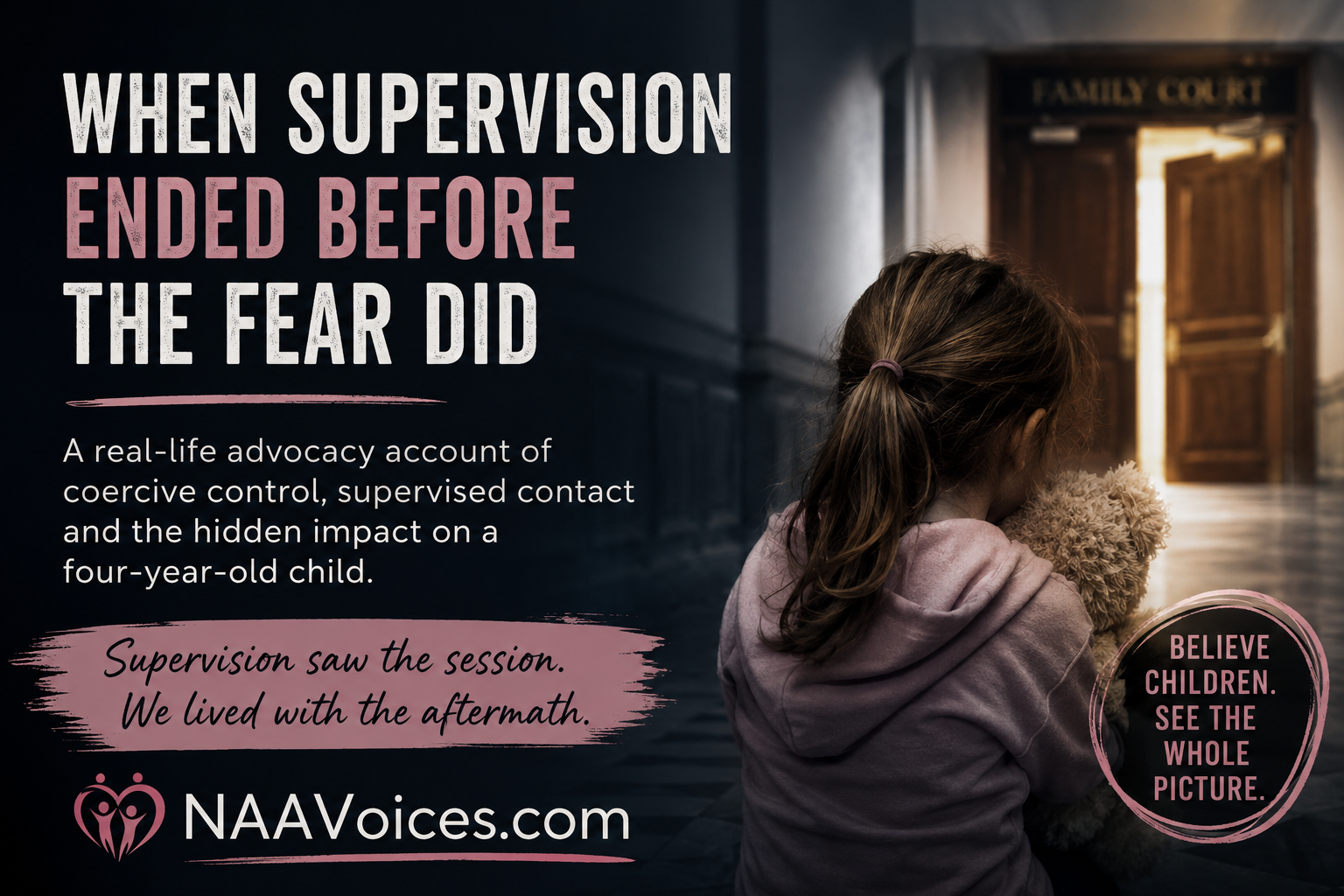
  • When Supervision Ended Before the Fear Did

    When Supervision Ended Before the Fear Did

    This is my personal account of the final hearing in private family proceedings, written as part of a professional advocacy series about coercive control, trauma and safeguarding. Names, locations, precise dates and some identifying details have been removed or generalised to protect the children involved.

    When Supervision Ended Before the Fear Did

    By the final hearing in March, my four-year-old child had completed a small number of supervised sessions with her father at a contact centre.

    She would not turn five until July.

    On paper, those sessions created a pathway forward.

    They showed that he could attend, interact with her and follow expectations while another adult was present.

    What they could not show was what happened before she entered the building.

    They could not show the four-year-old who returned home.

    They could not show the nights that followed.

    They could not show the effect upon her older siblings.

    They could not show what years of limited and unsafe sole care had taught me.

    The court ordered ongoing contact and created the route away from professional supervision.

    I left knowing that the contact centre had seen only a short, carefully managed interaction.

    My four-year-old child carried everything that happened outside it.

    Before Contact

    Supervised contact had been ordered at an earlier hearing.

    When I returned home, I excitedly explained to my child that she would soon be seeing her dad.

    I made it sound positive because she was innocent and because that was what she needed from me.

    I did not tell her that I was frightened.

    I did not tell her about the police investigation.

    I did not explain the allegations, the family proceedings or the history of abuse.

    I smiled and told her she was going to see Daddy.

    Her response was immediate and unprompted.

    She said that she did not want to see him.

    She said that she did not want to become a daddy when she grew up.

    She associated being a father with shouting at me.

    She questioned how she could remain my baby if she was expected to grow into somebody like him.

    She was four years old.

    She should not have been trying to understand whether growing up meant becoming like an adult she feared.

    At that stage, I largely understood her rejection of being male through the trauma she had witnessed.

    For months, she had shown discomfort when described as a boy, but I believed much of it might be connected to her fear of becoming her father.

    I reassured her that she did not have to become like him.

    I told her that growing up did not mean repeating another person’s behaviour.

    I told her that she could be kind.

    I did not yet fully understand that she was also trying to communicate something deeper and more persistent about herself.

    Towards the end of December, while still only four, she began consistently identifying as a girl and chose a name that reflected who she understood herself to be.

    The sequence matters.

    Her fear of becoming her father came first.

    Her clear and persistent identity emerged later.

    I had initially interpreted the distress through trauma because that was the context I understood.

    I learned by listening to my four-year-old child.

    Protecting Her

    Despite everything our family had lived through, none of us spoke badly about her father to her.

    Not me.

    Not her older siblings.

    Not the relatives who had seen what leaving and rebuilding our lives had cost us.

    We protected her from the adult truth because she was a small child.

    She deserved the possibility of loving her father without carrying our memories, anger or trauma.

    That protection came at an enormous cost.

    Her siblings had their own experiences of him.

    They had seen instability, fear and the impact of his behaviour upon our home.

    They had watched my physical and mental health deteriorate.

    They had watched police investigations and court proceedings consume our lives.

    They had their own anger.

    They had their own grief.

    They had their own memories.

    But around their youngest sibling, they swallowed all of it.

    We all did.

    We said positive things about a man whose behaviour had harmed us.

    There is nothing easy about doing that.

    You have to separate what happened to you from what a child needs emotionally.

    You encourage excitement while your own body is responding with fear.

    You say that you hope they have a wonderful time when you do not know whether they will.

    You reassure them that a parent loves them while privately questioning whether that parent can consistently place the child’s needs above their own.

    You protect the image of somebody who abused you and your other children because the youngest child should not be forced to carry your pain.

    It was painful.

    It affected my health.

    It affected her siblings profoundly.

    But she was our priority.

    We did not ask her to choose.

    We did not describe him to her as abusive, dangerous or dishonest.

    We prepared her positively for contact.

    We helped her pack.

    We encouraged her to attend.

    We listened when she was excited.

    We comforted her when she was frightened.

    We left space for her to build her own relationship and reach her own understanding.

    That is not parental alienation.

    It is the opposite.

    First Contact

    Before the first supervised session, my child was initially excited.

    She chose what she wanted to wear and selected personal items to take with her.

    She wanted to share important things about herself.

    She believed her father would recognise the identity she was beginning to express consistently at home.

    That excitement mattered.

    I was not trying to prevent their relationship.

    I prepared her.

    I reassured her.

    I encouraged her throughout the journey.

    But as the handover approached, her confidence changed.

    She became anxious and said that she did not want to leave me.

    She needed considerable reassurance before she could enter the session.

    Her father arrived late.

    Inside the contact centre, the session could be described as broadly positive.

    A supervisor was present.

    The surroundings were controlled.

    The expectations were clear.

    The time was limited.

    When she returned, however, she was subdued.

    She appeared exhausted and clung tightly to me.

    She repeatedly needed reassurance that I would not leave her.

    In the days that followed, she began talking about which adults told the truth and whether people’s actions matched their words.

    She was already trying to understand adult inconsistency.

    She was only four.

    She was far too young to carry that responsibility.

    What Reports Miss

    A supervised-contact report records what happens during a limited session in a managed environment.

    It may record that a four-year-old played.

    It may record that the parent offered food, gifts or affection.

    It may record that no visible incident occurred.

    But a four-year-old child may not have the language, confidence or emotional understanding to explain what she is experiencing in front of unfamiliar adults.

    She may not openly refuse.

    She may not disclose.

    She may not be able to identify fear or explain why she has suddenly become silent.

    She may comply because compliance feels like the safest response available to her.

    A contact report cannot fully measure:

    • anxiety before handover;
    • silence during the journey home;
    • repeated reassurance afterwards;
    • disturbed sleep;
    • regression;
    • changes in speech;
    • delayed emotional collapse;
    • or the difference between compliance and emotional safety.

    A four-year-old who completes contact has not necessarily felt safe.

    Sometimes frightened children become quiet.

    Sometimes they comply.

    Sometimes they observe carefully.

    Sometimes they hold everything inside until they return to the person with whom they feel secure.

    The contact-centre staff saw the session.

    We lived with the four-year-old who came home afterwards.

    Further Contact

    During another supervised session, my child was given gifts and activities that did not reflect the identity she was expressing everywhere else.

    She noticed.

    She asked questions.

    But she appeared unable to tell her father what she actually wanted.

    During that session, she soiled herself.

    She was toilet-trained and normally able to communicate when she needed the toilet.

    Afterwards, she said that she had “forgotten” where it was.

    I did not understand that as an ordinary accident.

    A four-year-old child had been unable to communicate a basic bodily need while inside a supervised environment.

    Immediately after that contact, her communication reduced dramatically.

    She became almost entirely silent for more than a day.

    Once she felt secure at home again, the contrast was striking.

    She could talk, sing, laugh and engage.

    Around contact, she became withdrawn and dysregulated.

    A new stutter began.

    Her sleep deteriorated.

    Her anxiety increased.

    The difference was not subtle.

    The Third Session

    Before another supervised session, she had been excited about the clothes she was wearing.

    When she realised she was going to see her father, she asked me for a cuddle and said that she needed one.

    She then wanted to remove the clothes she had previously been excited to wear.

    After the session, she remained unsettled.

    That night, she screamed, could not regulate and did not settle until the early hours.

    A pattern was already visible:

    Before contact, anxiety.

    During contact, compliance, silence or an inability to express her needs.

    After contact, regression, disturbed sleep, communication changes and emotional dysregulation.

    Her father was being assessed on how he behaved while being watched.

    My four-year-old child lived with the impact when nobody was watching.

    Adult Information

    By the time of the final hearing, another concerning pattern had begun.

    My child was returning with information that a four-year-old should not reasonably have known.

    She appeared to be hearing adult matters and carrying them between households.

    She did not have the developmental understanding to process what she was repeating.

    Children should not be used as messengers.

    They should not be exposed to adult blame, litigation, housing disputes or competing explanations of why a family separated.

    Even when information is not given as an explicit instruction, discussing adult matters within a young child’s hearing can place them in an impossible emotional position.

    They begin to feel responsible for information they cannot understand.

    They may believe they must decide which parent is telling the truth.

    They may repeat something without understanding that it will cause distress.

    The burden quietly transfers from the adults to the child.

    That had already begun before unsupervised contact.

    The Allegation

    Throughout the proceedings, I was portrayed as somebody who might be influencing my child against her father.

    The language of parental alienation placed our entire family under suspicion.

    Every safeguarding concern risked being reframed as hostility.

    Every record risked being described as obsession.

    Every emotional response risked being used to suggest that I could not distinguish my own experiences from my child’s needs.

    The character attacks took their toll on all of us.

    We were already managing the effects of abuse and separation.

    We then had to live with the suggestion that our efforts to protect a child were themselves harmful.

    Her older siblings became frightened to speak freely about their own experiences.

    Anything they said could be dismissed as loyalty to me or as evidence that I had influenced them.

    Family members measured every sentence around the youngest child.

    I questioned whether documenting an incident would later be used to portray me as fixated or obstructive.

    Yet we continued protecting her.

    We still did not criticise him to her.

    We still encouraged contact.

    We still allowed her to feel excited.

    An independent welfare assessment ultimately found no evidence that I had coached her or alienated her from her father.

    That finding mattered.

    But it could not undo the damage caused by the allegation.

    It could not restore the health, emotional energy or sense of safety already taken from our family.

    Coercive Control

    Coercive control is often misunderstood because people expect abuse to be visible all the time.

    It is not.

    A person may be frightening, volatile or controlling in private while appearing calm, considerate and reasonable in front of other people.

    They may understand exactly what professionals expect to see.

    They may know which words to use.

    They may appear vulnerable.

    They may cry.

    They may agree to every recommendation.

    They may present as cooperative for as long as cooperation benefits them.

    An act does not have to last forever.

    It only has to last long enough.

    Long enough for a hearing.

    Long enough for an assessment.

    Long enough for a supervised-contact session.

    Long enough for the professional observing it to believe that the person is safe and reasonable.

    Meanwhile, the person who has experienced the private behaviour may appear anxious, physically unwell, defensive or overwhelmed.

    Their body is responding to the history.

    The other person may be responding to the audience.

    The system can then make a dangerous mistake.

    It can confuse composure with safety.

    It can confuse distress with unreliability.

    It can interpret the ability to demonstrate appropriate behaviour under observation as proof that the same behaviour will continue in private.

    That is how coercive control can move through professional systems.

    Not because every professional is careless.

    But because the system sees the controlled presentation.

    The family has lived with what happens afterwards.

    The Performance

    The contact centre gave him a structured environment.

    A supervisor was present.

    The interaction was short.

    His behaviour was visible.

    The expectations were obvious.

    He knew what was required.

    The setting allowed professionals to assess whether he could behave appropriately for a limited period while another adult watched.

    It did not reproduce ordinary family life.

    It did not show how he would respond when a four-year-old was distressed at night.

    It did not test what would happen when she rejected something he had chosen for her.

    It did not show how he would respond when she insisted upon her identity.

    It did not test what would happen when she wanted me.

    It did not establish what adult information might be discussed in her hearing.

    It did not establish how he would respond when tired, frustrated or challenged.

    Supervised contact assessed a supervised interaction.

    It did not establish safety in sole care.

    Those are not the same thing.

    The History

    The court appeared to approach contact as though my youngest child had previously experienced a substantial history of ordinary, safe and independent care with her father.

    That was not my experience.

    By my own calculation, across her entire four years of life, there had been less than approximately sixteen months during which she had been left in his sole care at all.

    Even within those limited periods, his care was not consistently independent.

    Other people were frequently present, became involved or had to intervene.

    There had been occasions when intoxication, unpredictable behaviour or an inability to provide safe care required another person to step in.

    There had been times when older children or family members had to protect, remove or collect the youngest child.

    After serious incidents, I avoided leaving her alone with him wherever possible.

    I arranged childcare around the risk.

    I relied upon relatives.

    I adjusted my work.

    I remained responsible when I desperately needed rest.

    I did whatever was necessary to prevent another incident.

    He was not a parent who had routinely provided safe sole care throughout her life and was simply resuming an established role.

    The reality was that I had spent much of her childhood preventing situations in which he would be solely responsible.

    The court did not see the years of practical arrangements behind that.

    It saw a father asking for contact and a mother expressing fear.

    Without the history, my fear could look disproportionate.

    With the history, it made complete sense.

    Prevented Harm

    There is a cruel problem faced by protective parents.

    When you successfully prevent something terrible from happening, professionals may see no evidence that it would have happened.

    They see a child who survived.

    They do not see the vigilance that kept the child safe.

    They do not see the childcare arrangements.

    They do not see the older sibling stepping in.

    They do not see the relative arriving.

    They do not see the nights spent awake.

    They do not see work shifts rearranged or the physical and mental cost of never being able to relax.

    The absence of catastrophe is then mistaken for the absence of risk.

    But prevention is not proof that the risk was imaginary.

    Sometimes it is evidence that somebody has been holding the danger back for years.

    I had done that without authority, recognition or meaningful support.

    I was then expected to prove the danger using the very disasters I had spent years preventing.

    No Voice

    I knew how little safe sole care had actually existed.

    I knew how often another person had been required.

    I knew about the intoxication, collapse, volatility and unsafe decisions.

    I knew why I had arranged our lives as I had.

    But when I tried to explain that history, I felt that I had no voice.

    My concerns became allegations.

    My records became excessive.

    My fear was interpreted through parental alienation rather than through the incidents that created it.

    The person who had spent years quietly preventing harm could be portrayed as the barrier to the relationship.

    The person who had rarely provided safe sole care could be presented as the parent unfairly denied the opportunity to do so.

    The roles were reversed.

    The Siblings

    The impact upon the older children was profound.

    They had lived through their own experiences.

    They knew why I was frightened.

    They saw their four-year-old sibling return from supervised contact withdrawn, unable to communicate normally and struggling to settle.

    They saw the stutter appear.

    They heard the adult information she was bringing home.

    They watched my health deteriorate under the strain.

    Yet they were expected to remain silent.

    The allegation of alienation meant their own experiences risked being dismissed.

    If they spoke, it could be said that I had influenced them.

    If they became upset, it could be said that they were responding to my anxiety.

    If they tried to protect their sibling, their actions could be treated as interference.

    They learned to measure their words.

    They learned that telling the truth might create more problems for the family.

    They carried anger, fear and helplessness that did not belong to them.

    Protecting their youngest sibling’s innocence meant asking the older children to contain emotions no child should have been required to hold.

    They did it because she was their priority too.

    Before Court

    As the final hearing approached, I became frightened even to open legal correspondence.

    I required friends and colleagues to help me read some of it.

    The other party’s position statement questioned my child’s identity, clothing and appearance.

    It suggested that I had influenced her and raised allegations about my parenting that I believed distorted the reality of her care.

    I sought evidence from professionals who knew her independently of the proceedings.

    I asked that her own wishes, behaviour and reactions be considered.

    A clinician who met her supported allowing her to explore her identity without judgement or persuasion.

    I also sought specialist education because I wanted to understand her properly rather than impose an explanation upon her.

    The independent welfare assessment found no evidence that I had coached her or alienated her from her father.

    Her voice existed across time and settings.

    It appeared through spontaneous conversations, behaviour observed by professionals, her drawings and play, her clothing choices and her distress when adults failed to recognise her.

    The finding should have ended the suggestion that her feelings had been placed into her mouth.

    But the accusation had already caused lasting damage.

    The Hearing

    At the final hearing, the court made directions intended to protect my child’s identity and ensure that her name, clothing and expression were respected.

    I was grateful for those protections.

    But the fact that they had to be written into an order told its own story.

    A parent who intended to respect a child should not ordinarily require a court direction to use the child’s chosen name or permit appropriate clothing.

    The court also made arrangements intended to reduce my exposure to him during proceedings.

    At the same time, it ordered ongoing contact.

    The supervised sessions became the basis for contact progressing outside the contact centre.

    I had already seen the stutter begin.

    I had seen the regression.

    I had seen my four-year-old child become almost entirely silent.

    I had seen her unable to communicate that she needed the toilet.

    I had heard the adult information she returned carrying.

    I had seen the effect upon her older siblings.

    I had seen the difference between the contact-centre reports and the child who came home.

    I knew the supervised sessions were not demonstrating emotional safety.

    They were demonstrating that an adult could maintain the expected behaviour while being observed.

    My Fear

    By the time the order was made, my fear had intensified beyond anything I could manage.

    I was not imagining risk in the abstract.

    I was remembering the occasions when he had been responsible for a child and somebody else had needed to intervene.

    I was remembering the intoxication.

    I was remembering the unsafe decisions.

    I was remembering how rarely the youngest child had ever truly been in his independent care.

    I was looking at what supervised contact was already doing to her.

    She was only four.

    And I knew the next stage would reduce observation rather than reduce the risk.

    The contact centre had not reassured me.

    It had shown me that he could sustain an appropriate presentation while being watched.

    It had also shown me what happened to my child afterwards.

    Removing supervision would not remove the warning signs.

    It would remove the independent witness.

    The Laughter

    As the hearing ended, I heard him laugh as he walked out through the door.

    That was the moment I collapsed.

    It was not something somebody told me later.

    I heard it myself.

    After everything I had tried to explain, after watching what supervised contact had already done and after hearing the decision that would take contact beyond professional observation, I heard him laugh.

    Something in me broke.

    I addressed the magistrates.

    I said words to the effect of:

    “When—not if—something happens to my child, I need you to know that I have done everything I can to protect her.”

    Those words did not come from bitterness.

    They came from terror and complete powerlessness.

    I had spent years arranging our lives to prevent unsafe sole care.

    I had relied upon family support.

    I had sacrificed my physical and mental health.

    The older children had sacrificed their freedom to speak honestly about their own experiences.

    We had protected the youngest child’s innocence even when doing so required us to say positive things about somebody whose behaviour had harmed us.

    I had complied with the proceedings.

    I had encouraged contact.

    I had obtained professional evidence.

    I had participated in the welfare assessment.

    I had continued bringing my four-year-old child to supervised sessions while watching the effect upon her.

    I had done everything asked of me.

    And now the safeguard of professional supervision was being removed.

    Watch Me

    After I collapsed, my barrister told my mother to watch me carefully.

    I knew what she meant.

    She had seen my condition.

    She understood that this was not ordinary disappointment after an unfavourable decision.

    The physical and psychological strain had become dangerous.

    I had reached a point where I could no longer carry the combination of the proceedings, the allegations, the historical risk and the fear of what would follow.

    Even then, my focus remained my child.

    I was not afraid of losing an argument.

    I was afraid of what the order would mean for a four-year-old who could not protect herself.

    The Assumption

    The decision relied upon a significant assumption:

    That behaviour demonstrated under supervision would continue when supervision ended.

    The contact centre showed that he could behave appropriately for limited periods in front of another adult.

    It did not establish that he could safely provide sole care to a four-year-old child.

    It did not erase the history of other people having to intervene.

    It did not explain why a child who had not yet reached her fifth birthday was showing physical, emotional and communication changes around contact.

    It did not establish how he would respond when she challenged him privately.

    It did not show whether the protections around her identity would be respected when nobody was there to enforce them.

    It did not address the adult information she appeared to be receiving.

    It did not measure the effect upon her siblings.

    A performance under observation was being relied upon to predict behaviour without observation.

    The person being placed into that unobserved environment was four years old.

    She could not protect herself.

    She could not leave.

    She could not reliably identify, understand or report coercive behaviour.

    She depended entirely upon the adults and systems around her recognising the risk before she was required to experience it.

    That is one of the dangers of coercive control within professional systems.

    A person does not need to convince everybody forever.

    They need only present the right version of themselves to the right professional for long enough to secure the next decision.

    If that presentation is accepted without the full history, supervision can be removed precisely because the person has demonstrated that they can perform while supervised.

    The child is then placed into private circumstances the system has never actually assessed.

    Her Discovery

    My child’s developing understanding of her father did not come from us.

    It came from her own experiences.

    It came through whether she felt listened to.

    It came through whether the things that mattered to her were respected.

    It came through what was discussed around her.

    It came through whether actions matched promises.

    It came through how she felt before contact and how her body responded afterwards.

    We had done everything possible to preserve her relationship with him.

    But we could not protect his image from his own conduct indefinitely.

    This was the beginning of her discovering for herself what that relationship felt like.

    That was never what I wanted.

    I wanted her to love him safely.

    I wanted him to prove my fears wrong.

    I wanted the arrangements to work.

    I wanted her experience to be entirely different from ours.

    But children form their own understanding of adults.

    Even at four years old, they notice who listens.

    They notice who respects them.

    They notice who makes them feel safe.

    They notice when words and actions do not match.

    They notice when they must become quiet, compliant or smaller in order to cope.

    No criticism from us created that understanding.

    Her own experiences did.

    The Pathway

    Unsupervised contact did not begin suddenly.

    It was built through stages.

    Contact was first ordered in a supervised setting.

    The sessions were then relied upon as evidence that contact could occur.

    The interactions witnessed inside the centre were given significant weight.

    The distress before and after contact was much harder to measure.

    The adult had a professional audience during the periods in which expected behaviour was demonstrated.

    The four-year-old child had no equivalent audience for the hours and days in which she processed the experience afterwards.

    By the time supervision ended, the pathway had already been established.

    The legal process had seen attendance, interaction and apparent cooperation.

    Our family had seen fear, regression, silence, disturbed sleep, a new stutter, inappropriate adult information and a child unable to express a basic physical need.

    Both accounts existed.

    Only one fitted neatly into the contact report.

    What Followed

    This was the beginning of my child discovering who her father was through his own actions.

    We had protected her from what we knew.

    We could not protect her from what she experienced once contact moved outside professional observation.

    She learned through whether her identity was respected.

    She learned through whether she was listened to when frightened.

    She learned through what was said around her.

    She learned through the difference between the parent presented in formal settings and the parent she experienced privately.

    That understanding did not result from parental alienation.

    It resulted from direct experience.

    What followed became increasingly serious.

    Those involved in the decision may have believed they were preserving an important parental relationship.

    But later events demonstrated the danger of treating supervised presentation as proof of safety outside supervision.

    I will never forget that.

    I will never forget how much evidence was already available.

    I will never forget the warning signs already present in a four-year-old child.

    I will never forget the cost to her older siblings.

    I will never forget how much of my health I had sacrificed to prevent harm.

    Most of all, I will never forget that what followed could have cost my child far more.

    Final Reflection

    Family courts must distinguish between a parent’s fear and a child’s actual risk.

    That scrutiny is necessary.

    But it must consider the whole pattern.

    A supervised-contact session is evidence of what happened during a supervised-contact session.

    It is not proof of what will happen in a private home, overnight or without observation.

    A four-year-old who completes contact has not necessarily felt safe.

    A four-year-old who becomes silent has not necessarily coped.

    A four-year-old who waits until returning home to collapse has not necessarily experienced positive contact.

    A four-year-old who soils herself because she cannot communicate a basic need is showing something that deserves careful attention.

    A four-year-old who develops a stutter, stops speaking normally and begins carrying adult information is not responsible for proving why.

    A parent who appears calm under supervision has not necessarily demonstrated safe sole care.

    Coercive control can involve performance.

    That performance can last long enough for professionals to believe it.

    Long enough for warnings to be reframed as hostility.

    Long enough for the protective parent to be characterised as obstructive.

    Long enough for supervision to be removed.

    Long enough for a child to be placed at risk.

    The court sought to protect my child while preserving her relationship with her father.

    It also created the route by which contact could take place without a supervisor present to enforce those protections.

    She was four years old.

    She would not turn five until July.

    She could not protect herself.

    We had protected her from every negative word that could have been said about him.

    We had absorbed fear, anger and trauma because she was our priority.

    We had been accused of alienation while doing everything possible not to influence her.

    The independent assessment found no evidence that we had.

    What changed my child’s understanding was not anything we told her.

    It was what she experienced.

    I had placed the evidence before the professionals involved.

    The records showed her distress.

    The order stated what was expected.

    But a court cannot order a parent to understand a child.

    It cannot guarantee that private behaviour will match behaviour demonstrated under supervision.

    And it cannot prevent a four-year-old child from discovering through experience what the rest of her family had sacrificed so much to protect her from.

  • The Healing Power of Connection: Lessons From My Grandmother’s Journey

    The Healing Power of Connection: Lessons From My Grandmother’s Journey

    NAAVoices was not created from certainty, but from lived experience and professional insight. As I migrate earlier work from the original platform, this post has been reviewed and approved for transfer. It remains true to its original context, with only minor clarity edits where needed. Some moments do not require rewriting to remain honest.

    Loneliness is one of the most profound and overlooked experiences a person can face, especially after losing a partner. Last week, I was reminded of this again when I met another widow still navigating the quiet ache of life after loss. Many people mourn not only the person they loved, but the life they once shared — the routines, the companionship, the sense of belonging.

    As I wrote in the original version of this blog, “More than 40% of widows and widowers report feeling isolated after the loss of their partner.” That statistic is more than a number. It represents real people living with a silence that can feel suffocating.

    My grandmother knew that silence intimately.

    Her First Experience of Loss

    My grandfather passed away when my grandmother was just under 60. She had to navigate the complexities of grief alone, at a time when support services didn’t fully understand the emotional and practical realities of widowhood. She felt isolated, unseen, and misunderstood — a feeling many widows and widowers still experience today.

    But instead of letting grief consume her, she transformed it into something extraordinary.

    A Legacy Born From Compassion

    In the years that followed, my grandmother founded a support group for widows and widowers — a group that has now been running for 25 years. What began with a single act of courage — “a letter to the local newspaper, reaching out to those who were living in similar situations” — became a lifeline for more than 200 people.

    She created a space where those grieving could come together, share their stories, and rediscover connection. A place where loneliness was met with understanding, and silence was replaced with companionship.

    I grew up watching her pour her heart into this work. I remember the open‑house sessions vividly: the smell of freshly baked cakes, the furniture rearranged to make room for everyone, the warmth that filled the room as people gathered. My baby boy was passed around like a tiny spark of hope. For some members, it was the only human interaction they had all week.

    Some found love again. Others found lifelong friends. Many simply found a reason to keep going.

    The Power of Shared Experience

    Working in primary care, I’ve seen firsthand how loneliness affects health — emotionally, mentally, and physically. I’ve often wished I had the time and resources to create a group like hers for my own patients. I can empathise deeply, but I haven’t walked in their shoes. That’s why her work matters so much: it came from lived experience, compassion, and courage.

    Even now, at over 80 years old, she still takes calls from those who need her. She doesn’t realise the magnitude of what she’s built. She never sought recognition, yet her legacy is undeniable. She has healed hearts, restored hope, and created a community that continues to thrive because she refused to let others feel the loneliness she once felt.

    Connection as a Lifeline

    Her story is a reminder that healing doesn’t always begin with grand gestures. Sometimes it starts with one letter, one conversation, one act of kindness. She proved that one person’s courage to reach out can transform hundreds of lives.

    Her legacy teaches us that connection is not a luxury — it is a lifeline. Loneliness affects the body, the mind, and the will to keep going. When we create spaces for people to be seen and heard, we offer them more than support. We offer them a way back to themselves.

    I carry her lessons with me every day:

    • No effort is too small.
    • Compassion creates ripples we may never fully see.
    • Community can grow from the simplest act of reaching out.

    Her strength, her love, and her quiet determination continue to guide me.

    Moving Forward: A Call to Connection

    Reflecting on her journey, I wish more services recognised the true impact of loneliness on widows and widowers. If the NHS had the capacity to support community‑led groups like hers, countless people could benefit from the healing power of shared experience.

    Her story is not just a testament to resilience — it is a blueprint for what compassionate community support can look like.

    A Year Later

    Nearly a year after writing this blog, I’ve created a dedicated bereavement support resource offering guidance, practical help, and most importantly, contact details for organisations that truly understand loss and provide meaningful support. It feels like a small way to honour her legacy and continue the work she began.

  • Finding Strength Amidst Chaos and Control

    Finding Strength Amidst Chaos and Control

    NAAVoices was not created from certainty, but from lived experience and professional insight. As I migrate earlier work from the original platform, this post has been reviewed and approved for transfer. It remains true to its original context, with only minor clarity edits where needed. Some moments do not require rewriting to remain honest.

    March 11, 2025 11.45pm

    I love my job, giving to others, and being true to myself. But some days, I face the painful reality of a man who finds joy in chaos and manipulation.

    The weight of this situation is overwhelming. I promised myself I wouldn’t let him stop me from being who I am, but his influence lingers. It’s a constant battle between living authentically and the anxiety he instils in me.

    For 34 years, I went without medication, therapy, or mental health support. I thought I understood mental health, but I knew nothing. Navigating family court to protect my children and myself has been especially hard.

    The heartbreaking truth is that my life remains under someone else’s control. Over the past 16 months, his behavior has escalated in ways I never thought possible.

    At 39, his patterns of manipulation and cruelty have been present since before he turned 13. I was warned his family would rally around him, but I stubbornly refused to believe it. I poured everything into trying to help them.

    I am not perfect, but I do not act in malice. My regrettable actions were reactions to years of psychological torment. His family knows who he is, yet they chose to back him. It feels like I’m being punished for walking away, and the weight of that thought is crushing. I’ve lost half a stone this week, and the trauma is all-consuming. I need an escape from this hell.

    I couldn’t move today, knowing the damage he has done will extend to this beautiful child who deserves so much more. I couldn’t go for lunch or leave my room, fearing someone would ask, “How are you?” I don’t want to hear it or explain what’s happening.

    I have a work mum, but I avoid her to hide how bad things have gotten. Colleagues have read solicitor letters and court orders because I couldn’t mentally do it anymore. The absurd lies in those documents are too much to handle.

    Today, I messaged a colleague to go for a walk. He asked later if I wanted to go, and though I didn’t, I knew I needed to.

    I read the closing email of the C+C case from the end of January, and that was it—I spiralled and knew I couldn’t keep reliving just how manipulative he is.

    I walked out of work, realising I was never given a chance to defend anything he had said, nor the statements he had people provide. And still, he had been fed false information, and no one had addressed the leak.

    I left work tonight, looking back at a place that kept me safe. I felt immense pain, knowing he is likely plotting and planning more false accusations.

    Here I am, having to prove my weight loss and PTSD diagnosis. I’ve fought for 16 months to support the kids and heal from the hell we lived. But when someone is intent on ‘ending’ you, there’s always more.

    I’ve published two memoirs, written a patent for a form of therapy, founded a website, studied the first year of a master’s program, worked full-time, supported three kids, lost six stone, and been diagnosed with PTSD. I’ve been a mum, friend, sister, nurse, and granddaughter. I paid off thousands of his debts and supported two traumatised kids. But he still plays the victim.

    We went. I collected the little one and headed to the beach. I needed to feel some peace, to reset.

    I know tomorrow is going to wipe me out again, and the only thing that keeps me going is that little one’s face, the love and innocence in them, a child they weren’t before.

    They are happy and safe. And the tears filled my eyes, knowing that I can’t keep them safe from someone who has already put their life at risk so many times. We set off, and they fell straight to sleep. I knew I needed to be outside but couldn’t bring myself to have them sitting in the car just so I could be near the sea. So i pulled over where i always go, the same laybe, the same field and just lay back and watched the stars.

    They have no idea what their life is going to be like. The only hope I can have is that the past 16 months of safety and a loving, happy, stress-free home are enough to have given them the confidence to speak up and not allow others to manipulate them, or to at least tell someone if that is happening.

    My friend told me I needed to teach them how to phone the police and to teach them how to get to a safe place or get them a phone to ring me. They are 4!!!….. Why does any mum have to worry about this?!.

    I understand why his ex tried to warn me years ago. How many lives does one person have to ruin? I will never understand how someone can lie so profoundly, damage people, and walk away laughing.

    Why aren’t people held accountable for their actions? Why don’t people question lies? Why aren’t people allowed to explain?

    Why is psychological abuse secondary to other forms of abuse? The damage is profound.

    My Lived Experience: A Personal Journey Through Trauma and Recovery
  • The Friday Everything Broke

    The Friday Everything Broke

    One year on, a moment of reflection:

    A week before, my coercive control case had been dropped.

    Not quietly. Not kindly. I had gone from being the victim in the crime they had arrested him for, to a member of the public. A reclassification so deliberate, so calculated, that I knew exactly what it meant. You cannot be a victim in one crime and a member of the public in another. I knew that. They knew I knew that.

    I had already watched them pour their energy into charging the only officer who had actually tried to do his job. The corruption wasn’t a suspicion anymore. It was obvious. Unapologetic. And the man — the one who would later put my child at risk, who had used DARVO tactics from the very beginning, who had twisted every truth until I questioned my own — walked away. No consequences. Nothing.

    And then I went to work.

    I don’t know what finally broke it open that Friday. Maybe it was the accumulation. Maybe it was the silence after the verdict. Maybe it was simply that my body had been holding too much for too long and finally said no more.

    I collapsed. I ended up doing my own ECG on the floor. My colleagues — people who had only ever seen me composed, capable, holding the line — saw me break for the first time.

    I am not ashamed of that moment. I never will be.

    But I won’t pretend it didn’t happen. Because understanding what led to it matters. And a lot has changed since then.

    NAAVoices was not created from certainty, but from lived experience and professional insight. As I migrate earlier work from the original platform, this post has been reviewed and approved for transfer. It remains true to its original context, with only minor clarity edits where needed. Some moments do not require rewriting to remain honest.

    Understanding Despair: Breaking the Misconceptions

    I was anxious coming back after Friday.

    Not the usual kind of anxious — the kind that sits heavy in your chest, replaying every moment, every word, every crack that showed. I have spent years perfecting the front. The composed, capable version of me that walks into a room and holds it together. Friday, that version didn’t show up.

    And I’m still processing that.

    PTSD doesn’t announce itself politely. It doesn’t wait for a convenient moment. It pulls you under, and sometimes — no matter how much work you’ve done, how many tools you have, how many times you’ve survived it before — it pulls you under in front of people.

    Re-traumatisation is brutal. It’s not just remembering. It’s reliving — your nervous system convinced, all over again, that you are back in the worst of it. The despair that follows isn’t weakness. It’s overload. It’s your mind and body hitting a wall they didn’t see coming.

    I spent so much of the weekend worrying about my colleagues. What they saw. What they thought. Whether they’d look at me differently. My darkest days usually produce productivity — not me on my knees, refusing help, doing my own ECG. I hope they know that moment didn’t define me. I hope they understood they were seeing something real, not something broken beyond repair.

    Because here’s what I want people to understand about despair — the things nobody talks about honestly:

    It is not weakness. It is one of the most human things you will ever feel. Everyone has a limit. Reaching yours doesn’t make you less; it makes you human.

    It is not permanent. In the depths of it, it feels like it will never lift. It does. It has before. It will again.

    It is not the same as depression. Despair is a response — raw, overwhelming, situational. Depression is a condition. Conflating the two helps no one.

    Isolating won’t protect you. It feels safer to disappear when you’re in it. Connection is uncomfortable when you’re raw. But it’s also the thing that pulls you back.

    It isn’t unproductive. Some of my most important self-realisations have come from the wreckage of a really bad day. Despair forces honesty in a way nothing else does.

    You don’t have to fight it. Sometimes the bravest thing is to let yourself feel it, name it, and wait for it to pass rather than white-knuckling through.

    I’m sharing this not because I have it figured out, but because I know I’m not the only one who has sat somewhere quiet after a really public moment of pain, wondering if they’ve changed how people see them forever.

    You haven’t. And neither have I.

    My Lived Experience: A Personal Journey Through Trauma and Recovery
  • Finding Silence in the Midst of Overload: Navigating Safety and Trauma

    Finding Silence in the Midst of Overload: Navigating Safety and Trauma

    NAAVoices was not created from certainty, but from lived experience and professional insight. As I migrate earlier work from the original platform, this post has been reviewed and approved for transfer. It remains true to its original context, with only minor clarity edits where needed. Some moments do not require rewriting to remain honest.

    Home is supposed to be the place where you can finally breathe. But for many of us who carry the weight of trauma, especially after a relationship with a narcissist, that quiet can feel anything but peaceful. Instead of rest, the silence can bring something harder: the space for our fears and memories to get louder.

    If that resonates with you, please know,  you are not alone, and what you’re feeling makes complete sense.

    When Your Body Won’t Switch Off

    Living with hyper-vigilance is exhausting in a way that’s hard to put into words. Your nervous system is constantly on duty, scanning for danger, bracing for the next blow, even when the threat is long gone. A creak on the stairs, a door slamming somewhere down the street, a certain tone of voice: things that seem small to others can feel enormous when your body has learned to stay on high alert.

    If you have children, there may be moments of genuine warmth that cut through the noise, their laughter, their small hands in yours. But as they grow into teenagers, the stakes can feel even higher. The need to protect them, to hold it all together, can sit heavy on your chest. You’re not just managing your own healing. You’re trying to be present for them, too.

    What PTSD Can Look Like Day to Day

    Post-Traumatic Stress Disorder doesn’t always look dramatic. Sometimes it’s just a heaviness you can’t shake. A memory that surfaces out of nowhere and takes the rest of the day with it. A feeling that you’re somehow failing, even when others can plainly see how hard you’re trying.

    PTSD can make it genuinely difficult to acknowledge good things, achievements, moments of joy, and progress. When the mind is still caught in survival mode, the positives can feel distant and unreal, while the fear feels very close and very loud.

    And if someone is still trying to manipulate or control your life, through legal proceedings, through the children, through mutual connections, that ongoing stress can make it feel almost impossible to heal. You’re trying to rebuild while the ground keeps shifting beneath you.

    Finding Something to Hold Onto

    On the harder days, even the smallest anchor can make a real difference. Something that brings you back to yourself, back to the present moment, back to the knowledge that you are still here, still standing. Here are a few things that many survivors have found genuinely helpful:

    • Grounding and mindfulness. When anxiety spikes, try to anchor yourself in the present, feel the weight of your feet on the floor, notice five things you can see, and take three slow, deliberate breaths. These aren’t clichés; they work because they redirect your nervous system away from threat mode.
    • A space that’s just yours. Whether it’s a corner of a room, a favourite chair, or a drawer full of things that comfort you, having a physical space that feels safe can be surprisingly powerful.
    • Journaling. Getting thoughts out of your head and onto paper can bring real relief. It doesn’t need to be eloquent. Even jotting down one small win from the day, anything at all, can gently shift your perspective over time.
    • Talking to someone who gets it. Whether that’s a friend, a support group, or a therapist, sharing your experience with someone who understands can lift an enormous weight. You don’t have to carry this alone.
    • Recognising your own resilience. This one can feel almost impossible on bad days, but it matters: you are still here. You have navigated things that would have floored most people. That is nothing. That is everything.

    Moving Forward, One Day at a Time

    There will be days when the past feels closer than the present. Days when the progress you’ve made feels invisible. That’s okay. Healing from trauma isn’t a straight line, and it doesn’t run on anyone else’s timeline.

    The silence that once felt threatening can, slowly and with time, become something gentler. A place to rest. A place to breathe. A place where you get to decide what comes next, on your terms.

    You are reclaiming your story. And that matters more than you might realise right now.

    You are not alone, and you never have to be.

    If you’re struggling, please reach out to a mental health professional or a domestic abuse support service in your area. You deserve support.

    My Lived Experience: A Personal Journey Through Trauma and Recovery
  • ADHD, RSD and Coercive Control: A Survivor’s Guide to Understanding and Awareness

    ADHD, RSD and Coercive Control: A Survivor’s Guide to Understanding and Awareness

    In July 2023 I was diagnosed with Combined Attention Deficit Hyperactivity Disorder. For the first time in my life, everything made sense. I had never realised that the constant internal restlessness I lived with was hyperactivity. I did not know it could present this way, but it is common in women and girls.

    I had not planned to start medication. The clinician used a simple comparison that stayed with me. If I were deficient in B12, would I take supplements? Of course I would. ADHD involves differences in dopamine regulation in parts of the brain such as the substantia nigra, ventral tegmental area and hypothalamus. Yet I hesitated, believing I had managed for 34 years without any medication. I worried medication would dull the parts of me that made me driven. I did not want to feel numb or altered.

    Looking back, I wish I had understood this sooner. I had not been myself for a long time. The impact of coercive control had stripped away many of the traits I once valued in myself.

    Rejection Sensitivity Dysphoria

    The clinician who assessed me also believed I experienced rejection sensitivity dysphoria. After researching it, so much of my life suddenly aligned. My childhood, my friendships, my fear of criticism and the intense emotional pain triggered by perceived rejection all made sense.

    Understanding RSD helped me recognise why I felt so compelled to help someone who was harming me, why I feared losing him, and why the emotional impact of his behaviour was so severe. It is not weakness. It is a recognised pattern linked to neurodivergence.

    When Abuse Is Dismissed

    On 21 December 2023, a police officer with more than 25 years of service told me, “Some relationships are just bad, not all are abusive.” It was the second time he failed to act on a disclosure, despite a documented history of controlling behaviour.

    This is the reality many victims face. Coercive control is often invisible to those who do not understand it. Dismissal from professionals can be devastating.

    Understanding Coercive Control

    Professor Evan Stark describes coercive control as being taken hostage. The victim becomes captive in an unreal world created by the abuser, trapped in confusion, contradiction and fear.

    Emotional abuse is not always shouting or threats. It can be sarcasm, dismissiveness, character attacks, subtle put downs and constant button pushing. It often stems from the abuser’s insecurities and their need to create a hierarchy where they are always right and you are always beneath them.

    Gaslighting Tactics Survivors Should Know

    Gaslighting is one of the most damaging tools of coercive control. Survivors often recognise the behaviours long before they have the language for them.

    Common tactics include:

    • Blatant lies told with confidence to destabilise your sense of truth
    • Denial even when presented with evidence
    • Using what matters most to you as ammunition
    • Gradual erosion of your confidence over time
    • Occasional praise to keep you off balance
    • Creating confusion so you rely on them for clarity
    • Projection, accusing you of what they are doing
    • Turning others against you to isolate you
    • Questioning your sanity to undermine your credibility
    • Claiming everyone else is lying so they become your only “truth”

    Recognising these tactics is essential for breaking the cycle.

    Socioeconomic Disadvantage

    Socioeconomic disadvantage significantly affects mental health outcomes. Children growing up in disadvantaged households are two to three times more likely to develop mental health disorders. When low socioeconomic status persists, the lifetime risk increases further. Improvements in household income and stability can reduce this risk, showing how strongly parental circumstances shape a child’s mental health (Misirliyan et al., 2023).

    Resilience in Children

    Resilience is shaped by a child’s personal qualities, their relationships and the wider systems around them. Children adapt best when their environments are safe, predictable and supportive. The focus should be on improving the child’s environment rather than expecting the child to become more resilient in the face of adversity (Misirliyan et al., 2023).

    A Personal Reflection on Diagnosis and Stigma

    When my son was diagnosed with ADHD at the age of five, I began researching everything I could. I did not expect to see myself reflected in the information. By the time I reached 32, I felt overwhelmed by different aspects of my life, particularly my home environment. I went to my GP hoping she would look beyond the surface.

    Before she prescribed antidepressants, I explained that I did not believe I was experiencing depression. I suspected undiagnosed ADHD. The stigma I had carried for years disappeared the moment she responded with understanding. She referred me to an adult ADHD service, and for the first time I felt seen.

    Years later, my diagnosis has strengthened my belief that correct identification of neurodiversity or mental health conditions is essential for appropriate support. Too many adults hide their struggles until everything collapses. If we recognised these challenges earlier in childhood, we could create a far more positive future.

    Embracing Neurodiversity

    Children thrive when they are understood. When we reassure them that there is nothing wrong with them, and that their differences are simply part of who they are, we help them build identity rooted in strength rather than shame.

    Some of the world’s most talented artists, musicians, authors and innovators are neurodivergent. Their challenges would be far less daunting if society accepted that difference is not deficiency.

    Embracing neurodiversity enriches our communities, workplaces and culture. Recognising different ways of thinking enhances creativity and innovation. Seeing conditions such as autism, ADHD and dyslexia as natural variations encourages acceptance and supports advocacy for the strengths associated with neurodivergence (Doyle, 2020).

    This shift is reflected in the growing number of specialist services and programmes designed to support neurodiverse individuals (LeFevre‑Levy et al., 2023). Advocates and thought leaders continue to drive this change, reinforcing neurodiversity as an essential aspect of human diversity (Johnson and Ahluwalia, 2024).

    Different is not less.

    Research and Evidence

    Research from the Evidence‑Based Practice Unit at University College London highlights the importance of school interventions. Community interventions are also crucial. These efforts improve mental health outcomes for children and young people (UCL, 2023).

    A systematic review by University College London found a clear association between academic pressure and adolescent mental health problems. These problems include anxiety and depression. This reinforces the need for public health approaches that address academic stress (Stearea et al., 2023).

    A scoping review exploring how children and young people perceive mental health emphasises the importance of developing a shared language. When children understand the difference between everyday challenges and issues that require support, outcomes improve significantly (Beckman et al., 2023).

    Research from the Evidence-Based Practice Unit at UCL highlights important factors. School and community interventions play a vital role. They help improve mental health outcomes for children and young people. Their findings suggest that targeted interventions can significantly reduce mental health issues and promote well-being (UCL, 2023).

    Domestic Abuse

    Domestic abuse is a mental health risk for both maternal depression and infant and child mental health. Abuse may contribute to toxic stress syndrome. This can lead to anxiety, depression, and long-term difficulties in handling stress and relationships. Abuse may first occur or intensify during pregnancy, further exacerbating these risks (Misirliyan et al., 2023).


    Embracing neurodiversity.

    Viewing conditions such as autism, ADHD, and dyslexia as natural variations rather than deficits fosters societal acceptance. It encourages advocacy for the positive aspects of neurodiversity, particularly within professional settings (Doyle, 2020).

    This shift is evident in the growing number of specialised services and programs designed to support neurodiverse individuals, promoting their well-being and enabling them to contribute meaningfully to society (LeFevre-Levy et al., 2023).

    The ongoing efforts of thought leaders and advocates play a crucial role in driving this change, reinforcing the importance of recognising neurodiversity as an essential aspect of human diversity (Johnson & Ahluwalia, 2024).

    Different is NOT less.