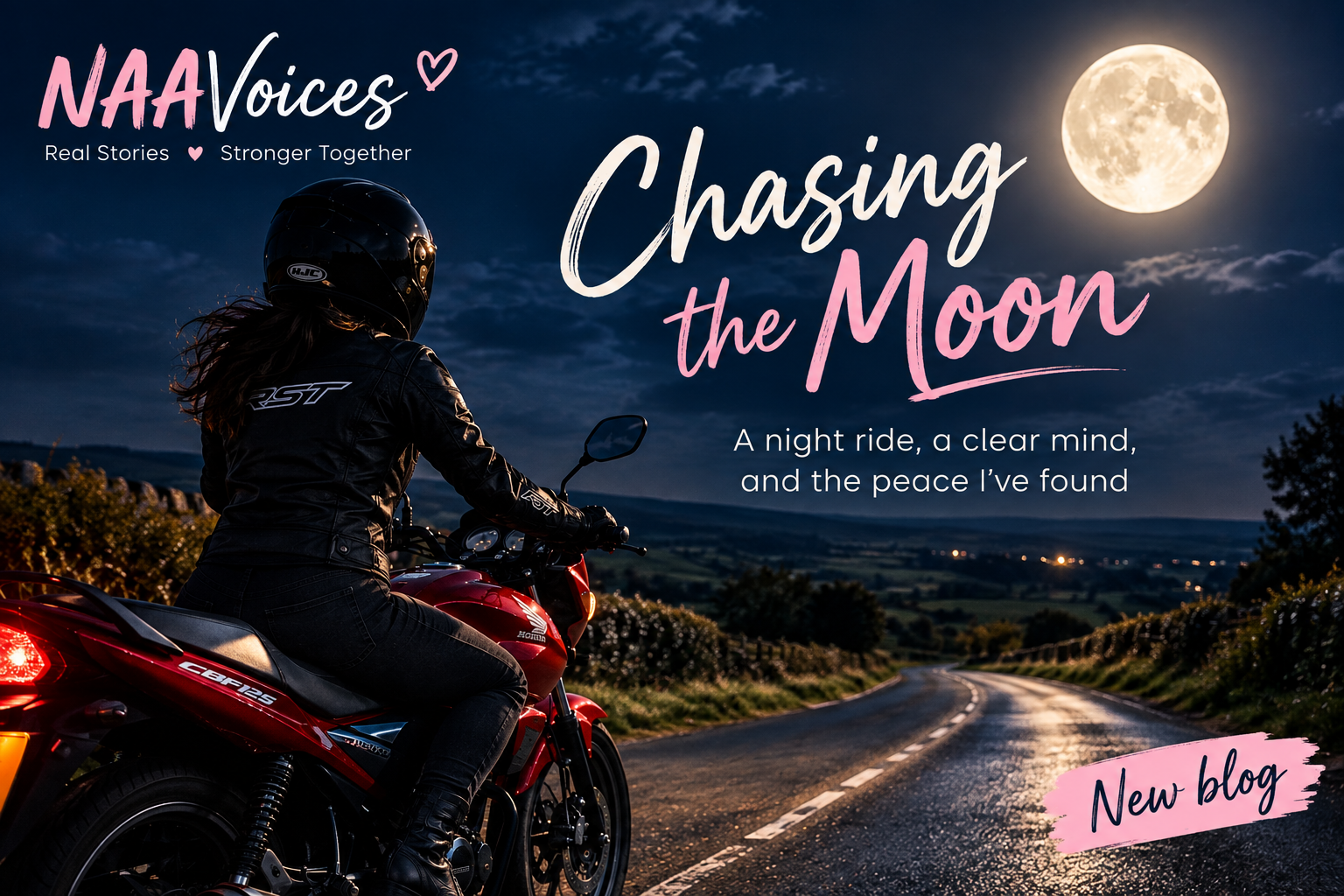
My teenager came home with a couple of his older friends and, somehow, I was the excited one.
“Can I go on my bike?”
Just for an hour.
There was something slightly ridiculous about the role reversal. When I say teenagers, we’re talking nearly 18. These are lads we’ve known for years, who my six-year-old absolutely worships and who have babysat her before.
So there I was, apparently the child of the household, while my teenager grabbed my earphones for me and I hurried into my bike jeans and threw on my leather jacket.
One of the lads had brought his girlfriend with him.
“I love your jacket,” she said. “It’s like a biker jacket.”
I laughed.
Hmm.
Yes.
Shock horror.
It is, in fact, a biker jacket.
And then I was gone.
Out of the house. Helmet on. Engine running. Into the dark.
We live rurally, so once you get away from the houses, darkness really is darkness. The roads disappear ahead of you except for the stretch illuminated by the bike.
But tonight there was the moon.
It was enormous.
Bright enough that I kept catching sight of it as the road twisted and opened up again, and for an hour it genuinely felt as though I was chasing it.
And my God, it was beautiful.
There is something about riding that clears my head in a way very little else can.
You can’t carry everything with you on a motorbike.
Your brain has to be where your body is.
The road.
The bend.
The gears.
The sound of the engine.
The cold air finding the tiny gaps in your clothes.
For once, there isn’t room for tomorrow, yesterday, paperwork, arguments, money, people, responsibilities or the thousand things constantly competing for space in my head.
There is just now.
For an hour, I chased the moon.
Then I came home.
My daughter had spent the evening with people she adores, making bracelets and generally having the time of her life.
Later, I watched a film with my 14-year-old.
Eventually everyone went to bed.
And now I’m sitting here with the moonlight coming through the window, thinking about how different life feels sometimes.
Not necessarily easier.
But different.
There are moments when I can actually see how far we’ve all come.
For a long time, home wasn’t synonymous with peace. Safety wasn’t something I could simply assume. My nervous system didn’t understand the concept of switching off because there was always something else to anticipate, manage or survive.
Now, increasingly, there are ordinary evenings.
Teenagers turning up.
A six-year-old making bracelets.
A film on the sofa.
Children sleeping safely upstairs.
And me disappearing for an hour because I fancied riding my motorbike under a ridiculously bright moon.
Ordinary things.
But after you’ve lived without peace, ordinary can feel extraordinary.
I’ve also learned something else.
People will come and go.
I don’t have the energy anymore for people who only appear when they want something from me, or relationships where I am valued primarily for what I can give, fix, carry or provide.
Peace changes your tolerance for that.
Once you’ve fought this hard to build a safe life, you become much more careful about who gets access to it.
And perhaps that is part of healing too.
Not becoming harder.
Just becoming more protective of the peace you’ve worked so hard to create.
Every time I get on that bike, I feel a little bit of it.
A sanctuary I haven’t felt in a very long time.
I’m not running away.
I’m not trying to disappear.
Sometimes I only get an hour. Sometimes it’s a short ride between everything else life demands of me.
But for those few miles, there is nothing to solve.
Just me.
Two wheels.
An open road.
And tonight, a moon so bright I couldn’t resist chasing it.
Then I get to turn around and ride home.
And perhaps that’s the biggest difference of all.
These days, I have somewhere safe to come back to.
An address. A town. The place your post gets delivered. The place you return to at the end of the day.
But I’m not sure that is what home means to me anymore.
Last night, after a ten-hour shift, I collected my daughter, got into the car and set off.
140 miles. That was the countdown on the sat nav.
It should have felt like a long drive after a long day. Instead, as the miles started disappearing behind us, I noticed something else.
My shoulders dropped.
I did not consciously decide to relax; my body seemed to do it before my mind caught up. Not because I had finished work. Not because I had a weekend off. Not even because we were getting away for a couple of days.
Somewhere inside me, I knew where we were going.
We were going home.
Except we weren’t driving towards the house where we live. We were driving towards a person.
140 miles
There are 140 miles between us.
Neither of us can simply move closer. Our older children are settled. Between us there are nine children whose lives, schools, friendships and futures matter more than making our geography convenient.
So 140 miles it is.
And somehow, across those miles, something has grown that feels far bigger than friendship.
One of her daughters once referred to my child as her sister. It stayed with me.
We talked afterwards about that phrase people use so easily: friends are the family you choose. Except sometimes I think it goes further than that.
Nobody held a family meeting and assigned titles. Somewhere along the way, “my mum’s best friend” simply became “Auntie”, and children who were not born as siblings began referring to one another as family.
It just became true.
Sometimes family is not created by blood. It is created by consistency.
It is created by showing up, by trust, by being safe, and by knowing someone is there without needing to ask whether they will be.
When home becomes a feeling
About two hours into the journey, my daughter asked me to put Country Roads on.
So I did. And we sang. Probably too loudly. Definitely not particularly well.
And somewhere in the middle of it, a feeling flooded over me so suddenly that I recognised it before I could explain it.
Home.
Not an address or a postcode, but people. Somewhere I don’t have to explain every silence, every reaction, or every part of the history that made me who I am. Somewhere I can arrive tired, overwhelmed, distracted or completely myself, and still belong.
Somewhere my daughter can simply be herself too.
Then she said it
A while later, she told me she wanted to go home.
I automatically thought she meant our house. I told her we were still about three hours from home, and that we weren’t far from where we were going.
She corrected me straight away. She didn’t mean our house at all. She meant home at Auntie’s.
And there it was again.
I hadn’t told her what I’d been thinking about earlier in the journey. I hadn’t said any of it aloud. Yet she had arrived at exactly the same word, and made exactly the same distinction.
Maybe children don’t need us to define belonging for them. They may not have the language for nervous systems, emotional security or psychological safety, but they know where their body settles. Where they can be loud. Where they can be quiet. Where they don’t have to monitor the room.
Maybe they understand that home can be more than one place.
And maybe, sometimes, home is not really a place at all.
Home after trauma
For anyone whose experience of home has been shaped by trauma, the idea of safety can become complicated.
We are often told that home should be the safest place in the world. For some people, it was not.
A house can be familiar without ever truly feeling safe. You can know where every cupboard is, where the light switches are, what the floorboards sound like at night, and still never feel completely at ease.
Sometimes, only after you leave, do you realise your body knew the difference all along.
Healing is not always dramatic. Sometimes it is simply noticing that your jaw is no longer clenched, that your shoulders have dropped, and that you are no longer preparing for something you cannot yet see.
Not the place where you survived, but the places where you started living again.
That safety does exist. That trust can be rebuilt. That family can be found. That belonging can exist 140 miles away.
And that eventually, home can become a word that feels good again.
So, where is home?
Last night there were still miles left on the sat nav. Technically, we had driven away from home hours earlier.
But somewhere on that dark road, with the music far too loud and my daughter singing beside me, I realised the opposite was true.
We were going home.
And a little later, without knowing a single word of what had been going through my head, she told me the same thing in her own way.
Perhaps that was the clearest answer I could have been given.
So I’d genuinely like to know: what does home mean to you?
Is it an address? A person? The family you were born into, or the family you found?
Or is home simply wherever your shoulders drop a little when you know you’re nearly there?
Part of the countdown to Domestic Abuse Awareness Month
Day 5 focuses on the science behind survival, the part I know both professionally and personally.
Trauma isn’t just emotional; it’s neurological. The body keeps the score long after the danger ends.
As a nurse, I understand the physiology of trauma. I can explain how the amygdala, our brain’s alarm system becomes hypervigilant after prolonged threat exposure.
I know that the nervous system gets stuck in survival mode, unable to distinguish between past danger and present safety.
I’ve seen it in patients: the racing heart rate, the elevated cortisol, the way their bodies react before their minds can even process what’s happening.
I could teach this. I do teach this to those who are struggling to understand the cause of their health when there are no other answers.
But knowing it academically doesn’t prepare you for living it.
The Personal Reality
Even after I left, my body reacted like I was still in danger.
My colleagues saw the shift in me. The hair falling out. The ECG shows irregular rhythms that shouldn’t have been there. The physical manifestation of a nervous system that couldn’t stand down.
It took time, research, studying, and therapy for me to understand what was happening: my nervous system was stuck in survival mode.
My body was still fighting a battle I’d already escaped.
I know the amygdala doesn’t forget a threat easily. It needs retraining through safety, breathwork, and connection.
As a survivor, I learned that healing isn’t intellectual, it’s embodied.
You can’t talk yourself out of hypervigilance; you have to teach your body it’s safe again.
That’s the part they don’t put in the textbooks.
You can understand every neural pathway, every stress hormone, every trauma response, and your body will still betray you with a panic attack in the shop because someone walked up behind you too quickly.
The shift happens when you stop fighting your nervous system and start working with it.
The Power of Self-Regulation
That’s where self-regulation becomes power.
Every time you ground yourself, feeling your feet on the floor, naming five things you can see, focusing on your breath, you’re not just “calming down.” You’re literally rewiring your brain toward peace.
Every time you breathe properly, with that long exhale that activates your vagus nerve, you’re telling your nervous system: “We’re safe now. You can stand down.”
Every time you stay present instead of dissociating, you’re building new neural pathways. Ones that lead to safety instead of survival.
It’s not quick. It’s not easy. But it’s real.
The body keeps the score, yes. But the body can also learn a new story.
Mine is still learning.
Some days are better than others.
Some triggers still catch me off guard.
But I’m no longer at war with my own nervous system.
I understand it now. I work with it. And slowly, so slowly, it’s learning to trust that the danger has passed.
That’s the science behind survival. And that’s the hope in healing.
If you or someone you know is experiencing domestic abuse:
National Domestic Abuse Helpline: 0808 2000 247 (24/7)
C.A.L.L. Helpline (Wales): 0800 132 737
Men’s Advice Line: 0808 8010 327
You deserve safety. You deserve peace. You deserve to teach your body that it’s finally safe to heal.
Part of the countdown to the end of Domestic Abuse Awareness Month
What major historical events do you remember?
The Day I Left
People frame leaving as bravery, but it’s far more complex.
It’s survival layered with fear, logistics, and sacrifice.
Leaving meant letting go of everything I’d built long before I met him.
I funded the home from my own savings, paid the mortgage alone, and raised my child as a single parent because of past events. A fair amount of time over the 18 months I spent living there was likely lost because he wouldn’t leave.
But finances and stability meant nothing compared to facing another day in that house, sleeping in clothes, and having my voice recorder always running on my phone.
I was done with the manipulation. I knew the truth.
The trauma bond was broken, but it still took more for me to find the strength to leave.
November 2023.
The day I finally said enough.
The day I took my three beautiful children and left, making ourselves homeless because staying meant we were no longer safe.
After seeing the fear in my son’s eyes, a mirror of the dread I had long buried.
I knew there was no going back.
No manipulation could ever drag me into that darkness again.
I still remember the look in his eyes, the flinch when my ex stood up.
The fear I’d carried for years had taken root in him.
I packed our bags in silence while, upstairs, he cast himself as the victim, accusing me of cruelty, unaware that within ten minutes, we would be gone. Free.
He could try all his usual tricks – tantrums, shouting, threats.
None of it could change my decision to leave.
I was desperate for freedom, for safety, to live, but had nowhere to go and felt trapped from the second I woke up!
Every sound made my heart race.
I pretended it was just another day, but inside, I knew: if I didn’t leave, I’d be gambling not just with my sanity, but with our safety.
So I left. Freedom came with consequences, and I paid for it.
But if you think the abuse stopped when I walked out that door, you’d be wrong.
Control Became a Narrative
In the weeks and nearly two years since I left, abuse didn’t stop; it evolved.
When direct control failed, the focus shifted to controlling the narrative: how others saw me, what they were told, and which version of events survived.
I can now name the pattern: blame-shifting, performative victimhood, and quiet history rewrites.
The old caution is accurate:
listen to how someone talks about every ex; they may be describing themselves.
I wish I’d believed those who came before me, but abusers are skilled performers.
He worked hard to make me doubt my judgment until I stopped accepting his script and wrote my own.
Those early days were filled with police disclosures, failing to document, safeguarding calls, and court forms.
Exhausting doesn’t begin to cover it.
But even in that exhaustion, there was one undeniable truth: I could breathe again.
I could choose when I saw my family. I could choose to spend time with all three of my children. I could choose to rebuild the bond we’d all been starved of.
As time passed, trauma set in, and I realised I needed help.
Yet, despite the torment that followed, I thrived as the version of myself I refused to let him strip away, the nurse, the empath, the mum, the student, the one committed to saving others from the pain I was forced to endure.
Some days, I questioned whether it was worth it, whether facing the consequences of leaving was worth it.
But the reality is, yes, it is!
That autonomy, the freedom, and the ability for our children to live, bond, and be a family after years of control was worth everything.
Here’s what he could never understand, what he could never do no matter how hard he tried: he could not change how I perceive the greatness in others, or diminish my capacity to help and to heal.
While he continued his attacks through family court, while he manipulated the world around him, I was building.
Not just surviving – thriving:
Through the pain, Through the love and words of my children. In 12 months I achieved.
A distinction in a postgraduate certificate in the Neuroscience of Psychology and Mental Health
Developed and published my original trauma-based therapy methodology m, created tools to help others navigate what I’d lived through
Published 6 books in total, 4 of which are part of my “From Troubled Minds to Empowered Voices” collection, including working with my daughter at age 4
Founded a peer support website – NAA Advocating for Change – providing information and resources for self-advocacy around mental health, domestic violence, and LGBTQIA+ awareness
Reestablished this blog after starting it before I left him.
Started doing things I enjoyed again, went to the rugby, taught my kids how to change pads and discs on cars, Fitted a new kitchen and bathroom myself, learnt to plaster, proving I could create a home with my own hands! And taught my kids.
Got a motorbike again.
Achieved financial stability after years of economic abuse and coercion, and brought a new car.
I studied the Children’s Act and police legislation. I took courses, constantly expanding my knowledge and capabilities to pray I could help others access the system that was supposedly meant to protect, because protecting against control had almost destroyed me and everything.
When insomnia was rife, and still to this day, I use the knowledge I gained and have now supported women who can’t afford legal representation, nor access legal aid, through domestic abuse, family court, and mistreatment, turning my pain into purpose
Of all my achievements, one stands above the rest.
My five-year-old now draws pictures of her family, her older brothers, herself, and me, all smiling in a row.
To some, it’s a small thing.
But not long ago, every drawing was filled with sad faces.
The most significant accomplishment I hold is reflected in the bond my children now share: the love they deserved but were once starved of.
Two nights ago, as I lay beside my little one, she whispered her nightly “I love you.” I always reply, “I love you more,” before she finishes. But she didn’t say “you” this time, she told her brother’s name.
A day spent with him, learning guitar, and being loved.
Her “safe people,” as she calls them, include her two teenage boys, me, and others close to us.
And I am proud of that.
The boys lived through hell, yet not one resents a single hair on her head.
Our home is finally filled with safety, guitars, time, together, and days out. Their friends became a support and part of our family, and they accepted her, letting her join in, her little protectors!
Years apart in age, never divided, no resentment, no rivalry.
Just pure sibling banter, jest, bickering, love and fierce protection… Just Normal!
How it was years before she was born.
That is what I’m proudest of. And in that safety, they’ve found the freedom to be who they truly are.
In the quiet of night, I continue working on more, but that will have to be saved for another blog!
But all of it has made me stronger, sharper, more determined.
He thought breaking me would be easy.
He thought taking everything would leave me empty.
He was catastrophically wrong.
The Truth About Leaving
I no longer respond to character attacks.
I don’t read anything directly from him; friends, family, or colleagues do it for me.
Then they outline what needs to be done, which, funny enough, I usually predict.
Just by revisiting the statement I wrote before I left him.
That’s DARVo in action.
I document. I protect my children. I keep moving.
Every book I publish is a testament to survival.
Every woman and man I have supported proves that pain can transform into purpose.
Every course I complete, every skill I learn, every achievement I claim, all pieces of myself I’ve reclaimed from the wreckage he tried to create.
Leaving isn’t a single event. It’s a process of reclaiming yourself, piece by piece.
And I’m not done yet.
For anyone still in the darkness: You are stronger than you know.
The person you were before the abuse is still within you, transformed yet waiting for you to remember.
And when you leave and finally break free, you’ll discover you’re capable of more than you ever imagined.
To those who came before me and tried to warn me: I see you now.
I believe you!
And I’m using everything I learned to make sure others don’t have to learn these lessons alone.
If you or someone you know is experiencing domestic abuse:
National Domestic Abuse Helpline: 0808 2000 247 (24/7)
C.A.L.L. Helpline (Wales): 0800 132 737
Men’s Advice Line: 0808 8010 327
You deserve safety. You deserve peace. You deserve to reclaim your life.
This is a story about resilience and routine. It is also about learning to calm a nervous system that’s been through too much. You don’t have to be spiritual to relate. The takeaway is simple: use what works.
For me, that includes trauma-informed workflows, safeguarding logs, and—unexpectedly—angel numbers. Not because they’re magical, but because they show up. Repeatedly. Predictably.
When the world feels chaotic, even one small pattern can help you keep going. Angel numbers became a quiet anchor, something I couldn’t control, but could count on. They weren’t weaponised. They weren’t manipulated. They just… appeared.
A Conversation That Landed
I’m not religious. I never had that pull, even with some exposure growing up. But I do believe. I do feel. And sometimes, someone walks in and reframes everything.
She had been finding her strength again. She showed me her new tattoo — three of the same number in a row. She’d been noticing that sequence for years.
Without thinking, I said, “11:11.”
She smiled. “They’re angel numbers,” she said. “And 11:11 might be yours.”
Her words shifted something in me. These numbers didn’t have to evoke fear. They could be gentle reminders from the universe, nudges to trust the journey.
She spoke about her guides, about how these numbers helped her feel protected. She shared a moment in a taxi when the mileage hit 444. She saw it as a message from her nan — a sign that she didn’t need to carry her past alone.
I don’t feel much these days, but that registered.
These numbers can be signs of love. Of connection. Of support from those who’ve passed.
When she left, she thanked me. Her gratitude filled the room. I burst into tears.
It reminded me that I carry my own pain quietly. Through what I’ve endured, I’ve gained a deeper ability to see others. It’s nearly broken me at times. Yet it has also helped me make a difference.
Strength comes from shared experience. From vulnerability. From moments like that.
She gave me far more than she’ll ever know. And in that moment, I understood something new — both practical and profound.
Angel Numbers & Spirituality: Finding Light in the Pattern
The Essence of Spirituality
Spirituality means connecting to something greater than yourself, whether that’s through religion, nature, meditation, or quiet reflection. It’s about finding meaning, purpose, and a sense of belonging within the broader context.
At its core, spirituality invites us to look inward, to explore compassion, connection, and what it means to be human. It can offer comfort in hard times, strengthen resilience, and help us feel less alone.
For some, it’s prayer or tradition. For others, it’s found in patterns, signs, or the quiet peace of a walk in nature.
Sometimes, it’s just one small thing that helps you breathe when everything else has collapsed.
Sometimes, it’s found in the stars.
If My Children Ever Read This
I want you to know something: I never stopped trying. Even when it felt like the world had. Even when the decisions weren’t mine, the consequences landed on us all.
There were nights I lay in the car, staring through the skylight, begging the stars to end the torment. I didn’t know what PTSD was. I didn’t know how to live with it.
Learning to navigate it meant finding my way without a map. I did it without understanding the impact. It rewired my body, my mind, and my sense of safety. There was no framework, no language for what I was feeling. Just chaos.
But I did know how to look up and ask for help from anyone, anything, anywhere.
[Video embed]
And you, my little one, you already know.
We look at the stars to find our people. The ones who love us. The ones who protect us. You’re amazing with numbers, even if letters feel harder. Maybe it’s generational. Maybe it’s something else. But I see you. And I see the patterns.
You see numbers like constellations — patterns I missed, but maybe you were born to catch. I’ve got so many screenshots of 11:11 now. Receipts. Clocks. Reg plates.
For a long time, I viewed the appearance of 11:11 with trepidation. I feared it was a harbinger of doom. Perhaps a sign that I would meet my end at that very hour. Maybe on the 11th of November. But lately, it’s shifting. It’s taking time, but it’s bringing a different perspective.
There’s no science in it, which makes it harder for me to understand. Still, there has to be some hope that life will improve. And sometimes, the stars have been the only place I’ve found myself during the darkest times.
I’ve begged them for peace. For safety. For an end to the torment. And somehow, I’m still here.
This is where my understanding began to change. Not in a textbook. Not in therapy. But in a conversation with someone who saw patterns where I saw threats.
Angel Numbers: Plain English
Call them angel numbers, spiritual numbers, or just meaningful patterns. Either way, they’re repeated sequences. People often interpret them as signposts — gentle prompts to pause, check in, and move forward with intention.
In spiritual belief, these numbers are seen as messages from guides or angels. Each one carries a different meaning: protection, prosperity, encouragement to stay on your path.
Do you have to believe in angels? Not at all. You only need a repeatable cue that helps you breathe, reset, and take a healthy step forward.
Do you have to believe in angels? Not at all. You only need a repeatable cue that helps you breathe, reset, and take a healthy step forward.
Finding Anchors in Chaos
I began noticing 11:11 repeatedly. Now, I see it differently. Not as a threat, but as a sign. A pattern. A small, predictable anchor in an unpredictable world.
It became one thing that consistently showed up. One thing that couldn’t be manipulated, controlled, or weaponised by anyone else.
The stars don’t gaslight you. Numbers don’t lie.
Hope isn’t passive — it’s a neurological intervention. And sometimes, it starts with a number on a receipt.
Spirituality and Self-Regulation: A Survivor-Led Len
Spirituality is often dismissed as “not medical.” Still, it remains a core part of personhood.
For those navigating trauma, crisis, or isolation, spiritual practices can offer:
A sense of control when autonomy has been stripped
Connection to something larger when isolation overwhelms
Meaning-making in the face of suffering
Hope when outcomes remain uncertain
Cultural continuity and identity preservation
Spirituality isn’t a replacement for safety planning or systemic support.
Still, it can be the bridge that keeps someone going when everything else feels unreachable.
Angel Numbers as Grounding Tools
Angel numbers, tarot, crystals, and other spiritual practices often serve as transitional objects.
They are safe and predictable cues.
These cues interrupt dysregulation and offer ritual structure.
If someone sees 11:11 and it helps them pause, breathe, and choose their next action, that’s adaptive coping.
That’s self-management.
If it evokes fear or distress, it’s worth exploring:
What does it mean to them? When did it start? Is it linked to intrusive thoughts or trauma?
The goal isn’t to validate or dismiss belief systems, it’s to honour what helps someone regulate and stay present.
Spirituality in Domestic Abuse Contexts
Spirituality can be both a lifeline and a complication. Abusers may weaponise belief systems to justify control —
“God says you must submit,” “The universe brought us together,” “Your angels wouldn’t want you to leave.”
Reclaiming spiritual agency involves several key aspects. It means recognizing that losing a faith community can deepen the trauma of leaving. It involves validating beliefs without validating abuse.
You must distinguish between spirituality, which liberates, and spiritual abuse, which controls. Supporting spiritual practices as coping tools while prioritizing safety is also essential.
Reclaiming Agency Through Meaning-Making
Spiritual practices can rebuild an internal locus of control, especially for survivors of coercive control.
When you see 444 and decide it means “I’m protected,” you’re practising decision-making in a low-stakes context. You’re noticing, interpreting, assigning meaning, and choosing a response. That’s agency. That’s healing.
Everyone deserves spiritual accommodations, whether they pray, consult tarot, or find comfort in numbers. Advocacy includes protecting spiritual rights and challenging systems that dismiss non-mainstream practices.
Where Spirituality Meets Psychology
The brain is a pattern-detection machine. If a symbol helps you regulate and re-engage with life, it’s an asset. If it becomes avoidance or replaces necessary safety planning, it’s a risk. Context matters. Safety first. Always.
Angel numbers aren’t a replacement for safeguarding or legal advocacy. They’re a regulating cue — a bridge to stay operational when systems fail. A reason to breathe when breathing feels impossible.
Guardrails & Resources
Angel numbers are tools, not treatment. If triggers are spiking or you’re unsafe, prioritise clinical and safeguarding pathways.
UK Crisis Resources:
999 in an emergency
NHS 111 for urgent advice
Samaritans 116 123 (free, 24/7)
National Domestic Abuse Helpline 0808 2000 247
IDVA services via local authorities
NHS mental health crisis teams
If you’re in a car begging the stars for help, please also call one of these numbers. The stars can hold you. But humans can help you.
Key Takeaway
Meaning that helps you breathe, act, and heal is good meaning. Whether you find it in spirituality, patterns, or simply in the act of pausing, honour what helps you survive. Your tools are yours. Your path is valid.
You don’t need to believe in angels to benefit from angel numbers. You just need to believe you deserve peace, regulation, and forward motion.
And if you do believe? Maybe they’ve been there all along. Maybe they showed themselves through a child who sees numbers like constellations. Maybe they whispered through a conversation that reframed everything. Maybe they held you in the stars when nowhere else felt safe.
Maybe hope doesn’t need peer review to be real We look at the stars to find our people. The ones who love us. The ones who protect us. And somehow, we’re still here.
My Lived Experience: A Personal Journey Through Trauma and Recovery
Original entry, 10 September 2024, written during active trauma
The entry that follows was written during a period of active trauma, while the abuse and its consequences were still ongoing. At the time, I was attempting to survive, parent, work and make sense of events that kept unfolding. I did not yet have the neurological framework to fully understand what was happening to my mind and body.
During that period, I was studying the neuroscience module of my postgraduate certificate. One lecture in particular focused on neuroplasticity and the neurological impact of trauma. Through neuroimaging and clinical evidence, it became clearer to me that PTSD is not a personal failure or a weakness of character. It is a trauma-related condition that can profoundly affect the nervous system, particularly when someone is repeatedly exposed to threat or forced to relive harm.
That understanding mattered.
For a long time, I carried responsibility that did not belong to me. I questioned my decisions, my resilience and my capacity to cope. I told myself I should have left sooner, should have handled things differently, should have been stronger.
What the science helped me understand was that the injury did not arise from leaving too late. It came from the abuse itself, and from being repeatedly pulled back into it through systems that failed to protect us.
I had left. I was no longer living with him.
What followed was not something I chose, and it was not something my children deserved.
The neurological changes I live with are the consequence of sustained harm and re-traumatisation. Those who caused that harm made choices. Systems and individuals who failed to intervene also made choices. The injury that resulted is not mine to own in terms of blame, even though I am the one who has had to live with its effects.
This reflection is not a correction of the entry that follows.
It is context.
The original post remains close to how it was written. It reflects the reality of that moment, before I had the same insight and understanding I have now. It was written before science helped me make some sense of what had happened to me.
Within the Two Years On series, entries are presented as they were lived, alongside the understanding that came later.
The words that follow are not evidence of failure.
They are evidence of injury.
And of survival.
Returning to Work with PTSD
(Original entry — 10TH September 2024)(written during active trauma)
PTSD is often described as a mental health condition. Living with it, however, has felt more like a traumatic injury to my nervous system than an illness I simply developed.
I learned about this recently, and it left me with questions I cannot easily answer.
Does this mean I have to endure it forever?
Will it worsen if the abuse and re-traumatisation continue?
Research increasingly shows that PTSD and traumatic brain injury can share overlapping neurological consequences following trauma. Global estimates suggest that around 1.1% of the population experiences PTSD within a 12-month period. Approximately 69 million people worldwide sustain a traumatic brain injury each year.
The neuroimaging below illustrates how PTSD and TBI can differ and overlap in brain perfusion patterns.
Trauma alters neural pathways involved in threat detection, memory and emotional regulation. These changes are adaptive during danger. However, they can become destabilising when safety is delayed or denied.
Figure 3. Brain SPECT Images of Healthy, PTSD, TBI and PTSD co-morbid with TBI perfusion patterns. Source: Amen et al. (2015). Functional neuroimaging distinguishes posttraumatic stress disorder from traumatic brain injury in focused and large community datasets. PLOS ONE, 10(7), e0129659.
Top row: surface scans with threshold set at 55%, showing the top 45% of brain perfusion. Bottom row: active scans where blue = 55%, red = 85%, and white = 93%.
Healthy brain: Full, even, symmetrical perfusion with the most active area in the cerebellum.
Classic PTSD: Increased perfusion in the anterior cingulate, basal ganglia, and thalamus.
Classic TBI: Multiple areas of low perfusion visible on surface scans.
PTSD + TBI: Displays both increased perfusion patterns associated with PTSD and low‑perfusion areas associated with TBI.
I struggled to wear my uniform
I Struggled to Wear My Uniform
With the children back in school and my return to work approaching, I thought it would be sensible to spend some time reacclimatising.
To get used to the environment again.
To be around people.
I struggled to wear my uniform.
I felt disconnected from the proud, compassionate nurse I once was.
The ongoing attacks on my character through the court process had deeply shaken my sense of self. It became difficult to protect my identity and continue fighting when so much of who I was felt under question.
I questioned my strength.
I questioned who I was.
I arrived early, completed the routine checks and went straight to my room.
The grip PTSD can have on the mind is profound. I expected relief when returning to a place that had felt safe for so long. Instead, it felt foreign.
The warmth had gone.
There were memories, but not the ones I had expected.
The comforting memories were gone.
There had been days when I went home thinking about patients. I would check in because I knew people had a lot to manage. There were times I knew I had made a difference. Work had been the place where I could be myself, where I felt free, and where I found respite from the hell I was living at home.
Instead, the photograph a colleague had encouraged me to keep was still on my shelf. We had covered part of it with another image so that only my child and I remained.
I could not even look at it.
When I tried to pick it up, my hands shook so badly that I dropped it. It smashed across my desk.
The room was full of memories.
Trauma does not stop at the outside world. It invades even the spaces that once felt safe.
Haunted by My Sanctuary
I avoided reception.
Everyone had been kind, but I was petrified of being asked how I was. I could not keep the emotion away, and crying in a shared workspace was not something I could cope with.
My nursing team had already been supportive through a difficult period. I did not want to cause more worry.
It was nearing a year since I left him, and the impact of what we had lived through had touched every aspect of our lives.
The continuation of it made me feel worse than I did when I left. I had believed leaving would end his control. Now I knew how far he would go, and I could not see an end in sight.
My colleagues came in individually to catch up, give me a hug and see how I was.
I wish there had been a cure.
A way to wave a wand and make it all stop.
A way to be me again.
We all have “our” rooms, even if we are not meant to call them that. I had decorated my noticeboard after twelve months because I was certain this was the right place for me.
I could not stop thinking about how to change the room.
I kept staring at the same wall. The same view. The same space connected to days when my private life was unstable and I was still trying to work, think and function.
The chest pain.
The stress.
The fear.
Unless you have lived through something like this, it is difficult to understand the depth of damage it causes.
One thing I do know is that people in healthcare care.
Even when they do not fully understand, they care.
That compassion had not been reflected by many other agencies involved.
Flashbacks and Intrusive Thoughts
Flashbacks and intrusive thoughts are particularly prominent in complex PTSD. I hope I reach a point where these experiences ease, where I can close my eyes without fearing what I might see.
I spoke to my manager about moving my desk.
A different view might help. However, it was not practical. It would affect the layout of the room and how safely I could work within it.
He was thoughtful and busy, but he still tried to think of ways we might change the space.
I suspect he could hear the struggle in my voice and knew I would not say exactly why.
Normally, I would share anything new with the team. That day, despite knowing I needed a drink, I could not even face going out to get one.
My work mum asked if I wanted a cup of tea, and I went with her.
I knew I had to find the strength to return, but where that strength would come from was beyond me.
Constraints Beyond Choice
He continued to control the mortgage and still had not signed the deed. I was paying over £600 more each month, and it could take weeks to resolve.
Going to half-pay was not an option when I needed to provide for the children.
I completed my flu vaccination training and deliberately avoided anything connected to the police or court. I was trying to find a connection beyond the constant protection of the children, but it felt almost impossible.
Even reviewing evidence to safeguard them brought further trauma.
Everything felt overwhelming. Silent and deafening at the same time.
I think those who live with PTSD will recognise that contradiction.
My manager found it amusing that I needed to update my safeguarding training. He knew I could probably recite Working Together to Safeguard Children by heart.
The sole focus of the previous ten months had been safeguarding my own children, yet no one had afforded them the same level of protection.
I had a few wobbles.
A few cries.
I hoped to manage six hours, but I could not.
At lunch, I felt jumpy. Although I knew I was safe in theory, my body did not believe it.
It is surreal to feel empty and hypervigilant at the same time.
Small talk felt pointless, but I still cared deeply about my colleagues. Normally, I would be full of ideas and support.
I did not want them to know how far away I felt inside.
I am beginning to realise it is not my team who are the odd ones.
It is the wider world.
When empathy and compassion feel rare, those who still carry them matter.
The Blog as a Safe Space
I contacted CMHT and called my GP.
I was not on regular medication, only medication for acute trauma responses, but I had run out and was worried about how I would manage the following day.
One colleague had become a close friend. She and my work mum provided character references for court. I could not read them at the time.
It was clear that I had changed, despite my attempts to fight through.
I hated being seen differently, yet part of me was relieved they could not see inside my head.
This blog became my safest space. The only place I could be honest without causing worry to those I care about.
The next day, I had to meet CAFCASS.
I was terrified they would see only the broken version of me, not the person I was before the abuse became too much.
I did not want to be broken.
I knew I could not live freely while he continued to exert control, and I feared what he would do next.
I had not been able to process what I had lived through because it had not stopped.
I knew there was still part of me inside.
I did not know whether I would ever fully come back.
The Real Hug
That evening, my youngest asked their middle brother for a “real hug.”
Watching them climb out of bed to embrace stirred something in me.
These moments, small and fleeting, are what I cling to.
They remind me of what things once felt like.
They remind me of what is still worth holding on to.
This reflection is shared as lived experience to support domestic abuse awareness, trauma-informed understanding and the normalisation of mental health support. It is not intended as clinical advice or a comment on any individual patient, colleague or workplace. Identifying details have been limited where appropriate to protect privacy and maintain professional boundaries. The purpose of sharing this is advocacy, reflection and reducing stigma around trauma, domestic abuse and seeking help.
My Lived Experience: A Personal Journey Through Trauma and Recovery
NAAVoices was not created from certainty, but from lived experience and professional insight. As I migrate earlier work from the original platform, this post has been reviewed and approved for transfer. It remains true to its original context, with only minor clarity edits where needed. Some moments do not require rewriting to remain honest.
When Night Falls
Since the end of August, the PTSD has not eased.
It has intensified.
Journaling has become difficult. Evenings are the worst. Closing my eyes now feels unsafe, not only because of the flashbacks, but because of something I do not fully understand.
The only way I can describe it is flash-forwards.
I see his face clearly. Not just his face, but a specific look. The one he used to give me, often when he was drunk or had taken drugs. It arrives without warning, usually when everything is quiet and I am trying to sleep.
I have tried to bury it.
I have tried to push it away.
But it is becoming unbearable.
I do not want to burden friends or family. I do not want to frighten anyone. But I need to get it out somewhere, even if all I can do tonight is write it down.
Content warning: PTSD, flashbacks, trauma response, family court, safeguarding concerns and distress.
Facing the System Again
In a matter of days, I have to attend a meeting to discuss safeguarding concerns around contact.
Six months ago, I could have prepared. I could have pulled the documents together, organised the evidence and forced myself through it.
I was functioning differently then.
Now, I am starting to understand the delayed impact of PTSD. I knew Complex PTSD could be devastating for patients. I understood that professionally. But I did not understand how cruel it is to live inside it until now.
This evening, I tried to review a statement that had previously been provided to the court for the non-molestation hearing in January.
I read one paragraph.
One.
And I ended up on my hands and knees, trying not to faint.
That is what frightens me most. Not just the fear itself, but what the fear is now preventing me from doing. I need to prepare. I need to protect my child. I need to access the evidence.
But my body is reacting before I can even begin.
I left that man to protect all three of my children. What followed was not freedom. It was another version of control, carried through court, paperwork, contact discussions and the systems that should have helped us.
And now I am terrified that the trauma is affecting my ability to keep protecting them.
Becoming the Patient
I am lying in bed trying to use every grounding technique I have been given.
I do not want to call a support line. I feel guilty when I do. I also do not want to say anything that makes anyone worry about me.
On Wednesday, I attended my second CMHT appointment. The second mental health appointment of my entire life. I was told I will be allocated a caseworker, possibly a psychiatrist, practitioner or another professional.
I understand mental health.
I have never judged anyone for needing support. I would never see another person as weak for needing help.
And yet I feel shame.
How has this happened?
How have I reached my mid-thirties and suddenly become someone who needs mental health support just to survive the fallout of another person’s harm?
I keep asking myself questions I would never ask anyone else.
Why can’t I get over it? Why can’t I move on? Why am I living with this much panic? Why do I fear closing my eyes? Why does facing court feel like a date my whole body is counting down to?
I do not want to be this person.
I want the old version of me back. The one who carried everything, supported everyone, stood tall and somehow kept going, even while going home to chaos.
Now I am out of that house.
And somehow, in some ways, it feels worse.
Being Seen
At Wednesday’s appointment, I saw the same professional I met at my first CMHT appointment.
She is empathetic, but rational. Kind, but clear. She listens in a way that makes me feel understood without feeling handled.
I spoke to her about the flash-forwards, if that is even what they are called.
I think I spoke about them too matter-of-factly. Almost like I was discussing something with a colleague in a staff room, rather than admitting how frightened I am.
Maybe that was my way of minimising it.
Maybe it was easier to make it sound clinical than to say how terrifying it feels when my mind keeps showing me the same images over and over again.
But she seemed to understand the seriousness of it.
She recognised the risk, not just from what has already happened, but from what is still being asked of me. Facing him. Preparing evidence. Going through family court. Trying to protect my children while traumatised by the very person I am being expected to face.
She saw the mask.
That is what broke me afterwards.
Not weakness.
Recognition.
Someone saw what I have carried, and seemed to understand how much more I am being expected to endure.
The Children
Every day, I see changes in my children.
The laughter coming back. The connection between us. The compassion. The love. The moments that remind me why I left, and why I keep going.
My youngest continues to amaze me. Their memory is extraordinary. This week alone, they directed me to a nursery they left at two. Four miles out of town. Nowhere near where we live now. They remembered being pushed there in a blue pushchair as a baby.
They remember more than people realise.
For months, I have tried gently to help them understand that people cry for lots of reasons, not only because “daddy shouted at you.”
Now they tell me people cry because they are happy, sad, because of music, because of “drops of heaven”, because they stub their toe, because there is water in their eyes in the hot tub.
And yes, still, because of daddy shouting.
That hurts.
But it also shows me something important.
They are processing.
They are learning new meanings.
They are not trapped in only one version of what emotion means.
No child is perfect. No family is perfect. But on the mornings after nights where I have barely slept, where his face has haunted me, where I have woken frightened or crying, one of the children will say something gentle.
Something beautiful.
Something that pulls me back into the room.
They seem to know when I need reminding why I am still here.
Facing What Comes Next
Next month, I have to face him in family court.
At this rate, I fear I may be facing that largely alone.
The flashbacks and flash-forwards have been happening for weeks now. The same images. The same sequence. The same details.
The stairs. The road. The building. The aftermath.
It plays in my head with disturbing precision, like Groundhog Day every time I try to close my eyes.
I need to be very clear.
I have no intention of harming myself.
But I am frightened by how vividly my mind keeps rehearsing danger. I am frightened by what prolonged exposure to this level of stress is doing to me. I am frightened for my children, and I am frightened of what it means to keep being pushed back into contact with the source of the trauma.
I think she saw that too.
She saw what I can take.
She saw what I have already taken.
And I think she also saw that there is a limit to how much more any person can endure before they break.
That is why I cried for hours on Wednesday night.
Because someone saw through the mask.
Not the polished version. Not the capable version. Not the professional version. Not the mother who somehow keeps going.
The real one.
The exhausted one.
The frightened one.
The one still trying to protect her children with whatever strength is left.
Why I Am Writing This
I am sharing this because isolation makes trauma worse.
Because systems can re-traumatise people while still calling it process.
Because there is a cost to repeatedly asking victims to relive, evidence, explain and defend the harm done to them.
And because someone reading this may recognise themselves in it.
If that is you, your story matters.
You matter.
If you are wearing the mask because it is the only thing holding you together, I see you.