Tag: PTSD

  • The Cost of Speaking Truth: A Year That Changed Everything

    The Cost of Speaking Truth: A Year That Changed Everything

    December 27, 2024

    I found myself thinking about the past year this morning, and what might come next. It’s been nearly seven months since Professional Standards and Anti‑Corruption turned up at my workplace. I had no idea what was coming, and I certainly didn’t expect my life to be turned upside down all over again.

    It only strengthened my belief that the police are anything but incorruptible.

    West Mercia Police took my voice, dismissed my reality, and violated the sanctity of the abuse we had endured. They stripped me of everything, driving me to the precipice of survival.

    But when you’ve endured the wrath of the devil and watched officers meant to protect instead protect him, leaking confidential information to further his power, you stop fearing anything.

    This isn’t just my story. It’s a pattern of systemic negligence, a failure of duty, a breach of safeguarding, and a disregard for the rights enshrined in our laws and professional codes. I’m still here, not because I was supported, but because I had children to protect.

    The Beginning of the End

    The First Report – November 21st, 2023

    I spent eighteen days, from November 21st to December 9th, 2023, waiting for PC Timothy Rolls to contact me after disclosing 4½ years of coercive controlling behaviour, harassment, fraud, drug cultivation, and assault. But worst of all, I’d disclosed child abuse and common assault inflicted on my child. At that point, I knew only what had happened to my 11-year-old.

    That night, following his advice, I filled in court applications detailing what had been disclosed. I should have recognised the incompetence when he forgot to take the laptop and I had to go downstairs in the middle of the night for him to return and collect it.

    I believed him when he said I wouldn’t need to give a statement because I’d told him everything. My 11-year-old believed it too. My family believed it.

    But I heard nothing.

    What I Got Instead of Justice

    Just advice. Advice on contact centres. Stories about what he would have done if he’d attended certain incidents:

    March 7th, 2023: When my 2½-year-old had to be collected and my ex was passed out drunk, head on the chair. He’d been trusted with his child for the first time since June 2022, just a few hours after nursery. The child was naked, running around the house with doors open, when the family arrived to retrieve them. PC Rolls said he would have arrested him for “endangering a minor.”

    Earlier incident: When I sped home from work because my ex was passed out with our 10-month-old, both covered in what I thought was faeces (it was chocolate). My 8-year-old had picked the baby up out of the road and cared for their sibling while I raced from work.

    Two well-documented incidents. But they apparently didn’t need acting on. Nor did the 60+ texts and emails sent that day alone, with threats that I was “taking his life.”

    The Character Assassination Begins

    Instead of investigating the abuse, PC Rolls brought up my history: an incident from 6+ years ago with my ex-husband when our eldest autistic son refused to leave school with him. School had called me, and when I arrived, my ex’s girlfriend screamed at me in the playground, witnessed by teachers who called the police.

    Yet this playground incident was somehow relevant to compare my character, while I sat disclosing abuse in a nursing uniform, not having slept all night, knowing I couldn’t let my patients down because I was the only nurse in all day. I went to work despite being homeless with three kids, having just disclosed abuse.

    There was no reference to the multiple documented histories on West Mercia’s files that linked to coercive control. Five incidents, if I remember correctly.

    The Summary That Says Everything

    To summarise what I disclosed on November 21st, 2023:

    • 4½ years of coercive controlling behaviour
    • Child abuse (multiple children)
    • Harassment
    • Fraud
    • Drug distribution and cultivation (with text messages as evidence)
    • Historic child abuse
    • Common assault

    What I received: advice on contact centres and an email two days later with a crime reference number for “a domestic.”

    Unlike my ex, I had NO criminal record, no experience dealing with the police on this front, except when he threatened suicide every five minutes and vanished, or drink-drove, or disappeared, or refused to hand my baby over when drunk.

    I HEARD NOTHING!

    Homelessness and Desperation

    December 2023: Living the Nightmare

    By December 7th, I had:

    • A non-molestation order application in place
    • Referrals to MARAC
    • Three homeless children

    Meanwhile, the perpetrator pleaded his sob story, and everyone around him fell for it, despite years of washing their hands of him, not wanting him back, knowing him.

    My three children are STILL being supported for what he put them through. At that time, they were:

    • Petrified
    • Carrying screwdrivers to school
    • Not sleeping
    • Living in fear

    I had NO IDEA that nothing was being done. IDVAs and solicitors constantly asked for updates on the police case. I had no update because I was still waiting.

    The Financial Abuse No One Mentions

    Money was everything to him, or rather, faking who he was. He hadn’t paid a penny toward our house in four years. My contributions: Ā£160,000. His: Ā£41,000.

    Throughout 2023 alone, I was coerced into spending Ā£13,700 on his demands, not counting the three years before or the two cars I bought him outright, or the fancy watch I found on my credit card statement. I didn’t even know I’d paid for that one. Not to mention thousands of his debts I paid off.

    He still can’t pay child maintenance on time, despite using it as a manipulation tool to blackmail me into staying. “Ā£7 a fucking week,” he repeated when I begged him to go. I didn’t want his money: Ā£7 per week! I spent more than that on his junk food each day.

    The Second Report and False Hope

    December 7th, 2023 – Trying Again

    While at work, one of my two IDVAs phoned: “Enough is enough, report it again!”

    I did. This time to a young, inexperienced officer, PC Lewis Finch. Maybe, I thought, just one rotten egg in the bunch.

    PC Finch seemed nice. Over the next two weeks, my faith started to grow. He came out again, got forms signed for the abuse of my child. My 11-year-old disclosed everything for the second time to a police officer. We headed to the station to sign the forms.

    The case was reopened on December 10th, 2023. THIS WAS THE SECOND REPORT OF THE SAME ABUSE. THE FIRST WAS ALREADY CRIME-REFERENCED WITH COERCIVE CONTROL.

    PC Rolls had done nothing. He’d NFA’d it (no further action, closed), with no reference to the child abuse disclosed, no reference to anything. NO DASH risk assessment completed for our family. No referral to organisations meant to help and support my children and me.

    The Evidence I Handed Over

    Within 10 days, I sent PC Finch:

    • Hundreds of documents
    • Videos
    • Audio recordings
    • Statements provided to family court by family members
    • Statements written and witnessed by my children’s teachers

    December 21st, 2023 – When Hope Died

    PC Rolls arrived on my doorstep with PC Finch. He was the young officer’s police mentor.

    That’s when the lies got worse.

    There was “no evidence” in six months of text messages and WhatsApps. That’s the ONLY evidence CPS will consider, I was told. Another Father’s Rights speech. Advice on drug hair strand testing.

    PC Finch looked up at PC Rolls, then at the floor, before confirming the lie.

    Doing Their Job for Them

    The PTSD Reality

    The thing about surviving daily with PTSD is that I relive every single detail:

    • Every interaction with every officer
    • How they were sitting
    • Where their hands were
    • The positioning of their feet
    • The look on their faces, their eyes
    • The way they spoke, how they moved
    • Words they used
    • The feelings I felt
    • The movements in them
    • The collapse on the floor after

    I’m haunted by it.

    Creating My Own Investigation

    By January 2024, after PC Rolls said “there’s a difference between a bad relationship and abuse,” I began my own investigation.

    NO SHIT!

    I wouldn’t wish narcissistic abuse on anyone, but I think it often happens: You live through it, and tell me that’s just a bad relationship.

    You’ll be threatened with suicide if you dare say anything against them. You live with constant psychological torment, fear of going home daily, knowing you have to get to your kids but petrified of what’s to come.

    My 77-Page Investigation

    I had my reality and life invalidated by people supposedly meant to protect me. I couldn’t sleep or eat, losing multiple stones over two months. I spent every night doing it myself. No one had investigated. I had to know whether they were right or if what I’d lived was abuse.

    The timelining happened, resulting in a 77-page statement on coercive controlling behaviour. I learnt everything about CPS guidance, legislation that the following officers didn’t even know existed.

    I HAD TO, because I had to understand the “why.”

    I printed all the evidence I’d sent PC Finch from the day we met. I went through four years of WhatsApp messages between us (he had four different phones, making it difficult). I highlighted different colours for each category of abuse and timeline-d everything from the beginning.

    What I Cross-Referenced

    My statement was cross-referenced with:

    • WhatsApp chats between his family and me
    • Messages between my family members about their concerns
    • Messages from his ex’s family to my family (despite not knowing me) warning them very early on
    • Audio recordings
    • Documents and images
    • Bank statements
    • Emails
    • Police call-outs from the past
    • Medical history: after 34 years with no mental health history, I’d seen my GP about stress at home
    • An 18-month cardiac history starting after rushing home to find him passed out with the kids
    • Parts of his medical history confirm some things (not all, that was to come)

    The Continued Betrayal

    By Late January 2024

    I’d faced five breaches of the non-molestation order. Not acted on.

    PC Rolls took it upon himself to give my nursery manager the third Father’s Rights speech, quoting information that was ONLY shared with my ex and me.

    PC Finch – The Betrayal That Broke Me

    This broke me. I’d trusted this young officer. I could see early on that he was likely young and had subtle traits reminding me of myself and my eldest son.

    But even he hadn’t reported the child abuse to my middle son. By this point, the kids were sleeping with hammers. Friends, family, and I were removing knives and hammers from their rooms. They were scared. Both had been referred for mental health support.

    HE DIDN’T EVEN RECORD IT, despite my coercive control case being “insufficient evidence” in six months of texts and WhatsApps (which is incorrect), and I wasn’t allowed to provide a statement.

    But my son deserved so much more.

    January 10th, 2024 – The Subject Access Revelation

    I spoke to the NSPCC about the other children. They told me I had to chase it or they would step in. So I did. I was informed that the additional information would be passed to CID.

    The SUBJECT ACCESS REQUEST proved mass neglect of duty:

    PC FINCH DOCUMENTED CHILD ABUSE AND HANDED IT OVER 3 MINUTES AFTER EMAILING ME, INFORMING ME HE WOULD SEND THE ADDITIONAL INFORMATION.

    January 10th, 2024. A traumatised 11-year-old waited all that time for NOTHING. The crime had NEVER been passed on. Every day, he asked when his ABE (interview) would be.

    November 21st, 2023, I reported that! NO ONE had investigated anything from disclosure for an 11-year-old!

    These officers have kids. I wouldn’t wish the pain of looking into a child’s eyes filled with fear yet refusing to show weakness because they’ve been traumatised for so long. Then there’s the 13-year-old who cut his wrists not long before finally getting help, believing he’d be safe once police were involved and their abuser arrested.

    This was done to my children. Innocent kids who’d done nothing wrong.

    Fighting Through Hell

    The Daily Battle

    I fought with every ounce of strength I had left. Colleagues and friends became increasingly worried, but I couldn’t find words to share my torment. I was:

    • Overwhelmed
    • Barely functioning as a parent
    • Feeling like I was drowning in a constant fight-or-flight
    • Living a reality I didn’t want and couldn’t understand

    The very people meant to protect me were continuing the hell I’d found strength to escape. I was bombarded with harassment. My child went missing while police officers attended, then made comments, making it clear they’d met my ex.

    I was drowning in debt from items he’d stolen, selling my kids’ toys and everything I owned to pay off the finance on items he stole. I had to focus on understanding it all while trying to keep my life together.

    Why I Couldn’t Give Up

    There were many days I almost gave up. But I couldn’t. The kids deserved more. They’d already lost 4½ years.

    4½ years I was denied being a mum, not only to the two who practically lived in their rooms but also to the beautiful child he “owned.”

    What they lived through: I never wanted them to feel as I had.

    MY CHILDREN did NOT deserve to live through this.

    The Arrest That Shouldn’t Have Happened

    Seven months ago, a situation turned my life upside down once again. A sergeant, who was falsely accused, along with me as a victim, is still awaiting a decision about charges. The arrival of anti-corruption and professional standards at my workplace to investigate anonymous reports surrounding his conduct made a significant impact.

    How he was arrested, a well-respected officer who’d dedicated over 38 years to the police, is beyond me. He was punished for seemingly trying to fix the problems his colleagues caused.

    False Reports and Familiar Patterns

    Five months before meeting him, I’d had a similar experience when false reports were made against my nursing registration. Fortunately, those reports were deemed malicious and recognised for what they were: an attempt to discredit my character. However, my standing and reputation for caring for others suppressed my ex’s need to cause further harm, and the situation was resolved.

    “Witch Hunt”: The Words That Echoed

    The day the sergeant was arrested, a colleague with connections in the police—thankfully not from the same force—reached out to a friend to explain what had happened. One of the first words out of her friend’s mouth was “witch hunt.”

    Another Officer, Another Letdown

    As the investigation into coercive control progressed, my case was handed over to another West Mercia police officer—the fifth one I was supposed to trust to investigate what had allegedly happened on four previous occasions. My current officer didn’t even inform me about this transfer, which added to my uncertainty.

    This change occurred just a day before I was forced to take sick leave to protect not only my mental health but also that of my children and my nursing registration.

    Silence, Avoidance, and Escalating Anxiety

    The investigating officer didn’t keep me informed or even pass over 3 of the crimes my ex had been bailed for, which only made my anxiety worse.

    Losing My Safe Space

    Although my patients and workplace had provided me with a much-needed sanctuary, and the ability to protect and help others felt like my only escape from the hell I was living in—both at the hands of my ex and the police—it all became too overwhelming.

    The safety of my children and myself was being jeopardised, and I no longer felt secure in my own town. This fear made it impossible for me to even drive into town, let alone shop or take my friends out.

    The Fear That Never Left

    The fear I continue to experience surrounding the police officer who should have been arrested for his actions is profound.

    Leaks, Lies, and Legal Consequences

    As the months passed, I lost count of how many officers I spoke to, and leaks continued, leading to serious consequences. One incident involved a police officer giving false information to my ex, which was then used in family court. The court accepted the information without hesitation, underscoring the extent of the manipulation, mainly because it could have originated only from the police.

    Despite the diligent efforts of one of the few remaining individuals with a sense of integrity to uncover the source of the leak, progress soon stagnated once again.

    Civilian Statement Taker: A Flawed Process

    It was later revealed that the officer named in the report was actually a civilian statement taker, tasked with gathering witness accounts. If the information presented to family court was indeed accurate, it raises serious concerns regarding the credibility of his statements.

    The witnesses, who’d observed the abuse for many years, failed to include crucial details that were ultimately used to weaken the protective measures for my children. This discrepancy not only questions the integrity of the process but also highlights the urgent need for a thorough re-evaluation of the evidence presented.

    Meeting the Sergeant: A Turning Point

    The day I met the sergeant, he came to discuss my conduct complaint after his PC tried to intimidate a witness and breached my human rights by disclosing confidential information and failing to act on criminal offences. Coincidentally, in the process he’d also tried to intimidate a competitor of his wife’s business.

    This, along with other incidents, breached the code of ethics and policing, and discriminated against my protective factors under the Equality Act.

    No Respect Left for the Uniform

    The sergeant wasn’t just met with my complaint; he was met with my four years of abuse. This time, I had no respect for the uniform, given the previous harm inflicted on me. With my sister beside me, I confronted him with brutal honesty about his PC’s actions.

    Now, I dread to think what PC ****’s wife endures at home, seeing similarities between him and my ex.

    Control, Manipulation, and the Junior Officer

    As the year continued, and the police seemed to protect this officer, I firmly believe he was the source of the anonymous complaints about the sergeant. He likely asserted control over his junior, who became my second investigating officer.

    I know that young officer lied to my face, but what upset me more was seeing him unable to answer my question without looking at his mentor, eventually staring at the floor whilst providing a false answer. I don’t blame him for what followed or the discoveries from the subject access, as I believe he was vulnerable to the controlling nature of the man who caused all this.

    This Was Never About Me

    This was never about me; it was about my children, teaching them that I would protect and advocate for them just as I do for my patients. Victims like me were put at risk because the focus wasn’t on protecting the victim but the accused.

    After enduring twelve months of stress, I became increasingly sure that those who hadn’t caused harm would be blamed. Given the lack of answers and the protection of PC ****, I imagine if the sergeant is charged, he’ll be one person providing a statement for the prosecution.

    However, heaven and earth will need to move before anyone keeps me off the stand for the defence, even if that means standing outside and shouting this from the top of my lungs or handing out Book 2. The first three chapters are a testimony to what that officer put me through, and that was just the start, before I knew he’d acted with such malice.

    Misconduct, Malice, and the Attempt to Shift Blame

    I’d already experienced one of the officers attempting to divert the original conduct complaint regarding the officer who’d failed in his duty, acted with malice, and caused unprecedented harm to the children and me by providing fathers’ rights speeches, breaching confidentiality and in my opinion and on review of the CPS guidance surrounding Misconduct in Public Office, used his position of power to inflict harm to a victim.

    It became increasingly clear that everything I’d endured and all the failures in disclosure were about to be blamed on this officer. This was the reality on the morning I raised the conduct complaint after PC **** acted with malice for the third time!

    Twelve Months On: The Damage Is Done

    I don’t know if he’s safe, well, still sane, or as damaged as I’ve been by the same people. However, what I do know is that 12 months on, the damage is irreparable. The sick and disturbing accusations he’s faced are beyond humane.

    For someone who didn’t commit the suggested crime, it’s deeply troubling when there’s a clear trail of corruption within the force. Clearly, advocating for others and doing one’s job is frowned upon.

    If Doing Your Job Is Criminal, Arrest Me Too

    If treating someone of equal rank and mindset fairly and causing them no harm is considered criminal, then they need to arrest not only me but also multiple others who’ve simply done their jobs.

    Unlike other aspects of the multidisciplinary team (MDT) I work with, where there’s a clear distinction, I viewed him as a professional. If I’d ever perceived his uniform as his identity, I would have been having panic attacks and shaking in a corner or possibly fainting under the table, much like I do whenever the police are mentioned, including at my workplace.

    Finding Solace in Nature

    Amidst the overwhelming harm and feelings of being unsafe in my town, I often sought refuge in nature. In the midst of chaos, the outdoors became my sanctuary.

    Feeling trapped at home and haunted by memories, I found peace in the natural world. My son and I would watch the sun rise and set, allowing the beauty of nature to calm us. It was during these moments that I realised how much I needed that sense of peace to cope with everything.

    It wasn’t until I started my master’s programme and learnt about different therapies, including the “Walk and Talk” initiative in Sheffield, that I understood why I was drawn to nature. Whilst I often wanted to talk and get support, I also needed grounding. Nature provided that for me.

    Whenever I felt anxious, I would escape outside to clear my mind. Traditional therapies usually rely on structured settings and professionals to help, but nature’s always available and free. It offers a space for reflection and growth, which has proved essential to my healing journey.

    As I continue to deal with the challenges of my past and the uncertainty of my future, I am thankful for the calm that nature provides, reminding me of my inner strength and resilience.

    Looking Forward

    This year has been a year of betrayal, systemic failure, and profound loss. But it has also been a year of survival, of learning that I am stronger than the forces that tried to break me.

    The police didn’t even document or record the abuse, leaving my children to suffer for months after disclosure. I won’t allow their pain to be repeated. I won’t accept that I failed them.

    My best friend was right: it’s not like it used to be. They’re all corrupt.

    But that is a story for another night.

  • The Heartache of Time Lost: A Journey Through Isolation and Healing

    The Heartache of Time Lost: A Journey Through Isolation and Healing

    NAAVoices was not created from certainty, but from lived experience and professional insight. As I migrate earlier work from the original platform, this post has been reviewed and approved for transfer. It remains true to its original context, with only minor clarity edits where needed. Some moments do not require rewriting to remain honest.

    The Heartache of Time Lost: A Journey Through Isolation and Healing

    One of the deepest sources of sadness in my life has been reflecting on the years I lost—years stolen by isolation, coercion, and fear. The distance that grew between the people who meant the most to me and me felt like a chasm I could never cross. Slowly, I withdrew from those I loved, terrified of what might be said or done in their presence. Terrified of the consequences. Terrified that the blame would always land on me.

    Among all the losses, the separation from my grandmother has been the most painful. Losing those years with her feels like losing something irreplaceable. She wasn’t just my grandma; she was one of my closest friends.

    Before my relationship with my ex, I chose to live with her for a year so she wouldn’t be alone after my step‑granddad passed away—a truly remarkable man. We had cared for him together during his final year, watching his pain slowly fade. It was her second time losing a partner, having been widowed in her 50s by my beloved granddad. I couldn’t leave her alone when my older children’s father was posted hundreds of miles away. He understood, and he supported that decision just weeks before our eldest was born.

    When I eventually moved to be with my ex‑husband, I didn’t go a single day without speaking to her—often more than once—for nine years. I visited monthly despite the distance. The bond she shared with my older children was something I treasured deeply.

    Her connection with my eldest was especially beautiful. He didn’t always want to be around people, but if I said the word ā€œGrandma,ā€ he’d be in the car before I’d even grabbed my keys. The joy on his face when they were together was unmistakable.

    But everything changed when doubt was planted early in my relationship. My ex accused both her and me of being unreasonable simply because I asked him not to smoke around her due to her respiratory issues.

    Caught in a cycle of narcissistic abuse, he only contacted her when he wanted something. He exaggerated his abilities, worked cash‑in‑hand, and pretended he was ā€œon top of everything.ā€ He offered to help with her house renovations, but when she tried to pay him for the work he’d been so eager to do, everything shifted.

    He ruined her home. He couldn’t deliver on the promises he’d made or the expertise he claimed to have. As soon as she paid him, he bought himself a Ā£400 coat instead of contributing to her bills. He accused her of having ā€œtoo high standardsā€ and insisted he was doing her a favour. That ā€œfavourā€ cost her over a thousand pounds—and thousands more to fix the damage. Eventually, she told him she needed someone else to help because she was worried about being away from the baby and me for too long.

    I didn’t learn the truth until my aunt contacted me. She sent photos of the shoddy work—nothing like the staged images he’d been sending me of himself ā€œworking hard.ā€ And the problems didn’t stop there. His ā€œrollsā€ smelled suspicious, and I later understood why.

    My bank card was being used without my consent. He spent far more on coffee than anyone reasonably could. The smell of alcohol on him when he came home was another red flag. Yet he insisted it was all in my head. He claimed my grandmother was ā€œtoo demandingā€ and that she was ā€œusing him,ā€ just like he said my family had used me.

    A divide formed. I could only call her in private because he’d make cruel comments whenever I spoke to her.

    The punishment for visiting her became unbearable. For four years, every visit ended with anger, accusations, and abuse—fuelled by alcohol and later drugs. By 2023, I felt completely trapped. I couldn’t visit anyone or go anywhere without being accused of ā€œsnatching his child.ā€

    The last visit before I left him was a nightmare. He harassed me relentlessly, demanding I return home because he was intoxicated and convinced I was ā€œtaking his son.ā€ I pulled over to call my GP, but he wanted me to give up my own appointment—one I’d booked for cardiac symptoms, so he could seek help again. I couldn’t sacrifice my health. I was barely coping.

    The isolation didn’t end when I left. I’m not the same person I once was. The grief and guilt of the time lost still weigh heavily, especially knowing my youngest barely knew her.

    Today, as we left her house, I had a moment of weakness. I cried on the drive home, overwhelmed by memories of everything we lost. But a year on, something has shifted. The boys smiled again. Their spirit is returning. Their bond with her is healing.

    We played dominoes together, and for the first time in years, no one punished me for wanting to reconnect with my own family.

    He may have dragged me into darkness, but I am free now—free from the fear of walking into a home not knowing who I’d meet. Free from the punishment. Free from the silence.

    I’m finding my way back to myself, one day at a time.

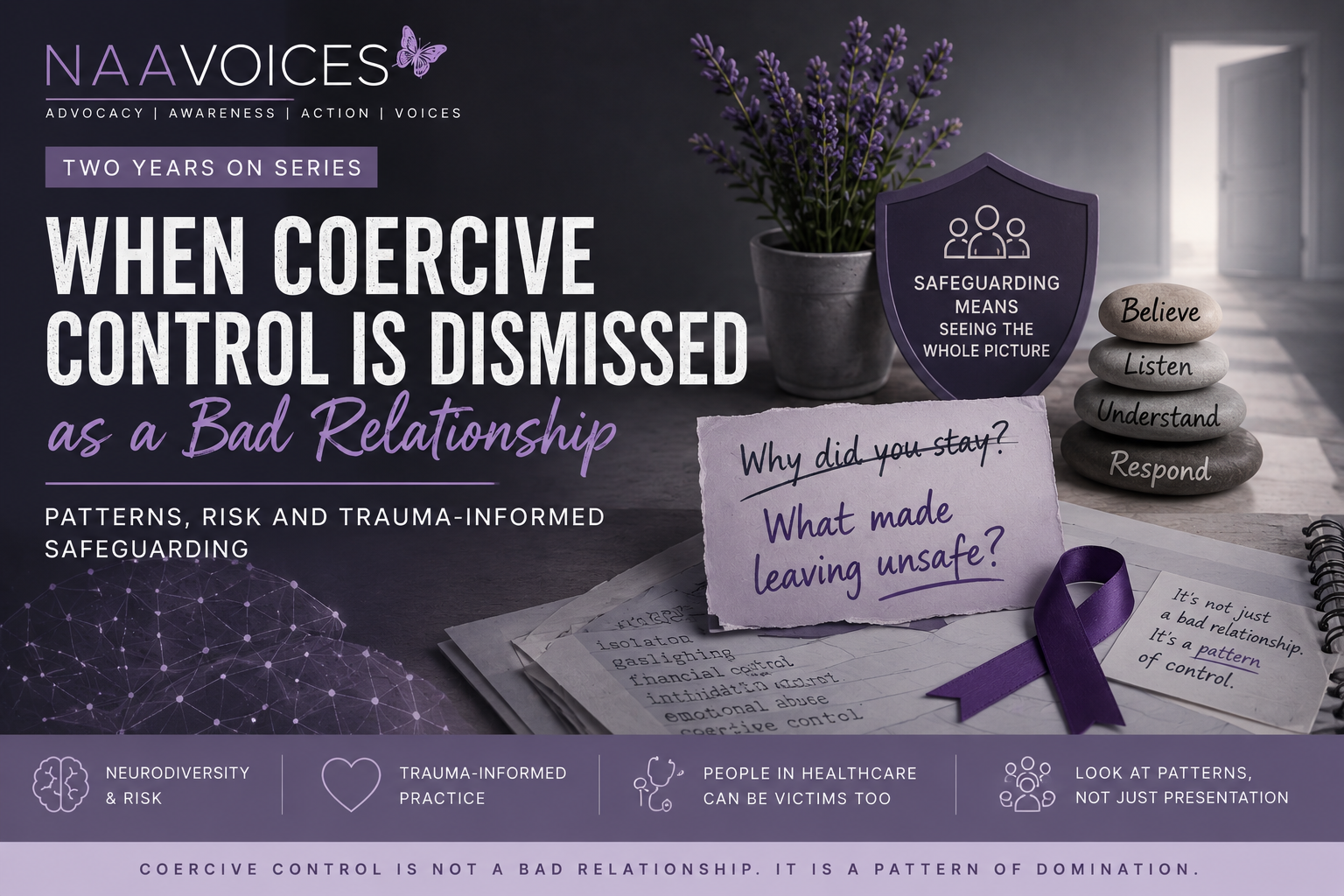
  • Coercive Control Dismissed as a Bad Relationship

    Coercive Control Dismissed as a Bad Relationship

    The Harm of Misunderstanding Risk, Trauma and Neurodivergence

    Originally written: 17 December 2024
    Transferred to NAAVoices as part of the Two Years On series

    This post was originally written on 17 December 2024, while I was still trying to understand why one sentence had caused such harm.

    On 21 December 2023, after disclosing years of abuse and safeguarding concerns, I was told by an experienced police officer:

    ā€œSome relationships are just bad, not all are abusive.ā€

    At the time, I knew that sentence was wrong. I knew it did not reflect what I had lived through. I knew it did not reflect what my children had lived through.

    What I understand more clearly now is why it stayed with me.

    It was not just an insensitive comment. It reflected a failure to recognise risk.

    When coercive control is reduced to ā€œrelationship conflictā€, professionals can miss the pattern. They can miss the imbalance of power. They can miss the fear. They can miss the children living inside that fear. They can miss the fact that a victim who looks articulate, organised, emotional, detached, overwhelmed or evidence-heavy may still be at serious risk.

    This post is being transferred onto NAAVoices using its original date because the chronology matters. These posts are part of a wider timeline showing how my understanding developed over time, particularly around trauma, neurodivergence, coercive control and institutional response.

    Some wording has been updated for clarity, safeguarding awareness, evidence and professional boundaries. The core reflection remains rooted in what I was trying to process at the time.

    This is part of my Two Years On series because the language used around abuse matters. Professional responses matter. When coercive control is dismissed, victims can be left carrying not only the abuse itself, but the consequences of not being believed.

    What I Understand Now

    Two years on, I understand more than I did then.

    I understand that coercive control is not just a set of incidents. It is a pattern of domination, restriction and psychological harm.

    I understand that neurodivergence can affect how abuse is experienced, explained and misread by professionals.

    I understand that trauma can make disclosure messy, fragmented, urgent, emotional or overly detailed, and none of that makes a victim unreliable.

    I understand that people working in healthcare can still be victims, even when they are trained to recognise risk in others.

    I understand that being capable does not mean being safe.

    And I understand that a professional misunderstanding coercive control can cause real harm, because their interpretation may influence what gets recorded, what gets investigated and what gets minimised.

    That is why I am writing this again with more context.

    Not to correct the original feeling.

    To explain it.

    A Note on Earlier Writing

    Some of my earlier writing about this period was shaped into a memoir, which I later unpublished.

    Not because the experiences were untrue, and not because the writing did not matter, but because it had been written while I was still in active trauma. Writing was survival then. It was where I put the things I could not safely say anywhere else.

    With time and distance, I can see that some of that writing deserves to be returned to carefully, from a place of greater stability, clarity and protection.

    The question at the centre of that writing was the same question so many survivors face:

    Why did I stay?

    Why I Stayed

    That question haunted me.

    Not because I did not know the answer, but because I had been taught by the abuse to blame myself before anyone else even had to.

    I thought I should have seen the signs.
    I thought I should have left sooner.
    I thought intelligence, motherhood, professional awareness and life experience should somehow have protected me from being controlled.

    They did not.

    Because coercive control does not rely on someone being weak.

    It relies on erosion.

    It works slowly. Through confusion, fear, threat, responsibility, shame, money, housing, children, hope and exhaustion. It narrows your world until your decisions are no longer made freely, but through constant risk assessment.

    Leaving is not one simple decision.

    It is often a calculation made under pressure.

    What will happen if I go?
    What will happen if I stay?
    What will happen to the children?
    Where will we live?
    Will anyone believe me?
    Will he get worse?
    Will I be blamed?
    Will the systems around us understand what has really happened?

    That is why ā€œWhy did you stay?ā€ is the wrong question.

    The better question is:

    What made leaving unsafe?

    Coercive Control Is Not a Bad Relationship

    The Domestic Abuse Act 2021 recognises that domestic abuse can include physical or sexual abuse, violent or threatening behaviour, controlling or coercive behaviour, economic abuse, and psychological or emotional abuse. That legal framework matters because abuse is not limited to physical violence. It can be a course of conduct. It can be a pattern. It can be the gradual removal of someone’s freedom, confidence and sense of reality. (Legislation.gov.uk)

    Coercive control is not simply arguing. It is not ordinary relationship breakdown. It is not two people failing to communicate.

    It is a pattern of domination.

    The Home Office statutory guidance explains that controlling or coercive behaviour can underpin economic, emotional, psychological, technology-facilitated abuse and threats, whether or not physical or sexual violence is also present. (GOV.UK)

    It can look like sarcasm that chips away at you.
    Dismissiveness that makes you doubt your own judgement.
    Character attacks that make you feel impossible to love.
    Accusations that keep you constantly defending yourself.
    Rules that are never called rules, but still control your life.
    Consequences that teach you it is easier to comply than resist.

    It is the slow loss of self-trust.

    You stop asking, ā€œIs this normal?ā€

    You start asking, ā€œHow do I stop this getting worse?ā€

    That is not a bad relationship.

    That is control.

    Gaslighting and the Loss of Reality

    Gaslighting is one of the most damaging tools of coercive control because it attacks your ability to trust your own reality.

    It can include blatant lies, told with complete confidence.

    It can include denial, even when you have proof.

    It can include someone using what matters most to you as ammunition: your children, your work, your identity, your reputation, your health, your past, your future.

    It can include small comments that wear you down over time.

    A joke that is not a joke.
    A criticism dressed as concern.
    A lie you are too tired to challenge.
    A compliment given just often enough to keep you confused.

    It can include projection, where they accuse you of the very behaviour they are displaying.

    It can include turning others against you, so you no longer know who is safe.

    It can include being called unstable, dramatic, bitter, difficult or irrational until you start wondering whether your distress is the problem, rather than a response to what is being done to you.

    Eventually, if it continues for long enough, you may stop asking, ā€œWhy are they doing this?ā€

    You start asking, ā€œWhat is wrong with me?ā€

    That is the harm.

    Neurodiversity, Masking and Being Misread

    This is something I understand more clearly now than I did when I first wrote this.

    My ADHD did not cause the abuse.

    Neurodivergence does not make anyone responsible for being harmed.

    The responsibility for abuse always sits with the person choosing to cause harm.

    But neurodivergence can affect how abuse is experienced, recognised, disclosed and interpreted by others.

    A 2023 systematic review and meta-analysis concluded:

    ā€œIndividuals with ADHD are at an increased risk of being involved in cases of violence, namely IPV and SV, either as victims or perpetrators.ā€ (PubMed)

    That sentence has to be handled carefully. It does not mean ADHD causes abuse. It does not mean neurodivergent people are responsible for being harmed. It does not mean ADHD makes someone unreliable.

    It means professionals need to understand risk, vulnerability and presentation with more care.

    For me, ADHD meant I searched for patterns. I tried to understand every contradiction. I over-explained because I needed things to make sense. I gathered evidence because I could see the gaps and inconsistencies. I masked because I was used to functioning, even when things were difficult.

    Those traits can be strengths.

    But in the context of coercive control, they can also be used against you.

    A neurodivergent victim may present with too much information, too much detail, too much emotion, too much urgency, or too much apparent competence. They may speak quickly, struggle to organise events chronologically, freeze, shut down, or appear detached.

    They may arrive with folders, timelines and evidence, not because they are obsessive or unreliable, but because they have already learned that if they do not create the record themselves, it may not exist.

    Risk is rarely about one factor in isolation. Neurodivergence, trauma, gender, parenting, financial dependence, professional identity and fear of not being believed can overlap in ways that make leaving and disclosing much harder.

    That should not be mistaken for instability.

    It should be understood as context.

    It may be trauma.
    It may be neurodivergence.
    It may be both.

    Either way, professionals need to look at the pattern, not just the presentation.

    What Research Tells Us About Risk

    Domestic abuse is common, but it is still often misunderstood.

    The ONS estimated that, in the year ending March 2025:

    ā€œ2.2 million females and 1.5 million males aged 16 years and over experienced domestic abuse in the last year.ā€ (Women’s Aid)

    The ONS also reported that, in the year ending March 2025:

    ā€œDomestic abuse related crimes represented 15.4% of all offences recorded by the police.ā€ (Office for National Statistics)

    Police-recorded data does not capture the full reality of domestic abuse. Many victims never report. Some report and are misunderstood. Some report and the quality of recording, investigation and safeguarding response becomes part of the harm.

    Risk is not always visible.

    A person may be working, parenting, studying and functioning while being controlled.

    A person may have no obvious injuries and still be in danger.

    A person may sound articulate and still be terrified.

    That is why professionals need to understand coercive control as a pattern of behaviour, not a collection of isolated incidents.

    People in Healthcare Can Still Be Victims

    There is another layer that matters.

    People working in healthcare can be very good at functioning while harmed.

    We know how to show up.
    We know how to care for others.
    We know how to compartmentalise.
    We know how to keep working under pressure.
    We know how to present as capable, even when life outside work is falling apart.

    That can make abuse harder for others to recognise.

    Not because the harm is less serious, but because the presentation does not match what people expect.

    Research has recognised that healthcare professionals’ own experiences of domestic violence and abuse are often overlooked, even though healthcare staff are expected to identify and respond to abuse in others. (PMC)

    A systematic review and meta-analysis found:

    ā€œHealthcare professionals experience domestic violence and abuse at similar or higher rates than the general population.ā€ (PMC)

    So yes, healthcare workers can identify abuse in others and still be experiencing it themselves.

    A nurse can safeguard others and still not be safeguarded herself.

    A clinician can understand trauma professionally and still be traumatised personally.

    A healthcare professional can look competent and still be living in fear.

    A parent can keep turning up and still be breaking inside.

    That is why assumptions are dangerous.

    Victims do not all look the same.
    They do not all sound the same.
    They do not all disclose in the same way.
    They do not all collapse in front of you.

    Some keep going until their body gives way.

    Why Professional Dismissal Causes Harm

    When a victim discloses abuse, the response matters.

    A professional does not need to understand every detail immediately, but they do need to understand risk, pattern and power.

    When coercive control is dismissed as a bad relationship, that is not neutral.

    It shifts the burden back onto the victim.

    It suggests their fear may be excessive.
    Their evidence may not be enough.
    Their reality may still be up for debate.

    For someone already conditioned to doubt themselves, that can be devastating.

    It can also strengthen the perpetrator’s position.

    Coercive control thrives when outsiders misunderstand it.

    It thrives when people look for isolated incidents instead of patterns.
    It thrives when emotional abuse is treated as conflict.
    It thrives when children’s experiences are minimised.
    It thrives when victims are expected to present in one acceptable way before they are believed.

    That is why professional understanding matters.

    It is not about taking sides.

    It is about safeguarding.

    What Professionals Need to Ask Instead

    If a disclosure does not sound neat, that does not mean it is not credible.

    If a victim brings too much evidence, that does not mean they are obsessive.

    If they speak quickly, jump between events, cry, freeze, shut down or appear detached, that does not mean they are unreliable.

    It may mean they are traumatised.

    It may mean they are neurodivergent.

    It may mean they have spent years trying to survive something that did not happen in a straight line.

    The aim is not to abandon professional curiosity.

    It is to use it properly.

    Professionals need to ask better questions.

    Not, ā€œWhy did you stay?ā€
    But, ā€œWhat made it unsafe to leave?ā€

    Not, ā€œWhy did you not report sooner?ā€
    But, ā€œWhat stopped you from feeling safe enough to tell someone?ā€

    Not, ā€œWhy are you only saying this now?ā€
    But, ā€œWhat has changed that means you can speak now?ā€

    Not, ā€œIs this just a relationship breakdown?ā€
    But, ā€œIs there a pattern of fear, control, intimidation, isolation or harm?ā€

    Not, ā€œWhy are you so emotional?ā€
    But, ā€œWhat has this person been carrying, and for how long?ā€

    That shift matters.

    Because the right question can open a door.

    The wrong one can close it completely.

    Awareness Is Safeguarding

    Understanding coercive control is not optional.

    It is the difference between seeing someone as difficult and recognising someone who has been systematically worn down.

    It is the difference between asking, ā€œWhy did you stay?ā€ and asking, ā€œWhat made leaving unsafe?ā€

    It is the difference between treating abuse as conflict and recognising it as control.

    Coercive control can happen to anyone.

    Intelligence does not prevent it.
    Professional knowledge does not prevent it.
    Neurodivergence does not cause it.
    Strength does not make someone immune to it.

    Abuse is always the responsibility of the person choosing to harm.

    Always.

    If This Feels Familiar

    You are not to blame for what someone else chose to do.

    You are not weak because you stayed.

    You are not foolish because you hoped things would change.

    You are not difficult because you need help.

    You are not unreliable because trauma changed how you explain things.

    You are not responsible for making abuse easier for other people to understand.

    If you recognise these patterns, please reach out to someone who understands domestic abuse and coercive control. Specialist support matters.

    If you are in immediate danger, call 999. In the UK, you can contact the National Domestic Abuse Helpline on 0808 2000 247, or seek specialist local domestic abuse support.

    You deserve safety, clarity and peace.

    Not blame.

    Not dismissal.

    Not another person telling you it was just a bad relationship.

    My Lived Experience: A Personal Journey Through Trauma and Recovery

    This reflection is shared as lived experience to support domestic abuse awareness, neurodiversity-informed safeguarding, trauma-informed practice and the normalisation of mental health support. It includes selected research to support public understanding, but is not clinical or legal advice. Names, dates or details may be retained where relevant to accountability, while unnecessary identifying information has been limited to protect privacy and maintain professional boundaries. The purpose is advocacy, reflection and reducing stigma around domestic abuse, coercive control, neurodivergence and help-seeking.

  • Police Victim Blaming in Domestic Abuse Cases: The Hidden Trauma No One Talks About

    Police Victim Blaming in Domestic Abuse Cases: The Hidden Trauma No One Talks About

    NAAVoices was not created from certainty, but from lived experience and professional insight. As I migrate earlier work from the original platform, this post has been reviewed and approved for transfer. It remains true to its original context, with only minor clarity edits where needed. Some moments do not require rewriting to remain honest.

    When Victims Are Blamed by the Systems Meant to Protect Them

    Victims of domestic abuse already carry enough.

    Fear. Shame. Confusion. Hypervigilance. The constant work of surviving someone else’s control while trying to make sense of what has happened to them.

    So when someone finally reaches out for help, the response matters.

    It can be the beginning of safety.

    Or it can become another wound.

    One of the most damaging responses a victim can receive is victim-blaming, especially from police. It does not always sound obvious. Sometimes it is subtle. Sometimes it comes dressed as professional questioning. Sometimes it appears in what is not recorded, what is minimised, or what is treated as less important than the perpetrator’s version of events.

    But the impact is real.

    And for victims of domestic abuse, it can be devastating.

    What Victim-Blaming Looks Like

    Victim-blaming happens when responsibility for abuse is shifted away from the person causing harm and placed, directly or indirectly, onto the person who has been harmed.

    In domestic abuse cases, this can sound like:

    Why did you stay?
    Why did you go back?
    Why did you not report it sooner?
    Why did you let the children see it?
    Are you sure it was that bad?
    Could this just be a relationship breakdown?
    Is this really about contact?

    These questions may be framed as fact-finding, but when asked without an understanding of coercive control, they can reinforce the exact messages the abuser has spent years embedding.

    That it was your fault.

    That you should have stopped it.

    That you are exaggerating.

    That you are the problem.

    For someone already conditioned by abuse, those messages do not land lightly.

    They go straight into the wound.

    Why It Causes So Much Harm

    Domestic abuse is rarely a single incident. It is often a pattern of control, fear, manipulation, degradation and psychological harm.

    By the time many victims speak to police, they may already be exhausted. They may doubt themselves. They may struggle to explain events in a neat, chronological order. They may appear calm when they are traumatised, or emotional when they are being honest.

    None of that means they are unreliable.

    It means they are human.

    When police respond with disbelief, minimisation or blame, the victim is forced to relive the abuse while also defending their right to be believed.

    That is retraumatisation.

    And it is not a minor side effect of poor communication.

    It can change the course of someone’s recovery.

    Retraumatisation Is Not Just Emotional

    People often talk about trauma as if it is only distress.

    It is not.

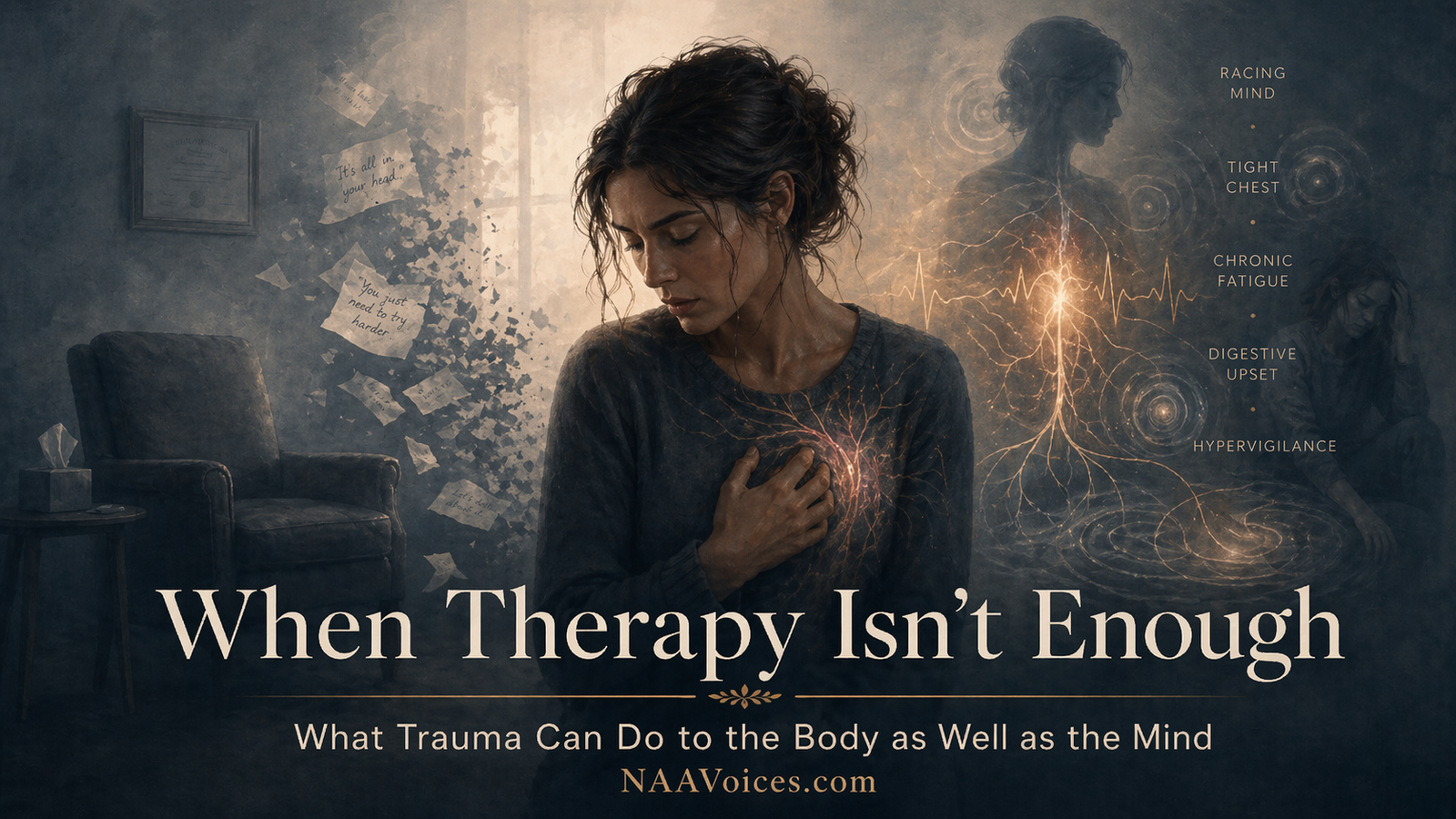
    Trauma lives in the body.

    It can look like panic, shaking, dizziness, nausea, chest pain, insomnia, flashbacks, dissociation, intrusive thoughts, memory fragmentation, emotional shutdown or complete collapse after appearing calm.

    A victim may sit through a police interview, answer questions, sign statements and look composed.

    Then fall apart afterwards.

    That does not mean they were fine.

    It means they were surviving the interaction.

    When police victim-blame, dismiss or mishandle disclosures, they can deepen that trauma. They can make the victim less likely to seek help again. They can also make the victim feel less safe than they did before they reported.

    That is institutional harm.

    The Link With PTSD

    Repeatedly having to disclose abuse, defend your credibility and correct inaccurate records can contribute to long-term psychological harm.

    For some victims, this becomes part of the trauma itself.

    PTSD can involve flashbacks, nightmares, hypervigilance, avoidance, intrusive thoughts, panic, emotional numbness and a constant sense of threat.

    For victims of domestic abuse, these symptoms can be intensified when the systems meant to protect them become another source of fear.

    It is not only what the perpetrator did.

    It is what happens afterwards.

    The disbelief.
    The poor recording.
    The minimisation.
    The handovers.
    The repeated retelling.
    The feeling that your own life is being interpreted by people who have not understood it.

    That is why police responses matter so much.

    What the Law and Guidance Already Recognise

    The Domestic Abuse Act 2021 gives a statutory definition of domestic abuse and recognises that abuse can include emotional, controlling, coercive and economic abuse.

    That matters because domestic abuse is not limited to physical violence.

    The NPCC and CPS Joint Justice Plan set out the need to improve the criminal justice response to domestic abuse, including better training, stronger accountability and improved support for victims.

    The Independent Office for Police Conduct has also issued guidance on ending victim-blaming, recognising that language, assumptions and professional attitudes can cause real harm.

    So the issue is not that nobody knows victim-blaming exists.

    The issue is whether those principles are being applied in practice.

    Because guidance means very little if victims are still leaving police interactions feeling blamed, disbelieved, unsafe or responsible for the abuse committed against them.

    What Needs to Change

    Police officers need proper trauma-informed training.

    Not tick-box training.

    Not a short online module that gets forgotten.

    Real training on coercive control, post-separation abuse, trauma responses, child safeguarding, perpetrator tactics and the harm caused by victim-blaming language.

    They need to understand that victims do not always present in the way people expect.

    Some cry.
    Some freeze.
    Some talk too much.
    Some cannot speak at all.
    Some sound detached.
    Some arrive with folders, timelines and evidence because they have already learned that if they do not create the record themselves, no one else will.

    None of those responses should be used against them.

    Police forces also need stronger accountability when officers fail to record crimes properly, minimise disclosures, or allow personal bias to influence safeguarding decisions.

    A victim should not have to become their own investigator just to prove they told the truth.

    Belief Is Not Bias

    Believing victims does not mean abandoning evidence.

    It does not mean ignoring due process.

    It means starting from a place of professional curiosity rather than suspicion.

    It means asking better questions.

    What has made it hard to leave?
    What control is still continuing?
    What are the children seeing, hearing or experiencing?
    What does the perpetrator gain from this version of events?
    What risks increase now the relationship has ended?
    What has already been disclosed, and has it been properly recorded?

    That is not bias.

    That is competent safeguarding.

    The Cost of Getting It Wrong

    When police blame victims, minimise abuse or fail to act, the harm does not end with that interaction.

    It follows the victim into family court.
    Into safeguarding meetings.
    Into mental health appointments.
    Into work.
    Into parenting.
    Into sleep.
    Into every attempt to rebuild a life.

    Poor police responses can strengthen the perpetrator’s position and weaken the victim’s credibility. They can leave children exposed to further harm. They can make the victim feel that telling the truth was not only pointless, but dangerous.

    That should concern everyone.

    Because domestic abuse victims do not need perfect systems.

    They need systems that do not make the abuse worse.

    A Survivor-Centred Response

    A survivor-centred response does not require grand gestures.

    It requires officers to listen properly.
    Record accurately.
    Avoid assumptions.
    Understand coercive control.
    Recognise trauma.
    Take children’s experiences seriously.
    Challenge perpetrator narratives.
    And remember that the person in front of them may have used every last bit of strength they had just to speak.

    Victim-blaming is not harmless.

    It is not just poor wording.

    It is not just a difficult conversation handled badly.

    It can retraumatise victims, damage mental health, obstruct justice and reinforce the control they were trying to escape.

    Victims of domestic abuse deserve to be met with dignity, belief and professional competence.

    Not blame.

    Not disbelief.

    Not another system they have to survive.

    Further Support

    If you are navigating police misconduct, victim-blaming, negligence or failures in duty of care, I have created a dedicated NAAVoices resource to help explain the process and your options:

    Police Misconduct Guide – NAAVoices.com

    You are not the problem for needing protection.

    You are not difficult for asking to be heard.

    And you are not responsible for the abuse someone else chose to inflict.

    Further Support

    For guidance on recognising and reporting police misconduct, refer to my dedicated resource. It covers topics such as victim-blaming, negligence, and breaches of duty of care. Police Misconduct Guide – NAAVoices.com

    My Lived Experience: A Personal Journey Through Trauma and Recovery
  • Returning to Work with PTSD: When a Place of Safety No Longer Feels Safe

    Returning to Work with PTSD: When a Place of Safety No Longer Feels Safe

    Reflection — Two Years On

    Original entry, 10 September 2024, written during active trauma

    The entry that follows was written during a period of active trauma, while the abuse and its consequences were still ongoing. At the time, I was attempting to survive, parent, work and make sense of events that kept unfolding. I did not yet have the neurological framework to fully understand what was happening to my mind and body.

    During that period, I was studying the neuroscience module of my postgraduate certificate. One lecture in particular focused on neuroplasticity and the neurological impact of trauma. Through neuroimaging and clinical evidence, it became clearer to me that PTSD is not a personal failure or a weakness of character. It is a trauma-related condition that can profoundly affect the nervous system, particularly when someone is repeatedly exposed to threat or forced to relive harm.

    That understanding mattered.

    For a long time, I carried responsibility that did not belong to me. I questioned my decisions, my resilience and my capacity to cope. I told myself I should have left sooner, should have handled things differently, should have been stronger.

    What the science helped me understand was that the injury did not arise from leaving too late. It came from the abuse itself, and from being repeatedly pulled back into it through systems that failed to protect us.

    I had left. I was no longer living with him.

    What followed was not something I chose, and it was not something my children deserved.

    The neurological changes I live with are the consequence of sustained harm and re-traumatisation. Those who caused that harm made choices. Systems and individuals who failed to intervene also made choices. The injury that resulted is not mine to own in terms of blame, even though I am the one who has had to live with its effects.

    This reflection is not a correction of the entry that follows.

    It is context.

    The original post remains close to how it was written. It reflects the reality of that moment, before I had the same insight and understanding I have now. It was written before science helped me make some sense of what had happened to me.

    Within the Two Years On series, entries are presented as they were lived, alongside the understanding that came later.

    The words that follow are not evidence of failure.

    They are evidence of injury.

    And of survival.

    Returning to Work with PTSD

    (Original entry — 10TH September 2024) (written during active trauma)

    PTSD is often described as a mental health condition. Living with it, however, has felt more like a traumatic injury to my nervous system than an illness I simply developed.

    I learned about this recently, and it left me with questions I cannot easily answer.

    Does this mean I have to endure it forever?

    Will it worsen if the abuse and re-traumatisation continue?

    Research increasingly shows that PTSD and traumatic brain injury can share overlapping neurological consequences following trauma. Global estimates suggest that around 1.1% of the population experiences PTSD within a 12-month period. Approximately 69 million people worldwide sustain a traumatic brain injury each year.

    The neuroimaging below illustrates how PTSD and TBI can differ and overlap in brain perfusion patterns.

    Trauma alters neural pathways involved in threat detection, memory and emotional regulation. These changes are adaptive during danger. However, they can become destabilising when safety is delayed or denied.

    Figure 3. Brain SPECT Images of Healthy, PTSD, TBI and PTSD co-morbid with TBI perfusion patterns.
    Source: Amen et al. (2015). Functional neuroimaging distinguishes posttraumatic stress disorder from traumatic brain injury in focused and large community datasets. PLOS ONE, 10(7), e0129659.


    Top row: surface scans with threshold set at 55%, showing the top 45% of brain perfusion.
    Bottom row: active scans where blue = 55%, red = 85%, and white = 93%.

    • Healthy brain: Full, even, symmetrical perfusion with the most active area in the cerebellum.
    • Classic PTSD: Increased perfusion in the anterior cingulate, basal ganglia, and thalamus.
    • Classic TBI: Multiple areas of low perfusion visible on surface scans.
    • PTSD + TBI: Displays both increased perfusion patterns associated with PTSD and low‑perfusion areas associated with TBI.

    I struggled to wear my uniform

    I Struggled to Wear My Uniform

    With the children back in school and my return to work approaching, I thought it would be sensible to spend some time reacclimatising.

    To get used to the environment again.

    To be around people.

    I struggled to wear my uniform.

    I felt disconnected from the proud, compassionate nurse I once was.

    The ongoing attacks on my character through the court process had deeply shaken my sense of self. It became difficult to protect my identity and continue fighting when so much of who I was felt under question.

    I questioned my strength.

    I questioned who I was.

    I arrived early, completed the routine checks and went straight to my room.

    The grip PTSD can have on the mind is profound. I expected relief when returning to a place that had felt safe for so long. Instead, it felt foreign.

    The warmth had gone.

    There were memories, but not the ones I had expected.

    The comforting memories were gone.

    There had been days when I went home thinking about patients. I would check in because I knew people had a lot to manage. There were times I knew I had made a difference. Work had been the place where I could be myself, where I felt free, and where I found respite from the hell I was living at home.

    Instead, the photograph a colleague had encouraged me to keep was still on my shelf. We had covered part of it with another image so that only my child and I remained.

    I could not even look at it.

    When I tried to pick it up, my hands shook so badly that I dropped it. It smashed across my desk.

    The room was full of memories.

    Trauma does not stop at the outside world. It invades even the spaces that once felt safe.

    Haunted by My Sanctuary

    I avoided reception.

    Everyone had been kind, but I was petrified of being asked how I was. I could not keep the emotion away, and crying in a shared workspace was not something I could cope with.

    My nursing team had already been supportive through a difficult period. I did not want to cause more worry.

    It was nearing a year since I left him, and the impact of what we had lived through had touched every aspect of our lives.

    The continuation of it made me feel worse than I did when I left. I had believed leaving would end his control. Now I knew how far he would go, and I could not see an end in sight.

    My colleagues came in individually to catch up, give me a hug and see how I was.

    I wish there had been a cure.

    A way to wave a wand and make it all stop.

    A way to be me again.

    We all have ā€œourā€ rooms, even if we are not meant to call them that. I had decorated my noticeboard after twelve months because I was certain this was the right place for me.

    I could not stop thinking about how to change the room.

    I kept staring at the same wall. The same view. The same space connected to days when my private life was unstable and I was still trying to work, think and function.

    The chest pain.

    The stress.

    The fear.

    Unless you have lived through something like this, it is difficult to understand the depth of damage it causes.

    One thing I do know is that people in healthcare care.

    Even when they do not fully understand, they care.

    That compassion had not been reflected by many other agencies involved.

    Flashbacks and Intrusive Thoughts

    Flashbacks and intrusive thoughts are particularly prominent in complex PTSD. I hope I reach a point where these experiences ease, where I can close my eyes without fearing what I might see.

    I spoke to my manager about moving my desk.

    A different view might help. However, it was not practical. It would affect the layout of the room and how safely I could work within it.

    He was thoughtful and busy, but he still tried to think of ways we might change the space.

    I suspect he could hear the struggle in my voice and knew I would not say exactly why.

    Normally, I would share anything new with the team. That day, despite knowing I needed a drink, I could not even face going out to get one.

    My work mum asked if I wanted a cup of tea, and I went with her.

    I knew I had to find the strength to return, but where that strength would come from was beyond me.

    Constraints Beyond Choice

    He continued to control the mortgage and still had not signed the deed. I was paying over £600 more each month, and it could take weeks to resolve.

    Going to half-pay was not an option when I needed to provide for the children.

    I completed my flu vaccination training and deliberately avoided anything connected to the police or court. I was trying to find a connection beyond the constant protection of the children, but it felt almost impossible.

    Even reviewing evidence to safeguard them brought further trauma.

    Everything felt overwhelming. Silent and deafening at the same time.

    I think those who live with PTSD will recognise that contradiction.

    My manager found it amusing that I needed to update my safeguarding training. He knew I could probably recite Working Together to Safeguard Children by heart.

    The sole focus of the previous ten months had been safeguarding my own children, yet no one had afforded them the same level of protection.

    I had a few wobbles.

    A few cries.

    I hoped to manage six hours, but I could not.

    At lunch, I felt jumpy. Although I knew I was safe in theory, my body did not believe it.

    It is surreal to feel empty and hypervigilant at the same time.

    Small talk felt pointless, but I still cared deeply about my colleagues. Normally, I would be full of ideas and support.

    I did not want them to know how far away I felt inside.

    I am beginning to realise it is not my team who are the odd ones.

    It is the wider world.

    When empathy and compassion feel rare, those who still carry them matter.

    The Blog as a Safe Space

    I contacted CMHT and called my GP.

    I was not on regular medication, only medication for acute trauma responses, but I had run out and was worried about how I would manage the following day.

    One colleague had become a close friend. She and my work mum provided character references for court. I could not read them at the time.

    It was clear that I had changed, despite my attempts to fight through.

    I hated being seen differently, yet part of me was relieved they could not see inside my head.

    This blog became my safest space. The only place I could be honest without causing worry to those I care about.

    The next day, I had to meet CAFCASS.

    I was terrified they would see only the broken version of me, not the person I was before the abuse became too much.

    I did not want to be broken.

    I knew I could not live freely while he continued to exert control, and I feared what he would do next.

    I had not been able to process what I had lived through because it had not stopped.

    I knew there was still part of me inside.

    I did not know whether I would ever fully come back.

    The Real Hug

    That evening, my youngest asked their middle brother for a ā€œreal hug.ā€

    Watching them climb out of bed to embrace stirred something in me.

    These moments, small and fleeting, are what I cling to.

    They remind me of what things once felt like.

    They remind me of what is still worth holding on to.

    This reflection is shared as lived experience to support domestic abuse awareness, trauma-informed understanding and the normalisation of mental health support. It is not intended as clinical advice or a comment on any individual patient, colleague or workplace. Identifying details have been limited where appropriate to protect privacy and maintain professional boundaries. The purpose of sharing this is advocacy, reflection and reducing stigma around trauma, domestic abuse and seeking help.

    My Lived Experience: A Personal Journey Through Trauma and Recovery
  • šŸ•Æļø When Night Falls: Flashbacks, Flash-Forwards, and the Weight of PTSD

    šŸ•Æļø When Night Falls: Flashbacks, Flash-Forwards, and the Weight of PTSD

    (6 September 2024)

    NAAVoices was not created from certainty, but from lived experience and professional insight. As I migrate earlier work from the original platform, this post has been reviewed and approved for transfer. It remains true to its original context, with only minor clarity edits where needed. Some moments do not require rewriting to remain honest.

    When Night Falls

    Since the end of August, the PTSD has not eased.

    It has intensified.

    Journaling has become difficult. Evenings are the worst. Closing my eyes now feels unsafe, not only because of the flashbacks, but because of something I do not fully understand.

    The only way I can describe it is flash-forwards.

    I see his face clearly. Not just his face, but a specific look. The one he used to give me, often when he was drunk or had taken drugs. It arrives without warning, usually when everything is quiet and I am trying to sleep.

    I have tried to bury it.

    I have tried to push it away.

    But it is becoming unbearable.

    I do not want to burden friends or family. I do not want to frighten anyone. But I need to get it out somewhere, even if all I can do tonight is write it down.

    Content warning: PTSD, flashbacks, trauma response, family court, safeguarding concerns and distress.

    Facing the System Again

    In a matter of days, I have to attend a meeting to discuss safeguarding concerns around contact.

    Six months ago, I could have prepared. I could have pulled the documents together, organised the evidence and forced myself through it.

    I was functioning differently then.

    Now, I am starting to understand the delayed impact of PTSD. I knew Complex PTSD could be devastating for patients. I understood that professionally. But I did not understand how cruel it is to live inside it until now.

    This evening, I tried to review a statement that had previously been provided to the court for the non-molestation hearing in January.

    I read one paragraph.

    One.

    And I ended up on my hands and knees, trying not to faint.

    That is what frightens me most. Not just the fear itself, but what the fear is now preventing me from doing. I need to prepare. I need to protect my child. I need to access the evidence.

    But my body is reacting before I can even begin.

    I left that man to protect all three of my children. What followed was not freedom. It was another version of control, carried through court, paperwork, contact discussions and the systems that should have helped us.

    And now I am terrified that the trauma is affecting my ability to keep protecting them.

    Becoming the Patient

    I am lying in bed trying to use every grounding technique I have been given.

    I do not want to call a support line. I feel guilty when I do. I also do not want to say anything that makes anyone worry about me.

    On Wednesday, I attended my second CMHT appointment. The second mental health appointment of my entire life. I was told I will be allocated a caseworker, possibly a psychiatrist, practitioner or another professional.

    I understand mental health.

    I have never judged anyone for needing support. I would never see another person as weak for needing help.

    And yet I feel shame.

    How has this happened?

    How have I reached my mid-thirties and suddenly become someone who needs mental health support just to survive the fallout of another person’s harm?

    I keep asking myself questions I would never ask anyone else.

    Why can’t I get over it?
    Why can’t I move on?
    Why am I living with this much panic?
    Why do I fear closing my eyes?
    Why does facing court feel like a date my whole body is counting down to?

    I do not want to be this person.

    I want the old version of me back. The one who carried everything, supported everyone, stood tall and somehow kept going, even while going home to chaos.

    Now I am out of that house.

    And somehow, in some ways, it feels worse.

    Being Seen

    At Wednesday’s appointment, I saw the same professional I met at my first CMHT appointment.

    She is empathetic, but rational. Kind, but clear. She listens in a way that makes me feel understood without feeling handled.

    I spoke to her about the flash-forwards, if that is even what they are called.

    I think I spoke about them too matter-of-factly. Almost like I was discussing something with a colleague in a staff room, rather than admitting how frightened I am.

    Maybe that was my way of minimising it.

    Maybe it was easier to make it sound clinical than to say how terrifying it feels when my mind keeps showing me the same images over and over again.

    But she seemed to understand the seriousness of it.

    She recognised the risk, not just from what has already happened, but from what is still being asked of me. Facing him. Preparing evidence. Going through family court. Trying to protect my children while traumatised by the very person I am being expected to face.

    She saw the mask.

    That is what broke me afterwards.

    Not weakness.

    Recognition.

    Someone saw what I have carried, and seemed to understand how much more I am being expected to endure.

    The Children

    Every day, I see changes in my children.

    The laughter coming back. The connection between us. The compassion. The love. The moments that remind me why I left, and why I keep going.

    My youngest continues to amaze me. Their memory is extraordinary. This week alone, they directed me to a nursery they left at two. Four miles out of town. Nowhere near where we live now. They remembered being pushed there in a blue pushchair as a baby.

    They remember more than people realise.

    For months, I have tried gently to help them understand that people cry for lots of reasons, not only because ā€œdaddy shouted at you.ā€

    Now they tell me people cry because they are happy, sad, because of music, because of ā€œdrops of heavenā€, because they stub their toe, because there is water in their eyes in the hot tub.

    And yes, still, because of daddy shouting.

    That hurts.

    But it also shows me something important.

    They are processing.

    They are learning new meanings.

    They are not trapped in only one version of what emotion means.

    No child is perfect. No family is perfect. But on the mornings after nights where I have barely slept, where his face has haunted me, where I have woken frightened or crying, one of the children will say something gentle.

    Something beautiful.

    Something that pulls me back into the room.

    They seem to know when I need reminding why I am still here.

    Facing What Comes Next

    Next month, I have to face him in family court.

    At this rate, I fear I may be facing that largely alone.

    The flashbacks and flash-forwards have been happening for weeks now. The same images. The same sequence. The same details.

    The stairs.
    The road.
    The building.
    The aftermath.

    It plays in my head with disturbing precision, like Groundhog Day every time I try to close my eyes.

    I need to be very clear.

    I have no intention of harming myself.

    But I am frightened by how vividly my mind keeps rehearsing danger. I am frightened by what prolonged exposure to this level of stress is doing to me. I am frightened for my children, and I am frightened of what it means to keep being pushed back into contact with the source of the trauma.

    I think she saw that too.

    She saw what I can take.

    She saw what I have already taken.

    And I think she also saw that there is a limit to how much more any person can endure before they break.

    That is why I cried for hours on Wednesday night.

    Because someone saw through the mask.

    Not the polished version.
    Not the capable version.
    Not the professional version.
    Not the mother who somehow keeps going.

    The real one.

    The exhausted one.

    The frightened one.

    The one still trying to protect her children with whatever strength is left.

    Why I Am Writing This

    I am sharing this because isolation makes trauma worse.

    Because systems can re-traumatise people while still calling it process.

    Because there is a cost to repeatedly asking victims to relive, evidence, explain and defend the harm done to them.

    And because someone reading this may recognise themselves in it.

    If that is you, your story matters.

    You matter.

    If you are wearing the mask because it is the only thing holding you together, I see you.

  • 🧠 When Therapy Isn’t Enough: A Reflective Journey into Psychosomatics

    🧠 When Therapy Isn’t Enough: A Reflective Journey into Psychosomatics

    NAAVoices was not created from certainty, but from lived experience and professional insight. As I migrate earlier work from the original platform, this post has been reviewed and approved for transfer. It remains true to its original context, with only minor clarity edits where needed. Some moments do not require rewriting to remain honest.

    Earlier this year, I was told I did not meet the threshold for further trauma support.

    That sentence stayed with me.

    Not because I expected miracles. Not because I believed therapy would undo what had happened. But because when you are already doing everything you can to hold yourself together, being told you do not qualify for more help lands heavily. It can feel less like a clinical decision and more like being quietly told to carry on alone.

    I had completed ten weeks of what was meant to be CBT, but it did not help in the way I needed at that time. Looking back, that makes sense. It is hard to process trauma while still living inside the aftermath of it. It is hard to ā€œwork onā€ what happened when your body still feels on alert, your life still feels unstable, and your mind is still trying to survive.

    When that support ended, there was no real next step. No clear path. No space to properly make sense of what trauma had done to me, not only emotionally, but physically too.

    That experience became a turning point.

    I started studying psychology and neurodiversity in mental health because I needed more than short-term coping strategies. I needed understanding. I needed to know why trauma was not just living in my thoughts, but in my body. I needed language for the exhaustion, the fear, the racing heart, the overwhelm, and the strange way the body can keep sounding the alarm long after other people think the danger has passed.

    For me, understanding matters. I need to know the why, not just the what. Without that, symptoms can feel frightening and shapeless. I was not looking for an academic answer for the sake of it. I was trying to understand survival.

    This is what keeps coming back to me: sometimes therapy is not enough on its own. Sometimes the problem is not that someone is unwilling to heal. It is that their body has been carrying too much, for too long, with too little understanding around it.

    When the Body Starts Speaking

    Psychosomatics is one of those words that can immediately put people on edge.

    Too often, it gets mistaken for ā€œit’s all in your head.ā€ For many people, that sounds dismissive, belittling, or dangerously close to not being believed.

    But that is not what it means.

    It means the body and mind are deeply connected. It means long-term stress, fear, trauma, grief, and emotional overload can affect the body in real and powerful ways. It means what happens to us emotionally does not stay neatly contained. It can show up through chest pain, dizziness, palpitations, poor sleep, exhaustion, stomach problems, muscle tension, headaches, pain, and countless other symptoms.

    The body does not forget simply because a person is trying to cope.

    And the body does not separate trauma into tidy boxes just because healthcare systems often do.

    The Gap Between Mental Health and Physical Health

    One of the things I have seen most clearly, both personally and professionally, is how often physical health and mental health are still treated as though they belong in separate conversations.

    On paper, we speak about holistic care, person-centred practice, and joined-up working. In reality, services are stretched, time is limited, and thresholds are high. That means the wider picture is not always explored, even when it should be.

    But people do not fall apart in separate categories.

    Stress at home affects the body. Fear affects the body. Caring responsibilities affect the body. Trauma affects the body. Living on edge for too long affects the body. So do exhaustion, grief, financial strain, coercion, and emotional isolation.

    When those realities are missed, the person behind the symptoms can be missed too.

    And that is where harm can quietly deepen.

    What Was Missed in My Own Experience

    For a long time, I sought help for symptoms including tachycardia, palpitations, dizziness, chest pain, low blood pressure, and ECG changes. I remain grateful that these symptoms were taken seriously and investigated thoroughly. They should have been.

    But what was less explored was the context around them.

    At the time, no meaningful link was made between what my body was doing and the prolonged stress and trauma I was living through. With hindsight, greater knowledge, and distance from that environment, I can now see that chronic trauma and ongoing stress were likely significant factors in how those symptoms appeared and persisted.

    Many improved once I was no longer living in the same circumstances. Some still return when stress becomes intense. That does not mean the symptoms were ever unreal. It means the body had been responding to more than one kind of threat.

    That is the part I wish more people understood.

    A nervous system under prolonged strain does not simply switch off because someone is trying their best. Survival leaves traces. Sometimes those traces are emotional. Sometimes they are physical. Often they are both.

    This is not about blaming individual clinicians. It is about recognising how powerful one question can be:

    What else is happening in this person’s life?

    Sometimes that question opens a door that blood tests and scans alone cannot reach.

    Why Being Believed Matters

    One of the hardest parts of trauma is not only what happened. It is what happens afterwards when your reality is minimised, misunderstood, or only partly seen.

    That is why language matters so much.

    When someone is told ā€œit’s probably stressā€ without explanation, it can feel like dismissal. But when someone explains that prolonged stress and trauma can affect the nervous system, sleep, pain, digestion, concentration, blood sugar, heart rate, and overall health, that feels different. That feels grounding. That gives shape to what otherwise feels frightening and invisible.

    People often need words not because they want a label for the sake of it, but because language can reduce shame. It can replace self-doubt with understanding. It can help someone realise they are not weak, dramatic, or failing. They are responding to what they have lived through.

    Validation is not indulgence. It is part of safe, humane care.

    What Clinical Practice Keeps Showing Me

    Working in healthcare has only deepened this belief.

    It is easy, especially under pressure, to focus on the numbers. Blood pressure. Blood sugar. ECG findings. Medication changes. Risk markers. Those things matter. Of course they do.

    But people’s lives matter too.

    I have seen how quickly physical health can worsen when someone is carrying unseen emotional strain, trauma, caring burdens, or simple relentless exhaustion. Sometimes what looks like poor control or non-engagement is actually overload. Sometimes what looks like someone ā€œnot coping wellā€ is the entirely understandable impact of carrying too much with too little support.

    Being listened to properly does not solve everything. But it does something important. It reduces shame. It builds trust. It reminds someone they are more than a set of symptoms to be managed.

    That should never be underestimated.

    The Point I Keep Coming Back To

    Psychosomatic understanding should never be used to minimise physical symptoms. It should be used to widen the lens.

    The mind and body are not rivals. They are not separate stories. They are part of the same human experience.

    Trauma does not only affect thoughts. It affects sleep, energy, heart rate, pain, concentration, appetite, blood sugar, resilience, and recovery. Chronic stress does not just sit quietly in the background. It changes the way a person lives in their body.

    That is why this matters.

    Take the symptoms seriously.
    Take the context seriously.
    Take the person seriously.

    Because sometimes the most important part of care is not only identifying what is wrong. It is understanding what has happened, what is being carried, and what has been missed.

    And sometimes, being truly heard is the first moment healing feels remotely possible.

    Let’s Talk

    Have your physical symptoms ever been affected by stress, trauma, or overwhelm?

    Have you ever felt that part of your story was missed when help was being offered?

    What helps people feel believed, understood, and supported?

    What would you change about the way healthcare approaches the connection between mind and body?

    My Lived Experience: A Personal Journey Through Trauma and Recovery
  • Avoidance and Invalidation — The Twin Costs of Not Being Allowed to Feel

    Avoidance and Invalidation — The Twin Costs of Not Being Allowed to Feel

    NAAVoices was not created from certainty, but from lived experience and professional insight. As I migrate earlier work from the original platform, this post has been reviewed and approved for transfer. It remains true to its original context, with only minor clarity edits where needed. Some moments do not require rewriting to remain honest.

    Avoidance, Honestly Defined

    Avoidance is easy to judge when you are looking at it from the outside.

    People call it denial. Running away. Burying your head in the sand. Refusing to deal with things.

    But that is not what it feels like when you are the one living it.

    Avoidance is not always weakness. It is not laziness. It is not a character flaw. Sometimes it is what happens when your mind and body learn, over time, that feeling too much is dangerous. That speaking is dangerous. That reacting honestly is dangerous. So instead, you push things down. You stay busy. You distract yourself. You numb out. You tell yourself you will deal with it later, when things are calmer, when you are stronger, when life gives you room to breathe.

    The problem is, later does not always come.

    What protects you in the moment can quietly trap you over time. Avoidance can get you through the day. It can help you function when the truth feels too heavy to carry. But it does not make the pain disappear. It just asks your body to hold it for longer.

    And the body does hold it.

    I know that now in a way I wish I did not.

    I live with the cost of it every day. Years of swallowed emotion. Years of pretending I was coping better than I was. Years of trying to stay composed, stay useful, stay needed, stay upright, while so much inside me was never given space to land. Four years of pain that never really had anywhere safe to go. Four years of being hurt, dismissed, frightened, invalidated, and still having to carry on.

    Those feelings do not just vanish because no one makes room for them. They settle somewhere. In your chest. In your stomach. In your sleep. In the constant tension in your body. In the exhaustion that never quite lifts. In the way your nervous system starts reacting before your mind has even caught up.

    That is the part people do not always see.

    Avoidance is not the absence of feeling. It is often the result of feeling too much, for too long, with nowhere safe to put it.

    And insight does not magically fix that. Understanding yourself does not suddenly make it easy to face the things you have spent years surviving. Sometimes it just means you can finally see the damage more clearly.

    Facing things is still hard. It is still painful. It is still exhausting.

    But eventually it stops being optional.

    Eventually, you realise the things you are trying not to feel are shaping your life anyway.

    Invalidation, Quietly Defined

    Invalidation can be hard to explain because it does not always look cruel from the outside.

    Sometimes it is obvious. Sometimes it is being told you are overreacting, being too sensitive, making a fuss, taking things the wrong way. Sometimes it is someone directly dismissing what you feel as though it does not matter.

    But often it is much quieter than that.

    It is the tone that tells you your feelings are inconvenient.
    It is the quick change of subject when you finally say something real.
    It is being ā€œreassuredā€ in a way that leaves no room for your actual experience.
    It is someone explaining your own pain back to you in a way that makes it smaller, neater, easier for them to sit with.
    It is being encouraged to move on before you have even been allowed to feel what happened.

    That is what makes invalidation so damaging. It does not always sound harsh. Sometimes it sounds reasonable. Calm. Practical. Well-meaning, even.

    But the impact is the same.

    You are left questioning yourself. Wondering whether you are too much. Whether your feelings are too big. Whether your reactions are wrong. Whether you are somehow the problem for being hurt by what hurt you.

    That kind of damage settles deeply, especially when it happens over and over again.

    Because after a while, you stop needing other people to dismiss your feelings. You start doing it for them. You get there first. You shrink your own experience before anyone else has the chance. You explain it away. Minimise it. Silence it. You become fluent in making your pain more acceptable to other people.

    And that is a heartbreaking way to live.

    Not all invalidation is deliberate. I know that.

    Some people genuinely do not know how to sit with another person’s emotions. Some were never taught that validating someone is not the same as agreeing with everything they say. Some people panic in the face of pain and rush to fix, soften, tidy, or redirect because they cannot tolerate the discomfort of simply witnessing it. Some people are so exhausted themselves that they have nothing left to offer.

    That may explain it.

    But it does not undo the harm.

    Intent matters, yes. But impact matters too. And being repeatedly left feeling unseen, doubted, or emotionally unsafe changes you, whether or not the other person meant it to.

    Holding the Line

    What I have learned, slowly and painfully, is that my feelings are not the problem.

    They are not an inconvenience. They are not a nuisance to be managed. They are not proof that I am weak, difficult, dramatic, or broken.

    They are information.

    They are my body and mind telling the truth about what I have lived through.

    They are the evidence of what something cost me.

    And other people’s discomfort with my feelings does not make those feelings less real. It does not make them less valid. It does not make me wrong for having them.

    I think when you have lived for years in environments where your feelings were dismissed, minimised, twisted, or ignored, you can start to lose touch with that. You start to believe that keeping the peace matters more than being honest. That staying quiet is safer than being real. That being easy to deal with is the same as being okay.

    It isn’t.

    There is a difference between surviving by shutting things down and actually healing. A huge difference.

    And I am no longer willing to keep abandoning myself just because other people find emotion uncomfortable.

    I refuse to keep treating my pain like an inconvenience.
    I refuse to keep apologising for having real human reactions to real human harm.
    I refuse to let years of being made to feel invisible convince me that I am still invisible now.

    The echo of those four years is still there. I feel that. Some days more than others.

    But I am learning, slowly, that not being allowed to feel is its own kind of damage.

    And I am done helping it silence me.