My teenager came home with a couple of his older friends and, somehow, I was the excited one.
“Can I go on my bike?”
Just for an hour.
There was something slightly ridiculous about the role reversal. When I say teenagers, we’re talking nearly 18. These are lads we’ve known for years, who my six-year-old absolutely worships and who have babysat her before.
So there I was, apparently the child of the household, while my teenager grabbed my earphones for me and I hurried into my bike jeans and threw on my leather jacket.
One of the lads had brought his girlfriend with him.
“I love your jacket,” she said. “It’s like a biker jacket.”
I laughed.
Hmm.
Yes.
Shock horror.
It is, in fact, a biker jacket.
And then I was gone.
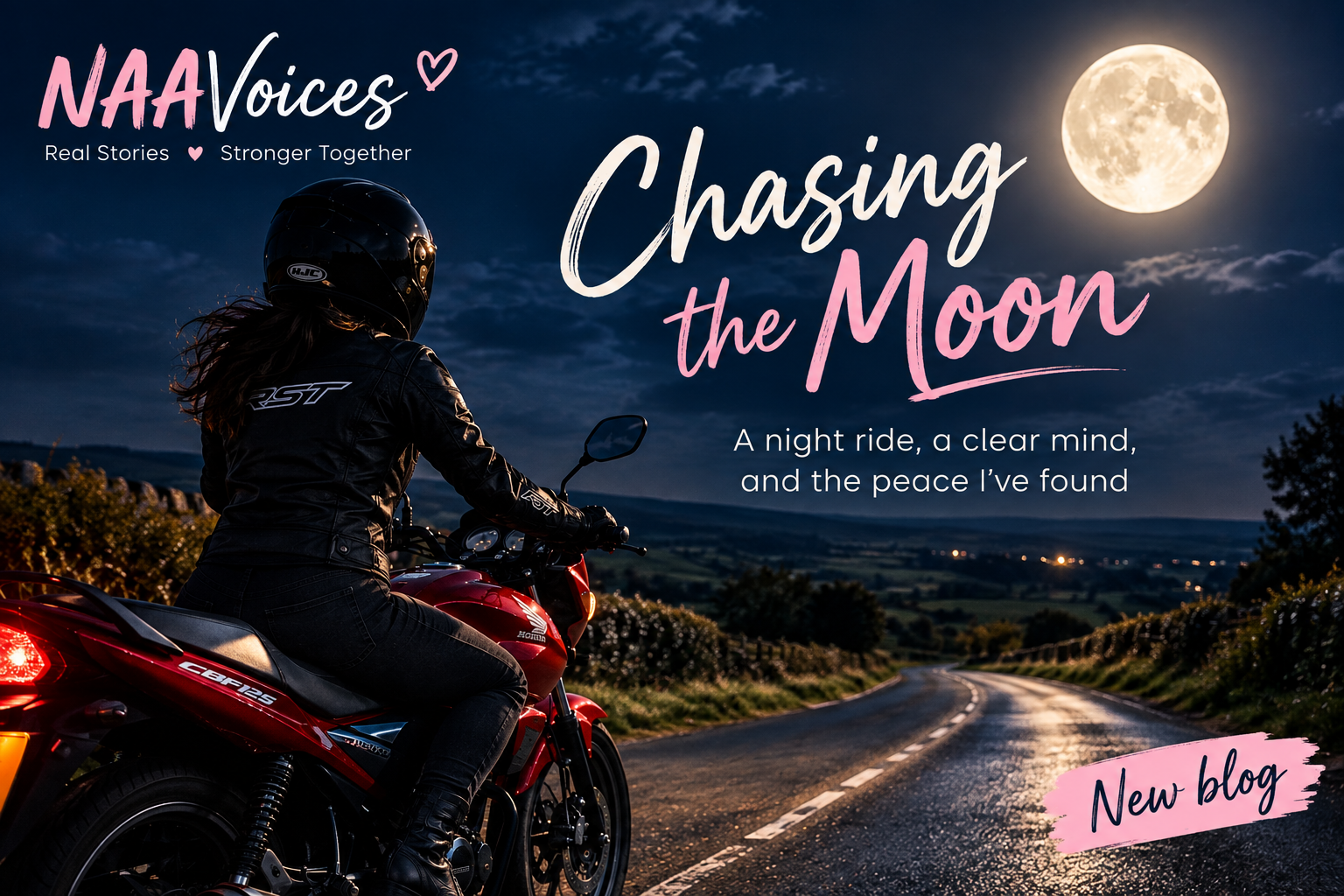
Out of the house. Helmet on. Engine running. Into the dark.
We live rurally, so once you get away from the houses, darkness really is darkness. The roads disappear ahead of you except for the stretch illuminated by the bike.
But tonight there was the moon.
It was enormous.
Bright enough that I kept catching sight of it as the road twisted and opened up again, and for an hour it genuinely felt as though I was chasing it.
And my God, it was beautiful.
There is something about riding that clears my head in a way very little else can.
You can’t carry everything with you on a motorbike.
Your brain has to be where your body is.
The road.
The bend.
The gears.
The sound of the engine.
The cold air finding the tiny gaps in your clothes.
For once, there isn’t room for tomorrow, yesterday, paperwork, arguments, money, people, responsibilities or the thousand things constantly competing for space in my head.
There is just now.
For an hour, I chased the moon.
Then I came home.
My daughter had spent the evening with people she adores, making bracelets and generally having the time of her life.
Later, I watched a film with my 14-year-old.
Eventually everyone went to bed.
And now I’m sitting here with the moonlight coming through the window, thinking about how different life feels sometimes.
Not necessarily easier.
But different.
There are moments when I can actually see how far we’ve all come.
For a long time, home wasn’t synonymous with peace. Safety wasn’t something I could simply assume. My nervous system didn’t understand the concept of switching off because there was always something else to anticipate, manage or survive.
Now, increasingly, there are ordinary evenings.
Teenagers turning up.
A six-year-old making bracelets.
A film on the sofa.
Children sleeping safely upstairs.
And me disappearing for an hour because I fancied riding my motorbike under a ridiculously bright moon.
Ordinary things.
But after you’ve lived without peace, ordinary can feel extraordinary.
I’ve also learned something else.
People will come and go.
I don’t have the energy anymore for people who only appear when they want something from me, or relationships where I am valued primarily for what I can give, fix, carry or provide.
Peace changes your tolerance for that.
Once you’ve fought this hard to build a safe life, you become much more careful about who gets access to it.
And perhaps that is part of healing too.
Not becoming harder.
Just becoming more protective of the peace you’ve worked so hard to create.
Every time I get on that bike, I feel a little bit of it.
A sanctuary I haven’t felt in a very long time.
I’m not running away.
I’m not trying to disappear.
Sometimes I only get an hour. Sometimes it’s a short ride between everything else life demands of me.
But for those few miles, there is nothing to solve.
Just me.
Two wheels.
An open road.
And tonight, a moon so bright I couldn’t resist chasing it.
Then I get to turn around and ride home.
And perhaps that’s the biggest difference of all.
These days, I have somewhere safe to come back to.
I have thought about this question deeply, and my answer is actually quite simple.
I kept going.
When the curtains were closed. When the doors were locked. When the world saw nothing but silence from me, I kept going.
I have been thinking a lot lately about something we do not talk about nearly enough.
Post-traumatic growth
We focus so much, and rightly so, on the weight of trauma. The reliving. The triggers. The dissociation. That buzzing sensation inside your head when you finally realise you have had enough and just need to reset.
I know all of this intimately. I live with PTSD.
I know how much heavier injustice feels when your nervous system is already stretched thin. I know the days when I have been so badly triggered that I could not sleep or leave the house, and the mornings when simply getting up and functioning took far more effort than anybody around me could possibly have known.
There were nights I lay awake. Mornings when breathing felt like work. Days when I was trying to hold myself together while still holding everyone else up.
But recently, I had to look back over the last couple of years to complete an application. As I pulled everything out and laid it all down in front of me, I saw something I had never really allowed myself to see before.
Just how much I had actually achieved while learning to live with all of it.
That was when I started thinking properly about post-traumatic growth.
It does not mean the pain was not real
For a long time, trauma brought pain with silence.
Looking back, though, that silence was not empty.
It was where I listened, learned, observed, questioned and slowly rebuilt. Most of it happened quietly, without recognition and without me even realising at the time that rebuilding was what I was doing.
I did not grow instead of being affected by trauma. I grew while being affected by it.
The triggers still come. Hard days still happen. There are things I have to manage now that I never had to manage before.
Growth does not erase any of that.
It simply means that somewhere amongst it all, I changed too.
What growth actually looks like for me
People often talk about growth as though it is something polished and neat.
Mine isn’t.
I built this space online. Not because I wanted recognition, but because people reached out. Some came back. Some told me that something I had written made them feel understood.
I don’t blog religiously. I write when something reminds me, when I need to get words out, or when something sparks something in me.
It is messy. Sporadic. Real.
And that is exactly how I want it to be.
I carried my family through some incredibly difficult years. I supported all three children who, at different points, needed additional mental health support themselves, while also navigating my own struggles.
There were days when I felt as though I had absolutely nothing left and still somehow found something.
I have also changed in the way I deal with fear.
I joke sometimes that I care less these days, but that isn’t really true. I still care deeply. I have never wanted to act out of malice, and I never want difficult experiences to turn me into somebody who does.
What changed is that I stopped being frightened of other people’s reactions to me doing what I believe is right.
I no longer automatically carry somebody else’s judgement as though it must say something about me. After having my character torn apart in court, something shifted.
I promised myself nobody would ever twist who I am and make me question myself like that again.
At the time, I felt I had already faced the very worst.
And I was still here.
My voice became stronger.
I advocate fiercely now when something is wrong.
I have also learned constantly. Not simply to understand myself, but because I wanted to understand other people better. I started noticing gaps in my own knowledge and going away to fill them.
Not for recognition. Not for another certificate on the wall.
Simply because sometimes another human being is standing in front of you and you want to understand how best to help them.
And some of my growth has looked far less. Five weeks ago, I hammer-jacked up a 16ft square concrete base and laid an 11ft square patio entirely on my own. I was absolutely shattered afterwards. I fitted my own kitchen from scratch.
I am one part away from earning my full A motorcycle licence so I can ride a big motorbike.
They might sound like completely random things to include in a piece about trauma.
They aren’t.
Every one of them represents something I might once have questioned whether I could do.
So I did it.
Some were done on difficult days when I was exhausted or overwhelmed. Sometimes having work, projects, or something practical to focus on gave me routine and purpose when other parts of life felt heavy.
Sometimes every part of me wanted to curl up and hide.
I did it anyway.
A new chapter, and proof of what I am capable of
Now I am hopefully stepping into another chapter of my career.
The last time I chose to study at postgraduate level, I did it for a very different reason.
I needed to understand.
Behaviour. People. The brain. Trauma.
I was trying to make sense of what I had lived through while, in many ways, I was still living through it.
I was experiencing post-separation abuse and was diagnosed with PTSD during my second module. At the time, I never truly believed I could succeed.
Yet I completed my postgraduate certificate with a distinction.
There were assignments written through tears. Nights spent awake learning about trauma and domestic abuse while simultaneously beginning to understand what had happened to me.
There was something surreal about studying the impact of trauma academically while living with its consequences personally.
What I gained from that postgraduate course was far more than academic knowledge.
It gave me evidence. Evidence of exactly what I am capable of.
I can see that now, though I couldn’t see it then.
Trauma did not give me my strength, my determination, my compassion or my voice. Those parts of me were already there.
What the experience did was force me to discover just how much of them I had.
I walked through abuse, diagnosis, trauma and some incredibly dark periods without allowing those experiences to decide who I would become.
Other people do not get to define who I am or what I am capable of. There were days when I genuinely could not see an end to any of it. Now I look back at the person I have become and think:
My God. I have changed.
Not into somebody hardened or bitter.
Into somebody far harder to silence.
And perhaps that is what post-traumatic growth means to me.
Not pretending something terrible became something wonderful.
Not being grateful for trauma.
Not saying everything happens for a reason.
I don’t believe any of those things.
It is recognising that something hurt you profoundly and that, while learning to live with what it left behind, you built something too.
So is post-traumatic growth real?
I believe it is.
Post-traumatic growth, or PTG, is the term used to describe positive psychological changes that some people experience while struggling with highly challenging or traumatic life events.
It is commonly described across five broad areas.
Appreciation of life. Priorities change. Things once taken for granted can suddenly matter far more.
Relating to others. Connections can deepen. Compassion can become stronger.
Personal strength. That realisation of: I survived something I once did not think I could.
New possibilities. New interests, ambitions, paths or directions can emerge.
Spiritual or existential change. A changed sense of meaning, purpose or understanding of life.
But I think it is incredibly important that we do not romanticise it.
Post-traumatic growth does not mean trauma was beneficial.
It does not mean somebody should be grateful for what happened to them.
And it certainly does not mean that somebody who continues to struggle has somehow failed to grow.
Growth and distress can exist at exactly the same time.
You can be stronger and still be triggered.
You can have found your voice and still have days when using it feels impossible.
You can rebuild huge parts of your life and still grieve for the parts that were damaged.
Both things can be true.
I will never be exactly the person I was before.
I no longer see that entirely as a loss.
I still have my kindness. That never left.
But now it has backbone behind it. Purpose. Knowledge. And a voice that I worked incredibly hard to find.
I didn’t wait until I felt completely healed to start rebuilding my life.
I built my life while I was healing.
And perhaps, more than anything else I have written here, that is what post-traumatic growth means to me.
Trauma brought pain with silence.
But the silence did not stay empty.
So, back to the question that started all of this.
What is the bravest thing I have ever done when no one was watching?
An address. A town. The place your post gets delivered. The place you return to at the end of the day.
But I’m not sure that is what home means to me anymore.
Last night, after a ten-hour shift, I collected my daughter, got into the car and set off.
140 miles. That was the countdown on the sat nav.
It should have felt like a long drive after a long day. Instead, as the miles started disappearing behind us, I noticed something else.
My shoulders dropped.
I did not consciously decide to relax; my body seemed to do it before my mind caught up. Not because I had finished work. Not because I had a weekend off. Not even because we were getting away for a couple of days.
Somewhere inside me, I knew where we were going.
We were going home.
Except we weren’t driving towards the house where we live. We were driving towards a person.
140 miles
There are 140 miles between us.
Neither of us can simply move closer. Our older children are settled. Between us there are nine children whose lives, schools, friendships and futures matter more than making our geography convenient.
So 140 miles it is.
And somehow, across those miles, something has grown that feels far bigger than friendship.
One of her daughters once referred to my child as her sister. It stayed with me.
We talked afterwards about that phrase people use so easily: friends are the family you choose. Except sometimes I think it goes further than that.
Nobody held a family meeting and assigned titles. Somewhere along the way, “my mum’s best friend” simply became “Auntie”, and children who were not born as siblings began referring to one another as family.
It just became true.
Sometimes family is not created by blood. It is created by consistency.
It is created by showing up, by trust, by being safe, and by knowing someone is there without needing to ask whether they will be.
When home becomes a feeling
About two hours into the journey, my daughter asked me to put Country Roads on.
So I did. And we sang. Probably too loudly. Definitely not particularly well.
And somewhere in the middle of it, a feeling flooded over me so suddenly that I recognised it before I could explain it.
Home.
Not an address or a postcode, but people. Somewhere I don’t have to explain every silence, every reaction, or every part of the history that made me who I am. Somewhere I can arrive tired, overwhelmed, distracted or completely myself, and still belong.
Somewhere my daughter can simply be herself too.
Then she said it
A while later, she told me she wanted to go home.
I automatically thought she meant our house. I told her we were still about three hours from home, and that we weren’t far from where we were going.
She corrected me straight away. She didn’t mean our house at all. She meant home at Auntie’s.
And there it was again.
I hadn’t told her what I’d been thinking about earlier in the journey. I hadn’t said any of it aloud. Yet she had arrived at exactly the same word, and made exactly the same distinction.
Maybe children don’t need us to define belonging for them. They may not have the language for nervous systems, emotional security or psychological safety, but they know where their body settles. Where they can be loud. Where they can be quiet. Where they don’t have to monitor the room.
Maybe they understand that home can be more than one place.
And maybe, sometimes, home is not really a place at all.
Home after trauma
For anyone whose experience of home has been shaped by trauma, the idea of safety can become complicated.
We are often told that home should be the safest place in the world. For some people, it was not.
A house can be familiar without ever truly feeling safe. You can know where every cupboard is, where the light switches are, what the floorboards sound like at night, and still never feel completely at ease.
Sometimes, only after you leave, do you realise your body knew the difference all along.
Healing is not always dramatic. Sometimes it is simply noticing that your jaw is no longer clenched, that your shoulders have dropped, and that you are no longer preparing for something you cannot yet see.
Not the place where you survived, but the places where you started living again.
That safety does exist. That trust can be rebuilt. That family can be found. That belonging can exist 140 miles away.
And that eventually, home can become a word that feels good again.
So, where is home?
Last night there were still miles left on the sat nav. Technically, we had driven away from home hours earlier.
But somewhere on that dark road, with the music far too loud and my daughter singing beside me, I realised the opposite was true.
We were going home.
And a little later, without knowing a single word of what had been going through my head, she told me the same thing in her own way.
Perhaps that was the clearest answer I could have been given.
So I’d genuinely like to know: what does home mean to you?
Is it an address? A person? The family you were born into, or the family you found?
Or is home simply wherever your shoulders drop a little when you know you’re nearly there?
Sometimes healing does not look like meditation apps, neat routines, or doing everything the “right” way.
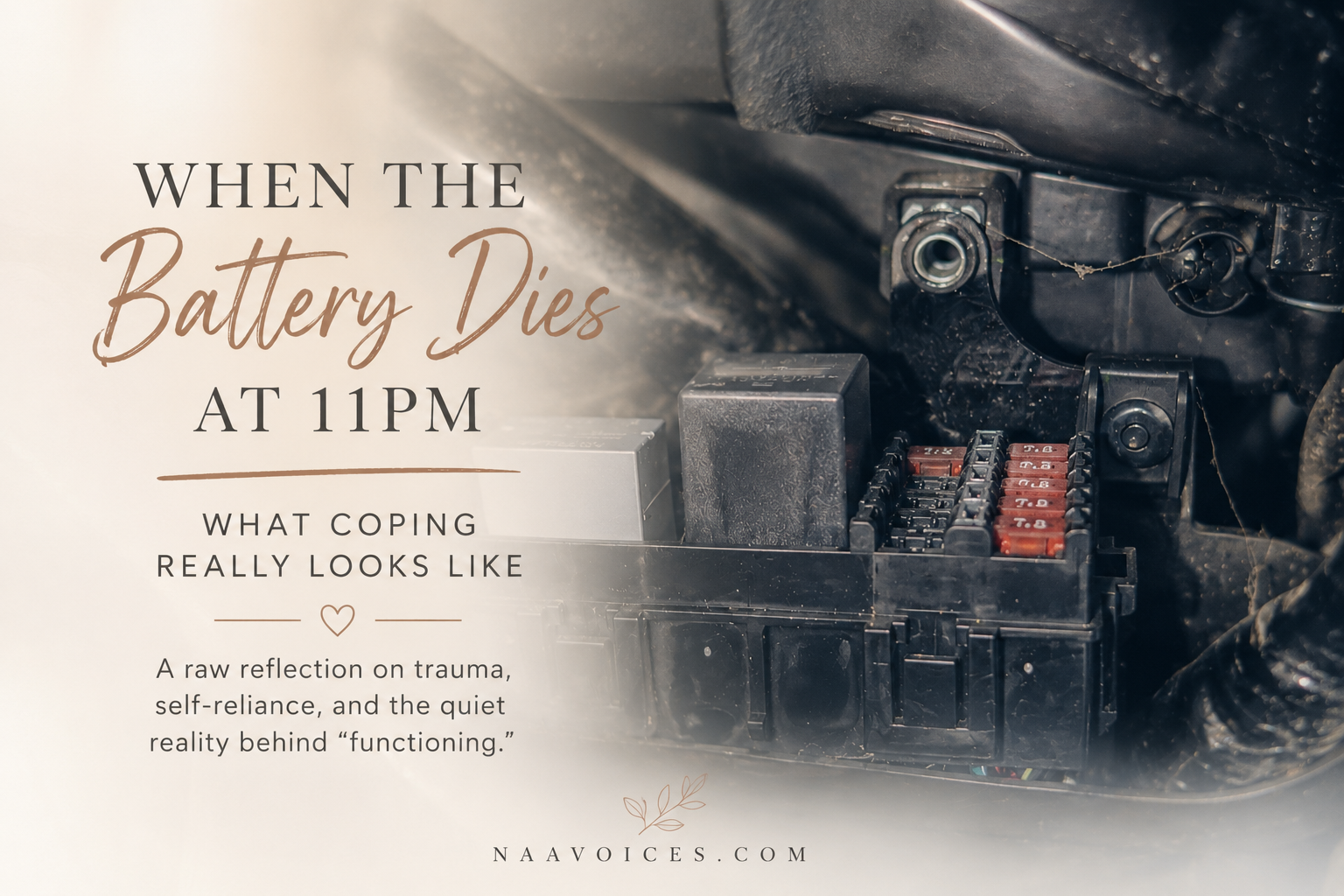
Sometimes it looks like sitting on the floor at 11 o’clock at night beside a motorbike with the seat off, staring at a fuse box because your mind will not settle until you know whether it is the battery, the fuse, or just another thing that has fallen onto your shoulders to sort out alone.
Tonight was hard.
I had already spent time riding earlier because I needed to clear my head. Riding has always done that for me. I grew up on the back of a bike. I have ridden on and off for over ten years now.
Almost two years ago, I completed my CBT for the third time. This time, I knew I was not going to let anyone take that part of me away again.
Friends, family, and colleagues could not always understand why I would choose to ride. What they did not realise was that, at that time, I was living through things I could barely articulate. Much of it was happening in silence.
They also did not realise that riding was one of the only things that made my whole body relax.
At the time, I did not understand dissociation. I did not have the words for it. I only knew that I had shut down so hard in order to survive that feeling anything at all had become difficult.
But on a bike, I could feel.
It was never about chasing danger. It was about finding a place where my body finally stopped bracing for it. For a while, the bike was the only place where I was not waiting for the next thing to happen.
I was just there.
Present.
Awake.
Alive.
I drove to Manchester for my test, and one of the instructors that day spoke openly about his own PTSD after serving in the army, and how riding helped him. I heard him then, but I did not fully understand it.
It took me a year.
Now I do.
He had no idea what I was living through. He had no idea that six months later, I would be diagnosed with PTSD too. But his honesty stayed with me. If I ever saw him again, I would want to thank him, because sometimes people say things without realising they have given someone else language for their own survival.
For some people, motorbikes will never make sense. In healthcare especially, there can be blunt assumptions about riders and risk. But the reality is more complicated than that.
Risk is subjective.
People drive cars recklessly every day. People drink. People use drugs. Chronic stress damages bodies quietly over years. Trauma changes the way people react to uncertainty, silence, fear, and pressure.
For me, a few hours on a bike can help calm the stress responses that build up over time.
That matters.
Self-care matters. Feeling free matters. Sometimes freedom is simply a helmet, an engine, and a stretch of road where nobody is asking anything of you for a little while.
When the battery was flat tonight, it threw me more than it probably should have.
Not just because my plans for tomorrow changed, but because it triggered that familiar feeling that everything ultimately falls back onto me. So when a colleague messaged, I sent her a photo of the fuse box I was sat tinkering with, trying to rule out every possibility before the replacement battery arrives in the morning.
Logically, I knew it could wait.
Emotionally, I could not switch off until I had checked everything.
Trauma can do that. When you have spent years anticipating the next crisis, the next escalation, or the next consequence, it changes how you process your own needs.
You stop asking for help.
You stop explaining pain.
You just keep functioning.
My best friend lives miles away, but she always knows when something is wrong because I go quiet. I shut off. I disappear into doing. Into fixing. Into surviving. Into movement.
That was me tonight.
The reality is that there has never really been anyone coming to save me. I learned that a long time ago.
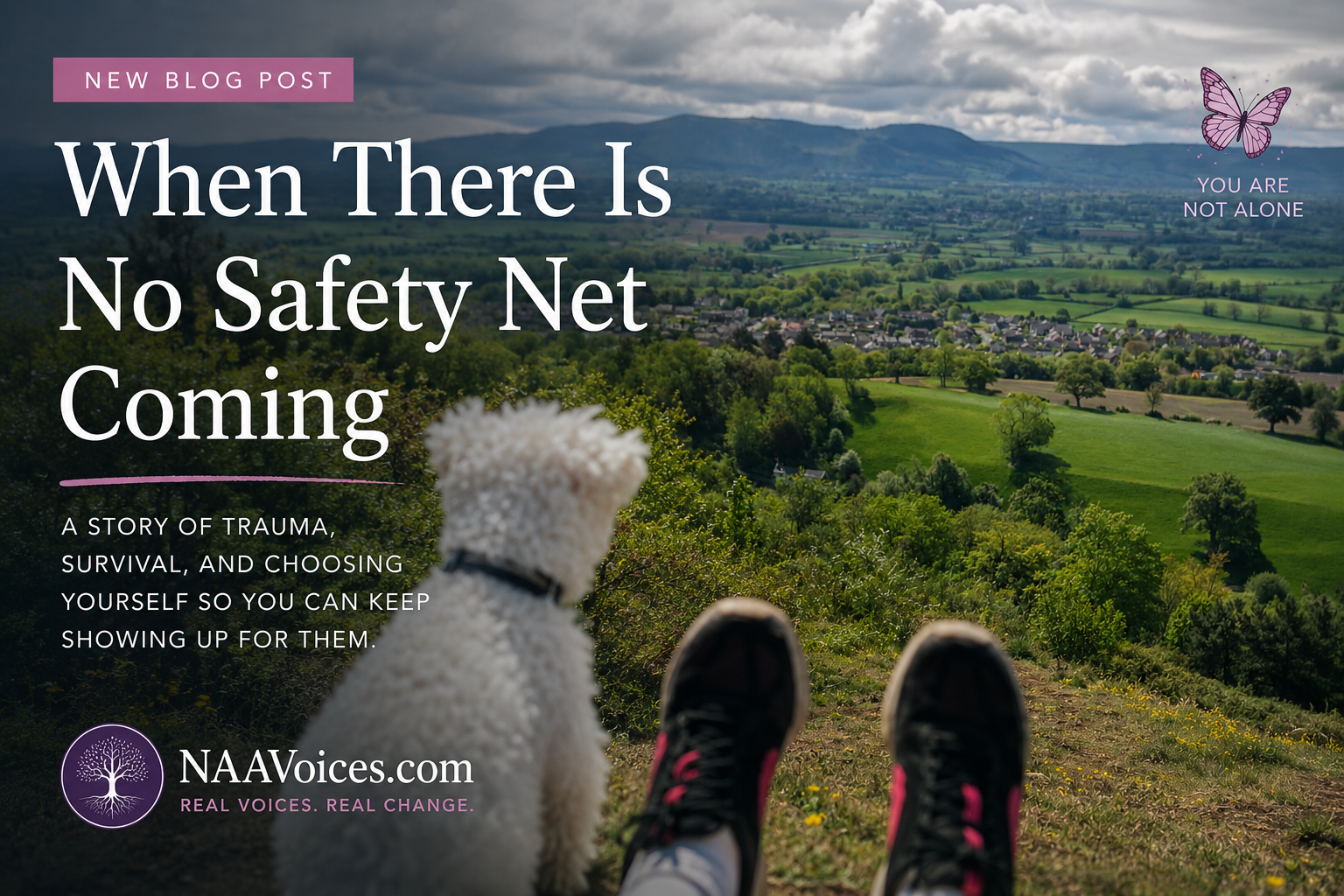
There is no emergency contact for emotional exhaustion. In reality, I do not even have an emergency contact listed anywhere. No obvious person to name. No automatic safety net. No rescue team arriving when life becomes too heavy.
Most of the time, I am the person people call when they need help.
And honestly, I do not resent that.
Caring for others is part of who I am. It is woven into both my personal life and my professional identity. Supporting people matters to me deeply.
But some nights I understand why others want to be in a relationship, and why they need that side of life. Not to be rescued. Not because they are weak. But because steady, practical, human support matters. Someone safe to call. Someone who notices when you go quiet. Someone who understands that even capable people get tired.
For me, that still feels complicated. When you have been through enough, closeness can feel less like comfort and more like risk. But I understand why people still want that connection. It is not about needing to be saved. Sometimes it is simply about not having to carry everything alone.
Social media is full of messages about independence. About not needing anyone. About strength meaning self-sufficiency.
But I do not think most people genuinely want to do life entirely alone.
I think many of us simply adapt to the absence of reliable support. We become resilient because we had no alternative. We become independent because dependence was unsafe. We learn to survive because survival was required.
And eventually people mistake survival for not needing connection.
Tonight reminded me that healing is rarely neat.
Sometimes it is deep conversations and therapy sessions.
Sometimes it is practical problem-solving.
Sometimes it is a fuse box under a motorbike seat at 11PM because your mind needs certainty before it can rest.
Maybe that is why we need to talk more honestly about what coping really looks like. Not the polished version. Not the inspirational quote version. The real version. The late-night, practical, messy, human version.
Because sometimes the people who look the most capable are the ones quietly holding everything together with no emergency contact, no safety net, and no room to fall apart.
And maybe that deserves a little more understanding too.
The events that unfolded were directly linked to the abuse my children lived through. I will not expand on those details publicly because some things belong to them, not the internet. Their story is not mine to expose. My role is to protect it, even while telling the truth about what trauma leaves behind.
Friday also marked the anniversary of my ex’s arrest. For a short time, I believed that moment meant safety had finally arrived. The reality that followed was very different. What came afterwards exposed my children and family to risks I never thought possible, not only through one individual, but through systems and institutions that were supposed to protect us.
This weekend was not only about an anniversary.
It was about what resurfaced because of it.
Trauma does not disappear because time passes. It shows up in behaviours, emotions, reactions, fear, anger and overwhelm. Especially in children.
And when it does, the hardest reality is not just managing the moment. It is knowing that, when everything falls apart, me and the kids only truly have me.
There is no reliable safety net arriving. Not in the way people imagine. Not consistently. Not when the damage has already been done and the consequences are still living inside my children.
That is why I went to the rocks.
Not because I had spare time. Not because it was scenic. Because my body knew I needed to reset before I broke under the weight of it.
People often think trauma lives in memory alone. It does not.
The body remembers what the mind tries to forget.
Certain dates pull you backwards. Certain places do too. Sometimes it arrives without warning, tightness in your chest, pressure in your throat, a sudden need to move, drive, breathe, or escape. For years, I did not understand why I instinctively sought out open spaces, music, nature, long drives or silence.
Now I do.
This morning, I drove the children to school and then headed to the rocks, the same place I used to go after leaving. I remember the first few times I went there. I cried most of the drive. At the time, I did not understand why being there mattered so much.
Looking back, I can see that my body was searching for regulation before my mind had fully processed what had happened.
People can dismiss walking, music, fresh air, the sea, nature, or grounding techniques as “airy-fairy”. They are not. The nervous system carries trauma. It also recognises safety, rhythm, space and movement before we always have the words for why they help.
Trauma changes the way you live. I have certain clothes I wear because they make me feel safer. Certain items I keep with me. Certain routines, places and songs that act as anchors. They may look insignificant to anyone else, but to a traumatised nervous system, they are reminders that I have survived before and can survive again.
Today I walked to the top, somewhere I had not climbed since carrying my then three-year-old on my back with the dog beside me.
It was almost comical at times. I avoided the proper path and ended up climbing through brambles instead. At one point, I was practically on my hands and knees dragging myself up the final stretch just to reach the spot I needed to get to.
And the dog never left my side.
She kept stopping and looking back to check where I was. No formal training. No commands. Just instinctively staying close while I crawled through mud, brambles and exhaustion towards somewhere my body had decided mattered.
When I finally got there, I sat.
Headphones on. Music playing. Breathing.
For the first time in a while, everything went quiet.
Walking back down, I did not want to leave. I circled for a while, climbed back through the brambles again, and delayed going home because something about being there made me feel human again.
Maybe that is what healing sometimes is.
Not fixing everything.
Not pretending it never happened.
Just finding a moment where your nervous system stops fighting long enough to let you breathe.
There is a version of me that existed before all of this, and I know now I will never fully be that person again. For a long time, that grief consumed me. I thought being broken meant I had lost myself forever.
But being broken also gave me understanding.
It changed the way I see pain in other people. It taught me to recognise what fear, exhaustion and trauma can look like beneath behaviour. It changed the way I advocate, the way I work, the way I parent, and the way I see injustice.
When you have lived through institutional failure, coercive control and fear, you begin to understand how many people are silently carrying things nobody else can see.
I have spent much of my life giving other people what I never had myself, support, compassion, protection and reassurance. Somewhere along the way, I forgot that self-care is not selfish.
It is necessary.
Because school runs still happen. GCSEs still happen. Parenting still happens. Life still continues.
Today, my 15-year-old came home after his first GCSE exam.
I asked him how it went.
He shrugged and said he did not even understand the question.
And I just told him, “You’re fine, as long as you tried your best.”
Because honestly, after everything he went through last year, I did not know whether he would emotionally make it to this point. Trauma comes out in children in ways people often fail to recognise. Attendance can be resilience. Showing up can be courage. Sitting an exam can be survival.
So I am proud of him.
Not because of grades.
Not because of results.
Because he showed up.
Because despite everything, he walked through those school gates and sat that exam.
Sometimes healing looks like climbing through brambles to sit on the rocks with your headphones on because your body needs reminding that you survived.
Sometimes resilience looks like a child walking into a GCSE exam after a year that nearly broke him.
And sometimes the strongest thing a person can do is keep showing up for their children, while finally learning to show up for themselves too.
Even when healing means accepting that the people and systems you believed would stand beside you were never really there.
Seven days ago, I finished work carrying the kind of weight you don’t always have words for. I’d received difficult news about a patient, the kind of news that shifts the tone of an entire day, even when you keep functioning on the outside.
In my own private language, I call people stars when they’re gone. It’s how I hold grief without letting it swallow everything else. It’s how I file loss in my mind when I still need to drive home, feed children, answer questions, and keep moving.
The Place I Didn’t Know Was Saving Me
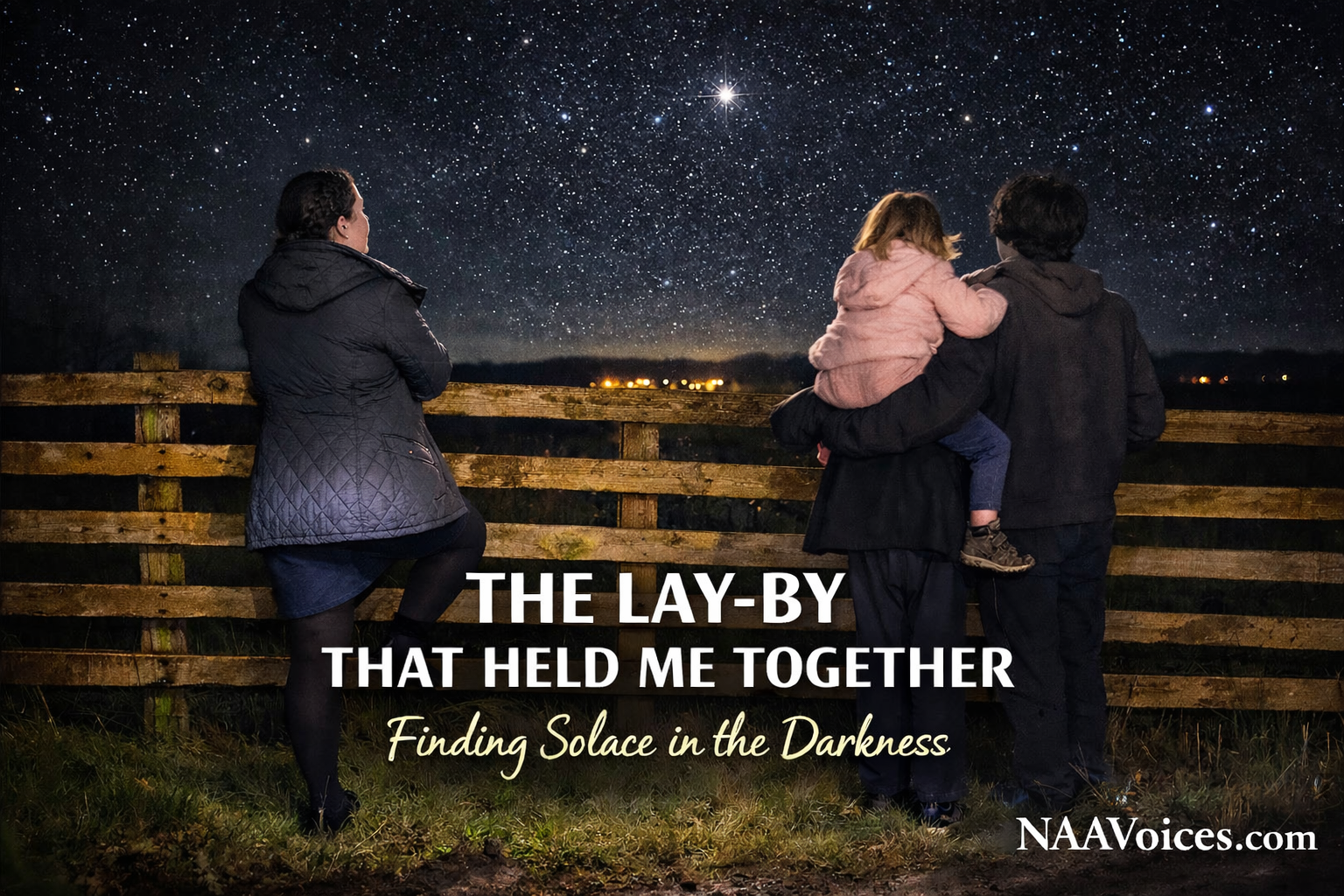
For over a year, I used to escape. I’d get in the car and drive to a lay‑by I always ended up at. Not because it was on the way to anything. Not because it fixed anything. But because it gave me a pocket of stillness, a place where my body could downshift when my life couldn’t.
Back then, I didn’t understand the language of nervous systems, grounding, or trauma responses. I just knew I was living under sustained pressure, in a situation that was eroding me, and I needed somewhere that I could breathe. Somewhere I could be safe.
That lay‑by became my therapy before I even knew what therapy was supposed to look like.
I slept there many times. My little girl slept there overnight many, many times. We’d sit and look at the stars. She grew up believing that when someone leaves, they become a star. It gave her something gentle to hold onto, and in truth, it gave me something too.
Returning to the Road That Once Held My Fear
I hadn’t been there for a while.
But last Thursday, after receiving that difficult news, I left work carrying more than tiredness. When I collected my daughter, she asked what was wrong. I told her I felt sad because there was a new star in the sky.
Then we collected my eldest and my middle one, the teenagers who have lived through more than most people will ever understand. One of them was struggling and asked if we were going to drive. And because of the conversation in the car, my five‑year‑old said, very simply:
“Let’s take him to see our star’s.”
So we did.
I drove the hour‑and‑a‑half round trip.
And this is what surprised me: it was different.
A Body That Finally Knows It’s Safe
Every time I’d driven that road before, it was in a state of activation: trigger, panic, dread, adrenaline, that constant internal noise that comes with prolonged stress. I learned that road in survival mode. I knew every bend, every stretch, every pull‑in point because I’d driven it while trying to keep myself together.
But this time, it felt like shifting gears.
My body relaxed.
No palpitations. No urgency. No bracing for impact. No internal pleading for the night to end.
Just calm.
The memories were still there. The past was still the past. But my nervous system didn’t respond as if it were still trapped in that time. And that’s not a small thing. That’s not “positive thinking.” That’s physiological change. That’s recovery showing up quietly, without ceremony.
I am a different person now.
Not fully healed and not pretending to be. Life is still hard. Trauma leaves marks. I’m not the person I once was.
Driving that road felt like an epiphany. It revealed something concrete to me. The place that once held my worst moments has also become evidence that I survived them.
The Field, the Stars, and the Quiet Truth
I know that lay‑by like the back of my hand. I’ve sat there in snow, ice, and rain. I’ve stood in that field. I’ve cried until my chest ached. I’ve lain under the stars trying to work out how I’d get through the next day.
And for a long time, nobody knew.
I’ve been there in uniform. I’ve been there in the middle of the night. I’ve been there when the world was sleeping, and I was wide awake, trying to stabilise myself enough to return to a life that didn’t feel safe.
I have photos of my feet in the field because sometimes I had to sit in the grass just to feel something real. To feel the earth. To feel grounded. It wasn’t aesthetic. It wasn’t curated. It was a lifeline when I didn’t have words, support, or accessible options.
This time, all three of my kids got out of the car.
And they appreciated it.
Not dramatically, quietly. In the way that says, we understand why this mattered. Because they’ve been through so much, too. They’re still healing. I’m still healing.
Even this time last year, there were moments when we didn’t know what the future would look like. whether things would stabilise, whether I’d be okay, whether any of this would ever feel “over.” The year before that, there were people who didn’t believe I’d still be here.
But I am.
What the Lay‑By Really Represents
I want to be clear about what that lay‑by represents, because it isn’t just a scenic stop.
Sometimes the thing that keeps you going isn’t a big intervention. It isn’t a perfect plan or the right professional at the right time. Sometimes it’s the small escape you build quietly when you can’t say what’s happening, when you don’t feel believed, when you’re functioning publicly but unravelling privately.
Sometimes it’s a lay‑by. Sometimes it’s the stars. Sometimes it’s a field where you can sit in the grass and let your body remember that the world is bigger than what you’re living through.
And then, one day, that same place shifts.
It flips.
It becomes a positive. A source of comfort. A marker of survival rather than panic.
Driving Home With a Different Kind of Grief
On the drive home, I realised I’d driven there and back almost on autopilot, not in shutdown, not in fear, just steady. And the significance of that landed hard, because for so long, that road was associated with crisis.
That night, I carried my new “star” quietly. The sadness was still there. The reflection was still there. But it wasn’t layered with the same terror, the same frantic need to escape the life I was living.
This time, it was grief held in a body that has learned, slowly, that the emergency is not constant anymore.
Life can get easier. Not neatly. Not quickly. Not without scars. But it can.
When you’re living in continuous trauma, you can’t always see that. You can’t picture a future where your body isn’t braced for impact. And yet, here I am, driving that road differently, feeling that place differently, and showing my children the real truth:
Even in the darkest periods, something can hold you.
And later, when you’re ready, that same place can become proof that you made it through.
Content note: This piece discusses suicidal ideation and trauma. If you’re struggling, please don’t hesitate to reach out. Resources are at the end.
For 34 years, I lived with ADHD, and never once needed mental health services.
I’d worked through the front line during COVID, wards, diabetes clinics, and mental health services. Thirty-hour weeks, raising three children, advocacy work on the side, a mortgage, a routine that worked. No medication. No therapy. No “management plans.”
I exhibited all the familiar traits, including constant energy, rapid processing, big emotions, and the usual executive-function challenges, but I’d built systems that worked for me. Hyperfocus helped me manage multiple critically unwell patients in acute medicine, keep the children organised, and continually take in new information while noticing details others missed. My ability to process information quickly meant I performed at my best in emergencies, where a calmness always settled over me, and my emotional intensity helped patients feel genuinely seen. ADHD wasn’t a weakness; it was often the thing that set me apart.
Then trauma arrived, and everything changed.
It didn’t just add stress. It felt like my brain had been rewired overnight. The mechanisms that sustained me for decades suddenly stopped working, and I had no idea why.
The Day My Superpower Became My Kryptonite
My brain had always processed quickly, scanned constantly, thrived on stimulation. But introduce PTSD into that system, and it accelerated into something I didn’t recognise.
My productive energy turned into agitation, and I couldn’t settle. My hyperfocus became locked onto legal papers and perceived threats, rather than the work I loved. My rapid thinking spiralled into intrusive loops I couldn’t escape. The emotional depth that made me a good nurse now overwhelmed me.
I wasn’t overreacting. My brain was in neurological overload, and I felt utterly destabilised by it.
When Everything I Knew Stopped Working
I’d built a toolkit over 34 years, honing my structure, movement, and ability to thrive in high-pressure environments, where empathy guided me. It had served me well.
Trauma dismantled all of it.
Leaving the house felt unsafe. My routines collapsed under flashbacks that came from nowhere. My hyperfocus became a prison, locking me onto court documents and risk assessments. The empathy that once guided me now overwhelmed my nervous system, leaving me unable to function.
I kept thinking: Why can’t I just cope like I always have?
But this wasn’t about resilience. My brain was prioritising survival at any cost. And my three children were watching me disappear in real time. They didn’t understand why. How could they, when the system couldn’t either?
They watched me lose the ability to live, to take them out, to walk into a shop, to function, even to eat without vomiting. They slowly had to learn what PTSD meant and why I was no longer the person I once was. They saw me retreat, pull down walls, teach myself DIY, and avoid driving the routes we used to sing along. They learned why I needed to stop suddenly, why certain songs grounded me while others didn’t, why I would drop to my knees to stop myself from fainting, why I constantly looked over my shoulder, and why I withdrew from family and friends. I needed the house, them, and work; anything more overwhelmed me.
The worry they tried to hide, the questions they didn’t know how to ask, I saw all of it, and I felt powerless to stop what they were witnessing.
When My Neurodiversity Became a Weapon
The psychological fallout wasn’t the only battle to be fought. The systems around me made everything worse.
In family court, my ADHD, the same neurotype I’d successfully lived with for 34 years, was suddenly reframed as evidence that I was “violent and aggressive because she has ADHD.”
That allegation came from someone with a lengthy criminal history. Yet his behaviour was never questioned. Never scrutinised.
I wasn’t given the chance to respond. My neurodiversity became their weapon. His history became invisible.
At the same time, I lost four stone in seven weeks. I was vomiting constantly, barely eating, and my body was in physiological shock. I could see myself disappearing. Clothes hanging off me. The faces of my children when they looked at me, the worry they tried to hide, the questions they didn’t know how to ask. But instead of recognising trauma, I was told, “It’s mediation stress.”
I had to prove otherwise, while being retraumatised in real time.
ADHD didn’t harm me; it never had in 34 years, and it wasn’t about to start now. What harmed me was bias, ignorance, and procedural failures that couldn’t tell the difference between a neurotype and a threat.
And the emotional cost was devastating.
Watching DARVO Play Out in Real Time
I finally found a name for what I was experiencing: DARVO — Deny, Attack, Reverse Victim and Offender.
He denied. He attacked my credibility. He recast himself as the victim — and me as the risk.
And instead of identifying the pattern, the agencies reinforced it. I watched it happen in real time — and felt utterly powerless to stop it.
Over and over, I was told: “Focus on your mental health.”
But at that stage, I didn’t have a mental health history. I had ADHD — and a system that couldn’t tell the difference between neurodiversity and pathology.
The cruel irony? It was the retraumatisation — the system’s response to me — that created the PTSD I now live with.
That distinction matters to me.
Shutdown: When Survival Looks Like Withdrawal
When the overload became too much, my life narrowed in ways I’d never experienced.
Messages went unread. Noise became physically intolerable. Engaging with anyone felt unsafe.
From the outside, I know it looked like I was withdrawing. Avoiding. Giving up.
But inside, it felt like my brain had thrown a circuit breaker to prevent complete collapse. I wasn’t checking out, I was trying to survive.
I had to learn to recognise the early signals, because by the time I hit shutdown, it was too late: my thoughts became too loud, sensory overload creeping in, and I avoided my phone and people, experiencing irritability that felt foreign to me, fatigue, and headaches, along with a desperate urge to disappear and decompress.
I learned: respond early, or collapse entirely.
This wasn’t a weakness. It was my brain trying to protect itself.
The Day I Almost Didn’t Survive
April 17th, 2024.
That’s the day my three children almost lost me.
I had planned it in silence, convinced that my pain was too much to share, that my children deserved better than a mother who couldn’t hold herself together under the weight of a system that kept failing us. No one knew. No one saw the signs because I’d become an expert at hiding them. I gave away everything of value, belongings, keepsakes, pieces of myself that meant something. I disguised it as decluttering, but it was actually a form of generosity. No one questioned it because I made it look intentional.
What pulled me back wasn’t strength or sudden clarity. It was someone telling me that in their 38‑year career, they had never met anyone who had done what I had to protect my children, even in the circumstances I was facing. Hearing that forced me to see the reality of what I’d already survived. I booked an urgent GP appointment that day and asked for help. For a few months, I found a small space to begin processing the abuse.
My youngest, an old soul even before turning four, seemed to sense everything. At the strangest moments, when the outside world was being shielded, and my mind felt tortured, she would say something that reminded me why I had fought so hard to keep them safe.
I used to believe that suicide was selfish, and I still understand why people feel that way when they’re the ones left behind. But living inside a mind with no respite, in a world that no longer makes sense, carrying pain no one else can see, can push a person to a place where they feel they can’t survive anymore.
That level of mental pain affects every part of the body and feels endless. People in that state don’t need judgment.
They need reminders of who they are, what they’ve survived, and that they matter. And we all need to check in on the friends who suddenly withdraw, give away belongings, or seem “lighter” in a way that doesn’t match their reality.
I’ve never written about this in such detail before. For a long time, I couldn’t even think about it. I had been threatened with suicide as a form of control for so many years, but I’m not that person anymore. Something shifted. I lost the fear that had ruled me. I let go of a phobia I’d carried for more than twenty years. I became a different person.
When you’re facing someone who has harmed you and your children, and the people meant to protect you don’t, it demands a strength you never knew you had.
I realised that my silence and everything I had been forced to endure could become my children’s future if I didn’t break the cycle.
The system’s failure to protect me couldn’t become my failure to protect them from further harm or from the grief that would follow.
After that, survival became minute‑by‑minute. Getting out of bed. Making breakfast for three children who needed me.
Going to work was the only thing that gave me some living, because it was there that I didn’t have to be the victim, tortured by the life she was being forced to live; I could be the nurse protecting others from feeling the pain.
So I was putting one foot in front of the other, not because I felt strong, but because I had passed the point of survival; I was merely existing.
My children lost part of their mum over the past two years.
But things are better now. Not perfect, I still have hard days, days when the circuit breaker threatens to flip, but I have language for it now. I have strategies that work for an injured brain, not just a neurodivergent one. And my children are getting a mum back who understands that vulnerability isn’t weakness, that asking for help is a sign of strength, and that healing is possible.
They got a different version of me: a stronger one.
Silence almost cost me everything. It nearly took me from my children. I thank the stars not through death, but through a system that couldn’t see the injury for what it was, and through my belief that I had to carry it alone.
Rebuilding Function From Scratch
Living with this meant redesigning everything:
Lower sensory environments. Adjusting to being triggered, Clear boundaries. Simplified routines I could actually maintain. Structured pauses before I hit the breaking point. Learning trauma-informed self-regulation. Knowing when to escalate to support.
It’s disciplined. Pragmatic. Protective.
And it’s kept me functioning, for myself, and for my three children who needed me to survive.
The Moment Everything Shifted
For a long time, I genuinely feared admitting I was suffering to close my eyes at night, that the reliving and symptoms had become so severe, the problem was me. My worry was that I would be viewed differently if others knew I had ptsd, whether it was friends, family, or my colleagues.
Then I attended a lecture on neuroimaging.
They showed scans side-by-side, PTSD compared to traumatic brain injury. Disrupted pathways. Altered regulation systems. Structural stress patterns.
What I’d been experiencing wasn’t weakness. It wasn’t instability. It was a neurological injury.
And in that moment, something clicked: This isn’t my fault. My brain is functioning exactly as a brain with an injury would.
I felt anger. Relief. Grief for the years I’d spent apologising. But mostly — validation.
Understanding the neuroscience gave me language. It gave me dignity. It gave me the confidence to return to work.
The Conversation That Changed Everything
Returning to work after a two-month absence, the longest of my career, was awful. My desk, once a safe space, now held the imprint of police visits and ongoing abuse. Very few people knew what I’d been living through, and I walked back into the surgery carrying all of it, unseen.
I wasn’t meant to be seeing patients that day, but in reception I bumped into one of my regulars trying to book an urgent appointment. I offered to see them the next day.
That night, I spiralled. I worried that everything I’d endured had taken something vital from me. If every system meant to protect my children and me had failed, would it have changed me? Had it damaged the part of me that cared for others? I stayed up late with my neuroscience module, printing brain-scan images and staring at the affected areas, desperate to know whether my compassion, my ability to connect, was still intact.
The next day proved it was.
The patient had been struggling with her Alzheimer’s diagnosis, so I sat with her and her family and explained the neuroscience behind it. I showed them the scans, talked through what was happening in her brain, and what it meant for her memory and future. Her daughter and son, whom I knew well, watched closely. She knew I wasn’t just teaching; I was working something out inside myself.
Then something shifted.
I asked her, with her cardiology background, to talk me through how she’d treat a heart attack. She explained the protocols, interventions, monitoring, and rehabilitation. And then I asked: Why is the brain any different from the heart?
She looked at me and said, “There isn’t one.”
We talked about illness, prevention, acceptance, and the parallels between the organs. And it hit me: We would never expect a heart to heal solely through willpower. We shouldn’t expect a brain to, either. A heart attack needs intervention, monitoring, and rehabilitation. A brain injury, PTSD, deserves the same.
That conversation brought me back. Not just to work, but to myself.
After the appointment, they came back in with gifts, small, thoughtful things they’d chosen with such care. One of them was from a learning‑disability charity, something so specific and meaningful that it stopped me in my tracks.
I hadn’t expected anything; I certainly hadn’t expected to feel seen in that moment.
The kindness of it, the intention behind it, broke through everything I’d been carrying.
I cried, not out of sadness, but because for the first time in a long time, someone’s gesture reminded me that what I do still matters, and that I hadn’t lost the part of me that connects with people.
Why I Refuse to Be Ashamed of Needing Help
I functioned independently for 34 years, and I still needed mental health support after trauma.
That’s not a weakness. That’s an injury that requires treatment.
We wouldn’t tell someone with spinal trauma to “push through.” We wouldn’t tell someone recovering from a heart attack to just “focus on staying positive.”
Brains deserve the same standard.
Where the System Failed Me
Police guidance on supporting neurodivergent victims exists. Across my entire case, one officer seemed aware of it, and that officer’s understanding stood in stark contrast to every other interaction I had. They inquired about my processing style and sensory needs. They didn’t treat my ADHD as evidence; they treated it as context.
One person who recognised neurodivergence for what it actually is.
That’s not a training gap. That’s a safeguarding failure.
My ADHD didn’t cause the harm I experienced. The stigma around it did.
My neurodiversity strengthened my analytical thinking. It accelerated my learning. It heightened my risk awareness. It improved my advocacy.
I thrived with ADHD for 34 years.
The last two years, I’ve had to survive while living with PTSD created by repeated retraumatisation.
ADHD shaped how I process the world. Systemic failures shaped how the world treated me.
Both truths matter.
What I Know Now
Neurodiversity is not pathology. It’s not evidence of risk. And it should never be weaponised in courtrooms or policing.
The harm I experienced wasn’t created by ADHD. It was created by bias, DARVO, and institutional failure to understand neurodivergence.
Yet despite everything, my neurodiversity remains my strength.
It fuels my learning. It drives my purpose. It keeps me engaged, analytical, and compassionate.
I thrived with ADHD for 34 years. For over two years, I’ve lived alongside PTSD, and I’m rebuilding.
Both realities coexist. Neither excuses abuse. And neither should ever be used as a weapon against survivors.
Now I see the pain in others that I felt then, in the families I work with through NAAVoices, in the survivor stories that mirror my own. I recognise it immediately. And I refuse to let them drown in silence the way I nearly did.
What I’d Tell Myself Two Years Ago
If I could go back to before April 17th, 2024, I’d tell myself: This will break you open, but it won’t break you.
You’ll lose six stone, teeth from the stress-induced vomiting. Your hair will fall out. You’ll lose your sense of safety. You’ll temporarily lose yourself. Your children will watch you disappear, and that will be the hardest part to forgive yourself for.
But your ADHD isn’t the problem. The system’s response to it is.
And you’ll survive this, not despite your neurodiversity, but in many ways, because of it.
Your brain isn’t broken. It’s injured. And just like that, a heart you know how to treat can heal.
Your three children will get more of you back. Not the same version, but a stronger one. Someone who spent 34 years believing she understood mental health, only to realise she knew nothing until she survived PTSD and learned how to live openly with a mental health condition. Someone who now knows that honesty isn’t weakness; it’s strength, especially in a world where stigma still exists.
Through lived experience, I see the pain in others’ eyes, the pain no one recognised in mine. And because of that, I ask the questions. I advocate. I remind people that their lives matter, because they do. I know now that the brain deserves the same care, compassion, and rehabilitation as any other organ.
I became someone who survived.
For 34 years, I never needed support for my mental health. For the past two years, I’ve learned to live with PTSD. My therapy came through training, courses, and a deep need to understand my own brain. Everyone heals differently, and for me, giving back to others was the beginning of my healing journey, and there’s no shame in that. My brain, like any other organ, deserved treatment when it was injured. And now, slowly, with the right support, it’s healing.
If you’re in crisis:
Samaritans: 116 123 (UK) – Available 24/7
Crisis text line: Text SHOUT to 85258
NHS 111 (select mental health option)
For neurodivergent survivors: Visit NAAVoices.com for trauma-informed, evidence-based resources created by and for families navigating complex systems.
The Mother They Created When They Failed My Children
At 34, I lost everything.
Not my job—work remained my only safe haven, the one place that still made sense when nothing else did.
What I lost was far more fundamental.
I lost my belief that people do the right thing.
I lost my trust in the world.
I lost my ability to understand how humanity functions.
Because when my children needed protection most, the world looked away.
The Breaking
My mental health collapsed for the first time in my life.
Not gradually. Not with the warning signs I could have prepared for.
It shattered, completely, devastatingly, in the face of a truth I couldn’t reconcile:
The systems designed to protect children don’t always protect children.
The people who should intervene don’t always intervene.
The world that promises safety doesn’t always deliver.
I stood face to face with the devil himself.
And nobody came.
Nobody protected my babies.
Nobody did the right thing.
And I couldn’t understand why.
How do people fail children? How do they see harm and turn away? How do institutions built for protection become instruments of further trauma?
I still don’t have those answers.
I’m not sure I ever will.
The Underestimation
What made it worse?
They treated me like I knew nothing.
Just another hysterical mother. Just another woman overreacting. Just another parent who didn’t understand “the process.”
I was dismissed. Patronised. Underestimated at every turn.
As if loving my children made me irrational. As if my fear for their safety made me unreliable. As if being a mother meant I couldn’t possibly understand the systems designed to “help” us.
They were wrong.
The Vow
But my three children were still watching.
Through my traumatisation, through my confusion, through my complete loss of faith in humanity, they were watching to see what I would do next.
And in that darkness, broken and alone, I made a vow that changed everything:
I will NEVER be that woman again.
The woman who believed people would do the right thing. The woman who trusted systems to protect her children. The woman who waited for help that never came.
I will NEVER wait for the world to save my kids.
Because I learned the brutal truth: it won’t.
The Rebuilding
So I stopped waiting.
And I rebuilt myself—not as the same person, but as someone entirely new.
I became educated.
If they were going to dismiss me as ignorant, I’d make sure I knew more than they did.
I earned qualifications while my world burned around me. I studied safeguarding frameworks, legal processes, and institutional procedures. I learned every system that had failed us, inside and out.
I became independent.
If I couldn’t trust anyone else to protect my children, I’d learn to do everything myself.
I built Nurse Against Abuse — the foundation that grew into NAAVoices — rising from the ashes of institutional betrayal.I created the resources I wish had existed when I needed them. I turned my shattered faith into actionable expertise.
I became the shield the world refused to be.
The Truth About Trauma
Here’s what they don’t tell you about surviving this kind of betrayal:
The triggers still come.
There are moments when I’m transported back to that version of myself—the one who believed, who trusted, who thought the world was fundamentally good.
I still don’t understand how people fail children.
Even with all my knowledge, training, and experience, I navigate these systems. I cannot comprehend how adults look at vulnerable children and choose inaction.
I remember the woman who believed in humanity.
Sometimes I grieve her. She was softer, more hopeful, easier to be around.
But she’s gone.
And honestly? She had to be.
Because that woman couldn’t protect my children.
This version can.
The Reality No One Wants to Say Out Loud
The world is not always safe.
Not everyone chooses to do what they should.
Not everyone will protect you.
When your children are at stake, trust must be earned, never assumed.;
But YOU—you can become everything your children need.
My 5-year-old needs a mother who will never break like that again.
My 13-year-old needs a warrior who fights without hesitation or fear.
My 15-year-old needs living proof that one person will never, ever give up on them.
That’s who I became.
Not because I’m special or extraordinary.
Because I had no other choice.
The Two Paths
Losing faith in the world at 34 gives you exactly two paths:
Path One: Drown in the grief of what you lost—your innocence, your trust, your belief in human goodness.
Path Two: Rise as something you have never seen in yourself before—forged in fire, built from betrayal, unstoppable in purpose.
I chose fire.
Now I have:
Expertise earned in hell
Knowledge forged from institutional failure
Strength built on broken promises from everyone else
Three souls who will never question whether their mother will give up
Because I always will.
The Problem We Don’t Talk About
Here’s what breaks my heart:
I shouldn’t have to use this knowledge for my own children.
No mother should.
I built expertise in safeguarding failures, legal frameworks, institutional navigation, complaint procedures, and evidence documentation; not because I wanted to, but because I had to.
And I’m not alone.
Too many mothers are being dismissed as hysterical. Too many are treated like we know nothing. Too many have to become experts in systems that should protect our children, just to be heard.
Not just for me.
For every mother who’s been underestimated. For every parent told they’re overreacting. For every family that has failed because of the very systems designed to help them.
Because until those systems change, we become the experts anyway.
We have to.
The Truth About Overcoming Betrayal
You don’t overcome betrayal by learning to trust again.
You overcome it by becoming so educated, so independent, so armed with knowledge that trust becomes irrelevant.
By building integrity so solid that you answer only to yourself.
By gaining expertise so deep that you don’t need anyone’s help.
By developing determination so fierce that other people’s failures can’t touch you anymore.
When you trust your own knowledge above all else— When you become independent enough to act alone— When your expertise makes you undeniable— When they can’t dismiss you anymore because you know more than they do—
Other people’s failures stop mattering.
Their underestimation becomes irrelevant.
Their dismissal loses its power.
Because you’re no longer waiting for the world to protect your children.
You became the protection.
The Promise
The world failed my children once.
I made absolutely certain it was the last time.
And now?.
Until the systems change?
We’ll document everything. We’ll learn every framework. We’ll master every process. We’ll build resources for each other. We’ll refuse to be dismissed.
We’ll protect our children—with or without the world’s help.
The Transformation
My children will never know the naive woman I was at 34.
The one who believed people were fundamentally good. The one who trusted institutions to function as designed. The one who thought loving your children was enough to keep them safe.
They know the fight she took on and the person she became as a result.
The woman who learned that sometimes the only person you can count on is yourself, so you’d better become someone worth counting on.
The Final Truth
At 34, the world broke me.
At 36, I became unbreakable.
Not for me.
For them.
For my 5-year-old, who deserves stability. For my 13-year-old, who deserves fierce advocacy. For my 15-year-old, who deserves unwavering protection.
Always for them.
And for every mother out there who’s been underestimated, dismissed, and forced to become an expert in systems that should have protected her children from the start.
You are not hysterical. You are not overreacting. You are not alone.
And you are far more powerful than they ever gave you credit for.
If this resonates with you, please share it. Because somewhere, another mother is being told she knows nothing, and she needs to know she’s not the only one who has had to become everything.
⚠️ Content Note: This post discusses trauma and dissociation. Please prioritise your wellbeing whilst reading. Take breaks as needed.
Quick Self-Check Before We Begin ❓
Do You Experience Dissociation? Quick Assessment:
□ Feel like you’re watching yourself from outside your body
□ The world seems unreal or dreamlike
□ Can’t remember parts of your day
□ Feel emotionally numb during stressful situations
□ Hear people talking but can’t process the words
□ Feel disconnected from your emotions
□ Time seems to speed up or slow down unusually
□ Feel like you’re on autopilot
If you tick 3+, consider speaking with a trauma-informed professional 💜
My Lived Experience – The Day It Finally Had a Name
Earlier this year, I was sitting in the middle of my clinic. A patient I’d been supporting for months used a word that stopped me cold: dissociation. They described the sensation of watching life unfold around them without truly being part of it. As they spoke, something shifted in my understanding of my own PTSD journey.
For months, I’d struggled to name that automatic shutdown, the moment when the world becomes too much. It isn’t dramatic or visible. One moment I’m present and engaged. Next, I’m observing my own life from a distance, as though it’s happening behind frosted glass. My body continues the motions, but I am not there.
In those moments, silence becomes essential. Music, once comforting, becomes unbearable. After nights of relentless triggers and flashbacks that loop like a broken record, my mind craves quiet. It’s exhausted by constant vigilance and the fear of what might come next.
The tangled complexities of ongoing abuse leave no room for recovery. My nervous system remains trapped in survival mode. It cannot process trauma, and it cannot meet the demands of a mind now burdened with PTSD. Eventually, it simply says: “Enough. I’m taking you somewhere else for a while.”
I understand now, this was never a weakness. It wasn’t me, “not coping well enough.” It was my brain’s extraordinary attempt to protect me from pain that threatened to overwhelm every defence I had.
But understanding doesn’t make it easier to live with.
Myth vs Fact: Let’s Clear This Up ❌✅
Myth vs. Fact: Let’s Clear This Up ❌✅
Dissociation is often misunderstood, and these misconceptions can make it harder for people to seek support or feel validated. It isn’t always dramatic or obvious — it can affect just one part of someone’s experience, such as their emotions.
Here’s what that might look like in practice. Someone might feel emotionally numb, even while going about their day as usual. They may appear composed externally, yet feel profoundly disconnected internally. This isn’t attention-seeking, and it isn’t something they can simply “snap out of.”
Dissociation is a real, involuntary response from the nervous system — as automatic as breathing or a heartbeat. It can be subtle, like zoning out whilst driving or becoming lost in a book. And it isn’t always linked to severe trauma; many people experience mild forms throughout their lives.
By challenging these myths and increasing awareness, we can build a more compassionate and informed understanding of what dissociation truly is.
The Neuroscience — What’s Really Happening in Our Brains 🧬
Dissociation isn’t a character flaw or a sign of weakness. It’s a sophisticated neurobiological response — your nervous system’s built-in safeguard.
When we begin to understand what’s happening inside us, we can start to let go of the shame. This shame often accompanies these experiences.
During trauma, the amygdala, our brain’s alarm system, goes into overdrive.
Flooding the body with stress hormones like cortisol and adrenaline.
At the same time, the prefrontal cortex, which helps us think clearly and regulate our emotions, temporarily shuts down. 📴
This isn’t a malfunction.
It’s an ancient survival mechanism, designed to help us endure immediate danger.
Your Brain During Dissociation 🧠
In chronic trauma or PTSD, something more complex occurs. The brain develops dissociation as an adaptive response, and three key neural networks are involved.
The Default Mode Network (DMN) maintains our sense of self and autobiographical memory. During dissociation, the DMN becomes fragmented, creating that familiar sense of detachment from our own identity.
The Salience Network is responsible for determining what’s important in our environment. When it becomes dysregulated, it grows difficult to distinguish between past trauma and present safety.
The Executive Control Network helps us focus and make decisions. When it becomes impaired, it contributes to the mental “fog” many of us experience during dissociative episodes.
💙 Remember, you’re learning about your brain’s protective mechanisms. This is self-compassion, not self-criticism.
🔍 Latest Research (2024–2025)
Structured trauma care helps. Programmes such as Finding Solid Ground have been shown to reduce symptoms and improve emotional regulation. (Oxford University Press)
The majority of trauma survivors experience dissociative symptoms. This is particularly common in PTSD and prolonged abuse cases. (NHS England)
Dissociation is a survival response. Brain imaging research confirms it is an adaptive mechanism, not a flaw. (Study by Reinders et al., University of Groningen)
👩⚕️ Through a Nurse’s Eyes: Reflection and Recognition
Through my postgraduate study, and as a nurse, I was trained to recognise dissociation. But it was my patients — and my own survival — that taught me what it truly looks like.
There’s a particular quality to it. A subtle disconnection. It isn’t dramatic. It’s quiet.
It’s the patient who seems unusually calm whilst describing horrific experiences. The assault survivor who recounts their story as though they’re reading someone else’s diary. The domestic abuse victim who appears “checked out” during safety planning.
People often say, “I don’t know how you’re still standing.” Truthfully? Neither do I.
For over two years, 90% of my life was spent surviving. I wasn’t living — I was bracing. Managing the impact on my health, my wellbeing, and my children. I’ve never shared the full story of what I endured since leaving. Even the fragments I’ve had to disclose have brought others to tears. But I no longer could cry.
And that’s dissociation. Because without it, I don’t believe I’d still be here.
The Power of Quiet Support: My Workplace and PTSD
An Extraordinary Workplace
My workplace has been nothing short of extraordinary. They understood that dissociation isn’t a choice. If anything, it made me more focused on my patients — because I couldn’t stay in my own mind. I needed to protect others from feeling the same pain I was carrying.
“I never had to quote the Equality Act. The few who knew supported me quietly, respectfully.”
Small Acts, Big Impact
My manager would take me for walks. Colleagues shielded me from triggers. They reminded me daily, through their actions, that the pain I was carrying wasn’t mine to own alone. I set up a music speaker on the wall. It was something to fill the silence when I needed it. I could mute it when I didn’t need it.
They sat with me during phone calls I could barely comprehend. They listened in disbelief as the system, supposedly designed to protect, gave a platform for further harm. They read the statements. They saw the contradictions. They witnessed the emotional toll of being forced to relive what I was trying so desperately to escape.
They called. They messaged. They left food. One even offered financial help. I declined, but the gesture stayed with me long after.
Chosen Family
These people became family. They didn’t demand explanations or force me to speak. They let me dissociate to survive and protected the part of me that couldn’t be taken. They stood back and stayed quiet. They let me do what I do best — give others the safety I couldn’t always find for myself.
“They stood back, quietly, and let me give others what I couldn’t access for myself: safety.”
Please know this: you are protected.
PTSD is recognised as a disability under UK law. You have the right to reasonable adjustments. You don’t need to justify your survival, and you don’t need to explain your coping mechanisms.
You just need to know, you are not alone.
If You Don’t Have a Workplace Like Mine…
Daily Living Strategies That Help 🏠
💬 “Sometimes, the loudest support is the quietest presence. And sometimes, that’s all we need to keep going.”going.”
Final Thoughts: From Survival to Living 🌅
Dissociation saved many of our lives. 💙 It allowed us to endure the unendurable, to survive experiences that might have otherwise destroyed us. But there comes a point where what once protected us begins to limit us. The challenge is learning to honour that protection whilst gently expanding our capacity to stay present. 🌸
For me, truly understanding dissociation — not just intellectually, but in my bones — has been transformative. 🦋 I no longer fight against it with shame and frustration. Instead, I recognise it as my brain’s misguided attempt at care. I thank it for keeping me alive, and then I gently remind myself: the danger has passed. I am safe now. I can stay. 🏡
Some days I can. Some days I can’t. And that’s okay. 💚
To my fellow survivors: Your dissociation tells a story of survival. It reflects a nervous system that loved you enough to take you somewhere else when reality became unbearable. That’s not weakness. That’s not pathology. That’s the fierce protection of a brain that refused to let trauma win.
To the professionals: When you see dissociation, you’re witnessing resilience in action. Treat it with the respect it deserves.
And to everyone else: Be gentle with those of us who sometimes seem far away. We’re not choosing to leave. We’re still learning how to stay.
This was never a choice. But healing — that’s a choice we make every single day..
Daily Living Strategies – Support Directory
🏡
Daily Living Strategies That Help
You are not alone. The organisations below offer free, confidential support — whenever you need it, day or night.
💜
If you are in immediate danger, please call 999. If you are struggling right now, Samaritans are available 24 hours a day, 7 days a week — you don’t have to be in crisis to reach out.
NAAVoices was not created from certainty, but from lived experience and professional insight. As I migrate earlier work from the original platform, this post has been reviewed and approved for transfer. It remains true to its original context, with only minor clarity edits where needed. Some moments do not require rewriting to remain honest.
Loneliness is one of the most profound and overlooked experiences a person can face, especially after losing a partner. Last week, I was reminded of this again when I met another widow still navigating the quiet ache of life after loss. Many people mourn not only the person they loved, but the life they once shared — the routines, the companionship, the sense of belonging.
As I wrote in the original version of this blog, “More than 40% of widows and widowers report feeling isolated after the loss of their partner.” That statistic is more than a number. It represents real people living with a silence that can feel suffocating.
My grandmother knew that silence intimately.
Her First Experience of Loss
My grandfather passed away when my grandmother was just under 60. She had to navigate the complexities of grief alone, at a time when support services didn’t fully understand the emotional and practical realities of widowhood. She felt isolated, unseen, and misunderstood — a feeling many widows and widowers still experience today.
But instead of letting grief consume her, she transformed it into something extraordinary.
A Legacy Born From Compassion
In the years that followed, my grandmother founded a support group for widows and widowers — a group that has now been running for 25 years. What began with a single act of courage — “a letter to the local newspaper, reaching out to those who were living in similar situations” — became a lifeline for more than 200 people.
She created a space where those grieving could come together, share their stories, and rediscover connection. A place where loneliness was met with understanding, and silence was replaced with companionship.
I grew up watching her pour her heart into this work. I remember the open‑house sessions vividly: the smell of freshly baked cakes, the furniture rearranged to make room for everyone, the warmth that filled the room as people gathered. My baby boy was passed around like a tiny spark of hope. For some members, it was the only human interaction they had all week.
Some found love again. Others found lifelong friends. Many simply found a reason to keep going.
The Power of Shared Experience
Working in primary care, I’ve seen firsthand how loneliness affects health — emotionally, mentally, and physically. I’ve often wished I had the time and resources to create a group like hers for my own patients. I can empathise deeply, but I haven’t walked in their shoes. That’s why her work matters so much: it came from lived experience, compassion, and courage.
Even now, at over 80 years old, she still takes calls from those who need her. She doesn’t realise the magnitude of what she’s built. She never sought recognition, yet her legacy is undeniable. She has healed hearts, restored hope, and created a community that continues to thrive because she refused to let others feel the loneliness she once felt.
Connection as a Lifeline
Her story is a reminder that healing doesn’t always begin with grand gestures. Sometimes it starts with one letter, one conversation, one act of kindness. She proved that one person’s courage to reach out can transform hundreds of lives.
Her legacy teaches us that connection is not a luxury — it is a lifeline. Loneliness affects the body, the mind, and the will to keep going. When we create spaces for people to be seen and heard, we offer them more than support. We offer them a way back to themselves.
I carry her lessons with me every day:
No effort is too small.
Compassion creates ripples we may never fully see.
Community can grow from the simplest act of reaching out.
Her strength, her love, and her quiet determination continue to guide me.
Moving Forward: A Call to Connection
Reflecting on her journey, I wish more services recognised the true impact of loneliness on widows and widowers. If the NHS had the capacity to support community‑led groups like hers, countless people could benefit from the healing power of shared experience.
Her story is not just a testament to resilience — it is a blueprint for what compassionate community support can look like.
A Year Later
Nearly a year after writing this blog, I’ve created a dedicated bereavement support resource offering guidance, practical help, and most importantly, contact details for organisations that truly understand loss and provide meaningful support. It feels like a small way to honour her legacy and continue the work she began.