Tag: trauma

  • And Then She Was Gone

    And Then She Was Gone

    NAAVoices was not created from certainty, but from lived experience and professional insight. As I migrate earlier work from the original platform, this post has been reviewed and approved for transfer. It remains true to its original context, with only minor clarity edits where needed. Some moments do not require rewriting to remain honest.

    This post forms part of my Two Years Forward series

    After a Year of Retelling: Losing the One Who Listened

    After twelve months of reliving the abuse to nineteen different police officers, I lost the second one who didn’t lie to my face, send misleading emails, or cause further harm.

    Jackie from Professional Standards was that officer.

    She was a rare exception in a system that too often fails victims, someone who understood how harm is inflicted, how power is misused, and how easily people are broken by processes that claim to protect them.

    I will always be grateful to Jackie for raising concerns and speaking up, even when the organisation around her appeared indifferent to the impact on victims.

    It is heartbreaking that officers who genuinely understand coercive control, trauma, and accountability are the exception rather than the norm.

    The Exhaustion of Recounting Trauma

    When you are living inside trauma, isolation becomes suffocating. The emotions are relentless, the weight unmanageable. Confronting abuse is harrowing enough — but being required to retell it again and again to investigators becomes its own form of harm.

    That was my reality.

    I explained what had happened to my children and me to nineteen different officers in person. Nineteen retellings. Each one required reopening wounds that had never been allowed to close. It was exhausting, destabilising, and dehumanising.

    Very few appeared to understand coercive control. Even fewer understood the legislation designed to protect victims and children.

    Those rights were meant to protect me and my three children. If they had been applied properly, my children would have been safeguarded. Instead, protection felt like an afterthought.

    Incompetence, Bias, and the Cost of Negligence

    When I first sought help, I was met with a disheartening mix of incompetence and personal bias. I was given little more than signposting, while the officer who took my initial report failed to correctly record or act on the crimes I disclosed.

    That failure caused further harm.

    It compounded the trauma I was already carrying and set in motion a cascade of consequences that never should have occurred.

    *21/12/23 – PC R + PC ***********


    Competent Officer Number 1 Arrested

    Each retelling felt like reopening a fresh wound. After the police caused further harm through inaction, the system turned on the one officer who had tried to repair the damage left by a colleague’s failures. I often think about him now, and wonder whether he, too, has been deeply harmed by the same system.

    Finding a Haven — Then Losing It

    I endured six gruelling months before finding one other officer out of nineteen I could genuinely trust.

    Jackie came from an unexpected place: Professional Standards. She was investigating anonymous claims that I had been groomed; a misconduct-in-public-office inquiry. Her involvement felt like a lifeline at a time when everything else had collapsed.

    She didn’t pretend to have all the answers. She listened. She cared not just about the process, but also about the impact on the children and on me. For months, she offered a fragile sense of safety.

    But that refuge was never secure.

    The last officer who acted on what she and others uncovered now faces serious consequences for doing his job. That reality left me afraid, not just for Jackie, but for anyone within the system who dares to speak up, particularly when power and influence sit on the other side.

    I remain profoundly thankful to Jackie. Her integrity and humanity stood in stark contrast to so much of what I experienced elsewhere.

    Fear, Systemic Failure, and the Fight to Be Heard

    The failures I witnessed and lived through have permanently altered my understanding of safety and justice. The trust I once placed in institutions meant to protect victims has been deeply compromised.

    I live with the fear that these patterns continue unchecked.

    Some days I wonder whether I will ever feel safe again — in my home, the county I grew up in, or the town where my children attend school. That sense of threat does not fade easily.

    And yet, I hold onto this: I met two officers who genuinely cared. Two people within a broken system who tried to do the right thing.

    Sharing my story is not about revenge.
    It is about survival.

    It is an act of defiance against silence; against the systems that rely on victims becoming so exhausted they can no longer continue.

    This was never just about me.
    It has always been about protecting those who are lost, isolated, and vulnerable.

    You Are Not Alone

    Your voice matters.

    Even in the darkest moments, there are people who care; people who will listen, even when institutions will not. It is okay to seek help. It is okay to trust carefully. It is okay to lean on others when the weight becomes too much.

    I will always advocate for my children and for others navigating similar harm. My journey has been shaped by loss, fear, and injustice, but it also carries the possibility of healing, growth, and safety.

    If you are reading this and wondering whether anyone will hear you:
    you are not alone.

    — Sister Laura

  • When Coercive Control Enters the Courtroom

    When Coercive Control Enters the Courtroom

    This account is shared in the exercise of my right to freedom of expression. It reflects my lived experience, understanding, and perceptions at the time. It does not seek to identify or name any individual, nor to assert findings of fact or legal conclusions. It is written solely to describe personal impact and experience, not to attribute legal or criminal responsibility.

    This account is shared in the exercise of my right to freedom of expression. It reflects my lived experience, understanding, and perceptions at the time. It does not seek to identify or name any individual, nor to assert findings of fact or legal conclusions. It is written solely to describe personal impact and experience, not to attribute legal or criminal responsibility.

    Navigating the Family Court: A Survivor‑Led Journey

    When the System Sees Performance, Not Risk

    Originally written: 16 December 2024
    Transferred to NAAVoices as part of the Two Years On series

    This is my personal account of what happened, as I experienced and understood it at the time.

    This piece took time to write when it was first published. It has taken even longer to revisit.

    I am now two years on from the day I left. This account forms part of a wider series examining how abuse can continue after separation through family court proceedings, legal correspondence, financial pressure, delay, silence and the repeated reshaping of a narrative.

    I have approached this piece carefully because the hearing did not stand alone as one difficult day. With distance, I can see it as part of a much longer pattern.

    Some hearings will be written about in time. Others remain too close to the surface. Trauma does not unfold neatly, and revisiting certain moments still carries a physical and emotional cost.

    This is not about withholding the truth.

    It is about telling it without losing myself in the process.

    What I understand now is that coercive control did not end when I left. It adapted. It moved through paperwork, allegations, professional language, delay and systems.

    By the sixth hearing, the same narrative that had appeared in the original non-molestation proceedings was being copied and carried forward.

    He was repositioning himself as the victim.

    I knew the pattern.

    I knew what was happening.

    But inside that courtroom, knowing did not give me the power to stop it.

    Before I Reached the Doors

    Attending family court while still living with the effects of coercive control was one of the most difficult experiences of my life.

    Before I entered the building, I was on my knees outside.

    My heart rate was over 140. I was dizzy, shaking and barely able to stand. The distress had been building for weeks, but it peaked before I reached the doors.

    Taking lorazepam to get through a legal process was something I had never imagined I would need.

    I do not say that with shame. Medication can be necessary, and nobody should be judged for needing it.

    I say it because people need to understand the physical reality of trauma.

    Walking into a courtroom with somebody who has harmed you is not a neutral act.

    It is a physiological event.

    Your body remembers what your mind is trying to manage.

    Nothing about it is ā€œjust a hearing.ā€

    In the weeks beforehand, I was still waiting for the police Protection of Vulnerable People team to return and take a further statement. They had attended only the previous month in relation to the coercive-control investigation.

    As far as I understood, that investigation remained active.

    I had also recently provided police with further material concerning harassment after separation.

    I entered the hearing believing that I might soon be asked to sit through further interviews about abuse I had already spent months trying to explain.

    I was preparing for family court while bracing myself for more police processes.

    Trauma does not pause while systems catch up.

    It accumulates.

    I Did Not Go Alone

    My friend came with me.

    She is the woman I trained as a nurse with, my child’s godmother and one of the few people I trust to recognise when I am not okay, even when I cannot say it.

    I was genuinely frightened that the stress could trigger a serious medical event. I needed somebody beside me who would know what to do if my body gave out.

    Before we reached the building, my legs went.

    My vision flashed.

    Inside court, I sat taking ECG recordings on my watch while experiencing crushing chest pain and blurred vision.

    I did not know whether what I was experiencing was cardiac, neurological, trauma-related or all three.

    That uncertainty intensified the fear.

    But I also knew I could not allow him to see how severely his presence affected me.

    That was part of surviving the room.

    I had to sit near the person whose behaviour had affected me and my children, control every visible reaction and appear calm enough to be considered credible.

    The better I concealed my trauma, the easier it became for the court to miss it.

    The Position Statement

    I could not read his position statement myself.

    By then, every new document felt like another route through which the abuse could reach me. Each submission appeared to contain another allegation, another distortion or another attempt to reverse what had happened.

    I sent the statement to a friend and asked her to read it aloud.

    That was not avoidance.

    It was survival.

    As she read it, the wording felt immediately familiar.

    The narrative had been copied from the original non-molestation proceedings.

    The same themes had been lifted from earlier documents and carried into the current case as though repetition itself established their truth.

    He was again presenting himself as the victim.

    My actions were stripped of context.

    My safeguarding concerns became hostility.

    My documentation became obsession.

    My fear became instability.

    My attempts to protect my child became evidence that I was unreasonable or obstructive.

    Material that had already been answered, disputed or overtaken by later events was repeated as though none of that had happened.

    That is how a record can be reshaped.

    An allegation appears in one document.

    It is copied into another.

    It is then referred to as part of the procedural history.

    Eventually, the repetition begins to resemble corroboration.

    But repetition is not evidence.

    Copying an allegation from the original non-molestation proceedings into later family court documents does not make it true.

    It simply gives the same allegation another place in the record.

    I Knew the Game

    Throughout the proceedings, he presented himself as the person who had been harmed.

    The magistrates saw a man sitting in tears.

    What they could not see was that I recognised this presentation.

    I had lived with it for years.

    I knew how his distress could move attention away from his behaviour and towards what other people had allegedly done to him.

    I knew how quickly he could become the injured party when questions were raised about his own conduct.

    I knew how sympathy could be secured before the wider pattern was understood.

    Other professionals and educational settings had previously been involved for long enough to see that the tears were not always the end of the interaction.

    They had seen what could follow.

    The magistrates had only a short hearing in which to assess us.

    They saw his tears.

    They saw me trying not to react.

    They did not see the years that had taught me what those moments could mean.

    That was the cruelty of the situation.

    I knew the pattern unfolding in front of me, but I was powerless to stop it.

    If I challenged it too forcefully, I risked appearing hostile.

    If I became visibly distressed, I risked appearing unstable.

    If I documented the contradictions, I risked appearing obsessed.

    If I remained calm, the impact of the abuse disappeared from view.

    There was no safe response.

    I knew the game.

    But I could not prove the game simply by saying, ā€œThis is what he does.ā€

    Allegations, Reversal and Powerlessness

    The position statement did more than repeat earlier material.

    It reinforced a complete reversal of victim and offender.

    He was no longer being presented as the person whose conduct had caused concern.

    He was being presented as the person needing protection from me.

    I understood what was happening.

    The original non-molestation narrative was being copied, repeated and reinforced through new proceedings, while the context explaining my behaviour was progressively removed.

    My distress was presented without its cause.

    My attempts to evidence patterns were presented without the events that made documentation necessary.

    My fear was presented without the history that created it.

    That was the trap.

    I was expected to disprove a performance while remaining calm enough not to confirm the version of me the performance was designed to create.

    Knowing that the roles were being reversed did not mean I had the authority to stop it.

    I could see the narrative being rebuilt around me.

    I could see him becoming the victim within the official record.

    I could also see that every attempt I made to challenge it risked becoming further evidence against me.

    Information From the Police Investigation

    The most alarming part of the hearing concerned information connected to the ongoing coercive-control investigation.

    His bail restrictions had been removed because there had been no direct contact.

    That did not mean the investigation had concluded.

    My understanding was that further investigation remained outstanding.

    Inside court, that distinction did not feel properly recognised.

    His barrister referred to the coercive-control case and suggested that it was going nowhere.

    A specific number of witness statements was mentioned, together with an alleged assessment of how many supported my account.

    I had not been formally given that information.

    I was the person who had reported the abuse.

    Yet the other side appeared to know the precise number of statements held within the investigation and what somebody connected to that investigation had allegedly concluded about them.

    At one point, a person was referred to in a way that appeared to give the impression that he was a police officer.

    My understanding was that he was a civilian statement taker.

    That distinction mattered.

    The way the information was presented gave it an authority and finality that I did not believe it should have carried.

    My watch showed my heart rate pass 160 and then drop sharply.

    I remained seated.

    I did not know whether the information was accurate, misunderstood, selectively presented or disclosed improperly.

    What I knew was that I had not received the same explanation.

    I could not understand how information connected to my own police report appeared to be available to the other party before it had been properly explained to me.

    I also could not challenge it effectively because I did not know precisely what the police themselves had concluded.

    The information from the police investigation was placed alongside allegations copied from the original non-molestation proceedings.

    Together, they reinforced the same distorted narrative:

    He was the victim.

    I was the aggressor.

    My attempts to explain the wider history were evidence of instability rather than evidence of what I had survived.

    Seeking Answers

    Following the hearing, I contacted Professional Standards.

    I needed to understand where the information had come from, who had accessed it and how it had reached the family proceedings.

    There had also been reference to a misconduct-in-public-office investigation involving a sergeant, presented in a way that appeared to connect that matter negatively to me.

    My understanding was different.

    That investigation existed independently of me. My later contact with Professional Standards concerned how information connected to my case appeared to be circulating.

    At the time, I did not receive a clear explanation.

    My understanding is that a name was passed for anti-corruption checks.

    But the immediate uncertainty remained.

    I had reported abuse to the police.

    I was still waiting for clarity about my own investigation.

    Yet inside family court, the other side appeared able to discuss specific information that had not been formally explained to me.

    The uncertainty itself became part of the trauma.

    When a Pattern Becomes a Series of ā€œComplaintsā€

    With a change in solicitor and limited context carried forward from earlier hearings, it felt as though I was being presented as somebody who complained about everyone.

    The implication was that the common factor was me.

    But what looked like separate complaints to somebody reading a file cold was, from my perspective, a pattern of interconnected failures and concerns.

    I was not raising unrelated grievances.

    I was trying to explain what was happening across police processes, family proceedings, safeguarding decisions, financial arrangements and post-separation conduct.

    A pattern I could document was being broken into separate incidents.

    Once separated from one another, each incident became easier to dismiss.

    The wider structure disappeared.

    I did not feel I had a meaningful opportunity to present the evidence connecting those events.

    That is how a truthful account can be overshadowed.

    Not necessarily by being disproved.

    Sometimes it is overshadowed because it is never allowed to exist as a complete account.

    The Name for It

    At the time, I did not fully understand the term DARVO:

    Deny, Attack, Reverse Victim and Offender.

    I understand it now.

    The behaviour is denied.

    The person reporting it is attacked.

    The person accused then presents himself as the true victim.

    In a professional setting, this reversal can be extraordinarily effective.

    The person using it may appear calm, organised and persuasive.

    The traumatised person may appear anxious, defensive, physically unwell or overwhelmed.

    The courtroom sees the behaviour occurring during the hearing.

    It may not see the history that produced it.

    A calm person is not automatically safe.

    A distressed person is not automatically unreliable.

    But I felt that his presentation was treated as credibility, while my trauma was treated as evidence against me.

    I wish I had known the term DARVO at the first hearing.

    I wish I had understood that what felt chaotic and cruel followed a recognised pattern.

    But even knowing the name would not necessarily have given me the power to stop it.

    Naming a mechanism is not the same as persuading a system to recognise it.

    My Mental Health Became Evidence Against Me

    My mental health was raised during the hearing.

    It did not feel as though it was discussed as the predictable consequence of prolonged abuse, fear, repeated exposure and re-traumatisation.

    It felt as though it was being used to question my reliability.

    I was asked whether a GP had diagnosed me.

    No.

    A psychologist had assessed me and diagnosed post-traumatic stress disorder.

    I found myself having to evidence my weight loss and PTSD while his narrative was given room to land.

    I had lost approximately six stone.

    I had experienced severe anxiety, dissociation, hair loss, physical symptoms and an inability to regulate my body when exposed to reminders of the abuse.

    Those symptoms did not prove that I was unreliable.

    They demonstrated the cost of what I had experienced.

    But when trauma becomes visible, attention can shift from what happened to the way the injured person presents.

    The harm moves into the background.

    The traumatised person becomes the problem.

    That is not trauma-informed safeguarding.

    It is a fundamental misreading of trauma.

    Better Representation, but an Existing Record

    By this hearing, I had changed solicitors.

    My new solicitor was supportive and instructed a prepared, skilled and deeply professional barrister.

    For the first time, I felt that somebody representing me could see the pattern I had been trying to explain.

    That mattered enormously.

    She warned me that seeking a fact-finding hearing would now be difficult, particularly because of how the earlier proceedings had developed.

    Some of the damage had already been done.

    The allegations and assumptions repeated through earlier hearings were already embedded in the procedural history.

    That is the danger when claims are allowed to pass forward without being properly tested.

    They become part of the record.

    Later representatives must then work within a narrative created before the evidence has been fully examined.

    What mattered to me was that my barrister saw it.

    Like others who took time to examine the evidence, she appeared dismayed by what had unfolded during the previous twelve months.

    She remained professional.

    But she was also human.

    That mattered.

    How Control Survives Separation

    Coercive control does not always stop when a relationship ends.

    Sometimes it adapts.

    In legal settings, it can appear through narrative control, selective detail, official-sounding language, professional name-dropping, allegations carried from one document into another and using process itself as leverage.

    It is not always loud.

    It can appear calm, organised and reasonable.

    Meanwhile, the person who has been harmed may look anxious, dysregulated, physically unwell or difficult because their body is reacting to trauma.

    The courtroom sees behaviour in the room.

    It may not see the history that created it.

    That is why trauma-informed practice matters in family court.

    Not to remove scrutiny.

    Not to accept every account without question.

    But to recognise that presentation is not the same as risk.

    The task should be to investigate the pattern, not reward the most convincing performance.

    When the Hearing Ended

    During the hearing, I remained seated.

    I remained quiet.

    I tried to appear composed.

    The magistrates saw me sitting in the room.

    They did not see what it cost me to stay there.

    When the hearing ended, my body gave up.

    Outside the courtroom, I was physically sick from the stress.

    I could not regulate my breathing.

    My vision was filled with stars.

    My best friend knelt beside me, held my hair back, tried to keep me conscious and helped me interpret the ECG recordings I had taken.

    The magistrates did not see that.

    They did not see me on my knees before I entered the building.

    They did not see the crushing chest pain or blurred vision.

    They did not see the collapse that followed.

    They saw the controlled part.

    They did not see the cost of controlling it.

    My friend saw something else.

    As he left, she saw him look towards her and smirk.

    I did not see it myself, so I can only record what she witnessed and later told me.

    But she had watched me vomit from stress.

    She had tried to help me breathe.

    She had seen what staying in that courtroom had cost me.

    The magistrates had not.

    Other people can maintain a faƧade.

    I cannot.

    My body tells the truth whether I want it to or not.

    The Control Running Alongside Court

    The coercive control did not stop at the courtroom doors.

    It ran alongside the proceedings.

    He had pushed for the mortgage to be resolved and for me to pay him out within a short timescale.

    I progressed matters much faster than expected.

    After that, delays followed.

    He was difficult for me and the solicitors to contact, and the signing process continued for months. He eventually signed shortly before the hearing, following repeated chasing.

    From July to December, I was paying more than £600 extra each month on the mortgage.

    That was financially crippling.

    Child maintenance was also inconsistent.

    I did not rely on it, but I claimed it because I needed to understand whether the financial control would continue after separation.

    It did.

    The Child Maintenance Service later moved the arrangement to collect and pay because payments were not arriving consistently.

    Delay can be control.

    Silence can be control.

    Financial instability can be control.

    When children are involved, they experience the consequences too.

    There were also inconsistencies regarding where he was living.

    The address declared in court did not appear to correspond with information provided elsewhere.

    My understanding was that safeguarding checks may have been undertaken at an address where he was not actually residing.

    That mattered because safeguarding checks are only meaningful when they assess the environment in which the child will actually spend time.

    If the wrong address is checked, risk may be missed.

    Once again, the burden fell upon me to identify the inconsistency and explain why it mattered.

    What the Courtroom Did Not See

    The courtroom saw prepared documents, professional submissions and behaviour within a controlled environment.

    It saw a man sitting in tears.

    It saw me sitting quietly.

    It did not see the years that had taught me to recognise the pattern.

    It did not see the alcohol and drug misuse I had experienced before leaving.

    It did not see the alcohol-related driving disqualification in 2022.

    It did not see the full police evidence.

    It did not see the years of financial pressure, instability and fear.

    It did not see the physical collapse outside the courtroom.

    It did not see how allegations from the original non-molestation proceedings had been copied into later documents until familiarity began to resemble truth.

    It did not see how powerless I felt while watching that happen.

    It saw how two people presented in a professional room.

    That is not the same as understanding risk.

    What I Cannot Make Peace With

    This was one of the hardest days of my life.

    Looking back, it still is.

    At no point did I feel properly heard.

    I looked emotionally numb and detached.

    In reality, I was in an absolute state.

    I genuinely believed that I might enter the building and not walk out again.

    What haunts me is how easily somebody with a long-established pattern of behaviour can appear credible in a professional setting while the traumatised person is left appearing unstable, defensive or difficult.

    I knew what I was watching.

    I knew the roles were being reversed.

    I knew the same allegations were being copied from the original non-molestation proceedings and carried into a new process.

    I knew the tears did not tell the whole story.

    I knew the game.

    But I had no safe way to expose it.

    Every possible response carried a risk.

    If I challenged him, I looked hostile.

    If I became distressed, I looked unstable.

    If I produced more evidence, I looked obsessed.

    If I said nothing, his narrative remained unchallenged.

    That is the powerlessness I still cannot make peace with.

    My evidence was not disproved.

    I did not feel it was properly heard.

    My children and I left the process feeling invalidated again.

    I did not feel there had been meaningful recognition of risk.

    I did not feel there had been a genuine sense of safeguarding.

    I did not feel the impact on us had been understood.

    I was left fighting to stay upright while the focus appeared to move further away from the children’s safety.

    That is the part I cannot accept.

    The lead-up was difficult.

    The hearing was traumatic.

    The aftermath was brutal.

    Through all of it, the one thing that should have remained central felt barely protected:

    My children, particularly the child we shared.

    Why I Started Writing

    That week, I founded the original website, NurseAgainstAbuse.co.uk.

    I did not create it because I had all the answers.

    I created it because I needed somewhere to put the truth.

    I needed somewhere to explain what coercive control can look like after separation.

    I needed to show how trauma can be misunderstood by police, courts and other professionals.

    I needed to advocate for people who are described as emotional, unstable, hostile, difficult or obstructive when they are actually trying to survive and protect their children.

    That website eventually became part of the wider journey leading to NAAVoices.

    Looking back, it was not simply advocacy.

    It was survival.

    It was my attempt to create something useful from an experience that was still harming me.

    Final Reflection

    This is my personal account of events as I experienced and understood them.

    It is not legal advice.

    It is not written to speak for every survivor, and it is not an attack upon the family court as a whole.

    It is written to show what can happen when coercive control continues through systems that do not fully recognise it.

    Post-separation abuse does not always look like abuse to the people watching.

    Sometimes it looks like paperwork.

    Sometimes it looks like delay.

    Sometimes it looks like unpaid maintenance or unsigned documents.

    Sometimes it looks like allegations copied from one set of proceedings into another.

    Sometimes it looks like information connected to a police investigation appearing in family court before the person who reported the abuse understands how it got there.

    Sometimes it looks like calm words spoken in a professional room.

    Sometimes it looks like a man in tears being accepted as the victim.

    And sometimes it looks like a woman who recognises the entire pattern but cannot expose it without being portrayed as the problem.

    Sometimes it looks like a victim on her knees outside court, forcing herself to stand before anybody sees.

    Safeguarding cannot depend upon who appears most composed.

    Presentation is not proof.

    Distress is not dishonesty.

    Repetition is not evidence.

    Recognising coercive control does not always give a victim the power to stop it.

    And a traumatised person should not become the problem simply because her body can no longer hide what has happened to her.

    Domestic Abuse Helpline (run by Refuge) can be reached on 0808 2000 247. For mental health support, you can call Samaritans free on 116 123 at any time.

    Navigating the Family Court: A Survivor‑Led Journey
  • šŸ•Šļø Truth Always Finds a Way: Lessons from History

    šŸ•Šļø Truth Always Finds a Way: Lessons from History

    Across every era, people in power have tried to bury truth beneath fear, manipulation, and carefully crafted narratives. Yet history shows us something steady and reassuring: truth is persistent. It resurfaces even when silenced. It outlives intimidation. It waits for the moment when people are ready — or brave enough — to hear it.

    These moments from history remind us that honesty is resilient, accountability matters, and the human spirit has a remarkable capacity to push back against deception.

    šŸ” When Lies Collapse: Six Times Truth Broke Through

    Watergate (1972–1974)

    A break‑in at the Democratic National Committee headquarters spiralled into one of America’s most defining political scandals. The Nixon administration attempted to bury the truth under layers of denial and misinformation. Persistent investigative journalism — particularly from Bob Woodward and Carl Bernstein — and congressional scrutiny exposed the cover‑up. Nixon resigned. The press proved its power. The public’s right to know prevailed.

    The Trial of Galileo (1610s)

    Galileo Galilei challenged the Church’s authority by supporting the heliocentric model. Forced to recant under threat, he paid a personal price. Yet the truth of his discoveries outlived the institutions that tried to silence him. His work became a cornerstone of modern science and a reminder that evidence eventually outlasts dogma.

    The Emancipation Proclamation (1863)

    During the Civil War, Abraham Lincoln made a crucial declaration. It struck at the core of the falsehood of racial superiority. The Emancipation Proclamation didn’t end slavery overnight, but it reshaped the moral landscape of the conflict and paved the way for abolition. It remains a defining moment in the long, ongoing struggle for racial justice.

    The Fall of the Berlin Wall (1989)

    For decades, the Berlin Wall stood as a concrete symbol of division, oppression, and false promises. When it fell, it wasn’t just a political shift — it was a collective declaration that people will always push towards freedom. Its collapse reunited families, reshaped Europe, and became a global emblem of hope.

    Holocaust Revelations (1945 onwards)

    After the Second World War, the world confronted the full horror of the Holocaust. Nazi propaganda crumbled under the weight of undeniable evidence: testimonies, documents, and the liberation of concentration camps. These revelations reshaped global human rights efforts and underscored the catastrophic consequences of unchecked lies and hate.

    ✊ A More Recent Example: The #MeToo Movement (2017–present)

    For decades, survivors of sexual harassment and abuse were silenced by fear, power imbalances, and cultural norms that protected perpetrators. When the #MeToo movement surged globally, millions of people shared their experiences publicly.

    What had been hidden in plain sight became impossible to ignore.
    Institutions were forced to confront systemic abuse. High‑profile figures faced accountability. Policies changed. Conversations shifted.

    Most importantly, survivors realised they were not alone — and that collective truth‑telling can transform culture.

    🌐 The Misinformation Reckoning (2020s)

    The rise of social media created an environment where misinformation spreads faster than facts. From public health to politics to global events, false narratives have shaped public perception and influenced decision‑making.

    In recent years, researchers, journalists, and grassroots educators have pushed back.
    Fact‑checking initiatives, digital literacy campaigns, and public scrutiny have begun to shift the landscape.

    This moment reflects a wider truth: when people have access to accurate information, harmful narratives lose their power.

    šŸ’› Why Truth Matters

    Truth isn’t just a philosophical ideal — it’s a foundation for justice, accountability, and human dignity.

    When truth is denied, people are harmed.
    When truth is acknowledged, people heal, societies learn, and progress becomes possible.

    History shows us that truth is not fragile. It is patient. It waits. And when the moment comes, it rises.

    šŸ“£ Digital Truth‑Telling: A New Frontier

    Today, truth spreads not only through institutions but through individuals.

    People sharing their stories.
    Communities challenging misinformation.
    Voices once ignored are now reaching millions.

    The internet has become a place where truth can travel further and faster than ever — especially when people speak openly and collectively.

    🧠 A Lesson in Restraint: Let Truth Speak

    In a world where manipulation can distort perception, restraint becomes a quiet form of strength. Those who twist reality often reveal themselves without intervention.

    Sometimes the wisest move is to step back, observe, and allow the truth to breathe.

    ā€œGive someone enough rope and they’ll hang themselves.ā€

    Patience, clarity, and vigilance often expose what force or confrontation cannot.

    šŸ’¬ Final Reflection: Truth Is Relentless

    History shows us that lies may obscure, delay, or distort — but they cannot endure. Truth has a way of resurfacing, reshaping, and restoring.

    If you’ve ever been silenced, doubted, or misrepresented, remember this: history is on the side of truth.
    It has outlived every attempt to bury it.
    And it will continue to rise — steady, undeniable, and stronger than the forces that tried to suppress it.

    Published with support from NAAVoices.

  • Police Victim Blaming in Domestic Abuse Cases: The Hidden Trauma No One Talks About

    Police Victim Blaming in Domestic Abuse Cases: The Hidden Trauma No One Talks About

    NAAVoices was not created from certainty, but from lived experience and professional insight. As I migrate earlier work from the original platform, this post has been reviewed and approved for transfer. It remains true to its original context, with only minor clarity edits where needed. Some moments do not require rewriting to remain honest.

    When Victims Are Blamed by the Systems Meant to Protect Them

    Victims of domestic abuse already carry enough.

    Fear. Shame. Confusion. Hypervigilance. The constant work of surviving someone else’s control while trying to make sense of what has happened to them.

    So when someone finally reaches out for help, the response matters.

    It can be the beginning of safety.

    Or it can become another wound.

    One of the most damaging responses a victim can receive is victim-blaming, especially from police. It does not always sound obvious. Sometimes it is subtle. Sometimes it comes dressed as professional questioning. Sometimes it appears in what is not recorded, what is minimised, or what is treated as less important than the perpetrator’s version of events.

    But the impact is real.

    And for victims of domestic abuse, it can be devastating.

    What Victim-Blaming Looks Like

    Victim-blaming happens when responsibility for abuse is shifted away from the person causing harm and placed, directly or indirectly, onto the person who has been harmed.

    In domestic abuse cases, this can sound like:

    Why did you stay?
    Why did you go back?
    Why did you not report it sooner?
    Why did you let the children see it?
    Are you sure it was that bad?
    Could this just be a relationship breakdown?
    Is this really about contact?

    These questions may be framed as fact-finding, but when asked without an understanding of coercive control, they can reinforce the exact messages the abuser has spent years embedding.

    That it was your fault.

    That you should have stopped it.

    That you are exaggerating.

    That you are the problem.

    For someone already conditioned by abuse, those messages do not land lightly.

    They go straight into the wound.

    Why It Causes So Much Harm

    Domestic abuse is rarely a single incident. It is often a pattern of control, fear, manipulation, degradation and psychological harm.

    By the time many victims speak to police, they may already be exhausted. They may doubt themselves. They may struggle to explain events in a neat, chronological order. They may appear calm when they are traumatised, or emotional when they are being honest.

    None of that means they are unreliable.

    It means they are human.

    When police respond with disbelief, minimisation or blame, the victim is forced to relive the abuse while also defending their right to be believed.

    That is retraumatisation.

    And it is not a minor side effect of poor communication.

    It can change the course of someone’s recovery.

    Retraumatisation Is Not Just Emotional

    People often talk about trauma as if it is only distress.

    It is not.

    Trauma lives in the body.

    It can look like panic, shaking, dizziness, nausea, chest pain, insomnia, flashbacks, dissociation, intrusive thoughts, memory fragmentation, emotional shutdown or complete collapse after appearing calm.

    A victim may sit through a police interview, answer questions, sign statements and look composed.

    Then fall apart afterwards.

    That does not mean they were fine.

    It means they were surviving the interaction.

    When police victim-blame, dismiss or mishandle disclosures, they can deepen that trauma. They can make the victim less likely to seek help again. They can also make the victim feel less safe than they did before they reported.

    That is institutional harm.

    The Link With PTSD

    Repeatedly having to disclose abuse, defend your credibility and correct inaccurate records can contribute to long-term psychological harm.

    For some victims, this becomes part of the trauma itself.

    PTSD can involve flashbacks, nightmares, hypervigilance, avoidance, intrusive thoughts, panic, emotional numbness and a constant sense of threat.

    For victims of domestic abuse, these symptoms can be intensified when the systems meant to protect them become another source of fear.

    It is not only what the perpetrator did.

    It is what happens afterwards.

    The disbelief.
    The poor recording.
    The minimisation.
    The handovers.
    The repeated retelling.
    The feeling that your own life is being interpreted by people who have not understood it.

    That is why police responses matter so much.

    What the Law and Guidance Already Recognise

    The Domestic Abuse Act 2021 gives a statutory definition of domestic abuse and recognises that abuse can include emotional, controlling, coercive and economic abuse.

    That matters because domestic abuse is not limited to physical violence.

    The NPCC and CPS Joint Justice Plan set out the need to improve the criminal justice response to domestic abuse, including better training, stronger accountability and improved support for victims.

    The Independent Office for Police Conduct has also issued guidance on ending victim-blaming, recognising that language, assumptions and professional attitudes can cause real harm.

    So the issue is not that nobody knows victim-blaming exists.

    The issue is whether those principles are being applied in practice.

    Because guidance means very little if victims are still leaving police interactions feeling blamed, disbelieved, unsafe or responsible for the abuse committed against them.

    What Needs to Change

    Police officers need proper trauma-informed training.

    Not tick-box training.

    Not a short online module that gets forgotten.

    Real training on coercive control, post-separation abuse, trauma responses, child safeguarding, perpetrator tactics and the harm caused by victim-blaming language.

    They need to understand that victims do not always present in the way people expect.

    Some cry.
    Some freeze.
    Some talk too much.
    Some cannot speak at all.
    Some sound detached.
    Some arrive with folders, timelines and evidence because they have already learned that if they do not create the record themselves, no one else will.

    None of those responses should be used against them.

    Police forces also need stronger accountability when officers fail to record crimes properly, minimise disclosures, or allow personal bias to influence safeguarding decisions.

    A victim should not have to become their own investigator just to prove they told the truth.

    Belief Is Not Bias

    Believing victims does not mean abandoning evidence.

    It does not mean ignoring due process.

    It means starting from a place of professional curiosity rather than suspicion.

    It means asking better questions.

    What has made it hard to leave?
    What control is still continuing?
    What are the children seeing, hearing or experiencing?
    What does the perpetrator gain from this version of events?
    What risks increase now the relationship has ended?
    What has already been disclosed, and has it been properly recorded?

    That is not bias.

    That is competent safeguarding.

    The Cost of Getting It Wrong

    When police blame victims, minimise abuse or fail to act, the harm does not end with that interaction.

    It follows the victim into family court.
    Into safeguarding meetings.
    Into mental health appointments.
    Into work.
    Into parenting.
    Into sleep.
    Into every attempt to rebuild a life.

    Poor police responses can strengthen the perpetrator’s position and weaken the victim’s credibility. They can leave children exposed to further harm. They can make the victim feel that telling the truth was not only pointless, but dangerous.

    That should concern everyone.

    Because domestic abuse victims do not need perfect systems.

    They need systems that do not make the abuse worse.

    A Survivor-Centred Response

    A survivor-centred response does not require grand gestures.

    It requires officers to listen properly.
    Record accurately.
    Avoid assumptions.
    Understand coercive control.
    Recognise trauma.
    Take children’s experiences seriously.
    Challenge perpetrator narratives.
    And remember that the person in front of them may have used every last bit of strength they had just to speak.

    Victim-blaming is not harmless.

    It is not just poor wording.

    It is not just a difficult conversation handled badly.

    It can retraumatise victims, damage mental health, obstruct justice and reinforce the control they were trying to escape.

    Victims of domestic abuse deserve to be met with dignity, belief and professional competence.

    Not blame.

    Not disbelief.

    Not another system they have to survive.

    Further Support

    If you are navigating police misconduct, victim-blaming, negligence or failures in duty of care, I have created a dedicated NAAVoices resource to help explain the process and your options:

    Police Misconduct Guide – NAAVoices.com

    You are not the problem for needing protection.

    You are not difficult for asking to be heard.

    And you are not responsible for the abuse someone else chose to inflict.

    Further Support

    For guidance on recognising and reporting police misconduct, refer to my dedicated resource. It covers topics such as victim-blaming, negligence, and breaches of duty of care. Police Misconduct Guide – NAAVoices.com

    My Lived Experience: A Personal Journey Through Trauma and Recovery
  • A Year Ago Today: The Disclosure That Changed Everything

    A Year Ago Today: The Disclosure That Changed Everything

    NAAVoices was not created from certainty, but from lived experience and professional insight. As I migrate earlier work from the original platform, this post has been reviewed and approved for transfer. It remains true to its original context, with only minor clarity edits where needed. Some moments do not require rewriting to remain honest.

    One Year Since I Told the Truth

    A year ago today, almost to the hour, I disclosed four years of domestic abuse to a West Mercia Police officer.

    I also disclosed child abuse, common assault, drug distribution, fraud and harassment.

    I told the truth.

    I expected protection.

    What followed changed everything.

    Instead of acting properly, recording what needed to be recorded, and protecting my children and me, that officer allowed his own views to shape what happened next. His response was not neutral. It was not safe. It carried assumptions about fathers’ rights into a situation where my children and I needed safeguarding.

    The consequences of that have never stopped unfolding.

    One Year Later

    Today, I received an updated court report based on open police disclosure.

    Reading it felt like being dragged back to the beginning.

    The police appear to have disclosed only one NFA relating to a non-molestation breach. What was missing mattered even more. There was no proper record that my children had disclosed abuse a year ago today.

    A year.

    And still, the record does not reflect what was said.

    Still, the harm is being carried forward.

    Still, the gaps left by that officer are shaping decisions about my children’s safety.

    There is so much more I could write about the months it took to evidence what had happened. The missing records. The failures to act. The attempts to challenge what should never have needed challenging in the first place.

    But tonight, the clearest truth is this.

    The actions of one officer placed my children and me at further risk, and I am still living with the consequences.

    Reading It at Work

    I was at work when I read the report.

    That detail matters, because trauma does not wait for a private room. It does not check whether you are in uniform, whether you have patients to see, whether you are expected to keep functioning.

    It lands where it lands.

    Tonight was also the final lecture of the first year of my master’s module. I had been doing well. Really well. I had fought hard to stay focused, to keep learning, to keep being the version of myself that still had a future beyond all of this.

    But tonight, I could not cope.

    It is one thing to have your life controlled by the person who abused you.

    It is another thing to have that control extended by the actions of someone who was supposed to protect you.

    The Layby

    I had to drive.

    I have not felt like that for a long time, but tonight I drove back to the layby I ended up in when Sergeant Smith was arrested.

    Back then, I would drive around for hours because I no longer felt safe in my own home. I would sit in places where nobody needed anything from me, where I did not have to explain, where I could just exist for a while.

    Tonight felt similar.

    Except this time, it was not my home that felt unsafe.

    It was me.

    My mind.

    My ability to keep carrying the weight of what his actions had created.

    I stood next to the gate and felt the wind hit my face.

    The stars were out.

    I used to look up and believe John and my grandad were somewhere up there. I am not religious, but I have always believed that the people you have loved and lost are still there somehow. Watching. Holding something you cannot hold for yourself.

    There were huge stars tonight.

    Maybe I needed to see them.

    Maybe I needed to remember that I am still here.

    The Question That Will Not Leave

    What gave a police officer the right to cause this much damage?

    What gave him the right to take my disclosure, my children’s safety, and four years of abuse, and filter it through his own bias?

    What gave him the right to leave gaps that I am still falling through a year later?

    Because that is what this feels like.

    Not one mistake.

    Not one bad day.

    A failure that became a chain reaction.

    A disclosure that should have led to protection became the beginning of another fight. A fight to be believed. A fight to correct the record. A fight to prove that what happened to us happened at all.

    And I am tired.

    Tired in a way sleep does not fix.

    Tired of carrying the consequences of decisions I did not make.
    Tired of trying to repair damage I did not cause.
    Tired of being expected to function inside systems that keep reopening the wound and calling it process.

    A year ago, I told the truth.

    Tonight, I am still living with what happened because the person listening did not do what he should have done.

    And that is the part I cannot make peace with.

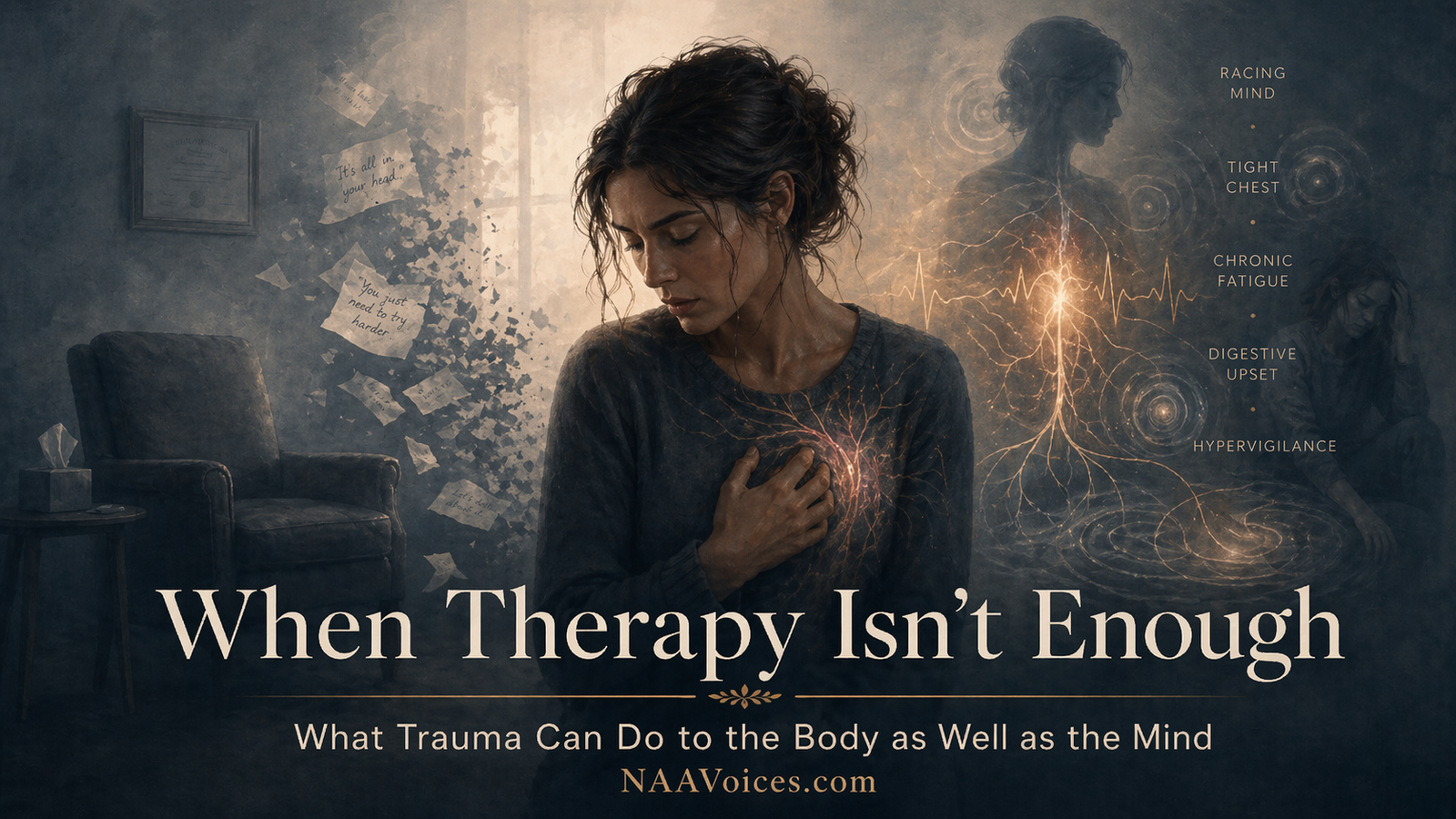
  • 🧠 When Therapy Isn’t Enough: A Reflective Journey into Psychosomatics

    🧠 When Therapy Isn’t Enough: A Reflective Journey into Psychosomatics

    NAAVoices was not created from certainty, but from lived experience and professional insight. As I migrate earlier work from the original platform, this post has been reviewed and approved for transfer. It remains true to its original context, with only minor clarity edits where needed. Some moments do not require rewriting to remain honest.

    Earlier this year, I was told I did not meet the threshold for further trauma support.

    That sentence stayed with me.

    Not because I expected miracles. Not because I believed therapy would undo what had happened. But because when you are already doing everything you can to hold yourself together, being told you do not qualify for more help lands heavily. It can feel less like a clinical decision and more like being quietly told to carry on alone.

    I had completed ten weeks of what was meant to be CBT, but it did not help in the way I needed at that time. Looking back, that makes sense. It is hard to process trauma while still living inside the aftermath of it. It is hard to ā€œwork onā€ what happened when your body still feels on alert, your life still feels unstable, and your mind is still trying to survive.

    When that support ended, there was no real next step. No clear path. No space to properly make sense of what trauma had done to me, not only emotionally, but physically too.

    That experience became a turning point.

    I started studying psychology and neurodiversity in mental health because I needed more than short-term coping strategies. I needed understanding. I needed to know why trauma was not just living in my thoughts, but in my body. I needed language for the exhaustion, the fear, the racing heart, the overwhelm, and the strange way the body can keep sounding the alarm long after other people think the danger has passed.

    For me, understanding matters. I need to know the why, not just the what. Without that, symptoms can feel frightening and shapeless. I was not looking for an academic answer for the sake of it. I was trying to understand survival.

    This is what keeps coming back to me: sometimes therapy is not enough on its own. Sometimes the problem is not that someone is unwilling to heal. It is that their body has been carrying too much, for too long, with too little understanding around it.

    When the Body Starts Speaking

    Psychosomatics is one of those words that can immediately put people on edge.

    Too often, it gets mistaken for ā€œit’s all in your head.ā€ For many people, that sounds dismissive, belittling, or dangerously close to not being believed.

    But that is not what it means.

    It means the body and mind are deeply connected. It means long-term stress, fear, trauma, grief, and emotional overload can affect the body in real and powerful ways. It means what happens to us emotionally does not stay neatly contained. It can show up through chest pain, dizziness, palpitations, poor sleep, exhaustion, stomach problems, muscle tension, headaches, pain, and countless other symptoms.

    The body does not forget simply because a person is trying to cope.

    And the body does not separate trauma into tidy boxes just because healthcare systems often do.

    The Gap Between Mental Health and Physical Health

    One of the things I have seen most clearly, both personally and professionally, is how often physical health and mental health are still treated as though they belong in separate conversations.

    On paper, we speak about holistic care, person-centred practice, and joined-up working. In reality, services are stretched, time is limited, and thresholds are high. That means the wider picture is not always explored, even when it should be.

    But people do not fall apart in separate categories.

    Stress at home affects the body. Fear affects the body. Caring responsibilities affect the body. Trauma affects the body. Living on edge for too long affects the body. So do exhaustion, grief, financial strain, coercion, and emotional isolation.

    When those realities are missed, the person behind the symptoms can be missed too.

    And that is where harm can quietly deepen.

    What Was Missed in My Own Experience

    For a long time, I sought help for symptoms including tachycardia, palpitations, dizziness, chest pain, low blood pressure, and ECG changes. I remain grateful that these symptoms were taken seriously and investigated thoroughly. They should have been.

    But what was less explored was the context around them.

    At the time, no meaningful link was made between what my body was doing and the prolonged stress and trauma I was living through. With hindsight, greater knowledge, and distance from that environment, I can now see that chronic trauma and ongoing stress were likely significant factors in how those symptoms appeared and persisted.

    Many improved once I was no longer living in the same circumstances. Some still return when stress becomes intense. That does not mean the symptoms were ever unreal. It means the body had been responding to more than one kind of threat.

    That is the part I wish more people understood.

    A nervous system under prolonged strain does not simply switch off because someone is trying their best. Survival leaves traces. Sometimes those traces are emotional. Sometimes they are physical. Often they are both.

    This is not about blaming individual clinicians. It is about recognising how powerful one question can be:

    What else is happening in this person’s life?

    Sometimes that question opens a door that blood tests and scans alone cannot reach.

    Why Being Believed Matters

    One of the hardest parts of trauma is not only what happened. It is what happens afterwards when your reality is minimised, misunderstood, or only partly seen.

    That is why language matters so much.

    When someone is told ā€œit’s probably stressā€ without explanation, it can feel like dismissal. But when someone explains that prolonged stress and trauma can affect the nervous system, sleep, pain, digestion, concentration, blood sugar, heart rate, and overall health, that feels different. That feels grounding. That gives shape to what otherwise feels frightening and invisible.

    People often need words not because they want a label for the sake of it, but because language can reduce shame. It can replace self-doubt with understanding. It can help someone realise they are not weak, dramatic, or failing. They are responding to what they have lived through.

    Validation is not indulgence. It is part of safe, humane care.

    What Clinical Practice Keeps Showing Me

    Working in healthcare has only deepened this belief.

    It is easy, especially under pressure, to focus on the numbers. Blood pressure. Blood sugar. ECG findings. Medication changes. Risk markers. Those things matter. Of course they do.

    But people’s lives matter too.

    I have seen how quickly physical health can worsen when someone is carrying unseen emotional strain, trauma, caring burdens, or simple relentless exhaustion. Sometimes what looks like poor control or non-engagement is actually overload. Sometimes what looks like someone ā€œnot coping wellā€ is the entirely understandable impact of carrying too much with too little support.

    Being listened to properly does not solve everything. But it does something important. It reduces shame. It builds trust. It reminds someone they are more than a set of symptoms to be managed.

    That should never be underestimated.

    The Point I Keep Coming Back To

    Psychosomatic understanding should never be used to minimise physical symptoms. It should be used to widen the lens.

    The mind and body are not rivals. They are not separate stories. They are part of the same human experience.

    Trauma does not only affect thoughts. It affects sleep, energy, heart rate, pain, concentration, appetite, blood sugar, resilience, and recovery. Chronic stress does not just sit quietly in the background. It changes the way a person lives in their body.

    That is why this matters.

    Take the symptoms seriously.
    Take the context seriously.
    Take the person seriously.

    Because sometimes the most important part of care is not only identifying what is wrong. It is understanding what has happened, what is being carried, and what has been missed.

    And sometimes, being truly heard is the first moment healing feels remotely possible.

    Let’s Talk

    Have your physical symptoms ever been affected by stress, trauma, or overwhelm?

    Have you ever felt that part of your story was missed when help was being offered?

    What helps people feel believed, understood, and supported?

    What would you change about the way healthcare approaches the connection between mind and body?

    My Lived Experience: A Personal Journey Through Trauma and Recovery
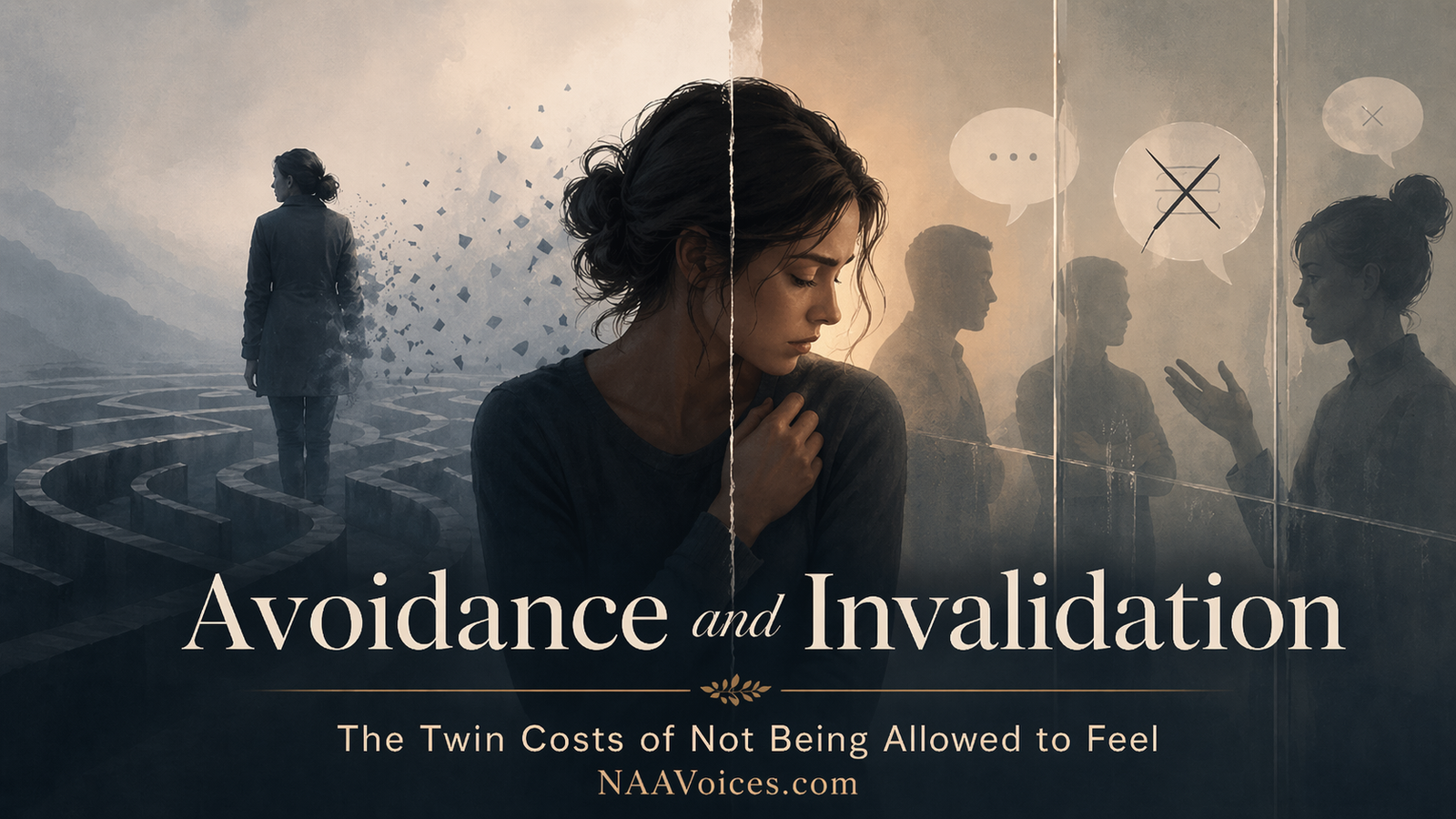
  • Avoidance and Invalidation — The Twin Costs of Not Being Allowed to Feel

    Avoidance and Invalidation — The Twin Costs of Not Being Allowed to Feel

    NAAVoices was not created from certainty, but from lived experience and professional insight. As I migrate earlier work from the original platform, this post has been reviewed and approved for transfer. It remains true to its original context, with only minor clarity edits where needed. Some moments do not require rewriting to remain honest.

    Avoidance, Honestly Defined

    Avoidance is easy to judge when you are looking at it from the outside.

    People call it denial. Running away. Burying your head in the sand. Refusing to deal with things.

    But that is not what it feels like when you are the one living it.

    Avoidance is not always weakness. It is not laziness. It is not a character flaw. Sometimes it is what happens when your mind and body learn, over time, that feeling too much is dangerous. That speaking is dangerous. That reacting honestly is dangerous. So instead, you push things down. You stay busy. You distract yourself. You numb out. You tell yourself you will deal with it later, when things are calmer, when you are stronger, when life gives you room to breathe.

    The problem is, later does not always come.

    What protects you in the moment can quietly trap you over time. Avoidance can get you through the day. It can help you function when the truth feels too heavy to carry. But it does not make the pain disappear. It just asks your body to hold it for longer.

    And the body does hold it.

    I know that now in a way I wish I did not.

    I live with the cost of it every day. Years of swallowed emotion. Years of pretending I was coping better than I was. Years of trying to stay composed, stay useful, stay needed, stay upright, while so much inside me was never given space to land. Four years of pain that never really had anywhere safe to go. Four years of being hurt, dismissed, frightened, invalidated, and still having to carry on.

    Those feelings do not just vanish because no one makes room for them. They settle somewhere. In your chest. In your stomach. In your sleep. In the constant tension in your body. In the exhaustion that never quite lifts. In the way your nervous system starts reacting before your mind has even caught up.

    That is the part people do not always see.

    Avoidance is not the absence of feeling. It is often the result of feeling too much, for too long, with nowhere safe to put it.

    And insight does not magically fix that. Understanding yourself does not suddenly make it easy to face the things you have spent years surviving. Sometimes it just means you can finally see the damage more clearly.

    Facing things is still hard. It is still painful. It is still exhausting.

    But eventually it stops being optional.

    Eventually, you realise the things you are trying not to feel are shaping your life anyway.

    Invalidation, Quietly Defined

    Invalidation can be hard to explain because it does not always look cruel from the outside.

    Sometimes it is obvious. Sometimes it is being told you are overreacting, being too sensitive, making a fuss, taking things the wrong way. Sometimes it is someone directly dismissing what you feel as though it does not matter.

    But often it is much quieter than that.

    It is the tone that tells you your feelings are inconvenient.
    It is the quick change of subject when you finally say something real.
    It is being ā€œreassuredā€ in a way that leaves no room for your actual experience.
    It is someone explaining your own pain back to you in a way that makes it smaller, neater, easier for them to sit with.
    It is being encouraged to move on before you have even been allowed to feel what happened.

    That is what makes invalidation so damaging. It does not always sound harsh. Sometimes it sounds reasonable. Calm. Practical. Well-meaning, even.

    But the impact is the same.

    You are left questioning yourself. Wondering whether you are too much. Whether your feelings are too big. Whether your reactions are wrong. Whether you are somehow the problem for being hurt by what hurt you.

    That kind of damage settles deeply, especially when it happens over and over again.

    Because after a while, you stop needing other people to dismiss your feelings. You start doing it for them. You get there first. You shrink your own experience before anyone else has the chance. You explain it away. Minimise it. Silence it. You become fluent in making your pain more acceptable to other people.

    And that is a heartbreaking way to live.

    Not all invalidation is deliberate. I know that.

    Some people genuinely do not know how to sit with another person’s emotions. Some were never taught that validating someone is not the same as agreeing with everything they say. Some people panic in the face of pain and rush to fix, soften, tidy, or redirect because they cannot tolerate the discomfort of simply witnessing it. Some people are so exhausted themselves that they have nothing left to offer.

    That may explain it.

    But it does not undo the harm.

    Intent matters, yes. But impact matters too. And being repeatedly left feeling unseen, doubted, or emotionally unsafe changes you, whether or not the other person meant it to.

    Holding the Line

    What I have learned, slowly and painfully, is that my feelings are not the problem.

    They are not an inconvenience. They are not a nuisance to be managed. They are not proof that I am weak, difficult, dramatic, or broken.

    They are information.

    They are my body and mind telling the truth about what I have lived through.

    They are the evidence of what something cost me.

    And other people’s discomfort with my feelings does not make those feelings less real. It does not make them less valid. It does not make me wrong for having them.

    I think when you have lived for years in environments where your feelings were dismissed, minimised, twisted, or ignored, you can start to lose touch with that. You start to believe that keeping the peace matters more than being honest. That staying quiet is safer than being real. That being easy to deal with is the same as being okay.

    It isn’t.

    There is a difference between surviving by shutting things down and actually healing. A huge difference.

    And I am no longer willing to keep abandoning myself just because other people find emotion uncomfortable.

    I refuse to keep treating my pain like an inconvenience.
    I refuse to keep apologising for having real human reactions to real human harm.
    I refuse to let years of being made to feel invisible convince me that I am still invisible now.

    The echo of those four years is still there. I feel that. Some days more than others.

    But I am learning, slowly, that not being allowed to feel is its own kind of damage.

    And I am done helping it silence me.