Tag: Resilience

  • Do I Believe in Karma

    Do I Believe in Karma

    Do you believe in karma?

    I don’t think it’s that simple.

    We like the idea of karma because it makes the world feel fair.

    Do good, and good will eventually find you.

    Cause harm, and somehow, somewhere, life will make you answer for it.

    But I’ve lived long enough to know that life doesn’t always work like that.

    I’ve watched good people suffer because of things they never caused, never deserved and could not have prevented.

    I’ve watched people carry trauma created entirely by somebody else’s choices.

    And I’ve watched people do hideous things and seemingly walk away from them.

    So where is the karma in that?

    If a good person is harmed, traumatised and left rebuilding their life while the person who caused it carries on as normal, are we really supposed to believe the universe has somehow balanced the scales?

    I don’t.

    At least, not in the traditional sense.

    Maybe karma isn’t punishment.

    Maybe it isn’t some invisible court where every wrong eventually receives an equal sentence.

    Maybe sometimes there simply isn’t justice.

    That is uncomfortable to admit, particularly when you have spent years waiting for accountability.

    But perhaps there is another way of looking at it.

    The person who harmed you does not get to decide who you become afterwards.

    They may have changed your life. They may have left consequences they never have to carry themselves. They may never fully understand the damage they caused.

    But surviving does something too.

    You learn.

    You rebuild.

    You become more discerning about who gets access to you.

    You recognise things you once overlooked.

    You speak when you once stayed silent.

    Sometimes you even take what nearly destroyed you and turn it into something that helps somebody else survive.

    That isn’t karma.

    And I don’t particularly like calling it a “lesson”, either. Some things should never have happened in the first place.

    It is simply what human beings can sometimes do with what remains.

    So, do I believe in karma?

    Not really.

    I believe actions have consequences — although frustratingly, those consequences don’t always land on the person who caused the harm.

    I believe accountability matters precisely because we cannot rely on the universe to provide it.

    And I believe being a good person does not guarantee you a painless life.

    Perhaps the better question isn’t whether the people who hurt us eventually get what they deserve.

    Perhaps it’s whether we can reach a point where their future no longer determines ours.

    Because I don’t want to spend the rest of my life waiting for karma.

    I’ve already spent enough of it waiting.

    NAAVoices.com

  • The Bravest Thing I Did When No One Was Watching.

    The Bravest Thing I Did When No One Was Watching.

    I have thought about this question deeply, and my answer is actually quite simple.

    I kept going.

    When the curtains were closed. When the doors were locked. When the world saw nothing but silence from me, I kept going.

    I have been thinking a lot lately about something we do not talk about nearly enough.

    Post-traumatic growth

    We focus so much, and rightly so, on the weight of trauma. The reliving. The triggers. The dissociation. That buzzing sensation inside your head when you finally realise you have had enough and just need to reset.

    I know all of this intimately. I live with PTSD.

    I know how much heavier injustice feels when your nervous system is already stretched thin. I know the days when I have been so badly triggered that I could not sleep or leave the house, and the mornings when simply getting up and functioning took far more effort than anybody around me could possibly have known.

    There were nights I lay awake. Mornings when breathing felt like work. Days when I was trying to hold myself together while still holding everyone else up.

    But recently, I had to look back over the last couple of years to complete an application. As I pulled everything out and laid it all down in front of me, I saw something I had never really allowed myself to see before.

    Just how much I had actually achieved while learning to live with all of it.

    That was when I started thinking properly about post-traumatic growth.

    It does not mean the pain was not real

    For a long time, trauma brought pain with silence.

    Looking back, though, that silence was not empty.

    It was where I listened, learned, observed, questioned and slowly rebuilt. Most of it happened quietly, without recognition and without me even realising at the time that rebuilding was what I was doing.

    I did not grow instead of being affected by trauma. I grew while being affected by it.

    The triggers still come. Hard days still happen. There are things I have to manage now that I never had to manage before.

    Growth does not erase any of that.

    It simply means that somewhere amongst it all, I changed too.

    What growth actually looks like for me

    People often talk about growth as though it is something polished and neat.

    Mine isn’t.

    I built this space online. Not because I wanted recognition, but because people reached out. Some came back. Some told me that something I had written made them feel understood.

    I don’t blog religiously. I write when something reminds me, when I need to get words out, or when something sparks something in me.

    It is messy. Sporadic. Real.

    And that is exactly how I want it to be.

    I carried my family through some incredibly difficult years. I supported all three children who, at different points, needed additional mental health support themselves, while also navigating my own struggles.

    There were days when I felt as though I had absolutely nothing left and still somehow found something.

    I have also changed in the way I deal with fear.

    I joke sometimes that I care less these days, but that isn’t really true. I still care deeply. I have never wanted to act out of malice, and I never want difficult experiences to turn me into somebody who does.

    What changed is that I stopped being frightened of other people’s reactions to me doing what I believe is right.

    I no longer automatically carry somebody else’s judgement as though it must say something about me. After having my character torn apart in court, something shifted.

    I promised myself nobody would ever twist who I am and make me question myself like that again.

    At the time, I felt I had already faced the very worst.

    And I was still here.

    My voice became stronger.

    I advocate fiercely now when something is wrong.

    I have also learned constantly. Not simply to understand myself, but because I wanted to understand other people better. I started noticing gaps in my own knowledge and going away to fill them.

    Not for recognition. Not for another certificate on the wall.

    Simply because sometimes another human being is standing in front of you and you want to understand how best to help them.

    And some of my growth has looked far less. Five weeks ago, I hammer-jacked up a 16ft square concrete base and laid an 11ft square patio entirely on my own. I was absolutely shattered afterwards. I fitted my own kitchen from scratch.

    I am one part away from earning my full A motorcycle licence so I can ride a big motorbike.

    They might sound like completely random things to include in a piece about trauma.

    They aren’t.

    Every one of them represents something I might once have questioned whether I could do.

    So I did it.

    Some were done on difficult days when I was exhausted or overwhelmed. Sometimes having work, projects, or something practical to focus on gave me routine and purpose when other parts of life felt heavy.

    Sometimes every part of me wanted to curl up and hide.

    I did it anyway.

    A new chapter, and proof of what I am capable of

    Now I am hopefully stepping into another chapter of my career.

    The last time I chose to study at postgraduate level, I did it for a very different reason.

    I needed to understand.

    Behaviour. People. The brain. Trauma.

    I was trying to make sense of what I had lived through while, in many ways, I was still living through it.

    I was experiencing post-separation abuse and was diagnosed with PTSD during my second module. At the time, I never truly believed I could succeed.

    Yet I completed my postgraduate certificate with a distinction.

    There were assignments written through tears. Nights spent awake learning about trauma and domestic abuse while simultaneously beginning to understand what had happened to me.

    There was something surreal about studying the impact of trauma academically while living with its consequences personally.

    What I gained from that postgraduate course was far more than academic knowledge.

    It gave me evidence. Evidence of exactly what I am capable of.

    I can see that now, though I couldn’t see it then.

    Trauma did not give me my strength, my determination, my compassion or my voice. Those parts of me were already there.

    What the experience did was force me to discover just how much of them I had.

    I walked through abuse, diagnosis, trauma and some incredibly dark periods without allowing those experiences to decide who I would become.

    Other people do not get to define who I am or what I am capable of. There were days when I genuinely could not see an end to any of it. Now I look back at the person I have become and think:

    My God. I have changed.

    Not into somebody hardened or bitter.

    Into somebody far harder to silence.

    And perhaps that is what post-traumatic growth means to me.

    Not pretending something terrible became something wonderful.

    Not being grateful for trauma.

    Not saying everything happens for a reason.

    I don’t believe any of those things.

    It is recognising that something hurt you profoundly and that, while learning to live with what it left behind, you built something too.

    So is post-traumatic growth real?

    I believe it is.

    Post-traumatic growth, or PTG, is the term used to describe positive psychological changes that some people experience while struggling with highly challenging or traumatic life events.

    It is commonly described across five broad areas.

    Appreciation of life. Priorities change. Things once taken for granted can suddenly matter far more.

    Relating to others. Connections can deepen. Compassion can become stronger.

    Personal strength. That realisation of: I survived something I once did not think I could.

    New possibilities. New interests, ambitions, paths or directions can emerge.

    Spiritual or existential change. A changed sense of meaning, purpose or understanding of life.

    But I think it is incredibly important that we do not romanticise it.

    Post-traumatic growth does not mean trauma was beneficial.

    It does not mean somebody should be grateful for what happened to them.

    And it certainly does not mean that somebody who continues to struggle has somehow failed to grow.

    Growth and distress can exist at exactly the same time.

    You can be stronger and still be triggered.

    You can have found your voice and still have days when using it feels impossible.

    You can rebuild huge parts of your life and still grieve for the parts that were damaged.

    Both things can be true.

    I will never be exactly the person I was before.

    I no longer see that entirely as a loss.

    I still have my kindness. That never left.

    But now it has backbone behind it. Purpose. Knowledge. And a voice that I worked incredibly hard to find.

    I didn’t wait until I felt completely healed to start rebuilding my life.

    I built my life while I was healing.

    And perhaps, more than anything else I have written here, that is what post-traumatic growth means to me.

    Trauma brought pain with silence.

    But the silence did not stay empty.

    So, back to the question that started all of this.

    What is the bravest thing I have ever done when no one was watching?

    I kept going.

    And somewhere in all that silence,

    I grew.

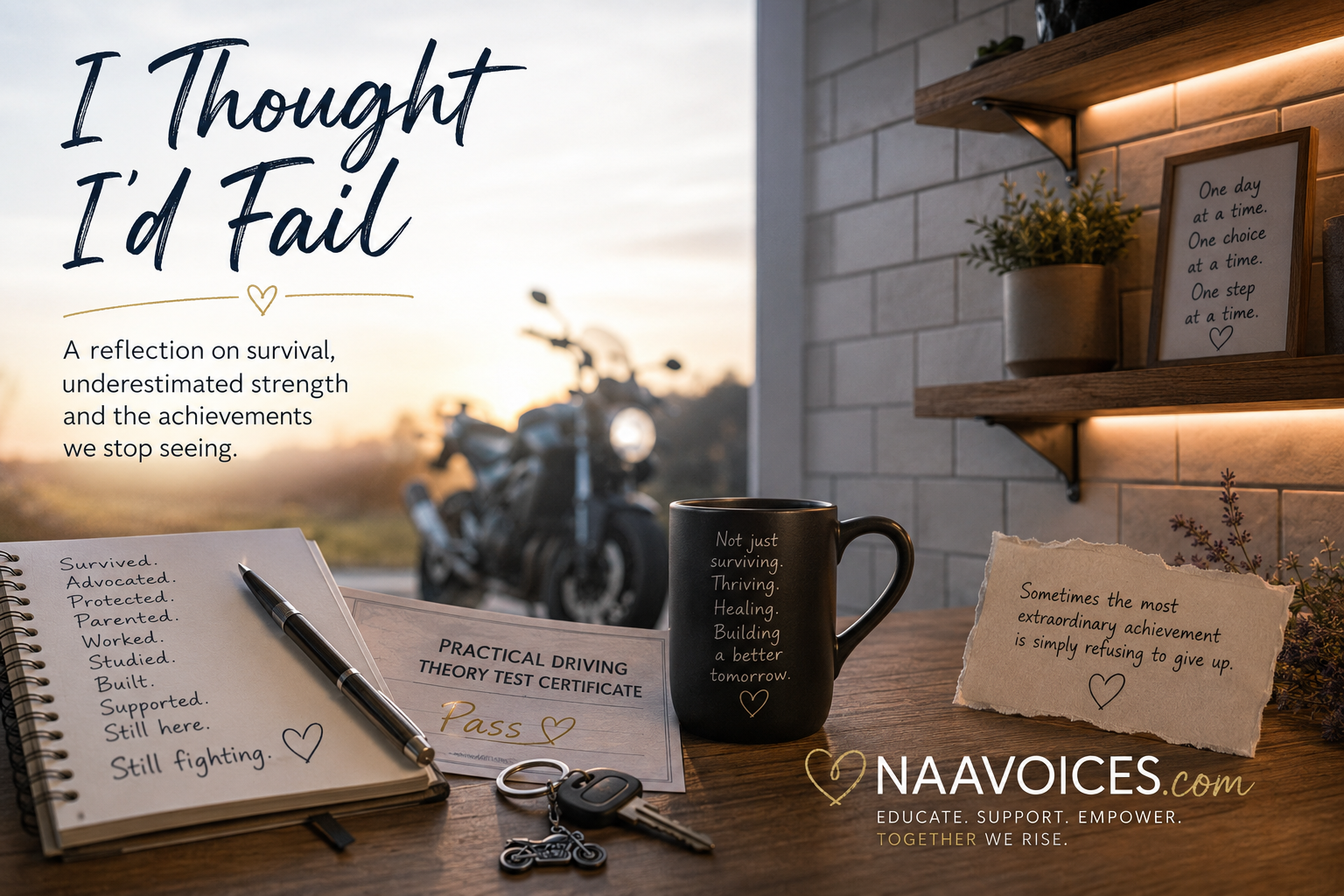
  • I Thought I’d Fail

    I Thought I’d Fail

    Content note: this piece touches on domestic abuse, coercive control, PTSD, suicide, self harm and disordered eating. Please look after yourself while reading, and come back to it another time if today is not the day.

    A week ago, I went to speak to my boss.

    Not about work.

    Not really.

    I had just received a letter from social services.

    Two days later I phoned and the letter was explained to me, my ex partner had been found intoxicated and attempting to obtain drugs. What caused my trauma to tighten was the location. The services that had attended to him meant he could be within the close vicinity. That prompted a fear to return.

    One of the first times in 3 years a service has done what it had a duty to do.

    Protect my child

    As I listened, I felt physically sick.

    Not because I was shocked.

    Because I wasn’t.

    What devastated me was how familiar it all felt.

    For years, I had tried to explain the pattern.

    The alcohol.

    The drugs.

    The chaos.

    The risk.

    The concerns that had led me through police disclosures, safeguarding referrals, social services involvement and family court proceedings.

    Years of being told things needed evidence.

    Years of being told the threshold wasn’t met.

    Years of fighting to protect my child.

    Years of watching systems make decisions that I feared would place her at risk.

    And now, more than two years later, I was staring at the wall attempting to not vomit listening to to a safeguarding professional describing the very pattern I had spent years trying to explain.

    I remember sitting there thinking:

    Why did the family court do this?

    Why did the police do this?

    Why did nobody listen?

    The truth is that PTSD does not care whether you have work the next morning.

    It does not care that people depend on you.

    It does not care that you have responsibilities.

    It simply reacts.

    And my body reacted.

    The vomiting returned.

    Years ago, after leaving the relationship, I lost four stone in seven weeks.

    Not because I wanted to.

    Not because I was dieting.

    Not because I was trying to lose weight.

    My body simply stopped coping.

    Food became impossible to keep down.

    Stress took over every system.

    Eventually I regained the weight.

    With the support of some incredible people around me, I became healthier again.

    But when those old symptoms started creeping back, it frightened me.

    Not because of the weight.

    Because I knew what it represented.

    I knew how much pressure my body had been under the last time it happened.

    The list

    So I went to speak to my boss.

    As usual, I tried to minimise it.

    “It is what it is.”

    “People have it harder than me.”

    “I don’t want anyone worrying.”

    The sort of things many trauma survivors become experts at saying.

    He listened.

    Then he said something that caught me completely off guard.

    He told me to write a list of everything I had achieved.

    Not professionally.

    Not academically.

    Everything.

    At first, I almost laughed.

    Because when life has been relentless for so long, you stop seeing achievement.

    You only see survival.

    You see the next appointment.

    The next safeguarding concern.

    The next form.

    The next court hearing.

    The next problem.

    The next thing that needs doing.

    The test

    Then, a few days later, I passed my motorbike theory test.

    I walked into that test convinced I was going to fail.

    I hadn’t revised.

    I hadn’t opened the Highway Code.

    I hadn’t done any preparation worth talking about.

    I sat there expecting the result to confirm what I had already decided in my head.

    That I wasn’t ready.

    That I hadn’t done enough.

    That I would fail.

    Instead, I passed.

    And on the drive home, I found myself thinking about what my boss had said.

    Maybe I have been underestimating myself for a very long time.

    Telling it, again and again

    Three years ago, I left an abusive relationship.

    Nineteen months ago, I started repeatedly reliving it.

    Not once.

    Not twice.

    But over and over again.

    To police officers.

    To social workers.

    To safeguarding professionals.

    To lawyers.

    To court officials.

    To agencies.

    To organisations.

    To anyone who needed another statement, another disclosure, another explanation or another piece of evidence.

    I have spent hours recording evidence.

    Attended multiple court hearings.

    Repeatedly revisited some of the worst experiences of my life because systems required me to explain them again.

    And again.

    And again.

    Somewhere in the middle of all of this, I was diagnosed with PTSD.

    Looking back, the diagnosis made perfect sense.

    The hypervigilance.

    The insomnia.

    The exhaustion.

    The flashbacks.

    The inability to truly relax.

    The constant feeling that danger might be waiting around the corner.

    Two years ago, I started my Direct Access course.

    I loved it.

    I was excited about it.

    I wanted it.

    Then the third court hearing arrived.

    Everything leading up to it consumed me.

    Everything that followed it took whatever was left.

    Eventually, I had to stop.

    For a long time, I viewed that as failure.

    Today, I don’t.

    Today, I see someone making an impossible decision while carrying more than anyone should ever have to carry.

    Everything that didn’t stop

    Because while all of that was happening, life did not stop.

    I still had three children who needed me.

    I supported my son through an eating disorder.

    I sat beside him after a suicide attempt.

    I navigated self harm, CAMHS referrals, mental health services, social care involvement, safeguarding concerns and endless appointments.

    I advocated for my youngest child when safeguarding concerns surrounding her protected characteristics meant she could no longer safely remain where she was.

    I attended meetings.

    Completed forms.

    Made phone calls.

    Chased referrals.

    Protected.

    Advocated.

    Parented.

    Then got up and did it all again the next day.

    At the same time, I continued working full time.

    I continued caring for patients.

    I advocated for people.

    I identified serious illness.

    I improved systems.

    Created databases.

    Developed resources.

    Introduced new services.

    Built governance tools.

    Supported colleagues.

    I created a workplace training database.

    Built induction resources.

    Introduced new clinical initiatives.

    Alongside that, I supported people through family court proceedings.

    Supported others through criminal proceedings.

    Spent countless hours helping survivors of domestic abuse navigate systems that often feel impossible to understand.

    I founded a website from what started as a personal blog.

    Then rebuilt it.

    Expanded it.

    Turned it into something bigger than myself.

    A place where other survivors might find information, support and understanding.

    At home, I became whatever was required.

    Decorator.

    Builder.

    Plumber.

    Problem solver.

    DIY specialist.

    I knocked down walls.

    Built new ones.

    Fixed toilets.

    Painted rooms.

    Tiled walls.

    Put up shelves.

    Worked things out because there was nobody else to do them.

    In fact, today, on my day off, I spent part of the day tiling a kitchen wall and putting up shelves.

    Just another job that needed doing.

    And somehow, through all of this, I kept learning.

    I completed postgraduate study in Neuroscience and Psychology of Mental Health, graduating with distinction.

    I became an accredited Neurodiversity Coach.

    An accredited Trauma Healing Practitioner.

    An accredited Narcissistic Abuse Recovery Professional.

    I completed advanced education in safeguarding, domestic abuse, trauma, neurodiversity, learning disability, autism, eating disorders, suicide awareness, menopause care, contraception, cervical screening, cardiovascular disease, respiratory medicine, governance, emergency care, Parkinson’s disease and more.

    The majority of that learning was completed in my own time.

    Apart from statutory updates and vaccination training, most of it was done in evenings, weekends and stolen hours around work, parenting, court hearings, safeguarding concerns and PTSD.

    Reading all of that back feels uncomfortable.

    Not because it isn’t true.

    Because none of it feels remarkable.

    It just feels like life.

    It just feels like surviving.

    Maybe that’s what trauma does.

    It minimises resilience.

    It shrinks achievements until they feel ordinary.

    It teaches you to focus on everything you haven’t done instead of everything you have.

    It teaches you to see the gaps rather than the progress.

    Which brings me back to that motorbike theory test.

    I sat there expecting to fail.

    Not because of the test.

    Because somewhere along the way, I learned to doubt myself.

    What the evidence says

    Yet when I look at the evidence, the evidence tells a very different story.

    The evidence says that over the last three years I have survived things that should have broken me.

    The evidence says that while surviving, I continued to parent, work, study, advocate, build, create, protect and support others.

    The evidence says I have done far more than simply survive.

    But if somebody asked me today what my greatest achievement is, my answer would still be the same.

    Not the qualifications.

    Not the distinction.

    Not the accreditations.

    Not the website.

    Not the career.

    Not even the motorbike theory test.

    My greatest achievement is survival.

    Not because survival was passive.

    Because survival was work.

    It was getting up when I wanted to stay in bed.

    It was showing up when nobody would have blamed me for walking away.

    It was protecting my children while trying to heal myself.

    It was helping others while carrying my own pain.

    It was continuing when continuing felt impossible.

    Three years ago, I wasn’t sure what my future would look like.

    Today, I am still here.

    Still parenting.

    Still learning.

    Still building.

    Still helping.

    Still hoping.

    The worst day

    And tonight, my mind went back to the worst day.

    The day I came closer to breaking than I ever have.

    The day my deepest fear for my daughter felt real, and no matter how loudly I tried, I was not heard.

    I will not set out what was said, or where, or by whom. There is still so much I am not free to write.

    But I remember the fear.

    I remember the particular cruelty of watching someone walk away untouched, never held responsible, already rewriting the story so that he was the one who had been wronged.

    I remember thinking, with a certainty that frightened me, that I was watching a risk to my child go unrecognised.

    And then I thought about what my boss had asked me to do.

    The list.

    Everything I had achieved.

    I picked up a pen.

    And the only thing I could write was this:

    I SURVIVED.

    This piece is written in a personal capacity. It reflects my own experiences and views. It does not relate to any patient, and is not connected to my employer.

    If any of this feels familiar

    You are not alone, and support is available.

    If you or someone else is in immediate danger, call 999.

    Live Fear Free, the all Wales helpline run by Welsh Women’s Aid, offers free and confidential support 24 hours a day for anyone affected by domestic abuse or sexual violence. Call 0808 80 10 800 or text 07860 077 333.

    Samaritans is there for anyone struggling to cope, free and 24 hours a day. Call 116 123.

    Beat offers information and support for anyone affected by an eating disorder. Call 0808 801 0677.

    You can also speak to your GP or call NHS 111.
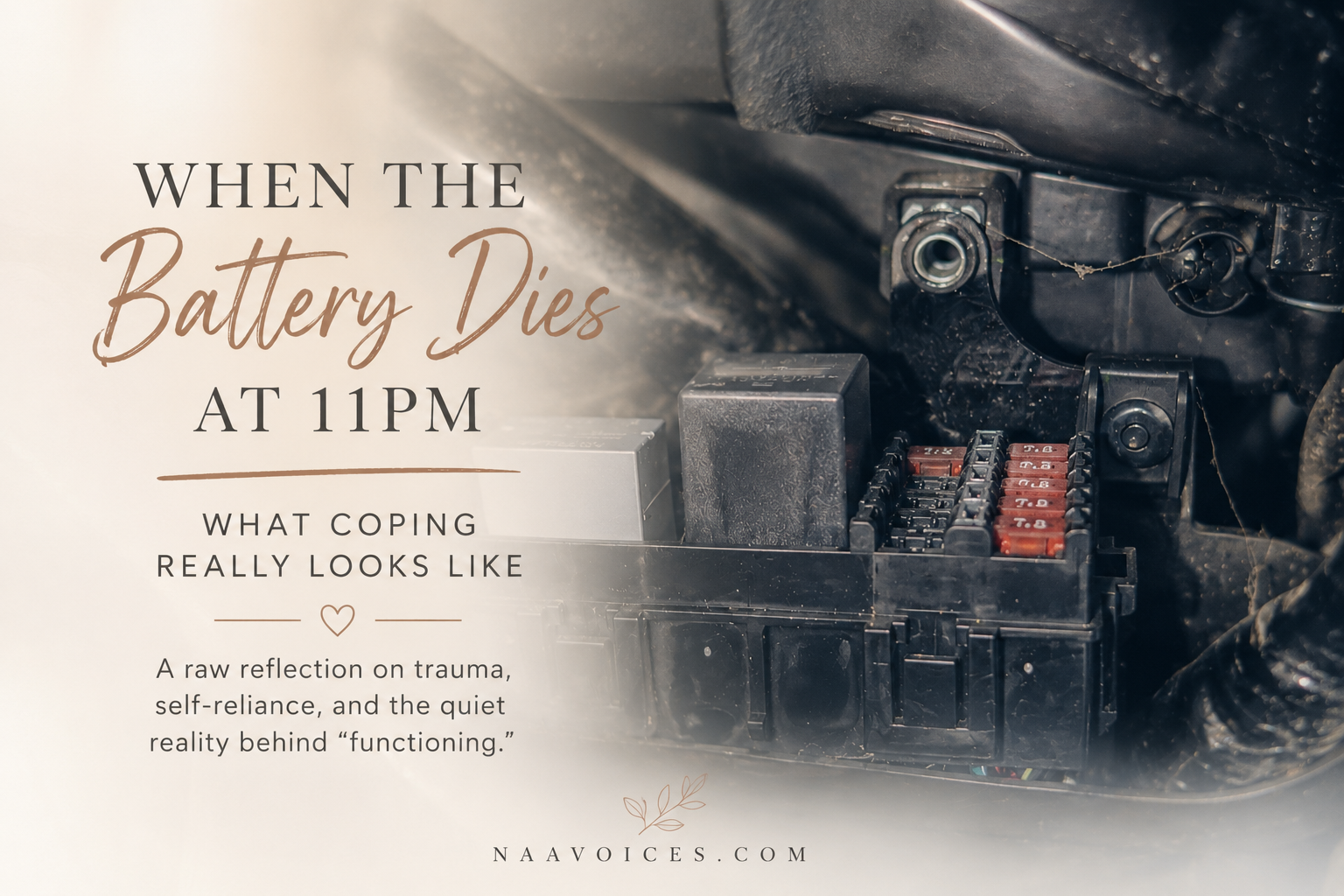
  • When the Battery Dies at 11PM: The Things That Keep Us Alive

    When the Battery Dies at 11PM: The Things That Keep Us Alive

    Sometimes healing does not look like meditation apps, neat routines, or doing everything the “right” way.

    Sometimes it looks like sitting on the floor at 11 o’clock at night beside a motorbike with the seat off, staring at a fuse box because your mind will not settle until you know whether it is the battery, the fuse, or just another thing that has fallen onto your shoulders to sort out alone.

    Tonight was hard.

    I had already spent time riding earlier because I needed to clear my head. Riding has always done that for me. I grew up on the back of a bike. I have ridden on and off for over ten years now.

    Almost two years ago, I completed my CBT for the third time. This time, I knew I was not going to let anyone take that part of me away again.

    Friends, family, and colleagues could not always understand why I would choose to ride. What they did not realise was that, at that time, I was living through things I could barely articulate. Much of it was happening in silence.

    They also did not realise that riding was one of the only things that made my whole body relax.

    At the time, I did not understand dissociation. I did not have the words for it. I only knew that I had shut down so hard in order to survive that feeling anything at all had become difficult.

    But on a bike, I could feel.

    It was never about chasing danger. It was about finding a place where my body finally stopped bracing for it. For a while, the bike was the only place where I was not waiting for the next thing to happen.

    I was just there.

    Present.

    Awake.

    Alive.

    I drove to Manchester for my test, and one of the instructors that day spoke openly about his own PTSD after serving in the army, and how riding helped him. I heard him then, but I did not fully understand it.

    It took me a year.

    Now I do.

    He had no idea what I was living through. He had no idea that six months later, I would be diagnosed with PTSD too. But his honesty stayed with me. If I ever saw him again, I would want to thank him, because sometimes people say things without realising they have given someone else language for their own survival.

    For some people, motorbikes will never make sense. In healthcare especially, there can be blunt assumptions about riders and risk. But the reality is more complicated than that.

    Risk is subjective.

    People drive cars recklessly every day. People drink. People use drugs. Chronic stress damages bodies quietly over years. Trauma changes the way people react to uncertainty, silence, fear, and pressure.

    For me, a few hours on a bike can help calm the stress responses that build up over time.

    That matters.

    Self-care matters. Feeling free matters. Sometimes freedom is simply a helmet, an engine, and a stretch of road where nobody is asking anything of you for a little while.

    When the battery was flat tonight, it threw me more than it probably should have.

    Not just because my plans for tomorrow changed, but because it triggered that familiar feeling that everything ultimately falls back onto me. So when a colleague messaged, I sent her a photo of the fuse box I was sat tinkering with, trying to rule out every possibility before the replacement battery arrives in the morning.

    Logically, I knew it could wait.

    Emotionally, I could not switch off until I had checked everything.

    Trauma can do that. When you have spent years anticipating the next crisis, the next escalation, or the next consequence, it changes how you process your own needs.

    You stop asking for help.

    You stop explaining pain.

    You just keep functioning.

    My best friend lives miles away, but she always knows when something is wrong because I go quiet. I shut off. I disappear into doing. Into fixing. Into surviving. Into movement.

    That was me tonight.

    The reality is that there has never really been anyone coming to save me. I learned that a long time ago.

    There is no emergency contact for emotional exhaustion. In reality, I do not even have an emergency contact listed anywhere. No obvious person to name. No automatic safety net. No rescue team arriving when life becomes too heavy.

    Most of the time, I am the person people call when they need help.

    And honestly, I do not resent that.

    Caring for others is part of who I am. It is woven into both my personal life and my professional identity. Supporting people matters to me deeply.

    But some nights I understand why others want to be in a relationship, and why they need that side of life. Not to be rescued. Not because they are weak. But because steady, practical, human support matters. Someone safe to call. Someone who notices when you go quiet. Someone who understands that even capable people get tired.

    For me, that still feels complicated. When you have been through enough, closeness can feel less like comfort and more like risk. But I understand why people still want that connection. It is not about needing to be saved. Sometimes it is simply about not having to carry everything alone.

    Social media is full of messages about independence. About not needing anyone. About strength meaning self-sufficiency.

    But I do not think most people genuinely want to do life entirely alone.

    I think many of us simply adapt to the absence of reliable support. We become resilient because we had no alternative. We become independent because dependence was unsafe. We learn to survive because survival was required.

    And eventually people mistake survival for not needing connection.

    Tonight reminded me that healing is rarely neat.

    Sometimes it is deep conversations and therapy sessions.

    Sometimes it is practical problem-solving.

    Sometimes it is a fuse box under a motorbike seat at 11PM because your mind needs certainty before it can rest.

    Maybe that is why we need to talk more honestly about what coping really looks like. Not the polished version. Not the inspirational quote version. The real version. The late-night, practical, messy, human version.

    Because sometimes the people who look the most capable are the ones quietly holding everything together with no emergency contact, no safety net, and no room to fall apart.

    And maybe that deserves a little more understanding too.

    NAAVoices.com

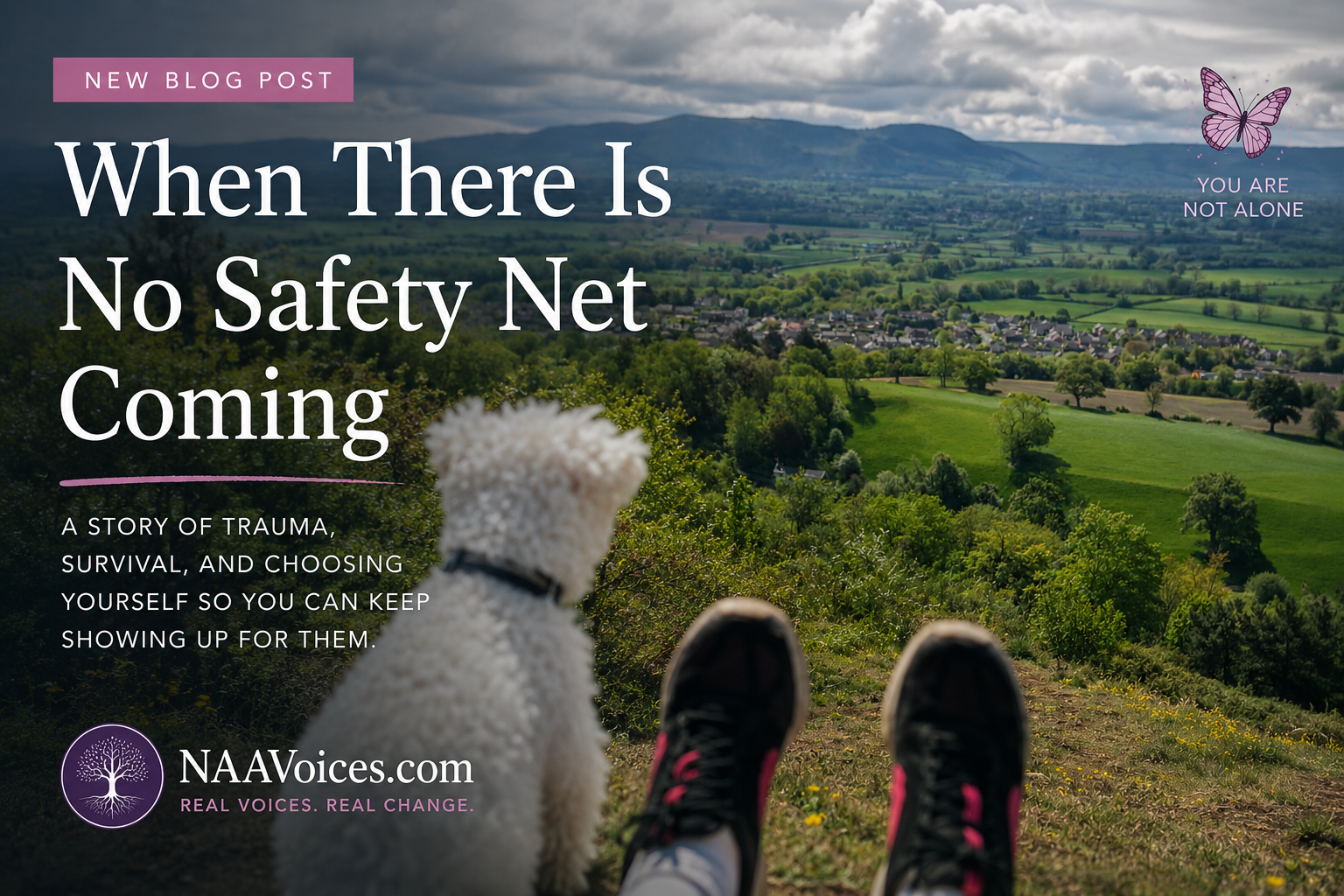
  • When There Is No Safety Net Coming

    When There Is No Safety Net Coming

    This weekend was difficult.

    The events that unfolded were directly linked to the abuse my children lived through. I will not expand on those details publicly because some things belong to them, not the internet. Their story is not mine to expose. My role is to protect it, even while telling the truth about what trauma leaves behind.

    Friday also marked the anniversary of my ex’s arrest. For a short time, I believed that moment meant safety had finally arrived. The reality that followed was very different. What came afterwards exposed my children and family to risks I never thought possible, not only through one individual, but through systems and institutions that were supposed to protect us.

    This weekend was not only about an anniversary.

    It was about what resurfaced because of it.

    Trauma does not disappear because time passes. It shows up in behaviours, emotions, reactions, fear, anger and overwhelm. Especially in children.

    And when it does, the hardest reality is not just managing the moment. It is knowing that, when everything falls apart, me and the kids only truly have me.

    There is no reliable safety net arriving. Not in the way people imagine. Not consistently. Not when the damage has already been done and the consequences are still living inside my children.

    That is why I went to the rocks.

    Not because I had spare time. Not because it was scenic. Because my body knew I needed to reset before I broke under the weight of it.

    People often think trauma lives in memory alone. It does not.

    The body remembers what the mind tries to forget.

    Certain dates pull you backwards. Certain places do too. Sometimes it arrives without warning, tightness in your chest, pressure in your throat, a sudden need to move, drive, breathe, or escape. For years, I did not understand why I instinctively sought out open spaces, music, nature, long drives or silence.

    Now I do.

    This morning, I drove the children to school and then headed to the rocks, the same place I used to go after leaving. I remember the first few times I went there. I cried most of the drive. At the time, I did not understand why being there mattered so much.

    Looking back, I can see that my body was searching for regulation before my mind had fully processed what had happened.

    People can dismiss walking, music, fresh air, the sea, nature, or grounding techniques as “airy-fairy”. They are not. The nervous system carries trauma. It also recognises safety, rhythm, space and movement before we always have the words for why they help.

    Trauma changes the way you live. I have certain clothes I wear because they make me feel safer. Certain items I keep with me. Certain routines, places and songs that act as anchors. They may look insignificant to anyone else, but to a traumatised nervous system, they are reminders that I have survived before and can survive again.

    Today I walked to the top, somewhere I had not climbed since carrying my then three-year-old on my back with the dog beside me.

    It was almost comical at times. I avoided the proper path and ended up climbing through brambles instead. At one point, I was practically on my hands and knees dragging myself up the final stretch just to reach the spot I needed to get to.

    And the dog never left my side.

    She kept stopping and looking back to check where I was. No formal training. No commands. Just instinctively staying close while I crawled through mud, brambles and exhaustion towards somewhere my body had decided mattered.

    When I finally got there, I sat.

    Headphones on. Music playing. Breathing.

    For the first time in a while, everything went quiet.

    Walking back down, I did not want to leave. I circled for a while, climbed back through the brambles again, and delayed going home because something about being there made me feel human again.

    Maybe that is what healing sometimes is.

    Not fixing everything.

    Not pretending it never happened.

    Just finding a moment where your nervous system stops fighting long enough to let you breathe.

    There is a version of me that existed before all of this, and I know now I will never fully be that person again. For a long time, that grief consumed me. I thought being broken meant I had lost myself forever.

    But being broken also gave me understanding.

    It changed the way I see pain in other people. It taught me to recognise what fear, exhaustion and trauma can look like beneath behaviour. It changed the way I advocate, the way I work, the way I parent, and the way I see injustice.

    When you have lived through institutional failure, coercive control and fear, you begin to understand how many people are silently carrying things nobody else can see.

    I have spent much of my life giving other people what I never had myself, support, compassion, protection and reassurance. Somewhere along the way, I forgot that self-care is not selfish.

    It is necessary.

    Because school runs still happen.
    GCSEs still happen.
    Parenting still happens.
    Life still continues.

    Today, my 15-year-old came home after his first GCSE exam.

    I asked him how it went.

    He shrugged and said he did not even understand the question.

    And I just told him, “You’re fine, as long as you tried your best.”

    Because honestly, after everything he went through last year, I did not know whether he would emotionally make it to this point. Trauma comes out in children in ways people often fail to recognise. Attendance can be resilience. Showing up can be courage. Sitting an exam can be survival.

    So I am proud of him.

    Not because of grades.

    Not because of results.

    Because he showed up.

    Because despite everything, he walked through those school gates and sat that exam.

    Sometimes healing looks like climbing through brambles to sit on the rocks with your headphones on because your body needs reminding that you survived.

    Sometimes resilience looks like a child walking into a GCSE exam after a year that nearly broke him.

    And sometimes the strongest thing a person can do is keep showing up for their children, while finally learning to show up for themselves too.

    Even when healing means accepting that the people and systems you believed would stand beside you were never really there.

  • Finding the Stars: Why Not Broken Had to Be Written

    Finding the Stars: Why Not Broken Had to Be Written

    Some books begin with a plan.
    Not Broken did not.

    It began at a kitchen table, in the middle of a life that felt too dark, too loud, and too fractured for easy answers. It began in conversations with my children, in moments when I needed words that did not seem to exist anywhere else. Words honest enough for pain, but gentle enough to carry hope.

    I am a Specialist Nurse Practitioner with postgraduate study in the psychology and neuroscience of mental health. I know the evidence. I know the therapies. I know the clinical frameworks that support healing. But the truth is this: while I was still living through sustained trauma, none of that knowledge could fully reach me.

    That is not because those therapies do not work. They do. I believe in them, and I recommend them with confidence. But when the body is still trapped in survival, healing does not always begin with structured processing. Sometimes it begins somewhere quieter. Somewhere instinctive. Somewhere outside language.

    For me, one of those places was a lay-by.

    For over a year, I returned to the same place again and again. Not because it fixed anything. Not because it was magical. But because it gave me a pocket of stillness when everything else felt unbearable. It gave my body a chance to breathe.

    At the time, I did not know the language of grounding, sensory regulation, trauma responses, or nervous system overload. I only knew that something about that space helped me stay here.

    Sometimes I slept there. Many times, my little girl slept there with me. We would look up at the stars. She grew up believing that when someone leaves, they become a star. It was her way of holding loss. In time, it became mine too.

    That lay-by held more than silence. It held grief, fear, exhaustion, and the desperate effort of trying to stay functional in public while quietly unravelling in private. I have stood in that field in rain, ice, and darkness. I have sat in the grass just to feel something real beneath me. I have gone there in uniform, in the middle of the night, trying to regulate myself enough to return to a life that did not feel safe.

    At the time, nobody knew.

    It was only later, after more study, training, and reflection, that I understood what I had already been doing. I had been grounding myself. I had been using nature as regulation. I had been using the cold air, the silence, the openness of the sky, and the feel of the earth beneath me to stabilise a body that had been pushed too far for too long.

    The body often finds ways to survive before the mind has language for what it is doing.

    That truth sits at the heart of Not Broken.

    This is not a book built on platitudes or polished clichés. It is not about pretending pain becomes beautiful. It is not about bypassing trauma with positivity. It is about survival, grief, family upheaval, and the slow process of finding words for experiences that once lived only in the body.

    Not Broken began as a therapeutic story for children — a way of speaking gently into the confusion trauma leaves behind. Over time, it became something wider: a collection of stories and reflective tools for those trying to make sense of darkness without being consumed by it.

    The title itself carries the message I needed most.

    The stars do not disappear during the day.
    They are always there.
    You just cannot see them until it is dark enough.

    That is not a slogan. It is not false comfort. It is the simplest truth I know about recovery. In the darkest periods of life, there are often strengths, capacities, and forms of hope that remain hidden until we need them most.

    Almost two years later, I drove that same road again.

    This time, I was not driving in panic. I was not bracing for impact. I was not trying to outrun a life that felt unsafe. The place had not changed, but I had. My body no longer responded as if I were still trapped in the same emergency.

    That is what recovery can look like.

    Not dramatic. Not neat. Not a perfect before-and-after. Just a quiet physiological shift. The road is still the road. The memories are still the memories. But your body no longer believes it is still living there.

    That night, all three of my children got out of the car and stood beneath the stars. Quietly. Gently. With the kind of understanding that does not need much explanation. They knew why that place mattered. They had lived through enough to understand.

    And that is why this book exists.

    It exists for the people who are functioning outwardly while falling apart inwardly.
    It exists for those who feel frustrated that healing has not yet “worked,” when the truth may be that they are still in survival mode.
    It exists for anyone who needs language that is compassionate, grounded, and real.

    I chose to publish this book under my own name for a reason. I am a nurse, a mother, and a survivor. Trauma does not discriminate. It reaches professionals, carers, clinicians, parents, and people who look as though they are coping from the outside. I believe honesty matters. Not for performance. Not for sympathy. But because silence protects stigma, and truth dismantles it.

    Not Broken is not the story of everything that happened to me.
    It is the story of what I built from it.

    If something brought you here, then perhaps this book is meant for you. If you are searching for words, for comfort, for understanding, or simply for proof that survival is possible, this book was written with that in mind.

    The stars are already there.
    Sometimes we just need help finding them.

    Not Broken is available now on Amazon:

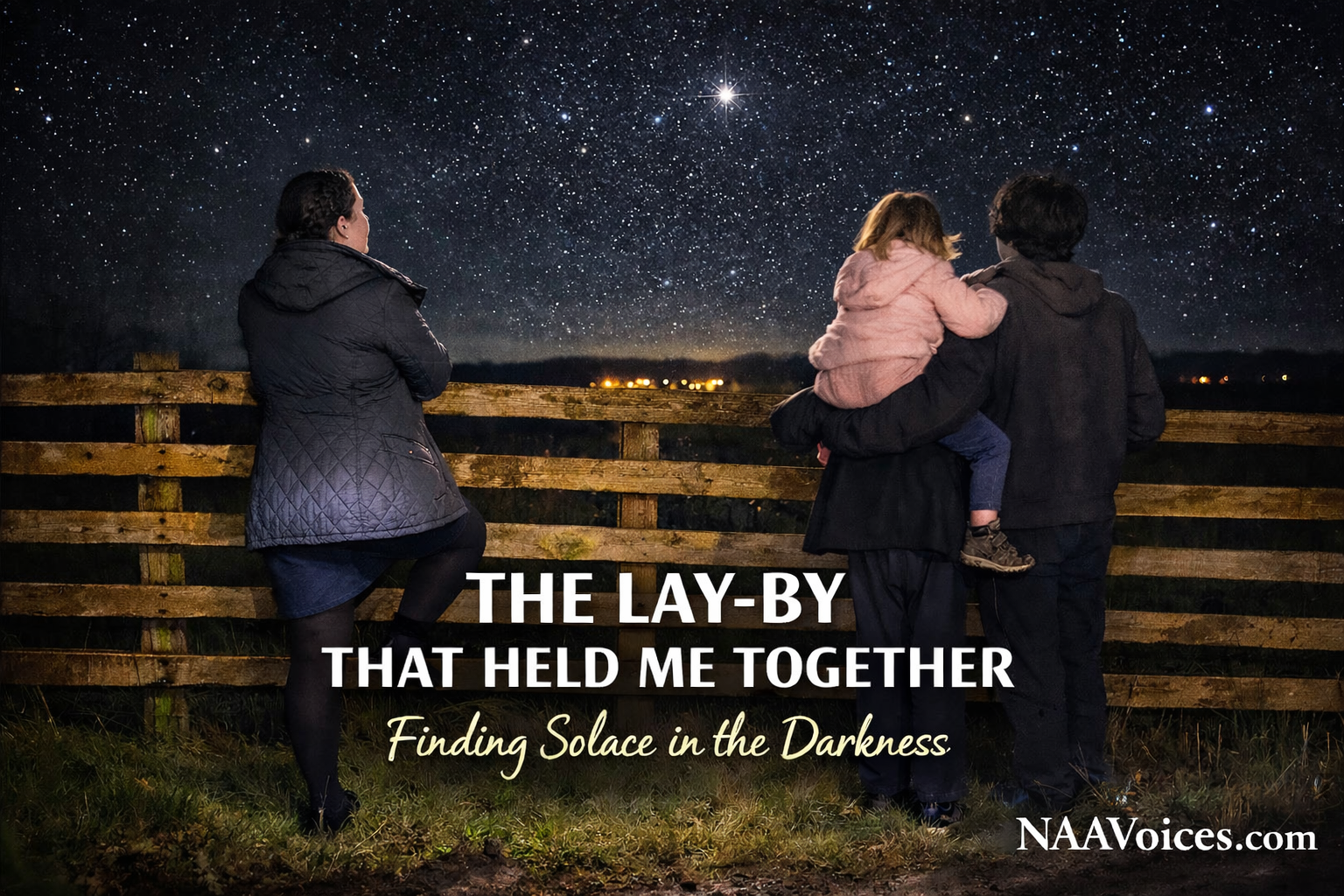
  • The Lay-By That Held Me Together

    The Lay-By That Held Me Together

    Seven days ago, I finished work carrying the kind of weight you don’t always have words for. I’d received difficult news about a patient, the kind of news that shifts the tone of an entire day, even when you keep functioning on the outside.

    In my own private language, I call people stars when they’re gone. It’s how I hold grief without letting it swallow everything else. It’s how I file loss in my mind when I still need to drive home, feed children, answer questions, and keep moving.

    The Place I Didn’t Know Was Saving Me

    For over a year, I used to escape. I’d get in the car and drive to a lay‑by I always ended up at. Not because it was on the way to anything. Not because it fixed anything. But because it gave me a pocket of stillness, a place where my body could downshift when my life couldn’t.

    Back then, I didn’t understand the language of nervous systems, grounding, or trauma responses. I just knew I was living under sustained pressure, in a situation that was eroding me, and I needed somewhere that I could breathe. Somewhere I could be safe.

    That lay‑by became my therapy before I even knew what therapy was supposed to look like.

    I slept there many times. My little girl slept there overnight many, many times. We’d sit and look at the stars. She grew up believing that when someone leaves, they become a star. It gave her something gentle to hold onto, and in truth, it gave me something too.

    Returning to the Road That Once Held My Fear

    I hadn’t been there for a while.

    But last Thursday, after receiving that difficult news, I left work carrying more than tiredness. When I collected my daughter, she asked what was wrong. I told her I felt sad because there was a new star in the sky.

    Then we collected my eldest and my middle one, the teenagers who have lived through more than most people will ever understand. One of them was struggling and asked if we were going to drive. And because of the conversation in the car, my five‑year‑old said, very simply:

    “Let’s take him to see our star’s.”

    So we did.

    I drove the hour‑and‑a‑half round trip.

    And this is what surprised me: it was different.

    A Body That Finally Knows It’s Safe

    Every time I’d driven that road before, it was in a state of activation: trigger, panic, dread, adrenaline, that constant internal noise that comes with prolonged stress. I learned that road in survival mode. I knew every bend, every stretch, every pull‑in point because I’d driven it while trying to keep myself together.

    But this time, it felt like shifting gears.

    My body relaxed.

    No palpitations. No urgency. No bracing for impact. No internal pleading for the night to end.

    Just calm.

    The memories were still there. The past was still the past. But my nervous system didn’t respond as if it were still trapped in that time. And that’s not a small thing. That’s not “positive thinking.” That’s physiological change. That’s recovery showing up quietly, without ceremony.

    I am a different person now.

    Not fully healed and not pretending to be. Life is still hard. Trauma leaves marks. I’m not the person I once was.

    Driving that road felt like an epiphany. It revealed something concrete to me. The place that once held my worst moments has also become evidence that I survived them.

    The Field, the Stars, and the Quiet Truth

    I know that lay‑by like the back of my hand. I’ve sat there in snow, ice, and rain. I’ve stood in that field. I’ve cried until my chest ached. I’ve lain under the stars trying to work out how I’d get through the next day.

    And for a long time, nobody knew.

    I’ve been there in uniform. I’ve been there in the middle of the night. I’ve been there when the world was sleeping, and I was wide awake, trying to stabilise myself enough to return to a life that didn’t feel safe.

    I have photos of my feet in the field because sometimes I had to sit in the grass just to feel something real. To feel the earth. To feel grounded. It wasn’t aesthetic. It wasn’t curated. It was a lifeline when I didn’t have words, support, or accessible options.

    This time, all three of my kids got out of the car.

    And they appreciated it.

    Not dramatically, quietly. In the way that says, we understand why this mattered. Because they’ve been through so much, too. They’re still healing. I’m still healing.

    Even this time last year, there were moments when we didn’t know what the future would look like. whether things would stabilise, whether I’d be okay, whether any of this would ever feel “over.” The year before that, there were people who didn’t believe I’d still be here.

    But I am.

    What the Lay‑By Really Represents

    I want to be clear about what that lay‑by represents, because it isn’t just a scenic stop.

    Sometimes the thing that keeps you going isn’t a big intervention. It isn’t a perfect plan or the right professional at the right time. Sometimes it’s the small escape you build quietly when you can’t say what’s happening, when you don’t feel believed, when you’re functioning publicly but unravelling privately.

    Sometimes it’s a lay‑by. Sometimes it’s the stars. Sometimes it’s a field where you can sit in the grass and let your body remember that the world is bigger than what you’re living through.

    And then, one day, that same place shifts.

    It flips.

    It becomes a positive. A source of comfort. A marker of survival rather than panic.

    Driving Home With a Different Kind of Grief

    On the drive home, I realised I’d driven there and back almost on autopilot, not in shutdown, not in fear, just steady. And the significance of that landed hard, because for so long, that road was associated with crisis.

    That night, I carried my new “star” quietly. The sadness was still there. The reflection was still there. But it wasn’t layered with the same terror, the same frantic need to escape the life I was living.

    This time, it was grief held in a body that has learned, slowly, that the emergency is not constant anymore.

    Life can get easier. Not neatly. Not quickly. Not without scars. But it can.

    When you’re living in continuous trauma, you can’t always see that. You can’t picture a future where your body isn’t braced for impact. And yet, here I am, driving that road differently, feeling that place differently, and showing my children the real truth:

    Even in the darkest periods, something can hold you.

    And later, when you’re ready, that same place can become proof that you made it through.

  • Angel Numbers & Everyday Spirituality: Finding Light in Life’s Patterns

    Angel Numbers & Everyday Spirituality: Finding Light in Life’s Patterns

    Finding Meaning in the Mess

    This is a story about resilience and routine. It is also about learning to calm a nervous system that’s been through too much. You don’t have to be spiritual to relate. The takeaway is simple: use what works.

    For me, that includes trauma-informed workflows, safeguarding logs, and—unexpectedly—angel numbers. Not because they’re magical, but because they show up. Repeatedly. Predictably.

    When the world feels chaotic, even one small pattern can help you keep going. Angel numbers became a quiet anchor, something I couldn’t control, but could count on. They weren’t weaponised. They weren’t manipulated. They just… appeared.

    A Conversation That Landed

    I’m not religious. I never had that pull, even with some exposure growing up. But I do believe. I do feel. And sometimes, someone walks in and reframes everything.

    She had been finding her strength again. She showed me her new tattoo — three of the same number in a row. She’d been noticing that sequence for years.

    Without thinking, I said, “11:11.”

    She smiled. “They’re angel numbers,” she said. “And 11:11 might be yours.”

    Her words shifted something in me. These numbers didn’t have to evoke fear. They could be gentle reminders from the universe, nudges to trust the journey.

    She spoke about her guides, about how these numbers helped her feel protected. She shared a moment in a taxi when the mileage hit 444. She saw it as a message from her nan — a sign that she didn’t need to carry her past alone.

    I don’t feel much these days, but that registered.

    These numbers can be signs of love. Of connection. Of support from those who’ve passed.

    When she left, she thanked me. Her gratitude filled the room. I burst into tears.

    It reminded me that I carry my own pain quietly. Through what I’ve endured, I’ve gained a deeper ability to see others. It’s nearly broken me at times. Yet it has also helped me make a difference.

    Strength comes from shared experience. From vulnerability. From moments like that.

    Angel Numbers & Spirituality: Finding Light in the Pattern

    The Essence of Spirituality

    Spirituality means connecting to something greater than yourself, whether that’s through religion, nature, meditation, or quiet reflection. It’s about finding meaning, purpose, and a sense of belonging within the broader context.

    At its core, spirituality invites us to look inward, to explore compassion, connection, and what it means to be human. It can offer comfort in hard times, strengthen resilience, and help us feel less alone.

    For some, it’s prayer or tradition. For others, it’s found in patterns, signs, or the quiet peace of a walk in nature.

    Sometimes, it’s just one small thing that helps you breathe when everything else has collapsed.

    Sometimes, it’s found in the stars.

    If My Children Ever Read This

    I want you to know something: I never stopped trying. Even when it felt like the world had. Even when the decisions weren’t mine, the consequences landed on us all.

    There were nights I lay in the car, staring through the skylight, begging the stars to end the torment. I didn’t know what PTSD was. I didn’t know how to live with it.

    Learning to navigate it meant finding my way without a map. I did it without understanding the impact. It rewired my body, my mind, and my sense of safety. There was no framework, no language for what I was feeling. Just chaos.

    But I did know how to look up and ask for help from anyone, anything, anywhere.

    [Video embed]

    And you, my little one, you already know.

    We look at the stars to find our people. The ones who love us. The ones who protect us. You’re amazing with numbers, even if letters feel harder. Maybe it’s generational. Maybe it’s something else. But I see you. And I see the patterns.

    You see numbers like constellations — patterns I missed, but maybe you were born to catch. I’ve got so many screenshots of 11:11 now. Receipts. Clocks. Reg plates.

    For a long time, I viewed the appearance of 11:11 with trepidation. I feared it was a harbinger of doom. Perhaps a sign that I would meet my end at that very hour. Maybe on the 11th of November. But lately, it’s shifting. It’s taking time, but it’s bringing a different perspective.

    There’s no science in it, which makes it harder for me to understand. Still, there has to be some hope that life will improve. And sometimes, the stars have been the only place I’ve found myself during the darkest times.

    I’ve begged them for peace. For safety. For an end to the torment. And somehow, I’m still here.

    This is where my understanding began to change. Not in a textbook. Not in therapy. But in a conversation with someone who saw patterns where I saw threats.

    Angel Numbers: Plain English

    Call them angel numbers, spiritual numbers, or just meaningful patterns. Either way, they’re repeated sequences. People often interpret them as signposts — gentle prompts to pause, check in, and move forward with intention.

    In spiritual belief, these numbers are seen as messages from guides or angels. Each one carries a different meaning: protection, prosperity, encouragement to stay on your path.

    Do you have to believe in angels? Not at all. You only need a repeatable cue that helps you breathe, reset, and take a healthy step forward.

    Do you have to believe in angels?
    Not at all.
    You only need a repeatable cue that helps you breathe, reset, and take a healthy step forward.

    A graphic featuring the number '1111' and the text 'Alignment & Awakening' with a description about the significance of this number as a wake-up call and reminder for self-reflection. It includes a mandala symbol at the bottom and is attributed to Laura Prince, founder of Nurse Against Abuse.
    Image featuring the number 222 with the text 'BALANCE AND TRUST' on a gradient background, symbolizing harmony and partnership. The image also includes a scale icon and a description emphasizing the importance of trust and maintaining balance in life.
    Image featuring the number 333 with the text 'Creativity & Voice' against a sunset background. The text discusses the significance of the number in relation to creativity and self-expression. It emphasizes the importance of embracing one's talents and expressing inner truth.
    An artistic graphic featuring the number '444' with the text 'Protection & Guidance' over a soft, gradient background. Additional text describes the significance of the number in relation to support and encouragement.
    An inspirational graphic displaying the text '555 Change Management' with a butterfly and cosmic background. The message conveys themes of transformation and seizing new opportunities.
    Image featuring the number '666' with the word 'Re-balance.' The background shows a soft, gradient sunset with clouds, and text emphasizes the significance of re-evaluating priorities and achieving balance between material desires and spiritual needs.
    An inspirational graphic featuring the number '777', the phrase 'Insight & Learning', and a motivational message that reads 'You’re on the path; keep seeking.' It includes the name 'Laura Prince' and the title 'Founder, NurseAgainstAbuse.co.uk' against a starry background.
    A graphic displaying the number '888' and the word 'Abundance', with a sunset background. Text explains that this number symbolizes abundance and prosperity, suggesting rewards are on the way for hard work and dedication.
    A cosmic background with the number 999 prominently displayed, symbolizing completion. The text below explains that this number signifies the end of a cycle and encourages letting go of what no longer serves you. It invites preparation for new beginnings.
    Night sky featuring a bright moon illuminating clouds, with power lines silhouetted against the backdrop.

    Finding Anchors in Chaos

    I began noticing 11:11 repeatedly. Now, I see it differently. Not as a threat, but as a sign. A pattern. A small, predictable anchor in an unpredictable world.

    It became one thing that consistently showed up. One thing that couldn’t be manipulated, controlled, or weaponised by anyone else.

    The stars don’t gaslight you. Numbers don’t lie.

    Hope isn’t passive — it’s a neurological intervention. And sometimes, it starts with a number on a receipt.

    Abstract illustration depicting neural connections on a dark background transitioning to a light, starry sky.

    Spirituality and Self-Regulation: A Survivor-Led Len

    A blurred nighttime image featuring a partially illuminated number two in the sky, surrounded by dark clouds.

    Reclaiming spiritual agency involves several key aspects. It means recognizing that losing a faith community can deepen the trauma of leaving. It involves validating beliefs without validating abuse.

    You must distinguish between spirituality, which liberates, and spiritual abuse, which controls. Supporting spiritual practices as coping tools while prioritizing safety is also essential.

    Spiritual practices can rebuild an internal locus of control, especially for survivors of coercive control.

    When you see 444 and decide it means “I’m protected,” you’re practising decision-making in a low-stakes context. You’re noticing, interpreting, assigning meaning, and choosing a response. That’s agency. That’s healing.

    Where Spirituality Meets Psychology

    The brain is a pattern-detection machine. If a symbol helps you regulate and re-engage with life, it’s an asset. If it becomes avoidance or replaces necessary safety planning, it’s a risk. Context matters. Safety first. Always.

    Angel numbers aren’t a replacement for safeguarding or legal advocacy. They’re a regulating cue — a bridge to stay operational when systems fail. A reason to breathe when breathing feels impossible.

    Guardrails & Resources

    Angel numbers are tools, not treatment. If triggers are spiking or you’re unsafe, prioritise clinical and safeguarding pathways.

    UK Crisis Resources:

    • 999 in an emergency
    • NHS 111 for urgent advice
    • Samaritans 116 123 (free, 24/7)
    • National Domestic Abuse Helpline 0808 2000 247
    • IDVA services via local authorities
    • NHS mental health crisis teams

    If you’re in a car begging the stars for help, please also call one of these numbers. The stars can hold you. But humans can help you.

    Key Takeaway

    My Lived Experience: A Personal Journey Through Trauma and Recovery
  • The Healing Power of Connection: Lessons From My Grandmother’s Journey

    The Healing Power of Connection: Lessons From My Grandmother’s Journey

    NAAVoices was not created from certainty, but from lived experience and professional insight. As I migrate earlier work from the original platform, this post has been reviewed and approved for transfer. It remains true to its original context, with only minor clarity edits where needed. Some moments do not require rewriting to remain honest.

    Loneliness is one of the most profound and overlooked experiences a person can face, especially after losing a partner. Last week, I was reminded of this again when I met another widow still navigating the quiet ache of life after loss. Many people mourn not only the person they loved, but the life they once shared — the routines, the companionship, the sense of belonging.

    As I wrote in the original version of this blog, “More than 40% of widows and widowers report feeling isolated after the loss of their partner.” That statistic is more than a number. It represents real people living with a silence that can feel suffocating.

    My grandmother knew that silence intimately.

    Her First Experience of Loss

    My grandfather passed away when my grandmother was just under 60. She had to navigate the complexities of grief alone, at a time when support services didn’t fully understand the emotional and practical realities of widowhood. She felt isolated, unseen, and misunderstood — a feeling many widows and widowers still experience today.

    But instead of letting grief consume her, she transformed it into something extraordinary.

    A Legacy Born From Compassion

    In the years that followed, my grandmother founded a support group for widows and widowers — a group that has now been running for 25 years. What began with a single act of courage — “a letter to the local newspaper, reaching out to those who were living in similar situations” — became a lifeline for more than 200 people.

    She created a space where those grieving could come together, share their stories, and rediscover connection. A place where loneliness was met with understanding, and silence was replaced with companionship.

    I grew up watching her pour her heart into this work. I remember the open‑house sessions vividly: the smell of freshly baked cakes, the furniture rearranged to make room for everyone, the warmth that filled the room as people gathered. My baby boy was passed around like a tiny spark of hope. For some members, it was the only human interaction they had all week.

    Some found love again. Others found lifelong friends. Many simply found a reason to keep going.

    The Power of Shared Experience

    Working in primary care, I’ve seen firsthand how loneliness affects health — emotionally, mentally, and physically. I’ve often wished I had the time and resources to create a group like hers for my own patients. I can empathise deeply, but I haven’t walked in their shoes. That’s why her work matters so much: it came from lived experience, compassion, and courage.

    Even now, at over 80 years old, she still takes calls from those who need her. She doesn’t realise the magnitude of what she’s built. She never sought recognition, yet her legacy is undeniable. She has healed hearts, restored hope, and created a community that continues to thrive because she refused to let others feel the loneliness she once felt.

    Connection as a Lifeline

    Her story is a reminder that healing doesn’t always begin with grand gestures. Sometimes it starts with one letter, one conversation, one act of kindness. She proved that one person’s courage to reach out can transform hundreds of lives.

    Her legacy teaches us that connection is not a luxury — it is a lifeline. Loneliness affects the body, the mind, and the will to keep going. When we create spaces for people to be seen and heard, we offer them more than support. We offer them a way back to themselves.

    I carry her lessons with me every day:

    • No effort is too small.
    • Compassion creates ripples we may never fully see.
    • Community can grow from the simplest act of reaching out.

    Her strength, her love, and her quiet determination continue to guide me.

    Moving Forward: A Call to Connection

    Reflecting on her journey, I wish more services recognised the true impact of loneliness on widows and widowers. If the NHS had the capacity to support community‑led groups like hers, countless people could benefit from the healing power of shared experience.

    Her story is not just a testament to resilience — it is a blueprint for what compassionate community support can look like.

    A Year Later

    Nearly a year after writing this blog, I’ve created a dedicated bereavement support resource offering guidance, practical help, and most importantly, contact details for organisations that truly understand loss and provide meaningful support. It feels like a small way to honour her legacy and continue the work she began.

  • The Heartache of Time Lost: A Journey Through Isolation and Healing

    The Heartache of Time Lost: A Journey Through Isolation and Healing

    NAAVoices was not created from certainty, but from lived experience and professional insight. As I migrate earlier work from the original platform, this post has been reviewed and approved for transfer. It remains true to its original context, with only minor clarity edits where needed. Some moments do not require rewriting to remain honest.

    One of the deepest sorrows I carry is the sense of time lost.

    Years that slipped away while I was cut off from the people who mattered most. Isolation didn’t arrive all at once. It crept in, a quiet narrowing of my world until the people I loved were on the other side of a chasm I felt powerless to cross.

    I began to pull away because I was afraid. Afraid of what might be said or done in front of my family, afraid of the blame that would always land on me when something went wrong. I stopped visiting, stopped calling as often, and watched relationships fray while I tried to keep everyone safe.

    The Loss That Hurts Most

    The hardest loss has been my grandmother. Losing those years with her feels like a theft of something irreplaceable. She was more than a relative — she was one of my closest friends. I chose to live with her for a year after my step-granddad died so she wouldn’t be alone. We had shared the last months of his life together; we understood grief and the quiet work of care.

    For nine years after that, I spoke to her almost every day and visited monthly despite the distance. She had a special bond with my eldest — the kind of connection that lit up both their faces. Those moments are what I miss most.

    How Things Changed

    Everything shifted after I met my ex. Small tensions became wedges. When I asked him not to smoke around my grandmother because of her breathing problems, he framed it as unreasonable. He reached out to her only when it suited him, offered help he never followed through on, and presented himself as more capable than he was.

    When she paid him to do work on her home, he failed to deliver. He spent money on himself instead of contributing to her bills. The work was shoddy; the cost ballooned. Photos my aunt later sent showed the truth — the mess he’d made. I discovered my bank card had been used without my consent. I noticed the smell of alcohol and, later, the signs of drug use. Each discovery was met with gaslighting: it was all in my head, she was too demanding, I was the problem.

    He controlled contact. I could only call my grandmother in private because he would make cutting remarks whenever I spoke to her. Visiting her became a punishment; every return home risked his anger and abuse. Over four years I never visited without coming back to confrontation, and by 2023 I felt trapped — unable to see anyone without being accused of “snatching his child.”

    The Breaking Point

    The last visit before I left was the worst. I was harassed and pressured to come home because he claimed I’d taken his son. I pulled over to call my GP about cardiac symptoms, and he demanded I cancel the appointment so he could get help. I couldn’t give up my health. I couldn’t keep sacrificing myself.

    Leaving was terrifying and necessary. The isolation has lingered since I left. I am not the same person I was. The guilt of missed time — especially with my youngest, who barely knew her grandmother — is heavy.

    Small Freedoms and Slow Repair

    There are moments of light now. A year on, the boys are smiling again. We played dominoes together; for the first time in a long time, no one punished me for wanting to reconnect with my family. Those small, ordinary joys feel enormous after so much fear.

    He may have pushed me into darkness, but I am free. I will never again walk into a home wondering who I will meet or what I will have to endure. I am finding my way back to myself, slowly, one day at a time.

    Time stolen is still time mourned. But time reclaimed — even in small pieces — becomes the work of healing.

    The loss of years with the people I love is a grief I carry, but it does not define the whole of me. I am rebuilding connection, protecting my health, and choosing presence over fear. If you recognise this story in your own life, know that reclaiming small freedoms matters. You do not have to stay where you are unsafe.