Tag: mental health

  • Returning to Work with PTSD: When a Place of Safety No Longer Feels Safe

    Returning to Work with PTSD: When a Place of Safety No Longer Feels Safe

    Reflection — Two Years On

    Original entry, 10 September 2024, written during active trauma

    The entry that follows was written during a period of active trauma, while the abuse and its consequences were still ongoing. At the time, I was attempting to survive, parent, work and make sense of events that kept unfolding. I did not yet have the neurological framework to fully understand what was happening to my mind and body.

    During that period, I was studying the neuroscience module of my postgraduate certificate. One lecture in particular focused on neuroplasticity and the neurological impact of trauma. Through neuroimaging and clinical evidence, it became clearer to me that PTSD is not a personal failure or a weakness of character. It is a trauma-related condition that can profoundly affect the nervous system, particularly when someone is repeatedly exposed to threat or forced to relive harm.

    That understanding mattered.

    For a long time, I carried responsibility that did not belong to me. I questioned my decisions, my resilience and my capacity to cope. I told myself I should have left sooner, should have handled things differently, should have been stronger.

    What the science helped me understand was that the injury did not arise from leaving too late. It came from the abuse itself, and from being repeatedly pulled back into it through systems that failed to protect us.

    I had left. I was no longer living with him.

    What followed was not something I chose, and it was not something my children deserved.

    The neurological changes I live with are the consequence of sustained harm and re-traumatisation. Those who caused that harm made choices. Systems and individuals who failed to intervene also made choices. The injury that resulted is not mine to own in terms of blame, even though I am the one who has had to live with its effects.

    This reflection is not a correction of the entry that follows.

    It is context.

    The original post remains close to how it was written. It reflects the reality of that moment, before I had the same insight and understanding I have now. It was written before science helped me make some sense of what had happened to me.

    Within the Two Years On series, entries are presented as they were lived, alongside the understanding that came later.

    The words that follow are not evidence of failure.

    They are evidence of injury.

    And of survival.

    Returning to Work with PTSD

    (Original entry — 10TH September 2024) (written during active trauma)

    PTSD is often described as a mental health condition. Living with it, however, has felt more like a traumatic injury to my nervous system than an illness I simply developed.

    I learned about this recently, and it left me with questions I cannot easily answer.

    Does this mean I have to endure it forever?

    Will it worsen if the abuse and re-traumatisation continue?

    Research increasingly shows that PTSD and traumatic brain injury can share overlapping neurological consequences following trauma. Global estimates suggest that around 1.1% of the population experiences PTSD within a 12-month period. Approximately 69 million people worldwide sustain a traumatic brain injury each year.

    The neuroimaging below illustrates how PTSD and TBI can differ and overlap in brain perfusion patterns.

    Trauma alters neural pathways involved in threat detection, memory and emotional regulation. These changes are adaptive during danger. However, they can become destabilising when safety is delayed or denied.

    Figure 3. Brain SPECT Images of Healthy, PTSD, TBI and PTSD co-morbid with TBI perfusion patterns.
    Source: Amen et al. (2015). Functional neuroimaging distinguishes posttraumatic stress disorder from traumatic brain injury in focused and large community datasets. PLOS ONE, 10(7), e0129659.


    Top row: surface scans with threshold set at 55%, showing the top 45% of brain perfusion.
    Bottom row: active scans where blue = 55%, red = 85%, and white = 93%.

    • Healthy brain: Full, even, symmetrical perfusion with the most active area in the cerebellum.
    • Classic PTSD: Increased perfusion in the anterior cingulate, basal ganglia, and thalamus.
    • Classic TBI: Multiple areas of low perfusion visible on surface scans.
    • PTSD + TBI: Displays both increased perfusion patterns associated with PTSD and low‑perfusion areas associated with TBI.

    I struggled to wear my uniform

    I Struggled to Wear My Uniform

    With the children back in school and my return to work approaching, I thought it would be sensible to spend some time reacclimatising.

    To get used to the environment again.

    To be around people.

    I struggled to wear my uniform.

    I felt disconnected from the proud, compassionate nurse I once was.

    The ongoing attacks on my character through the court process had deeply shaken my sense of self. It became difficult to protect my identity and continue fighting when so much of who I was felt under question.

    I questioned my strength.

    I questioned who I was.

    I arrived early, completed the routine checks and went straight to my room.

    The grip PTSD can have on the mind is profound. I expected relief when returning to a place that had felt safe for so long. Instead, it felt foreign.

    The warmth had gone.

    There were memories, but not the ones I had expected.

    The comforting memories were gone.

    There had been days when I went home thinking about patients. I would check in because I knew people had a lot to manage. There were times I knew I had made a difference. Work had been the place where I could be myself, where I felt free, and where I found respite from the hell I was living at home.

    Instead, the photograph a colleague had encouraged me to keep was still on my shelf. We had covered part of it with another image so that only my child and I remained.

    I could not even look at it.

    When I tried to pick it up, my hands shook so badly that I dropped it. It smashed across my desk.

    The room was full of memories.

    Trauma does not stop at the outside world. It invades even the spaces that once felt safe.

    Haunted by My Sanctuary

    I avoided reception.

    Everyone had been kind, but I was petrified of being asked how I was. I could not keep the emotion away, and crying in a shared workspace was not something I could cope with.

    My nursing team had already been supportive through a difficult period. I did not want to cause more worry.

    It was nearing a year since I left him, and the impact of what we had lived through had touched every aspect of our lives.

    The continuation of it made me feel worse than I did when I left. I had believed leaving would end his control. Now I knew how far he would go, and I could not see an end in sight.

    My colleagues came in individually to catch up, give me a hug and see how I was.

    I wish there had been a cure.

    A way to wave a wand and make it all stop.

    A way to be me again.

    We all have ā€œourā€ rooms, even if we are not meant to call them that. I had decorated my noticeboard after twelve months because I was certain this was the right place for me.

    I could not stop thinking about how to change the room.

    I kept staring at the same wall. The same view. The same space connected to days when my private life was unstable and I was still trying to work, think and function.

    The chest pain.

    The stress.

    The fear.

    Unless you have lived through something like this, it is difficult to understand the depth of damage it causes.

    One thing I do know is that people in healthcare care.

    Even when they do not fully understand, they care.

    That compassion had not been reflected by many other agencies involved.

    Flashbacks and Intrusive Thoughts

    Flashbacks and intrusive thoughts are particularly prominent in complex PTSD. I hope I reach a point where these experiences ease, where I can close my eyes without fearing what I might see.

    I spoke to my manager about moving my desk.

    A different view might help. However, it was not practical. It would affect the layout of the room and how safely I could work within it.

    He was thoughtful and busy, but he still tried to think of ways we might change the space.

    I suspect he could hear the struggle in my voice and knew I would not say exactly why.

    Normally, I would share anything new with the team. That day, despite knowing I needed a drink, I could not even face going out to get one.

    My work mum asked if I wanted a cup of tea, and I went with her.

    I knew I had to find the strength to return, but where that strength would come from was beyond me.

    Constraints Beyond Choice

    He continued to control the mortgage and still had not signed the deed. I was paying over £600 more each month, and it could take weeks to resolve.

    Going to half-pay was not an option when I needed to provide for the children.

    I completed my flu vaccination training and deliberately avoided anything connected to the police or court. I was trying to find a connection beyond the constant protection of the children, but it felt almost impossible.

    Even reviewing evidence to safeguard them brought further trauma.

    Everything felt overwhelming. Silent and deafening at the same time.

    I think those who live with PTSD will recognise that contradiction.

    My manager found it amusing that I needed to update my safeguarding training. He knew I could probably recite Working Together to Safeguard Children by heart.

    The sole focus of the previous ten months had been safeguarding my own children, yet no one had afforded them the same level of protection.

    I had a few wobbles.

    A few cries.

    I hoped to manage six hours, but I could not.

    At lunch, I felt jumpy. Although I knew I was safe in theory, my body did not believe it.

    It is surreal to feel empty and hypervigilant at the same time.

    Small talk felt pointless, but I still cared deeply about my colleagues. Normally, I would be full of ideas and support.

    I did not want them to know how far away I felt inside.

    I am beginning to realise it is not my team who are the odd ones.

    It is the wider world.

    When empathy and compassion feel rare, those who still carry them matter.

    The Blog as a Safe Space

    I contacted CMHT and called my GP.

    I was not on regular medication, only medication for acute trauma responses, but I had run out and was worried about how I would manage the following day.

    One colleague had become a close friend. She and my work mum provided character references for court. I could not read them at the time.

    It was clear that I had changed, despite my attempts to fight through.

    I hated being seen differently, yet part of me was relieved they could not see inside my head.

    This blog became my safest space. The only place I could be honest without causing worry to those I care about.

    The next day, I had to meet CAFCASS.

    I was terrified they would see only the broken version of me, not the person I was before the abuse became too much.

    I did not want to be broken.

    I knew I could not live freely while he continued to exert control, and I feared what he would do next.

    I had not been able to process what I had lived through because it had not stopped.

    I knew there was still part of me inside.

    I did not know whether I would ever fully come back.

    The Real Hug

    That evening, my youngest asked their middle brother for a ā€œreal hug.ā€

    Watching them climb out of bed to embrace stirred something in me.

    These moments, small and fleeting, are what I cling to.

    They remind me of what things once felt like.

    They remind me of what is still worth holding on to.

    This reflection is shared as lived experience to support domestic abuse awareness, trauma-informed understanding and the normalisation of mental health support. It is not intended as clinical advice or a comment on any individual patient, colleague or workplace. Identifying details have been limited where appropriate to protect privacy and maintain professional boundaries. The purpose of sharing this is advocacy, reflection and reducing stigma around trauma, domestic abuse and seeking help.

    My Lived Experience: A Personal Journey Through Trauma and Recovery
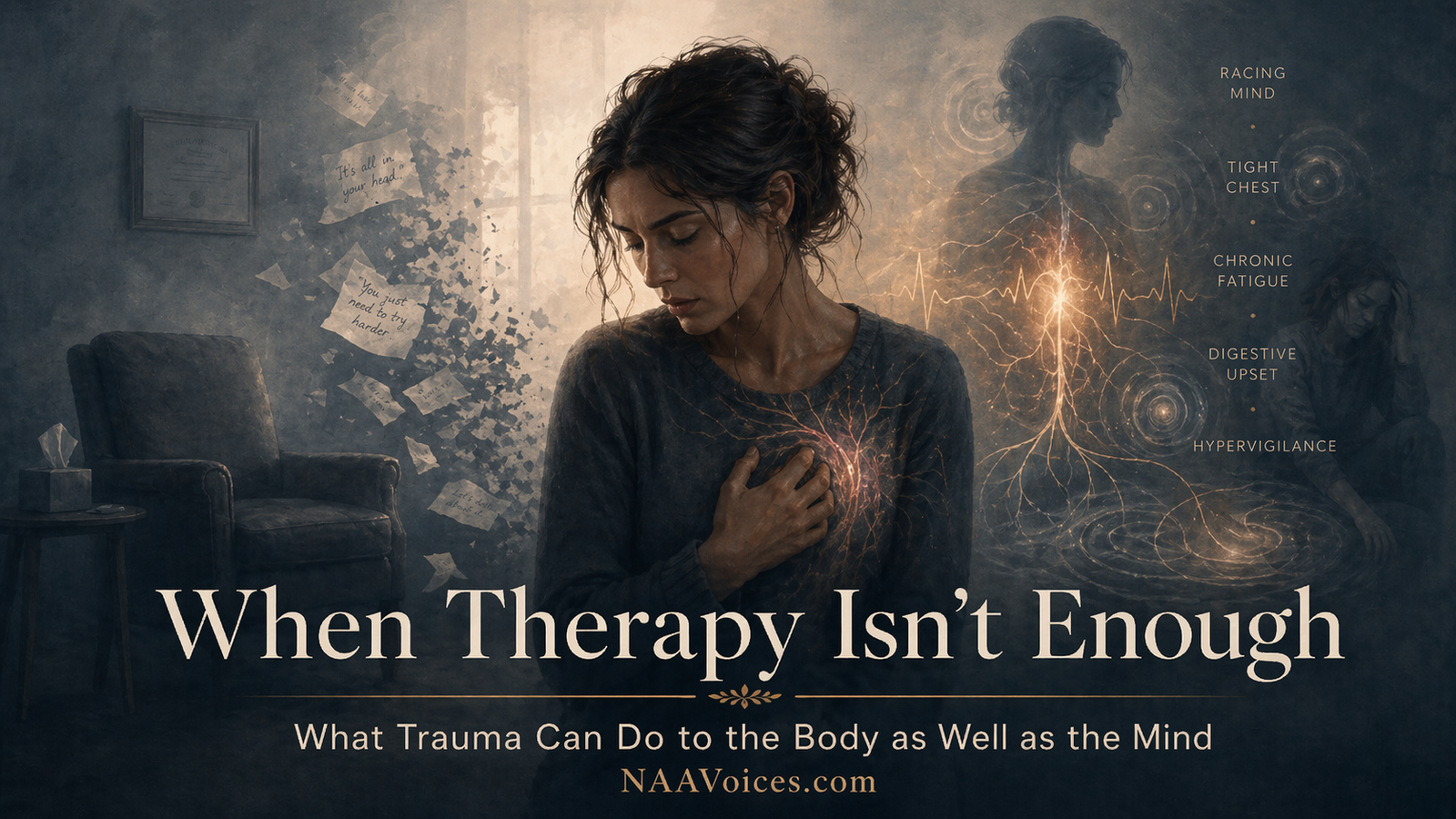
  • 🧠 When Therapy Isn’t Enough: A Reflective Journey into Psychosomatics

    🧠 When Therapy Isn’t Enough: A Reflective Journey into Psychosomatics

    NAAVoices was not created from certainty, but from lived experience and professional insight. As I migrate earlier work from the original platform, this post has been reviewed and approved for transfer. It remains true to its original context, with only minor clarity edits where needed. Some moments do not require rewriting to remain honest.

    Earlier this year, I was told I did not meet the threshold for further trauma support.

    That sentence stayed with me.

    Not because I expected miracles. Not because I believed therapy would undo what had happened. But because when you are already doing everything you can to hold yourself together, being told you do not qualify for more help lands heavily. It can feel less like a clinical decision and more like being quietly told to carry on alone.

    I had completed ten weeks of what was meant to be CBT, but it did not help in the way I needed at that time. Looking back, that makes sense. It is hard to process trauma while still living inside the aftermath of it. It is hard to ā€œwork onā€ what happened when your body still feels on alert, your life still feels unstable, and your mind is still trying to survive.

    When that support ended, there was no real next step. No clear path. No space to properly make sense of what trauma had done to me, not only emotionally, but physically too.

    That experience became a turning point.

    I started studying psychology and neurodiversity in mental health because I needed more than short-term coping strategies. I needed understanding. I needed to know why trauma was not just living in my thoughts, but in my body. I needed language for the exhaustion, the fear, the racing heart, the overwhelm, and the strange way the body can keep sounding the alarm long after other people think the danger has passed.

    For me, understanding matters. I need to know the why, not just the what. Without that, symptoms can feel frightening and shapeless. I was not looking for an academic answer for the sake of it. I was trying to understand survival.

    This is what keeps coming back to me: sometimes therapy is not enough on its own. Sometimes the problem is not that someone is unwilling to heal. It is that their body has been carrying too much, for too long, with too little understanding around it.

    When the Body Starts Speaking

    Psychosomatics is one of those words that can immediately put people on edge.

    Too often, it gets mistaken for ā€œit’s all in your head.ā€ For many people, that sounds dismissive, belittling, or dangerously close to not being believed.

    But that is not what it means.

    It means the body and mind are deeply connected. It means long-term stress, fear, trauma, grief, and emotional overload can affect the body in real and powerful ways. It means what happens to us emotionally does not stay neatly contained. It can show up through chest pain, dizziness, palpitations, poor sleep, exhaustion, stomach problems, muscle tension, headaches, pain, and countless other symptoms.

    The body does not forget simply because a person is trying to cope.

    And the body does not separate trauma into tidy boxes just because healthcare systems often do.

    The Gap Between Mental Health and Physical Health

    One of the things I have seen most clearly, both personally and professionally, is how often physical health and mental health are still treated as though they belong in separate conversations.

    On paper, we speak about holistic care, person-centred practice, and joined-up working. In reality, services are stretched, time is limited, and thresholds are high. That means the wider picture is not always explored, even when it should be.

    But people do not fall apart in separate categories.

    Stress at home affects the body. Fear affects the body. Caring responsibilities affect the body. Trauma affects the body. Living on edge for too long affects the body. So do exhaustion, grief, financial strain, coercion, and emotional isolation.

    When those realities are missed, the person behind the symptoms can be missed too.

    And that is where harm can quietly deepen.

    What Was Missed in My Own Experience

    For a long time, I sought help for symptoms including tachycardia, palpitations, dizziness, chest pain, low blood pressure, and ECG changes. I remain grateful that these symptoms were taken seriously and investigated thoroughly. They should have been.

    But what was less explored was the context around them.

    At the time, no meaningful link was made between what my body was doing and the prolonged stress and trauma I was living through. With hindsight, greater knowledge, and distance from that environment, I can now see that chronic trauma and ongoing stress were likely significant factors in how those symptoms appeared and persisted.

    Many improved once I was no longer living in the same circumstances. Some still return when stress becomes intense. That does not mean the symptoms were ever unreal. It means the body had been responding to more than one kind of threat.

    That is the part I wish more people understood.

    A nervous system under prolonged strain does not simply switch off because someone is trying their best. Survival leaves traces. Sometimes those traces are emotional. Sometimes they are physical. Often they are both.

    This is not about blaming individual clinicians. It is about recognising how powerful one question can be:

    What else is happening in this person’s life?

    Sometimes that question opens a door that blood tests and scans alone cannot reach.

    Why Being Believed Matters

    One of the hardest parts of trauma is not only what happened. It is what happens afterwards when your reality is minimised, misunderstood, or only partly seen.

    That is why language matters so much.

    When someone is told ā€œit’s probably stressā€ without explanation, it can feel like dismissal. But when someone explains that prolonged stress and trauma can affect the nervous system, sleep, pain, digestion, concentration, blood sugar, heart rate, and overall health, that feels different. That feels grounding. That gives shape to what otherwise feels frightening and invisible.

    People often need words not because they want a label for the sake of it, but because language can reduce shame. It can replace self-doubt with understanding. It can help someone realise they are not weak, dramatic, or failing. They are responding to what they have lived through.

    Validation is not indulgence. It is part of safe, humane care.

    What Clinical Practice Keeps Showing Me

    Working in healthcare has only deepened this belief.

    It is easy, especially under pressure, to focus on the numbers. Blood pressure. Blood sugar. ECG findings. Medication changes. Risk markers. Those things matter. Of course they do.

    But people’s lives matter too.

    I have seen how quickly physical health can worsen when someone is carrying unseen emotional strain, trauma, caring burdens, or simple relentless exhaustion. Sometimes what looks like poor control or non-engagement is actually overload. Sometimes what looks like someone ā€œnot coping wellā€ is the entirely understandable impact of carrying too much with too little support.

    Being listened to properly does not solve everything. But it does something important. It reduces shame. It builds trust. It reminds someone they are more than a set of symptoms to be managed.

    That should never be underestimated.

    The Point I Keep Coming Back To

    Psychosomatic understanding should never be used to minimise physical symptoms. It should be used to widen the lens.

    The mind and body are not rivals. They are not separate stories. They are part of the same human experience.

    Trauma does not only affect thoughts. It affects sleep, energy, heart rate, pain, concentration, appetite, blood sugar, resilience, and recovery. Chronic stress does not just sit quietly in the background. It changes the way a person lives in their body.

    That is why this matters.

    Take the symptoms seriously.
    Take the context seriously.
    Take the person seriously.

    Because sometimes the most important part of care is not only identifying what is wrong. It is understanding what has happened, what is being carried, and what has been missed.

    And sometimes, being truly heard is the first moment healing feels remotely possible.

    Let’s Talk

    Have your physical symptoms ever been affected by stress, trauma, or overwhelm?

    Have you ever felt that part of your story was missed when help was being offered?

    What helps people feel believed, understood, and supported?

    What would you change about the way healthcare approaches the connection between mind and body?

    My Lived Experience: A Personal Journey Through Trauma and Recovery
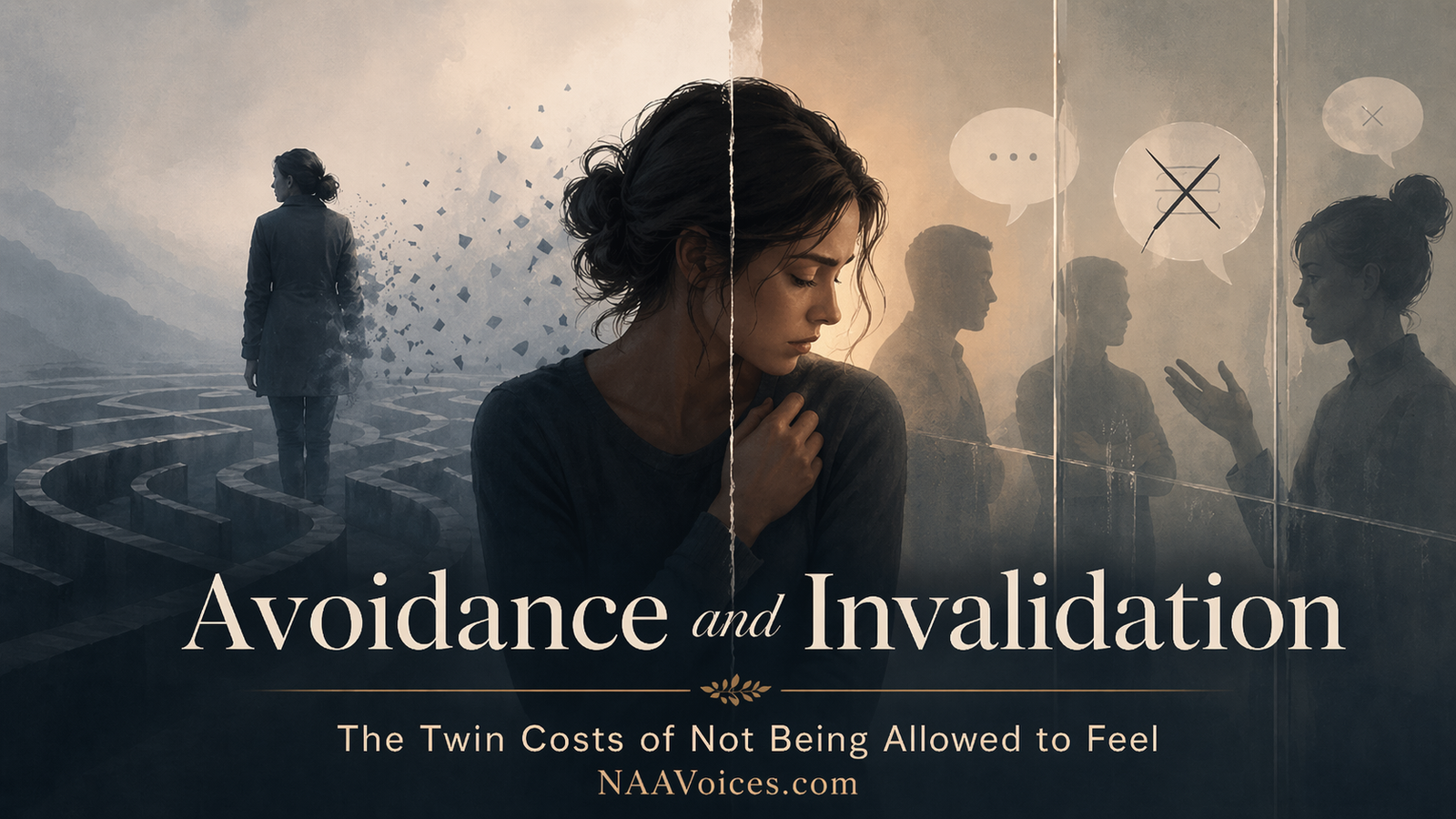
  • Avoidance and Invalidation — The Twin Costs of Not Being Allowed to Feel

    Avoidance and Invalidation — The Twin Costs of Not Being Allowed to Feel

    NAAVoices was not created from certainty, but from lived experience and professional insight. As I migrate earlier work from the original platform, this post has been reviewed and approved for transfer. It remains true to its original context, with only minor clarity edits where needed. Some moments do not require rewriting to remain honest.

    Avoidance, Honestly Defined

    Avoidance is easy to judge when you are looking at it from the outside.

    People call it denial. Running away. Burying your head in the sand. Refusing to deal with things.

    But that is not what it feels like when you are the one living it.

    Avoidance is not always weakness. It is not laziness. It is not a character flaw. Sometimes it is what happens when your mind and body learn, over time, that feeling too much is dangerous. That speaking is dangerous. That reacting honestly is dangerous. So instead, you push things down. You stay busy. You distract yourself. You numb out. You tell yourself you will deal with it later, when things are calmer, when you are stronger, when life gives you room to breathe.

    The problem is, later does not always come.

    What protects you in the moment can quietly trap you over time. Avoidance can get you through the day. It can help you function when the truth feels too heavy to carry. But it does not make the pain disappear. It just asks your body to hold it for longer.

    And the body does hold it.

    I know that now in a way I wish I did not.

    I live with the cost of it every day. Years of swallowed emotion. Years of pretending I was coping better than I was. Years of trying to stay composed, stay useful, stay needed, stay upright, while so much inside me was never given space to land. Four years of pain that never really had anywhere safe to go. Four years of being hurt, dismissed, frightened, invalidated, and still having to carry on.

    Those feelings do not just vanish because no one makes room for them. They settle somewhere. In your chest. In your stomach. In your sleep. In the constant tension in your body. In the exhaustion that never quite lifts. In the way your nervous system starts reacting before your mind has even caught up.

    That is the part people do not always see.

    Avoidance is not the absence of feeling. It is often the result of feeling too much, for too long, with nowhere safe to put it.

    And insight does not magically fix that. Understanding yourself does not suddenly make it easy to face the things you have spent years surviving. Sometimes it just means you can finally see the damage more clearly.

    Facing things is still hard. It is still painful. It is still exhausting.

    But eventually it stops being optional.

    Eventually, you realise the things you are trying not to feel are shaping your life anyway.

    Invalidation, Quietly Defined

    Invalidation can be hard to explain because it does not always look cruel from the outside.

    Sometimes it is obvious. Sometimes it is being told you are overreacting, being too sensitive, making a fuss, taking things the wrong way. Sometimes it is someone directly dismissing what you feel as though it does not matter.

    But often it is much quieter than that.

    It is the tone that tells you your feelings are inconvenient.
    It is the quick change of subject when you finally say something real.
    It is being ā€œreassuredā€ in a way that leaves no room for your actual experience.
    It is someone explaining your own pain back to you in a way that makes it smaller, neater, easier for them to sit with.
    It is being encouraged to move on before you have even been allowed to feel what happened.

    That is what makes invalidation so damaging. It does not always sound harsh. Sometimes it sounds reasonable. Calm. Practical. Well-meaning, even.

    But the impact is the same.

    You are left questioning yourself. Wondering whether you are too much. Whether your feelings are too big. Whether your reactions are wrong. Whether you are somehow the problem for being hurt by what hurt you.

    That kind of damage settles deeply, especially when it happens over and over again.

    Because after a while, you stop needing other people to dismiss your feelings. You start doing it for them. You get there first. You shrink your own experience before anyone else has the chance. You explain it away. Minimise it. Silence it. You become fluent in making your pain more acceptable to other people.

    And that is a heartbreaking way to live.

    Not all invalidation is deliberate. I know that.

    Some people genuinely do not know how to sit with another person’s emotions. Some were never taught that validating someone is not the same as agreeing with everything they say. Some people panic in the face of pain and rush to fix, soften, tidy, or redirect because they cannot tolerate the discomfort of simply witnessing it. Some people are so exhausted themselves that they have nothing left to offer.

    That may explain it.

    But it does not undo the harm.

    Intent matters, yes. But impact matters too. And being repeatedly left feeling unseen, doubted, or emotionally unsafe changes you, whether or not the other person meant it to.

    Holding the Line

    What I have learned, slowly and painfully, is that my feelings are not the problem.

    They are not an inconvenience. They are not a nuisance to be managed. They are not proof that I am weak, difficult, dramatic, or broken.

    They are information.

    They are my body and mind telling the truth about what I have lived through.

    They are the evidence of what something cost me.

    And other people’s discomfort with my feelings does not make those feelings less real. It does not make them less valid. It does not make me wrong for having them.

    I think when you have lived for years in environments where your feelings were dismissed, minimised, twisted, or ignored, you can start to lose touch with that. You start to believe that keeping the peace matters more than being honest. That staying quiet is safer than being real. That being easy to deal with is the same as being okay.

    It isn’t.

    There is a difference between surviving by shutting things down and actually healing. A huge difference.

    And I am no longer willing to keep abandoning myself just because other people find emotion uncomfortable.

    I refuse to keep treating my pain like an inconvenience.
    I refuse to keep apologising for having real human reactions to real human harm.
    I refuse to let years of being made to feel invisible convince me that I am still invisible now.

    The echo of those four years is still there. I feel that. Some days more than others.

    But I am learning, slowly, that not being allowed to feel is its own kind of damage.

    And I am done helping it silence me.