Tag: leaving an abusive relationship

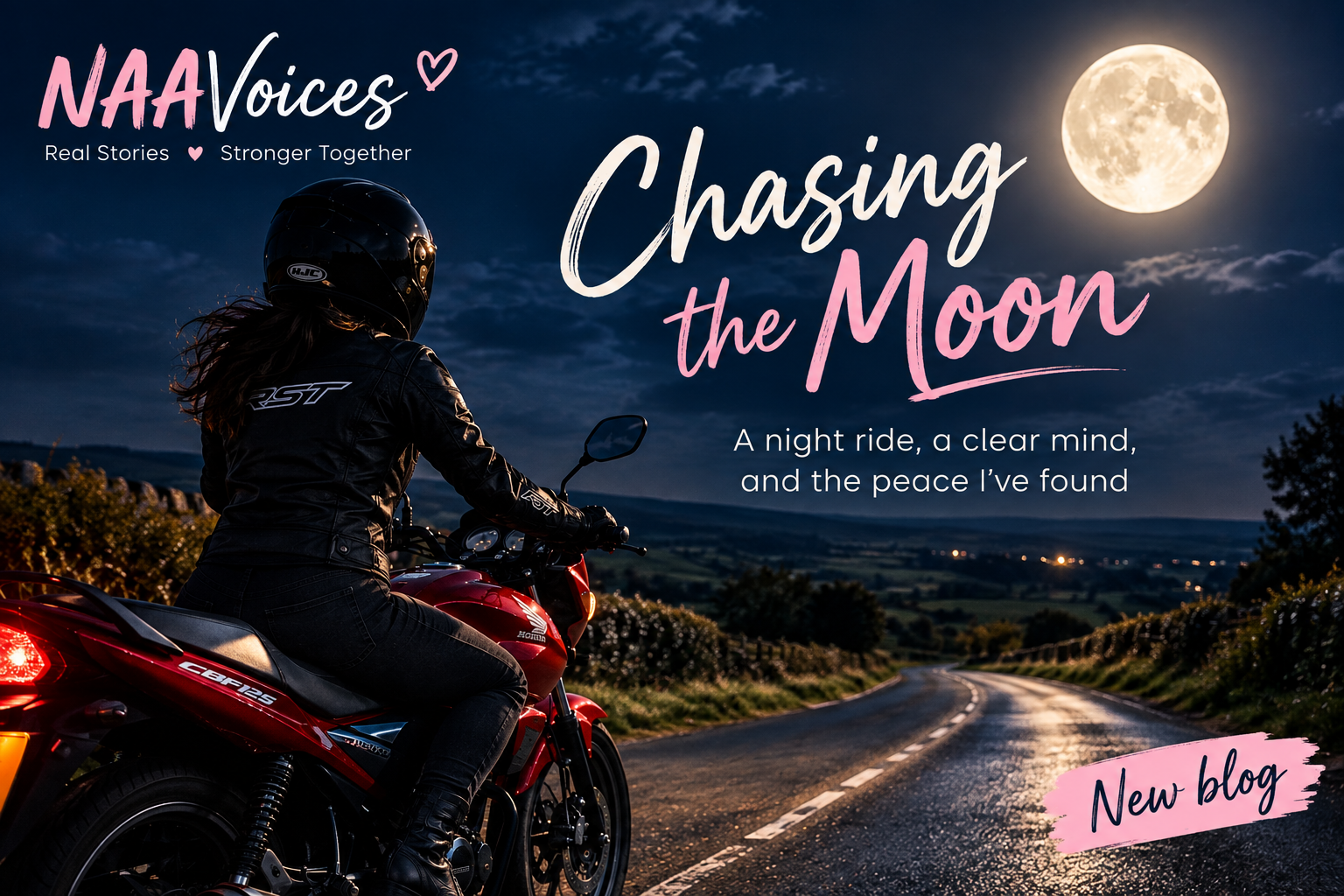
  • Chasing the Moon

    Chasing the Moon

    Tonight, I rode in the pitch black.

    My first proper night-time ride.

    And I hadn’t planned it.

    My teenager came home with a couple of his older friends and, somehow, I was the excited one.

    “Can I go on my bike?”

    Just for an hour.

    There was something slightly ridiculous about the role reversal. When I say teenagers, we’re talking nearly 18. These are lads we’ve known for years, who my six-year-old absolutely worships and who have babysat her before.

    So there I was, apparently the child of the household, while my teenager grabbed my earphones for me and I hurried into my bike jeans and threw on my leather jacket.

    One of the lads had brought his girlfriend with him.

    “I love your jacket,” she said. “It’s like a biker jacket.”

    I laughed.

    Hmm.

    Yes.

    Shock horror.

    It is, in fact, a biker jacket.

    And then I was gone.

    Out of the house. Helmet on. Engine running. Into the dark.

    We live rurally, so once you get away from the houses, darkness really is darkness. The roads disappear ahead of you except for the stretch illuminated by the bike.

    But tonight there was the moon.

    It was enormous.

    Bright enough that I kept catching sight of it as the road twisted and opened up again, and for an hour it genuinely felt as though I was chasing it.

    And my God, it was beautiful.

    There is something about riding that clears my head in a way very little else can.

    You can’t carry everything with you on a motorbike.

    Your brain has to be where your body is.

    The road.

    The bend.

    The gears.

    The sound of the engine.

    The cold air finding the tiny gaps in your clothes.

    For once, there isn’t room for tomorrow, yesterday, paperwork, arguments, money, people, responsibilities or the thousand things constantly competing for space in my head.

    There is just now.

    For an hour, I chased the moon.

    Then I came home.

    My daughter had spent the evening with people she adores, making bracelets and generally having the time of her life.

    Later, I watched a film with my 14-year-old.

    Eventually everyone went to bed.

    And now I’m sitting here with the moonlight coming through the window, thinking about how different life feels sometimes.

    Not necessarily easier.

    But different.

    There are moments when I can actually see how far we’ve all come.

    For a long time, home wasn’t synonymous with peace. Safety wasn’t something I could simply assume. My nervous system didn’t understand the concept of switching off because there was always something else to anticipate, manage or survive.

    Now, increasingly, there are ordinary evenings.

    Teenagers turning up.

    A six-year-old making bracelets.

    A film on the sofa.

    Children sleeping safely upstairs.

    And me disappearing for an hour because I fancied riding my motorbike under a ridiculously bright moon.

    Ordinary things.

    But after you’ve lived without peace, ordinary can feel extraordinary.

    I’ve also learned something else.

    People will come and go.

    I don’t have the energy anymore for people who only appear when they want something from me, or relationships where I am valued primarily for what I can give, fix, carry or provide.

    Peace changes your tolerance for that.

    Once you’ve fought this hard to build a safe life, you become much more careful about who gets access to it.

    And perhaps that is part of healing too.

    Not becoming harder.

    Just becoming more protective of the peace you’ve worked so hard to create.

    Every time I get on that bike, I feel a little bit of it.

    A sanctuary I haven’t felt in a very long time.

    I’m not running away.

    I’m not trying to disappear.

    Sometimes I only get an hour. Sometimes it’s a short ride between everything else life demands of me.

    But for those few miles, there is nothing to solve.

    Just me.

    Two wheels.

    An open road.

    And tonight, a moon so bright I couldn’t resist chasing it.

    Then I get to turn around and ride home.

    And perhaps that’s the biggest difference of all.

    These days, I have somewhere safe to come back to.

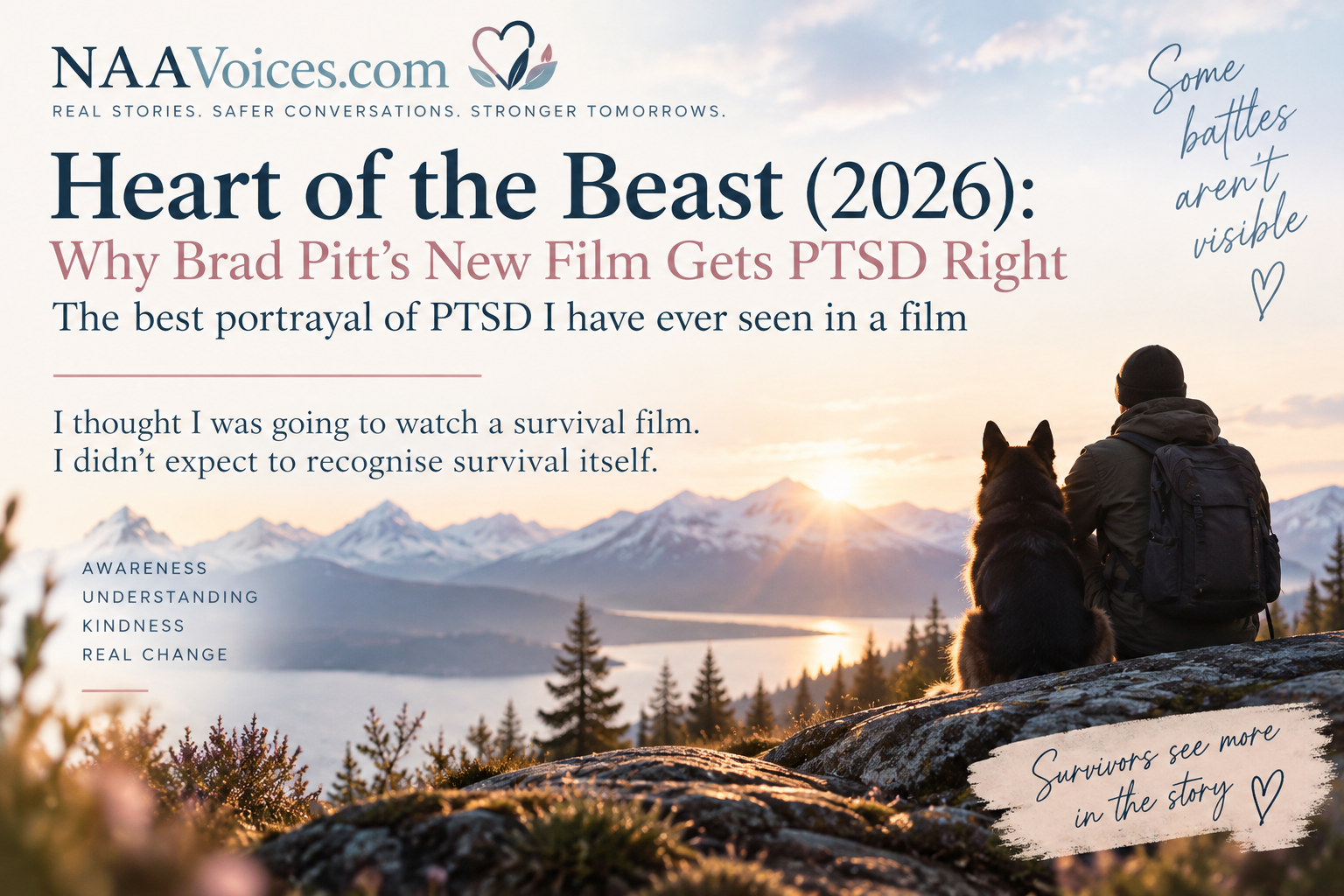
  • Heart of the Beast (2026): Why Brad Pitt’s New Film Gets PTSD Right

    Heart of the Beast (2026): Why Brad Pitt’s New Film Gets PTSD Right

    The best portrayal of PTSD I have ever seen in a film

    I thought I was going to watch a survival film. I didn’t expect to recognise survival itself.

    Spoiler warning: This piece discusses themes and events from Heart of the Beast.
    Content note: PTSD, combat trauma, grief, and animals in distress. No graphic personal account of abuse. If you need support while reading, skip to the directory at the end.

    9–14 minutes

    I went in expecting Brad Pitt, the Alaskan wilderness, a dog, and a physical fight to stay alive. Heart of the Beast, directed by David Ayer and written by Cameron Alexander, delivers all of that on the surface. Pitt plays James Belmont, a former Special Forces soldier stranded in the Alaskan wilderness with his combat dog, Odin. Released by Paramount, it’s an adventure thriller about endurance and the bond between man and dog, while early reviews have already noted the quiet thread of combat trauma running underneath.

    The setup is simple: a seaplane crash leaves James and Odin alone in terrain that would kill most people and most dogs. A trek of around 50 miles through brutal weather, wildlife, injury, and exhaustion. The film gives you the survival story you came for, but it also gives you something else, something quieter, something that doesn’t announce itself.

    It gives you recognition.

    Home, in this film, isn’t comfort. It’s recognition. James isn’t surrounded by people; he’s pulled into the wild with Odin, doing the next necessary thing. It’s a hard kind of belonging, not safety, but familiarity. The body knowing the work.

    Before the film even started, there was an armed forces recruitment advert. In it, a soldier turns, sees a dog on the floor, and doesn’t shoot. I didn’t know then how much that moment would echo.

    By the time the credits rolled, I could barely speak.

    I didn’t cry, though my friend did. Largely over the dog, I suspect. What I felt wasn’t sadness; it was something deeper. Under the adventure narrative sits a portrayal of trauma that doesn’t declare itself. Not the loud, familiar version of PTSD that films often highlight. The quiet kind. The one most people never notice.

    It doesn’t oversell it

    That is the most striking thing about the film. It refuses to oversell trauma.

    There are no endless explanations of what is happening inside James’s head. No speeches that tell the audience he is traumatised. It lives in the subtleties. The withdrawal. Standing back from people. The distance. The way the past can suddenly sit beside the present. The instinct to protect. The exhaustion. And then the ability to keep going anyway.

    Films often get this wrong because PTSD is not always someone visibly falling apart. Sometimes it gets up in the morning. Sometimes it works. Sometimes it looks after everyone else. Sometimes it laughs. Sometimes it looks completely composed. Sometimes it becomes exceptionally capable because being capable was once necessary for survival. Sometimes it simply says “I’m fine,” and people believe it. They see someone still standing and assume the battle must be over. They do not see how much effort standing takes.

    They do not see how much effort standing takes.

    That is what Heart of the Beast shows. Not a man constantly collapsing. A man repeatedly putting himself back together.

    The military context matters. James is a former Special Forces soldier. Odin is a former combat dog with the physical scars to match. Titanium teeth, a prosthetic leg, nightmares. Many years ago, long before my nursing degree, I worked in acute mental health, and some of the people I met there were veterans. I will never forget them. I fully respect just how difficult it is for veterans. Support written for that world exists too, including Combat Stress and PTSD Resolution.

    But PTSD does not solely sit with military veterans. Trauma after war, violence, loss, accidents, childhood experiences, or repeated exposure through work is not interchangeable. The events are not identical. Some of what follows can still be frighteningly recognisable. Hypervigilance. Withdrawal. Protectiveness. The habit of functioning at a cost no one else can see. PTSD UK explains that wider picture clearly. What this film does is make that relatable to anybody who lives with post-traumatic stress disorder.

    For some people, “home” is the first room where those things do not have to be performed away. For James, that room is the wilderness, and the only other heartbeat in it is Odin’s.

    Just get back up

    There are so many points where James could have stopped. Physically. Emotionally. Psychologically. Enough had already happened. He keeps getting back up. Another obstacle, another reserve, another reason, another way through.

    Every time he got there, the trauma would come back, and he would just keep fighting. He would find a way through. Yes, it was for the dog, and for himself. But it was his trauma, the flashbacks, the haunting, that kept him going. His trauma made him push through. I got it. I really got it.

    That lands hard because trauma is not only the thing that knocks you down. Sometimes the survival mechanisms created by it become the things that make you get back up. Not because you are fearless or particularly positive or some inspirational version of “strong.” Sometimes you are absolutely exhausted. You just know how to survive. There is a difference.

    When a nervous system has spent long enough treating the world as dangerous, it learns how to function in circumstances other people might find impossible. Another crisis. Another hurdle. Something inside simply goes: Right. What now? You deal with it. Then the next thing. Every hurdle becomes another battle in a war you never volunteered to fight. A never-ending battle. It feels relentless. There’s no end to it. People look at you and say they don’t know how you do it. Sometimes neither do you. You just keep getting back up.

    This should never be romanticised. There is nothing beautiful about PTSD. There is nothing desirable about intrusive memories, avoidance, emotional numbing, or a nervous system shaped by something that should never have happened. Home should not have to mean danger you already know how to walk through.

    Human beings are still complicated. Trauma can injure someone profoundly while the survival responses developed because of it become extraordinarily difficult to switch off. Fight. Protect. Keep moving. Get everyone else safe. Deal with yourself later. That last one especially. Later does not always come.

    The person who keeps functioning can become very good at hiding how much functioning costs.

    Even when everything is falling apart, the instinct to protect remains. Protect the dog. Protect the people who matter. Keep going. Get them through it. You can be depleted and still notice everyone else. You can be drowning and still check whether the person beside you can swim. From the outside that looks like strength. Inside it can feel completely different.

    Towards the end the film itself seems to change. Towards the end the film itself seems to change. The light. The colour. The pace. Everything quieter. That strange stillness when you know you might be about to leave someone you love, or lose them. There are not always words big enough. Sometimes there are no words at all. And even then the instinct remains. Are they going to be okay? Still protecting. Still thinking about everybody else. Even when there is almost nothing left to give.

    Odin is so much more than “the dog”

    The relationship between James and Odin sits at the centre of the film. Loyalty. Dependence. Mutual protectiveness. If anywhere on that map feels like home, it is that bond. Not the landscape. The other living thing that already knows the cost.

    The film also shows, without over-explaining, that trauma does not look one way, in humans or in animals. Fear does not always look like fear. Distress does not always look like distress. It can look like withdrawal, avoidance, aggression, hypervigilance, silence, restlessness, attachment, protectiveness, shutting down, or simply behaving differently because something inside no longer feels safe. I highly respect the film for raising awareness that dogs experience these symptoms too, and display them in their own ways.

    The film lets you observe rather than lecture. That restraint is what makes it powerful.

    Why I didn’t cry and why I couldn’t speak

    There is a kind of emotional overload where tears don’t come. Everything just goes quiet. That is where I was. I couldn’t really speak. Not through tears. Through overwhelm. Through overload.

    Not because I had watched a sad film about a man and his dog. Because I had watched something that put a complicated experience on screen without constantly explaining it. The withdrawal. The isolation. The memories. The distance. The protectiveness. The exhaustion. The moments where giving up would almost have been understandable. And then getting back up. Again. Again. Again.

    My dissociation means that anything emotional that relates too closely to PTSD is something my nervous system often protects itself from. During those times I write. Or I dictate. To get it out. For processing. That is what this is.

    So todays blog prompt asked for a place that felt like home.. The honest answer is awkward. It was a dark room full of strangers, and a story that did not flinch from the silent version of a fight most people never see. Recognition can feel like home even when it is not gentle.

    The battle nobody sees

    What stays with me most is this. There are people walking around every day fighting battles nobody else can see. They do not necessarily look traumatised. They do not always cry. They do not collapse in front of you. They might be the person everybody else depends on. Working. Parenting. Laughing. Helping other people. Making plans. Getting things done. Surviving.

    Because they are functioning, people assume they are okay. Functioning and being okay are not the same thing. Sometimes functioning is simply what survival looks like. Sometimes the person everyone thinks is incredibly strong is someone who learned a very long time ago that when something knocks them down, they have to get back up.

    Functioning and being okay are not the same thing.

    I keep coming back to the title. Different people will take different things from Heart of the Beast. For me the beast was not only the wilderness, the physical danger, everything waiting outside. It was also the thing carried within. The part of trauma that can pull you backwards without warning. The memories you cannot simply decide to forget. The instinct to withdraw. The exhaustion of fighting something other people cannot see. And also that relentless survival instinct. Get up. Keep moving. Protect them. One more step.

    I didn’t leave the cinema crying. I left silent. Because for once I didn’t feel as though I had watched somebody acting out the textbook version of PTSD. I felt as though I had watched somebody understand the silent one. The one people don’t see. That is to the credit of Brad Pitt, and of David Ayer’s direction.

    It was probably the best portrayal of post-traumatic stress disorder I have ever seen in a film.

    I felt it.


    🎬 Heart of the Beast (2026)
    Directed by David Ayer. Written by Cameron Alexander. Starring Brad Pitt, J.K. Simmons, Anna Lambe, and Uber as Odin. In UK/US cinemas from 25 September 2026.

    Sources

    Heart of the Beast official site: heartofthebeastmovie.com
    Mind, Post-traumatic stress disorder (PTSD) and Trauma: mind.org.uk
    PTSD UK: ptsduk.org
    Combat Stress: combatstress.org.uk
    PTSD Resolution: ptsdresolution.org

    Deadline, Heart of the Beast review (distributor and release date): deadline.com/2026/09/heart-of-the-beast-review-brad-pitt-german-shepherd-survive-1237109761
    Empire, Heart of the Beast review: empireonline.com/movies/reviews/heart-of-the-beast
    Flickering Myth, Heart of the Beast review: flickeringmyth.com/movie-review-heart-of-the-beast-2026

    If this film, or this piece, has stirred something up

    You do not have to sit with it alone. If you are in immediate danger, call emergency services (999 in the UK, 911 in the US and Canada, 000 in Australia).

    UK and Ireland

    Samaritans: 116 123 (24/7) · samaritans.org
    Combat Stress (veterans, serving personnel and families): 0800 138 1619 · text 07537 173 683 · combatstress.org.uk
    Mind: 0300 123 3393 · mind.org.uk
    PTSD UK: ptsduk.org
    PTSD Resolution (veterans, reservists and families): 0300 302 0551 · ptsdresolution.org
    NHS 111 (England, Scotland, Wales): 111 · in Wales, press 2 for 24/7 mental health support
    Op COURAGE (NHS veterans’ mental health, England): ask your GP or search NHS Op COURAGE
    Veterans’ NHS Wales (VNHSW): ask your GP or search Veterans NHS Wales

    United States

    988 Suicide & Crisis Lifeline: call or text 988 · 988lifeline.org
    Veterans Crisis Line: 988 then press 1 · text 838255 · veteranscrisisline.net
    NAMI HelpLine: 1-800-950-NAMI (6264) · nami.org
    National Center for PTSD (VA): ptsd.va.gov

    Canada

    988 Suicide Crisis Helpline: call or text 988 · 988.ca
    Canadian Mental Health Association: cmha.ca

    Australia and New Zealand

    Lifeline Australia: 13 11 14 · lifeline.org.au
    Beyond Blue: 1300 22 4636 · beyondblue.org.au
    Lifeline New Zealand: 0800 543 354 · lifeline.org.nz

    International directory

    IASP local crisis centres: iasp.info/suicidalthoughts

    If you are supporting someone else, those same numbers are for you too.

    Comments are welcome. Please do not share graphic detail about other people’s trauma, and do not use the comments as a crisis service. If you need help now, please use the numbers above.

    This is a personal reflection on a film and not clinical advice.

  • The Bravest Thing I Did When No One Was Watching.

    The Bravest Thing I Did When No One Was Watching.

    I have thought about this question deeply, and my answer is actually quite simple.

    I kept going.

    When the curtains were closed. When the doors were locked. When the world saw nothing but silence from me, I kept going.

    I have been thinking a lot lately about something we do not talk about nearly enough.

    Post-traumatic growth

    We focus so much, and rightly so, on the weight of trauma. The reliving. The triggers. The dissociation. That buzzing sensation inside your head when you finally realise you have had enough and just need to reset.

    I know all of this intimately. I live with PTSD.

    I know how much heavier injustice feels when your nervous system is already stretched thin. I know the days when I have been so badly triggered that I could not sleep or leave the house, and the mornings when simply getting up and functioning took far more effort than anybody around me could possibly have known.

    There were nights I lay awake. Mornings when breathing felt like work. Days when I was trying to hold myself together while still holding everyone else up.

    But recently, I had to look back over the last couple of years to complete an application. As I pulled everything out and laid it all down in front of me, I saw something I had never really allowed myself to see before.

    Just how much I had actually achieved while learning to live with all of it.

    That was when I started thinking properly about post-traumatic growth.

    It does not mean the pain was not real

    For a long time, trauma brought pain with silence.

    Looking back, though, that silence was not empty.

    It was where I listened, learned, observed, questioned and slowly rebuilt. Most of it happened quietly, without recognition and without me even realising at the time that rebuilding was what I was doing.

    I did not grow instead of being affected by trauma. I grew while being affected by it.

    The triggers still come. Hard days still happen. There are things I have to manage now that I never had to manage before.

    Growth does not erase any of that.

    It simply means that somewhere amongst it all, I changed too.

    What growth actually looks like for me

    People often talk about growth as though it is something polished and neat.

    Mine isn’t.

    I built this space online. Not because I wanted recognition, but because people reached out. Some came back. Some told me that something I had written made them feel understood.

    I don’t blog religiously. I write when something reminds me, when I need to get words out, or when something sparks something in me.

    It is messy. Sporadic. Real.

    And that is exactly how I want it to be.

    I carried my family through some incredibly difficult years. I supported all three children who, at different points, needed additional mental health support themselves, while also navigating my own struggles.

    There were days when I felt as though I had absolutely nothing left and still somehow found something.

    I have also changed in the way I deal with fear.

    I joke sometimes that I care less these days, but that isn’t really true. I still care deeply. I have never wanted to act out of malice, and I never want difficult experiences to turn me into somebody who does.

    What changed is that I stopped being frightened of other people’s reactions to me doing what I believe is right.

    I no longer automatically carry somebody else’s judgement as though it must say something about me. After having my character torn apart in court, something shifted.

    I promised myself nobody would ever twist who I am and make me question myself like that again.

    At the time, I felt I had already faced the very worst.

    And I was still here.

    My voice became stronger.

    I advocate fiercely now when something is wrong.

    I have also learned constantly. Not simply to understand myself, but because I wanted to understand other people better. I started noticing gaps in my own knowledge and going away to fill them.

    Not for recognition. Not for another certificate on the wall.

    Simply because sometimes another human being is standing in front of you and you want to understand how best to help them.

    And some of my growth has looked far less. Five weeks ago, I hammer-jacked up a 16ft square concrete base and laid an 11ft square patio entirely on my own. I was absolutely shattered afterwards. I fitted my own kitchen from scratch.

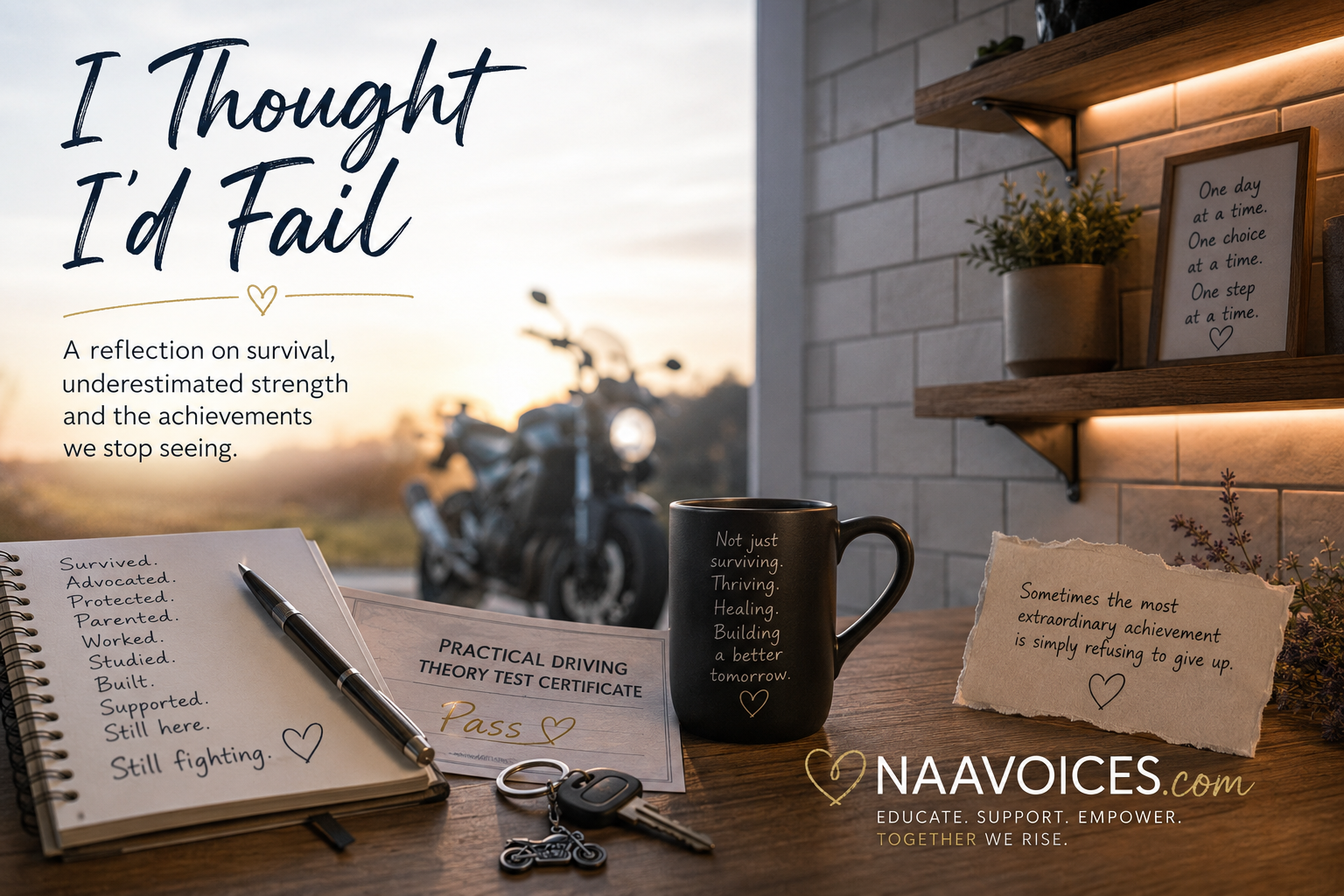
    I am one part away from earning my full A motorcycle licence so I can ride a big motorbike.

    They might sound like completely random things to include in a piece about trauma.

    They aren’t.

    Every one of them represents something I might once have questioned whether I could do.

    So I did it.

    Some were done on difficult days when I was exhausted or overwhelmed. Sometimes having work, projects, or something practical to focus on gave me routine and purpose when other parts of life felt heavy.

    Sometimes every part of me wanted to curl up and hide.

    I did it anyway.

    A new chapter, and proof of what I am capable of

    Now I am hopefully stepping into another chapter of my career.

    The last time I chose to study at postgraduate level, I did it for a very different reason.

    I needed to understand.

    Behaviour. People. The brain. Trauma.

    I was trying to make sense of what I had lived through while, in many ways, I was still living through it.

    I was experiencing post-separation abuse and was diagnosed with PTSD during my second module. At the time, I never truly believed I could succeed.

    Yet I completed my postgraduate certificate with a distinction.

    There were assignments written through tears. Nights spent awake learning about trauma and domestic abuse while simultaneously beginning to understand what had happened to me.

    There was something surreal about studying the impact of trauma academically while living with its consequences personally.

    What I gained from that postgraduate course was far more than academic knowledge.

    It gave me evidence. Evidence of exactly what I am capable of.

    I can see that now, though I couldn’t see it then.

    Trauma did not give me my strength, my determination, my compassion or my voice. Those parts of me were already there.

    What the experience did was force me to discover just how much of them I had.

    I walked through abuse, diagnosis, trauma and some incredibly dark periods without allowing those experiences to decide who I would become.

    Other people do not get to define who I am or what I am capable of. There were days when I genuinely could not see an end to any of it. Now I look back at the person I have become and think:

    My God. I have changed.

    Not into somebody hardened or bitter.

    Into somebody far harder to silence.

    And perhaps that is what post-traumatic growth means to me.

    Not pretending something terrible became something wonderful.

    Not being grateful for trauma.

    Not saying everything happens for a reason.

    I don’t believe any of those things.

    It is recognising that something hurt you profoundly and that, while learning to live with what it left behind, you built something too.

    So is post-traumatic growth real?

    I believe it is.

    Post-traumatic growth, or PTG, is the term used to describe positive psychological changes that some people experience while struggling with highly challenging or traumatic life events.

    It is commonly described across five broad areas.

    Appreciation of life. Priorities change. Things once taken for granted can suddenly matter far more.

    Relating to others. Connections can deepen. Compassion can become stronger.

    Personal strength. That realisation of: I survived something I once did not think I could.

    New possibilities. New interests, ambitions, paths or directions can emerge.

    Spiritual or existential change. A changed sense of meaning, purpose or understanding of life.

    But I think it is incredibly important that we do not romanticise it.

    Post-traumatic growth does not mean trauma was beneficial.

    It does not mean somebody should be grateful for what happened to them.

    And it certainly does not mean that somebody who continues to struggle has somehow failed to grow.

    Growth and distress can exist at exactly the same time.

    You can be stronger and still be triggered.

    You can have found your voice and still have days when using it feels impossible.

    You can rebuild huge parts of your life and still grieve for the parts that were damaged.

    Both things can be true.

    I will never be exactly the person I was before.

    I no longer see that entirely as a loss.

    I still have my kindness. That never left.

    But now it has backbone behind it. Purpose. Knowledge. And a voice that I worked incredibly hard to find.

    I didn’t wait until I felt completely healed to start rebuilding my life.

    I built my life while I was healing.

    And perhaps, more than anything else I have written here, that is what post-traumatic growth means to me.

    Trauma brought pain with silence.

    But the silence did not stay empty.

    So, back to the question that started all of this.

    What is the bravest thing I have ever done when no one was watching?

    I kept going.

    And somewhere in all that silence,

    I grew.

  • Home Is Not Always an Address

    Home Is Not Always an Address

    Home Is Not Always an Address

    Where is home?

    It sounds like such a simple question.

    An address. A town. The place your post gets delivered. The place you return to at the end of the day.

    But I’m not sure that is what home means to me anymore.

    Last night, after a ten-hour shift, I collected my daughter, got into the car and set off.

    140 miles. That was the countdown on the sat nav.

    It should have felt like a long drive after a long day. Instead, as the miles started disappearing behind us, I noticed something else.

    My shoulders dropped.

    I did not consciously decide to relax; my body seemed to do it before my mind caught up. Not because I had finished work. Not because I had a weekend off. Not even because we were getting away for a couple of days.

    Somewhere inside me, I knew where we were going.

    We were going home.

    Except we weren’t driving towards the house where we live. We were driving towards a person.

    140 miles

    There are 140 miles between us.

    Neither of us can simply move closer. Our older children are settled. Between us there are nine children whose lives, schools, friendships and futures matter more than making our geography convenient.

    So 140 miles it is.

    And somehow, across those miles, something has grown that feels far bigger than friendship.

    One of her daughters once referred to my child as her sister. It stayed with me.

    We talked afterwards about that phrase people use so easily: friends are the family you choose. Except sometimes I think it goes further than that.

    Nobody held a family meeting and assigned titles. Somewhere along the way, “my mum’s best friend” simply became “Auntie”, and children who were not born as siblings began referring to one another as family.

    It just became true.

    Sometimes family is not created by blood. It is created by consistency.

    It is created by showing up, by trust, by being safe, and by knowing someone is there without needing to ask whether they will be.

    When home becomes a feeling

    About two hours into the journey, my daughter asked me to put Country Roads on.

    So I did. And we sang. Probably too loudly. Definitely not particularly well.

    And somewhere in the middle of it, a feeling flooded over me so suddenly that I recognised it before I could explain it.

    Home.

    Not an address or a postcode, but people. Somewhere I don’t have to explain every silence, every reaction, or every part of the history that made me who I am. Somewhere I can arrive tired, overwhelmed, distracted or completely myself, and still belong.

    Somewhere my daughter can simply be herself too.

    Then she said it

    A while later, she told me she wanted to go home.

    I automatically thought she meant our house. I told her we were still about three hours from home, and that we weren’t far from where we were going.

    She corrected me straight away. She didn’t mean our house at all. She meant home at Auntie’s.

    And there it was again.

    I hadn’t told her what I’d been thinking about earlier in the journey. I hadn’t said any of it aloud. Yet she had arrived at exactly the same word, and made exactly the same distinction.

    Maybe children don’t need us to define belonging for them. They may not have the language for nervous systems, emotional security or psychological safety, but they know where their body settles. Where they can be loud. Where they can be quiet. Where they don’t have to monitor the room.

    Maybe they understand that home can be more than one place.

    And maybe, sometimes, home is not really a place at all.

    Home after trauma

    For anyone whose experience of home has been shaped by trauma, the idea of safety can become complicated.

    We are often told that home should be the safest place in the world. For some people, it was not.

    A house can be familiar without ever truly feeling safe. You can know where every cupboard is, where the light switches are, what the floorboards sound like at night, and still never feel completely at ease.

    Sometimes, only after you leave, do you realise your body knew the difference all along.

    Healing is not always dramatic. Sometimes it is simply noticing that your jaw is no longer clenched, that your shoulders have dropped, and that you are no longer preparing for something you cannot yet see.

    Not the place where you survived, but the places where you started living again.

    That safety does exist. That trust can be rebuilt. That family can be found. That belonging can exist 140 miles away.

    And that eventually, home can become a word that feels good again.

    So, where is home?

    Last night there were still miles left on the sat nav. Technically, we had driven away from home hours earlier.

    But somewhere on that dark road, with the music far too loud and my daughter singing beside me, I realised the opposite was true.

    We were going home.

    And a little later, without knowing a single word of what had been going through my head, she told me the same thing in her own way.

    Perhaps that was the clearest answer I could have been given.

    So I’d genuinely like to know: what does home mean to you?

    Is it an address? A person? The family you were born into, or the family you found?

    Or is home simply wherever your shoulders drop a little when you know you’re nearly there?

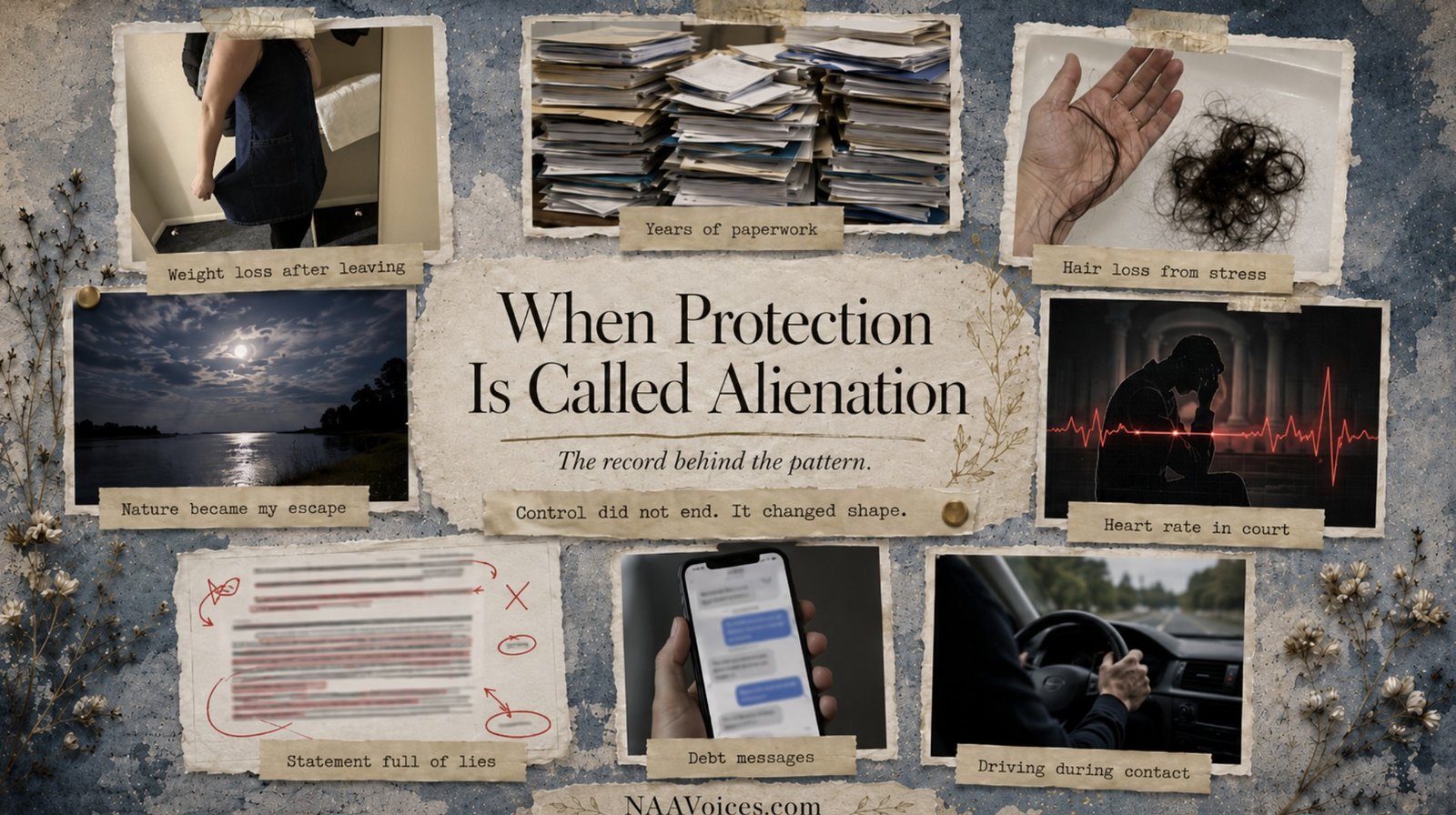
  • When Protection Is Framed as Parental Alienation

    When Protection Is Framed as Parental Alienation

    What happens when raising a safeguarding concern makes you the one under investigation? My family’s record, what I understand now that I couldn’t see then, and the practical things I wish somebody had told me in year one.

    Before you start. This describes domestic abuse, coercive control, family court proceedings and a child in distress. If you need support at any point: the National Domestic Abuse Helpline is 0808 2000 247, free, 24 hours. Samaritans is 116 123. There’s a fuller list at the end.

    My life is very different now.

    For a long time, I couldn’t talk about what we lived through at all. These days I can, and what unsettles me is how I do it: flatly, without emotion, as though I’m standing slightly outside myself, describing something that happened to somebody else. I watch people’s faces change while I’m speaking. They stare at me in disbelief, and I feel almost nothing, and then I go home and carry on with my day.

    I have never sat down and gone through all of it. Not the years before I left, and not the years afterwards. If I’m honest, I don’t want to.

    But I do support other people through this platform. People who are exactly where I was. And what I see, over and over, is the same pattern with different names attached.

    Parental alienation is enormous.

    Of the survivors I speak to, most of them women, most of them describing coercive control rather than physical violence, it is very often the first move the other side makes. Before the safeguarding concerns are examined. Before anyone has looked at the history. The accusation lands, and from that moment the protective parent is the one under investigation.

    And the family court system still doesn’t seem to recognise it for what it frequently is: a tactic, deployed early, by people who have had a great deal of practice at being believed.

    It is destroying lives. I watch it happening in real time to people I’ve never met, and I recognise every stage of it, because it happened to us.

    So this is the record. Not the whole thing, but the shape of it, with what I understand now that I couldn’t possibly see at the time.

    I’ve written the personal version separately, as a letter to my daughter. If you want to know what this costs a family, that’s where it is. This page is for anyone living something similar, or anyone who works in the system and wants to understand why survivors describe it the way we do.

    There’s a practical section at the end. If you’re mid-proceedings and short on time, skip straight to it.


    The email I sent myself

    In August 2021, two years before I left, I sent myself an email at ten o’clock at night. No subject line, no message. Just a long list of everything I could see but couldn’t say out loud, ending with two questions: what will my children have to face growing up around this, and what will my life look like in five years’ time?

    Many people will recognise that moment. I knew. Long before I had the language for any of it, before I had ever heard the term coercive control, before a single professional became involved, I was sitting in the dark emailing evidence to myself with no idea of what would unfold.

    I didn’t need persuading that something was wrong.

    I needed someone to name what was happening, to reassure me that it wasn’t my fault, and to help me see that the pattern would not shift simply because I tried harder.

    So why didn’t I leave?

    I’ve been asked that, kindly and unkindly, more times than I can count. Here’s the honest answer.

    It wasn’t only about what he was doing. It was about him not being well.

    There was always a crisis. From the moment I became pregnant, and right through the year that followed. But that summer something shifted, and the pattern became harder to ignore.

    The police were called out while he had sole care of an eight-month-old baby. Weeks later, he was in charge of all three of my children, and I ended up having to ring a crisis line.

    Two incidents, weeks apart, both involving children who could not have removed themselves from the situation. Both were recorded at the time by the agencies involved.

    How an explanation becomes a shield

    From that point on, every crisis came with an explanation attached, and the explanation removed any sense of choice. Each episode was framed as something that couldn’t be helped, rooted in circumstances rather than in behaviour.

    Which meant that every time I tried to raise anything, I found myself speaking about somebody who had been positioned as unwell. Any concern I voiced became an accusation. Any boundary I tried to hold became me kicking someone while they were down.

    Silence started to feel safer than honesty. That is exactly the point at which you stop reporting things, even to yourself.

    That’s how it worked on me. Not through threats. Through obligation.

    You don’t leave someone who’s struggling. You especially don’t leave when you’re a nurse, when looking after people is who you are, and when you’ve been told by him and by everyone around you that you’re the only one who can.

    Every reason to go became a reason to stay a little longer. Every concern arrived with a ready-made answer that made me feel cruel for having it.

    What I understand now about pregnancy

    Coercive control frequently escalates during pregnancy and in the year after a birth. It’s a period when routines change, when you are physically and financially more dependent, when your attention is entirely occupied elsewhere, and when leaving becomes exponentially harder to imagine.

    Everything that makes that time vulnerable also makes it useful to somebody who wants control.

    I didn’t recognise any of that then. I only knew that the crises came more often, that the explanations never changed, and that the weight of managing all of it had somehow become mine.

    And I want to say the obvious thing, because I couldn’t say it at the time. Two emergency responses involving three children, weeks apart, is not a difficult patch. It’s a safeguarding history. It was recorded by the people who attended, and it existed in writing long before any court was involved.

    An explanation is not an entitlement

    I want to be careful here, because ill health is not abuse and the two must never be collapsed together. Most people who are unwell hurt nobody but themselves.

    But an explanation is not an entitlement. A reason for behaviour is not permission for it.

    When everything is explained, indefinitely, by something a person can’t help, the effect is that nothing changes, nobody is accountable, and the person absorbing all of it becomes responsible for managing it.

    That’s what kept me there for two more years after I wrote that list. Not confusion about what was happening. I’d sat in the dark and written the whole thing down.

    I just couldn’t work out how to leave without being the villain.

    And I will never judge anybody for that question

    If you’re reading this and you’ve lived through coercive control, you will already have asked yourself why didn’t I just leave more times than anybody else has ever asked you. You’ll have gone through it at three in the morning. You’ll have built a case against yourself out of it. You’ll have decided, somewhere along the way, that the fact you stayed says something about you.

    It doesn’t. It says something about how well it works.

    It’s an empty question, and an unanswerable one, because it assumes there was a clear moment with a clear door, and there almost never is. There’s a slow narrowing. There’s an explanation for everything. There’s the version of yourself you’ve been slowly talked into, the one who’s difficult and unreasonable and would be lost without them. There are children, and money, and a house, and the certainty that nobody will believe you, and often somebody who is genuinely struggling, which makes leaving feel like cruelty rather than survival.

    You didn’t stay because you were weak. You stayed because leaving looked impossible and staying looked survivable, right up until the day it didn’t.

    So I won’t ask you why you didn’t leave. I know exactly why. It’s the same reason I didn’t, and you’ve tortured yourself with that question quite enough already.

    It’s now five years since I sent myself that email, and I have the answer to both questions I asked in it.

    In the house

    Coercive control, financial control, alcohol, disappearances, and a version of him that appeared whenever anyone else was in the room. He had lost his driving licence.

    I left one November with three children and a shopping bag, and disclosed four years of abuse to the police the following night.

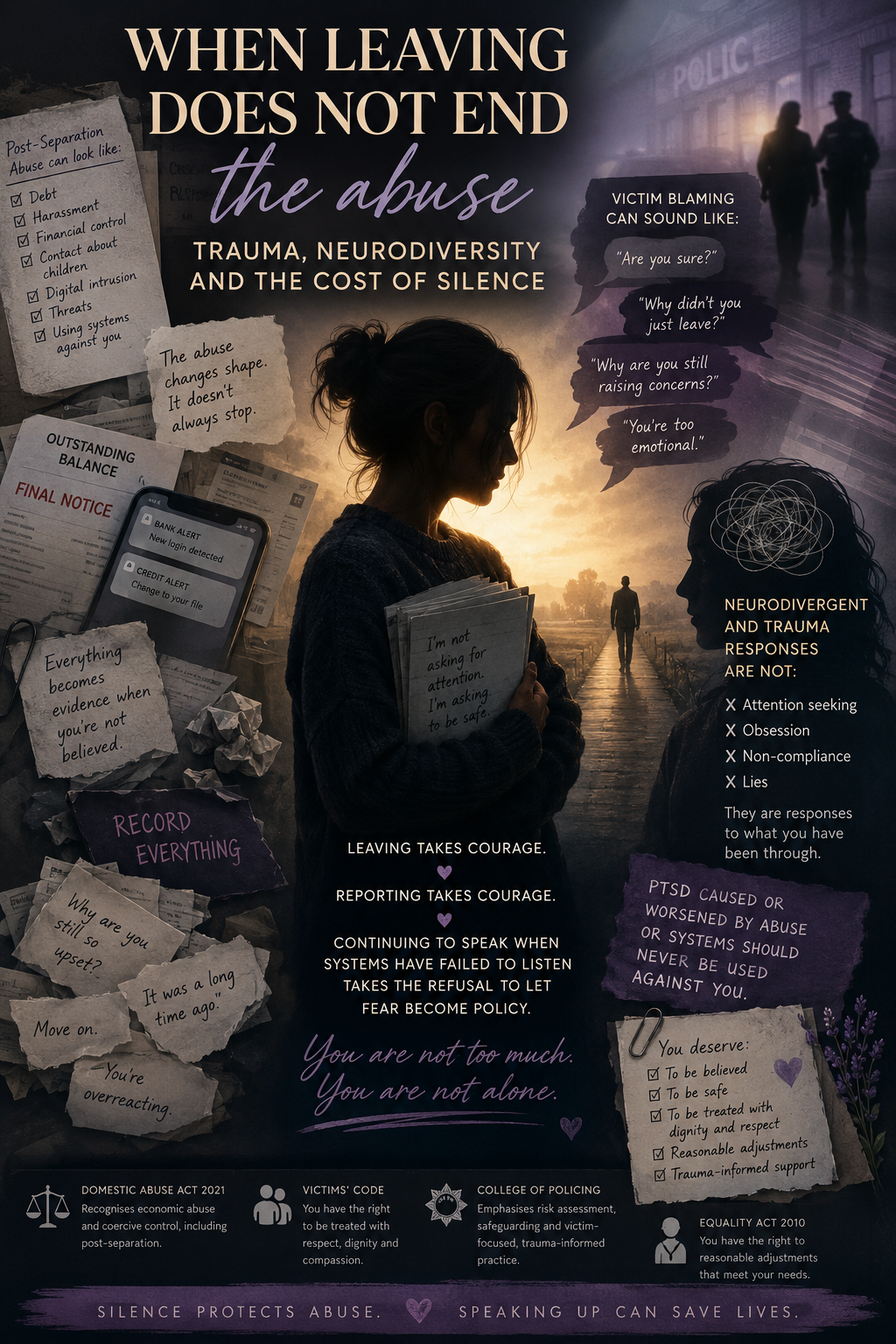
    What I understand now. I thought leaving was the end of it. Almost everyone does. It’s how the whole thing is framed: get out, get safe, start again. Nobody tells you that leaving is the point at which a certain kind of person loses their primary means of control and begins looking for another one.

    I also didn’t know what I’d lived through had a name. I could describe individual incidents and they sounded like a difficult relationship. It took me a long time to understand that the incidents weren’t the abuse. The pattern was.

    In the systems, the year after I left

    I was told my criminal case was with the CPS for a charging decision. Then a call came saying it had “met threshold” for further investigation, which meant it had never gone to the CPS at all. Eight months out, four officers in.

    In the family court, being on legal aid was treated as a mark against me, and I was asked whether I really wanted my child to have independent representation. I ended up speaking to Cafcass alone, because my own solicitor would not raise Practice Direction 12J or request a fact-finding hearing.

    PD12J requires a court to consider whether abuse allegations need deciding before contact is arranged. It exists for cases exactly like ours. Ours was never put in front of the court, because the person paid to represent me wouldn’t ask.

    📄 The Day Everything Changed: written that week. What it feels like when you’re unsafe with your own representation.

    📄 Finding Strength in Tough Times and Back to Reality: the garden shed, and driving home again. This is where the blog began.

    What I understand now. I assumed that raising a concern meant it would be examined. It doesn’t. It means it enters a process, and processes have their own logic, their own deadlines and their own tolerance for how much complexity they can hold.

    I also assumed my representation was on my side by default. That was naive, and it’s the mistake I see most often in the people I now support. Your solicitor works for you. If they won’t ask the questions the rules require, that isn’t a matter of professional judgement you have to defer to. It’s a reason to find somebody else, and to do it faster than I did.

    The two mechanics

    Two things ran through all of it.

    DARVO: deny, attack, then reverse victim and offender. Done fluently, it’s extremely convincing to anyone hearing a case cold.

    The word alienation. Raise a safeguarding concern and you can be recast as hostile and obstructive, and once that label sticks, everything protective becomes evidence against you. Reporting looks like malice. Documenting looks like obsession. Hesitating looks like sabotage.

    It’s worth saying plainly that alienating behaviour is real and does happen. Children are sometimes turned against a parent who has done nothing wrong, by mothers and by fathers, and where that occurs it causes serious harm. That is exactly why the concept exists, and exactly why its misuse is so damaging: every time the allegation is deployed as a tactic, it costs credibility to the people with a genuine claim.

    The problem isn’t the concept. It’s that it can be raised at the start, before any safeguarding concern has been examined, and then determine how everything afterwards is read.

    This isn’t only my experience. The Ministry of Justice’s 2020 Harm Panel report found exactly this: a pro-contact culture that minimised abuse allegations, and systemic failures to keep children and protective parents safe. Six years on, families are still living it.

    What I understand now. This is the part I most want professionals to sit with, because I only recognised it properly once I started supporting other people.

    I thought what happened to us was particular to our case. It isn’t. I hear the same sequence almost every week, from people who have never met each other, in different courts, in different parts of the country. Concerns are raised. An alienation allegation appears, often within weeks. The focus shifts from what the child is experiencing to whether the parent reporting it is credible. Everything the protective parent does from that point is read through a lens of suspicion.

    When something happens that consistently, to that many unconnected people, it isn’t coincidence and it isn’t a series of unfortunate individual cases. It’s a tactic that works, being used by people who have worked out that it works.

    In the hearings, over the following winter and spring

    By then I’d stopped showing anything. I didn’t cry once. I was medicated to get through court days and nothing else, because I knew that if I felt any of it in that room I wouldn’t be able to speak.

    There’s no version of yourself that works in there: break down and you’re unstable; hold it together and you’re suspiciously unaffected for someone describing four years of abuse.

    Years earlier he had told me, in writing, that he knew exactly what to say to professionals and that it wasn’t the first time. I still have it. I sat and watched professional after professional receive it as sincerity.

    Supervision was removed. Contact was ordered to progress. He laughed on his way out of the door, and I broke, and said the only thing I had left.

    📄 When the System Sees Performance, Not Risk: the winter hearing. On my knees outside the building, and how a record gets reshaped.

    📄 When Supervision Ended Before the Fear Did: the final hearing, and why a supervised contact session proves only that somebody can behave for an hour while being watched.

    What I understand now. That flatness I describe at the start of this piece, the out-of-body way I talk about it now, began in those rooms. It wasn’t composure. It was the only way I could function, and it was read as detachment.

    The system assesses people on how they present in a room, in a building designed to be intimidating, on one of the worst days of their life. And presentation is precisely the thing a practised person can control and a traumatised person cannot.

    I don’t think most of the professionals involved intended any harm. I think they were reading the room, and the room was showing them the exact opposite of the truth.

    In my child

    Six months of contact. Fear of the car. A stutter. Her name written on her own leg in marker pen. Coming home in the uniform she’d left in with every clean thing untouched in her bag. Asking to phone me before bed and being told no.

    And it reached her brothers too, in the cruellest way. They’d spent two years protecting her from every detail, and then she started coming home and repeating those details back to them, in her own voice, with no idea what she was carrying.

    In the proceedings, they were the non-subject children. Nobody assessed them. Nobody asked them anything. Both needed professional support. Both still have it.

    What I understand now. Everything I predicted in my first statement happened. Not approximately. Exactly. I had described it in advance, in writing, and it was read as a mother’s fear rather than a child’s risk.

    That distinction, fear versus risk, does an enormous amount of damage. It treats the person with the most information about the child as the least reliable source of it, on the grounds that she’s too close to it to be objective. But being close to it is precisely why she knows.

    And the thing I’d say to any professional reading this: children rarely announce distress. They show it. In sleep, in speech, in continence, in what they stop asking for. My daughter’s stutter appeared during contact and disappeared when it stopped. That is not a coincidence you can afford to file under adjustment.

    When it started to slip

    The third parties handling handovers withdrew, because the state she was in before and afterwards was more than their own household could absorb. People with nothing to gain either way stepped away from facilitating the relationship at all.

    Social services referrals were made by outside parties, concerned for a child too young to protect herself.

    He had been disqualified from driving. Despite that, he was seen driving more than once and not only by me, including driving my daughter while banned. Photographed, documented and reported at the time.

    And not once in three years did anyone put contempt of court in front of the court. Everything was recorded. Everything sat in a file. The burden of doing something with it stayed exactly where it had always been.

    What I understand now. This was the first shift, and it had nothing to do with me becoming more persuasive.

    For two years, I was a parent raising concerns, and every one of them was absorbed by the DARVO and alienation tactics I described earlier. Then other people began raising their own, independently, without being asked, and with nothing to gain from it.

    I want to be honest about how that felt, because it wasn’t vindication. It was closer to grief. Right up until then, some part of me had still been hoping I was wrong. Other people seeing it meant I wasn’t.

    But it changed something structural. It was no longer only my word, and it never should have needed to be.

    If you’re in this, that’s the thing I’d hold on to. You may spend years trying to convince people that you’re reliable, and it may never work, because that argument isn’t winnable once someone has decided who you are.

    But you aren’t the only one showing them. My daughter was telling them too, in the only ways a small child has. And the people around her, who had no reason to say anything at all, could see it for themselves.

    You don’t have to be the only evidence. You never were.

    The month I stopped waiting

    He cancelled contact himself. An emergency situation. No details beyond that.

    Two weeks later a relative of his contacted me to say the same thing, this time for the foreseeable future.

    And a few days after that he appeared on the app as though none of it had happened, asking me to confirm the collection point.

    That was a sequence of events I had anticipated; it is the reason I stopped waiting. Not the cancellation. The fact that something serious enough to need a relative and an indefinite pause had, within days, become a routine message about logistics.

    I logged it, as I always did, and I was told again that I should be reporting it.

    So I did, properly this time. One document, every ground, the whole history in order, handed to three separate authorities at once.

    In front of witnesses, social services told me the risk was too high without full transparency, that contact shouldn’t resume without proper assessment, and that I should use my parental responsibility to keep her safe.

    For years, not one agency had acted. Given the same information assembled in one place, all three reached the same conclusion within days.

    The evidence had always been there. What changed was that I stopped presenting it in pieces.

    What I understand now. Every report I’d made had been assessed on its own. Of course it was. Individually, most of it is minor.

    The harm was never in any single incident. It was in the accumulation, and no system I encountered was built to see accumulation.

    They are not going to assemble it for you. You have to do it, and you have to hand it over in one piece.

    That was the second thing. The third came a month later.

    The month the record spoke for me

    He applied for an order against me, served the morning before the hearing, without notice, directly after my safeguarding enquiries.

    I want to be clear about my position going into that hearing, because it matters. I wasn’t asking for anything to happen to him. I never had been. Every application, every referral, every report I ever made was about one question: whether my daughter was safe, and what needed to be in place so that she was.

    By then I had three things I hadn’t had before. Other people’s accounts. One complete chronology. And two years of correspondence, in writing, dated.

    So I stopped trying to defend my character, which had never worked, and put the documents in front of the court instead.

    His statement was a sworn one. He had signed it. Set against the dates, the emails and the sequence of events they described, the inaccuracies were visible on the page.

    I didn’t need anyone to take my word for anything. I only needed them to read both.

    It didn’t survive the comparison.

    The terms were rewritten in my favour and made mutual.

    And then there was my writing. He objected to this blog.

    Here is the part I have never been able to stop thinking about. At the time I was writing under a pseudonym. Nothing on the site named him. Nothing identified him. No dates, no places, no details anyone could trace, and I had been careful about that from the very first post.

    So the question I put to the court, and the question I’d put to anyone reading this, is a simple one. If the writing didn’t name him and didn’t identify him, how did he know it was about him?

    In an anonymous account of coercive control, written by somebody he had no way of identifying, he recognised himself.

    I don’t say that to score a point. I say it because I have turned it over hundreds of times since and I still don’t know what to do with it.

    The court was more than content for the website and the blog to remain live, for me to share my account of what I had experienced and for the work I was doing to continue. The point was made that removing content about him would itself have been telling.

    I was taken to court over my voice and came out still allowed to use it.

    📄 This Time I Knew the Script: recognising the choreography before it started.

    What I understand now. This was the first time it had ever gone the other way.

    For three years, every hearing followed the same pattern. He would say something, it would be accepted, and I would become the one under scrutiny. I would leave knowing exactly which parts weren’t true, yet with no way to challenge any of it without sounding bitter. It was a cycle where the narrative was fixed before I even entered the room, and where the truth had no safe place to land.

    This time, the inaccuracies were in a document he had signed. I made sure every one of them was evidenced, clearly shown to be untrue, and given a voice in front of the judge. For the first time, the record didn’t stand uncontested.

    I also named DARVO out loud, for the first time. Deny, attack, reverse victim and offender. For two years, I had been living inside a sequence I could feel but couldn’t describe, and being unable to describe it was most of the problem. Once a thing has a name, it stops being your emotional reaction to something and becomes a pattern other people can look for.

    None of it was about exposing anybody. I would have given a great deal for the record to have shown something different.

    It didn’t. And I had a child who needed somebody to notice.

    I didn’t have to make anything happen. I just had to still be standing there with the dates when it did.

    And now

    Months of quiet. Then it started again.

    Calls and texts looking for him, on a number I have held for over a decade. Emails addressed to him, landing in my inbox. Debt correspondence, chasing accounts I have never held.

    And here is why that matters more to me than it might to you.

    About a year after we met, the letters started arriving. Debt letters, in his name, at our address. I was told they were his ex-partner’s doing. That she had run up debts in his name after they separated, and that this was the sort of thing she did.

    I believed it. I cleared them. All of them. I am now fully aware that was far from the truth.

    I know that a story I was told about a previous partner is the same story that now attaches to me, and I know what my own paperwork says about what I paid and when.

    I’m not going to speculate about who’s responsible for what’s arriving now. I don’t need to, and it isn’t mine to determine. What I can tell you is what arrived, and when, and that I reported it the same day, as I always do. It was at least the eighth time I’ve reported fraud. The result has been the same every time.

    The house. The systems. The child. The court. The credit file. Every time one closed, it found another. It was never really about any of those things. They were just what was available.

    What I understand now. This is what I mean when I tell people the pattern is the evidence. I couldn’t see it at the time, because at the time I only had one data point and somebody else’s reputation to hang it on.

    If you are early in something and you’re being told a story about a previous partner, listen carefully to it. Not because it’s necessarily untrue. Because one day you may find yourself cast in exactly the same role.

    I used to wait for it to be over. I’ve stopped. What I have instead is a much smaller version of it. It gets my paperwork and my admin time. It doesn’t get my summer, my sleep or my children. That isn’t the ending I wanted, but it’s a life, and three years ago I didn’t believe I’d have one.

    If you’re in it now

    I didn’t believe it would end. Not for one single day of that last summer. I thought this was simply our life now, and I wasn’t being dramatic; I had two years of evidence that nothing changed no matter what I did.

    Six weeks later, it changed.

    So I’m not going to tell you to have hope. I had none, and being told to find some would have made me feel like I was failing at that too.

    What I’ll tell you instead is that you cannot feel change while it’s happening. It doesn’t announce itself, and it almost never arrives on the day you decide you can’t take any more. It builds quietly, underneath a life that still looks exactly the same. In the records you keep. In the patterns that repeat one time too many. In the day somebody finally reads the whole file.

    You don’t have to believe it’s going to change. You only have to still be there when it does.

    If you are early in a relationship and something isn’t sitting right, you can make a Clare’s Law request. It’s called the Domestic Violence Disclosure Scheme, and you don’t need a reason beyond a concern. You can ask the police directly, online or in person, and you can also ask on behalf of somebody else you’re worried about.

    The practical version

    None of this is legal advice. I’m a nurse, not a lawyer. It’s what three years and eight hearings taught me, and what I now find myself saying, over and over, to people who are where I was.

    Ask about Practice Direction 12J by name, in writing, at the first opportunity. If your representative won’t raise it, or won’t request a fact-finding hearing, ask them to put their reasons in writing. That single request tells you very quickly whether you have the right representation.

    Ask early about a Section 7 report or a guardian for your child. If you’re asked whether you really want someone independent appointed, the answer can simply be yes.

    Keep contemporaneous notes. Date and time everything, on the day. Boring, factual, unemotional. A note written on the day carries weight that a memory recalled two years later never will. Set up a separate email address and send everything to yourself as it happens, including photographs, video and audio. It timestamps itself and it can’t be lost.

    Build one chronology, not twenty complaints. This is the thing that changed my case. For two years I reported incidents one at a time and each was treated as trivial in isolation. The moment I assembled the whole picture into a single indexed document, the presentation changed, and what my children and I had survived became visible.

    Keep it short and indexed. A clean chronology with a short exhibit list gets read. Two boxes of paperwork don’t.

    Use one recorded channel for everything. A court-approved parenting app, or email only. It removes the argument about what was said.

    Get third-party witnesses where you can. Handovers with another adult present. Notes from school. Observations from people with no stake in the outcome are worth more than anything you can say about yourself, and you can’t be accused of coaching them.

    Report on the day, every time, even when nothing comes of it. Each report adds another piece to the record: another documented incident, another missed opportunity, another repetition that becomes harder for professionals to dismiss. Even when a system fails to respond, consistent reporting builds the evidence trail that eventually shows the truth clearly enough for somebody else to recognise it. That is very often how survivors are finally heard.

    Expect the alienation label, and don’t let it change your behaviour. Keep encouraging the relationship, even when it feels unbearable. Resist the urge to speak for your child or to let your voice replace theirs. It is agonising, and it is right. If an independent assessment is ever carried out, the integrity of that choice, allowing your child’s voice to remain their own, will stand.

    Presentation is not risk. If you’re numb, medicated, flat or shaking in that room, you are not failing; you are having a physiological response to trauma. Ask for adjustments: separate waiting areas, remote attendance, screens. These reactions are frequently misread and used against victims when they are, in fact, direct consequences of the abuse. Don’t be ashamed of them. Many survivors had no history of mental health difficulties at all before coercive control.

    Get your own support in place, separately from the case. The process may take years and you cannot be your only resource. Independent emotional and practical support is not a weakness; it’s a safeguard. Counselling, peer support, supervision or simply trusted people outside the proceedings give you somewhere to process events and keep perspective. Sustained exposure to litigation and coercive dynamics erodes resilience. Structured support helps prevent that. Seeking help isn’t a sign of instability. It’s a sign of insight.


    What needs to change

    The protections already exist. The difficulty is not an absence of legislation, policy or professional guidance. The difficulty is the gap between what those protections say should happen, and what happens when a traumatised parent and vulnerable children enter an overstretched and fragmented system.

    When safeguards are applied properly, they protect children and support proportionate, evidence-based decisions. When they’re treated as procedural language rather than active duties, serious concerns can go insufficiently examined.

    In my family’s experience, those protections did not operate effectively. Information was considered in fragments. Short observations were given disproportionate weight. Legal definitions appeared to narrow the safeguarding focus. In my view the information available at the time indicated risks that required fuller and earlier assessment, and the consequences of those decisions were ultimately carried by children who had no control over the systems making decisions about their lives.

    PD12J must be applied, not merely cited

    Practice Direction 12J exists because allegations of domestic abuse can fundamentally affect the safety and appropriateness of child arrangements.

    Its purpose is not fulfilled because it is mentioned in a report, listed in a court document or briefly acknowledged at a hearing. It must meaningfully shape the decision.

    That requires the court to identify the relevant allegations, determine whether findings are necessary, assess the potential impact of abuse on the children and on the parent reporting it, and consider whether any proposed arrangements can operate safely.

    It also requires an understanding that domestic abuse is not limited to isolated incidents of physical violence. Allegations may involve coercive or controlling behaviour, intimidation, harassment, financial abuse, post-separation abuse, monitoring, manipulation through third parties, and the misuse of legal or administrative processes. Where such behaviour is alleged, it must be assessed fairly and on the evidence.

    The application of PD12J should not depend on whether a traumatised, unrepresented or legally inexperienced parent knows which questions to raise.

    People affected by trauma do not present evidence in a neat chronology. They become overwhelmed. They forget dates. They repeat themselves, focus on events that look minor in isolation, or struggle to explain how separate incidents form a wider pattern. Those difficulties do not remove the responsibility of professionals and the court to examine the evidence properly.

    A safeguard that only becomes effective when the person seeking protection repeatedly demands its application is not functioning as intended.

    Siblings are not irrelevant

    The term “non-subject child” may accurately describe a child’s formal legal position within specific proceedings. It should not become a reason to exclude that child from safeguarding consideration.

    Children live within families, not legal compartments.

    What happens to one child affects siblings emotionally, psychologically and practically. They witness distress. They absorb fear. They change their own behaviour, attempt to protect one another, and become part of the wider family dynamic. They also hold relevant information about routines, household conditions, changes in behaviour and the impact of contact arrangements.

    In my experience, a narrow focus on the child formally named in proceedings risked treating the experiences of the wider sibling group as peripheral.

    Safeguarding assessments should consider the whole family context. That doesn’t mean assuming every sibling has experienced the same thing. It means remaining professionally curious about how decisions concerning one child may affect the others.

    “Non-subject” should describe a procedural status. It should not mean unaffected, irrelevant, or outside the safeguarding picture.

    Supervised contact does not establish safety in sole care

    Supervised contact provides useful evidence, but only about the circumstances actually observed.

    It demonstrates how an adult and child interact for a limited period, in a controlled environment, while the adult knows the session is being monitored. It may show that contact can take place safely under those particular conditions. It cannot, by itself, establish that the same safety continues during unsupervised, extended or overnight care.

    Supervision changes the environment, and may change behaviour. That is part of its function.

    An adult may present as calm, attentive and compliant during a short observed session, and respond very differently when a child becomes distressed, routines become difficult, conflict arises, or no independent witness is present.

    Successful supervised sessions should not be treated as conclusive evidence of safety in every other setting. The relevant question is not whether a session appeared positive. It is whether the full body of evidence supports a reduction in safeguards.

    Any progression from supervised to unsupervised contact should be evidence-led, proportionate, gradual where appropriate, and responsive to the child’s presentation before and after contact.

    Supervised contact is evidence of supervised contact. It should not be treated as an assessment of parenting capacity in circumstances that were never observed.

    Presentation is not evidence

    Safeguarding assessments and family proceedings place considerable weight on how adults present.

    A calm person is perceived as reasonable, credible and emotionally regulated. A distressed person is perceived as chaotic, hostile, obsessive or unreliable. That is unsafe reasoning wherever presentation becomes a substitute for evidential assessment.

    Where domestic abuse is alleged, professionals should remain alert to the possibility of impression management. Equally, they should recognise that prolonged stress, fear, litigation and repeated disclosure affect how a person communicates.

    A parent reporting abuse may appear anxious, tearful, angry, hypervigilant, repetitive or overwhelmed. Those responses may be consistent with trauma, though they should not automatically be treated as proof of any allegation. The same evidential standard must apply to everyone.

    Composure does not establish credibility. Distress does not establish unreliability. Confidence does not prove parenting capacity, and difficulty communicating under pressure does not make an account untrue.

    This is particularly relevant for people who are neurodivergent, traumatised, or experiencing symptoms of post-traumatic stress. Communication may be detailed, repetitive, emotionally intense or difficult to structure. Meaningful reasonable adjustments improve participation and the quality of evidence available to decision-makers.

    Credibility should be assessed through consistency, contemporaneous records, corroboration and behaviour over time. Not through performance in a meeting room.

    Breaches must have meaningful consequences

    Protective orders and child arrangement directions only provide effective protection when alleged breaches are identified, properly recorded and addressed.

    An order should not depend entirely on the protected person detecting a possible breach, preserving the evidence, understanding the correct legal route, contacting the right agency, repeating the history, and persuading somebody that the matter warrants action.

    That places the practical burden of enforcement on the person the order was intended to protect. For somebody already managing trauma, employment, childcare, appointments, proceedings and ongoing safeguarding concerns, that burden becomes overwhelming.

    Not every alleged breach requires the same response, and allegations must be investigated fairly. But repeated incidents should be assessed cumulatively rather than only in isolation. A series of apparently minor events may, taken together, indicate boundary testing, indirect contact, intimidation or continued controlling behaviour.

    An order without meaningful accountability feels less like a safeguard and more like a suggestion.

    Prevented harm is still relevant to risk

    Safeguarding systems can fall into the trap of looking for the most serious possible outcome before accepting that a risk was genuine. But safeguarding exists to prevent harm, not to document it afterwards.

    Where a parent, child, professional or family member intervenes before a foreseeable incident occurs, the fact that a serious outcome was avoided does not mean the concern was unfounded. It may mean the protective action worked.

    A child removed from a deteriorating situation. Contact paused after a disclosure. An adult intervening before unsafe transport takes place. Routines altered in response to credible concerns. These are protective actions, and successful intervention should not be mistaken for evidence that the original risk never existed.

    Risk assessment should consider what might reasonably have occurred without intervention, alongside what actually happened once safeguards were in place.

    Otherwise the person raising the concern is placed in an impossible position: expected to prevent harm, then told that successful prevention proves the protection was unnecessary.

    The absence of catastrophe is not, by itself, evidence that there was no danger.

    Patterns must be assessed as patterns

    A recurring weakness across safeguarding, policing and family proceedings is the tendency to separate events by date, agency or legal category.

    One incident is treated as a family disagreement. Another is recorded as a financial issue. Another is viewed as a communication problem. Another is considered a parenting concern. Each appears limited when examined alone, and the significance only becomes clear when they’re placed in order and assessed cumulatively.

    Coercive control operates through repetition, unpredictability, and consequences attached to resistance. Post-separation abuse continues through contact arrangements, litigation, finances, third parties, digital communication, reputational harm and the misuse of personal information.

    Professionals need systems that connect relevant information across agencies, subject to lawful and proportionate information-sharing. A parent should not have to reconstruct an entire history every time a new professional becomes involved. Decisions made without access to the chronology are made on an incomplete picture.

    Patterns should not be presumed. They should be identified through evidence. But evidence should not be artificially fragmented in a way that prevents a pattern from being seen.

    The child’s lived experience must remain central

    Children do not always communicate distress in formal or consistent language. They communicate through changes in behaviour, sleep, appetite, toileting, play, emotional regulation, physical symptoms, school presentation, or comments made in passing.

    They give partial accounts. They change terminology. They appear inconsistent, or repeat an adult’s explanation. They fear getting somebody into trouble, worry about consequences, or lack the developmental language to explain what has happened.

    The response should not be to interrogate the child, or to assume every change proves harm. It should be careful, developmentally appropriate professional curiosity:

    • What changed?
    • When did it change?
    • What happened before and after contact?
    • Is the behaviour seen across different settings?
    • What have education, healthcare and other carers recorded?
    • Does the presentation form part of a wider pattern?

    A child should not be expected to produce an adult-standard witness statement before their distress is taken seriously. Equally, children must be protected from repeated and suggestive questioning, and from unnecessary exposure of their private information. Their welfare, dignity and long-term privacy remain central.

    Trauma-informed practice must affect decisions

    Trauma-informed practice is more than compassionate language. It requires an understanding of how trauma affects memory, communication, emotional regulation, trust, concentration and participation.

    It means avoiding unnecessary repetition of disclosures. Explaining processes clearly. Enabling meaningful adjustments. Allowing sufficient opportunity for relevant evidence to be presented coherently.

    It also means ensuring that a person’s trauma response is not automatically used to discredit the concerns that may have caused that trauma.

    A distressed parent should not automatically be regarded as obstructive. A composed parent should not automatically be regarded as safe. That applies whichever parent is which, and regardless of gender or family structure. The assumption that mothers are protective and fathers are not is as unsafe as its opposite.

    Trauma-informed practice does not require professionals to accept every allegation without scrutiny. It requires allegations to be considered fairly, without penalising the person raising them for the psychological effects of what they report having experienced.

    Accountability must be shared

    Protecting children cannot depend on one parent carrying every strand of the case.

    Courts, police, social care, education, healthcare and legal representatives each hold part of the safeguarding picture. Where relevant information is missing, professionals should seek it. Where responsibilities overlap, agencies should communicate lawfully and proportionately. Where a decision is made not to act, the reasoning should be recorded and capable of later scrutiny.

    Parents should be able to challenge factual inaccuracies and understand how significant decisions were reached. Professionals should be able to raise concerns without organisational defensiveness preventing legitimate review.

    Learning should examine not only individual actions but the systems that allowed information to be missed, minimised, fragmented or passed repeatedly between departments.

    Accountability is not about assigning blame for every adverse outcome. It is about identifying where systems failed to operate as intended, learning from it, and preventing repetition.

    The truth I see now

    I don’t believe every professional involved intended harm.

    Many people work within systems that are under-resourced, fragmented and dependent on incomplete information. Some acted with real care and integrity in extremely difficult circumstances.

    But good intentions do not make unsafe processes safe.

    The central question should not be whether a parent was persuasive enough, calm enough, or legally knowledgeable enough to activate protections that already existed.

    The question should be whether the system properly examined the available evidence, assessed the wider pattern, considered the needs of all the affected children, and acted before preventable harm occurred.

    Safeguards must operate in practice, not only on paper. Children should not have to experience serious harm before adults accept that earlier concerns required proper investigation.


    Three small asks

    If you know someone in this: send them this, or just the practical part. Ask them once, privately, and then ask again in a month.

    If you work in this system, as a judge, magistrate, solicitor, social worker, Cafcass officer, teacher, police officer, GP or nurse: read the Ministry of Justice’s 2020 Harm Panel report if you haven’t. It’s six years old and it describes my case exactly. And next time you weigh a composed account against a distressed one, remember that composure is not credibility.

    And if you’re the one in it right now: start your chronology today. One document. Dates, facts, no adjectives. It’s the single most useful thing I ever did, and I wish somebody had told me in year one instead of year three.

    Surviving, existing, living

    People ask how I am now, and I’ve started answering properly, because the distinction matters.

    Three years ago I knew life would never be the same. That’s the moment the ground goes. Not the leaving. The knowing.

    Two years ago I stopped surviving and started existing. There’s a difference. Surviving has some fight in it. Existing is what’s left when the fight has gone and you get up anyway, because three people need feeding and taking to school. I don’t remember much of that year. I functioned. I went to work. I was not there.

    Last year was much the same, except I had to fight anyway. Because I could see the harm arriving, and because I knew the act drops sooner or later. It always does. Nobody holds a performance forever.

    This year I’ve learned to live again.

    I get asked now what I do for myself, and the fact that I have an answer still catches me out. I ride a motorbike. I do DIY. I have work, which has been a sanctuary rather than a job. I have this website. I love learning, and I’ve gone back to it properly.

    None of that existed three years ago. There wasn’t a version of me with room to want anything.

    I’ll be honest about what’s still here, because recovery stories that skip this part are no use to anybody. I still can’t cope in large crowds. That’s the damage that stayed. And I still catch myself waiting to see what he’ll do next, because the correspondence hasn’t stopped and I’ve learned not to assume it will.

    But instead of existing on a planet I never believed existed, I’m living. I owe every bit of that to my children, because they were the reason I fought at all.

    There’s one thing I used to say, over and over, in the worst of it. I have faced the devil, and those who were supposed to protect us. I fear nothing.

    That’s the part that’s remained.

    2026 is different, and so is the rest of it, because I am not the person I was three years ago and I’m not the person I was last year either.

    What should have ended me didn’t.

    If you need support

    Abuse is not always physical. Control, monitoring, financial interference, threats, and the use of children or the courts as a route back to you are all recognised forms of it. You don’t need an injury, a police reference or anyone’s permission to ask for help.

    • National Domestic Abuse Helpline (Refuge): 0808 2000 247, free, 24 hours
    • Respect Men’s Advice Line: 0808 8010 327
    • ManKind Initiative: 01823 334 244
    • Galop, for LGBT+ people: 0800 999 5428
    • Dyn Wales, for men in Wales: 0808 801 0321
    • Rights of Women: legal advice, including on non-molestation orders
    • Surviving Economic Abuse: for debt, credit and financial abuse
    • Samaritans: 116 123, free, 24 hours, for any kind of distress
    • In an emergency, call 999. If you can’t speak, dial 999 then press 55.

    Please check these details are current before relying on them, and if you think your devices may be monitored, use a phone or computer someone else can’t access.


    This is the record behind Four Julys: A letter to my daughter a letter written to my daughter the week she turned six.

    Publication and privacy note. This article discusses safeguarding principles through the lens of lived experience. Details have been removed, combined or generalised to protect the privacy, dignity and welfare of children and other individuals. It does not identify parties to private family proceedings, reproduce confidential records, or seek to determine disputed allegations. Any criticism is directed towards processes, decision-making structures and opportunities for systemic learning.

    August 2026. Written in a personal capacity as a survivor and advocate. It is not written on behalf of my employer, the NHS, the Nursing and Midwifery Council, or any organisation with which I am professionally associated. No patient, service or clinical information is disclosed, and no individual professional is identified. Nothing described here has affected my ability to practise safely. References to any other person’s health or circumstances have been generalised. References to trauma, coercive control and safeguarding principles are general and should not be read as a clinical opinion, diagnosis, formal risk assessment or legal finding concerning any identifiable person. It is not legal advice.

    HEAL. SPEAK. CHANGE.

    Parenting and Learning, Through a Gender Journey
    My Lived Experience: A Personal Journey Through Trauma and Recovery
  • The Therapy Nature Gives Me

    The Therapy Nature Gives Me

    Therapy doesn’t always happen in a counselling room.

    Life is often a million miles an hour, and I’m regularly asked how I keep going or how I never seem to stop. The truth is, that’s the reality of living with ADHD and PTSD. Keeping busy is often how I cope. Silence leaves space for memories, and with PTSD, silence isn’t always peaceful.

    But when I need to reset, this is where I come. Somewhere natural. Somewhere that helps me ground myself.

    I’ve said it many times: the body remembers what the mind forgets. In reality, the mind doesn’t forget the events; it just loses track of time. The dates blur, the anniversaries become less obvious, and the conscious reminders fade. But the body still knows. It remembers long before the mind catches up.

    So for a few hours today, I’m choosing to appreciate life. To recognise everything we’ve survived, to be grateful for how far I’ve come, and simply to be present.

    I’m still here.

    The truth is, far too many people never get that chance.

  • I Thought I’d Fail

    I Thought I’d Fail

    Content note: this piece touches on domestic abuse, coercive control, PTSD, suicide, self harm and disordered eating. Please look after yourself while reading, and come back to it another time if today is not the day.

    A week ago, I went to speak to my boss.

    Not about work.

    Not really.

    I had just received a letter from social services.

    Two days later I phoned and the letter was explained to me, my ex partner had been found intoxicated and attempting to obtain drugs. What caused my trauma to tighten was the location. The services that had attended to him meant he could be within the close vicinity. That prompted a fear to return.

    One of the first times in 3 years a service has done what it had a duty to do.

    Protect my child

    As I listened, I felt physically sick.

    Not because I was shocked.

    Because I wasn’t.

    What devastated me was how familiar it all felt.

    For years, I had tried to explain the pattern.

    The alcohol.

    The drugs.

    The chaos.

    The risk.

    The concerns that had led me through police disclosures, safeguarding referrals, social services involvement and family court proceedings.

    Years of being told things needed evidence.

    Years of being told the threshold wasn’t met.

    Years of fighting to protect my child.

    Years of watching systems make decisions that I feared would place her at risk.

    And now, more than two years later, I was staring at the wall attempting to not vomit listening to to a safeguarding professional describing the very pattern I had spent years trying to explain.

    I remember sitting there thinking:

    Why did the family court do this?

    Why did the police do this?

    Why did nobody listen?

    The truth is that PTSD does not care whether you have work the next morning.

    It does not care that people depend on you.

    It does not care that you have responsibilities.

    It simply reacts.

    And my body reacted.

    The vomiting returned.

    Years ago, after leaving the relationship, I lost four stone in seven weeks.

    Not because I wanted to.

    Not because I was dieting.

    Not because I was trying to lose weight.

    My body simply stopped coping.

    Food became impossible to keep down.

    Stress took over every system.

    Eventually I regained the weight.

    With the support of some incredible people around me, I became healthier again.

    But when those old symptoms started creeping back, it frightened me.

    Not because of the weight.

    Because I knew what it represented.

    I knew how much pressure my body had been under the last time it happened.

    The list

    So I went to speak to my boss.

    As usual, I tried to minimise it.

    “It is what it is.”

    “People have it harder than me.”

    “I don’t want anyone worrying.”

    The sort of things many trauma survivors become experts at saying.

    He listened.

    Then he said something that caught me completely off guard.

    He told me to write a list of everything I had achieved.

    Not professionally.

    Not academically.

    Everything.

    At first, I almost laughed.

    Because when life has been relentless for so long, you stop seeing achievement.

    You only see survival.

    You see the next appointment.

    The next safeguarding concern.

    The next form.

    The next court hearing.

    The next problem.

    The next thing that needs doing.

    The test

    Then, a few days later, I passed my motorbike theory test.

    I walked into that test convinced I was going to fail.

    I hadn’t revised.

    I hadn’t opened the Highway Code.

    I hadn’t done any preparation worth talking about.

    I sat there expecting the result to confirm what I had already decided in my head.

    That I wasn’t ready.

    That I hadn’t done enough.

    That I would fail.

    Instead, I passed.

    And on the drive home, I found myself thinking about what my boss had said.

    Maybe I have been underestimating myself for a very long time.

    Telling it, again and again

    Three years ago, I left an abusive relationship.

    Nineteen months ago, I started repeatedly reliving it.

    Not once.

    Not twice.

    But over and over again.

    To police officers.

    To social workers.

    To safeguarding professionals.

    To lawyers.

    To court officials.

    To agencies.

    To organisations.

    To anyone who needed another statement, another disclosure, another explanation or another piece of evidence.

    I have spent hours recording evidence.

    Attended multiple court hearings.

    Repeatedly revisited some of the worst experiences of my life because systems required me to explain them again.

    And again.

    And again.

    Somewhere in the middle of all of this, I was diagnosed with PTSD.

    Looking back, the diagnosis made perfect sense.

    The hypervigilance.

    The insomnia.

    The exhaustion.

    The flashbacks.

    The inability to truly relax.

    The constant feeling that danger might be waiting around the corner.

    Two years ago, I started my Direct Access course.

    I loved it.

    I was excited about it.

    I wanted it.

    Then the third court hearing arrived.

    Everything leading up to it consumed me.

    Everything that followed it took whatever was left.

    Eventually, I had to stop.

    For a long time, I viewed that as failure.

    Today, I don’t.

    Today, I see someone making an impossible decision while carrying more than anyone should ever have to carry.

    Everything that didn’t stop

    Because while all of that was happening, life did not stop.

    I still had three children who needed me.

    I supported my son through an eating disorder.

    I sat beside him after a suicide attempt.

    I navigated self harm, CAMHS referrals, mental health services, social care involvement, safeguarding concerns and endless appointments.

    I advocated for my youngest child when safeguarding concerns surrounding her protected characteristics meant she could no longer safely remain where she was.

    I attended meetings.

    Completed forms.

    Made phone calls.

    Chased referrals.

    Protected.

    Advocated.

    Parented.

    Then got up and did it all again the next day.

    At the same time, I continued working full time.

    I continued caring for patients.

    I advocated for people.

    I identified serious illness.

    I improved systems.

    Created databases.

    Developed resources.

    Introduced new services.

    Built governance tools.

    Supported colleagues.

    I created a workplace training database.

    Built induction resources.

    Introduced new clinical initiatives.

    Alongside that, I supported people through family court proceedings.

    Supported others through criminal proceedings.

    Spent countless hours helping survivors of domestic abuse navigate systems that often feel impossible to understand.

    I founded a website from what started as a personal blog.

    Then rebuilt it.

    Expanded it.

    Turned it into something bigger than myself.

    A place where other survivors might find information, support and understanding.

    At home, I became whatever was required.

    Decorator.

    Builder.

    Plumber.

    Problem solver.

    DIY specialist.

    I knocked down walls.

    Built new ones.

    Fixed toilets.

    Painted rooms.

    Tiled walls.

    Put up shelves.

    Worked things out because there was nobody else to do them.

    In fact, today, on my day off, I spent part of the day tiling a kitchen wall and putting up shelves.

    Just another job that needed doing.

    And somehow, through all of this, I kept learning.

    I completed postgraduate study in Neuroscience and Psychology of Mental Health, graduating with distinction.

    I became an accredited Neurodiversity Coach.

    An accredited Trauma Healing Practitioner.

    An accredited Narcissistic Abuse Recovery Professional.

    I completed advanced education in safeguarding, domestic abuse, trauma, neurodiversity, learning disability, autism, eating disorders, suicide awareness, menopause care, contraception, cervical screening, cardiovascular disease, respiratory medicine, governance, emergency care, Parkinson’s disease and more.

    The majority of that learning was completed in my own time.

    Apart from statutory updates and vaccination training, most of it was done in evenings, weekends and stolen hours around work, parenting, court hearings, safeguarding concerns and PTSD.

    Reading all of that back feels uncomfortable.

    Not because it isn’t true.

    Because none of it feels remarkable.

    It just feels like life.

    It just feels like surviving.

    Maybe that’s what trauma does.

    It minimises resilience.

    It shrinks achievements until they feel ordinary.

    It teaches you to focus on everything you haven’t done instead of everything you have.

    It teaches you to see the gaps rather than the progress.

    Which brings me back to that motorbike theory test.

    I sat there expecting to fail.

    Not because of the test.

    Because somewhere along the way, I learned to doubt myself.

    What the evidence says

    Yet when I look at the evidence, the evidence tells a very different story.

    The evidence says that over the last three years I have survived things that should have broken me.

    The evidence says that while surviving, I continued to parent, work, study, advocate, build, create, protect and support others.

    The evidence says I have done far more than simply survive.

    But if somebody asked me today what my greatest achievement is, my answer would still be the same.

    Not the qualifications.

    Not the distinction.

    Not the accreditations.

    Not the website.

    Not the career.

    Not even the motorbike theory test.

    My greatest achievement is survival.

    Not because survival was passive.

    Because survival was work.

    It was getting up when I wanted to stay in bed.

    It was showing up when nobody would have blamed me for walking away.

    It was protecting my children while trying to heal myself.

    It was helping others while carrying my own pain.

    It was continuing when continuing felt impossible.

    Three years ago, I wasn’t sure what my future would look like.

    Today, I am still here.

    Still parenting.

    Still learning.

    Still building.

    Still helping.

    Still hoping.

    The worst day

    And tonight, my mind went back to the worst day.

    The day I came closer to breaking than I ever have.

    The day my deepest fear for my daughter felt real, and no matter how loudly I tried, I was not heard.

    I will not set out what was said, or where, or by whom. There is still so much I am not free to write.

    But I remember the fear.

    I remember the particular cruelty of watching someone walk away untouched, never held responsible, already rewriting the story so that he was the one who had been wronged.

    I remember thinking, with a certainty that frightened me, that I was watching a risk to my child go unrecognised.

    And then I thought about what my boss had asked me to do.

    The list.

    Everything I had achieved.

    I picked up a pen.

    And the only thing I could write was this:

    I SURVIVED.

    This piece is written in a personal capacity. It reflects my own experiences and views. It does not relate to any patient, and is not connected to my employer.

    If any of this feels familiar

    You are not alone, and support is available.

    If you or someone else is in immediate danger, call 999.

    Live Fear Free, the all Wales helpline run by Welsh Women’s Aid, offers free and confidential support 24 hours a day for anyone affected by domestic abuse or sexual violence. Call 0808 80 10 800 or text 07860 077 333.

    Samaritans is there for anyone struggling to cope, free and 24 hours a day. Call 116 123.

    Beat offers information and support for anyone affected by an eating disorder. Call 0808 801 0677.

    You can also speak to your GP or call NHS 111.

  • When Leaving Does Not End the Abuse: Trauma, Neurodiversity and the Cost of Silence

    When Leaving Does Not End the Abuse: Trauma, Neurodiversity and the Cost of Silence

    When Leaving Does Not End the Abuse: Trauma, Neurodiversity and the Cost of Silence

    One of the most dangerous misconceptions about domestic abuse is that leaving ends the risk.

    For many victims, leaving is not the end of the abuse. It is the beginning of a different form of it.

    The physical proximity may stop. The home may change. Legal processes may begin. Police may become involved. But control can continue through other routes: money, debt, data, children, reputation, paperwork, systems, silence, delay and disbelief.

    That is why post-separation abuse must be understood properly.

    The Domestic Abuse Act 2021 recognises that abuse is not limited to physical harm. It includes economic abuse, controlling or coercive behaviour, emotional abuse and psychological abuse where people are personally connected. Economic abuse can include behaviour that affects a person’s ability to acquire, use or maintain money, property, goods or services.

    That matters because victims have been saying this for years.

    Abuse can look like a threat.
    It can also look like a debt.
    A message.
    A form.
    A password alert.
    A contact detail used without consent.
    A system that expects the victim to prove, again, why they are concerned.

    The impact is not “just admin”. It is safety. It is housing. It is credit. It is parenting. It is employment. It is sleep. It is the constant mental load of checking whether something new is innocent, mistaken, malicious or dangerous.

    Many victims do not stay silent because they have nothing to say.

    They stay silent because speaking previously resulted in disbelief, minimisation, retraumatisation, procedural exhaustion, or fear that their trauma responses will be used against them.

    The question is not always:

    “Why didn’t they report?”

    Sometimes it is:

    “What happened when they did?”

    Victim blaming does not always arrive as open hostility. Sometimes it comes through tone, delay, minimisation, poor recording, disbelief, or a failure to join the dots. The victim is left feeling they must present perfectly to be believed: calm enough to be credible, detailed enough to be taken seriously, but not so detailed that they are labelled obsessive.

    For neurodivergent victims, this can become even harder.

    ADHD, autism, dyslexia, dyspraxia, trauma responses and PTSD can affect processing, recall, communication, emotional regulation and the ability to engage with authority under stress.

    Neurodivergent communication styles can be misread within safeguarding and criminal justice settings.

    Information dumping may be interpreted as inconsistency.
    Precision may be labelled fixation.
    A need for certainty may be mistaken for challenge.
    Written communication needs may be misunderstood as avoidance.

    Without trauma-informed and neurodiversity-informed practice, reasonable adjustments risk being treated as behavioural concerns rather than accessibility needs.

    That distinction matters.

    A trauma response is not a credibility flaw.
    A need for written records is not non-cooperation.
    Detailed documentation is not obsession.
    Hypervigilance is not hysteria.

    Across healthcare, safeguarding and policing, trauma-informed practice is not simply about kindness. It is about safety, accessibility, accurate assessment and reducing avoidable harm.

    When professionals misunderstand trauma or neurodivergence, the consequences are not theoretical. They affect credibility assessments, safeguarding responses, engagement, trust and outcomes.

    The Victims’ Code requires victims to be treated with respect, dignity, sensitivity, compassion and courtesy. The Equality Act 2010 requires reasonable adjustments where a person is disabled. The College of Policing recognises the importance of risk assessment, safeguarding and victim-focused practice in domestic abuse.

    These standards matter most when a victim is distressed, neurodivergent, traumatised or frightened of not being believed.

    There is a particular harm when PTSD caused or worsened by abuse, reporting, or system involvement is then treated as a reason to doubt the victim.

    That is how people become silent.

    Not because nothing happened.

    But because speaking up has already cost too much.

    Silence is dangerous. It allows patterns to continue unchecked. It leaves victims managing risk alone. It protects poor practice, whether by individuals or institutions. It teaches survivors that the safest thing to do is say nothing, document nothing, challenge nothing.

    That cannot be the standard.

    Victims should be able to report concerns without being punished for the effects of what they have survived. They should be able to ask for reasonable adjustments without being treated as difficult. They should be able to request email communication, accurate records and trauma-informed handling without that being reframed as unreasonable.

    Leaving takes courage.

    Reporting takes courage.

    Continuing to speak when systems have failed to listen takes something beyond courage. It takes the refusal to let fear become policy.

    Post-separation abuse is real. Economic abuse is real. Neurodivergent victims deserve to be understood. PTSD should never be weaponised against the person living with it.

    Leaving should not mean carrying lifelong responsibility for proving risk alone.

    Trauma should not become evidence against the person carrying it.

    Neurodivergence should not reduce access to protection.

    And no victim should ever be made to believe that silence is safer than seeking help.

  • When the Battery Dies at 11PM: The Things That Keep Us Alive

    When the Battery Dies at 11PM: The Things That Keep Us Alive

    Sometimes healing does not look like meditation apps, neat routines, or doing everything the “right” way.

    Sometimes it looks like sitting on the floor at 11 o’clock at night beside a motorbike with the seat off, staring at a fuse box because your mind will not settle until you know whether it is the battery, the fuse, or just another thing that has fallen onto your shoulders to sort out alone.

    Tonight was hard.

    I had already spent time riding earlier because I needed to clear my head. Riding has always done that for me. I grew up on the back of a bike. I have ridden on and off for over ten years now.

    Almost two years ago, I completed my CBT for the third time. This time, I knew I was not going to let anyone take that part of me away again.

    Friends, family, and colleagues could not always understand why I would choose to ride. What they did not realise was that, at that time, I was living through things I could barely articulate. Much of it was happening in silence.

    They also did not realise that riding was one of the only things that made my whole body relax.

    At the time, I did not understand dissociation. I did not have the words for it. I only knew that I had shut down so hard in order to survive that feeling anything at all had become difficult.

    But on a bike, I could feel.

    It was never about chasing danger. It was about finding a place where my body finally stopped bracing for it. For a while, the bike was the only place where I was not waiting for the next thing to happen.

    I was just there.

    Present.

    Awake.

    Alive.

    I drove to Manchester for my test, and one of the instructors that day spoke openly about his own PTSD after serving in the army, and how riding helped him. I heard him then, but I did not fully understand it.

    It took me a year.

    Now I do.

    He had no idea what I was living through. He had no idea that six months later, I would be diagnosed with PTSD too. But his honesty stayed with me. If I ever saw him again, I would want to thank him, because sometimes people say things without realising they have given someone else language for their own survival.

    For some people, motorbikes will never make sense. In healthcare especially, there can be blunt assumptions about riders and risk. But the reality is more complicated than that.

    Risk is subjective.

    People drive cars recklessly every day. People drink. People use drugs. Chronic stress damages bodies quietly over years. Trauma changes the way people react to uncertainty, silence, fear, and pressure.

    For me, a few hours on a bike can help calm the stress responses that build up over time.

    That matters.

    Self-care matters. Feeling free matters. Sometimes freedom is simply a helmet, an engine, and a stretch of road where nobody is asking anything of you for a little while.

    When the battery was flat tonight, it threw me more than it probably should have.

    Not just because my plans for tomorrow changed, but because it triggered that familiar feeling that everything ultimately falls back onto me. So when a colleague messaged, I sent her a photo of the fuse box I was sat tinkering with, trying to rule out every possibility before the replacement battery arrives in the morning.

    Logically, I knew it could wait.

    Emotionally, I could not switch off until I had checked everything.

    Trauma can do that. When you have spent years anticipating the next crisis, the next escalation, or the next consequence, it changes how you process your own needs.

    You stop asking for help.

    You stop explaining pain.

    You just keep functioning.

    My best friend lives miles away, but she always knows when something is wrong because I go quiet. I shut off. I disappear into doing. Into fixing. Into surviving. Into movement.

    That was me tonight.

    The reality is that there has never really been anyone coming to save me. I learned that a long time ago.

    There is no emergency contact for emotional exhaustion. In reality, I do not even have an emergency contact listed anywhere. No obvious person to name. No automatic safety net. No rescue team arriving when life becomes too heavy.

    Most of the time, I am the person people call when they need help.

    And honestly, I do not resent that.

    Caring for others is part of who I am. It is woven into both my personal life and my professional identity. Supporting people matters to me deeply.

    But some nights I understand why others want to be in a relationship, and why they need that side of life. Not to be rescued. Not because they are weak. But because steady, practical, human support matters. Someone safe to call. Someone who notices when you go quiet. Someone who understands that even capable people get tired.

    For me, that still feels complicated. When you have been through enough, closeness can feel less like comfort and more like risk. But I understand why people still want that connection. It is not about needing to be saved. Sometimes it is simply about not having to carry everything alone.

    Social media is full of messages about independence. About not needing anyone. About strength meaning self-sufficiency.

    But I do not think most people genuinely want to do life entirely alone.

    I think many of us simply adapt to the absence of reliable support. We become resilient because we had no alternative. We become independent because dependence was unsafe. We learn to survive because survival was required.

    And eventually people mistake survival for not needing connection.

    Tonight reminded me that healing is rarely neat.

    Sometimes it is deep conversations and therapy sessions.

    Sometimes it is practical problem-solving.

    Sometimes it is a fuse box under a motorbike seat at 11PM because your mind needs certainty before it can rest.

    Maybe that is why we need to talk more honestly about what coping really looks like. Not the polished version. Not the inspirational quote version. The real version. The late-night, practical, messy, human version.

    Because sometimes the people who look the most capable are the ones quietly holding everything together with no emergency contact, no safety net, and no room to fall apart.

    And maybe that deserves a little more understanding too.

    NAAVoices.com

  • When There Is No Safety Net Coming

    When There Is No Safety Net Coming

    This weekend was difficult.

    The events that unfolded were directly linked to the abuse my children lived through. I will not expand on those details publicly because some things belong to them, not the internet. Their story is not mine to expose. My role is to protect it, even while telling the truth about what trauma leaves behind.

    Friday also marked the anniversary of my ex’s arrest. For a short time, I believed that moment meant safety had finally arrived. The reality that followed was very different. What came afterwards exposed my children and family to risks I never thought possible, not only through one individual, but through systems and institutions that were supposed to protect us.

    This weekend was not only about an anniversary.

    It was about what resurfaced because of it.

    Trauma does not disappear because time passes. It shows up in behaviours, emotions, reactions, fear, anger and overwhelm. Especially in children.

    And when it does, the hardest reality is not just managing the moment. It is knowing that, when everything falls apart, me and the kids only truly have me.

    There is no reliable safety net arriving. Not in the way people imagine. Not consistently. Not when the damage has already been done and the consequences are still living inside my children.

    That is why I went to the rocks.

    Not because I had spare time. Not because it was scenic. Because my body knew I needed to reset before I broke under the weight of it.

    People often think trauma lives in memory alone. It does not.

    The body remembers what the mind tries to forget.

    Certain dates pull you backwards. Certain places do too. Sometimes it arrives without warning, tightness in your chest, pressure in your throat, a sudden need to move, drive, breathe, or escape. For years, I did not understand why I instinctively sought out open spaces, music, nature, long drives or silence.

    Now I do.

    This morning, I drove the children to school and then headed to the rocks, the same place I used to go after leaving. I remember the first few times I went there. I cried most of the drive. At the time, I did not understand why being there mattered so much.

    Looking back, I can see that my body was searching for regulation before my mind had fully processed what had happened.

    People can dismiss walking, music, fresh air, the sea, nature, or grounding techniques as “airy-fairy”. They are not. The nervous system carries trauma. It also recognises safety, rhythm, space and movement before we always have the words for why they help.

    Trauma changes the way you live. I have certain clothes I wear because they make me feel safer. Certain items I keep with me. Certain routines, places and songs that act as anchors. They may look insignificant to anyone else, but to a traumatised nervous system, they are reminders that I have survived before and can survive again.

    Today I walked to the top, somewhere I had not climbed since carrying my then three-year-old on my back with the dog beside me.

    It was almost comical at times. I avoided the proper path and ended up climbing through brambles instead. At one point, I was practically on my hands and knees dragging myself up the final stretch just to reach the spot I needed to get to.

    And the dog never left my side.

    She kept stopping and looking back to check where I was. No formal training. No commands. Just instinctively staying close while I crawled through mud, brambles and exhaustion towards somewhere my body had decided mattered.

    When I finally got there, I sat.

    Headphones on. Music playing. Breathing.

    For the first time in a while, everything went quiet.

    Walking back down, I did not want to leave. I circled for a while, climbed back through the brambles again, and delayed going home because something about being there made me feel human again.

    Maybe that is what healing sometimes is.

    Not fixing everything.

    Not pretending it never happened.

    Just finding a moment where your nervous system stops fighting long enough to let you breathe.

    There is a version of me that existed before all of this, and I know now I will never fully be that person again. For a long time, that grief consumed me. I thought being broken meant I had lost myself forever.

    But being broken also gave me understanding.

    It changed the way I see pain in other people. It taught me to recognise what fear, exhaustion and trauma can look like beneath behaviour. It changed the way I advocate, the way I work, the way I parent, and the way I see injustice.

    When you have lived through institutional failure, coercive control and fear, you begin to understand how many people are silently carrying things nobody else can see.

    I have spent much of my life giving other people what I never had myself, support, compassion, protection and reassurance. Somewhere along the way, I forgot that self-care is not selfish.

    It is necessary.

    Because school runs still happen.
    GCSEs still happen.
    Parenting still happens.
    Life still continues.

    Today, my 15-year-old came home after his first GCSE exam.

    I asked him how it went.

    He shrugged and said he did not even understand the question.

    And I just told him, “You’re fine, as long as you tried your best.”

    Because honestly, after everything he went through last year, I did not know whether he would emotionally make it to this point. Trauma comes out in children in ways people often fail to recognise. Attendance can be resilience. Showing up can be courage. Sitting an exam can be survival.

    So I am proud of him.

    Not because of grades.

    Not because of results.

    Because he showed up.

    Because despite everything, he walked through those school gates and sat that exam.

    Sometimes healing looks like climbing through brambles to sit on the rocks with your headphones on because your body needs reminding that you survived.

    Sometimes resilience looks like a child walking into a GCSE exam after a year that nearly broke him.

    And sometimes the strongest thing a person can do is keep showing up for their children, while finally learning to show up for themselves too.

    Even when healing means accepting that the people and systems you believed would stand beside you were never really there.