NAAVoices was not created from certainty, but from lived experience and professional insight. As I migrate earlier work from the original platform, this post has been reviewed and approved for transfer. It remains true to its original context, with only minor clarity edits where needed. Some moments do not require rewriting to remain honest.
When Victims Are Blamed by the Systems Meant to Protect Them
Victims of domestic abuse already carry enough.
Fear. Shame. Confusion. Hypervigilance. The constant work of surviving someone else’s control while trying to make sense of what has happened to them.
So when someone finally reaches out for help, the response matters.
It can be the beginning of safety.
Or it can become another wound.
One of the most damaging responses a victim can receive is victim-blaming, especially from police. It does not always sound obvious. Sometimes it is subtle. Sometimes it comes dressed as professional questioning. Sometimes it appears in what is not recorded, what is minimised, or what is treated as less important than the perpetrator’s version of events.
But the impact is real.
And for victims of domestic abuse, it can be devastating.
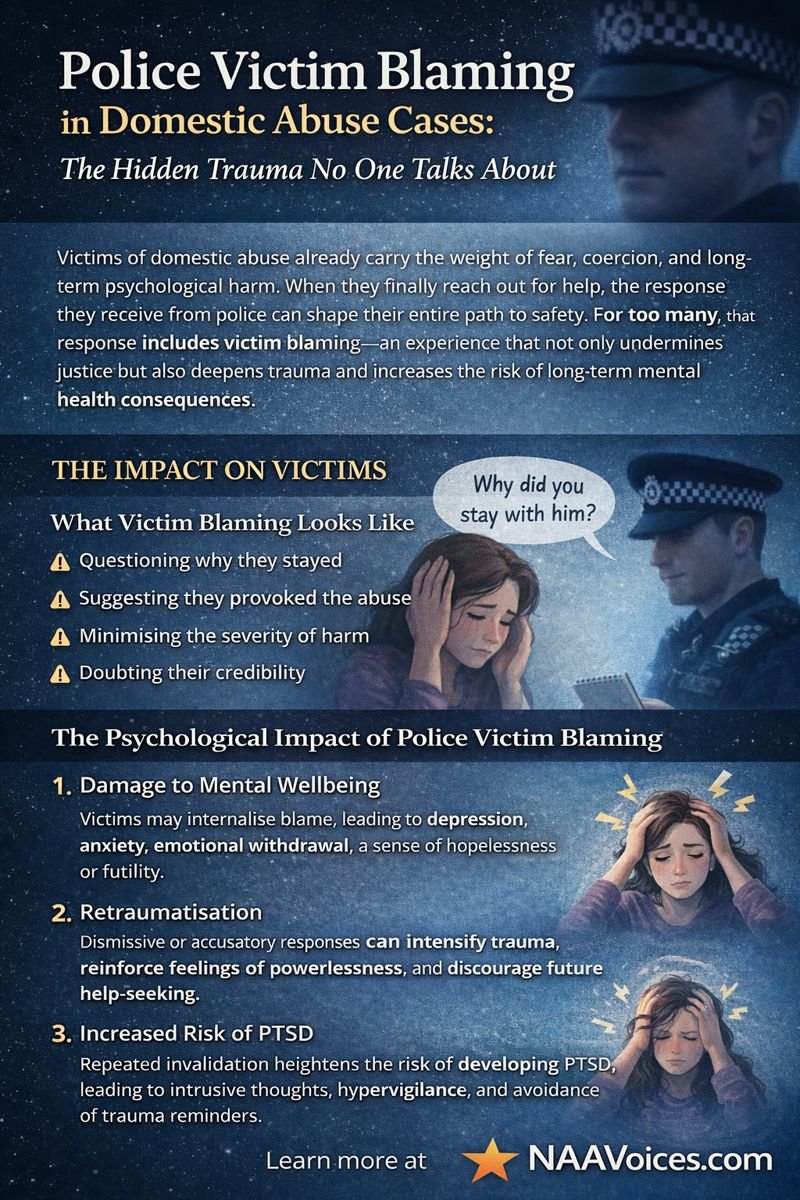
What Victim-Blaming Looks Like
Victim-blaming happens when responsibility for abuse is shifted away from the person causing harm and placed, directly or indirectly, onto the person who has been harmed.
In domestic abuse cases, this can sound like:
Why did you stay?
Why did you go back?
Why did you not report it sooner?
Why did you let the children see it?
Are you sure it was that bad?
Could this just be a relationship breakdown?
Is this really about contact?
These questions may be framed as fact-finding, but when asked without an understanding of coercive control, they can reinforce the exact messages the abuser has spent years embedding.
That it was your fault.
That you should have stopped it.
That you are exaggerating.
That you are the problem.
For someone already conditioned by abuse, those messages do not land lightly.
They go straight into the wound.
Why It Causes So Much Harm
Domestic abuse is rarely a single incident. It is often a pattern of control, fear, manipulation, degradation and psychological harm.
By the time many victims speak to police, they may already be exhausted. They may doubt themselves. They may struggle to explain events in a neat, chronological order. They may appear calm when they are traumatised, or emotional when they are being honest.
None of that means they are unreliable.
It means they are human.
When police respond with disbelief, minimisation or blame, the victim is forced to relive the abuse while also defending their right to be believed.
That is retraumatisation.
And it is not a minor side effect of poor communication.
It can change the course of someone’s recovery.
Retraumatisation Is Not Just Emotional
People often talk about trauma as if it is only distress.
It is not.
Trauma lives in the body.
It can look like panic, shaking, dizziness, nausea, chest pain, insomnia, flashbacks, dissociation, intrusive thoughts, memory fragmentation, emotional shutdown or complete collapse after appearing calm.
A victim may sit through a police interview, answer questions, sign statements and look composed.
Then fall apart afterwards.
That does not mean they were fine.
It means they were surviving the interaction.
When police victim-blame, dismiss or mishandle disclosures, they can deepen that trauma. They can make the victim less likely to seek help again. They can also make the victim feel less safe than they did before they reported.
That is institutional harm.
The Link With PTSD
Repeatedly having to disclose abuse, defend your credibility and correct inaccurate records can contribute to long-term psychological harm.
For some victims, this becomes part of the trauma itself.
PTSD can involve flashbacks, nightmares, hypervigilance, avoidance, intrusive thoughts, panic, emotional numbness and a constant sense of threat.
For victims of domestic abuse, these symptoms can be intensified when the systems meant to protect them become another source of fear.
It is not only what the perpetrator did.
It is what happens afterwards.
The disbelief.
The poor recording.
The minimisation.
The handovers.
The repeated retelling.
The feeling that your own life is being interpreted by people who have not understood it.
That is why police responses matter so much.
What the Law and Guidance Already Recognise
The Domestic Abuse Act 2021 gives a statutory definition of domestic abuse and recognises that abuse can include emotional, controlling, coercive and economic abuse.
That matters because domestic abuse is not limited to physical violence.
The NPCC and CPS Joint Justice Plan set out the need to improve the criminal justice response to domestic abuse, including better training, stronger accountability and improved support for victims.
The Independent Office for Police Conduct has also issued guidance on ending victim-blaming, recognising that language, assumptions and professional attitudes can cause real harm.
So the issue is not that nobody knows victim-blaming exists.
The issue is whether those principles are being applied in practice.
Because guidance means very little if victims are still leaving police interactions feeling blamed, disbelieved, unsafe or responsible for the abuse committed against them.
What Needs to Change
Police officers need proper trauma-informed training.
Not tick-box training.
Not a short online module that gets forgotten.
Real training on coercive control, post-separation abuse, trauma responses, child safeguarding, perpetrator tactics and the harm caused by victim-blaming language.
They need to understand that victims do not always present in the way people expect.
Some cry.
Some freeze.
Some talk too much.
Some cannot speak at all.
Some sound detached.
Some arrive with folders, timelines and evidence because they have already learned that if they do not create the record themselves, no one else will.
None of those responses should be used against them.
Police forces also need stronger accountability when officers fail to record crimes properly, minimise disclosures, or allow personal bias to influence safeguarding decisions.
A victim should not have to become their own investigator just to prove they told the truth.
Belief Is Not Bias
Believing victims does not mean abandoning evidence.
It does not mean ignoring due process.
It means starting from a place of professional curiosity rather than suspicion.
It means asking better questions.
What has made it hard to leave?
What control is still continuing?
What are the children seeing, hearing or experiencing?
What does the perpetrator gain from this version of events?
What risks increase now the relationship has ended?
What has already been disclosed, and has it been properly recorded?
That is not bias.
That is competent safeguarding.
The Cost of Getting It Wrong
When police blame victims, minimise abuse or fail to act, the harm does not end with that interaction.
It follows the victim into family court.
Into safeguarding meetings.
Into mental health appointments.
Into work.
Into parenting.
Into sleep.
Into every attempt to rebuild a life.
Poor police responses can strengthen the perpetrator’s position and weaken the victim’s credibility. They can leave children exposed to further harm. They can make the victim feel that telling the truth was not only pointless, but dangerous.
That should concern everyone.
Because domestic abuse victims do not need perfect systems.
They need systems that do not make the abuse worse.
A Survivor-Centred Response
A survivor-centred response does not require grand gestures.
It requires officers to listen properly.
Record accurately.
Avoid assumptions.
Understand coercive control.
Recognise trauma.
Take children’s experiences seriously.
Challenge perpetrator narratives.
And remember that the person in front of them may have used every last bit of strength they had just to speak.
Victim-blaming is not harmless.
It is not just poor wording.
It is not just a difficult conversation handled badly.
It can retraumatise victims, damage mental health, obstruct justice and reinforce the control they were trying to escape.
Victims of domestic abuse deserve to be met with dignity, belief and professional competence.
Not blame.
Not disbelief.
Not another system they have to survive.
Further Support
If you are navigating police misconduct, victim-blaming, negligence or failures in duty of care, I have created a dedicated NAAVoices resource to help explain the process and your options:
Police Misconduct Guide – NAAVoices.com
You are not the problem for needing protection.
You are not difficult for asking to be heard.
And you are not responsible for the abuse someone else chose to inflict.
Further Support
For guidance on recognising and reporting police misconduct, refer to my dedicated resource. It covers topics such as victim-blaming, negligence, and breaches of duty of care. Police Misconduct Guide – NAAVoices.com
My Lived Experience: A Personal Journey Through Trauma and Recovery
- Back to reality. Two Days of Kindness Can’t Erase Months of Trauma 28/07/2024
- Still Standing- The Quiet Aftermath of Survival Life After Trauma: Motherhood, Exhaustion, and Carrying On Without a Safety Net 1/08/2024
- Learning to Recognise and Manage Triggers of Post-Traumatic Stress Disorder Resulting from Coercive Control 2/08/2024
- The Impact of Ignoring Domestic Abuse Reports 3/08/2024
- At the Starting Line, Again — The Cost of Being Passed from Officer to Officer 5/08/2024
- Professional Standards, Signed Statements, and the Aftermath You Do Not See 5/08/2024
- Returning to Work with PTSD: When a Place of Safety No Longer Feels Safe 10/09/2024
- 🧠 When Therapy Isn’t Enough: A Reflective Journey into Psychosomatics
- When Coercive Control Is Dismissed as a Bad Relationship 17/12/2024
- When the Police Came Knocking: A Personal Journey Through Fear and Recovery 29/12/2024
- Finding Silence in the Midst of Overload: Navigating Safety and Trauma 25/01/2025
- The Friday Everything Broke 06/02/2025
- Finding Strength Amidst Chaos and Control 11/03/2025
- The Power of Truth: Advocating Against Police Misconduct 18/04/2025
- Living Behind the Mask: My Journey with PTSD 22/05/2025
- When Trauma Shatters Your Coping Strategies: How PTSD Changes Everything for the ADHD Brain 09/09/2025
- Why I Write 03/10/2025
- Understanding Dissociation Through Lived Experience, Neuroscience, and Survivor-Led Advocacy 💙 16/10/2025
- Angel Numbers & Everyday Spirituality: Finding Light in Life’s Patterns 21/10/25
- When Your Nervous System Remembers: Understanding Polyvagal Theory After Narcissistic Abuse 28/12/2025
- Two Years On: What They Could Never Take 10/04/2026
- The Break in Me — Two Days That Made the Damage Impossible to Ignore 21/04/2026

Accountability & Experience: My West Mercia Police Story
- Back to reality. Two Days of Kindness Can’t Erase Months of Trauma 28/07/2024
- Two Years On: The Day I Met Jackie 29/07/2024
- The Impact of Ignoring Domestic Abuse Reports 3/08/2024
- At the Starting Line, Again — The Cost of Being Passed from Officer to Officer 5/08/2024
- Professional Standards, Signed Statements, and the Aftermath You Do Not See 5/08/2024
- When Coercive Control Is Dismissed as a Bad Relationship 17/12/2024
- The Cost of Speaking Truth: A Year That Changed Everything 27/12/2024
- When the Police Came Knocking: A Personal Journey Through Fear and Recovery 29/12/2024
- The Friday Everything Broke 06/02/2025
- The Power of Truth: Advocating Against Police Misconduct 18/04/2025
- The Accountability That Never Comes from West Mercia Police 28/05/2025
- Why I Write 03/10/2025
- Two Years On: A Survivor’s Account of Instatutianal Failure 20/11/2025
- Two Years On: What They Could Never Take 10/04/2026
- The Break in Me — Two Days That Made the Damage Impossible to Ignore 11/08/24 + 15/08/2024 Reflection 21/04/2026
- The Most Underrated People in History Are the Ones Who Told the Truth