Tag: Healing After Trauma

  • Chasing the Moon

    Chasing the Moon

    Tonight, I rode in the pitch black.

    My first proper night-time ride.

    And I hadn’t planned it.

    My teenager came home with a couple of his older friends and, somehow, I was the excited one.

    “Can I go on my bike?”

    Just for an hour.

    There was something slightly ridiculous about the role reversal. When I say teenagers, we’re talking nearly 18. These are lads we’ve known for years, who my six-year-old absolutely worships and who have babysat her before.

    So there I was, apparently the child of the household, while my teenager grabbed my earphones for me and I hurried into my bike jeans and threw on my leather jacket.

    One of the lads had brought his girlfriend with him.

    “I love your jacket,” she said. “It’s like a biker jacket.”

    I laughed.

    Hmm.

    Yes.

    Shock horror.

    It is, in fact, a biker jacket.

    And then I was gone.

    Out of the house. Helmet on. Engine running. Into the dark.

    We live rurally, so once you get away from the houses, darkness really is darkness. The roads disappear ahead of you except for the stretch illuminated by the bike.

    But tonight there was the moon.

    It was enormous.

    Bright enough that I kept catching sight of it as the road twisted and opened up again, and for an hour it genuinely felt as though I was chasing it.

    And my God, it was beautiful.

    There is something about riding that clears my head in a way very little else can.

    You can’t carry everything with you on a motorbike.

    Your brain has to be where your body is.

    The road.

    The bend.

    The gears.

    The sound of the engine.

    The cold air finding the tiny gaps in your clothes.

    For once, there isn’t room for tomorrow, yesterday, paperwork, arguments, money, people, responsibilities or the thousand things constantly competing for space in my head.

    There is just now.

    For an hour, I chased the moon.

    Then I came home.

    My daughter had spent the evening with people she adores, making bracelets and generally having the time of her life.

    Later, I watched a film with my 14-year-old.

    Eventually everyone went to bed.

    And now I’m sitting here with the moonlight coming through the window, thinking about how different life feels sometimes.

    Not necessarily easier.

    But different.

    There are moments when I can actually see how far we’ve all come.

    For a long time, home wasn’t synonymous with peace. Safety wasn’t something I could simply assume. My nervous system didn’t understand the concept of switching off because there was always something else to anticipate, manage or survive.

    Now, increasingly, there are ordinary evenings.

    Teenagers turning up.

    A six-year-old making bracelets.

    A film on the sofa.

    Children sleeping safely upstairs.

    And me disappearing for an hour because I fancied riding my motorbike under a ridiculously bright moon.

    Ordinary things.

    But after you’ve lived without peace, ordinary can feel extraordinary.

    I’ve also learned something else.

    People will come and go.

    I don’t have the energy anymore for people who only appear when they want something from me, or relationships where I am valued primarily for what I can give, fix, carry or provide.

    Peace changes your tolerance for that.

    Once you’ve fought this hard to build a safe life, you become much more careful about who gets access to it.

    And perhaps that is part of healing too.

    Not becoming harder.

    Just becoming more protective of the peace you’ve worked so hard to create.

    Every time I get on that bike, I feel a little bit of it.

    A sanctuary I haven’t felt in a very long time.

    I’m not running away.

    I’m not trying to disappear.

    Sometimes I only get an hour. Sometimes it’s a short ride between everything else life demands of me.

    But for those few miles, there is nothing to solve.

    Just me.

    Two wheels.

    An open road.

    And tonight, a moon so bright I couldn’t resist chasing it.

    Then I get to turn around and ride home.

    And perhaps that’s the biggest difference of all.

    These days, I have somewhere safe to come back to.

  • Home Is Not Always an Address

    Home Is Not Always an Address

    Home Is Not Always an Address

    Where is home?

    It sounds like such a simple question.

    An address. A town. The place your post gets delivered. The place you return to at the end of the day.

    But I’m not sure that is what home means to me anymore.

    Last night, after a ten-hour shift, I collected my daughter, got into the car and set off.

    140 miles. That was the countdown on the sat nav.

    It should have felt like a long drive after a long day. Instead, as the miles started disappearing behind us, I noticed something else.

    My shoulders dropped.

    I did not consciously decide to relax; my body seemed to do it before my mind caught up. Not because I had finished work. Not because I had a weekend off. Not even because we were getting away for a couple of days.

    Somewhere inside me, I knew where we were going.

    We were going home.

    Except we weren’t driving towards the house where we live. We were driving towards a person.

    140 miles

    There are 140 miles between us.

    Neither of us can simply move closer. Our older children are settled. Between us there are nine children whose lives, schools, friendships and futures matter more than making our geography convenient.

    So 140 miles it is.

    And somehow, across those miles, something has grown that feels far bigger than friendship.

    One of her daughters once referred to my child as her sister. It stayed with me.

    We talked afterwards about that phrase people use so easily: friends are the family you choose. Except sometimes I think it goes further than that.

    Nobody held a family meeting and assigned titles. Somewhere along the way, “my mum’s best friend” simply became “Auntie”, and children who were not born as siblings began referring to one another as family.

    It just became true.

    Sometimes family is not created by blood. It is created by consistency.

    It is created by showing up, by trust, by being safe, and by knowing someone is there without needing to ask whether they will be.

    When home becomes a feeling

    About two hours into the journey, my daughter asked me to put Country Roads on.

    So I did. And we sang. Probably too loudly. Definitely not particularly well.

    And somewhere in the middle of it, a feeling flooded over me so suddenly that I recognised it before I could explain it.

    Home.

    Not an address or a postcode, but people. Somewhere I don’t have to explain every silence, every reaction, or every part of the history that made me who I am. Somewhere I can arrive tired, overwhelmed, distracted or completely myself, and still belong.

    Somewhere my daughter can simply be herself too.

    Then she said it

    A while later, she told me she wanted to go home.

    I automatically thought she meant our house. I told her we were still about three hours from home, and that we weren’t far from where we were going.

    She corrected me straight away. She didn’t mean our house at all. She meant home at Auntie’s.

    And there it was again.

    I hadn’t told her what I’d been thinking about earlier in the journey. I hadn’t said any of it aloud. Yet she had arrived at exactly the same word, and made exactly the same distinction.

    Maybe children don’t need us to define belonging for them. They may not have the language for nervous systems, emotional security or psychological safety, but they know where their body settles. Where they can be loud. Where they can be quiet. Where they don’t have to monitor the room.

    Maybe they understand that home can be more than one place.

    And maybe, sometimes, home is not really a place at all.

    Home after trauma

    For anyone whose experience of home has been shaped by trauma, the idea of safety can become complicated.

    We are often told that home should be the safest place in the world. For some people, it was not.

    A house can be familiar without ever truly feeling safe. You can know where every cupboard is, where the light switches are, what the floorboards sound like at night, and still never feel completely at ease.

    Sometimes, only after you leave, do you realise your body knew the difference all along.

    Healing is not always dramatic. Sometimes it is simply noticing that your jaw is no longer clenched, that your shoulders have dropped, and that you are no longer preparing for something you cannot yet see.

    Not the place where you survived, but the places where you started living again.

    That safety does exist. That trust can be rebuilt. That family can be found. That belonging can exist 140 miles away.

    And that eventually, home can become a word that feels good again.

    So, where is home?

    Last night there were still miles left on the sat nav. Technically, we had driven away from home hours earlier.

    But somewhere on that dark road, with the music far too loud and my daughter singing beside me, I realised the opposite was true.

    We were going home.

    And a little later, without knowing a single word of what had been going through my head, she told me the same thing in her own way.

    Perhaps that was the clearest answer I could have been given.

    So I’d genuinely like to know: what does home mean to you?

    Is it an address? A person? The family you were born into, or the family you found?

    Or is home simply wherever your shoulders drop a little when you know you’re nearly there?

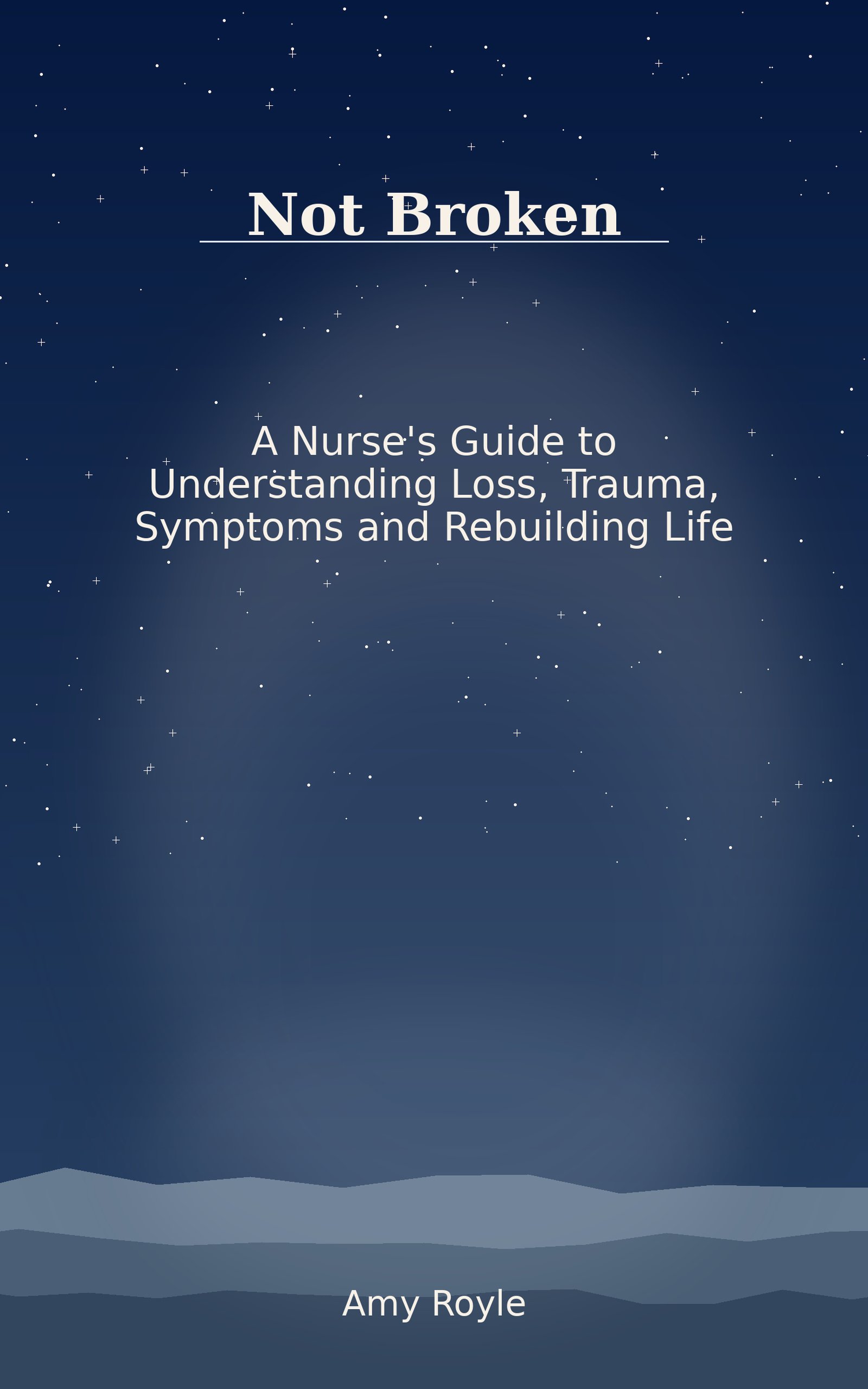
  • Finding the Stars: Why Not Broken Had to Be Written

    Finding the Stars: Why Not Broken Had to Be Written

    Some books begin with a plan.
    Not Broken did not.

    It began at a kitchen table, in the middle of a life that felt too dark, too loud, and too fractured for easy answers. It began in conversations with my children, in moments when I needed words that did not seem to exist anywhere else. Words honest enough for pain, but gentle enough to carry hope.

    I am a Specialist Nurse Practitioner with postgraduate study in the psychology and neuroscience of mental health. I know the evidence. I know the therapies. I know the clinical frameworks that support healing. But the truth is this: while I was still living through sustained trauma, none of that knowledge could fully reach me.

    That is not because those therapies do not work. They do. I believe in them, and I recommend them with confidence. But when the body is still trapped in survival, healing does not always begin with structured processing. Sometimes it begins somewhere quieter. Somewhere instinctive. Somewhere outside language.

    For me, one of those places was a lay-by.

    For over a year, I returned to the same place again and again. Not because it fixed anything. Not because it was magical. But because it gave me a pocket of stillness when everything else felt unbearable. It gave my body a chance to breathe.

    At the time, I did not know the language of grounding, sensory regulation, trauma responses, or nervous system overload. I only knew that something about that space helped me stay here.

    Sometimes I slept there. Many times, my little girl slept there with me. We would look up at the stars. She grew up believing that when someone leaves, they become a star. It was her way of holding loss. In time, it became mine too.

    That lay-by held more than silence. It held grief, fear, exhaustion, and the desperate effort of trying to stay functional in public while quietly unravelling in private. I have stood in that field in rain, ice, and darkness. I have sat in the grass just to feel something real beneath me. I have gone there in uniform, in the middle of the night, trying to regulate myself enough to return to a life that did not feel safe.

    At the time, nobody knew.

    It was only later, after more study, training, and reflection, that I understood what I had already been doing. I had been grounding myself. I had been using nature as regulation. I had been using the cold air, the silence, the openness of the sky, and the feel of the earth beneath me to stabilise a body that had been pushed too far for too long.

    The body often finds ways to survive before the mind has language for what it is doing.

    That truth sits at the heart of Not Broken.

    This is not a book built on platitudes or polished clichés. It is not about pretending pain becomes beautiful. It is not about bypassing trauma with positivity. It is about survival, grief, family upheaval, and the slow process of finding words for experiences that once lived only in the body.

    Not Broken began as a therapeutic story for children — a way of speaking gently into the confusion trauma leaves behind. Over time, it became something wider: a collection of stories and reflective tools for those trying to make sense of darkness without being consumed by it.

    The title itself carries the message I needed most.

    The stars do not disappear during the day.
    They are always there.
    You just cannot see them until it is dark enough.

    That is not a slogan. It is not false comfort. It is the simplest truth I know about recovery. In the darkest periods of life, there are often strengths, capacities, and forms of hope that remain hidden until we need them most.

    Almost two years later, I drove that same road again.

    This time, I was not driving in panic. I was not bracing for impact. I was not trying to outrun a life that felt unsafe. The place had not changed, but I had. My body no longer responded as if I were still trapped in the same emergency.

    That is what recovery can look like.

    Not dramatic. Not neat. Not a perfect before-and-after. Just a quiet physiological shift. The road is still the road. The memories are still the memories. But your body no longer believes it is still living there.

    That night, all three of my children got out of the car and stood beneath the stars. Quietly. Gently. With the kind of understanding that does not need much explanation. They knew why that place mattered. They had lived through enough to understand.

    And that is why this book exists.

    It exists for the people who are functioning outwardly while falling apart inwardly.
    It exists for those who feel frustrated that healing has not yet “worked,” when the truth may be that they are still in survival mode.
    It exists for anyone who needs language that is compassionate, grounded, and real.

    I chose to publish this book under my own name for a reason. I am a nurse, a mother, and a survivor. Trauma does not discriminate. It reaches professionals, carers, clinicians, parents, and people who look as though they are coping from the outside. I believe honesty matters. Not for performance. Not for sympathy. But because silence protects stigma, and truth dismantles it.

    Not Broken is not the story of everything that happened to me.
    It is the story of what I built from it.

    If something brought you here, then perhaps this book is meant for you. If you are searching for words, for comfort, for understanding, or simply for proof that survival is possible, this book was written with that in mind.

    The stars are already there.
    Sometimes we just need help finding them.

    Not Broken is available now on Amazon:

  • The Friday Everything Broke

    The Friday Everything Broke

    One year on, a moment of reflection:

    A week before, my coercive control case had been dropped.

    Not quietly. Not kindly. I had gone from being the victim in the crime they had arrested him for, to a member of the public. A reclassification so deliberate, so calculated, that I knew exactly what it meant. You cannot be a victim in one crime and a member of the public in another. I knew that. They knew I knew that.

    I had already watched them pour their energy into charging the only officer who had actually tried to do his job. The corruption wasn’t a suspicion anymore. It was obvious. Unapologetic. And the man — the one who would later put my child at risk, who had used DARVO tactics from the very beginning, who had twisted every truth until I questioned my own — walked away. No consequences. Nothing.

    And then I went to work.

    I don’t know what finally broke it open that Friday. Maybe it was the accumulation. Maybe it was the silence after the verdict. Maybe it was simply that my body had been holding too much for too long and finally said no more.

    I collapsed. I ended up doing my own ECG on the floor. My colleagues — people who had only ever seen me composed, capable, holding the line — saw me break for the first time.

    I am not ashamed of that moment. I never will be.

    But I won’t pretend it didn’t happen. Because understanding what led to it matters. And a lot has changed since then.

    NAAVoices was not created from certainty, but from lived experience and professional insight. As I migrate earlier work from the original platform, this post has been reviewed and approved for transfer. It remains true to its original context, with only minor clarity edits where needed. Some moments do not require rewriting to remain honest.

    Understanding Despair: Breaking the Misconceptions

    I was anxious coming back after Friday.

    Not the usual kind of anxious — the kind that sits heavy in your chest, replaying every moment, every word, every crack that showed. I have spent years perfecting the front. The composed, capable version of me that walks into a room and holds it together. Friday, that version didn’t show up.

    And I’m still processing that.

    PTSD doesn’t announce itself politely. It doesn’t wait for a convenient moment. It pulls you under, and sometimes — no matter how much work you’ve done, how many tools you have, how many times you’ve survived it before — it pulls you under in front of people.

    Re-traumatisation is brutal. It’s not just remembering. It’s reliving — your nervous system convinced, all over again, that you are back in the worst of it. The despair that follows isn’t weakness. It’s overload. It’s your mind and body hitting a wall they didn’t see coming.

    I spent so much of the weekend worrying about my colleagues. What they saw. What they thought. Whether they’d look at me differently. My darkest days usually produce productivity — not me on my knees, refusing help, doing my own ECG. I hope they know that moment didn’t define me. I hope they understood they were seeing something real, not something broken beyond repair.

    Because here’s what I want people to understand about despair — the things nobody talks about honestly:

    It is not weakness. It is one of the most human things you will ever feel. Everyone has a limit. Reaching yours doesn’t make you less; it makes you human.

    It is not permanent. In the depths of it, it feels like it will never lift. It does. It has before. It will again.

    It is not the same as depression. Despair is a response — raw, overwhelming, situational. Depression is a condition. Conflating the two helps no one.

    Isolating won’t protect you. It feels safer to disappear when you’re in it. Connection is uncomfortable when you’re raw. But it’s also the thing that pulls you back.

    It isn’t unproductive. Some of my most important self-realisations have come from the wreckage of a really bad day. Despair forces honesty in a way nothing else does.

    You don’t have to fight it. Sometimes the bravest thing is to let yourself feel it, name it, and wait for it to pass rather than white-knuckling through.

    I’m sharing this not because I have it figured out, but because I know I’m not the only one who has sat somewhere quiet after a really public moment of pain, wondering if they’ve changed how people see them forever.

    You haven’t. And neither have I.

    My Lived Experience: A Personal Journey Through Trauma and Recovery
  • On Trust, Sanctuary, and Quiet Protection

    On Trust, Sanctuary, and Quiet Protection

    NAAVoices was not created from certainty, but from lived experience and professional insight. As I migrate earlier work from the original platform, this post has been reviewed and approved for transfer. It remains true to its original context, with only minor clarity edits where needed. Some moments do not require rewriting to remain honest.

    On Trust, Sanctuary, and Quiet Protection

    I believe in recognising the good in people. Not blindly, and not because life has always made trust easy, but because sometimes kindness still shows up when you least expect it.

    Today has been one of those days that tested that belief.

    Today Was Hard

    I struggled to get out of bed this morning. I slept far later than I should have and woke up feeling completely drained. I feel very alone at the moment. I saw a message from a friend late last night and couldn’t bring myself to open it. I have stepped back from messages in general. Not because I don’t care, but because when trauma is loud, even simple contact can feel too much.

    Writing is what I can manage today. It gives me a way to put words to things I can’t always say out loud.

    Trauma changes how you function. On the outside, you can look as though you are coping, while inside you are using every bit of energy just to stay upright.

    Even so, I got up. The children need stability. They have already seen too much. I cry behind sunglasses, even when there is no sun, so they do not have to see it again. They sit in the back of the car thinking it is for the youngest, but really it is another way of shielding them. Protection has become instinct.

    I contacted my GP today to try to speed up my CMHT referral. I can see where my mental health is heading if support does not come soon. Knowing that does not stop it, but it does mean I can act before things get worse.

    The control he has had over our lives has not simply disappeared, even now. What I can do is try to limit how much of me it reaches and protect what is left.

    Today I took the children to buy a hot tub and a trampoline. The hot tub did not work out, but the trampoline is bought and waiting to be built. Small things, maybe, but still something real. A reminder that life is still moving, even when I feel as though I am barely holding on.

    There is no strength in pretending you are fine when you are not. Real strength is knowing when you need help.

    Trust Is Built by What People Do

    A lot of what I write reflects distress, because that is the truth of where I have been. But that is not the whole picture. There are still people who show up with care, quietly and without making it about themselves.

    A message from Faith this evening reminded me of something important: trust is built by what people do, not by what they say.

    Boundaries matter. Consistency matters. Respect matters.

    I am very careful about what I share and with whom. I do not want my life becoming discussion or gossip. Only a very small number of people know what I am dealing with, and that is deliberate.

    Today, when I was in a state of acute distress, I shared only what I needed to. What I got back was not curiosity or intrusion. It was calm, discretion, and quiet support.

    The stress has affected me physically as well as emotionally. Chest pain. Palpitations. Dizziness. Moments where I have needed practical help without questions or attention. That help was given quietly, without fuss, and that mattered more than I can explain.

    Sanctuary Does Not Always Look the Way People Expect

    Earlier that year, in May, after my ex was arrested, I found myself unable to go home. I drove and ended up at work. It became a place of structure and safety at a time when everything else felt uncertain.

    Sanctuary does not always look like rest. Sometimes it looks like somewhere you can keep functioning when everything inside you feels unsteady.

    When I disclosed what had happened to a very small number of people, it was met with care and respect. Confidentiality was kept. Boundaries were understood. That kind of protection matters.

    Trust Can Be Immediate

    I have not known Faith long, which is exactly why this has stood out so clearly. Trust does not always take years. Sometimes you know because of how someone handles your vulnerability when they have no obligation to do so.

    It is not history that creates trust. It is behaviour. It is discretion. It is respect for what is not yours to share.

    That is what today reminded me of.

    Sometimes the safest people are the quiet ones. The ones who protect without performing it. The ones who do not push, do not pry, and do not turn your pain into something public.

    Today reminded me that trust can arrive quickly when your safety is treated as something that matters.

    That understanding sits at the heart of NAAVoices.

    NAAVoices exists because safety should not depend on power, proximity, or who is watching. It should be protected through boundaries, accountability, and respect. Quietly. Consistently. Without needing praise for it.

    That is what today has shown me.