Category: Neurodiversity Resources, Rights, and Support

Clear, accessible guidance on understanding neurodiversity, recognising individual needs, and navigating support across education, healthcare, and daily life. This section explains key neurodivergent profiles, rights under UK law, and practical adjustments that help children, young people, and adults thrive.

  • Neurodiversity-Affirming Guidance & UK Support Pathways for Health, Education and Social Care

    Neurodiversity-Affirming Guidance & UK Support Pathways for Health, Education and Social Care

    NAAVoices – Neurodiversity-Affirming Guidance & UK Support Pathways

    Choose Your Path

    Neurodiversity-Affirming Guidance for Real Life

    UK pathways, evidence-based strategies, and ready-to-use templates — built to help you communicate needs, access support, and reduce harm from misunderstandings.

    About the Creator

    Built from Professional & Lived Experience

    I’m neurodivergent (ADHD, dyspraxia, dyslexia) and a Specialist Nurse Practitioner with a PGCert in Psychology & Neuroscience of Mental Health. This hub translates complexity into practical, respectful steps, enabling people to communicate their needs, access support, and reduce harm from misunderstandings.

    Privacy commitment: Names and identifying details are never shared.

    Choose Your Path

    Select your role for tailored guidance

    For Parents & Carers

    Navigate school support, healthcare pathways, and your child’s rights

    England: Getting School Support (SEND)

    Step-by-Step Process

    1. Ask for SEN Support now — You don’t need a diagnosis. Put your request in writing to the SENCO (Special Educational Needs Coordinator).
    2. Agree on reasonable adjustments — The school must make changes to remove barriers (e.g., visual timetables, movement breaks, quiet spaces).
    3. Get a written plan — Request an SEN Support Plan or provision map detailing what support will be provided, by whom, and when.
    4. If needs are significant/long-term, request an EHC needs assessment — This formal assessment can lead to an Education, Health and Care Plan with legally binding provision.
    5. Review termly — Insist on regular reviews with measurable outcomes.
    Key Legislation (England)

    Get help: IPSEA provides free legal advice for parents.

    Wales: Getting School Support (ALN)

    Step-by-Step Process

    1. Request an ALN assessment — Contact the school’s Additional Learning Needs Coordinator (ALNCo) in writing.
    2. Agree on an Individual Development Plan (IDP) — This must include specific adjustments, provision, and outcomes.
    3. Review frequently — IDPs must be reviewed regularly and updated as needs change.
    Key Legislation (Wales)

    Get help: SNAP Cymru provides free support for Welsh families.

    Getting a Healthcare Assessment

    ADHD & Autism Referrals

    1. Book a GP appointment — Request a referral to your local neurodevelopmental assessment service.
    2. Prepare your evidence — Keep an impact diary showing how differences affect daily life. Use the One-Page Symptom Impact Summary template below.
    3. England: Consider Right to Choose — You can choose an NHS-funded private provider for faster assessment.
    4. Expect waiting times — NHS pathways can have long waits. Private assessment costs £500-£2000.

    Your Legal Rights

    You Do NOT Need a Diagnosis

    The Equality Act 2010 protects anyone with a substantial, long-term impairment affecting day-to-day activities. Schools must make reasonable adjustments immediately, based on identified need.

    If school says “wait for assessment”: Politely remind them that reasonable adjustments are required now, and waiting for diagnosis breaches the Equality Act.

    Sensory & Eating: Practical Support

    Restricted diets and sensory sensitivities can impact constipation, growth, and dental health. These aren’t “fussy eating” — they’re neurological responses requiring practical support.

    Portion Prompts Visual guides and portion control tools to support consistent intake
    Safe-Food Rotations Systematically expand accepted foods whilst respecting sensory needs
    Texture Ladders Gradual exposure to new textures at the child’s pace
    Hydration Reminders Scheduled prompts and preferred containers to support fluid intake
    School Lunch Notes Written agreements that respect safe foods whilst gently expanding choice
    Toothbrushing Scaffolds Visual steps, hand-over-hand support, and sensory modifications

    What is Neurodiversity?

    Neurodiversity recognises that differences such as autism, ADHD, dyslexia, and dyspraxia are natural variations, not defects. The aim isn’t to ‘fix’ individuals but to reduce barriers so everyone can thrive.

    What is Neurodiversity?

    Neurodiversity recognises that differences such as autism, ADHD, dyslexia, and dyspraxia are natural variations, not defects. The aim isn’t to ‘fix’ individuals but to reduce barriers so everyone can thrive.

    For Healthcare Professionals

    Clinical pathways, NICE guidance, and referral frameworks

    ADHD Assessment Pathway

    Clinical Standards

    NICE Guideline: NG87 – Attention deficit hyperactivity disorder: diagnosis and management

    Key Criteria
    • Symptoms present before age 12
    • Pervasive across multiple settings (home, school, work)
    • Functional impairment in social, academic, or occupational functioning
    • Not better explained by another condition
    Referral Pathway
    1. GP/Primary Care — Initial screening, developmental history, impact assessment
    2. Specialist Assessment — Psychiatrist or paediatrician conducts full diagnostic evaluation
    3. Multi-informant approach — Gather evidence from parents, teachers, and self-report
    4. Post-diagnosis support — Medication titration if indicated, psychoeducation, signposting

    Autism Assessment Pathway

    Clinical Standards

    NICE Guidelines:

    Core Features
    • Persistent difficulties in social communication and social interaction
    • Restricted, repetitive patterns of behaviour, interests, or activities
    • Symptoms present from early developmental period
    • Functional impairment across settings
    Assessment Process
    1. Developmental history — Early childhood development, social-communication milestones
    2. Multidisciplinary team assessment — Psychiatrist, psychologist, SALT, OT as appropriate
    3. Standardised tools — ADOS-2, ADI-R, or equivalent gold-standard instruments
    4. Differential diagnosis — Rule out social anxiety, attachment difficulties, trauma responses

    Reasonable Adjustments in Healthcare Settings

    Equality Act 2010 compliance: Healthcare settings must make reasonable adjustments for neurodivergent patients.

    Environment
    • Quiet waiting areas
    • First/last appointments
    • Reduced sensory stimulation
    • Clear signage
    Communication
    • Written appointment confirmations
    • Literal, concrete language
    • Visual aids and summaries
    • Allow extra processing time
    Consultation
    • Allow supporter present
    • Provide written aftercare instructions
    • Longer appointment slots
    • Avoid unnecessary waiting

    For Schools & Educators

    SEND/ALN statutory duties, classroom adjustments, and inclusive practice

    England: SEND Framework & Statutory Duties

    Legal Requirements

    Legislation: Children and Families Act 2014 | SEND Code of Practice 2015

    Graduated Approach
    1. Assess — Identify needs through observation, assessment, and consultation with parents and pupil
    2. Plan — Agree on adjustments, interventions, and expected outcomes in a written SEN Support Plan
    3. Do — Implement agreed provision; class teacher retains responsibility with SENCO support
    4. Review — Evaluate impact termly; adjust provision as needed
    When to Request an EHC Needs Assessment
    • Needs are significant and long-term
    • Multiple cycles of SEN Support have not led to adequate progress
    • Specialist provision or input required
    • Parent or young person requests assessment
    Key Principle

    You must not wait for a diagnosis to provide SEN Support. Provision should be based on identified need and functional impact, not diagnostic labels.

    Wales: ALN Framework & Statutory Duties

    Legal Requirements

    Legislation: Additional Learning Needs and Education Tribunal (Wales) Act 2018 | ALN Code 2021

    Individual Development Plan (IDP)
    1. Identify ALN — Determine whether learner has additional learning needs
    2. Decide on ALP — Identify additional learning provision required
    3. Prepare IDP — Document needs, provision, outcomes, and review arrangements
    4. Review and revise — Minimum annual review; more frequent if needs change
    Person-Centred Approach
    • Learner’s views must be sought and considered
    • Parents/carers must be involved in decision-making
    • Provision must prepare learners for adulthood
    • Collaborative multi-agency working

    Practical Classroom Adjustments

    Attention & Executive Function
    • Short, concrete instructions (one step at a time)
    • Visual now-next boards
    • Timers and visual schedules
    • Chunked tasks with clear success criteria
    • Movement breaks between activities
    Sensory
    • Ear defenders or quiet workspace option
    • Reduced visual clutter
    • Predictable routines and transitions
    • Fidget tools or movement opportunities
    • Flexible seating arrangements
    Communication
    • Literal, concrete language (avoid idioms)
    • Written instructions alongside verbal
    • Extra processing time for responses
    • Visual supports (symbols, photos, diagrams)
    • Pre-teaching of new vocabulary
    Recording & Assessment
    • Alternative recording (scribe, voice-to-text)
    • Reduced copying from board
    • Assistive technology (laptop, spell-checker)
    • Extra time or rest breaks in assessments
    • Alternative formats for demonstrating knowledge

    Equality Act 2010: Schools’ Duties

    Equality Act 2010 — Schools must make reasonable adjustments for disabled pupils

    Three Requirements
    1. Changing provisions, criteria, or practices — e.g., allowing extra time, reducing written work
    2. Providing auxiliary aids — e.g., visual timetables, fidget tools, assistive technology
    3. Making physical alterations — e.g., quiet spaces, sensory-friendly environments

    Critical: Reasonable adjustments duty is anticipatory. Schools must not wait for a request or diagnosis — they should identify and remove barriers proactively.

    UK Legislation & Rights

    Understanding your legal rights is essential for accessing support. Here’s what protects neurodivergent people across the UK.

    England: Education Framework

    Wales: Education Framework

    UK-Wide: Equality & Work

    Healthcare & Assessment

    Key Principle Across All Frameworks

    You do not need a diagnosis to request reasonable adjustments. Support should be based on identified need and functional impact, not diagnostic labels. The Equality Act 2010 protects anyone with a physical or mental impairment that has a substantial and long-term adverse effect on their ability to carry out normal day-to-day activities.

    Key Support Organisations

    England:
    IPSEA (Independent Provider of Special Education Advice)
    Contact (for families with disabled children)
    SOS!SEN (Special Educational Needs advice)
    Wales:
    SNAP Cymru (Special Needs Advisory Project)
    PACEY Cymru (Professional Association for Childcare)
    Meic (Advocacy for children and young people)

    Sensory & Eating: Real-World Impact

    Restricted diets (such as dry, predictable foods) and sensory sensitivities can impact constipation, growth, and dental health. These aren’t “fussy eating” — they’re neurological responses that require practical support.

    Practical Levers

    Portion Prompts Visual guides and portion control tools to support consistent intake
    Safe-Food Rotations Systematically expand accepted foods while respecting sensory needs
    Texture Ladders Gradual exposure to new textures at the child’s pace
    Hydration Reminders Scheduled prompts and preferred containers to support fluid intake
    School Lunch Notes Written agreements that respect safe foods while gently expanding choice
    Toothbrushing Scaffolds Visual steps, hand-over-hand support, and sensory modifications
    Dentist-Ready Summaries One-page profiles explaining sensory needs and successful strategies

    Learning Differences

    Dyslexia, dyspraxia, and dyscalculia

    Support isn’t about lowering expectations

    It’s about changing the access route so neurodivergent learners can demonstrate their full capability.

    Assistive Technology Text-to-speech, speech-to-text, screen readers, mind-mapping software
    Alternative Formats Audio materials, visual organizers, simplified instructions, colour-coding
    Reduced Time Pressure Extended deadlines, rest breaks, chunked assessments
    OT-Informed Strategies Handwriting alternatives, movement breaks, adapted equipment

    Official Resources & Support Services

    Direct links to UK legislation, guidance, and support organisations

    📋

    England: SEND Support

    Official guidance, legal frameworks, and parent resources

    ✓

    Wales: ALN Support

    Welsh framework, statutory guidance, and family resources

    📄

    UK-Wide Support

    Equality Act guidance, workplace support, and advocacy organisations

    🏥

    Healthcare Pathways

    NHS guidance, NICE standards, and diagnostic pathways

    💼

    Workplace & Legal

    Employment rights, tribunals, and advocacy support

    Frequently Asked Questions

    Do I need a diagnosis to get adjustments?
    No — adjustments should be made based on identified need and functional impact. The Equality Act 2010 protects anyone with a substantial, long-term impairment affecting day-to-day activities, regardless of diagnostic label.
    What’s the difference between England and Wales frameworks?
    England uses SEN Support and EHCPs (Education, Health and Care Plans); Wales uses ALN (Additional Learning Needs) and IDPs (Individual Development Plans). Both systems must provide reasonable adjustments, but the terminology and processes differ.
    What if school says ‘wait for assessment’?
    Reasonable adjustments should start immediately based on current need. Assessment may clarify needs further, but waiting for diagnosis should never delay basic support. Reference the Equality Act 2010 duty to make adjustments.
    How do I evidence impact?
    Use the One-Page Symptom Impact Summary to document specific examples of how differences affect daily functioning. Keep logs of incidents, attendance patterns, work avoidance, meltdowns, or health impacts. Photographs of work samples can also demonstrate need.
    Can I request workplace adjustments without disclosing my diagnosis?
    Yes. You can request adjustments by describing functional needs without naming a diagnosis. However, disclosure may help access more comprehensive support and protection under the Equality Act 2010.
    What is Access to Work and who can apply?
    Access to Work is a UK government scheme providing practical support if your disability or health condition affects your work. It can fund specialist equipment, adaptations to premises, support workers, job coaches, and travel costs. Anyone employed or self-employed in England, Scotland, or Wales can apply.

    Glossary

    Reasonable Adjustments

    Practical changes to remove barriers for disabled people, required under the Equality Act 2010. Must be implemented unless they impose a disproportionate burden on the organisation.

    SEN (England)

    Special Educational Needs — the framework used in England for identifying and supporting children with learning differences or disabilities.

    ALN (Wales)

    Additional Learning Needs — Wales’s framework (replacing SEN) for supporting learners aged 0–25 who need additional provision to access education.

    EHCP (England)

    Education, Health and Care Plan — a legal document in England describing a child or young person’s needs and the provision required to meet them (ages 0–25).

    IDP (Wales)

    Individual Development Plan — Wales’s statutory plan outlining additional learning provision, targets, and review arrangements for learners with ALN.

    Right to Choose (England)

    NHS policy allowing patients in England to choose any qualified provider for NHS-funded treatment, including ADHD and autism assessments (subject to local ICB policies).

    Public Sector Equality Duty

    Legal obligation on public bodies to eliminate discrimination, advance equality of opportunity, and foster good relations. Applies to schools, NHS, local authorities, etc.

    Executive Function

    Mental skills for planning, organizing, focusing attention, managing time, and regulating behavior. Often affected in ADHD, autism, and dyspraxia.

    Sensory Processing

    How the nervous system receives and responds to sensory information (sight, sound, touch, taste, smell, movement). Differences are common in neurodivergent people.

    Reasonable Adjustments Request Template (UK)

    Use this template to request support at school, work, or healthcare settings under the Equality Act 2010. Copy the parts you need, add specifics, and attach any one-page summaries or evidence.

    1) Cover Line

    Subject: Request for Reasonable Adjustments – [Your Name] / [Child’s Name] – [Setting]

    2) Quick Summary

    I am requesting reasonable adjustments for [me/my child] due to [diagnosed/suspected] neurodivergence (e.g., ADHD, autism, dyslexia, dyspraxia). These adjustments are needed to remove barriers to access and participation.

    3) Needs in Brief

    • Attention/processing: short, concrete instructions; extra processing time
    • Sensory: reduced noise/lighting; ear defenders; predictable routines
    • Executive function: visual now–next; timers; chunked tasks; prompts
    • Communication: written follow-up; literal language; avoid idiom
    • Environment: quiet space option; seating away from high-traffic areas

    4) Adjustments Requested

    School/College: visual timetable; movement breaks; reduced copying; alternative recording; toilet/changing privacy plan; flexible transitions

    Workplace: written instructions; flexible deadlines; reduced meetings; quiet workspace; noise-cancelling; clear priorities; meeting agendas in advance

    Healthcare: quiet waiting; first/last appointment; written after-care; allow supporter present

    5) Legal Footing (Plain English)

    Under the Equality Act 2010, organisations must make reasonable adjustments to avoid substantial disadvantages arising from disability. Public bodies also have a Public Sector Equality Duty.

    6) Close

    Please confirm in writing which adjustments will be implemented and when. I’m happy to discuss workable options.

    Kind regards,
    [Name] | [Role/Relationship] | [Contact]

    School/SEND Meeting Checklist (UK)

    A one-page prompt sheet for parents and professionals. Adapt for EHCP (England) or ALN IDP (Wales).

    Before the Meeting

    • Confirm purpose (review, new support, escalation) and attendees
    • Send a one-page profile and recent symptom-impact summary
    • Request data: attendance, progress, behaviour/incident logs, current support
    • List top 3 barriers to access; bring examples
    • Agree time limits and desired outcomes in advance

    During the Meeting

    • Start with the child’s profile: communication preferences and sensory needs
    • Agree measurable outcomes (what will change in 12 weeks)
    • Specify provision: frequency, duration, who, where (be concrete)
    • Record reasonable adjustments (classroom, transitions, unstructured times)
    • Plan reviews; name a lead and dates

    After the Meeting

    • Receive written notes/plan (SEN Support / IDP / IEP) and check accuracy
    • Share with child in accessible language/visuals
    • Set calendar reminders for review points
    • Collect evidence: work samples, incident notes, attendance/health impacts
    • Escalate if plan isn’t implemented (follow local policy)

    One-Page Symptom Impact Summary

    Name: ____________
    DOB: ____________
    Date: ____________
    Setting: ____________
    Prepared by: ____________

    Main Differences (tick/add):

    ☐ Attention/organisation
    ☐ Sensory (seek/avoid)
    ☐ Communication/pragmatics
    ☐ Social interaction
    ☐ Motor/dyspraxia
    ☐ Sleep/energy

    How This Shows Up (2–4 examples):

    • Loses track of multi-step instructions; needs one thing at a time
    • Distressed by hand dryers; uses ear defenders
    • Eats only dry/predictable foods; needs prompting and portion monitoring
    • Bolts near roads; requires hand-held guidance when outside

    What Helps (reasonable adjustments):

    • Visual now–next, written instructions, extra processing time
    • Movement breaks; reduced noise/lighting; predictable routines
    • Alternative recording of work; reduced copying; quiet space when needed
    • Meal structure, safe foods list, hydration prompts; toothbrushing scaffold

    Agreed Actions (who/what/when):

    1) _________________________ by __________ (name) by ______ (date)
    2) _________________________ by __________ (name) by ______ (date)
    3) _________________________ by __________ (name) by ______ (date)

    Review Date & Metrics:

    Review on: ________
    Success looks like: ____________________________

    NAAVoices.com | Neurodiversity-Affirming Advocacy

    Created by a neurodivergent Specialist Nurse Practitioner

    Resource created by pseudonym Laura Prince, founder of NAAVoices.com

    Privacy Commitment: Names and identifying details are never shared | © 2025

  • Domestic Abuse Training for Healthcare Professionals

    Domestic Abuse Training for Healthcare Professionals

    England & Wales — Verified Resources and Legal Responsibilities

    A comprehensive guide for NHS, primary care, and multi-agency teams

    Why This Matters

    Nearly half a million victims of domestic abuse seek assistance from medical professionals every year. The Domestic Abuse Commissioner reports that domestic abuse features in almost 90% of family court cases. Healthcare professionals are often the first—and sometimes only—professionals that victims encounter, making training essential for recognition, response, and referral.

    This resource provides verified training links, legal responsibilities, and multi-agency resources for healthcare professionals across England and Wales.

    Legal Responsibilities to Recognise and Act

    Healthcare professionals in the UK have specific legal and professional duties regarding domestic abuse. Understanding these responsibilities is crucial for ensuring compliance and maintaining patient safety.

    Key Legislation and Professional Duties

    FrameworkHealthcare Responsibilities
    Domestic Abuse Act 2021Recognises children as victims in their own right. Prohibits GPs from charging for supporting letters for legal aid applications. Creates statutory framework for multi-agency working.
    VAWDASV (Wales) Act 2015Statutory duty on Local Health Boards and NHS Trusts to provide consistent ‘Ask and Act’ training to all staff. Mandatory refresher training every 3 years for Group 2; every 2 years for Group 3.
    Care Act 2014Duty to safeguard adults at risk. Healthcare professionals must report concerns to Local Authority when there is reasonable cause to suspect abuse or neglect.
    Children Act 2004 (Section 11)Organisations must ensure functions are discharged with regard to safeguarding and promoting welfare of children. Includes domestic abuse exposure.
    NHS Mandatory Safeguarding TrainingAll NHS staff must undertake mandatory safeguarding training which includes focus on domestic abuse. Levels 1-4 depending on role and patient contact.
    NICE Guidelines (PH50)Commissioners and providers have responsibility to enable guideline application. Quality Standard requires adequate training for appropriate and consistent response to disclosures.
    FGM Mandatory ReportingMandatory reporting duty for regulated health professionals to report known cases of FGM in under-18s to Police (via 101). In force since October 2015.
    NMC Code / GMC Good Medical PracticeProfessional duty to act on concerns about patient safety, maintain competence in safeguarding, and work within multi-agency frameworks.

    What Healthcare Professionals Must Do

    • Recognise signs and indicators of domestic abuse in patients
    • Complete mandatory safeguarding training appropriate to role
    • Ask about domestic abuse when clinically relevant (using appropriate enquiry methods)
    • Document disclosures accurately and safely in clinical records
    • Know local referral pathways and specialist services
    • Make safeguarding referrals when adults or children are at risk
    • Participate in multi-agency processes (including MARAC when required)
    • Report FGM in under-18s to Police (mandatory for regulated professionals)

    Wales — Healthcare Training

    ProviderDescriptionCostLink
    NHS Wales VAWDASV e-Learning (Group 1)Mandatory online training for all NHS Wales and local authority staff. Covers awareness, recognising abuse, and signposting.FREEAccess
    Ask and Act Group 2 TrainingStatutory training for professionals likely to encounter abuse. Enables targeted enquiry and appropriate response. Refresher every 3 years.FREEInfo
    Ask and Act Group 3 (Champion)Advanced training for those supporting colleagues with complex decisions. Champions advise on appropriate actions for all family members.FREEInfo
    Welsh Women’s Aid National Training CentreCPD accredited and Agored Cymru Level 2/3 courses. Covers coercive control, domestic abuse awareness, vicarious trauma. Train the Trainer for Ask & Act.PaidWebsite
    SafeLives Wales IDVA FoundationWelsh Government-funded accredited training for IDVAs and domestic abuse practitioners. Relevant to NHS safeguarding teams.FUNDEDApply
    Trusted Professional TrainingTwo-day course developed by Welsh Women’s Aid and Respect. Recognise signs, respond to disclosures, and refer appropriately.PaidInfo

    England — Healthcare Training

    ProviderDescriptionCostLink
    e-Learning for Healthcare (elfh) — DVA ProgrammeNHS England programme for health visitors and nurses. Covers identification, routine enquiry, impact on children, and safe responses.FREE (NHS)Access
    IRIS Programme (Primary Care)Evidence-based DVA training for GPs, practice nurses, and primary care teams. Includes embedded advocate-educators and referral pathways. RCGP Research Paper of the Year.CommissionedWebsite
    ADViSE (Sexual Health Settings)Specialist DVA programme for sexual health services. Partnership between IRISi and Advance charity. Trained 65 staff, supported 94 patients in first year.CommissionedInfo
    SafeLives — Understanding Domestic AbuseOne-day online course for all healthcare professionals. Covers coercive control, trauma, safe responses, and building confidence to discuss domestic abuse.PaidBook
    SafeLives — DASH Risk AssessmentTraining on using the Domestic Abuse, Stalking and Harassment risk checklist. Essential for those who may need to refer to MARAC.PaidInfo
    SafeLives — Non-Fatal StrangulationFree e-Learning on recognising and responding to non-fatal strangulation, which became a criminal offence under the Domestic Abuse Act 2021.FREERegister
    NHS England — Safeguarding Level 3 & 4Mandatory safeguarding training including domestic abuse modules. Covers coercive control, DASH risk assessment, trauma-informed practice.FREE (NHS)Info
    IDAS Free Online CoursesCPD accredited online courses on domestic abuse and sexual violence. Suitable for all professionals who may encounter victims.FREEAccess
    Free Courses in England — Level 2Government-funded Level 2 qualification in Understanding Domestic Abuse. Accredited certificate on completion.FREEApply

    Scotland — Healthcare Training

    ProviderDescriptionCostLink
    SafeLives DAART (Free Online)Domestic Abuse Awareness Raising Tool. Free online resource for all professionals. Introduction to domestic abuse and coercive control.FREEAccess
    SafeLives — Open Training ScotlandHalf-day and full-day courses for any professionals. Covers risk assessment, safety planning, young people, minority ethnic women.£45-70Book
    SafeLives IDAA FoundationIndependent Domestic Abuse Advocate training for Scotland. Equips managers and practitioners with skills for consistent, safe response to high-risk victims.PaidApply
    Identification & Referral PathwaysEmpowers practitioners to recognise domestic abuse, navigate risk assessment and referral processes in Scotland.PaidInfo
    IRIS ScotlandPrimary care DVA programme available in Scotland since 2013. Training, support and referral pathways for GP practices.CommissionedWebsite

    Multi-Agency Resources (Used by Healthcare)

    ResourceDescriptionLink
    Live Fear Free (Wales)Welsh Government helpline managed by Welsh Women’s Aid. 24/7 support for survivors, families, and professionals seeking guidance. Phone, text, email and webchat. Helpline: 0808 80 10 800Website
    SafeLives Knowledge HubComprehensive collection of research, toolkits, MARAC guidance, DASH risk assessment resources, Spotlight reports, and clinical practice materials for frontline professionals.Access
    SafeLives MARAC ResourcesResources for Multi-Agency Risk Assessment Conferences including referral templates, governance guidance, toolkits for individual agencies, video resources, and quarterly national datasets.Access
    SafeLives DASH ResourcesDomestic Abuse, Stalking and Harassment risk checklist in multiple languages. Practice guidance, FAQs, and versions adapted for Wales, Scotland, and Northern Ireland.Download
    Welsh Government VAWDASVNational Training Framework, Ask and Act guidance, implementation resources, and professional guidance for relevant authorities in Wales. Strategy 2022-2026.Access
    UK Government Statutory GuidanceDomestic Abuse Act 2021 statutory guidance covering multi-agency responsibilities, NHS duties, definition of domestic abuse, and recognising children as victims.Read
    NICE Quality Standard (QS116)Quality standard covering domestic violence and abuse. Ensures healthcare professionals receive adequate training for appropriate and consistent response to disclosures.View
    GOV.UK Health Professional ResourceDepartment of Health resource for all NHS staff. Draws on NICE guidelines. Covers legal and policy context, identification, sensitive enquiry, and responding to disclosures.Read
    Public Health Wales SafeguardingKey topics guidance including VAWDASV, FGM protocols, honour-based violence, modern slavery, and links to Mental Capacity Act considerations.Browse

    Key Helplines for Professionals and Patients

    ServiceNumberHoursCoverage
    Live Fear Free0808 80 10 80024/7Wales
    National DA Helpline (Refuge)0808 2000 24724/7UK (Women)
    Men’s Advice Line0808 8010 327Mon-Fri 9 am-8pmUK (Men)
    Galop (LGBT+)0800 999 5428VariousUK (LGBT+)
    Karma Nirvana0800 5999 247Mon-Fri 9am-5pmUK (HBV/FM)
    NSPCC Helpline0808 800 500024/7UK (Children)
    Respect Perpetrator Line0808 802 4040Mon-Fri 9 am-8 pmUK (Perpetrators)

    Key Points for Healthcare Professionals

    • In Wales: Ask and Act training is a statutory duty for NHS staff. Group 1 e-learning is mandatory for all; Group 2 for those with patient contact.
    • In England, Safeguarding training (Levels 1-4) must include domestic abuse. IRIS is the gold standard for primary care.
    • DASH Risk Assessment: 14+ ticks = refer to MARAC. Professional judgement applies for cases below threshold with high-risk indicators.
    • Children: Under the Domestic Abuse Act 2021, children who see, hear, or experience effects of abuse are victims in their own right.
    • FGM: Mandatory reporting duty for regulated health professionals — report known cases in under-18s to Police via 101.
    • GP practices with IRIS: 30 times more likely to refer patients to specialist support. 4.8 times more cost-effective than the flu jab.
    • Research shows: ‘Lack of training and education’ is the most prevalent barrier preventing health professionals from screening for domestic abuse.

    ━━━━━━━━━━━━━━━━━━━━━━━━━━━━━━━━━━━━━━━━━━━━━━━━━

    This resource was created for NAAVoices.com

    Links verified January 2025. Always check for the most current training availability.

    Author: Laura Prince | www.naavoices.com

  • Mental Health and Neurodiversity – Understanding the Link

    Mental Health and Neurodiversity – Understanding the Link

    A detailed, evidence-informed blog for survivors, families, and professionals

    By Laura Prince | NAAVoices.com

    Why This Conversation Matters

    Neurodiversity and mental health are deeply interconnected — not because neurodivergent people are ‘predisposed’ to mental illness, but because society has historically failed to recognise, support, and accommodate different neurotypes. Research consistently shows that autistic, ADHD, and otherwise neurodivergent individuals experience higher rates of anxiety, depression, burnout, trauma responses, and chronic stress. These outcomes are shaped by unmet needs, stigma, late or missed diagnosis, and environments that demand constant masking.

    This is not a story of inherent deficit. It is a story of environmental mismatch, systemic barriers, and the profound cost of being misunderstood.

    In December 2025, the UK Government launched an independent review into mental health, ADHD and autism services, acknowledging that demand has risen significantly and that many people who are autistic or have ADHD are struggling to access the right services and support. This blog explores the evidence behind these struggles — and points towards a more compassionate, trauma-informed approach.

    The Scale of the Challenge: Key Statistics

    • 15% of the global population is estimated to be neurodivergent, often experiencing multiple conditions simultaneously
    • 13 times more people were waiting for an autism assessment in September 2025 compared to April 2019 (UK Government data)
    • 22.6% of 16-64 year olds in the UK had a common mental health condition in 2023-24, compared to 15.5% in 1993
    • 40% prevalence of ADHD is estimated among autistic people — demonstrating significant overlap between conditions
    • 7 million neurodivergent individuals are estimated to live in the UK — roughly 1 in 10 of the population
    • Autistic adults are significantly more likely to experience poor mental health, contributing to a greater risk for suicidal ideation, self-harm, and death by suicide

    What the Research Tells Us

    Beyond Labels: A New Framework

    A groundbreaking 2024 article published in World Psychiatry by Dr Giorgia Michelini (Queen Mary University of London) challenges the traditional approach to diagnosing neurodivergent conditions. The research introduces a transdiagnostic framework that views autism, ADHD, and learning disabilities as points on a spectrum rather than distinct categories — and recognises their frequent overlap with mental health challenges.

    Current diagnostic systems, such as the DSM-5 and ICD-11, separate these conditions into distinct categories, overlooking their shared characteristics and complex interplay. Dr Michelini’s work proposes a more holistic approach, acknowledging that mental health difficulties often arise not from the neurotype itself, but from the interaction between a person’s traits and the world around them.

    Understanding Neurodiversity Across the UK Population

    Research from the University of Birmingham (2024) — the largest examination of neurodiversity among UK adults to date — surveyed 1,000 people aged 18-70 about their experiences of characteristics associated with neurodevelopmental conditions.

    The findings revealed significant overlap: people with higher levels of characteristics associated with one condition (e.g., ADHD) are also more likely to have higher levels of the characteristics related to other neurodevelopmental conditions (e.g., autism, dyslexia, dyspraxia). Professor Ian Apperly explains: “People’s experiences of neurodevelopmental conditions are highly variable, and it is common for people to have more than one condition.”

    Crucially, the research also showed that different underlying causes can explain the same traits — some people exhibited high levels of autistic traits without showing high overall neurodivergent characteristics. In contrast, others showed autistic traits alongside traits associated with other conditions.

    The Mental Health Impact: Evidence Summary

    FindingResearch Evidence
    Higher rates of anxiety and depressionFrontiers in Psychology (2025) found that neurodivergent individuals experience significantly higher levels shaped by the interaction between neurodivergence and other identity factors, such as gender and sexuality.
    Masking linked to burnoutMultiple studies confirm masking is consistently one of the highest predictors of autistic burnout — a distinct, recurring condition with severe consequences for functioning and wellbeing.
    Suicidality riskGrowing evidence suggests masking to hide autistic traits is strongly associated with poor mental health and suicidality in autistic adults (PMC research).
    Environmental mismatchPLOS Mental Health (2025) stresses that neurodivergence and mental health are ‘distinct but too often intertwined’ — calling for systems that recognise lived experience and reduce stigma.
    Gender disparitiesWomen are diagnosed later, more likely to display internalised symptoms, and experience greater masking burden. Quinn (2005) calls ADHD the ‘hidden disorder’ in females.

    A Generation Left Behind: The Impact of Late or Missed Diagnosis

    Across the UK, there is a whole generation of adults — particularly women, AFAB (assigned female at birth) people, and those from marginalised backgrounds — who were never identified as neurodivergent in childhood. Many were labelled ‘difficult’, ‘sensitive’, ‘lazy’, or ‘too much’, internalising shame and self-blame instead of receiving understanding and support.

    What Late-Diagnosed Adults Often Describe:

    • Lifelong masking to fit into school, work, and relationships — suppressing natural behaviours and mimicking neurotypical social cues
    • Chronic anxiety and burnout from constantly compensating for difficulties that others couldn’t see
    • Misdiagnosis with conditions like borderline personality disorder, bipolar disorder, or depression — without recognition of underlying neurodivergence
    • Trauma responses shaped by years of unmet needs, invalidation, and discrimination
    • Identity confusion — feeling disconnected from who they truly are beneath the mask
    • Barriers to accessing care — especially for women, people of colour, and those from lower socioeconomic backgrounds

    Research published in 2024 on women with combined autism and ADHD (AuDHD) confirms this lived experience. The study found that the combination of ADHD and autism contributed to women being missed and dismissed, as they didn’t fit gendered stereotypes and didn’t fit neatly within one diagnostic box.

    For many adults, receiving a diagnosis later in life brings both relief and grief — relief at finally understanding themselves, and grief for the decades spent unsupported and misunderstood.

    Understanding Masking: A Survival Mechanism With Serious Costs

    Masking is when neurodivergent individuals conceal their authentic selves to conform to societal expectations or avoid judgment. It involves suppressing natural behaviours (like stimming), forcing uncomfortable eye contact, mentally rehearsing conversations, and performing neurotypically — often from a very young age.

    Masking is not a conscious choice or a form of deception. It’s a deeply ingrained survival mechanism that enables individuals to navigate a neurotypical world. For women especially, societal pressures to be agreeable, empathetic, and socially graceful intensify the pressure to mask.

    The Consequences of Long-Term Masking:

    • Chronic fatigue — constant physical and mental exhaustion from the non-stop effort of performing
    • Autistic/ADHD burnout — a distinct state of profound exhaustion where even basic daily functioning becomes difficult
    • Anxiety and depression — from constant self-monitoring and fear of social missteps
    • Loss of identity — feeling disconnected from who you are beneath the mask
    • Delayed diagnosis — masking can hide neurodivergent traits so effectively that professionals don’t recognise them
    • Increased suicidality risk — research links masking to higher rates of suicidal ideation in autistic adults

    Research confirms that masking is a ‘no win’ situation — while it facilitates access to opportunities and social inclusion, it is consistently described as exhausting and ultimately leads to burnout. One participant in research described it as: “Masking is a skill, but can feel like a curse.”

    The Legal Framework: Rights and Protections in UK Law

    UK legislation recognises the connection between neurodiversity, mental health, and vulnerability — even if the term ‘neurodiversity’ itself is not explicitly used in the law.

    The Equality Act 2010

    Under the Equality Act 2010, a person is considered to have a disability if they have a ‘physical or mental impairment that has a substantial and long-term adverse effect on their ability to carry out normal day-to-day activities’.

    This includes mental health conditions such as anxiety, depression, OCD, and bipolar disorder — all of which are more common among neurodivergent people due to chronic stress, discrimination, and unmet needs.

    Key Legal Points:

    • No diagnosis required: A worker does not need a formal diagnosis to be considered disabled under the Equality Act 2010 (ACAS guidance)
    • Reasonable adjustments: Employers have a legal duty to make reasonable adjustments to prevent disabled employees from being put at a substantial disadvantage
    • Anticipatory duty: Organisations must think and plan to make sure disabled people can access their services
    • Protection from discrimination: Direct discrimination, indirect discrimination, and discrimination arising from a disability are all prohibited
    • Constructive knowledge: Case law has repeatedly shown that tribunals may deem employers could have gained reasonable knowledge of an employee’s neurological differences, even without disclosure

    Public Sector Equality Duty

    Public bodies, including the NHS, police, schools, and local authorities, must comply with the Public Sector Equality Duty, requiring them to:

    • Eliminate discrimination
    • Advance equality of opportunity
    • Make reasonable adjustments
    • Consider the needs of disabled and neurodivergent people in all decisions

    What Compassionate Support Looks Like

    Understanding the connection between neurodiversity and mental health is not about pathologising neurodivergent people — it is about recognising the harm caused by systems that were never designed for them.

    A Trauma-Informed, Neurodiversity-Affirming Approach:

    1. Recognise environmental mismatch: Mental health difficulties arise from the interaction between neurodivergent traits and unsupportive environments — not inherent deficit
    2. Consider intersectionality: Gender, sexuality, race, and socioeconomic status all shape mental health outcomes for neurodivergent people
    3. Acknowledge masking: Support people to unmask safely rather than rewarding ‘passing’ as neurotypical
    4. Avoid behavioural activation pitfalls: Standard depression treatments may worsen burnout unless adapted for autistic/ADHD individuals
    5. Respect late diagnosis: Diagnosis in adulthood brings validation but also grief — both need space
    6. Create safe spaces: Where neurodivergent people can be their authentic selves without judgment or penalty

    Practical Strategies for Preventing and Recovering from Burnout

    Burnout varies greatly from person to person, and often looks different for neurodivergent people compared to neurotypicals. Here are evidence-informed strategies:

    Prevention:

    • Spend time unmasked — masking is consistently one of the highest predictors of burnout
    • Ensure appropriate accommodations are in place at work, school, and other settings
    • Practice boundaries — neurodivergent people often have fewer ‘spoons’ (energy reserves)
    • Engage in special interests — activities that are enlivening and restorative
    • Prioritise sensory needs — manage sensory overload proactively
    • Support healthy rhythms — sleep hygiene, routines, and predictability

    Recovery:

    • Rest without guilt — recovery takes months or years, not days
    • Reduce demands — strip back obligations to essentials
    • Seek neurodiversity-affirming therapy — approaches like CBT, ACT, or IFS adapted for neurodivergent needs
    • Connect with the neurodivergent community — peer support is consistently identified as essential
    • Avoid ‘exposure’ approaches — unlike anxiety, autistic burnout often worsens with exposure; avoidance can be protective

    Towards a More Compassionate System

    The research is clear:

    • Neurodivergent people experience higher rates of mental health difficulties due to environmental mismatch, not inherent deficit
    • Intersectional factors — gender, sexuality, race — further shape mental health outcomes
    • Late or missed diagnosis contributes to lifelong distress, burnout, and trauma
    • UK legislation recognises the need for protection, reasonable adjustments, and anti-discrimination measures
    • Masking — while a survival skill — comes at a profound cost

    A compassionate, trauma-informed approach acknowledges that neurodivergent people are not ‘broken’ — the systems around them are. When society adapts, mental health outcomes improve. When people are understood, supported, and allowed to be their authentic selves, they thrive.

    The goal is not just for neurodivergent people to unmask — it’s to create a world where they don’t have to.

    UK Support Resources

    OrganisationSupport OfferedContact
    National Autistic SocietyInformation, advice, and support for autistic people and familiesautism.org.uk
    ADHD UKAdvocacy, resources, and reasonable adjustments guidanceadhduk.co.uk
    MindMental health support, legal rights guidancemind.org.uk
    ACASWorkplace neurodiversity and reasonable adjustmentsacas.org.uk
    Samaritans24/7 emotional support116 123

    ━━━━━━━━━━━━━━━━━━━━━━━━━━━━━━━━━━━━━━━━━━━━━━━━━

    This resource was created for NAAVoices.com.

    Evidence reviewed January 2026. For educational purposes only — not a substitute for professional advice.

    Author: Laura Prince | www.naavoices.com

  • From Survival to Voice: The Journey Behind NAAvoices

    From Survival to Voice: The Journey Behind NAAvoices

    From Survival to Voice | NAAVoices.com
    NAAVoices.com

    From Survival
    to Voice

    The journey behind NAAVoices

    If you met me at work, you would see a primary care nurse getting on with the job. The clinic lists. The assessments. The routine pressures of general practice. You might notice that I take safeguarding seriously, that I ask different questions, that I pay attention when something doesn’t quite fit.

    What you would not see is the path that brought me here, or why I rebuilt my entire life, and this website, from scratch.

    This is that story.

    The Name on This Page

    I first wrote this story as Laura Prince.

    The pseudonym was protection, but it was also honesty about where I was when I started writing. The early pages were not produced from clarity; they were produced from inside the storm. I was still raw, still in active legal proceedings, still finding language for things I had no framework for. Laura Prince gave me a place to put words on the page when my own name could not yet hold them.

    I have since unpublished my first memoir, Everything Was Beautiful and Nothing Hurt. It was written in a season of trauma, before I had the channel or the capacity to properly articulate what I was processing. It was true. But it was raw.

    One day it will become part of a trilogy. When that trilogy arrives, it will not be a record of trauma. It will be a record of the healing that so many people walk through in silence. The slow, unspectacular work of coming back to yourself, over time. And it will arrive in my own name.

    I am no longer writing under Laura Prince. She was the name that held the words while I was still inside what had happened to me. Amy Royle is the name that will tell the story of what came after: the integration, the rebuilding, the return to a self that is no longer hiding. The trilogy has earned that name. So have I.

    This site is the same decision. NAAVoices is not memoir. It is advocacy, clinical reflection, and survivor work in real time, and it belongs to my own name from the start.

    My name is Amy.

    I am here under my own name now because the work has changed, and so have I. The healing has happened, and is still happening. My children have walked through every part of this with me, and they have come through their own years alongside mine. They have learned, as I have, that their lives matter. They have learned to speak the truth. They know their mum will do everything in her power to protect them. They are proud of what I have built.

    My daughter’s story is her own. Even at her age, her voice and her strength are extraordinary. Her name, like the names of her brothers, will be shielded until she is old enough to choose what she wants to do with it. Throughout the books, the blogs, and any future publication, my children appear under names they have chosen for themselves. They know they are written about. The choice of name is theirs.

    Their privacy is not silence. Their privacy is consent.

    So I sign this in my own name. I leave theirs for them.

    The Question That Sent Me Back to University

    By the time everything fell apart, I had already earned my BSc (Hons) in Nursing, completed multiple master’s-level modules, and gained advanced diplomas across general practice. Years of primary care experience, a foundation in acute medicine, and several years in mental health and child and adolescent services sat behind me.

    None of it protected me.

    After years of coercive control and abuse, I left. What followed was worse than I had imagined. The abuse continued through the very services meant to protect us, then through the family court, where professionals looked the other way and systems I had trusted were turned into weapons.

    I found myself asking a question I could not let go of:

    How can a human being choose to inflict that level of pain on the people closest to them and remain unmoved by it? How does deceit come so easily, as though truth were meaningless? How can someone act with deliberate cruelty and still rest at night?

    It was not an abstract interest in psychology. I was living with the aftermath of it. I needed to understand coercive control, psychopathy, and intentional harm because I needed to understand what kind of mind can cause that level of damage and still perform “normality” for professionals.

    That question sent me back to university. I self-funded a Postgraduate Certificate in Neuroscience and Psychology of Mental Health, completing it quietly alongside my job in primary care. Few colleagues even knew I was studying. It was not about promotion or another title. It was about survival and understanding.

    The reality is blunt: no amount of academic theory will ever make intentional cruelty make sense in human terms. But the course did something else important. It gave me language, evidence, and a framework for what I had lived through: trauma, attachment, adverse childhood experiences, personality structure, chronic stress, and the way the brain adapts in order to survive.

    I am qualified in mental health, but my day-to-day employed role remains in primary care, with different clinical priorities. The mental-health training sits behind the scenes. It informs how I think, how I listen, and how I have built this work. I am not employed as a specialist mental-health clinician, and that distinction matters.

    What also matters is what came next. The PGCert became a foundation. From there, my focus shifted from personal survival to a commitment to serve others standing where I once stood. That commitment led to further specialised training: Certified Trauma Healing Practitioner, Certified Narcissist Recovery Practitioner, and Certified Neurodiversity Coach, all through CMA- and IPHM-accredited providers.

    These qualifications are not credentials for their own sake. They represent a deliberate effort to turn lived experience and academic knowledge into structured, ethical, evidence-informed tools, so this work can extend beyond personal narrative into something practical for the people who need it.

    ADHD, Masking, and the Shape of “Resilience”

    At 34, I was finally diagnosed with ADHD. I had suspected it for years, but I had never prioritised it. I was too busy coping.

    Suddenly, a lot made sense: the ability to hyperfocus through chaos; the drive to fix complex problems that were not, technically, mine to fix; the tendency to keep going long after most people would stop, until I crashed.

    ADHD had quietly shaped both my career success and my personal vulnerability. It helped me advocate, absorb information quickly, and think laterally about systems. It also meant I masked distress and over-functioned for far too long, calling it resilience while my nervous system burned out beneath it.

    The combination of primary care nursing, postgraduate mental-health training, ADHD, and lived experience of abuse and institutional failure produced a particular kind of clarity. I could see the patterns. I could name the dynamics. I could track exactly how systems were failing: not only for me, but for my children.

    The Day the Music Told the Truth

    There was a point where the clinical knowledge, the qualifications, and the “I’m fine” façade all came apart.

    One night, I sat in a chair and listened to “I Am Not OK” on repeat for an hour. I was not writing. I was not coping. I was rocking, dissociating, and trying to keep my brain from breaking under the weight of what had happened, and what was still happening through the courts and the institutional response.

    Two months later, in September 2024, I was diagnosed with PTSD. The label did not shock me. It simply caught up with reality. Hypervigilance, flashbacks, sensory overload, the constant scanning for threat. Textbook trauma,, layered on chronic stress and unresolved safeguarding failures.

    At that point, writing stopped being a hobby.

    It became survival.

    When Your Children Show You the Cost

    Some memories do not fade, no matter how much time passes.

    I will never forget the day my eldest son cut his wrists.

    I will never forget my middle child hiding at the bottom of the stairs, convinced his stepdad had come back.

    Their fear was a mirror. It reflected my own internal state: the same dread, the same hyperawareness, the same sense that danger could reappear at any moment.

    These were not isolated incidents. They were symptoms of living in prolonged fear and then being failed by the very systems meant to protect us. Those moments changed the trajectory of my life. They moved advocacy from something I did around my job to something that sits at the centre of who I am.

    The Courtroom Where My Voice Did Not Count

    Leaving an abuser should mark the beginning of safety. Instead, I watched the family court become another arena for control.

    My ex played the system. Professionals stayed silent. I was never properly heard. Evidence that should have mattered was omitted from the narrative. At one point, the court even accepted the names of individuals presented as “police officers”, individuals who were not, in fact, officers at all.

    One person stood up and did his job: a police officer who tried to act with integrity. He paid a heavy price for it. His own investigating officer eventually became my point of contact, and her humanity ruffled the wrong feathers in the process. That told me everything I needed to know about where the priorities really sat.

    You can be a nurse, a mother, and a credible witness, and still be silenced the moment your truth threatens the wrong reputation.

    That level of institutional betrayal changes a person.

    The Moment NAAVoices Was Born

    The night after court, I was not okay. My daughter was upset that evening because she was not “the best” at something. I had been trying to explain that everyone is good at different things. She looked at me and said:

    “You are the best at looking after people.”

    When the systems around us refused to protect us, that one sentence became my compass. If I could not make institutions listen to me, I could at least build a space where others would not feel the same erasure. A space where they would not be left without a map.

    During a period of severe mental decline, triggered by further police leaks and ongoing court proceedings, I realised something uncomfortable but undeniable: if I kept trying to be heard in spaces designed not to listen, I was going to break.

    So I did the only thing that made sense to my ADHD brain, my nurse brain, and my traumatised brain all at once. I built something new.

    Nurse Against Abuse did not start as a brand. It started as a survival mechanism. It began with a nurse who had no idea how to build a website, documenting everything in real time. It was raw: a rolling account of disclosure failures, safeguarding concerns, and procedural anomalies as they accumulated.

    Over time, informed by my postgraduate mental-health training and my ongoing experience, it evolved. I rebuilt the blog. I turned loose posts into structured tools, timelines, and resources. Now, two years on, it is evolving again, into NAAVoices: a space built not only from my story, but for every voice that deserves to be heard.

    From Troubled Minds to Empowered Voices

    From Troubled Minds to Empowered Voices was never a branding exercise. It grew out of my own journey: traumatised, feeling voiceless, unable to find the words I so desperately needed.

    Traditional trauma therapies do not fit everyone living with PTSD. For me, speaking was impossible. Out of that silence, I developed a technique. It became a journal for myself first, then a tool for others who also struggled to speak but longed for help.

    The journals are available to purchase, but the honest truth is that I give away and donate far more than I ever sell.

    Not Broken

    Not Broken: A Nurse’s Guide to Understanding Loss, Trauma, Symptoms and Rebuilding Life is a different kind of book. It is not a memoir. It is not a workbook. It is the clinical companion to everything else I have written: a practical, evidence-informed guide for anyone trying to understand what is happening in their mind and body after bereavement, trauma, abuse, chronic stress, anxiety or depression, and what support might actually help.

    It is not false reassurance. It is the book I wish someone had handed me at the beginning.

    The story of why I had to write it is told in a separate piece on this site: Finding the Stars: Why Not Broken Had to Be Written →

    Work as Sanctuary

    Through all of this, work remained constant. I love primary care. I love my patients and my work family. Though it is a workplace, it has always been the place I turn to when I am struggling.

    A CAMHS worker asked me this week whether I had support in place, given that my children are still recovering from the abuse they endured. My answer was simple: I have work. There, I could just be myself. Not a victim. Not only the parent of traumatised children. Just someone able to give others the care they deserve. My therapy has been the ability to serve others. Work was where I could still be me.

    Work became my sanctuary when home was no longer safe. My mental-health qualification provides the theoretical foundation for what I share here. My lived experience ensures none of it drifts into abstract theory. Together, those threads underpin everything on this site: the blogs, the survivor tools, the professional resources, and the insistence that people deserve to be heard, believed, and properly safeguarded.

    Why This Story Is Here

    This page exists for one reason: context. When you read my work on coercive control, family court, ADHD, PTSD, child safeguarding, or institutional failure, I want you to know the perspective it is written from:

    A clinician with lived experience and the qualifications to support that knowledge. A mother whose children have lived through domestic abuse and systemic failure. A survivor who has seen what happens when institutions protect themselves instead of the vulnerable.

    I am not neutral.

    I am informed.

    And I am still here.

    If you are reading this because you are trying to make sense of your own situation, as a survivor, a parent, a professional, or all three at once, hear this clearly:

    You are not overreacting. You are not weak. You are not the problem. And you no longer have to walk through this without language, without tools, or without a voice.

    Founder, NAAVoices.com
    Registered Nurse (RN, NMC)  ·  Survivor  ·  Neurodivergent
    Trauma Healing Practitioner  ·  Neurodiversity Coach
    🎓 Qualifications
    🎓 PGCert Neuroscience & Psychology of Mental HealthDistinction, University of Warwick, self-funded
    🎓 BSc (Hons) Adult Nursing, RN NMC
    ★ Certified Excellence: Neurodiversity CoachingCMA & IPHM accredited
    ★ Certified Excellence: Trauma Healing
    ★ Certified Excellence: Narcissistic Abuse Recovery
    📋 128+ CPD courses, self-funded
    🧡 Lived experience
    ♡ Survivor of DA & coercive control
    🧠 Neurodivergent, ADHD (diagnosed age 34)
    👪 Parent, children with SEN
    🛡 PTSD, diagnosed September 2024
    📚 Published authorPublications →
    🏥 Primary care nurseGeneral practice, acute medicine and CAMHS
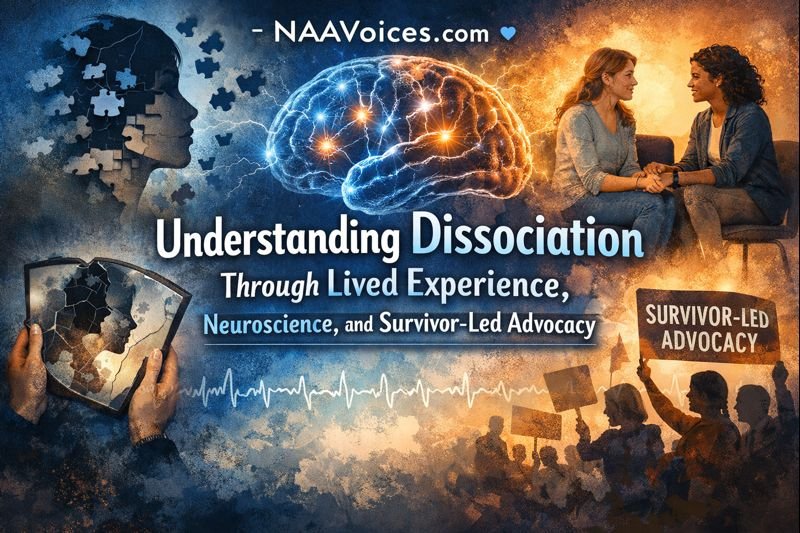
  • Understanding Dissociation Through Lived Experience, Neuroscience, and Survivor-Led Advocacy 💙

    Understanding Dissociation Through Lived Experience, Neuroscience, and Survivor-Led Advocacy 💙

    ⚠️ Content Note: This post discusses trauma and dissociation. Please prioritise your wellbeing whilst reading. Take breaks as needed.

    Quick Self-Check Before We Begin ❓

    Do You Experience Dissociation? Quick Assessment:

    • □ Feel like you’re watching yourself from outside your body
    • □ The world seems unreal or dreamlike
    • □ Can’t remember parts of your day
    • □ Feel emotionally numb during stressful situations
    • □ Hear people talking but can’t process the words
    • □ Feel disconnected from your emotions
    • □ Time seems to speed up or slow down unusually
    • □ Feel like you’re on autopilot

    If you tick 3+, consider speaking with a trauma-informed professional 💜


    Earlier this year, I was sitting in the middle of my clinic. A patient I’d been supporting for months used a word that stopped me cold: dissociation. They described the sensation of watching life unfold around them without truly being part of it. As they spoke, something shifted in my understanding of my own PTSD journey.

    For months, I’d struggled to name that automatic shutdown, the moment when the world becomes too much. It isn’t dramatic or visible. One moment I’m present and engaged. Next, I’m observing my own life from a distance, as though it’s happening behind frosted glass. My body continues the motions, but I am not there.

    In those moments, silence becomes essential. Music, once comforting, becomes unbearable. After nights of relentless triggers and flashbacks that loop like a broken record, my mind craves quiet. It’s exhausted by constant vigilance and the fear of what might come next.


    The tangled complexities of ongoing abuse leave no room for recovery. My nervous system remains trapped in survival mode. It cannot process trauma, and it cannot meet the demands of a mind now burdened with PTSD. Eventually, it simply says: “Enough. I’m taking you somewhere else for a while.”

    I understand now, this was never a weakness. It wasn’t me, “not coping well enough.” It was my brain’s extraordinary attempt to protect me from pain that threatened to overwhelm every defence I had.

    But understanding doesn’t make it easier to live with.


    💙 Remember, you’re learning about your brain’s protective mechanisms. This is self-compassion, not self-criticism.

    Structured trauma care helps. Programmes such as Finding Solid Ground have been shown to reduce symptoms and improve emotional regulation. (Oxford University Press)

    The majority of trauma survivors experience dissociative symptoms. This is particularly common in PTSD and prolonged abuse cases. (NHS England)

    Dissociation is a survival response. Brain imaging research confirms it is an adaptive mechanism, not a flaw. (Study by Reinders et al., University of Groningen)


    👩‍⚕️ Through a Nurse’s Eyes: Reflection and Recognition

    Through my postgraduate study, and as a nurse, I was trained to recognise dissociation. But it was my patients — and my own survival — that taught me what it truly looks like.

    There’s a particular quality to it. A subtle disconnection. It isn’t dramatic. It’s quiet.

    It’s the patient who seems unusually calm whilst describing horrific experiences. The assault survivor who recounts their story as though they’re reading someone else’s diary. The domestic abuse victim who appears “checked out” during safety planning.


    An illustration featuring two young women, one seemingly floating above the other in a serene, blue-toned background. Accompanying text discusses the emotional disconnection experienced by trauma survivors, emphasizing the feeling of being outside one's body.

    People often say, “I don’t know how you’re still standing.” Truthfully? Neither do I.

    For over two years, 90% of my life was spent surviving. I wasn’t living — I was bracing. Managing the impact on my health, my wellbeing, and my children. I’ve never shared the full story of what I endured since leaving. Even the fragments I’ve had to disclose have brought others to tears. But I no longer could cry.

    And that’s dissociation. Because without it, I don’t believe I’d still be here.

    The Power of Quiet Support: My Workplace and PTSD

    An Extraordinary Workplace

    My workplace has been nothing short of extraordinary. They understood that dissociation isn’t a choice. If anything, it made me more focused on my patients — because I couldn’t stay in my own mind. I needed to protect others from feeling the same pain I was carrying.

    “I never had to quote the Equality Act. The few who knew supported me quietly, respectfully.”

    Small Acts, Big Impact

    My manager would take me for walks. Colleagues shielded me from triggers. They reminded me daily, through their actions, that the pain I was carrying wasn’t mine to own alone. I set up a music speaker on the wall. It was something to fill the silence when I needed it. I could mute it when I didn’t need it.

    They sat with me during phone calls I could barely comprehend. They listened in disbelief as the system, supposedly designed to protect, gave a platform for further harm. They read the statements. They saw the contradictions. They witnessed the emotional toll of being forced to relive what I was trying so desperately to escape.

    They called. They messaged. They left food. One even offered financial help. I declined, but the gesture stayed with me long after.

    Chosen Family

    These people became family. They didn’t demand explanations or force me to speak. They let me dissociate to survive and protected the part of me that couldn’t be taken. They stood back and stayed quiet. They let me do what I do best — give others the safety I couldn’t always find for myself.

    “They stood back, quietly, and let me give others what I couldn’t access for myself: safety.”

    Please know this: you are protected.

    PTSD is recognised as a disability under UK law. You have the right to reasonable adjustments. You don’t need to justify your survival, and you don’t need to explain your coping mechanisms.

    You just need to know, you are not alone.

    If You Don’t Have a Workplace Like Mine…

    Daily Living Strategies That Help 🏠


    Final Thoughts: From Survival to Living 🌅

    Dissociation saved many of our lives. 💙 It allowed us to endure the unendurable, to survive experiences that might have otherwise destroyed us. But there comes a point where what once protected us begins to limit us. The challenge is learning to honour that protection whilst gently expanding our capacity to stay present. 🌸

    For me, truly understanding dissociation — not just intellectually, but in my bones — has been transformative. 🦋 I no longer fight against it with shame and frustration. Instead, I recognise it as my brain’s misguided attempt at care. I thank it for keeping me alive, and then I gently remind myself: the danger has passed. I am safe now. I can stay. 🏡

    Some days I can. Some days I can’t. And that’s okay. 💚

    To my fellow survivors: Your dissociation tells a story of survival. It reflects a nervous system that loved you enough to take you somewhere else when reality became unbearable. That’s not weakness. That’s not pathology. That’s the fierce protection of a brain that refused to let trauma win.

    To the professionals: When you see dissociation, you’re witnessing resilience in action. Treat it with the respect it deserves.

    And to everyone else: Be gentle with those of us who sometimes seem far away. We’re not choosing to leave. We’re still learning how to stay.

    This was never a choice. But healing — that’s a choice we make every single day..


    Daily Living Strategies – Support Directory
    🏡

    Daily Living Strategies That Help

    You are not alone. The organisations below offer free, confidential support — whenever you need it, day or night.

    💜

    If you are in immediate danger, please call 999. If you are struggling right now, Samaritans are available 24 hours a day, 7 days a week — you don’t have to be in crisis to reach out.

    Crisis Support

    🆘
    Samaritans Available 24 hours a day, 7 days a week
    Crisis Text Line Text-based support
    NHS Crisis Team Mental health emergency support
    Via 111
    Emergency Services Immediate danger
    999

    Specialist Trauma Support

    💜
    Rape Crisis England & Wales
    Women’s Aid
    Refuge DV Helpline
    Mankind Initiative Support for male victims
    Galop LGBT+ abuse support
    NAPAC Childhood abuse survivors
    Combat Stress Veterans’ mental health

    Mental Health Organisations

    🌿
    Rethink Mental Illness
    Hub of Hope Search for local services by postcode

    Online Resources

    🌐
    PTSD UK Information, support & community
    The Survivors Trust Rape & sexual abuse support
    PODS Positive Outcomes for Dissociative Survivors
    ISSTD International Society for the Study of Trauma & Dissociation

    Therapy Directories

    🌼
    BACP British Association for Counselling & Psychotherapy
    UKCP UK Council for Psychotherapy
    EMDR Association UK Find a qualified EMDR therapist

    Children & Young People

    🌸
    The Mix Support for under 25s
    Young Minds UK Young people’s mental wellbeing
    Childline Free, confidential support for children

    #PTSD #Dissociation #TraumaRecovery #MentalHealthAwareness #NursingPerspective #SurvivorStories #Neuroscience #TraumaInformed #HealingJourney #MentalHealthMatters #PTSDAwareness #DomesticAbuseAwareness #ComplexPTSD #TraumaSurvivor #MentalHealthUK #NHSMentalHealth #DisabilityRights #WorkplaceWellbeing #GroundingTechn

    My Lived Experience: A Personal Journey Through Trauma and Recovery

  • ADHD, RSD and Coercive Control: A Survivor’s Guide to Understanding and Awareness

    ADHD, RSD and Coercive Control: A Survivor’s Guide to Understanding and Awareness

    In July 2023 I was diagnosed with Combined Attention Deficit Hyperactivity Disorder. For the first time in my life, everything made sense. I had never realised that the constant internal restlessness I lived with was hyperactivity. I did not know it could present this way, but it is common in women and girls.

    I had not planned to start medication. The clinician used a simple comparison that stayed with me. If I were deficient in B12, would I take supplements? Of course I would. ADHD involves differences in dopamine regulation in parts of the brain such as the substantia nigra, ventral tegmental area and hypothalamus. Yet I hesitated, believing I had managed for 34 years without any medication. I worried medication would dull the parts of me that made me driven. I did not want to feel numb or altered.

    Looking back, I wish I had understood this sooner. I had not been myself for a long time. The impact of coercive control had stripped away many of the traits I once valued in myself.

    Rejection Sensitivity Dysphoria

    The clinician who assessed me also believed I experienced rejection sensitivity dysphoria. After researching it, so much of my life suddenly aligned. My childhood, my friendships, my fear of criticism and the intense emotional pain triggered by perceived rejection all made sense.

    Understanding RSD helped me recognise why I felt so compelled to help someone who was harming me, why I feared losing him, and why the emotional impact of his behaviour was so severe. It is not weakness. It is a recognised pattern linked to neurodivergence.

    When Abuse Is Dismissed

    On 21 December 2023, a police officer with more than 25 years of service told me, “Some relationships are just bad, not all are abusive.” It was the second time he failed to act on a disclosure, despite a documented history of controlling behaviour.

    This is the reality many victims face. Coercive control is often invisible to those who do not understand it. Dismissal from professionals can be devastating.

    Understanding Coercive Control

    Professor Evan Stark describes coercive control as being taken hostage. The victim becomes captive in an unreal world created by the abuser, trapped in confusion, contradiction and fear.

    Emotional abuse is not always shouting or threats. It can be sarcasm, dismissiveness, character attacks, subtle put downs and constant button pushing. It often stems from the abuser’s insecurities and their need to create a hierarchy where they are always right and you are always beneath them.

    Gaslighting Tactics Survivors Should Know

    Gaslighting is one of the most damaging tools of coercive control. Survivors often recognise the behaviours long before they have the language for them.

    Common tactics include:

    • Blatant lies told with confidence to destabilise your sense of truth
    • Denial even when presented with evidence
    • Using what matters most to you as ammunition
    • Gradual erosion of your confidence over time
    • Occasional praise to keep you off balance
    • Creating confusion so you rely on them for clarity
    • Projection, accusing you of what they are doing
    • Turning others against you to isolate you
    • Questioning your sanity to undermine your credibility
    • Claiming everyone else is lying so they become your only “truth”

    Recognising these tactics is essential for breaking the cycle.

    Socioeconomic Disadvantage

    Socioeconomic disadvantage significantly affects mental health outcomes. Children growing up in disadvantaged households are two to three times more likely to develop mental health disorders. When low socioeconomic status persists, the lifetime risk increases further. Improvements in household income and stability can reduce this risk, showing how strongly parental circumstances shape a child’s mental health (Misirliyan et al., 2023).

    Resilience in Children

    Resilience is shaped by a child’s personal qualities, their relationships and the wider systems around them. Children adapt best when their environments are safe, predictable and supportive. The focus should be on improving the child’s environment rather than expecting the child to become more resilient in the face of adversity (Misirliyan et al., 2023).

    A Personal Reflection on Diagnosis and Stigma

    When my son was diagnosed with ADHD at the age of five, I began researching everything I could. I did not expect to see myself reflected in the information. By the time I reached 32, I felt overwhelmed by different aspects of my life, particularly my home environment. I went to my GP hoping she would look beyond the surface.

    Before she prescribed antidepressants, I explained that I did not believe I was experiencing depression. I suspected undiagnosed ADHD. The stigma I had carried for years disappeared the moment she responded with understanding. She referred me to an adult ADHD service, and for the first time I felt seen.

    Years later, my diagnosis has strengthened my belief that correct identification of neurodiversity or mental health conditions is essential for appropriate support. Too many adults hide their struggles until everything collapses. If we recognised these challenges earlier in childhood, we could create a far more positive future.

    Embracing Neurodiversity

    Children thrive when they are understood. When we reassure them that there is nothing wrong with them, and that their differences are simply part of who they are, we help them build identity rooted in strength rather than shame.

    Some of the world’s most talented artists, musicians, authors and innovators are neurodivergent. Their challenges would be far less daunting if society accepted that difference is not deficiency.

    Embracing neurodiversity enriches our communities, workplaces and culture. Recognising different ways of thinking enhances creativity and innovation. Seeing conditions such as autism, ADHD and dyslexia as natural variations encourages acceptance and supports advocacy for the strengths associated with neurodivergence (Doyle, 2020).

    This shift is reflected in the growing number of specialist services and programmes designed to support neurodiverse individuals (LeFevre‑Levy et al., 2023). Advocates and thought leaders continue to drive this change, reinforcing neurodiversity as an essential aspect of human diversity (Johnson and Ahluwalia, 2024).

    Different is not less.

    Research and Evidence

    Research from the Evidence‑Based Practice Unit at University College London highlights the importance of school interventions. Community interventions are also crucial. These efforts improve mental health outcomes for children and young people (UCL, 2023).

    A systematic review by University College London found a clear association between academic pressure and adolescent mental health problems. These problems include anxiety and depression. This reinforces the need for public health approaches that address academic stress (Stearea et al., 2023).

    A scoping review exploring how children and young people perceive mental health emphasises the importance of developing a shared language. When children understand the difference between everyday challenges and issues that require support, outcomes improve significantly (Beckman et al., 2023).

    Research from the Evidence-Based Practice Unit at UCL highlights important factors. School and community interventions play a vital role. They help improve mental health outcomes for children and young people. Their findings suggest that targeted interventions can significantly reduce mental health issues and promote well-being (UCL, 2023).

    Domestic Abuse

    Domestic abuse is a mental health risk for both maternal depression and infant and child mental health. Abuse may contribute to toxic stress syndrome. This can lead to anxiety, depression, and long-term difficulties in handling stress and relationships. Abuse may first occur or intensify during pregnancy, further exacerbating these risks (Misirliyan et al., 2023).


    Embracing neurodiversity.

    Viewing conditions such as autism, ADHD, and dyslexia as natural variations rather than deficits fosters societal acceptance. It encourages advocacy for the positive aspects of neurodiversity, particularly within professional settings (Doyle, 2020).

    This shift is evident in the growing number of specialised services and programs designed to support neurodiverse individuals, promoting their well-being and enabling them to contribute meaningfully to society (LeFevre-Levy et al., 2023).

    The ongoing efforts of thought leaders and advocates play a crucial role in driving this change, reinforcing the importance of recognising neurodiversity as an essential aspect of human diversity (Johnson & Ahluwalia, 2024).

    Different is NOT less.