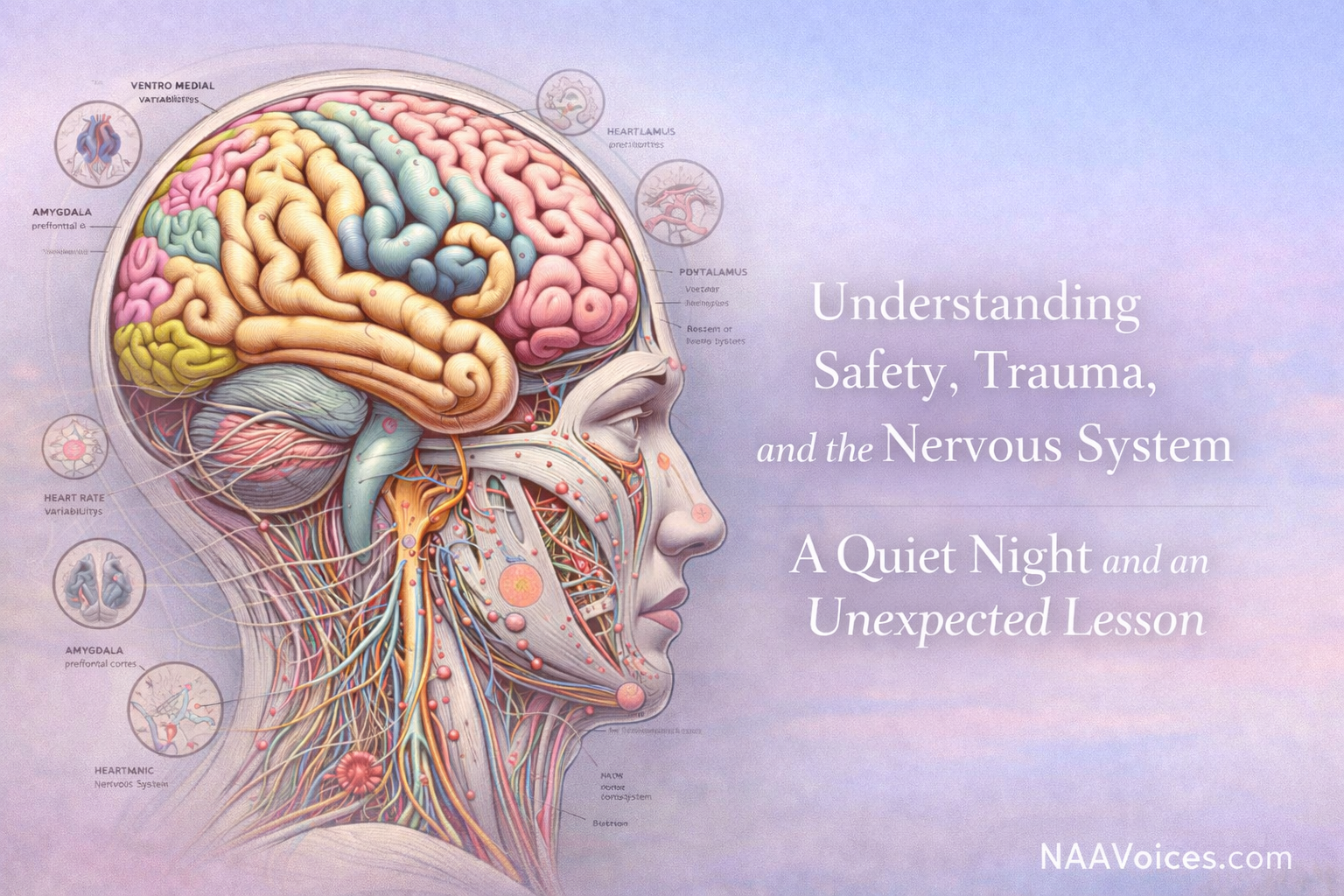
A personal reflection on self-care, lived experience, and understanding the nervous system
People say it all the time, don’t they?
You need a hobby.
You need to switch off.
You need to rest.
You need to look after yourself.
I say it myself every single day at work. I talk to patients about self-care constantly. About slowing down, resting, listening to their bodies, giving themselves space, not pushing through the point of exhaustion. It is easy advice to give when you know how important it is.
Actually doing it is something else entirely.
Today, I got on with all the usual things that seem to fill a weekend. I packed things away, did some gardening, sorted out bits that needed doing, and got everything ready for the week ahead. Then I sat down.
And I realised I had absolutely no idea what to do with myself.
Everything that needed doing was done. The house was quiet. There was space. And instead of feeling peaceful, I felt a bit lost in it.
That, in itself, says a lot.
When “rest” turns into productivity
So, instead of properly resting, I did what I often do when I don’t quite know how to stop: I found something useful to do.
I logged on and started some training.
I completed three courses that felt relevant to my role. One, the trust’s domestic abuse training, one on an update on the device we use for our patients currently on anticoagulation, and one on learning disabilities. I genuinely believe that in healthcare, we should never do things we are not competent or trained to do. Training matters. Competence matters. Safe practice matters.
I write enough about those in roles who are far from competent at their jobs, and likely why I could never understand just how they could be allowed to cause so much harm in such a position of trust. I can’t and have never been that way.
But as I worked through the modules, I found myself sitting with an unexpected feeling.
A lot of the content felt familiar.
Not because I think I know everything. Not because I think I am better than anyone else. And certainly not because I think there is anything wrong with the NHS including this content in training. Quite the opposite, actually.
The truth is much more personal than that.
Some of the content felt familiar because I have lived far more than what was covered in the modules.
The domestic abuse training, in particular, was sobering. Not because it was poor training, but because it covered realities I understand not just professionally, but personally. As someone with lived experience of domestic abuse, there is something deeply unsettling about recognising your own reality in mandatory learning content. It is not a criticism of the training. It is simply the reality that some of us have lived beyond the points.
The same was true of the learning disability training. Again, not because it was wrong or not useful, but because I have years of experience with learning disabilities, both in life and in practice. When something has been part of your world for a long time, the concepts can feel less like “new learning” and more like something you have been carrying, navigating, and understanding for years.
If anything, that saddened me.
Not because the training should be different, but because it was a reminder that some knowledge does not come from textbooks or e-learning packages. Sometimes it comes from surviving. Sometimes it comes from caring. Sometimes it comes from living through far more than anyone should ever have to.
But alongside that sadness, I also felt something else.
I felt proud that these subjects are incorporated into NHS training.
I am genuinely glad that healthcare staff are being asked to think about domestic abuse. I am glad learning disability awareness is part of mandatory or role-relevant education. These are not optional extras. They matter. They affect how people are seen, how they are spoken to, how safe they feel, and the quality of care they receive.
It also made me reflect on how I know that other organisations are provided with training in these areas, and that it’s individuals who let organisations and people down, not the lack of integration into professional practices expected of them.
No training package can fully hold the depth, complexity, or emotional reality of lived experience. But it can lay foundations. It can raise awareness. It can get people thinking. And that is important.
The promise I keep breaking
As I sat there, I also had to be honest with myself.
I have said so many times that I am going to stop doing work-related training at home. That this should be protected time during work hours. That we should not normalise doing professional development in our own time just because we are conscientious enough to do it.
And yet there I was, doing exactly that.
To be fair, my manager knows me well enough to know I do this. He would give me time back if I needed it, and I could do them at work. So this is not really about blame or pressure. It is about a pattern.
I do it because I get bored.
I do it because I am wired to keep moving.
I do it because being productive often feels easier than being still.
But eventually, I stopped after three courses.
And then I decided to do something that wasn’t for work.
At least, that is what I told myself.
The course that was “not for work”
I opened a course on Polyvagal Therapy.
Technically, it is not part of my current role. But the minute I started reading, I found myself thinking exactly what I always do with anything related to mental health, trauma, behaviour, and human functioning:
This absolutely overlaps with work.
The reality is that physical and mental health are not separate. Trauma affects the body. Stress affects the body. Relationships affect the body. Safety affects the body. The way a person feels in themselves can shape everything from pain to sleep to behaviour to engagement with healthcare.
Despite having postgraduate training in the neuroscience of psychology and mental health, there are always areas that deserve deeper exploration. Formal qualifications provide a strong foundation, but they do not cover every framework, model, or therapy in depth. Over the last few months, I have found myself increasingly drawn to therapy-based training. Part of that is professional curiosity. Part of it is personal interest. And part of it is knowing that, when life allows, I may want to build on some of this further.
I already hold training as a narcissistic recovery coach, a trauma practitioner coach, and a neurodiversity coach. I can already see how these areas interconnect. But timing matters. Capacity matters. Mental well-being matters too. There is no point pursuing something deeply trauma-related if it comes at the cost of retraumatising yourself.
Still, tonight, I found myself going down the polyvagal route.
And before I knew it, I was already into Module 2 of 13.
So, if you are curious too, come along with me while I break down some of what I learned tonight in plain English.
What is Polyvagal Theory?
Polyvagal Theory was developed by Dr Stephen Porges. In simple terms, it is a way of understanding how the body responds to safety, stress, danger, and connection.
At the centre of it is the autonomic nervous system. This is the part of the nervous system that controls things we do not consciously have to think about, such as heart rate, breathing, digestion, and stress responses.
Polyvagal Theory suggests that our nervous system is constantly scanning our environment and asking one basic question:
Am I safe?
And depending on the answer, the body responds in different ways.
This does not happen only through conscious thought. In fact, it often happens before we have had time to think anything through logically.
The body has different survival states
One of the core ideas in Polyvagal Theory is that the nervous system can move through different states.
1. Safe and connected
This is the state where we feel calm enough to think clearly, talk, engage, and connect with other people.
When someone feels safe, they are more likely to:
- feel settled
- communicate better
- regulate emotions more easily
- think more clearly
- feel present rather than threatened
This is where learning, healing, and connection happen best.
2. Fight or flight
When the nervous system senses danger, it can shift into a more activated state.
This might look like:
- anxiety
- panic
- racing thoughts
- irritability
- restlessness
- muscle tension
- feeling on edge
- needing to do something immediately
This is not a person being dramatic or difficult. It is the body preparing to protect itself.
3. Freeze or shut down
If something feels too overwhelming, the body can go the other way and begin to shut down.
This can look like:
- numbness
- dissociation
- emotional flatness
- exhaustion
- going blank
- withdrawal
- feeling stuck
- loss of energy or collapse
Again, this is not a weakness. It is another survival response.
Neuroception: when the body decides before the mind
One of the most interesting ideas in Polyvagal Theory is neuroception.
This means the body is constantly scanning for signs of safety, danger, or threat without us consciously realising it.
A warm tone of voice can signal safety.
A harsh expression can signal danger.
A sudden noise can make the body jump into alert.
An unpredictable environment can keep the nervous system on edge.
This helps explain why, sometimes, we can logically know we are safe, yet our bodies still react as though we are not.
The nervous system has already made its assessment.
Why this matters in real life
This theory matters because it helps explain why people do not always respond to stress, fear, trauma, or relationships in neat or rational ways.
It helps us understand that many behaviours are not simply choices or personality flaws. They are often body-based survival responses.
Instead of asking,
“What is wrong with this person?”
it encourages us to ask,
“What has this person’s nervous system learned to expect?”
That is a very different question.
And, frankly, a much more compassionate one.
How polyvagal theory links to trauma and mental health
Polyvagal Theory has been used to help explain a range of difficulties, especially in trauma and mental health.
Trauma
Trauma can leave the nervous system stuck in survival mode. Some people become hyper-alert, anxious, and reactive. Others shut down, dissociate, or feel emotionally disconnected. Some move between both.
Anxiety
From this perspective, anxiety is not just “worrying too much.” It can also be understood as the body being chronically mobilised and scanning for threat.
Attachment and relationships
If someone has grown up around unpredictability, neglect, fear, or instability, their body may learn that connection itself is not always safe. That can shape relationships for years.
Neurodiversity
There are also discussions around polyvagal-informed perspectives on sensory regulation, overwhelm, and social engagement in autistic individuals. Not as a full explanation, but as one possible framework for understanding regulation and safety.
Dissociation
Shutdown, disconnection, and dissociation can be understood as the body’s way of coping when something feels too much to bear.
What I found useful about it
What I like about this framework is that it joins the dots between body and mind.
It does not treat emotions as if they exist in isolation from the nervous system. It recognises that what happens physically in the body influences how people think, feel, behave, connect, and cope.
It is also compassionate.
It reframes reactions that are often judged harshly. Fight, flight, freeze, withdrawal, panic, irritability, numbness, social shutdown — these stop looking like character flaws and start making sense as nervous system responses.
That matters.
But it is not beyond criticism
At the same time, I think it is important to stay balanced.
Polyvagal Theory is useful, but it is not a magic answer to everything. Some of its concepts are difficult to measure precisely, and some critics argue that parts of the theory are easier to describe than to validate scientifically in a consistent way.
Human experience is also far more complex than any one theory can fully explain. Culture, identity, trauma, health, relationships, personality, social context, and lived experience all shape how people respond to the world around them.
So for me, this is best seen as a helpful framework, not a complete explanation for all human behaviour.
Why this connects so strongly with practice
Even though I did not start this course “for work,” I can already see how much it overlaps with practice.
In healthcare, and particularly in roles involving emotional well-being, safeguarding, neurodiversity, trauma, communication, and behaviour, this way of thinking is highly relevant.
It affects:
- how we understand distress
- how we respond to fear
- how we support regulation
- how we communicate safety
- how we avoid retraumatising people
- how we interpret behaviours that may otherwise be misunderstood
It also reinforces something that should sit at the heart of good care anyway: people need to feel safe before they can engage fully.
Tonight started with something very simple: I was trying to stop.
Trying to pause.
Trying to rest.
Trying not to fill every spare moment with tasks.
And instead, I found myself learning.
Tonight reminded me of something simple but powerful.
Our bodies remember what our minds try to forget.
Polyvagal Theory helps explain why people react the way they do to stress, trauma, and connection. Why some people become anxious. Why others shut down. Why safety matters more than we often realise.
Understanding the nervous system does not solve everything.
But it does something important.
It reminds us that many reactions we judge as weakness or overreaction are actually survival responses.
And when we begin to see people through that lens, we respond differently.
Sometimes the most healing thing we can offer someone is not advice, not solutions, and not judgment.
Sometimes it is simply helping them feel safe enough to exist without fear.
NAAVoices.com