I have thought about this question deeply, and my answer is actually quite simple.
I kept going.
When the curtains were closed. When the doors were locked. When the world saw nothing but silence from me, I kept going.
I have been thinking a lot lately about something we do not talk about nearly enough.
Post-traumatic growth
We focus so much, and rightly so, on the weight of trauma. The reliving. The triggers. The dissociation. That buzzing sensation inside your head when you finally realise you have had enough and just need to reset.
I know all of this intimately. I live with PTSD.
I know how much heavier injustice feels when your nervous system is already stretched thin. I know the days when I have been so badly triggered that I could not sleep or leave the house, and the mornings when simply getting up and functioning took far more effort than anybody around me could possibly have known.
There were nights I lay awake. Mornings when breathing felt like work. Days when I was trying to hold myself together while still holding everyone else up.
But recently, I had to look back over the last couple of years to complete an application. As I pulled everything out and laid it all down in front of me, I saw something I had never really allowed myself to see before.
Just how much I had actually achieved while learning to live with all of it.
That was when I started thinking properly about post-traumatic growth.
It does not mean the pain was not real
For a long time, trauma brought pain with silence.
Looking back, though, that silence was not empty.
It was where I listened, learned, observed, questioned and slowly rebuilt. Most of it happened quietly, without recognition and without me even realising at the time that rebuilding was what I was doing.
I did not grow instead of being affected by trauma. I grew while being affected by it.
The triggers still come. Hard days still happen. There are things I have to manage now that I never had to manage before.
Growth does not erase any of that.
It simply means that somewhere amongst it all, I changed too.
What growth actually looks like for me
People often talk about growth as though it is something polished and neat.
Mine isn’t.
I built this space online. Not because I wanted recognition, but because people reached out. Some came back. Some told me that something I had written made them feel understood.
I don’t blog religiously. I write when something reminds me, when I need to get words out, or when something sparks something in me.
It is messy. Sporadic. Real.
And that is exactly how I want it to be.
I carried my family through some incredibly difficult years. I supported all three children who, at different points, needed additional mental health support themselves, while also navigating my own struggles.
There were days when I felt as though I had absolutely nothing left and still somehow found something.
I have also changed in the way I deal with fear.
I joke sometimes that I care less these days, but that isn’t really true. I still care deeply. I have never wanted to act out of malice, and I never want difficult experiences to turn me into somebody who does.
What changed is that I stopped being frightened of other people’s reactions to me doing what I believe is right.
I no longer automatically carry somebody else’s judgement as though it must say something about me. After having my character torn apart in court, something shifted.
I promised myself nobody would ever twist who I am and make me question myself like that again.
At the time, I felt I had already faced the very worst.
And I was still here.
My voice became stronger.
I advocate fiercely now when something is wrong.
I have also learned constantly. Not simply to understand myself, but because I wanted to understand other people better. I started noticing gaps in my own knowledge and going away to fill them.
Not for recognition. Not for another certificate on the wall.
Simply because sometimes another human being is standing in front of you and you want to understand how best to help them.
And some of my growth has looked far less. Five weeks ago, I hammer-jacked up a 16ft square concrete base and laid an 11ft square patio entirely on my own. I was absolutely shattered afterwards. I fitted my own kitchen from scratch.
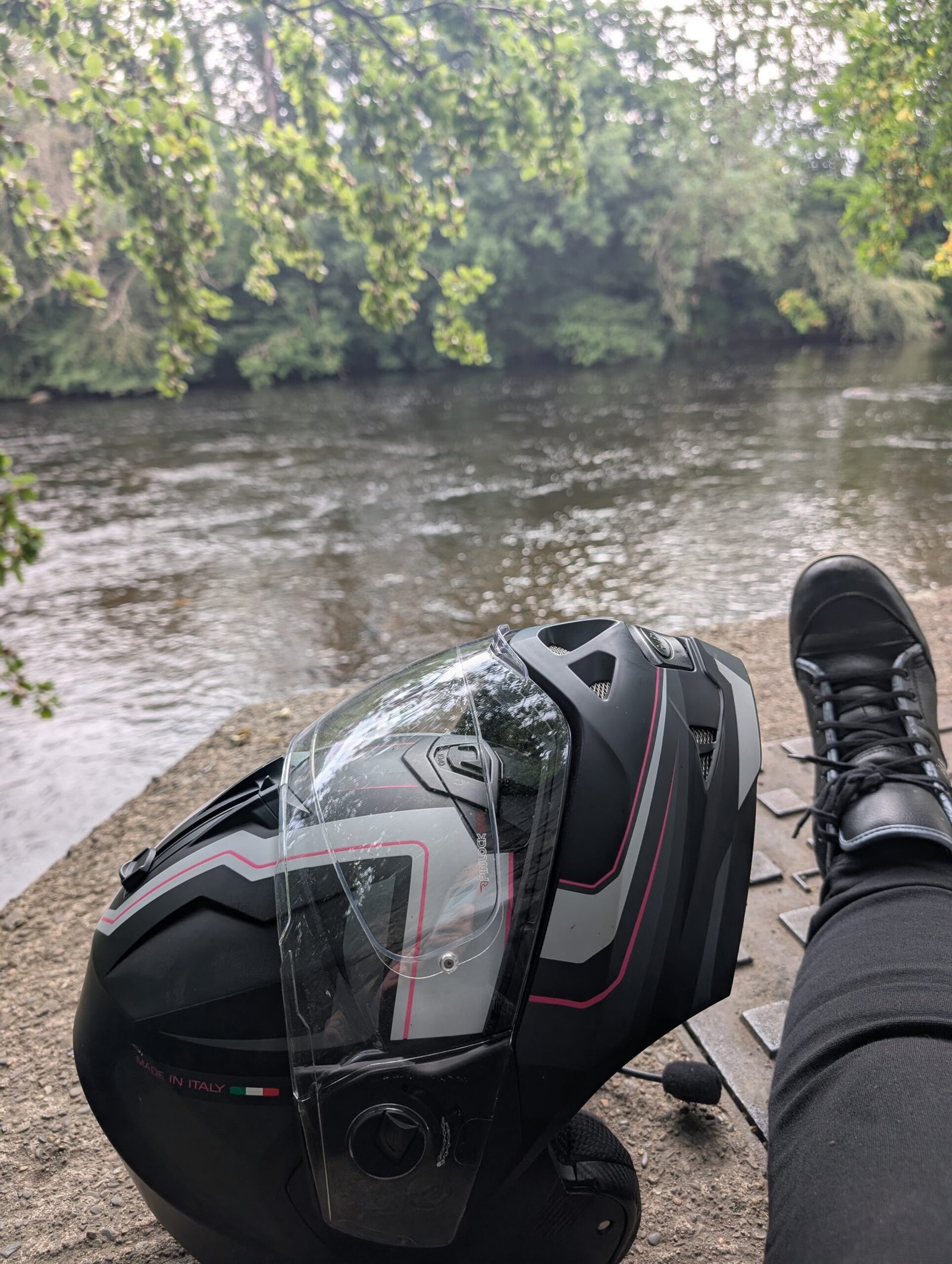
I am one part away from earning my full A motorcycle licence so I can ride a big motorbike.
They might sound like completely random things to include in a piece about trauma.
They aren’t.
Every one of them represents something I might once have questioned whether I could do.
So I did it.
Some were done on difficult days when I was exhausted or overwhelmed. Sometimes having work, projects, or something practical to focus on gave me routine and purpose when other parts of life felt heavy.
Sometimes every part of me wanted to curl up and hide.
I did it anyway.
A new chapter, and proof of what I am capable of
Now I am hopefully stepping into another chapter of my career.
The last time I chose to study at postgraduate level, I did it for a very different reason.
I needed to understand.
Behaviour. People. The brain. Trauma.
I was trying to make sense of what I had lived through while, in many ways, I was still living through it.
I was experiencing post-separation abuse and was diagnosed with PTSD during my second module. At the time, I never truly believed I could succeed.
Yet I completed my postgraduate certificate with a distinction.
There were assignments written through tears. Nights spent awake learning about trauma and domestic abuse while simultaneously beginning to understand what had happened to me.
There was something surreal about studying the impact of trauma academically while living with its consequences personally.
What I gained from that postgraduate course was far more than academic knowledge.
It gave me evidence. Evidence of exactly what I am capable of.
I can see that now, though I couldn’t see it then.
Trauma did not give me my strength, my determination, my compassion or my voice. Those parts of me were already there.
What the experience did was force me to discover just how much of them I had.
I walked through abuse, diagnosis, trauma and some incredibly dark periods without allowing those experiences to decide who I would become.
Other people do not get to define who I am or what I am capable of. There were days when I genuinely could not see an end to any of it. Now I look back at the person I have become and think:
My God. I have changed.
Not into somebody hardened or bitter.
Into somebody far harder to silence.
And perhaps that is what post-traumatic growth means to me.
Not pretending something terrible became something wonderful.
Not being grateful for trauma.
Not saying everything happens for a reason.
I don’t believe any of those things.
It is recognising that something hurt you profoundly and that, while learning to live with what it left behind, you built something too.
So is post-traumatic growth real?
I believe it is.
Post-traumatic growth, or PTG, is the term used to describe positive psychological changes that some people experience while struggling with highly challenging or traumatic life events.
It is commonly described across five broad areas.
Appreciation of life. Priorities change. Things once taken for granted can suddenly matter far more.
Relating to others. Connections can deepen. Compassion can become stronger.
Personal strength. That realisation of: I survived something I once did not think I could.
New possibilities. New interests, ambitions, paths or directions can emerge.
Spiritual or existential change. A changed sense of meaning, purpose or understanding of life.
But I think it is incredibly important that we do not romanticise it.
Post-traumatic growth does not mean trauma was beneficial.
It does not mean somebody should be grateful for what happened to them.
And it certainly does not mean that somebody who continues to struggle has somehow failed to grow.
Growth and distress can exist at exactly the same time.
You can be stronger and still be triggered.
You can have found your voice and still have days when using it feels impossible.
You can rebuild huge parts of your life and still grieve for the parts that were damaged.
Both things can be true.
I will never be exactly the person I was before.
I no longer see that entirely as a loss.
I still have my kindness. That never left.
But now it has backbone behind it. Purpose. Knowledge. And a voice that I worked incredibly hard to find.
I didn’t wait until I felt completely healed to start rebuilding my life.
I built my life while I was healing.
And perhaps, more than anything else I have written here, that is what post-traumatic growth means to me.
Trauma brought pain with silence.
But the silence did not stay empty.
So, back to the question that started all of this.
What is the bravest thing I have ever done when no one was watching?
An address. A town. The place your post gets delivered. The place you return to at the end of the day.
But I’m not sure that is what home means to me anymore.
Last night, after a ten-hour shift, I collected my daughter, got into the car and set off.
140 miles. That was the countdown on the sat nav.
It should have felt like a long drive after a long day. Instead, as the miles started disappearing behind us, I noticed something else.
My shoulders dropped.
I did not consciously decide to relax; my body seemed to do it before my mind caught up. Not because I had finished work. Not because I had a weekend off. Not even because we were getting away for a couple of days.
Somewhere inside me, I knew where we were going.
We were going home.
Except we weren’t driving towards the house where we live. We were driving towards a person.
140 miles
There are 140 miles between us.
Neither of us can simply move closer. Our older children are settled. Between us there are nine children whose lives, schools, friendships and futures matter more than making our geography convenient.
So 140 miles it is.
And somehow, across those miles, something has grown that feels far bigger than friendship.
One of her daughters once referred to my child as her sister. It stayed with me.
We talked afterwards about that phrase people use so easily: friends are the family you choose. Except sometimes I think it goes further than that.
Nobody held a family meeting and assigned titles. Somewhere along the way, “my mum’s best friend” simply became “Auntie”, and children who were not born as siblings began referring to one another as family.
It just became true.
Sometimes family is not created by blood. It is created by consistency.
It is created by showing up, by trust, by being safe, and by knowing someone is there without needing to ask whether they will be.
When home becomes a feeling
About two hours into the journey, my daughter asked me to put Country Roads on.
So I did. And we sang. Probably too loudly. Definitely not particularly well.
And somewhere in the middle of it, a feeling flooded over me so suddenly that I recognised it before I could explain it.
Home.
Not an address or a postcode, but people. Somewhere I don’t have to explain every silence, every reaction, or every part of the history that made me who I am. Somewhere I can arrive tired, overwhelmed, distracted or completely myself, and still belong.
Somewhere my daughter can simply be herself too.
Then she said it
A while later, she told me she wanted to go home.
I automatically thought she meant our house. I told her we were still about three hours from home, and that we weren’t far from where we were going.
She corrected me straight away. She didn’t mean our house at all. She meant home at Auntie’s.
And there it was again.
I hadn’t told her what I’d been thinking about earlier in the journey. I hadn’t said any of it aloud. Yet she had arrived at exactly the same word, and made exactly the same distinction.
Maybe children don’t need us to define belonging for them. They may not have the language for nervous systems, emotional security or psychological safety, but they know where their body settles. Where they can be loud. Where they can be quiet. Where they don’t have to monitor the room.
Maybe they understand that home can be more than one place.
And maybe, sometimes, home is not really a place at all.
Home after trauma
For anyone whose experience of home has been shaped by trauma, the idea of safety can become complicated.
We are often told that home should be the safest place in the world. For some people, it was not.
A house can be familiar without ever truly feeling safe. You can know where every cupboard is, where the light switches are, what the floorboards sound like at night, and still never feel completely at ease.
Sometimes, only after you leave, do you realise your body knew the difference all along.
Healing is not always dramatic. Sometimes it is simply noticing that your jaw is no longer clenched, that your shoulders have dropped, and that you are no longer preparing for something you cannot yet see.
Not the place where you survived, but the places where you started living again.
That safety does exist. That trust can be rebuilt. That family can be found. That belonging can exist 140 miles away.
And that eventually, home can become a word that feels good again.
So, where is home?
Last night there were still miles left on the sat nav. Technically, we had driven away from home hours earlier.
But somewhere on that dark road, with the music far too loud and my daughter singing beside me, I realised the opposite was true.
We were going home.
And a little later, without knowing a single word of what had been going through my head, she told me the same thing in her own way.
Perhaps that was the clearest answer I could have been given.
So I’d genuinely like to know: what does home mean to you?
Is it an address? A person? The family you were born into, or the family you found?
Or is home simply wherever your shoulders drop a little when you know you’re nearly there?
Therapy doesn’t always happen in a counselling room.
Life is often a million miles an hour, and I’m regularly asked how I keep going or how I never seem to stop. The truth is, that’s the reality of living with ADHD and PTSD. Keeping busy is often how I cope. Silence leaves space for memories, and with PTSD, silence isn’t always peaceful.
But when I need to reset, this is where I come. Somewhere natural. Somewhere that helps me ground myself.
I’ve said it many times: the body remembers what the mind forgets. In reality, the mind doesn’t forget the events; it just loses track of time. The dates blur, the anniversaries become less obvious, and the conscious reminders fade. But the body still knows. It remembers long before the mind catches up.
So for a few hours today, I’m choosing to appreciate life. To recognise everything we’ve survived, to be grateful for how far I’ve come, and simply to be present.
I’m still here.
The truth is, far too many people never get that chance.
Seven days ago, I finished work carrying the kind of weight you don’t always have words for. I’d received difficult news about a patient, the kind of news that shifts the tone of an entire day, even when you keep functioning on the outside.
In my own private language, I call people stars when they’re gone. It’s how I hold grief without letting it swallow everything else. It’s how I file loss in my mind when I still need to drive home, feed children, answer questions, and keep moving.
The Place I Didn’t Know Was Saving Me
For over a year, I used to escape. I’d get in the car and drive to a lay‑by I always ended up at. Not because it was on the way to anything. Not because it fixed anything. But because it gave me a pocket of stillness, a place where my body could downshift when my life couldn’t.
Back then, I didn’t understand the language of nervous systems, grounding, or trauma responses. I just knew I was living under sustained pressure, in a situation that was eroding me, and I needed somewhere that I could breathe. Somewhere I could be safe.
That lay‑by became my therapy before I even knew what therapy was supposed to look like.
I slept there many times. My little girl slept there overnight many, many times. We’d sit and look at the stars. She grew up believing that when someone leaves, they become a star. It gave her something gentle to hold onto, and in truth, it gave me something too.
Returning to the Road That Once Held My Fear
I hadn’t been there for a while.
But last Thursday, after receiving that difficult news, I left work carrying more than tiredness. When I collected my daughter, she asked what was wrong. I told her I felt sad because there was a new star in the sky.
Then we collected my eldest and my middle one, the teenagers who have lived through more than most people will ever understand. One of them was struggling and asked if we were going to drive. And because of the conversation in the car, my five‑year‑old said, very simply:
“Let’s take him to see our star’s.”
So we did.
I drove the hour‑and‑a‑half round trip.
And this is what surprised me: it was different.
A Body That Finally Knows It’s Safe
Every time I’d driven that road before, it was in a state of activation: trigger, panic, dread, adrenaline, that constant internal noise that comes with prolonged stress. I learned that road in survival mode. I knew every bend, every stretch, every pull‑in point because I’d driven it while trying to keep myself together.
But this time, it felt like shifting gears.
My body relaxed.
No palpitations. No urgency. No bracing for impact. No internal pleading for the night to end.
Just calm.
The memories were still there. The past was still the past. But my nervous system didn’t respond as if it were still trapped in that time. And that’s not a small thing. That’s not “positive thinking.” That’s physiological change. That’s recovery showing up quietly, without ceremony.
I am a different person now.
Not fully healed and not pretending to be. Life is still hard. Trauma leaves marks. I’m not the person I once was.
Driving that road felt like an epiphany. It revealed something concrete to me. The place that once held my worst moments has also become evidence that I survived them.
The Field, the Stars, and the Quiet Truth
I know that lay‑by like the back of my hand. I’ve sat there in snow, ice, and rain. I’ve stood in that field. I’ve cried until my chest ached. I’ve lain under the stars trying to work out how I’d get through the next day.
And for a long time, nobody knew.
I’ve been there in uniform. I’ve been there in the middle of the night. I’ve been there when the world was sleeping, and I was wide awake, trying to stabilise myself enough to return to a life that didn’t feel safe.
I have photos of my feet in the field because sometimes I had to sit in the grass just to feel something real. To feel the earth. To feel grounded. It wasn’t aesthetic. It wasn’t curated. It was a lifeline when I didn’t have words, support, or accessible options.
This time, all three of my kids got out of the car.
And they appreciated it.
Not dramatically, quietly. In the way that says, we understand why this mattered. Because they’ve been through so much, too. They’re still healing. I’m still healing.
Even this time last year, there were moments when we didn’t know what the future would look like. whether things would stabilise, whether I’d be okay, whether any of this would ever feel “over.” The year before that, there were people who didn’t believe I’d still be here.
But I am.
What the Lay‑By Really Represents
I want to be clear about what that lay‑by represents, because it isn’t just a scenic stop.
Sometimes the thing that keeps you going isn’t a big intervention. It isn’t a perfect plan or the right professional at the right time. Sometimes it’s the small escape you build quietly when you can’t say what’s happening, when you don’t feel believed, when you’re functioning publicly but unravelling privately.
Sometimes it’s a lay‑by. Sometimes it’s the stars. Sometimes it’s a field where you can sit in the grass and let your body remember that the world is bigger than what you’re living through.
And then, one day, that same place shifts.
It flips.
It becomes a positive. A source of comfort. A marker of survival rather than panic.
Driving Home With a Different Kind of Grief
On the drive home, I realised I’d driven there and back almost on autopilot, not in shutdown, not in fear, just steady. And the significance of that landed hard, because for so long, that road was associated with crisis.
That night, I carried my new “star” quietly. The sadness was still there. The reflection was still there. But it wasn’t layered with the same terror, the same frantic need to escape the life I was living.
This time, it was grief held in a body that has learned, slowly, that the emergency is not constant anymore.
Life can get easier. Not neatly. Not quickly. Not without scars. But it can.
When you’re living in continuous trauma, you can’t always see that. You can’t picture a future where your body isn’t braced for impact. And yet, here I am, driving that road differently, feeling that place differently, and showing my children the real truth:
Even in the darkest periods, something can hold you.
And later, when you’re ready, that same place can become proof that you made it through.
Content note: This piece discusses suicidal ideation and trauma. If you’re struggling, please don’t hesitate to reach out. Resources are at the end.
For 34 years, I lived with ADHD, and never once needed mental health services.
I’d worked through the front line during COVID, wards, diabetes clinics, and mental health services. Thirty-hour weeks, raising three children, advocacy work on the side, a mortgage, a routine that worked. No medication. No therapy. No “management plans.”
I exhibited all the familiar traits, including constant energy, rapid processing, big emotions, and the usual executive-function challenges, but I’d built systems that worked for me. Hyperfocus helped me manage multiple critically unwell patients in acute medicine, keep the children organised, and continually take in new information while noticing details others missed. My ability to process information quickly meant I performed at my best in emergencies, where a calmness always settled over me, and my emotional intensity helped patients feel genuinely seen. ADHD wasn’t a weakness; it was often the thing that set me apart.
Then trauma arrived, and everything changed.
It didn’t just add stress. It felt like my brain had been rewired overnight. The mechanisms that sustained me for decades suddenly stopped working, and I had no idea why.
The Day My Superpower Became My Kryptonite
My brain had always processed quickly, scanned constantly, thrived on stimulation. But introduce PTSD into that system, and it accelerated into something I didn’t recognise.
My productive energy turned into agitation, and I couldn’t settle. My hyperfocus became locked onto legal papers and perceived threats, rather than the work I loved. My rapid thinking spiralled into intrusive loops I couldn’t escape. The emotional depth that made me a good nurse now overwhelmed me.
I wasn’t overreacting. My brain was in neurological overload, and I felt utterly destabilised by it.
When Everything I Knew Stopped Working
I’d built a toolkit over 34 years, honing my structure, movement, and ability to thrive in high-pressure environments, where empathy guided me. It had served me well.
Trauma dismantled all of it.
Leaving the house felt unsafe. My routines collapsed under flashbacks that came from nowhere. My hyperfocus became a prison, locking me onto court documents and risk assessments. The empathy that once guided me now overwhelmed my nervous system, leaving me unable to function.
I kept thinking: Why can’t I just cope like I always have?
But this wasn’t about resilience. My brain was prioritising survival at any cost. And my three children were watching me disappear in real time. They didn’t understand why. How could they, when the system couldn’t either?
They watched me lose the ability to live, to take them out, to walk into a shop, to function, even to eat without vomiting. They slowly had to learn what PTSD meant and why I was no longer the person I once was. They saw me retreat, pull down walls, teach myself DIY, and avoid driving the routes we used to sing along. They learned why I needed to stop suddenly, why certain songs grounded me while others didn’t, why I would drop to my knees to stop myself from fainting, why I constantly looked over my shoulder, and why I withdrew from family and friends. I needed the house, them, and work; anything more overwhelmed me.
The worry they tried to hide, the questions they didn’t know how to ask, I saw all of it, and I felt powerless to stop what they were witnessing.
When My Neurodiversity Became a Weapon
The psychological fallout wasn’t the only battle to be fought. The systems around me made everything worse.
In family court, my ADHD, the same neurotype I’d successfully lived with for 34 years, was suddenly reframed as evidence that I was “violent and aggressive because she has ADHD.”
That allegation came from someone with a lengthy criminal history. Yet his behaviour was never questioned. Never scrutinised.
I wasn’t given the chance to respond. My neurodiversity became their weapon. His history became invisible.
At the same time, I lost four stone in seven weeks. I was vomiting constantly, barely eating, and my body was in physiological shock. I could see myself disappearing. Clothes hanging off me. The faces of my children when they looked at me, the worry they tried to hide, the questions they didn’t know how to ask. But instead of recognising trauma, I was told, “It’s mediation stress.”
I had to prove otherwise, while being retraumatised in real time.
ADHD didn’t harm me; it never had in 34 years, and it wasn’t about to start now. What harmed me was bias, ignorance, and procedural failures that couldn’t tell the difference between a neurotype and a threat.
And the emotional cost was devastating.
Watching DARVO Play Out in Real Time
I finally found a name for what I was experiencing: DARVO — Deny, Attack, Reverse Victim and Offender.
He denied. He attacked my credibility. He recast himself as the victim — and me as the risk.
And instead of identifying the pattern, the agencies reinforced it. I watched it happen in real time — and felt utterly powerless to stop it.
Over and over, I was told: “Focus on your mental health.”
But at that stage, I didn’t have a mental health history. I had ADHD — and a system that couldn’t tell the difference between neurodiversity and pathology.
The cruel irony? It was the retraumatisation — the system’s response to me — that created the PTSD I now live with.
That distinction matters to me.
Shutdown: When Survival Looks Like Withdrawal
When the overload became too much, my life narrowed in ways I’d never experienced.
Messages went unread. Noise became physically intolerable. Engaging with anyone felt unsafe.
From the outside, I know it looked like I was withdrawing. Avoiding. Giving up.
But inside, it felt like my brain had thrown a circuit breaker to prevent complete collapse. I wasn’t checking out, I was trying to survive.
I had to learn to recognise the early signals, because by the time I hit shutdown, it was too late: my thoughts became too loud, sensory overload creeping in, and I avoided my phone and people, experiencing irritability that felt foreign to me, fatigue, and headaches, along with a desperate urge to disappear and decompress.
I learned: respond early, or collapse entirely.
This wasn’t a weakness. It was my brain trying to protect itself.
The Day I Almost Didn’t Survive
April 17th, 2024.
That’s the day my three children almost lost me.
I had planned it in silence, convinced that my pain was too much to share, that my children deserved better than a mother who couldn’t hold herself together under the weight of a system that kept failing us. No one knew. No one saw the signs because I’d become an expert at hiding them. I gave away everything of value, belongings, keepsakes, pieces of myself that meant something. I disguised it as decluttering, but it was actually a form of generosity. No one questioned it because I made it look intentional.
What pulled me back wasn’t strength or sudden clarity. It was someone telling me that in their 38‑year career, they had never met anyone who had done what I had to protect my children, even in the circumstances I was facing. Hearing that forced me to see the reality of what I’d already survived. I booked an urgent GP appointment that day and asked for help. For a few months, I found a small space to begin processing the abuse.
My youngest, an old soul even before turning four, seemed to sense everything. At the strangest moments, when the outside world was being shielded, and my mind felt tortured, she would say something that reminded me why I had fought so hard to keep them safe.
I used to believe that suicide was selfish, and I still understand why people feel that way when they’re the ones left behind. But living inside a mind with no respite, in a world that no longer makes sense, carrying pain no one else can see, can push a person to a place where they feel they can’t survive anymore.
That level of mental pain affects every part of the body and feels endless. People in that state don’t need judgment.
They need reminders of who they are, what they’ve survived, and that they matter. And we all need to check in on the friends who suddenly withdraw, give away belongings, or seem “lighter” in a way that doesn’t match their reality.
I’ve never written about this in such detail before. For a long time, I couldn’t even think about it. I had been threatened with suicide as a form of control for so many years, but I’m not that person anymore. Something shifted. I lost the fear that had ruled me. I let go of a phobia I’d carried for more than twenty years. I became a different person.
When you’re facing someone who has harmed you and your children, and the people meant to protect you don’t, it demands a strength you never knew you had.
I realised that my silence and everything I had been forced to endure could become my children’s future if I didn’t break the cycle.
The system’s failure to protect me couldn’t become my failure to protect them from further harm or from the grief that would follow.
After that, survival became minute‑by‑minute. Getting out of bed. Making breakfast for three children who needed me.
Going to work was the only thing that gave me some living, because it was there that I didn’t have to be the victim, tortured by the life she was being forced to live; I could be the nurse protecting others from feeling the pain.
So I was putting one foot in front of the other, not because I felt strong, but because I had passed the point of survival; I was merely existing.
My children lost part of their mum over the past two years.
But things are better now. Not perfect, I still have hard days, days when the circuit breaker threatens to flip, but I have language for it now. I have strategies that work for an injured brain, not just a neurodivergent one. And my children are getting a mum back who understands that vulnerability isn’t weakness, that asking for help is a sign of strength, and that healing is possible.
They got a different version of me: a stronger one.
Silence almost cost me everything. It nearly took me from my children. I thank the stars not through death, but through a system that couldn’t see the injury for what it was, and through my belief that I had to carry it alone.
Rebuilding Function From Scratch
Living with this meant redesigning everything:
Lower sensory environments. Adjusting to being triggered, Clear boundaries. Simplified routines I could actually maintain. Structured pauses before I hit the breaking point. Learning trauma-informed self-regulation. Knowing when to escalate to support.
It’s disciplined. Pragmatic. Protective.
And it’s kept me functioning, for myself, and for my three children who needed me to survive.
The Moment Everything Shifted
For a long time, I genuinely feared admitting I was suffering to close my eyes at night, that the reliving and symptoms had become so severe, the problem was me. My worry was that I would be viewed differently if others knew I had ptsd, whether it was friends, family, or my colleagues.
Then I attended a lecture on neuroimaging.
They showed scans side-by-side, PTSD compared to traumatic brain injury. Disrupted pathways. Altered regulation systems. Structural stress patterns.
What I’d been experiencing wasn’t weakness. It wasn’t instability. It was a neurological injury.
And in that moment, something clicked: This isn’t my fault. My brain is functioning exactly as a brain with an injury would.
I felt anger. Relief. Grief for the years I’d spent apologising. But mostly — validation.
Understanding the neuroscience gave me language. It gave me dignity. It gave me the confidence to return to work.
The Conversation That Changed Everything
Returning to work after a two-month absence, the longest of my career, was awful. My desk, once a safe space, now held the imprint of police visits and ongoing abuse. Very few people knew what I’d been living through, and I walked back into the surgery carrying all of it, unseen.
I wasn’t meant to be seeing patients that day, but in reception I bumped into one of my regulars trying to book an urgent appointment. I offered to see them the next day.
That night, I spiralled. I worried that everything I’d endured had taken something vital from me. If every system meant to protect my children and me had failed, would it have changed me? Had it damaged the part of me that cared for others? I stayed up late with my neuroscience module, printing brain-scan images and staring at the affected areas, desperate to know whether my compassion, my ability to connect, was still intact.
The next day proved it was.
The patient had been struggling with her Alzheimer’s diagnosis, so I sat with her and her family and explained the neuroscience behind it. I showed them the scans, talked through what was happening in her brain, and what it meant for her memory and future. Her daughter and son, whom I knew well, watched closely. She knew I wasn’t just teaching; I was working something out inside myself.
Then something shifted.
I asked her, with her cardiology background, to talk me through how she’d treat a heart attack. She explained the protocols, interventions, monitoring, and rehabilitation. And then I asked: Why is the brain any different from the heart?
She looked at me and said, “There isn’t one.”
We talked about illness, prevention, acceptance, and the parallels between the organs. And it hit me: We would never expect a heart to heal solely through willpower. We shouldn’t expect a brain to, either. A heart attack needs intervention, monitoring, and rehabilitation. A brain injury, PTSD, deserves the same.
That conversation brought me back. Not just to work, but to myself.
After the appointment, they came back in with gifts, small, thoughtful things they’d chosen with such care. One of them was from a learning‑disability charity, something so specific and meaningful that it stopped me in my tracks.
I hadn’t expected anything; I certainly hadn’t expected to feel seen in that moment.
The kindness of it, the intention behind it, broke through everything I’d been carrying.
I cried, not out of sadness, but because for the first time in a long time, someone’s gesture reminded me that what I do still matters, and that I hadn’t lost the part of me that connects with people.
Why I Refuse to Be Ashamed of Needing Help
I functioned independently for 34 years, and I still needed mental health support after trauma.
That’s not a weakness. That’s an injury that requires treatment.
We wouldn’t tell someone with spinal trauma to “push through.” We wouldn’t tell someone recovering from a heart attack to just “focus on staying positive.”
Brains deserve the same standard.
Where the System Failed Me
Police guidance on supporting neurodivergent victims exists. Across my entire case, one officer seemed aware of it, and that officer’s understanding stood in stark contrast to every other interaction I had. They inquired about my processing style and sensory needs. They didn’t treat my ADHD as evidence; they treated it as context.
One person who recognised neurodivergence for what it actually is.
That’s not a training gap. That’s a safeguarding failure.
My ADHD didn’t cause the harm I experienced. The stigma around it did.
My neurodiversity strengthened my analytical thinking. It accelerated my learning. It heightened my risk awareness. It improved my advocacy.
I thrived with ADHD for 34 years.
The last two years, I’ve had to survive while living with PTSD created by repeated retraumatisation.
ADHD shaped how I process the world. Systemic failures shaped how the world treated me.
Both truths matter.
What I Know Now
Neurodiversity is not pathology. It’s not evidence of risk. And it should never be weaponised in courtrooms or policing.
The harm I experienced wasn’t created by ADHD. It was created by bias, DARVO, and institutional failure to understand neurodivergence.
Yet despite everything, my neurodiversity remains my strength.
It fuels my learning. It drives my purpose. It keeps me engaged, analytical, and compassionate.
I thrived with ADHD for 34 years. For over two years, I’ve lived alongside PTSD, and I’m rebuilding.
Both realities coexist. Neither excuses abuse. And neither should ever be used as a weapon against survivors.
Now I see the pain in others that I felt then, in the families I work with through NAAVoices, in the survivor stories that mirror my own. I recognise it immediately. And I refuse to let them drown in silence the way I nearly did.
What I’d Tell Myself Two Years Ago
If I could go back to before April 17th, 2024, I’d tell myself: This will break you open, but it won’t break you.
You’ll lose six stone, teeth from the stress-induced vomiting. Your hair will fall out. You’ll lose your sense of safety. You’ll temporarily lose yourself. Your children will watch you disappear, and that will be the hardest part to forgive yourself for.
But your ADHD isn’t the problem. The system’s response to it is.
And you’ll survive this, not despite your neurodiversity, but in many ways, because of it.
Your brain isn’t broken. It’s injured. And just like that, a heart you know how to treat can heal.
Your three children will get more of you back. Not the same version, but a stronger one. Someone who spent 34 years believing she understood mental health, only to realise she knew nothing until she survived PTSD and learned how to live openly with a mental health condition. Someone who now knows that honesty isn’t weakness; it’s strength, especially in a world where stigma still exists.
Through lived experience, I see the pain in others’ eyes, the pain no one recognised in mine. And because of that, I ask the questions. I advocate. I remind people that their lives matter, because they do. I know now that the brain deserves the same care, compassion, and rehabilitation as any other organ.
I became someone who survived.
For 34 years, I never needed support for my mental health. For the past two years, I’ve learned to live with PTSD. My therapy came through training, courses, and a deep need to understand my own brain. Everyone heals differently, and for me, giving back to others was the beginning of my healing journey, and there’s no shame in that. My brain, like any other organ, deserved treatment when it was injured. And now, slowly, with the right support, it’s healing.
If you’re in crisis:
Samaritans: 116 123 (UK) – Available 24/7
Crisis text line: Text SHOUT to 85258
NHS 111 (select mental health option)
For neurodivergent survivors: Visit NAAVoices.com for trauma-informed, evidence-based resources created by and for families navigating complex systems.
Contains descriptions of domestic abuse, police failures, and trauma. Read only if you feel safe to do so.
When Corruption and Abuse Collide, Children Pay the Price
Sometimes I can’t write. The weight of what we lived through—what was ignored, what was twisted—can feel too heavy to put into words. I started writing for one reason: for my children.
This isn’t just my story. It’s the story of countless survivors failed by abusers, by institutions, and by the systems meant to protect them. It’s about children caught in the fallout of coercive control and systemic neglect. I write because silence protects perpetrators. I write because my children deserve a record of the truth. I write because someone has to.
When Police Fail, Victims Pay
No victim should have five different investigating officers. No victim should have their personal information leaked to the defendant. No victim should have witnesses told they will be called to court, only to be dropped without explanation.
And yet, that is what happened to me.
I discovered corruption isn’t only in headlines. It exists in quiet offices where officers decide which stories get told and which are buried. My case wasn’t merely mishandled — it was manipulated. Statements were rehearsed. Timelines were twisted. Evidence was ignored. The focus wasn’t on protecting children; it was on protecting reputations.
Child Impact
Safeguarding referrals ignored; children left unprotected.
Interviews were conducted poorly or not at all.
Rights under the Children Act and the Victims’ Code denied.
The Timeline I Built
After three years of the relationship I have more than 100 pages of notes. That’s before the police correspondence and management timeline. I never tried to “get him”; I tried to protect my children. That meant educating myself and documenting everything.
What I have gathered and cross-referenced to CPS guidance and the Children Act:
WhatsApp messages spanning four and a half years.
Videos and photos I took to protect myself.
GP records documenting stress, cardiac problems, and time signed off sick.
Police logs that contradict officers’ own statements.
Every safeguarding failure: MARAC referrals ignored, child protection interviews mishandled, rights denied.
Child Impact
Unsafe contact with a dangerous parent.
Psychological harm from instability.
Loss of trust in protective services.
The Home Wasn’t Safe Either
Domestic abuse is more than bruises. It’s coercion. It’s financial fraud. It’s rage in front of the children. It’s drink-driving with them in the car. It’s staged self-harm.
I remember the day my ex took an overdose and stabbed himself in the arm while our child was present. I remember him drunk at the wheel at a known suicide spot, children within earshot of his rage. I remember cutting a fringe to cover a head injury before a family christening.
And I remember my children’s fear — refusing to sleep alone, lashing out, developing tics, refusing food. Trauma etched into their bodies in fear of him returning to our home.
Child Impact
Exposure to violence, drugs, and alcohol.
Emotional trauma and behavioural regression.
Long-term safety undermined by police inaction.
What Matters Most The Children
This blog isn’t about revenge. It isn’t even just about the police, though their failures run deep. It’s about children. Children who don’t get a voice when institutions silence their parents. Children labelled “resilient” when they’re actually terrified.
Children forced to adapt to chaos when what they need is safety and stability. Every time domestic abuse is minimised, every time coercive control is brushed aside, every time safeguarding is ignored — children’s futures are gambled with. And that is unforgivable.
My child saw things no child should ever see.
Why I Keep Writing
I don’t write because it’s easy. I don’t write because it makes me feel better. I write because my children deserve a record of the truth. I write because victims need to know they aren’t alone. I write because silence only protects perpetrators — whether that’s an abusive partner or institutions covering for their own.
Children’s safety must always come first. Until it does, I will keep writing.
Finding Small Freedoms
Existing isn’t enough. Surviving isn’t enough. This week I reclaimed a small piece of myself: I brought home a bike. Something simple, but something that makes me feel alive.
On that bike, for a short while, I feel freedom. I feel breath in my lungs that isn’t weighed down by fear, and I remember there is more to me than what they put me through.
It isn’t the end of the fight. But it’s a reminder: I am still here.
Accountability & Experience: My West Mercia Police Story