Tag: motherhood

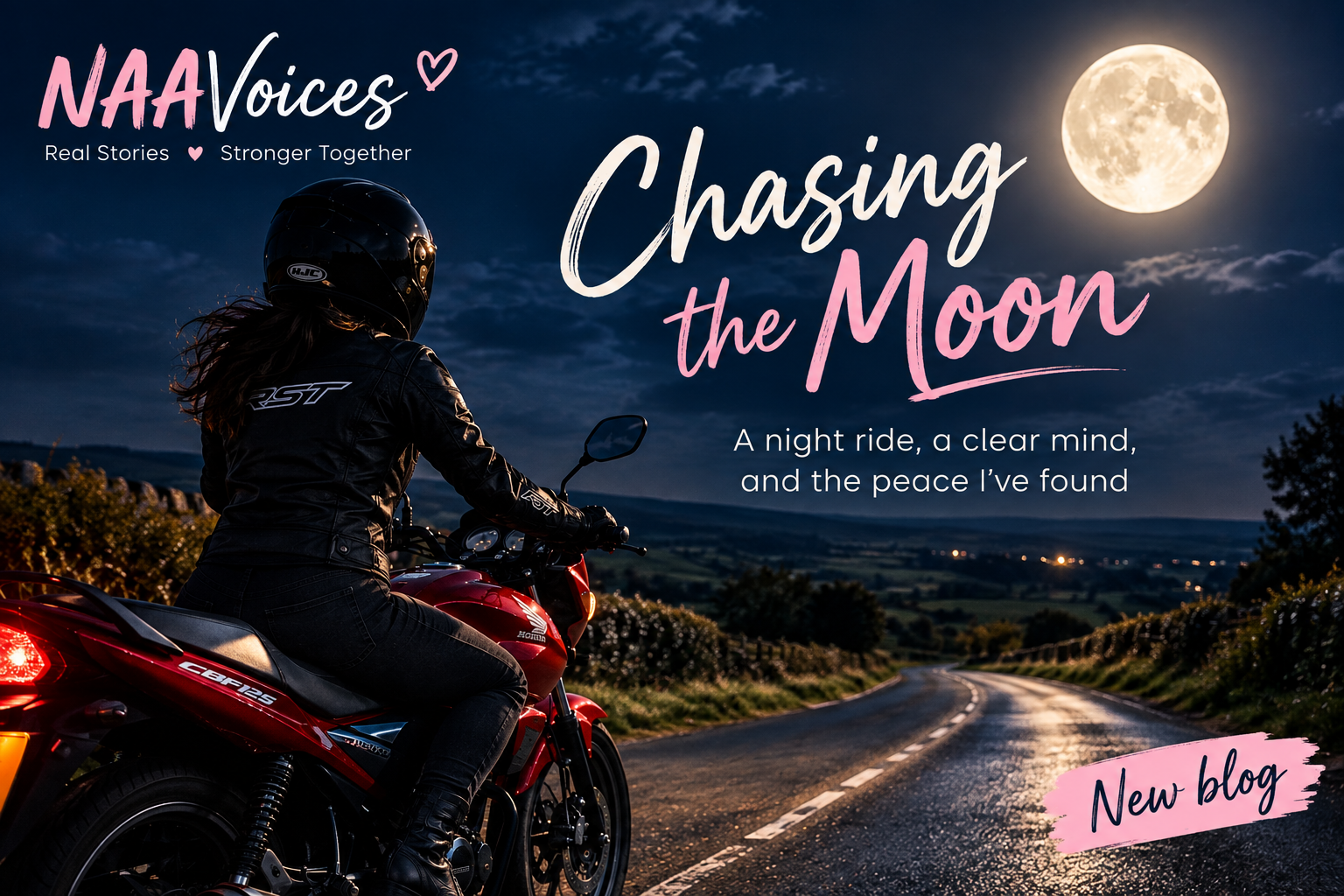
  • Chasing the Moon

    Chasing the Moon

    Tonight, I rode in the pitch black.

    My first proper night-time ride.

    And I hadn’t planned it.

    My teenager came home with a couple of his older friends and, somehow, I was the excited one.

    “Can I go on my bike?”

    Just for an hour.

    There was something slightly ridiculous about the role reversal. When I say teenagers, we’re talking nearly 18. These are lads we’ve known for years, who my six-year-old absolutely worships and who have babysat her before.

    So there I was, apparently the child of the household, while my teenager grabbed my earphones for me and I hurried into my bike jeans and threw on my leather jacket.

    One of the lads had brought his girlfriend with him.

    “I love your jacket,” she said. “It’s like a biker jacket.”

    I laughed.

    Hmm.

    Yes.

    Shock horror.

    It is, in fact, a biker jacket.

    And then I was gone.

    Out of the house. Helmet on. Engine running. Into the dark.

    We live rurally, so once you get away from the houses, darkness really is darkness. The roads disappear ahead of you except for the stretch illuminated by the bike.

    But tonight there was the moon.

    It was enormous.

    Bright enough that I kept catching sight of it as the road twisted and opened up again, and for an hour it genuinely felt as though I was chasing it.

    And my God, it was beautiful.

    There is something about riding that clears my head in a way very little else can.

    You can’t carry everything with you on a motorbike.

    Your brain has to be where your body is.

    The road.

    The bend.

    The gears.

    The sound of the engine.

    The cold air finding the tiny gaps in your clothes.

    For once, there isn’t room for tomorrow, yesterday, paperwork, arguments, money, people, responsibilities or the thousand things constantly competing for space in my head.

    There is just now.

    For an hour, I chased the moon.

    Then I came home.

    My daughter had spent the evening with people she adores, making bracelets and generally having the time of her life.

    Later, I watched a film with my 14-year-old.

    Eventually everyone went to bed.

    And now I’m sitting here with the moonlight coming through the window, thinking about how different life feels sometimes.

    Not necessarily easier.

    But different.

    There are moments when I can actually see how far we’ve all come.

    For a long time, home wasn’t synonymous with peace. Safety wasn’t something I could simply assume. My nervous system didn’t understand the concept of switching off because there was always something else to anticipate, manage or survive.

    Now, increasingly, there are ordinary evenings.

    Teenagers turning up.

    A six-year-old making bracelets.

    A film on the sofa.

    Children sleeping safely upstairs.

    And me disappearing for an hour because I fancied riding my motorbike under a ridiculously bright moon.

    Ordinary things.

    But after you’ve lived without peace, ordinary can feel extraordinary.

    I’ve also learned something else.

    People will come and go.

    I don’t have the energy anymore for people who only appear when they want something from me, or relationships where I am valued primarily for what I can give, fix, carry or provide.

    Peace changes your tolerance for that.

    Once you’ve fought this hard to build a safe life, you become much more careful about who gets access to it.

    And perhaps that is part of healing too.

    Not becoming harder.

    Just becoming more protective of the peace you’ve worked so hard to create.

    Every time I get on that bike, I feel a little bit of it.

    A sanctuary I haven’t felt in a very long time.

    I’m not running away.

    I’m not trying to disappear.

    Sometimes I only get an hour. Sometimes it’s a short ride between everything else life demands of me.

    But for those few miles, there is nothing to solve.

    Just me.

    Two wheels.

    An open road.

    And tonight, a moon so bright I couldn’t resist chasing it.

    Then I get to turn around and ride home.

    And perhaps that’s the biggest difference of all.

    These days, I have somewhere safe to come back to.

  • Home Is Not Always an Address

    Home Is Not Always an Address

    Home Is Not Always an Address

    Where is home?

    It sounds like such a simple question.

    An address. A town. The place your post gets delivered. The place you return to at the end of the day.

    But I’m not sure that is what home means to me anymore.

    Last night, after a ten-hour shift, I collected my daughter, got into the car and set off.

    140 miles. That was the countdown on the sat nav.

    It should have felt like a long drive after a long day. Instead, as the miles started disappearing behind us, I noticed something else.

    My shoulders dropped.

    I did not consciously decide to relax; my body seemed to do it before my mind caught up. Not because I had finished work. Not because I had a weekend off. Not even because we were getting away for a couple of days.

    Somewhere inside me, I knew where we were going.

    We were going home.

    Except we weren’t driving towards the house where we live. We were driving towards a person.

    140 miles

    There are 140 miles between us.

    Neither of us can simply move closer. Our older children are settled. Between us there are nine children whose lives, schools, friendships and futures matter more than making our geography convenient.

    So 140 miles it is.

    And somehow, across those miles, something has grown that feels far bigger than friendship.

    One of her daughters once referred to my child as her sister. It stayed with me.

    We talked afterwards about that phrase people use so easily: friends are the family you choose. Except sometimes I think it goes further than that.

    Nobody held a family meeting and assigned titles. Somewhere along the way, “my mum’s best friend” simply became “Auntie”, and children who were not born as siblings began referring to one another as family.

    It just became true.

    Sometimes family is not created by blood. It is created by consistency.

    It is created by showing up, by trust, by being safe, and by knowing someone is there without needing to ask whether they will be.

    When home becomes a feeling

    About two hours into the journey, my daughter asked me to put Country Roads on.

    So I did. And we sang. Probably too loudly. Definitely not particularly well.

    And somewhere in the middle of it, a feeling flooded over me so suddenly that I recognised it before I could explain it.

    Home.

    Not an address or a postcode, but people. Somewhere I don’t have to explain every silence, every reaction, or every part of the history that made me who I am. Somewhere I can arrive tired, overwhelmed, distracted or completely myself, and still belong.

    Somewhere my daughter can simply be herself too.

    Then she said it

    A while later, she told me she wanted to go home.

    I automatically thought she meant our house. I told her we were still about three hours from home, and that we weren’t far from where we were going.

    She corrected me straight away. She didn’t mean our house at all. She meant home at Auntie’s.

    And there it was again.

    I hadn’t told her what I’d been thinking about earlier in the journey. I hadn’t said any of it aloud. Yet she had arrived at exactly the same word, and made exactly the same distinction.

    Maybe children don’t need us to define belonging for them. They may not have the language for nervous systems, emotional security or psychological safety, but they know where their body settles. Where they can be loud. Where they can be quiet. Where they don’t have to monitor the room.

    Maybe they understand that home can be more than one place.

    And maybe, sometimes, home is not really a place at all.

    Home after trauma

    For anyone whose experience of home has been shaped by trauma, the idea of safety can become complicated.

    We are often told that home should be the safest place in the world. For some people, it was not.

    A house can be familiar without ever truly feeling safe. You can know where every cupboard is, where the light switches are, what the floorboards sound like at night, and still never feel completely at ease.

    Sometimes, only after you leave, do you realise your body knew the difference all along.

    Healing is not always dramatic. Sometimes it is simply noticing that your jaw is no longer clenched, that your shoulders have dropped, and that you are no longer preparing for something you cannot yet see.

    Not the place where you survived, but the places where you started living again.

    That safety does exist. That trust can be rebuilt. That family can be found. That belonging can exist 140 miles away.

    And that eventually, home can become a word that feels good again.

    So, where is home?

    Last night there were still miles left on the sat nav. Technically, we had driven away from home hours earlier.

    But somewhere on that dark road, with the music far too loud and my daughter singing beside me, I realised the opposite was true.

    We were going home.

    And a little later, without knowing a single word of what had been going through my head, she told me the same thing in her own way.

    Perhaps that was the clearest answer I could have been given.

    So I’d genuinely like to know: what does home mean to you?

    Is it an address? A person? The family you were born into, or the family you found?

    Or is home simply wherever your shoulders drop a little when you know you’re nearly there?

  • Big Hearts: A Four-Year-Old, a Stranger, and a 60-Mile Round Trip

    Big Hearts: A Four-Year-Old, a Stranger, and a 60-Mile Round Trip

    Today, my youngest and I ventured into Telford shopping centre for a bit of shopping. As we made our way to the car park pay station near Primark, we encountered a gentleman sitting on the floor, drawing with a tin out for donations.

    I rarely carry cash — only my card — but seeing him there, I immediately checked. My little one asked about his drawings. Children have a unique way of seeing the world, and my son sees no harm in others.

    Over the past year, I’ve realised that despite what others may project about who I am, he has been shielded from the true events and the behaviours of others. He has always been my priority, and I have protected him from the harsh reality that not everyone is kind, considerate of others’ wellbeing, or capable of causing harm.

    This year has truly highlighted how hard life can be, and what I would have given to change even one aspect of what was happening. Life can take unexpected turns, making it difficult for some to find a way out of their circumstances.

    We met ‘Sketch,’ who shared a bit of his story with us. He had been through a lot, especially during COVID when he ended up in intensive care. His life took a downward turn from there. He had even written his experiences in a book but felt his handwriting wasn’t good enough to share.

    That hit close to home. When I wrote over 40,000 words about the abuse I had endured, no one listened or cared. A police officer told me I didn’t even need to provide a statement. Journaling became the thing that helped me find closure and process what had happened. Sitting there with Sketch, I realised how many of us feel that our lives and experiences simply don’t matter to others.

    It’s something I’ve made it a point to change — at work and in my daily life. I let people know that they do matter, that their stories matter. That need to affirm others perhaps stems from my intense desire to protect my children and fight for them, despite my ex manipulating others the way he had manipulated me for years.

    Listening to people’s stories is vital, because so many endure hardships in silence.

    It’s not realistic to help every person you come across, especially financially, but I felt for him. He had commented on his handwriting, and I knew that converting it into text was something I could do without much effort — something that might actually help him. I offered to do it if he ever decided to share his story and gave him my website email address.

    Sketch shared his journey of finding solace in drawing, a heartfelt way he copes with his challenges. As my little one carefully looked through Sketch’s pictures, he eagerly searched his bag for a drawing he wanted to share with him.

    I felt compelled to ask Sketch if I could write about him in my blog, highlighting the importance of instilling kindness and empathy in my children. To my joy, he agreed to a photo.

    Initially, he appeared a bit reserved, but by the time we left, a warm smile lit up his face. It was a beautiful reminder of the connection we can create through understanding and compassion.

    On the way back to the car, my son said something that melted my heart: “Mummy, I have a big heart, like you.” This brought tears to my eyes, especially after a teacher recently told me he was like his older brothers. I was incredibly proud to hear that.

    Before the youngest’s dad came into my life, my older boys were amazing kids who saw no harm in others and cared unconditionally about the people around them. Ten years ago, my middle son, at the same age my little one is now, had asked to buy water for a homeless man we encountered on the street. Sadly, they have since witnessed and experienced the harm that others can cause, and that is something I will never forgive myself for.

    Just a year ago, my little one was struggling with his emotions while living in an environment I wouldn’t wish on anyone. He rarely showed me much empathy. One of his ‘long’ memories with his dad is of him shouting at me because he wanted to play with his toys in the room I was cleaning. For a three-year-old to have that as a ‘happy long’ memory speaks volumes about the kind of behaviour he saw as acceptable. But today, he demonstrated profound empathy and understanding, showing how far he’s come.

    Once back in the car, I rummaged through our belongings to find something for Sketch. I found an old jumper of my teenage son’s and my little one’s drawing pad. I turned around, and my little one eagerly grabbed a toy train to give as well.

    As we returned to find Sketch, my son expressed his pride in being kind, suggesting we give him his pennies from his bag. It’s unsettling what he remembers — like how an act of kindness wasn’t the norm. He said, “Daddy has a bad heart. I don’t want to shout at you.” I reassured him that he indeed has a big heart, one capable of kindness and love.

    When we found Sketch again, my son proudly showed him the elephant he had drawn in the sketch pad, declaring it was for him. He also playfully pointed out his “dirty hands” — a charming reminder that, at four years old, such things are just part of life. The train was a gift for Sketch to play with while he wasn’t drawing.

    We chatted on our way back to the car, and just as we were leaving, Sketch ran after us with stickers he had found, eager to share them with my son. It was a little reminder that those who have so little often give what they can — not just in material possessions, but in time, energy, and effort, often to their own detriment.

    In the car, my little one suggested we get Sketch a house and some dinner.

    We returned after running our errands, only to find that he had left the car park.

    Today, I felt a swell of pride for my young man, but also for myself. I’ve chosen not to let the actions of others deter my desire to help those in need. Life may throw challenges our way, but moments like these remind us of the power of kindness and the importance of teaching our children to care for others.

    Since arriving home, my little one has put together a bag of things all on his own: popcorn, which he insisted on cooking himself, baby wipes for Sketch’s dirty hands after drawing, and snacks. But the most beautiful part is that he has drawn and cut out about a million hearts, colouring them in for Sketch.

    It looks like we’ll be making another 60-mile round trip tomorrow. Because I want this boy to know that even if we can’t find Sketch in the same spot, the effort, care, and compassion he has shown at the age of four is beyond anything many others would or could show. And I am unbelievably proud of him.


    Shout out to Sketch: Your resilience and creativity are truly inspiring. Despite all you’ve been through, you’ve shown that there is still room for kindness and generosity. It’s a powerful reminder for us all to care for one another and not judge others, because we never know where life might take us.

  • The Heartache of Time Lost: A Journey Through Isolation and Healing

    The Heartache of Time Lost: A Journey Through Isolation and Healing

    NAAVoices was not created from certainty, but from lived experience and professional insight. As I migrate earlier work from the original platform, this post has been reviewed and approved for transfer. It remains true to its original context, with only minor clarity edits where needed. Some moments do not require rewriting to remain honest.

    The Heartache of Time Lost: A Journey Through Isolation and Healing

    One of the deepest sources of sadness in my life has been reflecting on the years I lost—years stolen by isolation, coercion, and fear. The distance that grew between the people who meant the most to me and me felt like a chasm I could never cross. Slowly, I withdrew from those I loved, terrified of what might be said or done in their presence. Terrified of the consequences. Terrified that the blame would always land on me.

    Among all the losses, the separation from my grandmother has been the most painful. Losing those years with her feels like losing something irreplaceable. She wasn’t just my grandma; she was one of my closest friends.

    Before my relationship with my ex, I chose to live with her for a year so she wouldn’t be alone after my step‑granddad passed away—a truly remarkable man. We had cared for him together during his final year, watching his pain slowly fade. It was her second time losing a partner, having been widowed in her 50s by my beloved granddad. I couldn’t leave her alone when my older children’s father was posted hundreds of miles away. He understood, and he supported that decision just weeks before our eldest was born.

    When I eventually moved to be with my ex‑husband, I didn’t go a single day without speaking to her—often more than once—for nine years. I visited monthly despite the distance. The bond she shared with my older children was something I treasured deeply.

    Her connection with my eldest was especially beautiful. He didn’t always want to be around people, but if I said the word “Grandma,” he’d be in the car before I’d even grabbed my keys. The joy on his face when they were together was unmistakable.

    But everything changed when doubt was planted early in my relationship. My ex accused both her and me of being unreasonable simply because I asked him not to smoke around her due to her respiratory issues.

    Caught in a cycle of narcissistic abuse, he only contacted her when he wanted something. He exaggerated his abilities, worked cash‑in‑hand, and pretended he was “on top of everything.” He offered to help with her house renovations, but when she tried to pay him for the work he’d been so eager to do, everything shifted.

    He ruined her home. He couldn’t deliver on the promises he’d made or the expertise he claimed to have. As soon as she paid him, he bought himself a £400 coat instead of contributing to her bills. He accused her of having “too high standards” and insisted he was doing her a favour. That “favour” cost her over a thousand pounds—and thousands more to fix the damage. Eventually, she told him she needed someone else to help because she was worried about being away from the baby and me for too long.

    I didn’t learn the truth until my aunt contacted me. She sent photos of the shoddy work—nothing like the staged images he’d been sending me of himself “working hard.” And the problems didn’t stop there. His “rolls” smelled suspicious, and I later understood why.

    My bank card was being used without my consent. He spent far more on coffee than anyone reasonably could. The smell of alcohol on him when he came home was another red flag. Yet he insisted it was all in my head. He claimed my grandmother was “too demanding” and that she was “using him,” just like he said my family had used me.

    A divide formed. I could only call her in private because he’d make cruel comments whenever I spoke to her.

    The punishment for visiting her became unbearable. For four years, every visit ended with anger, accusations, and abuse—fuelled by alcohol and later drugs. By 2023, I felt completely trapped. I couldn’t visit anyone or go anywhere without being accused of “snatching his child.”

    The last visit before I left him was a nightmare. He harassed me relentlessly, demanding I return home because he was intoxicated and convinced I was “taking his son.” I pulled over to call my GP, but he wanted me to give up my own appointment—one I’d booked for cardiac symptoms, so he could seek help again. I couldn’t sacrifice my health. I was barely coping.

    The isolation didn’t end when I left. I’m not the same person I once was. The grief and guilt of the time lost still weigh heavily, especially knowing my youngest barely knew her.

    Today, as we left her house, I had a moment of weakness. I cried on the drive home, overwhelmed by memories of everything we lost. But a year on, something has shifted. The boys smiled again. Their spirit is returning. Their bond with her is healing.

    We played dominoes together, and for the first time in years, no one punished me for wanting to reconnect with my own family.

    He may have dragged me into darkness, but I am free now—free from the fear of walking into a home not knowing who I’d meet. Free from the punishment. Free from the silence.

    I’m finding my way back to myself, one day at a time.