Tag: Mental Health Awareness

  • When the Battery Dies at 11PM: The Things That Keep Us Alive

    When the Battery Dies at 11PM: The Things That Keep Us Alive

    Sometimes healing does not look like meditation apps, neat routines, or doing everything the “right” way.

    Sometimes it looks like sitting on the floor at 11 o’clock at night beside a motorbike with the seat off, staring at a fuse box because your mind will not settle until you know whether it is the battery, the fuse, or just another thing that has fallen onto your shoulders to sort out alone.

    Tonight was hard.

    I had already spent time riding earlier because I needed to clear my head. Riding has always done that for me. I grew up on the back of a bike. I have ridden on and off for over ten years now.

    Almost two years ago, I completed my CBT for the third time. This time, I knew I was not going to let anyone take that part of me away again.

    Friends, family, and colleagues could not always understand why I would choose to ride. What they did not realise was that, at that time, I was living through things I could barely articulate. Much of it was happening in silence.

    They also did not realise that riding was one of the only things that made my whole body relax.

    At the time, I did not understand dissociation. I did not have the words for it. I only knew that I had shut down so hard in order to survive that feeling anything at all had become difficult.

    But on a bike, I could feel.

    It was never about chasing danger. It was about finding a place where my body finally stopped bracing for it. For a while, the bike was the only place where I was not waiting for the next thing to happen.

    I was just there.

    Present.

    Awake.

    Alive.

    I drove to Manchester for my test, and one of the instructors that day spoke openly about his own PTSD after serving in the army, and how riding helped him. I heard him then, but I did not fully understand it.

    It took me a year.

    Now I do.

    He had no idea what I was living through. He had no idea that six months later, I would be diagnosed with PTSD too. But his honesty stayed with me. If I ever saw him again, I would want to thank him, because sometimes people say things without realising they have given someone else language for their own survival.

    For some people, motorbikes will never make sense. In healthcare especially, there can be blunt assumptions about riders and risk. But the reality is more complicated than that.

    Risk is subjective.

    People drive cars recklessly every day. People drink. People use drugs. Chronic stress damages bodies quietly over years. Trauma changes the way people react to uncertainty, silence, fear, and pressure.

    For me, a few hours on a bike can help calm the stress responses that build up over time.

    That matters.

    Self-care matters. Feeling free matters. Sometimes freedom is simply a helmet, an engine, and a stretch of road where nobody is asking anything of you for a little while.

    When the battery was flat tonight, it threw me more than it probably should have.

    Not just because my plans for tomorrow changed, but because it triggered that familiar feeling that everything ultimately falls back onto me. So when a colleague messaged, I sent her a photo of the fuse box I was sat tinkering with, trying to rule out every possibility before the replacement battery arrives in the morning.

    Logically, I knew it could wait.

    Emotionally, I could not switch off until I had checked everything.

    Trauma can do that. When you have spent years anticipating the next crisis, the next escalation, or the next consequence, it changes how you process your own needs.

    You stop asking for help.

    You stop explaining pain.

    You just keep functioning.

    My best friend lives miles away, but she always knows when something is wrong because I go quiet. I shut off. I disappear into doing. Into fixing. Into surviving. Into movement.

    That was me tonight.

    The reality is that there has never really been anyone coming to save me. I learned that a long time ago.

    There is no emergency contact for emotional exhaustion. In reality, I do not even have an emergency contact listed anywhere. No obvious person to name. No automatic safety net. No rescue team arriving when life becomes too heavy.

    Most of the time, I am the person people call when they need help.

    And honestly, I do not resent that.

    Caring for others is part of who I am. It is woven into both my personal life and my professional identity. Supporting people matters to me deeply.

    But some nights I understand why others want to be in a relationship, and why they need that side of life. Not to be rescued. Not because they are weak. But because steady, practical, human support matters. Someone safe to call. Someone who notices when you go quiet. Someone who understands that even capable people get tired.

    For me, that still feels complicated. When you have been through enough, closeness can feel less like comfort and more like risk. But I understand why people still want that connection. It is not about needing to be saved. Sometimes it is simply about not having to carry everything alone.

    Social media is full of messages about independence. About not needing anyone. About strength meaning self-sufficiency.

    But I do not think most people genuinely want to do life entirely alone.

    I think many of us simply adapt to the absence of reliable support. We become resilient because we had no alternative. We become independent because dependence was unsafe. We learn to survive because survival was required.

    And eventually people mistake survival for not needing connection.

    Tonight reminded me that healing is rarely neat.

    Sometimes it is deep conversations and therapy sessions.

    Sometimes it is practical problem-solving.

    Sometimes it is a fuse box under a motorbike seat at 11PM because your mind needs certainty before it can rest.

    Maybe that is why we need to talk more honestly about what coping really looks like. Not the polished version. Not the inspirational quote version. The real version. The late-night, practical, messy, human version.

    Because sometimes the people who look the most capable are the ones quietly holding everything together with no emergency contact, no safety net, and no room to fall apart.

    And maybe that deserves a little more understanding too.

    NAAVoices.com

  • When There Is No Safety Net Coming

    When There Is No Safety Net Coming

    This weekend was difficult.

    The events that unfolded were directly linked to the abuse my children lived through. I will not expand on those details publicly because some things belong to them, not the internet. Their story is not mine to expose. My role is to protect it, even while telling the truth about what trauma leaves behind.

    Friday also marked the anniversary of my ex’s arrest. For a short time, I believed that moment meant safety had finally arrived. The reality that followed was very different. What came afterwards exposed my children and family to risks I never thought possible, not only through one individual, but through systems and institutions that were supposed to protect us.

    This weekend was not only about an anniversary.

    It was about what resurfaced because of it.

    Trauma does not disappear because time passes. It shows up in behaviours, emotions, reactions, fear, anger and overwhelm. Especially in children.

    And when it does, the hardest reality is not just managing the moment. It is knowing that, when everything falls apart, me and the kids only truly have me.

    There is no reliable safety net arriving. Not in the way people imagine. Not consistently. Not when the damage has already been done and the consequences are still living inside my children.

    That is why I went to the rocks.

    Not because I had spare time. Not because it was scenic. Because my body knew I needed to reset before I broke under the weight of it.

    People often think trauma lives in memory alone. It does not.

    The body remembers what the mind tries to forget.

    Certain dates pull you backwards. Certain places do too. Sometimes it arrives without warning, tightness in your chest, pressure in your throat, a sudden need to move, drive, breathe, or escape. For years, I did not understand why I instinctively sought out open spaces, music, nature, long drives or silence.

    Now I do.

    This morning, I drove the children to school and then headed to the rocks, the same place I used to go after leaving. I remember the first few times I went there. I cried most of the drive. At the time, I did not understand why being there mattered so much.

    Looking back, I can see that my body was searching for regulation before my mind had fully processed what had happened.

    People can dismiss walking, music, fresh air, the sea, nature, or grounding techniques as “airy-fairy”. They are not. The nervous system carries trauma. It also recognises safety, rhythm, space and movement before we always have the words for why they help.

    Trauma changes the way you live. I have certain clothes I wear because they make me feel safer. Certain items I keep with me. Certain routines, places and songs that act as anchors. They may look insignificant to anyone else, but to a traumatised nervous system, they are reminders that I have survived before and can survive again.

    Today I walked to the top, somewhere I had not climbed since carrying my then three-year-old on my back with the dog beside me.

    It was almost comical at times. I avoided the proper path and ended up climbing through brambles instead. At one point, I was practically on my hands and knees dragging myself up the final stretch just to reach the spot I needed to get to.

    And the dog never left my side.

    She kept stopping and looking back to check where I was. No formal training. No commands. Just instinctively staying close while I crawled through mud, brambles and exhaustion towards somewhere my body had decided mattered.

    When I finally got there, I sat.

    Headphones on. Music playing. Breathing.

    For the first time in a while, everything went quiet.

    Walking back down, I did not want to leave. I circled for a while, climbed back through the brambles again, and delayed going home because something about being there made me feel human again.

    Maybe that is what healing sometimes is.

    Not fixing everything.

    Not pretending it never happened.

    Just finding a moment where your nervous system stops fighting long enough to let you breathe.

    There is a version of me that existed before all of this, and I know now I will never fully be that person again. For a long time, that grief consumed me. I thought being broken meant I had lost myself forever.

    But being broken also gave me understanding.

    It changed the way I see pain in other people. It taught me to recognise what fear, exhaustion and trauma can look like beneath behaviour. It changed the way I advocate, the way I work, the way I parent, and the way I see injustice.

    When you have lived through institutional failure, coercive control and fear, you begin to understand how many people are silently carrying things nobody else can see.

    I have spent much of my life giving other people what I never had myself, support, compassion, protection and reassurance. Somewhere along the way, I forgot that self-care is not selfish.

    It is necessary.

    Because school runs still happen.
    GCSEs still happen.
    Parenting still happens.
    Life still continues.

    Today, my 15-year-old came home after his first GCSE exam.

    I asked him how it went.

    He shrugged and said he did not even understand the question.

    And I just told him, “You’re fine, as long as you tried your best.”

    Because honestly, after everything he went through last year, I did not know whether he would emotionally make it to this point. Trauma comes out in children in ways people often fail to recognise. Attendance can be resilience. Showing up can be courage. Sitting an exam can be survival.

    So I am proud of him.

    Not because of grades.

    Not because of results.

    Because he showed up.

    Because despite everything, he walked through those school gates and sat that exam.

    Sometimes healing looks like climbing through brambles to sit on the rocks with your headphones on because your body needs reminding that you survived.

    Sometimes resilience looks like a child walking into a GCSE exam after a year that nearly broke him.

    And sometimes the strongest thing a person can do is keep showing up for their children, while finally learning to show up for themselves too.

    Even when healing means accepting that the people and systems you believed would stand beside you were never really there.

  • When Rest Feels Unfamiliar: What a Quiet Evening Led Me to Learn About Polyvagal Theory

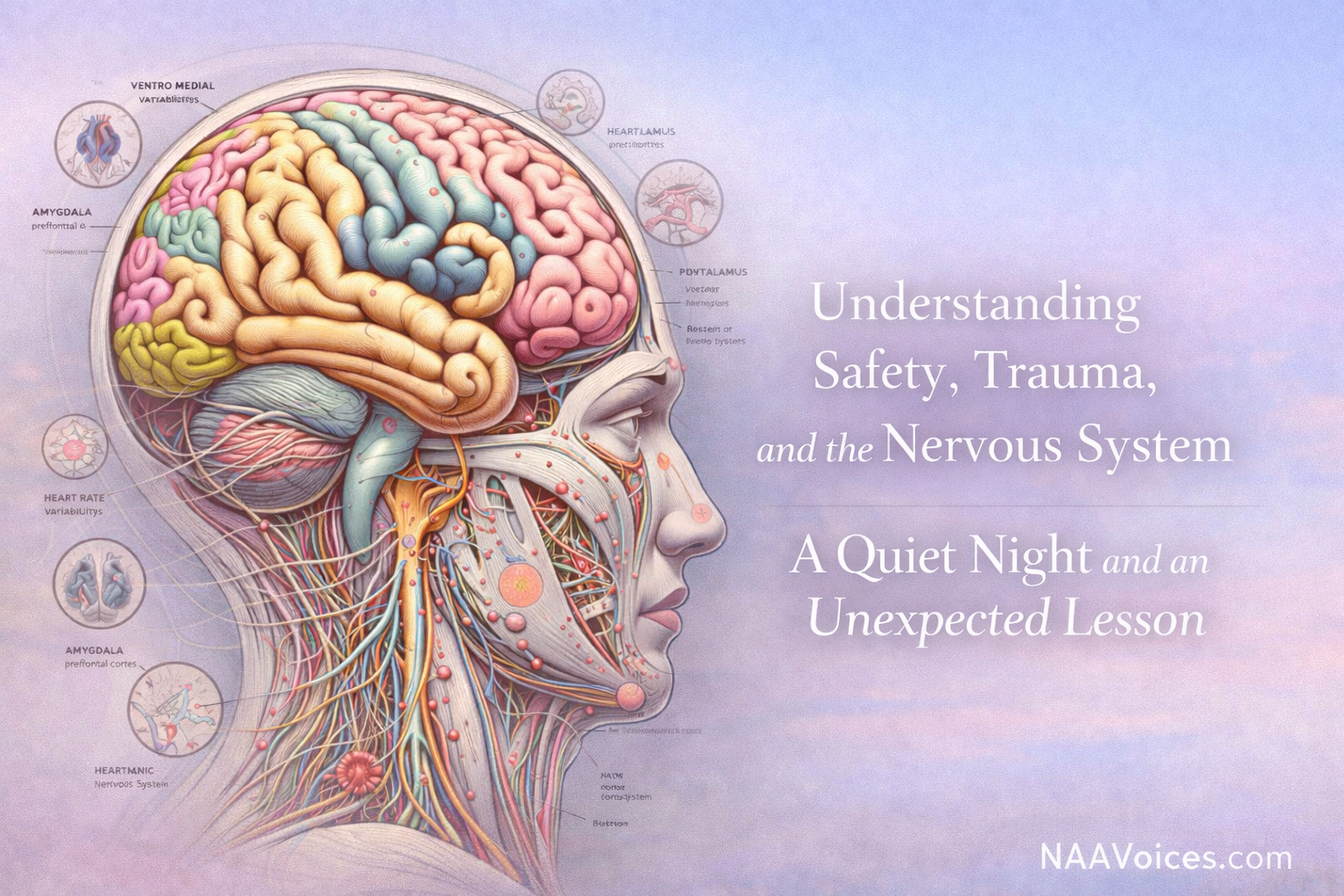
    When Rest Feels Unfamiliar: What a Quiet Evening Led Me to Learn About Polyvagal Theory

    A personal reflection on self-care, lived experience, and understanding the nervous system

    People say it all the time, don’t they?

    You need a hobby.
    You need to switch off.
    You need to rest.
    You need to look after yourself.

    I say it myself every single day at work. I talk to patients about self-care constantly. About slowing down, resting, listening to their bodies, giving themselves space, not pushing through the point of exhaustion. It is easy advice to give when you know how important it is.

    Actually doing it is something else entirely.

    Today, I got on with all the usual things that seem to fill a weekend. I packed things away, did some gardening, sorted out bits that needed doing, and got everything ready for the week ahead. Then I sat down.

    And I realised I had absolutely no idea what to do with myself.

    Everything that needed doing was done. The house was quiet. There was space. And instead of feeling peaceful, I felt a bit lost in it.

    That, in itself, says a lot.

    When “rest” turns into productivity

    So, instead of properly resting, I did what I often do when I don’t quite know how to stop: I found something useful to do.

    I logged on and started some training.

    I completed three courses that felt relevant to my role. One, the trust’s domestic abuse training, one on an update on the device we use for our patients currently on anticoagulation, and one on learning disabilities. I genuinely believe that in healthcare, we should never do things we are not competent or trained to do. Training matters. Competence matters. Safe practice matters.

    I write enough about those in roles who are far from competent at their jobs, and likely why I could never understand just how they could be allowed to cause so much harm in such a position of trust. I can’t and have never been that way.

    But as I worked through the modules, I found myself sitting with an unexpected feeling.

    A lot of the content felt familiar.

    Not because I think I know everything. Not because I think I am better than anyone else. And certainly not because I think there is anything wrong with the NHS including this content in training. Quite the opposite, actually.

    The truth is much more personal than that.

    Some of the content felt familiar because I have lived far more than what was covered in the modules.

    The domestic abuse training, in particular, was sobering. Not because it was poor training, but because it covered realities I understand not just professionally, but personally. As someone with lived experience of domestic abuse, there is something deeply unsettling about recognising your own reality in mandatory learning content. It is not a criticism of the training. It is simply the reality that some of us have lived beyond the points.

    The same was true of the learning disability training. Again, not because it was wrong or not useful, but because I have years of experience with learning disabilities, both in life and in practice. When something has been part of your world for a long time, the concepts can feel less like “new learning” and more like something you have been carrying, navigating, and understanding for years.

    If anything, that saddened me.

    Not because the training should be different, but because it was a reminder that some knowledge does not come from textbooks or e-learning packages. Sometimes it comes from surviving. Sometimes it comes from caring. Sometimes it comes from living through far more than anyone should ever have to.

    But alongside that sadness, I also felt something else.

    I felt proud that these subjects are incorporated into NHS training.

    I am genuinely glad that healthcare staff are being asked to think about domestic abuse. I am glad learning disability awareness is part of mandatory or role-relevant education. These are not optional extras. They matter. They affect how people are seen, how they are spoken to, how safe they feel, and the quality of care they receive.

    It also made me reflect on how I know that other organisations are provided with training in these areas, and that it’s individuals who let organisations and people down, not the lack of integration into professional practices expected of them.

    No training package can fully hold the depth, complexity, or emotional reality of lived experience. But it can lay foundations. It can raise awareness. It can get people thinking. And that is important.

    The promise I keep breaking

    As I sat there, I also had to be honest with myself.

    I have said so many times that I am going to stop doing work-related training at home. That this should be protected time during work hours. That we should not normalise doing professional development in our own time just because we are conscientious enough to do it.

    And yet there I was, doing exactly that.

    To be fair, my manager knows me well enough to know I do this. He would give me time back if I needed it, and I could do them at work. So this is not really about blame or pressure. It is about a pattern.

    I do it because I get bored.
    I do it because I am wired to keep moving.
    I do it because being productive often feels easier than being still.

    But eventually, I stopped after three courses.

    And then I decided to do something that wasn’t for work.

    At least, that is what I told myself.

    The course that was “not for work”

    I opened a course on Polyvagal Therapy.

    Technically, it is not part of my current role. But the minute I started reading, I found myself thinking exactly what I always do with anything related to mental health, trauma, behaviour, and human functioning:

    This absolutely overlaps with work.

    The reality is that physical and mental health are not separate. Trauma affects the body. Stress affects the body. Relationships affect the body. Safety affects the body. The way a person feels in themselves can shape everything from pain to sleep to behaviour to engagement with healthcare.

    Despite having postgraduate training in the neuroscience of psychology and mental health, there are always areas that deserve deeper exploration. Formal qualifications provide a strong foundation, but they do not cover every framework, model, or therapy in depth. Over the last few months, I have found myself increasingly drawn to therapy-based training. Part of that is professional curiosity. Part of it is personal interest. And part of it is knowing that, when life allows, I may want to build on some of this further.

    I already hold training as a narcissistic recovery coach, a trauma practitioner coach, and a neurodiversity coach. I can already see how these areas interconnect. But timing matters. Capacity matters. Mental well-being matters too. There is no point pursuing something deeply trauma-related if it comes at the cost of retraumatising yourself.

    Still, tonight, I found myself going down the polyvagal route.

    And before I knew it, I was already into Module 2 of 13.

    So, if you are curious too, come along with me while I break down some of what I learned tonight in plain English.


    What is Polyvagal Theory?

    Polyvagal Theory was developed by Dr Stephen Porges. In simple terms, it is a way of understanding how the body responds to safety, stress, danger, and connection.

    At the centre of it is the autonomic nervous system. This is the part of the nervous system that controls things we do not consciously have to think about, such as heart rate, breathing, digestion, and stress responses.

    Polyvagal Theory suggests that our nervous system is constantly scanning our environment and asking one basic question:

    Am I safe?

    And depending on the answer, the body responds in different ways.

    This does not happen only through conscious thought. In fact, it often happens before we have had time to think anything through logically.


    The body has different survival states

    One of the core ideas in Polyvagal Theory is that the nervous system can move through different states.

    1. Safe and connected

    This is the state where we feel calm enough to think clearly, talk, engage, and connect with other people.

    When someone feels safe, they are more likely to:

    • feel settled
    • communicate better
    • regulate emotions more easily
    • think more clearly
    • feel present rather than threatened

    This is where learning, healing, and connection happen best.

    2. Fight or flight

    When the nervous system senses danger, it can shift into a more activated state.

    This might look like:

    • anxiety
    • panic
    • racing thoughts
    • irritability
    • restlessness
    • muscle tension
    • feeling on edge
    • needing to do something immediately

    This is not a person being dramatic or difficult. It is the body preparing to protect itself.

    3. Freeze or shut down

    If something feels too overwhelming, the body can go the other way and begin to shut down.

    This can look like:

    • numbness
    • dissociation
    • emotional flatness
    • exhaustion
    • going blank
    • withdrawal
    • feeling stuck
    • loss of energy or collapse

    Again, this is not a weakness. It is another survival response.


    Neuroception: when the body decides before the mind

    One of the most interesting ideas in Polyvagal Theory is neuroception.

    This means the body is constantly scanning for signs of safety, danger, or threat without us consciously realising it.

    A warm tone of voice can signal safety.
    A harsh expression can signal danger.
    A sudden noise can make the body jump into alert.
    An unpredictable environment can keep the nervous system on edge.

    This helps explain why, sometimes, we can logically know we are safe, yet our bodies still react as though we are not.

    The nervous system has already made its assessment.


    Why this matters in real life

    This theory matters because it helps explain why people do not always respond to stress, fear, trauma, or relationships in neat or rational ways.

    It helps us understand that many behaviours are not simply choices or personality flaws. They are often body-based survival responses.

    Instead of asking,
    “What is wrong with this person?”
    it encourages us to ask,
    “What has this person’s nervous system learned to expect?”

    That is a very different question.

    And, frankly, a much more compassionate one.


    How polyvagal theory links to trauma and mental health

    Polyvagal Theory has been used to help explain a range of difficulties, especially in trauma and mental health.

    Trauma

    Trauma can leave the nervous system stuck in survival mode. Some people become hyper-alert, anxious, and reactive. Others shut down, dissociate, or feel emotionally disconnected. Some move between both.

    Anxiety

    From this perspective, anxiety is not just “worrying too much.” It can also be understood as the body being chronically mobilised and scanning for threat.

    Attachment and relationships

    If someone has grown up around unpredictability, neglect, fear, or instability, their body may learn that connection itself is not always safe. That can shape relationships for years.

    Neurodiversity

    There are also discussions around polyvagal-informed perspectives on sensory regulation, overwhelm, and social engagement in autistic individuals. Not as a full explanation, but as one possible framework for understanding regulation and safety.

    Dissociation

    Shutdown, disconnection, and dissociation can be understood as the body’s way of coping when something feels too much to bear.


    What I found useful about it

    What I like about this framework is that it joins the dots between body and mind.

    It does not treat emotions as if they exist in isolation from the nervous system. It recognises that what happens physically in the body influences how people think, feel, behave, connect, and cope.

    It is also compassionate.

    It reframes reactions that are often judged harshly. Fight, flight, freeze, withdrawal, panic, irritability, numbness, social shutdown — these stop looking like character flaws and start making sense as nervous system responses.

    That matters.


    But it is not beyond criticism

    At the same time, I think it is important to stay balanced.

    Polyvagal Theory is useful, but it is not a magic answer to everything. Some of its concepts are difficult to measure precisely, and some critics argue that parts of the theory are easier to describe than to validate scientifically in a consistent way.

    Human experience is also far more complex than any one theory can fully explain. Culture, identity, trauma, health, relationships, personality, social context, and lived experience all shape how people respond to the world around them.

    So for me, this is best seen as a helpful framework, not a complete explanation for all human behaviour.


    Why this connects so strongly with practice

    Even though I did not start this course “for work,” I can already see how much it overlaps with practice.

    In healthcare, and particularly in roles involving emotional well-being, safeguarding, neurodiversity, trauma, communication, and behaviour, this way of thinking is highly relevant.

    It affects:

    • how we understand distress
    • how we respond to fear
    • how we support regulation
    • how we communicate safety
    • how we avoid retraumatising people
    • how we interpret behaviours that may otherwise be misunderstood

    It also reinforces something that should sit at the heart of good care anyway: people need to feel safe before they can engage fully.


    Tonight started with something very simple: I was trying to stop.

    Trying to pause.
    Trying to rest.
    Trying not to fill every spare moment with tasks.

    And instead, I found myself learning.

    Tonight reminded me of something simple but powerful.

    Our bodies remember what our minds try to forget.

    Polyvagal Theory helps explain why people react the way they do to stress, trauma, and connection. Why some people become anxious. Why others shut down. Why safety matters more than we often realise.

    Understanding the nervous system does not solve everything.

    But it does something important.

    It reminds us that many reactions we judge as weakness or overreaction are actually survival responses.

    And when we begin to see people through that lens, we respond differently.

    Sometimes the most healing thing we can offer someone is not advice, not solutions, and not judgment.

    Sometimes it is simply helping them feel safe enough to exist without fear.

    NAAVoices.com
  • When the Training Becomes Personal

    When the Training Becomes Personal

    When the Training Becomes Personal

    December 28, 2025

    I’ve just completed the Narcissistic Abuse Recovery training, and it was tougher than expected.

    I began to deepen my understanding of supporting others through this. Facing how deeply it resonated with my own experiences required absolute honesty, humility, and resilience.

    This process reinforced a critical point: recovery isn’t theoretical. It’s lived, layered, and often confronting, but it’s also where meaningful transformation happens.

    If you’re navigating this kind of healing, you’re not “behind.” You’re doing complex work with courage and accountability. And that matters.

    Screenshot

    #NarcissisticAbuseRecovery

    #TraumaInformedHealing

    #SurvivorStrong

    #HealingJourney

    #DomesticAbuseAwareness

    #TraumaRecovery

    #EmotionalAbuse

    #MentalHealthMatters

    #BoundariesMatter

    #FromSurvivingToThriving

  • When Emergency Calm Hides a Different Kind of Crisis

    When Emergency Calm Hides a Different Kind of Crisis

    When Emergency Calm Hides a Different Kind of Crisis

    25 November 202

    Content note: This post discusses domestic abuse, child trauma, safeguarding concerns, and emergency medical situations.


    Two Years On — And Still Learning

    Two years after leaving domestic abuse, people tell me how strong I am. They see how I keep going, how I deal with whatever comes next. They are beginning to understand that control does not end when you leave.

    What many people still do not realise is how much children continue to carry their experiences with them.

    It is not just in their memories. It shows in their bodies, their behaviour, and the way they move through the world.

    This weekend in A&E brought that into sharp focus.

    It reminded me why I respond the way I do in a crisis, and it highlighted the weight of what my children have already lived through.

    It also explains why I created the accompanying resource for this blog.

    A practical tool available on NAAVoices.com to help parents and professionals recognise signs of child abuse and domestic abuse in real children, not textbook examples.


    The Calm That Comes With Crisis

    It is strange how my brain works in an emergency.

    On Friday, I ran out of work because there was an emergency with my eldest. Colleagues worried I would be too upset to drive, too panicked, too emotional.

    But that is never the problem for me.

    It is not “Can I drive?”
    It is “Can I get there fast enough?”

    Once I am on my way, the calm comes. It always has — professionally and personally. Whether that is ADHD, trauma, or the result of starting my nursing career on the frontline during the COVID‑19 pandemic, I do not know. But in an emergency, my anxiety switches off, and my focus switches on.

    I thought it would be different when it was my own child.

    It wasn’t.

    Above all, it is my children whom I protect beyond all measure.

    Hours in the Emergency Department at the Princess Royal Hospital in Telford: assessments, bloods, observations, treatment plan, follow‑up arranged. The A&E team were excellent. We were in and out in around six hours.

    Most A&Es get a bad press. People see the waits and the crowded corridors. They rarely see the pressures underneath — the conveyor belt of acuity, the constant risk‑balancing, the impossible demand.

    I thought that was our crisis for the weekend.

    It wasn’t.


    When the “Never Ill” Child Goes Down

    The next day, we had a PJ day. We relaxed and got ready for Christmas.

    The calm did not last long.

    In the middle of the night, my second child went down.

    This is the child who never gets ill. The one who wants to be out with his mates from dawn till dusk. The one who shakes things off, never complains, and hates being stuck at home.

    The nurse in me always waits. Kids bounce back. Headaches, sore throats, coughs, colds — you learn not to overreact. Being the child of a nurse or doctor must be challenging. You get Paracetamol and sleep, and then they see if you’ve bounced back.

    If it is not hanging off, crack on.

    But this time, it wasn’t right.

    He couldn’t look at the light.
    He couldn’t bend his neck.
    He couldn’t stay awake.
    And I couldn’t keep his temperature down.

    The calm was still there, but it sharpened.

    Bag packed.
    111 called.
    Triage: he needed to be seen within the hour.

    The nearest A&E? No. Because I knew that would likely mean a transfer. That is the bit call handlers cannot always see; the system logic you learn from working inside it. So I drove the extra ten minutes to Telford, because they can admit children.


    Eleven Ambulances and a Burning Forehead

    We pulled up to a wall of blue lights.

    More than eleven ambulances were queued outside. Inside, the waiting room was overflowing. Parents compared waiting times. Frustration simmered. One said, “We’ve been here six hours and still haven’t seen a doctor.”

    It was the familiar chaos of a Sunday night in A&E. Beds full. Demand high. Staff stretched across multiple areas. People do not see the ambulance offloads or the crash bell that pulls staff away without warning.

    My son — now taller than me — was burning beside me. I hovered my hand over his back and felt the heat through his clothes. He had a scarf over his head to block the light. I kept fetching cold flannels; they warmed within a minute.

    I know what that means.

    The calm stayed, but the edges hardened.

    I did not storm the desk. I did not make a scene. I know what it is like on the other side of that glass. Those nurses and doctors were managing what we could see — and what we could not.

    So I asked politely for a thermometer.

    Within minutes, a nurse checked him.
    Despite regular pain relief, his temperature was unbearable.

    Within 30 minutes, he had a cannula in.
    He had been fully reviewed.
    Bloods, observations, and a clear plan were in place.


    Being “Just Mum” on the Other Side of the Curtain

    I have spent more time in Telford Hospital this weekend than I have since my daughter was born five years ago. It is a strange feeling, being on the other side.

    On Friday, the staff knew I worked in healthcare. I had run out of work in uniform. There is always a slight shift when staff realise you are “one of them.”

    On Sunday, they knew none of that.

    I arrived in pyjamas. No uniform. No badge. No mention of my job. Just a mum with a very unwell child.

    The care did not change.

    They were unaware of my clinical background. They simply saw a child who needed prompt assessment and a parent who needed reassurance.

    This blog is, in part, a tribute to that team:

    • Triage nurses juggling a full waiting room
    • Junior doctors making complex decisions in ten‑minute windows
    • HCAs quietly fetch blankets and water

    From my side of the curtain, I was “just mum”. And I saw what I already knew: the staff are exhausted, under relentless pressure, and still turning up to care.

    But that is only half the story.


    What My Son’s Behaviour Really Told Me

    The clinical side was one thing. What struck me most was my son’s behaviour around different professionals.

    My 13‑year‑old was clearly unwell. Yet he refused to show pain in front of male doctors.

    He minimised everything.
    Brushed off symptoms.
    Tried to appear fine.

    Thankfully, the doctor noticed the flinches he could not hide.

    Then the female nurses and the female doctor stepped in, and everything changed. His posture softened. His answers became honest. He reached for my hand during his blood test — the first time in years.

    To an outsider, it might appear to be teenage stoicism.

    To me, it was a trauma response:

    Do not show weakness in front of men.

    This is not the first time I have seen it.

    A few months ago, he thought he saw my ex while out walking. He insisted he “wasn’t bothered”.

    Then he didn’t sleep for a week.
    He phoned me every time he had to walk alone.

    On the surface: “I’m fine, Mum.”
    Underneath: hyper‑vigilance, exhaustion, a nervous system braced for threat.


    What My Children Lived Through

    There were signs at school, too. A compassionate teacher emailed me about both boys. Coincidentally — or not — both emails came within a month of an “event” with my ex.

    Friends noticed changes in the boys and in me as I prepared to leave. Like most victims of covert abuse, the scars are not easy to see.

    Minimising is a survival strategy — for adults and children.

    This Christmas marks the first time all three of my children are heading into the holidays with a mum who is far stronger than she believed she could be two years ago.

    I no longer fear his retaliation.
    I no longer lie awake rehearsing what he might do next.

    He has already done more to me — and to these children — than most people could imagine. The trauma almost cost them everything. But it also gave them something he will never have: depth, empathy, and courage forged in reality.

    When I left, both boys were shorter than me. Within six months, they towered over me. Whether it was nutrition, safety, or simply being allowed to grow, the difference was stark.

    He once said:

    “Ask me anything, I’ll tell you how I can do it better.”

    Growing wasn’t part of his plan.

    Now they are 5ft 11 in and 5ft 8 in.

    Little boys turn into men.
    The difference is this: these two will never inflict the harm they lived through.

    Last summer, they watched their sister be retraumatised through contact. They were the ones there during night terrors. They were the ones helping her find her words again when she developed a stutter.

    She told them “Daddy hadn’t done” the things he did to them — things she had never known about until she went back.

    That is manipulation.
    That is grooming.
    And they do not hold it against her.

    Children are not “witnesses” to domestic abuse. They are victims in their own right.


    Why I Built This Resource

    This weekend in A&E brought two parts of my life together:

    • The clinician who stays calm in an emergency
    • The mum whose children have lived through domestic abuse

    That combination is why I created the resource that sits alongside this blog.

    It exists because children like mine should not have to reach breaking point before someone joins the dots.


    The Resource: Recognising the Signs in Real Children

    It is designed for:

    • Parents who feel something is wrong
    • Teachers who see changes but cannot name them
    • Health professionals who sense risk but fear “overreacting”
    • Anyone who suspects abuse but lacks a clear framework

    It brings together what I have seen as:

    • A nurse inside the system
    • A mother in A&E in her pyjamas
    • A survivor watching her children navigate trauma

    It focuses on:

    • Behavioural signs
    • Physical and health clues
    • School and social changes
    • Interaction with professionals
    • The impact of contact with an abusive parent

    It is not about turning every bad day into a safeguarding alert. It is about recognising child victims of domestic abuse earlier — and responding in a way that protects, believes, and supports them.

    My children deserve to be seen, believed, and protected the first time.

  • Day 5: The Science Behind Survival – When Your Body Remembers What Your Mind Tries to Forget

    Day 5: The Science Behind Survival – When Your Body Remembers What Your Mind Tries to Forget

    Part of the countdown to Domestic Abuse Awareness Month

    Day 5 focuses on the science behind survival, the part I know both professionally and personally.

    Trauma isn’t just emotional; it’s neurological. The body keeps the score long after the danger ends.

    As a nurse, I understand the physiology of trauma. I can explain how the amygdala, our brain’s alarm system becomes hypervigilant after prolonged threat exposure.

    I know that the nervous system gets stuck in survival mode, unable to distinguish between past danger and present safety.

    I’ve seen it in patients: the racing heart rate, the elevated cortisol, the way their bodies react before their minds can even process what’s happening.

    I could teach this. I do teach this to those who are struggling to understand the cause of their health when there are no other answers.

    But knowing it academically doesn’t prepare you for living it.

    The Personal Reality

    Even after I left, my body reacted like I was still in danger.

    Loud noises. Unexpected messages. Footsteps behind me. Instant panic.

    My colleagues saw the shift in me. The hair falling out. The ECG shows irregular rhythms that shouldn’t have been there. The physical manifestation of a nervous system that couldn’t stand down.

    It took time, research, studying, and therapy for me to understand what was happening: my nervous system was stuck in survival mode.

    My body was still fighting a battle I’d already escaped.

    I know the amygdala doesn’t forget a threat easily. It needs retraining through safety, breathwork, and connection.

    As a survivor, I learned that healing isn’t intellectual, it’s embodied.

    You can’t talk yourself out of hypervigilance; you have to teach your body it’s safe again.

    That’s the part they don’t put in the textbooks.

    You can understand every neural pathway, every stress hormone, every trauma response, and your body will still betray you with a panic attack in the shop because someone walked up behind you too quickly.

    The shift happens when you stop fighting your nervous system and start working with it.

    The Power of Self-Regulation

    That’s where self-regulation becomes power.

    Every time you ground yourself, feeling your feet on the floor, naming five things you can see, focusing on your breath, you’re not just “calming down.” You’re literally rewiring your brain toward peace.

    Every time you breathe properly, with that long exhale that activates your vagus nerve, you’re telling your nervous system: “We’re safe now. You can stand down.”

    Every time you stay present instead of dissociating, you’re building new neural pathways. Ones that lead to safety instead of survival.

    It’s not quick. It’s not easy. But it’s real.

    The body keeps the score, yes. But the body can also learn a new story.

    Mine is still learning.

    Some days are better than others.

    Some triggers still catch me off guard.

    But I’m no longer at war with my own nervous system.

    I understand it now. I work with it. And slowly, so slowly, it’s learning to trust that the danger has passed.

    That’s the science behind survival. And that’s the hope in healing.

    If you or someone you know is experiencing domestic abuse:

    • National Domestic Abuse Helpline: 0808 2000 247 (24/7)
    • C.A.L.L. Helpline (Wales): 0800 132 737
    • Men’s Advice Line: 0808 8010 327

    You deserve safety. You deserve peace. You deserve to teach your body that it’s finally safe to heal.

  • DAY 8 | The Quiet Before It Starts, Recognising the Calm That Isn’t

    DAY 8 | The Quiet Before It Starts, Recognising the Calm That Isn’t

    Day 8: When Silence Speaks First

    We’re entering the final eight‑day countdown to the end of Domestic Abuse Awareness Month.

    Each day, I want to unpack one truth I lived through.

    This isn’t theory or statistics.
    This is lived experience.

    These reflections aren’t about blame; they’re about understanding.

    Day 8 begins where most stories truly start: with silence.

    Abuse rarely arrives shouting.
    It arrives softly—dressed as care, cloaked in concern, disguised as love.

    I remember believing I was lucky. I thought I had someone who cared deeply. They checked in constantly.

    They wanted to know where I was “to make sure I was safe.”

    Only later did I realise: I wasn’t being protected, I was being monitored.

    That kind of calm isn’t comfort. It’s a warning.

    Coercive control often masquerades as devotion.
    Your boundaries blur.
    Your voice quietens.
    Your world shrinks to fit someone else’s version of safety.

    Looking back, the pattern is unmistakable:

    • My autonomy traded for “love.”
    • My friendships slowly erased.
    • My life reduced to his comfort zone — never mine.

    If you feel that heavy calm, trust your instinct.

    Real safety doesn’t confine you — it expands you.

    It lets you breathe, move, choose, and be.


  • The Power of Truth: Advocating Against Police Misconduct

    The Power of Truth: Advocating Against Police Misconduct

    NAAVoices was not created from certainty, but from lived experience and professional insight. As I migrate earlier work from the original platform, this post has been reviewed and approved for transfer. It remains true to its original context, with only minor clarity edits where needed. Some moments do not require rewriting to remain honest.

    Walking Through the Corridor of Truth: A Journey of Pain, Corruption, and Resilience

    Last week, two friends unknowingly shared the same thought on the same day—the 11th. Little did they know that this date holds profound significance for me. It marked the day I walked down my work corridor. I confronted the shadows of my past. I decided I could no longer live a life haunted by trauma.

    A History of Abuse and Betrayal

    The trauma inflicted by my ex was deeply scarring. What worsened it was the role West Mercia Police played in exacerbating my pain. They forced me to relive the abuse countless times. From the outset, the first officer I encountered, PC Rolls, lied to my face. PC Finch, his mentee, followed. Fourteen months after disclosing coercive control and child abuse, my ex was still having sensitive information leaked. This continued the abuse via the family court. Their actions betrayed the trust I once placed in them.

    The Officer Who Stood Alone

    Midst the corruption, one officer emerged as a beacon of integrity. Out of five investigating officers and nineteen individuals I met in person, only he showed any level of integrity. He upheld the once misinformed perception of what I believed the police force stood for. He didn’t lie, leak information to my ex, or cause harm to me or my children. Yet in May 2024, this officer was arrested for misconduct in public office. The charge falsely named me as a victim.

    The Witch Hunt Against Sgt Smith

    The arrest of Sgt Smith marked another turning point in my life. I wondered how the police could proceed with my case. I refused to be used as a pawn in their crusade against him. Sgt Smith was one of the few who acted with humanity, choosing truth over corruption. Funnily enough, one of the superintendents he spoke out against years ago is linked to my ex’s family. It is a chilling connection that raised even more questions about the motives behind the investigation.

    The Toll of Manipulation and Corruption

    For 4 ½ years, I endured my ex’s threats of suicide whenever he didn’t get his way. My mental health suffered greatly for the first time in 34 years. Sgt Smith’s empathy helped me face the darkness. He could see through the masks and manipulation in those around me. This ability in society became a source of strength for me. It showed me that not all officers were out to harm others. There were others who had empathy and humanity and cared about the truth.

    I didn’t realise the extent of dishonesty and calculation within the police force. My friend had warned me not to trust the police when I left my ex. I believed in their integrity. How wrong I was. This week, she said something that hit me hard: “You know he will kill himself, don’t you?”

    Lives Forever Changed

    The day of Sgt Smith’s arrest transformed both our lives. The investigation into him felt less about justice and more like a witch hunt. It was a way for West Mercia Police to evade responsibility for their own failures.

    I knew that telling the truth was the only way to save him from being ruined. I grappled with this decision for a year. Finally, I sent an email to the CPS to expose the malicious nature of the investigation. They only managed to invent a new charge. They changed my status to ‘member of the public.’ They tried to find anything possible to bury him. Is this a way of cutting costs now? Bury those who actually protect victims?

    The Fight for Justice: Uncovering Neglect and Manipulation

    The evidence returned to me painted a picture of negligence. Confidential information was mishandled. Threats were followed through. Malicious accusations were exposed. Despite the fear and struggles, I found strength to navigate these challenges. The teens and toddler in my home motivated me. Now, I am trying to tell the truth for the one officer. This officer acted without any intent to harm.

    Raising the initial conduct complaint is where this all began. If PC Rolls had actually done his job, none of this would have happened. A role of 16 months and 6 officers in total were allocated to the initial complaint. The lies continue. The contradictions in letters from Professional Standards and the legal team reflect a system desperate to avoid responsibility.

    Resilience in the Face of Fear

    Despite daily struggles, my journey has to have some meaning. I ploughed myself into writing these days. My trauma journals are something I am immensely proud of. My ex spent over a year spreading lies. He attempted to destroy my kids and me. He was also colluding with West Mercia.

    I spent it trying to help myself understand psychopaths. How others inflict so much harm on others. But in doing so, I learned far more than I believed I could.

    Now, my sole purpose is to stop others from having to live as I have. I still continue on this journey. I have to highlight the importance of resilience.

    The fear and trauma I’ve endured have shaped my resolve to tell the truth and advocate for justice. This fight isn’t just for me—it’s for others who have suffered in silence.

    A Case of Contradictions and Neglect

    My case was dropped the Friday before the Sergeant was set to appear in court. It raised a crucial question. How could I be considered a victim in a coercive control case? At the same time, I was categorised as a “member of the public” in another. It was impossible.

    Instead of investigating the corruption and leaks that emerged 14 months after I left my ex, the focus shifted. The goal became destroying the reputation of a man who had done no wrong. The lies documented by PC Rolls remained unaddressed. The glaring contradictions between a letter from Professional Standards and another from the legal team were also ignored.

    To West Mercia Police, the Sergeant’s true “offence” seemed to be his refusal to act with malice. He did not attempt to push a victim further into the grave of despair. His integrity became the reason for the witch hunt against him.

    The first video I made was based on West Mercia Police, which was based on Officer Number 1.

    Now, there is no threat of suicide over me to control. I go to bed worried. The mask an innocent man is trying to wear is very much like the one I did. False

    Knocking on Midnight: A Year of Reflections and Revelations

    It’s now knocking on midnight. A year ago today, I wrote and sealed a letter to this officer. He never read it, nor was it needed, because of him. I later received all of my evidence back from my investigating officer. One thing became painfully clear. The 13 lever arch files of documents, in my case, hadn’t even been properly reviewed.

    The returned evidence included confidential communications between officers. It also contained the MARAC referral that my ex had fraudulently used to claim legal aid. This referral proved, beyond doubt, that they acted on the threat he and his father made to my nursing registration. The threat was linked to me reporting him to the police.

    The Lies and Manipulation Unveiled

    Thankfully, my workplace saw straight through it. But my ex, a master storyteller, had gone to great lengths this time—accusing me of something impossible to do. The malicious intent was easy to identify. How? He had informed me of it three weeks before my workplace even knew. His MARAC referral, packed with lies, had been completed just two days before the “anonymous” report was made.

    The depth of manipulation and dishonesty is exhausting. Every revelation heightens the fear I live with daily.

    One page of 7 red are lies I could prove from my ex….

    It’s heartbreaking that the officer who acted with humanity is facing repercussions. Because of him, my life and my children’s lives will never be the same, for better or for worse.

    I just hope that, where this all began, on the 21st of November, they gave an in-depth disclosure. They provided it to a call handler. It was also provided to PC Roll’s. I hope this never happens to him or his family. He has gone to such a level to lie his way out of this. If they ever need help or protection from others, those who ‘protect and serve’ are treated with humanity and competency. All systems should act positively, unlike he and his colleagues have. Otherwise, the world could be dangerous.

    How does West Mercia Police think failing the innocent is acceptable while shielding the corrupt?

    The officer showed humanity and deserves justice. He should not live a life traumatised. The same uniform and people he once protected should not cause him trauma.

    The scars left by corruption may never fully heal for him as they certainly haven’t eased for me

    They may never fully heal for me. However, my commitment to truth and accountability remains unwavering. Victims deserve a voice.

    I had that right removed from me. It almost cost me my life. The impact before his arrival and the treatment by West Mercia police after has made me question many things. But I can’t and won’t allow their lack of humanity, care, integrity, or competency to change who I am. I refuse to let them change how I treat others because, unlike those I have encountered. I have a conscience

    My Lived Experience: A Personal Journey Through Trauma and Recovery
  • The Friday Everything Broke

    The Friday Everything Broke

    One year on, a moment of reflection:

    A week before, my coercive control case had been dropped.

    Not quietly. Not kindly. I had gone from being the victim in the crime they had arrested him for, to a member of the public. A reclassification so deliberate, so calculated, that I knew exactly what it meant. You cannot be a victim in one crime and a member of the public in another. I knew that. They knew I knew that.

    I had already watched them pour their energy into charging the only officer who had actually tried to do his job. The corruption wasn’t a suspicion anymore. It was obvious. Unapologetic. And the man — the one who would later put my child at risk, who had used DARVO tactics from the very beginning, who had twisted every truth until I questioned my own — walked away. No consequences. Nothing.

    And then I went to work.

    I don’t know what finally broke it open that Friday. Maybe it was the accumulation. Maybe it was the silence after the verdict. Maybe it was simply that my body had been holding too much for too long and finally said no more.

    I collapsed. I ended up doing my own ECG on the floor. My colleagues — people who had only ever seen me composed, capable, holding the line — saw me break for the first time.

    I am not ashamed of that moment. I never will be.

    But I won’t pretend it didn’t happen. Because understanding what led to it matters. And a lot has changed since then.

    NAAVoices was not created from certainty, but from lived experience and professional insight. As I migrate earlier work from the original platform, this post has been reviewed and approved for transfer. It remains true to its original context, with only minor clarity edits where needed. Some moments do not require rewriting to remain honest.

    Understanding Despair: Breaking the Misconceptions

    I was anxious coming back after Friday.

    Not the usual kind of anxious — the kind that sits heavy in your chest, replaying every moment, every word, every crack that showed. I have spent years perfecting the front. The composed, capable version of me that walks into a room and holds it together. Friday, that version didn’t show up.

    And I’m still processing that.

    PTSD doesn’t announce itself politely. It doesn’t wait for a convenient moment. It pulls you under, and sometimes — no matter how much work you’ve done, how many tools you have, how many times you’ve survived it before — it pulls you under in front of people.

    Re-traumatisation is brutal. It’s not just remembering. It’s reliving — your nervous system convinced, all over again, that you are back in the worst of it. The despair that follows isn’t weakness. It’s overload. It’s your mind and body hitting a wall they didn’t see coming.

    I spent so much of the weekend worrying about my colleagues. What they saw. What they thought. Whether they’d look at me differently. My darkest days usually produce productivity — not me on my knees, refusing help, doing my own ECG. I hope they know that moment didn’t define me. I hope they understood they were seeing something real, not something broken beyond repair.

    Because here’s what I want people to understand about despair — the things nobody talks about honestly:

    It is not weakness. It is one of the most human things you will ever feel. Everyone has a limit. Reaching yours doesn’t make you less; it makes you human.

    It is not permanent. In the depths of it, it feels like it will never lift. It does. It has before. It will again.

    It is not the same as depression. Despair is a response — raw, overwhelming, situational. Depression is a condition. Conflating the two helps no one.

    Isolating won’t protect you. It feels safer to disappear when you’re in it. Connection is uncomfortable when you’re raw. But it’s also the thing that pulls you back.

    It isn’t unproductive. Some of my most important self-realisations have come from the wreckage of a really bad day. Despair forces honesty in a way nothing else does.

    You don’t have to fight it. Sometimes the bravest thing is to let yourself feel it, name it, and wait for it to pass rather than white-knuckling through.

    I’m sharing this not because I have it figured out, but because I know I’m not the only one who has sat somewhere quiet after a really public moment of pain, wondering if they’ve changed how people see them forever.

    You haven’t. And neither have I.

    My Lived Experience: A Personal Journey Through Trauma and Recovery
  • When the Police Came Knocking: A Personal Journey Through Fear and Recovery

    When the Police Came Knocking: A Personal Journey Through Fear and Recovery

    NAAVoices was not created from certainty, but from lived experience and professional insight. As I migrate earlier work from the original platform, this post has been reviewed and approved for transfer. It remains true to its original context, with only minor clarity edits where needed. Some moments do not require rewriting to remain honest.

    29 December 2024 — 11.45pm

    “I don’t want to be labelled as resilient or strong, nor do I want to bear the weight of those expectations. I simply want to be myself — to live freely, unshackled by the burdens of the past and the control others seek to impose on my future.”

    I finally managed to get up off the floor. Shaking and crying. Feeling the weight of everything that had happened.

    The emotional turmoil had been overwhelming. I took a deep breath, trying to regain some control.

    Just when I thought I might find a moment of peace, there was an unexpected knock at the door.

    At first, I hesitated. Thought it might be another delivery — so many Temu orders arriving before Christmas.

    But the uncertainty had me on edge. I always check through the peephole now. It was dark outside. Impossible to see who was there.

    After a moment of internal debate, I opened the door just a crack.

    Standing there was a police officer.

    My heart sank.

    When Police Arrive at Your Door

    I could barely form words. The panic rose within me.

    The officer asked about CCTV footage and mentioned a crash. A wave of anxiety washed over me.

    This CCTV had been installed to protect my children and me — a safeguard in a year already riddled with trauma. Yet the very presence of police — an authority I’d come to associate with harm rather than safety — sent me spiralling.

    I struggled to speak. My voice stuttered through my response. I managed to tell him I had PTSD linked to my experiences with the police. And still, at that moment, I found myself apologising.

    Sorry for my condition.

    Sorry that I couldn’t help.

    Why was I saying sorry?

    I didn’t recognise this officer. Yet here I was, feeling the need to explain my pain and fear, as if I owed him an apology for the damage done to my neuroplasticity by a colleague from the same station.

    The Panic Attack

    When I finally closed the door, I sank to my knees.

    Gasping. The tears released. The shaking returned. The familiar onset of a panic attack.

    It was as if my body was trying to process a flood of emotions that had been building for over a year.

    Once I managed to settle, I sat on the floor and let my thoughts swirl. I knew I had to articulate what had just happened. It was all I had left after a year of feeling trapped in my own mind.

    Why I Keep Speaking Out

    I realise the importance of speaking out.

    My experiences are valid. Sharing them is a crucial step towards healing.

    I still have a long way to go. But acknowledging my feelings and confronting the past is a step in the right direction. The journey to reclaim my voice and my peace is fraught with challenges. I know that.

    But each moment of honesty brings me closer to understanding. Closer to healing.

    The Ongoing Corruption

    Then I sat down to work on my website. A million thoughts racing through my mind.

    I needed answers about how information had been leaked to my ex. How he’d been able to provide specifics to his barrister that falsely represented witness statements I knew to be factually inaccurate.

    How had he always been a step ahead?

    It doesn’t take much to connect the dots. But with everything else going on, it’s no surprise there’s more corruption.

    After being given the details of two other officers to contact, I couldn’t face it.

    I was already on my knees answering the door to a police officer about the CCTV. When I checked — the bloody CCTV wasn’t even plugged in.

    Due to the haunting memories, I had to move out of the main bedroom where it’s located.

    The teenager clearly thought the Xbox was a priority.

    I’ve been awake all night, running through it all.

    I Just Want My Life Back

    I haven’t felt such intense trauma for a long time.

    I did ring the CMHT line to talk it through.

    I just want my life back.

    I don’t want to fear the police. I don’t want to spend nights on end reading guidance — hoping it will prevent situations like this from happening to others.

    The police haven’t adhered to anything with me and my children.

    If I were to contact them now, I would not want to relive what I’ve been through with officers 20 and 21.

    I just want to live my life again. Free from control.

    I know that sharing my story is just one piece of that puzzle.

    If you’ve experienced something similar — know that you’re not alone. And it’s okay to seek help.

    My Lived Experience: A Personal Journey Through Trauma and Recovery