Tag: gaslighting

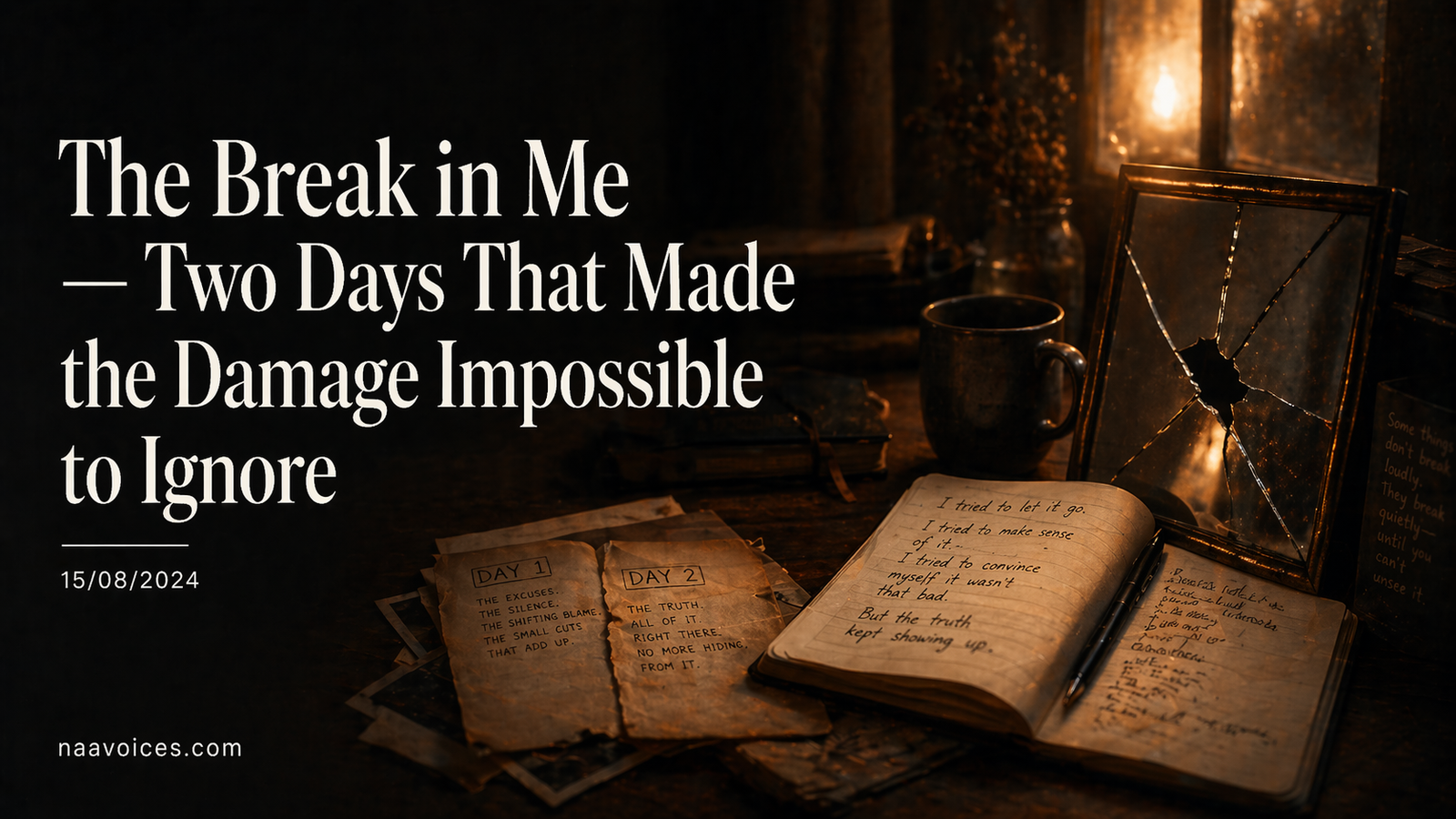
  • Two Days That Made the Damage Impossible to Ignore

    Two Days That Made the Damage Impossible to Ignore

    Monday, 21 April 2026 · Two Years On · reconstructed from entries dated 11 and 15 August 2024

    When Rest Still Does Not Feel Safe

    Two Years On, reconstructed from entries dated 11 and 15 August 2024

    This post brings together entries originally written on Sunday 11 August 2024 and Thursday 15 August 2024.

    It has been rewritten and reshaped for NAAVoices as part of moving my older writing onto this platform. Some lines remain close to the language of those days because the immediacy matters. Others are written with the clarity that only distance gives.

    Together, they tell the fuller truth of what those days did to me, and what I understand now about trauma, re-traumatisation, and the damage caused when systems become part of the harm.

    On Privacy, and Not Being Fragile

    I never hid what happened.

    What I chose not to do was tell everyone.

    For the most part, I kept what I was living through private. That decision was deliberate. It was not shame. It was not denial. It was not fear of judgement.

    It was autonomy.

    I told only a very small number of people at work. People I trusted deeply. People who were close enough to know something was wrong, even if they did not know everything.

    Even they only knew enough.

    I imagine more than half of my colleagues still do not know what I have lived through. That has always been intentional. I kept my professional life and my private life as separate as I could, not because I was hiding, but because I needed some balance. Some safety. Some part of me that was not completely swallowed by trauma.

    Privacy is not secrecy.

    It is not concealment.

    And it is not shameful.

    Sometimes that boundary exists because I do not want pity. Sometimes it exists because I cannot bear the well-meaning but exhausting question, “Are you okay?”

    I know people ask it kindly. I know it usually comes from care. But when you are holding yourself together with everything you have, even being asked to assess your own pain can feel like one demand too many.

    I was not fragile.

    I was functioning.

    I was working, parenting, showing up, answering messages, doing what needed to be done. I was also living with something complex, ongoing and largely invisible.

    PTSD did not make me weak. If anything, it revealed a level of resilience I did not know I had. It also gave me a depth of understanding that no theory, no training and no professional language alone could ever fully give.

    Some things are learned academically.

    Some things are learned by surviving them.

    Injury, Not Weakness

    Looking back now, I can see something much more clearly than I could at the time.

    What happened to my mental health was not random. It was not an overreaction. It was not weakness. It was not some hidden flaw in me suddenly surfacing.

    It was injury.

    And it was cumulative.

    Domestic abuse caused the first damage. Police failures deepened it. Re-traumatisation compounded it. Family court prolonged it.

    Every incident added something. Every delay took something. Every forced retelling left another mark.

    I understand now why so many victims, and so many women in particular, end up being judged for their mental health, when what people are often seeing is the consequence of what was done to them.

    The panic.
    The sleeplessness.
    The fear.
    The emotional shutdown.
    The hypervigilance.
    The tears.
    The inability to settle.
    The inability to rest.

    These things do not appear out of nowhere.

    They are the visible aftermath of prolonged harm.

    What broke in me was not caused by one email, one conversation or one bad week.

    But there were two days in August 2024 that made the damage impossible to ignore.

    When the System Becomes the Trigger

    The relationship ended.

    The harm did not.

    It simply changed shape.

    It moved through police contact. Through delay. Through safeguarding failures. Through being forced to explain the same things to new people over and over again. Through emails and updates that reopened what should never have still been live.

    Sometimes the abuse ends in one form and continues in another.

    Sometimes the system becomes part of the trauma too.

    That was what I was only just beginning to understand in August 2024.

    People often ask whether PTSD or C-PTSD means you cannot cope with stress. The truth is more complicated than that.

    Many people with trauma cope incredibly well under pressure. We plan ahead. We stay alert. We anticipate problems. We become responsible to a fault. We keep going because there is no other option.

    The problem is not always the crisis itself.

    The problem is what happens afterwards.

    PTSD is not simply about stress. It is about a nervous system that no longer recognises safety properly. Even when the original danger is no longer physically present, the body does not always believe it.

    If something echoes the original trauma closely enough, a person, a place, an email, a conversation, a building, a system, the body reacts as though the danger is happening again.

    That is why triggers are so often misunderstood.

    They are not always dramatic. They are not always like the flashbacks people imagine from films. Often they are quieter. Stranger. More physical. More cognitive. More exhausting.

    They can look like no sleep. Racing thoughts. Compulsive planning. Dread. Emotional numbness. Mistrust. Hyper-alertness. Feeling unable to settle even when you are physically still.

    That was what it looked like for me.

    And one of my strongest triggers had become police contact.

    Not because every officer was the same.

    Not because every conversation was harmful.

    But because police contact had come to represent something much bigger than individual people. It had come to represent failed protection, unanswered disclosures, safeguarding failures, lost time, repeated harm and the unbearable knowledge that I had asked for help and had not been protected when it mattered most.

    Sunday 11 August 2024, 02:39

    The Night I Broke

    The first entry was written in the early hours of Sunday 11 August 2024, at 02:39.

    It began in the bluntest possible way.

    That was the day I broke.

    Even now, I think that was accurate.

    What broke me was not simply the email itself. It was what it reopened.

    That night, a police email tipped everything sideways. On paper, it was an update. In reality, it dragged me straight back into months of unresolved trauma.

    I had been absorbing it for months. I had been taking it. I had been keeping it contained.

    Since January, I had held off taking the handling of the case outside official channels. I had kept hoping my voice would be heard within the system. I had kept hoping justice would come the way it should have.

    I kept wanting to believe it was one officer. One failure. One catastrophic lapse.

    Not something wider.

    Not something more systemic.

    Not something that would keep reaching into my life month after month.

    The new officer who emailed me was kind. That matters. She had not caused the life I had endured over those previous months. She was not the one who failed to act when it mattered.

    What I could not bear was this: she was updating me with information I had already received months earlier from a different set of officers.

    In an instant, I was back in December.

    That was the point at which I broke, and others recognised I needed help before it escalated.

    Not because one email caused everything.

    Because it landed on top of months of unresolved harm, delay, repetition and re-traumatisation.

    By then, it had been nine months since I disclosed.

    Nine months.

    Long enough for a life to fracture. Long enough for trauma to settle in the body. Long enough for people around you to start assuming things must surely be improving, when the reality is that process is still dragging you backwards.

    It should have been dealt with much earlier.

    I should have been in recovery by then.

    I should have been able to begin counselling. I should have been able to work properly with support services and start processing what had happened to me.

    Instead, there was more pressure. More delay. More repetition.

    More harm, dressed up as procedure.

    Somewhere in the middle of it, I lost the one person in the system who had made me feel that the abuse I had survived actually mattered.

    That loss is difficult to explain if you have not lived through something similar. Sometimes, when trust in a system is almost gone, one safe professional becomes an anchor.

    Not because they fix it.

    Not because they save you.

    But because they make the reality of what happened feel seen.

    Losing that kind of anchor, when everything else is already unstable, can feel devastating.

    The Email to BBC Watchdog

    That night, I was sick of being re-traumatised.

    Sick of the updates. Sick of being dragged back. Sick of weighing, every single time, what it would cost other people if I stopped keeping all of it quiet.

    Sick of silence starting to feel less like dignity and more like containment.

    That was the night I emailed BBC Watchdog and Panorama.

    I did not want to be the person sending that email.

    I had spent months trying to protect my privacy, my profession, my colleagues and the quieter corners of my life. I had not wanted to make everything public. I had not wanted to become another woman shouting because the proper channels had failed her.

    But there comes a point when silence stops functioning as a boundary and becomes another room the harm is happening inside.

    That was the night I reached that point.

    Forty-Eight Hours Awake

    By then, I had been awake for 48 hours.

    I remained awake throughout the entire night.

    There is a particular kind of exhaustion that comes with trauma-triggered sleeplessness, and it is difficult to explain to someone who has not felt it.

    It is not ordinary tiredness. It is not just feeling drained after a bad night.

    It is deeper than that.

    Stranger than that.

    Your body is present but not fully yours. Your skin can feel too tight or too distant. Your thoughts slow down and race at the same time. Everything feels heavy and unreal all at once.

    Small decisions become enormous. Replying to a message can feel impossible. Deciding what to eat can feel absurdly hard. Time goes strange. Your emotions feel both raw and numbed out.

    And still, life keeps going.

    Children still need feeding. The dog still needs walking. The washing still needs hanging out. Messages still arrive. Appointments still happen.

    The world keeps asking ordinary things of a body that has not rested in days.

    Sunday 11 August 2024, 22:32

    What the Body Was Doing

    The second entry was written later the same day, on Sunday 11 August at 22:32.

    That matters, because it shows how quickly the raw breaking point became a question about trauma, triggers and what all of this was actually doing to me.

    By that point, the question was no longer only, why has this happened?

    It had become, what is this doing to me?

    The answer was in my body.

    That week looked like this:

    Sunday night: no sleep.
    Monday night: asleep around 3am.
    Tuesday night: slept.
    Wednesday night: asleep around 1am.
    Thursday night: an email from a former investigating officer, no sleep.
    Friday: crisis calls with Victim Support, CMHT and the British Legion.
    Friday night: asleep around 4am, awake by 8am.
    Saturday night: another email from the new investigating officer, no sleep.

    Three full nights without sleep in seven days.

    Not because I could not cope with ordinary life. Not because I was weak. Not because I was falling apart for no reason.

    Because my nervous system did not perceive safety.

    That distinction matters more than it sounds.

    Stress was not the real issue.

    Safety was.

    The Splinter

    There was another thought going round and round in my head during that time.

    My ex was placed on bail within two months, once the case reached someone who treated it seriously.

    Two months.

    That fact sat in me like a splinter.

    Because if that level of action was possible within two months once it reached the right hands, it is impossible not to ask why it was not possible earlier.

    Why not in January?

    Why not sooner?

    Why only after more damage had already been done?

    At the time, I was carrying concerns I could not yet prove. I want to be careful about that, because hindsight and evidence are not the same thing as fear in the middle of trauma.

    I also want to be honest.

    I was not the only person asking those questions.

    My IDVA raised separate concerns from her own professional position. It was not just me lying awake imagining things. There were reasons those questions existed.

    That matters, because survivors are so often encouraged not to trust their own reading of patterns.

    We are encouraged to minimise. To self-correct. To avoid sounding difficult. To avoid sounding paranoid. To wait quietly until the pattern becomes undeniable.

    Often, the person living inside the pattern sees it first.

    Professionals who listen carefully may see it second.

    Institutions, if they see it at all, often see it last.

    “Every Avenue Possible”

    I was told that the investigation into the abuse of my children had “followed every avenue possible.”

    That phrase has stayed with me.

    Because what it meant in practice did not match what it sounded like.

    DC Rhian Davies, the children’s investigating officer from PVP, spoke to my children. My ex was spoken to.

    No one else who had been in our home was approached.

    No witnesses.
    No friends.
    No one who had seen.
    No one who had heard.
    No one who could have spoken to what life was actually like.

    That is not what “every avenue” sounds like to me.

    By the time I fully understood how limited that investigation had been, I had run out of fight. Trauma does not just wound. It depletes.

    There comes a point where even pushing back against obvious failures requires energy you no longer have.

    What made it worse was the familiar feeling that I was facing all of it alone again.

    Thursday 15 August 2024

    The Day Someone Finally Acted

    The third entry was written on Thursday 15 August at 16:02, after the first urgent contact with mental health services had happened.

    That was the point where the experience stopped being only about collapse and started becoming about recognition.

    The day after that sleepless night, I spoke to Jackie in Professional Standards and to a woman from the Royal British Legion who had been supporting me and my children.

    That second conversation mattered.

    She could hear the level of distress I was in. She did not minimise it. She did not leave me to explain it over and over. She did not ask me to make my pain tidier before acting.

    She heard it.

    And she acted.

    She contacted CMHT directly on my behalf.

    That intervention changed everything. It also exposed one of the hardest truths in all of this.

    It took my service history, my link to the forces, for someone to step in with the urgency the situation had needed for a long time.

    That is not easy to admit, because gratitude sits alongside discomfort there.

    I am deeply grateful to her. I will always be grateful that she heard what others had not heard and acted when I no longer had the strength to keep turning my distress into words people might take seriously.

    But gratitude does not erase the inequity.

    Support came when the right person made the right call.

    Need alone should have been enough.

    First Mental Health Contact in 34 Years

    Within a few weeks, I had been seen by CMHT.

    That marked the first contact with any mental health service in 34 years of my life.

    That fact matters more than I can easily explain.

    I had never previously needed psychiatric care. I had never needed crisis intervention. I had never needed long-term mental health support.

    I had worked, parented, carried responsibility, managed pressure and kept going without any of it.

    So when I reached CMHT, it was not evidence of some long-standing inability to cope.

    It was evidence of sustained trauma.

    It was evidence of cumulative harm.

    Even getting to that appointment was difficult.

    I had to walk past the police building connected to so much of the harm just to reach the service meant to help me. Once I was near it, memories came back in waves. Sitting in the car with distressed children, waiting. Holding everything together while the person responsible seemed able to move through systems with ease.

    By the time I was in the waiting room, I struggled to articulate how I felt.

    That is one of the cruellest parts of finally getting support after a long period of survival. People imagine that when help appears, words become easy.

    They do not.

    Years of emotional suppression do not dissolve just because a room is safe enough for them.

    The practitioner was visibly shocked by the scale of the police failures.

    That was validating.

    It was also painful.

    Because it reinforced what I had already begun to understand.

    I was not recovering from something that had ended.

    I was still living it.

    Not Depression

    I was very clear throughout that appointment.

    I was not clinically depressed.

    I was experiencing low mood when triggered, yes. Exhaustion. Fear. Emotional shutdown. Hypervigilance. Panic. Sleep deprivation. The strange deadness that follows prolonged alertness.

    That is not the same as depression.

    I knew that if the wrong label was attached to what I was living through, the real issue risked being missed all over again.

    Context mattered.

    This was not a long-standing mental health problem appearing out of nowhere. This was a nervous system responding exactly as expected to unresolved threat.

    That is part of what so many victims are up against.

    Once you become visibly unwell after prolonged harm, the focus can shift from what happened to you to how you are presenting now.

    The system starts responding to the symptoms and forgetting the cause.

    You become anxious. Too emotional. Not coping. Difficult.

    And the original injury drifts into the background.

    That is not understanding.

    That is misreading harm.

    I was not seeking a label.

    I was seeking stabilisation while external threats were still active.

    Why EMDR Had to Wait

    We discussed trauma-focused therapies, including EMDR.

    I was explicitly told that EMDR could not begin while the police investigation remained ongoing. That was clinically appropriate.

    People sometimes interpret pauses in trauma therapy as avoidance. But trauma processing cannot be done properly while the body still believes the danger is live.

    It requires at least some baseline sense of safety.

    If investigations are ongoing, if legal processes remain unresolved, if emails and updates keep reopening the wound, that safety does not really exist.

    Processing trauma while still inside the conditions that keep recreating it can destabilise rather than help.

    That is not avoidance.

    That is correct timing.

    Immediate Regulation

    The focus had to be on immediate regulation instead.

    Medication was discussed not as a long-term answer, but as temporary stabilising support for acute symptoms such as insomnia and heightened arousal.

    Prolonged sleep deprivation is not just unpleasant. It is risky. After enough nights without sleep, emotional regulation drops, cognitive function suffers, and physical resilience starts to fray.

    In that context, support is not about dependency.

    It is about harm reduction.

    It is about getting someone through a period their body should never have been pushed into in the first place.

    We also spoke about grounding techniques, including EFT.

    Afterwards, I realised I had been instinctively tapping my collarbone during acute stress long before I knew it had a name.

    That recognition stayed with me.

    There was something strangely moving about realising my body had been trying, quietly, to regulate itself even when I felt furthest from myself.

    EFT is not a cure. It is not enough on its own. But sometimes the smallest acts of regulation matter, because they remind you your body has not completely abandoned you, even when everything else feels unsafe.

    Moral Injury

    There was another dimension to all of this that I could not fully name at the time, but which makes complete sense to me now.

    Moral injury.

    The damage was not rooted only in the abuse itself. It was also rooted in the repeated institutional failures that followed. Failures that sat in direct conflict with the professional, ethical and safeguarding standards I work within every day in my own role.

    When systems tasked with protection become sources of harm, the injury is not only personal.

    It becomes institutional.

    Something deeper gets damaged. Not just trust in people, but trust in what the system is supposed to mean.

    That is part of why police contact became so triggering. It was not only about the original abuse. It was also about the collision between what should have happened and what did happen.

    It was about knowing, professionally and morally, that this should not have unfolded the way it did.

    That kind of rupture leaves its own wound.

    Why Survivors Get Judged for Their Mental Health

    Looking back now, I can see why so many victims end up being judged for their mental health.

    Not because they are inherently unwell.

    Not because they are weak.

    Not because they are unstable in any simple sense.

    Because abuse causes damage, and systems often respond badly to the damage they helped deepen.

    In my case, domestic abuse caused the initial injury. Police failures compounded it. Re-traumatisation intensified it. Family court prolonged it.

    Once that damage became visible, there was a terrible risk that I became the problem in the eyes of others.

    My exhaustion could be scrutinised. My distress could be noted. My anxiety documented. My sleep loss pathologised. My attempts to explain treated as too much.

    Instead of asking, “What has happened to her?” the world starts asking, “What is wrong with her?”

    That is the cruelty of it.

    So when I look back on those days now, I do not see weakness.

    I see injury.

    I see the predictable outcome of cumulative trauma with nowhere safe to settle.

    It was not an inability to cope with everyday stress. It was not a long-standing mental health condition waiting to surface. It was not resistance to treatment. It was not depression wearing the wrong name.

    It was a body that had been asked to survive too much for too long.

    What broke in me was not resilience.

    It was the illusion that I could keep carrying all of it and remain untouched by it.

    When Will Rest Feel Safe Again?

    In the end, the question underneath all of it was not, can I cope?

    I had coped.

    For months. For years, in many ways.

    Through abuse. Through police failures. Through fear. Through family court. Through parenting. Through work. Through sleeplessness. Through repeated retellings. Through silence.

    The real question was simpler, and sadder.

    When will rest feel safe again?

    That is what trauma takes in the end.

    Not always your ability to function. Not always your ability to survive. Often what it steals first and longest is your ability to feel safe enough to truly rest.

    Recovery from PTSD does not happen through therapy alone.

    It requires safety.

    It requires accountability.

    It requires the harm to stop being recreated by the very systems that should have reduced it.

    Until that happens, many survivors remain suspended between endurance and exhaustion.

    Not because they cannot cope.

    Because rest still does not feel safe.

    A Note From This Week, Two Years On

    I want to add something here that was not part of the original entries, because the gap between then and now is part of what this piece is trying to hold.

    This week, I have been in contact again with the woman from the Royal British Legion who supported me during the period described above. She is the person who heard what others had not heard, and who made the call that led to my first CMHT appointment.

    Speaking to her again brought the memories back in the way that voices sometimes do.

    Voices carry time.

    A sentence from someone who was present at the worst of it can reopen the room you were in when you last heard them speak.

    The timing was not accidental either.

    Last week marked the anniversary of my first ABE interview, the point at which a profound mental decline began. Yesterday was two years since the second.

    I am not ready to write about the second one yet.

    I do not think I have to be ready to mark every date that has caused profound harm. I remember them all. But the timing has to be set by my ability to go back there, relive it and, hopefully, like every other passing date I write about, close the door on it.

    What I noticed, though, is how differently I moved through it this time.

    A friend sent me a message last week that put into words what I had not managed to say myself:

    “This year you are coping better than last year. Last year you just went quiet. This year, you are aware. Can name it. Articulate it. That’s a massive step up.”

    I sat with that message for a long time, because she was right.

    Last year, I went quiet.

    This year, I can name it.

    That, in one sentence, is what recovery from this kind of injury can look like.

    It is not the absence of pain. It is not dates passing unnoticed. It is not triggers losing their grip completely.

    It is the return of language.

    The return of awareness.

    The capacity to recognise what is happening while it is happening, rather than only afterwards, once the silence has already swallowed the weeks you lost.

    I thought about those dates again today. I acknowledged them. I let them be what they were.

    And I kept moving.

    That is not the same as being healed. I know that.

    Healing from something that is still, in places, ongoing is not a straight line. It is more like learning to carry the same weight with a different grip.

    But it is a step up.

    And for anyone reading this who has been where I was in August 2024, silent, sleepless, carrying something nobody around you has the full picture of, please know this:

    The silence is not the end of the story.

    The naming will come.

    The articulation will come.

    The capacity to recognise a date, feel it land, and still know who you are on the other side of it will come.

    It does not arrive on a schedule.

    It does not announce itself.

    One day, you simply notice that you can name what is happening to you.

    And sometimes, the person beside you, the one who has been watching more carefully than you realised, will notice first.

    My Lived Experience: A Personal Journey Through Trauma and Recovery
  • Two Years On: What They Could Never Take

    Two Years On: What They Could Never Take

    A survivor’s reflection on ABE interviews, police failures, and coercive control — and what the system still needs to understand

    What victims of coercive control are entitled to in the UK

    Victims of coercive control in the UK have a legal right to give a statement, to be supported during ABE interviews, and to have post-separation abuse recognised under the Victims’ Code. These rights are not discretionary. However, in practice, they are often inconsistently applied, delayed, or overlooked entirely.

    Content note:

    This post discusses police failures in coercive control cases, institutional retraumatisation, and suicidal crisis. If you are currently in crisis, please reach out to Samaritans on 116 123, free, 24 hours a day. You can also text SHOUT to 85258.

    A note on disclosure

    Everything stated in this post is my documented lived experience, drawn from contemporaneous records, emails, diary entries, and evidence compiled at the time, or clearly identified as my personal perspective. I am a private individual exercising my legal right to freedom of expression under Article 10 of the Human Rights Act 1998. I am sharing my own story in the public interest, as a survivor, a nurse, and an advocate. I have not stated anything I do not believe, at the time of writing, to be true and evidenced.

    If you are an officer named in this post or a future post and you believe anything stated is inaccurate, you are welcome to contact me directly via the site.

    The Day I Forgot to Remember

    There was a time when every date mattered. Every anniversary of every incident that contributed to the life I’ve been living since leaving a domestic violence relationship, I carry them all. Not through choice. The abuse that followed my leaving was enabled by the one organisation that should have protected me from it. Those dates became triggers I couldn’t escape, no matter how much time passed.

    But this morning, I woke up, and I didn’t remember.

    I didn’t remember until I was sitting at my desk, adding a patient feedback from the morning clinic to my NMC revalidation paperwork, typing in today’s date without thinking. And then it registered.

    April 10th.

    Two years.

    Maybe that’s progress. Maybe that’s just what survival looks like when you’ve built a life that refuses to be defined by the days that tried to destroy you. Life is different now. Not easier. Not healed. Just different.

    Two years ago today.

    Two years ago today, 730 days, I sat through my first ABE interview.

    I acknowledged the trigger. I know myself well enough now to name what is happening when it happens. I had taken half a day’s annual leave, but once work had finished, I couldn’t leave. I cleared my room, because that is what my nervous system does when it needs to make order of the physical space while the internal one becomes overwhelming, and I have stopped apologising for it. I turned it outward, the way I always do, because doing something for other people is what keeps me here on the hardest days.

    My patients today had no idea what today was. My colleagues had no idea. I held it together, I did my job, I held the mask on through every appointment, and that is something no one will ever take from me. They tried to make sure my life didn’t matter. They did not succeed. I am not the person their failures tried to create. I am the person I built from the wreckage of them.

    This is the truth about that day. Two years on, I am ready to tell it properly.

    The five months before

    Before I tell you about the room, I need to tell you what it took to get there.

    For five months, West Mercia Police had effectively denied me the right to give a statement. Not through any formal decision. Through neglect, inaction, and the conduct of individual officers who had failed or refused to do their jobs. Through what I now understand is formally recognised as victim-blaming. Through a pattern of behaviour that did not just fail me in isolation, but created the conditions for everything that followed.

    A victim’s right to give a statement is not a courtesy. It is not discretionary. It is a legal right enshrined in the Victims’ Code. And for five months, that right had been withheld from me.

    The consequences of that did not stay within the walls of a police investigation. They bled into every other arena of my life. Without a formal record, without a statement, without the investigation being progressed as it should have been, the family court proceedings continued in a vacuum, and in that vacuum, the abuse continued by another means. My children were placed at further risk. And the person responsible deployed what is now well documented in the research as DARVO: Deny, Attack, Reverse Victim and Offender. Textbook. Documented. And made significantly easier by five months of institutional inaction that handed him exactly the space he needed to operate in.

    I had a retired Detective Sergeant of the same force in my family. He was the one who first opened my eyes, in the weeks after my initial disclosure, to what the police should have done and had failed to do. I felt I had already asked too much of him. I had a separate aunt, also a retired officer from the same force, who guided me in making the formal complaint against the first officer. After January, I stopped asking. I withdrew from all of them. They were cc’d into nothing further. They knew nothing more. They still don’t understand that I am not the niece and goddaughter I once was.

    I was completely alone in this. Not because there was no one. Because I could not bear to keep asking people who had already given so much, and because i was already someone who never asked for help, and when pushed to accept i did with guilt of putting on others, so i stopped, that version of me that was pushed to accept any help had been systematically dismantled over four years of being told she didn’t deserve it.

    This is not incidental. The failure of West Mercia Police to act was not a process error with no consequences. It was the open door through which the continuation of abuse walked. 

    During those five months, my body was failing under the weight of it.

    I was going dizzy. Holding on to walls and door frames. Collapsing under my desk when triggers hit without warning, and they were everywhere, in letters, in emails, in the sound of certain words in certain tones. For months, I could not open correspondence from my solicitor, because with every letter came a new accusation, a new document, a new version of my own life authored by the person who had spent years systematically dismantling it. My nervous system had learned that opening those envelopes meant pain, and so it refused. My colleague had to read the Cafcass report to me. I could not do it alone.

    I had lost over five stone. Four dress sizes. I had been running on adrenaline and legislation and very little else for months, and it showed in everything: my body, my face, my hair falling out, vomiting every meal, my wardrobe, which by that point consisted of my nursing uniform and hand-me-downs from my teenage son.

    I am neurodivergent. I say that here, in this section, because it is directly relevant to what I am about to describe, not as an explanation, and not as an excuse, but because it is the reason the evidence existed in the form that it did. My neurodivergence is not a weakness. In this process, it was the only thing holding it together.

    By the time the 10th of April arrived, I had already disclosed the full details of what I had lived through to seven West Mercia officers. In person. From the beginning. Every single time, because the person before had either failed to record it, failed to act on it, or failed to understand it. Seven officers. And beyond the police, I had disclosed to multiple other organisations: Cafcass, social services, legal teams, schools, and domestic abuse services. Each time, a different room. The same wound opened. Starting from scratch.

    My children

    There is something that sits beneath everything I have described, and I cannot do it full justice here. But I will not omit it.

    My children were victims too. They had lived in the same house, breathed the same air, grown up inside the same environment of control and fear. They had been emotionally and psychologically abused. They had been neglected. They had been threatened. They had been physically pushed into walls. And for a significant period, their existence as victims had not been formally recognised, because the officers dealing with my case had not treated it as the serious, separate matter that it was and on initial disclosure, failed to event document it, amongst other things..

    According to my records and the subject access records, it took the NSPCC pushing me to chase it before PC Finch passed the crime relating to my children was over to the PVP, after being informed he had done so a month before it was recorded in January 2024. When it was recorded, it happened within minutes of a routine email update, as though it were an administrative afterthought rather than the formal acknowledgement that my children had been living through abuse. Without that external pressure, I do not believe it would have happened at all.

    The children’s investigating officer was DC Rhian Davies. When I met with her for the second time at Shrewsbury police station to provide a statement regarding my children, I was referencing events from a document I had taken. This was the start of my own written statement. After asking what I was pulling the information from, I recall her stating, “that’s coercive control”. I can still see her sitting in the chair opposite me, flicking through the pages. According to my records, she asked whether she could share it with her inspector. I agreed. She later confirmed via email that she had done so, and following a chase, confirmed that her supervisor had subsequently made contact with PC Finch’s supervisor.

    The officer who eventually came to address my initial complaint surrounding PC Rolls and the lack of action on breaches of my non-molestation order, who arrived on the 9th of March 2024, and subsequently, following our local MP submitting a complaint on my behalf surrounding the coercive control investigation, was unaware of any of this. He had no knowledge of any email, no knowledge of my children’s case, and no knowledge of me, prior to receiving the complaint. He acted on my disclosure. He was the first person to do so.

    I want to be clear that I am raising a question, not making an allegation. DC Davies came from the same department to which I was eventually handed over. The information I had provided had been passed up a chain of command within that department. It had reached a supervisor. And yet the officer who ultimately acted, the one who listened, the one who progressed the case, had no idea any of it existed before the complaint landed on his desk.

    I don’t have an explanation for that. What I have is a documented record, and a question that has never been adequately answered: if the information reached the department, and the department was already involved through DC Davies, why was nothing done? Why did it take a formal complaint and the involvement of an MP?

    My boys gave their own ABE interviews in March 2024. I had been in that building. I knew what those rooms asked of a person. And my children, one of whom is autistic and could not disclose in the way the system recognises as standard, were asked to sit in those rooms and give their own accounts of what they had lived through.

    I had sat outside that room while my children did what I was about to do.

    That experience is its own specific, devastating thing, and I am still finding the right language for it. What I will say is that by the time I walked into that building for my own interview in April, my body already knew what that place meant. I had already been there as their mother.

    The only person who listened

    The only officer in this entire process who had treated me with honesty and genuine care was Conrad Smith, who held the rank of Sergeant at the time. 

    I will refer to him throughout this post as Sgt Smith, as that was his rank during the events described.

    He had come into my life exactly one month before the ABE. One month. He had worked with me to go through the timeline chronologically, the way it had actually happened, from the beginning, and for the first time in five months, I had been allowed to process rather than just perform. 

    For the first time, someone in that uniform had sat across from me and actually listened. And for the first time in five months, something that felt like faith was beginning to form, not in the police, not in the institution, not in the uniform, in him. In one person who had chosen to do his job properly, in a case where almost everyone before him had chosen not to.

    I had told him plainly, more than once: I cannot be passed over to someone new. I cannot go through this from the beginning again. He knew about the dizziness. The collapsing under my desk. The inability to open letters. He knew what each transfer had cost me, not because I had told him, but because he had seen it, every time I relived a part of what I had been through. And he had heard it from the people around me, family, friends, colleagues, early help workers, who had told him, in person, in short summaries they had emailed to him for gathering statements, in their own words, that I was not the person I had once been. Since disclosure, they had feared for me. More than once. And he knew that too.

    He reassured me that the officers taking over would look after me. That he would still oversee the case. That the complaint side would continue to be dealt with, though that had not been a priority up to that point, given the volume of information I had continued to provide.

    And then he handed me over. Not because he chose to. Because the system decided his rank meant he shouldn’t be doing that job.

    My new officer in charge was PC Jess Davies. Investigating Officer Number 4. She confirmed that he would remain involved in an oversight capacity and that the complaint element would still sit with him. It was something. But it wasn’t the same. And I think anyone who has ever experienced a breakdown in trust, in any context, understands why.

    I am a nurse. I understand continuity of care. I understand what it costs a patient when you break it, particularly in complex cases, particularly where trust has been damaged, particularly where the relationship between the professional and the person in their care has taken significant time and significant pain to build. 

    We do not reassign a patient mid-treatment simply because of a clinician’s grade. We consider the case’s complexity. We consider the history. We consider what a transfer will cost the person at the centre of it. We ask whether the system’s administrative convenience is worth more than the human being’s ability to continue.

    The police made a different calculation. And I was the one who paid for it.

    I did not feel comfortable that my new officer in charge fully understood the extent of what I had been through, or what it had cost me to get to this point. And I did not feel reassured with the officer who would be conducting the interview. Two more people. Two more times, sitting in the home where the abuse had taken place, reliving it from the beginning, before I had even set foot in that interview room. 

    By that point, it had become something close to autopilot, the history of what I had lived through leaving me at speed, dates and events and details firing out one after another, because I had learned that thinking, truly thinking, while I was doing it was more than my mind could hold. It was safer to list. Safer to recite. Safer to keep moving than to stop and feel what I was saying. Because if I stopped and felt it, I wasn’t sure I would be able to start again.

    The day came, and a third officer was present to observe. I hadn’t met her, but something about her felt genuine, and in a room where I was scanning every surface for safety the way people with PTSD do, that mattered. But she wasn’t asking the questions.

    I was also walking in fully aware that the officers present were close colleagues of the officers whose failures had denied me this statement for five months, officers about whom I had been forced to file a formal complaint. I am not suggesting that it influenced what happened. I am saying I carried that awareness in through the door, and that it cost energy I did not have.

    The emails sent in the early hours

    In the days before the ABE, while my children slept, I sat at my kitchen table in the early hours of the morning and wrote to the officer who would be conducting my interview.

    Not once. Across multiple nights.

    The first email went out at 1:53 in the morning on the 6th of April, four days before the interview. In it, I laid out everything she would need to know about interviewing me. Not because anyone had asked me to. Because I knew, from everything I had already lived through in this process, that if I didn’t do it, it would not be done.

    I cited the College of Police guidance on investigative interviewing. I cited Section 20 of the Equality Act 2010, the legal duty to make reasonable adjustments for disabled people, and I broke it down, applied it to my situation, and explained what I needed. I told her I sit on one foot and change positions due to an injury from my RAF service, and that if I looked like I was about to stand up or walk out, I was just moving position. I told her I divert from questions in emotionally heightened environments, that I sometimes can’t get words out, that I occasionally create words or mispronounce them and that this is not a sign of instability or inability. I told her to remind me to drink, because my blood pressure had been through the floor for months.

    I told her what I needed to help with recall. I asked her to bring me back to where we were if I trailed off. I asked her to confirm whether I was allowed to reference the previous officer’s failures, because those failures were a direct part of the continuation of the abuse and the psychological harm I had suffered.

    I wrote: “I NEVER use or even say the word ‘disabled’, because I don’t see having a neurodiversity as a disability, it’s given me an awful lot, however, every piece of legislation seems to class it as one. So given none of it has been followed so far, I am going to follow in line with it.”

    I wrote: “I can not risk anyone else being so horrific within their role, and I will no longer expect anyone to have any understanding regarding difference, or anyone reacting to situations.”

    And at the end, I wrote: “Tell me what to wear… please.”

    I had no clothes. My wardrobe was my uniform and my son’s hand-me-downs. I was asking the officer conducting my ABE what to wear to the interview because I had nothing, was alone, and didn’t know what a person was supposed to look like when they walked into that room.

    She did not reply to that question. Or to most of the others.

    Then, the following night — at 2:27 in the morning on the 7th of April — I sent a second email. Six attachments. A full 77-page coercive control statement. A document titled “The Beginning and The End.” A document called All Faith Lost, a diary of entries from the time. A breakdown of evidence-based points under the statutory guidance. A timeline, seventy pages long, nowhere near finished, finances not yet touched. Evidence, built by me alone, across months, because no one else was going to build it.

    Among the documents across both emails was the police’s own guidance on neurodiversity, sent to the officer preparing to interview a neurodivergent victim, days before she sat across from her.

    I ended that second email with this:

    “I am trying my best to break down the damage that was done. It has left me with a constant fear that mistakes or just pure incompetence will result in more harm, and I am struggling to step back. I have lived this every day and most nights since the reality that if I didn’t prove what he did, then no one would. I just hope you nor Jess think that I am overstepping, or that I don’t value your time and help.”

    At 2:27 in the morning, I was apologising for sending too much evidence.

    I was apologising for being thorough. For caring. For doing the work that no one else had done.

    In the same email, I felt compelled to write, unprompted: “NO REQUIREMENT FOR A SUPPORT PERSON!! I have full capacity and understanding!! I assess capacity professionally!!” I was asserting my own mind before anyone had questioned it — because enough people already had.

    Preparing to walk in

    Sgt Smith replied in the morning, after reading what I sent him. The same documents were sent to the officer conducting the interview. He said it was very comprehensive. He said he was concerned about the impact reliving it would have on me. He said, “Do you have someone who can be there with you when you get home? You’ll need time to decompress.”

    He was the only person who asked that question. 

    The officer who would spend four hours with me did not ask it. There was no IDVA present. There was no trauma-informed debrief arranged. There was no welfare protocol in place after that had all closed due to lack of crime being recorded, despite the MARAC hearing in January, five months on, and all the other services had done all they could to protect and help my children, other than the police.

    The morning of my ABE, a letter from PC Finch arrived, dated December 2023. It arrived on the 10th of April 2024, four months late, on the day I was due to walk into that room and give the most important statement of my life. The second officer, who had failed to allow me to give a statement, had the crime record disclosed. Whose failures had been part of the five months of inaction that had cost me everything described in this post. And on that morning, of all mornings, a letter arrived to remind me of exactly that.

    The timing was not just inconvenient. It was destabilising. I was already running on nothing, blood pressure through the floor, four years mapped across mind maps built alone in the early hours. And this letter was addressed only to my middle child. Not to my eldest, my autistic son, pushed into walls, threatened, psychologically dismantled in the same house, whose neurodivergence meant he could not disclose in the way the system demands. He had also sat an ABE the month before. He was made invisible again by the same officer who had not recorded what he should have on the morning I was preparing to try to make it all visible.

    I responded at 2:32 that afternoon, less than three hours before the ABE, questioning the timing, questioning Jonathan’s exclusion, and attaching the NAS Police Guide on neurodiversity, a guide to trauma bonds, and the Justice Guide to SpLDs. The following morning, the officer replied, acknowledging the delay, noting his familiarity with neurodiversity, and that he found the guides useful. A victim had sent an officer his own organisation’s neurodiversity guidance on the day of her ABE. He was reading it the morning after.

    I had spent the nights before building mind maps. Not notes, mind maps, the way my neurodivergent brain actually retains and recalls information, the way I got through my degree and every qualification since. Each map centred on a different aspect of coercive control, with examples branching from each node, drawn from WhatsApp histories, photographs, diary entries, and specific memories, all organised, evidenced, and mapped back to the statutory guidance.

    I had started making video diaries. Not written records, videos of myself talking directly to the camera, because I was so frightened of what I was walking into that I needed a version of me to exist outside of it. Proof, somewhere, that this person was real, and that she had tried.

     I had gone through four years of abuse and broken it down, piece by piece, into each recognised category, because I knew that with both my neurodivergence and the trauma later diagnosed with PTSD, I had developed, I was scared that my recall under pressure would vanish. By that point, I shouldn’t have worried. I remember every date for the four years and now the years following. But after five months of retraumatisation, I feared the impact on my ability to string the sentences together in an emotionally heightened environment. So I did what I always do: I built a system. I had made the chaos navigable.

    I had also phoned my grandma earlier. My safety person.

    I don’t know exactly what broke in me that day. I had been shutting the world out for months, not because I didn’t need people, but because I had so little capacity left and I was terrified of what it would cost me to let anyone see how bad it had become. My grandma was someone I didn’t want to worry. She didn’t know the full extent of what I had been living through, because I hadn’t told her. I hadn’t wanted to put that on her.

    But I phoned her, and I broke down completely.

    She was frightened for me. That was the thing I hadn’t expected, not just her sadness, but her fear. She had known something was wrong, but hearing it, hearing me in that state in the days before this interview, frightened her in a way I hadn’t anticipated. I had been carrying it so quietly, so privately, that the people who loved me most had only been seeing the edges of it. And in that phone call, some of the edges came away.

    By that point, if I am honest, I barely knew who I was outside of that uniform. The nurse was still intact. The rest of me had been stripped back to something much more fundamental. 

    So I went as the only other version of myself I still recognised: a mother. A person who had spent five months fighting to keep her children safe, who had to get through this to show them that you do not give up, that you do not lie down, that abuse does not get to win. 

    My children had lived through what I had lived through. They had sat in that same building and given their own accounts. The least I could do was walk into that room and give mine.

    I had developed a mask by then. Anyone who has lived through prolonged coercive control understands what I mean: the controlled exterior, the professional composure, the face that tells the world you are coping and reveals nothing of what is underneath. I had worn it for so long it had become automatic. The problem was that I needed to take it off in that room, and I did not feel safe enough with those officers to do it.

    I did everything I could to keep from crying. Not to show weakness. Maybe that was wrong. But I was not safe enough to be anything other than armoured, and I think that needs to be said clearly in a world that tells victims they must perform their trauma convincingly enough to be believed.

    The room

    The ABE suite is a normal house on a normal street. Two sofas. A kitchen. A layout designed to feel domestic, to feel safe. And I mean this genuinely, with the right people, the right training, and the right understanding of what a survivor carries through that door, it could be exactly what it is trying to be. A sanctuary. It deserves to be.

    It wasn’t that for me that day.

    According to my records, when I arrived in that room on the 10th of April, the interviewing officer confirmed she had not had the chance to read the documents I had sent her. Not the timeline. Not the evidenceable points. Not the breakdown of mandatory statutory criteria. Not the police’s own neurodiversity guidance, sent across two nights in the early hours of the morning to the officer preparing to interview a neurodivergent victim who had spent those nights making sure she had everything she needed.

    I sat with my files and paper work as if i was prepared for a clinical meeting, but it softened to points where i held a cushion held against me and my fidget rings turning in my hands. There were cameras, one positioned on me, one on the whole room, and a recording room directly behind me where I knew another officer was watching. I want to say something about that to anyone approaching an ABE who is frightened of being filmed: once I started talking, I stopped noticing the cameras entirely. You are too present in what you are saying to be conscious of the lenses. That part is more manageable than you fear it will be.

    What is not manageable — what no one prepares you for — is what it does to your body.

    My blood pressure had been critically low for months. We had to stop at times, despite trying to fight through it, because I could see stars at the edges of my vision and felt myself starting to go. I had developed a habit of tapping my shoulder when I was reliving, an automatic response I had found without understanding why. I didn’t learn until much later that it was a recognised form of trauma therapy. My body had found its own way to regulate without anyone guiding it, because no one was guiding it. It was doing everything it could to keep me upright in a room where my mind was being asked to go to the worst places it had ever been.

    And then came the moments I still carry.

    According to my records, the Home Office guidance on coercive and controlling behaviour was misquoted during the interview, the same guidance I had spent months building my entire case around, cross-referencing, evidencing, and sending to the officer days before. It caused confusion at the exact moment I needed absolute clarity.

    Which should be captured on the official ABE recording, I repeated the information I had been told before starting the abe that nothing that happened after I left the relationship was relevant, that post-separation abuse did not count. That is factually and legally wrong. Post-separation coercive control is explicitly recognised in the statutory guidance. I said so at the time. I was told I was incorrect.

    I also want to address something I left that room carrying, because I think it matters for anyone trying to understand what coercive control actually looks like.

    I was directed to focus on consequences. On what happened when I did or didn’t comply. I understand why that framing exists — it forms part of how coercive control is evidenced. But coercive control is not simply “he will hit you if you do x, y or z.” 

    For most victims, and certainly for me, the consequences were not primarily physical. They were profound, sustained, and relentless psychological harm. If I took our child somewhere alone, I would be accused of snatching them. If I questioned anything, he would return drunk, or on drugs, or with hours of silence designed to make me feel responsible for his state, and me, knowing my child was with him in that state, unable to do anything. And by the end, the consequence was threats to take his own life. Every few minutes. Relentlessly. Until the weight of managing that became its own form of imprisonment. That is coercive control. That is what I was trying to evidence in that room. And that is what the framing of consequences, applied too narrowly by someone who had not read the guidance, does not capture.

    I left that interview feeling like I had done something wrong. Like the mind maps I had built, the WhatsApp histories broken down by category, the images, the dates, the memories painstakingly mapped against each area of the statutory guidance, because my neurodivergent brain and developing PTSD meant my recall under pressure was not reliable, were somehow the problem. Like the way I had organised, evidenced, and prepared was being viewed as the behaviour of someone difficult, rather than someone who had spent months compensating for everyone else’s failures.

    I left feeling like I was the one in the wrong.

    I was not the one conducting the interview.

    Four hours. Eighteen months of a four-year timeline. And at the end of the first session, I was told no more time was allowed, and that we would have to come back and do it again.

    During my second ABE, worse came.

    More of the room. More trauma to face.

    More than six months after that day, my fifth officer in charge, another reassignment, another person handed my case as though it were a file rather than a life, came to see me with her sergeant. According to my records of that meeting, she told me the footage from that day had been very difficult to watch.

    Very difficult to watch.

    I want to sit with that. Trained officers found it difficult to watch.

    Imagine what it was to live.

    After

    Sgt Smith had asked that morning whether someone would be there when I got home. I had told him yes.

    There was no one.

    I didn’t want anyone to worry about me. The people closest to me, including those who had professional knowledge of exactly what had gone wrong in this case, had been kept at a distance since January. I had withdrawn from all of them. They didn’t know what day it was. They didn’t know what I was walking into. They still don’t know the full extent of what happened in those weeks. I couldn’t bear to keep being the person who asked for help from people who had already given everything they could. So I said yes, someone would be there, and I drove home alone.

    I sat in my car for a long time before I went inside. The sky had changed colour. I don’t know how long I sat there.

    Sgt Smith phoned to check on me. Not the officer who had conducted the interview. Conrad rang at 11 pm. I couldn’t speak about it in depth, I started talking about other things, I think I even spoke about motorbikes, to try and change the subject. According to my records, the message relayed back to him that evening was that I needed to focus on the consequences of the abuse for the next session. That I needed to think about that, to prepare, to come back ready to go through it in those terms.

    I was sitting on the sofa when he rang. My middle son was asleep upstairs. I sat down on the sofa, fully dressed, coat still on. And I could not move.

    I did not take the coat off. I did not lie down. I sat upright on the side of the sofa, in the dark, through the entire night. Numb. Empty. Hollowed out in a way I still don’t have adequate language for. Not sleeping, but not present either, the kind of state where your body has simply stopped responding to normal instructions because it has nothing left to give. The kind of state that is not dramatic or visible or legible to anyone who hasn’t been there. It just looks like someone sitting still. It is so much more than that.

    Sometime in those hours, as the world outside stayed dark and quiet, I wrote this:

    When you reverse the cards how do you explain the internal battle, the torment, the pain, the suffering, the flashback, the grief, the loss, the guilt, the triggers, the numbness, the lies, the hows, the why, the isolation, the trauma, the void, the emptiness, the psychological damage, the choices no longer under your control, the fight, the changes, the tears, the panic, the nothingness, the you who once was isn’t…

    You don’t. You don’t ‘move on’ ‘find peace’ ‘let it go’ ‘take care of yourself’ ‘calm down’ ‘it will be fine’ ‘you’re free now’

    Living life with post-traumatic stress is an impasse. A void. A constant battle, days of reliving, paralysed by the haunting. This is not a choice made consciously. It is a product of harm inflicted upon a person.

    No reaction is wrong. What is wrong is that so many people choose to disappear rather than live in the torment they have endured.

    Be kind. Don’t judge. Don’t compare. Understand.

    As the light began to come through the curtains in the morning, I got up.

    I put my uniform on.

    And I went to work.

    At some point during that day, I needed to speak to one of the GPs about a patient. A small, routine thing. He looked at me and said of course, anything I needed, the words stung, “anything for you, trusted me completely.”

    And that was it. That was all it took.

    I had to walk out of that room.

    Not because of anything terrible. Because of something kind. Because he knew who I was, what I did, and how I showed up for people, and in that moment, his simple, genuine trust in me was more than I could hold. I walked back down the corridor to my room, empty, numb, and beyond any level of traumatised I had ever experienced before. I knew, walking that corridor, that I would never be the same person I had been before the 10th of April 2024. I knew it with a certainty that had settled into my bones overnight on that sofa.

    I was right. I wasn’t. But I would not allow what I was living through to touch the people who needed me. Not then. Not ever.

    I sat at my desk between patients and wrote an email to myself, from my NHS address to my personal account, at 4:56 in the afternoon. A record. A timestamp. Proof that something was happening to me on this day.

    Today I am scared.

    I wrote about receiving another letter from him via a solicitor during my shift. I wrote about not being able to see the point of anything. I wrote that the only thing I could think of to spend money on was taking the boys somewhere nice so they would have some happy memories to remember me by. I wrote that I had so little left in me.

    My patients had no idea. My colleagues had no idea. The mask was worn through every appointment. And then I sat at my desk and wrote that email to myself because there was nowhere else to put what was happening inside me.

    What happened in the days that followed is documented. In diaries, in timestamps, in records that exist as evidence of exactly how close to the edge I was. I am not sharing all of it here; some of it belongs in the book, where it can be held properly. What I will say is that the distance between that sofa on the night of the 10th and where I ended up five days later is not complicated or ambiguous. It is a straight line. It begins in a building, with an officer who had not had the chance to read the documents sent to her across two nights in the early hours of the morning, including the police’s own guidance on neurodiversity, while I sat opposite her trying not to faint, trying not to cry, trying to hold on long enough to give a statement that two other officers had already decided I didn’t deserve to give.

    What should have happened

    I am a nurse. I understand trauma-informed care. I understand what it means to meet a person where they are, to hold space without re-injuring, to recognise when a body is in physiological crisis and respond accordingly.

    A neurodivergent victim presenting for an ABE with documented history, displaying symptoms of PTSD (I was diagnosed less than six months later), history of collapsing under stress, five months of having her statement withheld, and detailed preparation emails sent across two nights in the early hours,  including the police’s own neurodiversity guidance, the College of Police investigative interviewing guidance, and a breakdown of her legal rights under the Equality Act, that person requires an IDVA. A specialist advocate. An officer who has read the case file. An officer who has read the guidance she is applying, including the guidance sent to her by the victim herself. An officer who has not recently been a close colleague of the officers the victim has been forced to formally complain about.

    She should not have needed to be handed off to a new officer in the final weeks before the interview, after explicitly stating she cannot manage another transfer.

    She should not spend two nights in the early hours preparing the officer for the interview she is about to give.

    She should not arrive in that room to be told those documents had not been read.

    She should not be told, after four hours, that she needed to not do it the way she had been doing it.

    And she should never, not once, not in any version of a system that claims to support victims, have to build her own case file, source her own guidance, and educate her own interviewing officer, to compensate for the failures of the people she is trusting with her life.

    That house could be a sanctuary. With the right people, the right preparation, and the basic professional obligation of reading the evidence sent across two nights in the early hours of the morning, it could be exactly what it is trying to be. I hope that one day it is.

    What trauma-informed ABE practice should look like:

    Before the interview:

    • Victim’s legal rights under the Victims’ Code fully explained and upheld
    • IDVA or specialist advocate offered and arranged
    • Interviewing officer reads all submitted materials before the interview
    • Reasonable adjustments identified and implemented (Equality Act 2010)
    • Neurodiversity accommodations discussed and put in place
    • Medical needs acknowledged (e.g., blood pressure monitoring, breaks)
    • Post-separation abuse recognised as part of the investigation
    • Continuity of care maintained wherever possible
    • Officer assigned who is not a close colleague of officers subject to formal complaint
    • Welfare plan arranged for after the interview

    During the interview:

    • Guidance applied correctly (Home Office guidance on coercive control, College of Policing investigative interviewing)
    • Victim’s preparation materials and evidence structures respected, not dismissed
    • Physiological distress recognised and responded to appropriately
    • Multiple sessions scheduled from the outset if complexity indicates
    • Victim’s communication style and needs accommodated

    After the interview:

    • Welfare check conducted (not just a phone call)
    • Support person or IDVA contact confirmed
    • Clear communication about next steps
    • Follow-up arranged
    • Victim not left alone in crisis

    This is not an aspirational list. This is the baseline standard of care that should be afforded to every victim giving an ABE interview.

    What came after — and what I will not omit

    There is something else from this period that I will not omit, because to omit it would be to tell an incomplete truth.

    The one officer in this entire process who had genuinely helped me, who had rung at 11 pm when no one else did, who had read what I sent, read a 77-page statement, hundreds of pages of timelined events, all documents I created due to the trauma I had endured by his colleagues, who had asked if someone would be there when I got home,  later faced criminal allegations of misconduct in public office. Those allegations were connected to his work on my case. They hung over him for fifteen months. A huge part of the proceedings against him had direct links to many involved in my own case.

    I fought endlessly to ensure the truth was heard. The criminal allegations were dropped.

    He was subsequently dismissed from the police service for gross misconduct. By that point, I understood he no longer had the strength to fight it.

    I am not in a position to set out the full account here. That account, documented, evidenced, and told in full, will come in the book. What I will say is that what happened to him, and the timing and context of what was alleged against him, is a profound part of this story. A part that the women who come after me deserve to know.

    The system did not just fail me. It then turned on the person who didn’t, and was closely supported by those who did.

    Two years on

    I sat at my desk. I acknowledged the trigger. I cleared my room. I wrote this blog tonight because writing for other people is what I do when I don’t know what else to do with myself.

    My patients today had no idea what today was. My colleagues had no idea. I did my job. I held it together. I did what I have always done.

    And something no one will ever take from me, not the officers who failed me, not the system that retraumatised me, not the person who spent years trying to convince me my life didn’t matter, is this: they did not turn me into the person their failures tried to create.

     I am still here. I still care. I still get up every single day and fight for other people, because that is who I am. It is who I was before any of this. It is who I will remain.

    I am a different person now. Harder in some ways. More guarded. More certain about what I will and will not accept from the systems I move through, both personally and professionally. I still withdraw. I still have days when it comes back without warning, like today, like this morning, like a CPD log, an anniversary, and a room that needed clearing. But I understand now why I am the way I am, and I have stopped treating my own survival instincts as character flaws.

    Things don’t get better with time. They change. You change.

    I went through absolute hell. I would do it again to keep my children safe.

    The difference now is that I go into that fight as the person I have become, not the person I was. I didn’t know much then.

    I know a great deal now. And my drive in life, the thing that gets me out of bed on the days that are hardest, the thing that sat me at that kitchen table in the early hours of the morning building evidence for an officer who would not have the chance to read it, remains exactly what it has always been.

    To protect others. In whatever form that takes. For as long as I am here to do it.

    I’m not staying quiet. Not about any of it.

    I share this because silence protects systems, not survivors. Every woman/man who sits at their kitchen table in the early hours, building evidence that should have been built for them, deserves to know they are not alone, they are not wrong, and the system’s failures are not theirs to carry.

    Resources and support

    If you are preparing for an ABE interview or experiencing failures in your investigation:

     A note on the memoir

    I am slowly working through a full memoir of my experience, with these officers, with this process, with everything the timelines and the diaries and the 2:27am emails represent. It is not easy to write. It is not a comfortable thing to write.

    What I have shared in this post covers a handful of days out of years of documented, evidence-based experience. Those handful of days alone have taken me 730 of them to be ready to put into words publicly. Some of it will take longer still. Some of it I am not ready for yet.

    But I am working through it, as time allows, because the full account, not the fragments, not the blog posts, but the complete and honest truth of what happened to me, to my children, and to the one officer in this process who actually did his job, deserves to exist properly. For me. For my children. And for every woman sitting at a kitchen table in the early hours of the morning, building a case that someone else should have built for her.

    It will come. In the meantime, this is what today gave me.

    If you are approaching an ABE interview, you are entitled to an IDVA or specialist advocate. You are entitled to have post-separation abuse included. You are entitled to have neurodivergence accommodated. You do not have to prepare alone.

    If you are in crisis right now, please contact Samaritans on 116 123, free, 24 hours a day. You can also text SHOUT to 85258.

    My Lived Experience: A Personal Journey Through Trauma and Recovery
  • Finding the Stars: Why Not Broken Had to Be Written

    Finding the Stars: Why Not Broken Had to Be Written

    Some books begin with a plan.
    Not Broken did not.

    It began at a kitchen table, in the middle of a life that felt too dark, too loud, and too fractured for easy answers. It began in conversations with my children, in moments when I needed words that did not seem to exist anywhere else. Words honest enough for pain, but gentle enough to carry hope.

    I am a Specialist Nurse Practitioner with postgraduate study in the psychology and neuroscience of mental health. I know the evidence. I know the therapies. I know the clinical frameworks that support healing. But the truth is this: while I was still living through sustained trauma, none of that knowledge could fully reach me.

    That is not because those therapies do not work. They do. I believe in them, and I recommend them with confidence. But when the body is still trapped in survival, healing does not always begin with structured processing. Sometimes it begins somewhere quieter. Somewhere instinctive. Somewhere outside language.

    For me, one of those places was a lay-by.

    For over a year, I returned to the same place again and again. Not because it fixed anything. Not because it was magical. But because it gave me a pocket of stillness when everything else felt unbearable. It gave my body a chance to breathe.

    At the time, I did not know the language of grounding, sensory regulation, trauma responses, or nervous system overload. I only knew that something about that space helped me stay here.

    Sometimes I slept there. Many times, my little girl slept there with me. We would look up at the stars. She grew up believing that when someone leaves, they become a star. It was her way of holding loss. In time, it became mine too.

    That lay-by held more than silence. It held grief, fear, exhaustion, and the desperate effort of trying to stay functional in public while quietly unravelling in private. I have stood in that field in rain, ice, and darkness. I have sat in the grass just to feel something real beneath me. I have gone there in uniform, in the middle of the night, trying to regulate myself enough to return to a life that did not feel safe.

    At the time, nobody knew.

    It was only later, after more study, training, and reflection, that I understood what I had already been doing. I had been grounding myself. I had been using nature as regulation. I had been using the cold air, the silence, the openness of the sky, and the feel of the earth beneath me to stabilise a body that had been pushed too far for too long.

    The body often finds ways to survive before the mind has language for what it is doing.

    That truth sits at the heart of Not Broken.

    This is not a book built on platitudes or polished clichés. It is not about pretending pain becomes beautiful. It is not about bypassing trauma with positivity. It is about survival, grief, family upheaval, and the slow process of finding words for experiences that once lived only in the body.

    Not Broken began as a therapeutic story for children — a way of speaking gently into the confusion trauma leaves behind. Over time, it became something wider: a collection of stories and reflective tools for those trying to make sense of darkness without being consumed by it.

    The title itself carries the message I needed most.

    The stars do not disappear during the day.
    They are always there.
    You just cannot see them until it is dark enough.

    That is not a slogan. It is not false comfort. It is the simplest truth I know about recovery. In the darkest periods of life, there are often strengths, capacities, and forms of hope that remain hidden until we need them most.

    Almost two years later, I drove that same road again.

    This time, I was not driving in panic. I was not bracing for impact. I was not trying to outrun a life that felt unsafe. The place had not changed, but I had. My body no longer responded as if I were still trapped in the same emergency.

    That is what recovery can look like.

    Not dramatic. Not neat. Not a perfect before-and-after. Just a quiet physiological shift. The road is still the road. The memories are still the memories. But your body no longer believes it is still living there.

    That night, all three of my children got out of the car and stood beneath the stars. Quietly. Gently. With the kind of understanding that does not need much explanation. They knew why that place mattered. They had lived through enough to understand.

    And that is why this book exists.

    It exists for the people who are functioning outwardly while falling apart inwardly.
    It exists for those who feel frustrated that healing has not yet “worked,” when the truth may be that they are still in survival mode.
    It exists for anyone who needs language that is compassionate, grounded, and real.

    I chose to publish this book under my own name for a reason. I am a nurse, a mother, and a survivor. Trauma does not discriminate. It reaches professionals, carers, clinicians, parents, and people who look as though they are coping from the outside. I believe honesty matters. Not for performance. Not for sympathy. But because silence protects stigma, and truth dismantles it.

    Not Broken is not the story of everything that happened to me.
    It is the story of what I built from it.

    If something brought you here, then perhaps this book is meant for you. If you are searching for words, for comfort, for understanding, or simply for proof that survival is possible, this book was written with that in mind.

    The stars are already there.
    Sometimes we just need help finding them.

    Not Broken is available now on Amazon:

  • NAAVoices: Narcissist’s Cycle of Abuse | A Trauma‑Informed Resource for Survivors & Practitioners

    NAAVoices: Narcissist’s Cycle of Abuse | A Trauma‑Informed Resource for Survivors & Practitioners

    Understanding the Narcissist’s Cycle of Abuse – UK Evidence-Based Guide

    Understanding the Narcissist’s Cycle of Abuse

    Evidence-Based UK Resource • Knowledge is Power • Recovery is Possible

    Idealisation Devaluation Discard Hoovering The Cycle of Abuse

    What is Narcissistic Abuse?

    Narcissistic abuse is a pattern of psychological and emotional manipulation perpetrated by individuals with narcissistic personality traits. In the UK, this form of abuse is increasingly recognised within the framework of coercive and controlling behaviour, which became a criminal offence under the Serious Crime Act 2015.

    Emergency Support: If you are in immediate danger, call 999. For non-emergency support, the National Domestic Abuse Helpline is available 24/7 on 0808 2000 247 (free to call, including from mobiles).
    UK Research Context: Research from the University of Hull highlights that narcissistic abuse formulations of domestic violence are lesser known concepts and not commonly recognised in UK health care or mental health services. This gap in recognition can leave victims without appropriate support and understanding from professionals.

    Understanding the Pattern

    The cycle of abuse typically includes four main stages: Idealisation, Devaluation, Discard, and Hoovering. These patterns align with behaviours defined under UK law as coercive and controlling, including:

    • Isolating a person from their sources of support
    • Exploiting their resources and capacities for personal gain
    • Depriving them of the means needed for independence and escape
    • Regulating their everyday behaviour
    📊 UK Statistics: As of March 2024, an estimated 3.9 million people aged 16 and over experienced domestic abuse in the last year (8.0% of the adult population), with 9.5% of women and 6.5% of men affected.

    The Impact of Narcissistic Abuse

    Research published in Issues in Mental Health Nursing emphasises that the effects on individuals who have experienced narcissistic abuse can be fatal or extremely debilitating, long-lasting, and that individual recovery can be a complex process. Common impacts include:

    • Psychological effects: Anxiety, depression, PTSD, complex trauma
    • Emotional consequences: Diminished self-esteem, confusion, self-doubt
    • Physical symptoms: Sleep disturbances, fatigue, stress-related illnesses
    • Social isolation: Withdrawal from support networks
    • Cognitive distortions: Difficulty trusting one’s own perceptions (gaslighting effects)
    Important Context: Whilst “narcissistic abuse” is commonly used in popular discourse, UK research suggests this term may be problematic. The behaviours described aren’t exclusive to narcissistic individuals and can occur in various forms of intimate partner violence and family abuse. What matters most is recognising the harmful patterns, not diagnosing the perpetrator.

    UK Evidence and Research

    Research Foundation: This resource is informed by peer-reviewed research from UK institutions including the University of Hull, Edinburgh Napier University, University of Bristol, and data from the Office for National Statistics.

    Prevalence in the UK

    📊 Latest ONS Data (Year Ending March 2024):
    • 8.0% of adults (3.9 million people) experienced domestic abuse in the last year
    • 2.3 million women (9.5%) and 1.5 million men (6.5%) affected
    • 26.1% of adults (12.6 million) have experienced domestic abuse since age 16
    • 30.3% of women and 21.7% of men have experienced abuse since age 16

    Coercive Control Statistics

    Police Recorded Offences

    There were 45,310 offences of coercive control recorded by police in England and Wales in the year ending March 2024. This represents a continued increase from:

    • 43,774 offences in year ending March 2023
    • 41,626 offences in year ending March 2022
    • 33,954 offences in year ending March 2021

    The rise in recorded coercive control offences may be attributed to improvements made by police in recognising incidents and using the law accordingly, rather than necessarily indicating an increase in prevalence.

    Gender Differences in Narcissistic Traits and Abuse

    Edinburgh Napier University Research: A qualitative study published in 2019 found important differences between grandiose and vulnerable narcissism in domestic violence contexts:
    • Grandiose narcissists: Violence triggered by threats to self-esteem and challenges to perceived authority
    • Vulnerable narcissists: Explosive anger triggered by fears of abandonment
    • Both types: Exhibited covert and overt aggressive and violent reactions to narcissistic injury
    Gender-Sensitive Assessment: Research highlighted by the British Psychological Society reveals that vulnerable narcissism (but not grandiose narcissism) is a risk factor in female perpetrators. When using gender-sensitive assessments:
    • Vulnerable narcissistic features in women include manipulative tactics such as withholding intimacy and affection, playing the ‘mother card’, and making false allegations
    • Male violence is often exerted overtly and physically
    • Female-perpetrated narcissistic abuse is more likely overlooked as it deviates from stereotypical expressions of (male) narcissism
    • Analysis of Merseyside Police data found 95% of coercive control victims were women and 74% of perpetrators were men

    Relationship Between Narcissism and IPV

    Systematic Review Findings

    A 2023 meta-analysis published in Trauma, Violence, & Abuse found:

    • Significant positive relationship between narcissism and intimate partner violence perpetration
    • Both cyber IPV and psychological IPV were significantly related to narcissism
    • No significant relationship found between narcissism and physical IPV specifically
    • Vulnerable narcissism showed stronger correlations with IPV than grandiose narcissism

    Types of Coercive Control Behaviours

    Merseyside Police Analysis (Barlow et al., 2018): Common abusive behaviours used in coercive control cases included:
    • Use of technology (phone trackers, controlling social media usage, barrage of text messages, monitoring phone usage)
    • Sexual coercion
    • Monitoring behaviours
    • Isolation from support networks
    • Threats and intimidation
    • Financial abuse
    • Deprivation (depriving access to support)
    • Physical violence (present in 63% of coercive control cases)

    Recognition in UK Healthcare

    Healthcare Gap: Research published in Issues in Mental Health Nursing argues that narcissistic abuse formulations should be at the forefront of multidisciplinary teams’ knowledge, particularly mental health nurses’, to enable victims to be directly supported or signposted to appropriate support services for timely interventions.
    Psychotherapeutic Considerations: Research in the British Journal of Psychotherapy highlights that whilst social media narratives about narcissistic abuse have exploded in popularity, those clinging rigidly to simplistic narratives often struggle to engage deeply in psychodynamic treatment. Professional therapeutic support requires nuanced understanding beyond popular psychology frameworks.

    The Four Stages of the Abuse Cycle

    Research from Edinburgh Napier University and international studies has identified consistent patterns in how individuals with narcissistic traits perpetrate abuse. Understanding these stages can help victims recognise what they’re experiencing.

    1. Idealisation: The Honeymoon Phase

    At the beginning of a relationship, the narcissistic individual creates an illusion of perfection, engaging in behaviours that make their target feel incredibly valued and special.

    Key Behaviours:

    • Love Bombing: Overwhelming the target with compliments, extravagant gifts, and constant attention
    • False Intimacy: Claiming to be soulmates or expressing profound emotional connection very early
    • Mirroring: Adopting the target’s interests, values, and personality traits to create false compatibility
    • Future Faking: Making grand promises about the future together without genuine intent
    • Building Dependency: Making the target feel that the narcissist is their perfect partner
    What to Look Out For: This level of affection often feels “too good to be true” because it is. The goal is to hook the target emotionally and build dependence. Be wary of relationships that escalate extremely quickly or where someone seems too perfect. Healthy relationships develop gradually with mutual respect and realistic expectations.

    2. Devaluation: The Cracks Begin to Show

    Once the individual feels their target is securely attached, they shift into devaluation. Research shows this is when their true controlling nature starts to emerge, aligning with coercive and controlling behaviours defined in UK law.

    Common Tactics:

    • Gaslighting: Manipulating the target into doubting their perceptions and reality
    • Criticism and Ridicule: Undermining self-esteem with frequent put-downs
    • Emotional Withdrawal: Withholding affection, approval, or attention as punishment
    • Creating Chaos: Using unpredictable behaviour to keep the target off balance
    • Jealousy and Possessiveness: Controlling social interactions, movements, or communications to isolate them
    • Triangulation: Bringing a third party into the dynamic to create jealousy and competition
    • Silent Treatment: Ignoring the target as a form of punishment
    • Projection: Accusing the target of behaviours they themselves exhibit
    Research Insight: Edinburgh Napier University research found that for those with vulnerable narcissistic features, explosive anger episodes during devaluation were often triggered by fears of abandonment, whilst those with grandiose features reacted violently to challenges to their self-perceived authority.
    The Psychological Impact: By this point, the target may feel confused, anxious, and desperate to regain the approval and affection once given in the idealisation phase. This further entrenches their dependence on the abuser.

    3. Discard: The Sudden Exit or Emotional Abandonment

    In the discard stage, the individual abruptly withdraws, either emotionally or physically, often leaving the target feeling blindsided and devastated.

    How Discard Manifests:

    • Ending Without Explanation: May ghost the target or deliver a cold, calculated breakup
    • Emotional Coldness: Remaining in the relationship but showing indifference, contempt, or hostility
    • Seeking New Supply: Moving on to new targets to secure fresh admiration and attention
    • Blame Shifting: Making the target feel entirely responsible for the relationship’s failure
    • Smear Campaigns: Spreading false or distorted information about the target to mutual contacts
    Why This Happens: The individual discards their target when they no longer find them useful or when they crave the thrill of a new source of admiration. Remember: the discard reflects the abuser’s dysfunction, not your worth. Domestic abuse charity research emphasises that victims often internalise this rejection, but it’s a manipulation tactic, not a reflection of their value.

    4. Hoovering: The Recycle Tactic

    Even after the discard, the abusive individual may reappear through a process known as hoovering (named after the Hoover vacuum cleaner, as they attempt to “suck” the target back in).

    Hoovering Tactics:

    • Promising Change: Swearing they’ll seek help or be the person the target initially fell in love with
    • Using Guilt or Pity: Claiming to be lost or broken without the target
    • Fake Remorse: Apologising without truly accepting responsibility for their actions
    • Breadcrumbing: Sending occasional messages to keep the target interested
    • Emergency Contact: Reaching out during holidays, birthdays, or claiming emergencies
    • Nostalgia: Reminiscing about the “good times” to trigger emotional memories
    The Danger: The hoovering phase reignites the cycle and gives the abuser further opportunities to continue their harmful behaviour. Research shows that each time the target returns, the cycle often becomes more intense and damaging. UK domestic abuse services report that leaving an abusive relationship takes an average of 7 attempts, partly due to these manipulation tactics.
    Breaking the Cycle: If you recognise these patterns, it’s important to establish “no contact” where possible and safe. Seek support from UK domestic abuse services who understand these dynamics and can help you develop a safety plan.

    Recognising the Warning Signs

    Based on UK research and clinical practice, here are the key indicators that you may be experiencing abuse within the narcissistic pattern.

    Early Red Flags in Relationships

    Women’s Aid and other UK domestic abuse charities identify these early warning signs:

    • Moving the relationship forward at an unusually rapid pace
    • Love bombing: excessive flattery, gifts, and attention that feels overwhelming
    • Idealising you as “perfect” or their “soulmate” very early on
    • Sharing very personal information too soon or expecting you to do the same
    • Pressuring you to commit or make major decisions quickly
    • Intense jealousy masked as “caring deeply” about you
    • Subtle criticism disguised as jokes or “helpful advice”
    • Monitoring your communications, whereabouts, or social media
    • Dismissing your boundaries or needs as unimportant
    • Isolating you from friends and family early on
    Gaslighting: Recognising Reality Distortion

    What is Gaslighting? Gaslighting is a manipulative tactic where the abuser makes you question your own memory, perception, and sanity. Research from the University of Hull emphasises this as a core component of narcissistic abuse.

    Common Gaslighting Tactics:

    • Denying things they clearly said or did, even when you have evidence
    • Telling you you’re “too sensitive,” “overreacting,” or “dramatic”
    • Accusing you of making things up or being “crazy” or “mental”
    • Twisting conversations to make you appear to be the problem
    • Using your vulnerabilities or mental health against you
    • Trivialising your feelings and experiences (“you’re making a big deal out of nothing”)
    • Countering your memories with their own “version” of events
    • Telling others you’re unstable, creating doubt about your credibility
    • Using confusion and contradiction to keep you off balance
    UK Legal Context: Gaslighting behaviours fall under the coercive and controlling behaviour offence in the Serious Crime Act 2015, particularly where they serve to “regulate everyday behaviour” and cause psychological harm.
    Emotional Manipulation Tactics

    Based on Edinburgh Napier University research and UK domestic abuse literature:

    • Triangulation: Creating competition by involving a third party (ex-partner, new interest, family member) to make you jealous or insecure
    • Silent Treatment: Withdrawing communication as punishment, leaving you anxious and desperate to “fix” things
    • Projection: Accusing you of their own behaviours (e.g., accusing you of cheating when they are)
    • Word Salad: Confusing, circular conversations that go nowhere and leave you exhausted
    • Moving the Goalposts: Changing expectations constantly so you can never succeed or please them
    • Hoovering: Reeling you back in after discard with false promises
    • DARVO: Deny, Attack, Reverse Victim and Offender – claiming they’re the victim of your abuse
    • Financial Control: Restricting access to money, monitoring spending, or sabotaging employment
    • Technology Abuse: Using phone trackers, monitoring social media, barrage of text messages (identified in Merseyside Police research)
    Signs You’re Being Isolated

    Isolation is a key component of coercive control under UK law. Warning signs include:

    • They criticise your friends and family constantly, finding fault with everyone
    • Creating conflicts between you and loved ones
    • Monopolising your time and attention, becoming upset when you’re unavailable
    • Becoming angry, sulky, or punishing when you spend time with others
    • Gradually cutting you off from your support network
    • Making you feel guilty for maintaining outside relationships
    • Discouraging your hobbies, interests, and activities
    • Monitoring or controlling your movements and communications
    • Making excuses to prevent you from seeing others
    • Undermining your relationships by spreading false information
    Why Isolation Matters: UK domestic abuse research shows isolation is one of the strongest predictors of escalating abuse and difficulty leaving. It removes your support network and makes you dependent on the abuser.
    How Your Body and Mind React

    Research published in Issues in Mental Health Nursing highlights that narcissistic abuse can be “fatal or extremely debilitating.” Common responses include:

    Physical Symptoms:

    • Chronic anxiety or feeling constantly “on edge”
    • Sleep disturbances, nightmares, or insomnia
    • Digestive issues, nausea, or loss of appetite
    • Persistent fatigue or exhaustion
    • Headaches, migraines, or muscle tension
    • Panic attacks or heart palpitations
    • Weakened immune system (frequent illness)

    Emotional and Mental Signs:

    • Constantly second-guessing yourself and your decisions
    • Feeling confused or “walking on eggshells”
    • Significant loss of confidence and self-esteem
    • Difficulty making even simple decisions
    • Feeling responsible for the abuser’s emotions and actions
    • Losing touch with your own identity, interests, and goals
    • Depression, hopelessness, or suicidal thoughts
    • Hypervigilance – constantly monitoring the abuser’s mood
    • Difficulty trusting your own perception of reality
    Seeking Help: If you’re experiencing these symptoms, please reach out to your GP or a UK domestic abuse service. These are recognised trauma responses to abuse, not personal failings.
    Coercive Control Indicators

    Under the Serious Crime Act 2015, coercive and controlling behaviour is a criminal offence in England and Wales. You may be experiencing this if your partner:

    • Isolates you from friends, family, or other sources of support
    • Deprives you of basic needs (food, sleep, shelter)
    • Monitors your activities, time, or conversations
    • Controls aspects of your everyday life (what you wear, eat, where you go)
    • Takes your wages or controls finances
    • Repeatedly puts you down or humiliates you
    • Enforces rules and activities to humiliate or degrade you
    • Forces you to take part in criminal activity
    • Threatens to reveal private information or hurt you, children, or pets
    • Controls your access to contraception or forces pregnancy/abortion
    Legal Definition: The behaviour must be “repeated or continuous,” have a “serious effect” on you, and the perpetrator must know or ought to know it would have a serious effect. A serious effect means causing you to fear violence will be used against you, or causing you serious alarm or distress that substantially affects your day-to-day activities.

    Types of Narcissistic Presentations

    Edinburgh Napier University research and other UK studies identify different presentations of narcissistic traits. Understanding these can help you recognise manipulative behaviour in various forms.

    Research Note: UK academic research emphasises that narcissistic traits exist on a spectrum. Whilst Narcissistic Personality Disorder (NPD) is a clinical diagnosis requiring professional assessment, many individuals display narcissistic features that cause significant harm without meeting full diagnostic criteria.

    Grandiose (Overt) Narcissism

    This is the “classic” presentation most people envision when thinking about narcissism.

    Characteristics:

    • Openly boastful, arrogant, and self-aggrandising
    • Expects special treatment, admiration, and constant attention
    • Domineering and aggressive in behaviour
    • Loud, attention-seeking, and socially dominant
    • Lacks empathy and doesn’t hide it
    • Exploits others without guilt or remorse
    • Reacts with rage when authority is challenged (narcissistic injury)
    • May be successful professionally due to confidence and ambition
    Edinburgh Napier Research: Grandiose narcissists in domestic violence contexts showed violence triggered by threats to their self-esteem and challenges to their perceived authority. Their reactions tend to be overt and explosive.

    Vulnerable (Covert) Narcissism

    Vulnerable narcissists are harder to identify because they present as introverted, sensitive, or victim-like.

    Characteristics:

    • Plays the victim to gain sympathy and control
    • Passive-aggressive behaviour patterns
    • Chronically envious of others’ success or happiness
    • Hypersensitive to any perceived criticism
    • Martyrdom and self-sacrifice (with expectation of recognition)
    • Subtle manipulation through guilt and shame
    • May present as shy, anxious, or depressed
    • Explosive anger triggered by fears of abandonment
    • Sulking, silent treatment, and emotional withdrawal
    UK Research Findings: A 2023 meta-analysis found vulnerable narcissism showed stronger correlations with intimate partner violence than grandiose narcissism. British Psychological Society research revealed vulnerable narcissism is a risk factor in female perpetrators, with tactics including withholding intimacy, playing the “mother card,” and making false allegations.
    Why It’s Dangerous: Covert narcissists are often harder to recognise because their tactics are more subtle. They may appear vulnerable or wounded, making it difficult for targets to identify the manipulation. Their victimhood narrative can be particularly effective at garnering support from others.

    Malignant Narcissism

    The most dangerous form, combining narcissism with antisocial traits, aggression, and sadism.

    Characteristics:

    • Deliberately cruel, vindictive, and destructive
    • Takes pleasure in others’ pain and suffering
    • Complete absence of remorse or conscience
    • Extremely controlling, possessive, and paranoid
    • May engage in physical violence or threats
    • Often exhibits criminal or antisocial behaviour
    • Manipulative and deceptive without guilt
    • May stalk, threaten, or seek revenge when challenged
    Safety Warning: If you’re dealing with someone showing these characteristics, your safety may be at serious risk. Contact the National Domestic Abuse Helpline (0808 2000 247) immediately to discuss safety planning. If in immediate danger, call 999.

    Communal Narcissism

    These individuals gain their narcissistic supply through appearing helpful, charitable, or community-oriented.

    Characteristics:

    • Publicly generous but privately exploitative
    • Seeks recognition, praise, and status for “good deeds”
    • Uses charity and helping as a façade for superiority
    • Expects special treatment for their contributions
    • May work in helping professions, charity, or activism
    • Presents as selfless but underlying motive is admiration
    • Becomes angry if contributions aren’t sufficiently acknowledged
    • May use their “good person” image to deflect criticism
    Important Clarification: Narcissism exists on a spectrum, and individuals may display traits from multiple presentations. Only qualified mental health professionals can diagnose Narcissistic Personality Disorder (NPD). These descriptions are meant to help identify harmful patterns of behaviour, not to diagnose. UK research emphasises that what matters most is recognising the impact of abusive behaviours, not labelling the perpetrator.
    Gender Considerations: British Psychological Society research highlights that narcissistic abuse by women is often overlooked as it deviates from stereotypical (male) expressions. Female perpetrators may use tactics like withholding affection, manipulating through children, or making false allegations – forms of abuse that don’t fit traditional patterns but are equally harmful.

    Self-Assessment: Recognising Patterns

    This self-assessment can help you identify whether you might be experiencing abuse. This is not a diagnostic tool, but rather a guide for reflection based on UK research and clinical practice.

    Please Note: If you answer “yes” or “sometimes” to several of these questions, it may indicate you’re in an unhealthy or abusive relationship. Consider reaching out to a UK domestic abuse service for support and guidance.

    1. Does your partner frequently make you question your memory or perception of events?

    2. Do you find yourself constantly trying to please them or gain their approval?

    3. Have they isolated you from friends, family, or support networks?

    4. Do you feel like you’re “walking on eggshells” around them?

    5. Has your self-esteem or confidence significantly decreased since being with them?

    6. Do they monitor your phone, social media, whereabouts, or communications?

    7. Do they blame you for their problems or emotional outbursts?

    8. Have they ever threatened you, your children, pets, or property?

    9. Do they control your access to money, work, or basic necessities?

    10. Are you afraid of how they’ll react to everyday situations?

    Breaking Free and Recovery

    Research shows that recovery from narcissistic abuse is possible, though it can be a complex process. Here’s evidence-based guidance for UK residents.

    You Are Not Alone: 8% of UK adults experienced domestic abuse in the last year. Recovery is possible with the right support. Many people go on to live fulfilling, healthy lives after abuse.

    Safety Planning

    Creating a Safety Plan (UK-Specific)

    If you’re planning to leave or have concerns about your safety:

    • Emergency contacts: Save the National Domestic Abuse Helpline (0808 2000 247) and 999 in your phone under different names
    • Important documents: Gather passport, birth certificates, bank statements, tenancy agreements – store copies with a trusted person or in cloud storage
    • Financial safety: Open a separate bank account they don’t know about; document financial abuse
    • Safe person: Identify someone you can stay with; pack an emergency bag and leave it with them
    • Evidence collection: Keep screenshots, save threatening messages, photograph injuries (this can support police reports)
    • Exit route: Plan how you’ll leave safely; consider timing when they’re out
    • Children’s safety: If you have children, contact social services for support; inform schools of the situation
    • Pet safety: Make arrangements for pets, as abusers often threaten or harm animals
    Leaving Can Be Dangerous: Research shows the period when leaving or immediately after is when risk is highest. Always contact domestic abuse services for professional safety planning support. The National Domestic Abuse Helpline can help you create a personalised safety plan.

    Establishing No Contact or Grey Rock

    No Contact Method

    No contact means completely cutting off communication. This is the most effective method when possible:

    • Block their number, email, and social media accounts
    • Block their friends and family who may act as “flying monkeys”
    • Change your number if necessary
    • Avoid places you know they frequent
    • Do not respond to hoovering attempts
    • If you receive threatening communication, document it and report to police
    • Consider a Non-Molestation Order through UK courts if harassment continues
    Legal Protection: In England and Wales, you can apply for a Non-Molestation Order to prevent someone from harassing or threatening you. You can also apply for an Occupation Order to regulate who can live in your home.
    Grey Rock Method (When No Contact Isn’t Possible)

    If you share children or have unavoidable contact (e.g., workplace, legal proceedings), the Grey Rock method can help:

    • Keep all responses brief, boring, and factual
    • Don’t share personal information, emotions, or details about your life
    • Stay neutral in tone – don’t react emotionally to provocations
    • Limit communication to essential topics only (children’s needs, legal matters)
    • Use written communication (email, text) rather than phone calls when possible
    • Keep all communication for potential evidence
    • Don’t engage with emotional manipulation or baiting
    • Use parallel parenting rather than co-parenting if you share children

    Example: If they ask “How was your weekend?” respond with “Fine” rather than detailing your activities.

    Recovery Steps

    Your Recovery Journey

    Recovery isn’t linear, but these steps can help guide your healing:

    Acknowledge the abuse: Recognise what happened wasn’t your fault and was a form of abuse
    Establish safety: Create a safety plan and reach out to domestic abuse services
    Cut contact: Implement no contact or grey rock method where possible
    Seek professional support: Contact GP, therapist, or counsellor experienced in trauma
    Reconnect with support network: Rebuild relationships with friends and family
    Process trauma: Work through the abuse with professional support (trauma-focused therapy)
    Rebuild self-esteem: Challenge negative self-beliefs instilled by abuse
    Learn about healthy relationships: Understand what respectful partnerships look like
    Rediscover yourself: Reconnect with your interests, values, and identity
    Set boundaries: Learn to establish and maintain healthy boundaries in relationships
    Practice self-compassion: Be patient and kind with yourself during recovery
    Build resilience: Develop coping strategies and emotional regulation skills

    Therapeutic Support

    Recommended Therapies for Trauma Recovery

    Research supports these therapeutic approaches for recovering from abuse:

    • Trauma-Focused CBT: Available through NHS; helps process traumatic memories and develop coping strategies
    • EMDR (Eye Movement Desensitisation and Reprocessing): NICE-approved for PTSD; particularly effective for trauma
    • Psychodynamic therapy: Explores patterns and helps understand the abuse experience
    • Group therapy: Connect with other survivors; many domestic abuse charities offer this
    • Counselling: Available through GP referral, IAPT services, or private practice
    Accessing Therapy in the UK: Contact your GP for NHS mental health referral. IAPT (Improving Access to Psychological Therapies) services are available across England. Many domestic abuse charities also offer free specialist counselling. Women’s Aid, Refuge, and local services provide trauma-informed support.

    Legal Options in the UK

    Legal Protections Available

    • Report to Police: Coercive control is a criminal offence; police can investigate and prosecute
    • Non-Molestation Order: Court order preventing someone from harassing, threatening, or using violence against you
    • Occupation Order: Regulates who can live in the family home and can exclude an abuser
    • Restraining Order: Can be issued by criminal courts to protect you after a conviction or acquittal
    • Clare’s Law (Domestic Violence Disclosure Scheme): Right to ask police if a new or existing partner has history of domestic abuse
    • Housing support: Local authorities have duty to help if you’re homeless due to domestic abuse
    • Legal aid: May be available for domestic abuse cases (evidence of abuse required)
    Evidence of Abuse: For legal proceedings or legal aid, evidence can include: police reports, GP records, photographs of injuries, threatening messages, witness statements, or letters from domestic abuse services supporting you.

    Financial Recovery

    Regaining Financial Independence

    • Open a bank account at a different bank in your name only
    • Check your credit report (free through Credit Karma, Clearscore, or MSE Credit Club)
    • Report any fraudulent activity or accounts opened in your name
    • Apply for Universal Credit if needed; domestic abuse exemption from benefit cap available
    • Contact MoneyHelper (government service) for free financial advice
    • Seek help from Citizens Advice for benefits, debt, and financial guidance
    • Consider a grant from Refuge, Turn2Us, or other charities supporting abuse survivors
    • Employment support available through JobCentre Plus with domestic abuse disclosure
    Recovery Timeline: Research indicates that recovery from narcissistic abuse is “a complex process” and varies greatly between individuals. Be patient with yourself. Many survivors report it takes 1-3 years to feel significantly better, but healing continues beyond this. You don’t have to do this alone – professional support significantly aids recovery.

    UK Support Services and Resources

    These UK-based organisations provide specialist support for people experiencing domestic abuse, including narcissistic abuse and coercive control.

    Safety Warning: If your abuser monitors your internet use, browse in private/incognito mode or use a safe device. Consider clearing your browser history. Most domestic abuse websites have a “quick exit” button.

    🆘 National Domestic Abuse Helpline

    Phone: 0808 2000 247

    Available: 24/7, free, confidential

    Run by Refuge. Support for women and children experiencing domestic abuse.

    Website: nationaldahelpline.org.uk

    👨 Men’s Advice Line

    Phone: 0808 8010 327

    Available: Mon-Fri 9am-8pm

    Email: info@mensadviceline.org.uk

    Confidential support for male victims of domestic abuse.

    Website: mensadviceline.org.uk

    🏳️‍🌈 Galop (LGBT+ Support)

    Phone: 0800 999 5428

    Available: Mon-Fri 10am-5pm, Wed 10am-8pm

    Email: help@galop.org.uk

    National LGBT+ domestic abuse helpline.

    Website: galop.org.uk

    🏠 Women’s Aid

    Live Chat: Available on website

    Email: helpline@womensaid.org.uk

    Support, information, and refuge services. Survivor’s Handbook available online.

    Website: womensaid.org.uk

    🏠 Refuge

    Refuge services and support across the UK.

    Website: refuge.org.uk

    Information about leaving safely, finding refuge accommodation, and recovery resources.

    👮 Rights of Women

    Legal Advice: 020 7251 6577

    Available: Tue-Thu 11am-1pm, 2pm-4pm, 7pm-9pm

    Free confidential legal advice for women on family law, criminal law, and more.

    Website: rightsofwomen.org.uk

    🌐 The Survivors Trust

    Phone: 08088 010 818

    Umbrella agency for specialist rape and sexual abuse services in the UK.

    Website: thesurvivorstrust.org

    💭 Samaritans

    Phone: 116 123

    Available: 24/7, free

    Email: jo@samaritans.org

    Confidential emotional support for anyone in distress or at risk of suicide.

    Website: samaritans.org

    👶 NSPCC (Children at Risk)

    Phone: 0808 800 5000

    Available: 24/7

    Help for adults concerned about a child at risk. Children can contact Childline on 0800 1111.

    Website: nspcc.org.uk

    💷 MoneyHelper

    Phone: 0800 138 7777

    Free, impartial financial guidance from government. Support for financial abuse survivors.

    Website: moneyhelper.org.uk

    📞 Respect (Perpetrator Services)

    Phone: 0808 802 4040

    Support for people who are concerned about their own behaviour and want to stop being abusive.

    Website: respectphoneline.org.uk

    🏴󠁧󠁢󠁳󠁣󠁴󠁿 Scotland: Domestic Abuse Helpline

    Phone: 0800 027 1234

    Available: 24/7

    Website: sdafmh.org.uk

    🏴󠁧󠁢󠁷󠁬󠁳󠁿 Wales: Live Fear Free Helpline

    Phone: 0808 80 10 800

    Available: 24/7

    Website: gov.wales/live-fear-free

    Northern Ireland: Domestic Abuse Helpline

    Phone: 0808 802 1414

    Available: 24/7

    Website: dsahelpline.org

    👥 Victim Support

    Phone: 08 08 16 89 111

    Free, confidential support for victims of crime across England and Wales.

    Website: victimsupport.org.uk

    🔗 The Mankind Initiative

    Phone: 01823 334244

    Support for male victims of domestic abuse and domestic violence.

    Website: mankind.org.uk

    Additional Resources

    Online Support Communities

    • Women’s Aid Survivors’ Forum: Moderated online community for women survivors
    • The Chayn: Open-source resources for abuse survivors (chayn.co)
    • Survivors UK: Support for male and non-binary survivors of sexual abuse

    Recommended UK Books

    • “Why Does He Do That?” by Lundy Bancroft – Understanding abusive men
    • “The Body Keeps the Score” by Bessel van der Kolk – Understanding trauma
    • “Complex PTSD: From Surviving to Thriving” by Pete Walker
    • “Healing from Hidden Abuse” by Shannon Thomas
    • “Psychopath Free” by Jackson MacKenzie
    Finding Local Support: Contact your local authority’s community safety team or search “domestic abuse support near me” with your city/town name. Most areas have local domestic abuse services offering face-to-face support, advocacy, and refuge services.
    Remember: You deserve to be safe, respected, and valued. Reaching out for help is a sign of strength, not weakness. These services are confidential and exist to support you, not to judge you.

    Emergency: Call 999

    National Domestic Abuse Helpline: 0808 2000 247 (24/7, free, confidential)

    Legal Disclaimer:

    This resource is provided by NAAVoices.com for educational and informational purposes only. It is not intended to provide, and does not constitute, legal advice, medical advice, psychological advice, or any other form of professional advice. Whilst this content is based on peer-reviewed research, UK legislation, and guidance from recognised domestic abuse organisations, it should not be relied upon as a substitute for professional consultation.

    Every situation is unique. If you require legal advice, please consult a qualified solicitor. If you need medical or mental health support, please contact your GP or appropriate healthcare professional. For specialist domestic abuse support, please contact the services listed in this resource.

    NAAVoices.com makes no representations or warranties regarding the accuracy, completeness, or suitability of this information and accepts no liability for any reliance placed on it. Laws and services may change; please verify current information with relevant authorities.

    This resource is based on peer-reviewed research and UK domestic abuse service guidance.

    Sources: Office for National Statistics, University of Hull, Edinburgh Napier University, University of Bristol, Women’s Aid, Refuge, Rights of Women, British Psychological Society

    © 2025 NAAVoices.com • Supporting Survivors • Raising Awareness

  • Day 3 of 8 The System That Kept Me Silent: Understanding the Architecture of Abuse

    Day 3 of 8 The System That Kept Me Silent: Understanding the Architecture of Abuse

    When I left, I was given a warning that would haunt me: “They will become disciples.”

    Those words came from someone who knew. Someone who’d watched the pattern before. Yet even with that warning ringing in my ears, I couldn’t fully grasp what was about to unfold. The same family who’d refused to house him for years would soon close ranks. They would platform his narrative.

    Abuse isn’t chaos. It’s architecture. It’s a deliberately constructed system. It is designed to manufacture doubt, recruit accomplices, and keep you questioning your own reality. It continues until silence feels safer than speaking.

    Today, I want to map that system for you. I do this not because every story is identical. I do this because seeing the blueprint helped me understand that what happened to me wasn’t random. It was engineered.

    The Manipulation Isn’t Love Gone Wrong, It’s Control Gone Right

    For years, I believed I was experiencing “messy love.” It’s the kind where passion and pain intertwine. Sometimes, the good days make you forget the bad ones. But abuse isn’t messy love. It operates exactly as designed, functioning as a control system.

    The manipulation started subtly. First, it was my own family I lost touch with. Not through any dramatic declaration, but through a thousand small discouragements. A sulk when I wanted to visit them. Escalating to being accused of ‘Snatching his son’, when I tried, returning home to an aggressive drunk. A crisis that always seemed to emerge just before family gatherings. Gradually, incrementally, my world shrank until his family became my only “family.”

    And that’s when the real work began.

    Manipulation in abuse follows a predictable pattern:

    • Engineer doubt: Every memory you have gets questioned. “That’s not what happened.” “You’re being dramatic.” “You always twist things.”
    • Control narratives: Your story gets rewritten before you even tell it. By the time you speak, they’ve already briefed the jury.
    • Manufacture isolation: When you question yourself and can’t trust your own narrative, who can you turn to? When “family” becomes your only support and they’re all hearing his version, where do you go?

    The mechanism worked so well that I self-policed. I edited my words before speaking them. I questioned my memories before trusting them. I silenced myself before anyone else had to.

    When Your Circle Becomes the Audience: The Disciple Effect

    The hardest truth I’ve had to accept is that some people don’t just watch abuse happen; they participate in it. They become what I now call “disciples.” These are active enablers. They don’t just look away. They actively work to maintain the abuser’s reputation and control.

    When I finally set boundaries, the family transformation was swift and coordinated. People who’d privately acknowledged his issues for years suddenly became his strongest advocates. They weren’t just neutral; they were recruiters.

    The roles they played were distinct but interconnected. I won’t go into depth about my experience here. At the end of the day, they remain my Child’s Grandparents. For my child’s sake, and for my child’s sake alone, I will not do that.

    I supported other victims. After hearing their stories with consent to share, here are some examples.


    • Enablers rationalise harm by reframing abuse as hardship, turning perpetrators into victims and survivors into burdens.
    • They minimise danger by insisting on neutrality, treating safety as a matter of opinion rather than a matter of urgency.
    • They redirect concern away from the survivor, casting doubt on her credibility, stability, or motives.
    • They isolate victims by quietly influencing mutual connections, eroding trust in every shared space.
    • They pressure survivors to reconcile, not for healing—but to preserve their own comfort, reputation, or routine.
    • They weaponise community, implying that protection is conditional and belonging must be earned through silence.
    • They avoid accountability by clinging to context, as if understanding the abuser’s past absolves their present harm.
    • They uphold the status quo by discouraging disruption, even when that status quo is built on the suffering of others.
    • They deflect responsibility by framing the survivor’s resistance as instability, bitterness, or a desire for revenge.
    • They demand forgiveness before safety, reconciliation before truth, and compliance before healing.
    • They confuse loyalty with complicity, choosing proximity to harm over proximity to justice.
    • They silence survivors not with threats, but with expectations: to be calm, kind, and quiet.
    • They protect the system that failed her—because confronting it would mean confronting their own role within it.

    The Threats That Trap: A Three-Pronged Prison

    Threats of abuse aren’t always explicit. They’re often implied, suggested, and demonstrated through the consequences faced by others who’ve tried to leave before. But whether spoken or shown, they serve one purpose: to make leaving feel more dangerous than staying.

    The threats came in three forms, each designed to trap a different part of me:

    Threats to me were about survival: Financial ruin. Custody weaponised before I even contemplated leaving. My professional reputation was threatened if I spoke to the police. That it would end in ‘Suicidal Madness’, Hopefully mine now his….

    Threats to himself were about guilt: The suicide threats that arrived whenever I drew a boundary. The health crises that emerged when I mentioned space. The self-harm that was somehow always my responsibility to prevent. These weren’t cries for help; they were control tactics designed to make me responsible for his choices.

    Threats to my world centred on the issue of belonging. I was already isolated from my own family. The threat of losing his family, too, felt like stepping off a cliff into complete abandonment. They were my child’s grandparents. They were my emergency contacts for help during the latest episode with him. They were people I loved and considered family. The threat wasn’t just losing him, it was losing everyone.

    Each threat type worked together to create a state of paralysis. Self-harm threats made me fear guilt. Social threats made me fear isolation. Together, they built a prison where staying felt like the only survivable option.

    The Pattern That Predicts: Your Escape Map

    It took me years to see it. Abuse follows a loop. It’s a predictable, repeatable pattern. Once recognised, it becomes your map to freedom. Here’s what I learned:

    Stage 1: Isolate. They distance you from your support system, making their network your primary or only “family.” It happens so gradually you don’t notice until you realise you haven’t seen your own family in months.

    Stage 2: Recruit. They turn bystanders into disciples through charm offensives, crisis stories, and selective truths. By the time you need support, everyone’s already been briefed on why you’re “difficult.”

    Stage 3: Test Compliance. Small boundaries get breached to gauge your tolerance. Each time you don’t react, the boundary retreats further.

    Stage 4: Punish/Pity Cycle Resist and face the smear campaign. Comply and get the pity play. Either way, they maintain control whilst appearing reasonable to onlookers.

    Stage 5: Entrap via Conditional Belonging. Your place in the “family” becomes conditional on accepting the abuse. Rock the boat and lose everything. Stay silent and keep your fragile belongings.

    Stage 6: Escalate at Exit. When you finally try to leave, everything intensifies. The disciples mobilise. The threats materialise. The “concern” for you becomes overwhelming. This is the extinction burst, the final attempt to regain control.

    Understanding this pattern gave me something crucial: the ability to predict what would happen next. When I finally left and the smear campaign began, I wasn’t surprised. When the family closed ranks, I was prepared. When the threats escalated, I had already documented everything.

    The Day I Stopped Debating My Safety

    The turning point often comes when survivors realise they are spending more energy justifying their need for safety. They use more energy on justification than actually pursuing it.

    Some try to preserve relationships for the sake of their children—only to find that access is conditional. Conditional on proximity to the person who caused harm. Conditional on silence. Conditional on tolerating DARVO tactics that rewrite history and discredit truth.

    Survivors describe how enablers stand beside the perpetrator, not out of ignorance, but despite knowing the patterns. Despite witnessing the harm. Despite understanding what he is capable of.

    They hoped others would prioritise a child’s well-being over the comfort of a familiar pattern. But instead, they watched those same people risk that child’s safety to preserve their own denial.

    Every conversation became a trial.
    Every boundary required a dissertation.
    Every protective decision needed committee approval from people who benefited from the survivor’s silence.

    The pushback was immediate and intense. But something remarkable happened:
    When survivors stopped engaging with the debates, those debates lost their power.
    When they stopped trying to convince people who didn’t want to be convinced, they found energy they’d forgotten they had.

    What Breaking Free Actually Looks Like

    Leaving isn’t a moment, it’s a process. It’s not just physically removing yourself; it’s untangling from a system designed to make leaving feel impossible.

    Here’s what I learned:

    Document everything. Every threat, every incident, every message. Not to convince others, but to remind yourself when the gaslighting makes you doubt your own experience.

    Reduce communication to one channel. Written only. No phone calls where words can be twisted. No doorstep confrontations where witnesses mysteriously “didn’t see anything.”

    Stop protecting their reputation. Their actions are not a secret to be kept. Speaking truth isn’t vengeance; it’s recovery.

    Accept the losses. I lost his family. I lost the future I’d imagined. But I gained something worth more: myself.

    Build forward, not back. I couldn’t return to who I was before. That person was gone. Instead, I built forward into who I could become.

    The Truth That Sets You Free

    Here’s what I wish someone had told me earlier: The family that enables abuse was never your family. The belonging that requires your silence was never real belonging. The love that costs you your safety was never love.

    When I was warned not to believe his family, I thought it meant they’d lie about him. What it actually meant was that they’d lie about me. They’d rewrite history. They’d erase their own knowledge of his patterns. They’d sacrifice my truth for their comfort.

    But here’s what else I learned: Their denial doesn’t diminish my truth. Their enabling doesn’t erase my experience. Their complicity doesn’t make me complicit in my own silencing.

    The system that kept me trapped was intricate, intentional, and intergenerational in nature. But systems can be dismantled. Patterns can be broken. And survivors, we can speak.

    Moving Forward: From Survivor to Advocate

    Today, I don’t just survive, I advocate. Through Nurse Against Abuse, I help others identify these patterns. I name the tactics. I validate the experiences. I remind survivors that what they’re experiencing isn’t chaos. it’s control. And control can be broken.

    If you recognise yourself in this story, know this:

    • Your confusion is not a coincidence; it’s manufactured
    • Your isolation is not circumstantial; it’s orchestrated
    • Your fear is not weakness; it’s a rational response to a real threat
    • Your desire to leave is not betrayal, it’s survival

    The system that keeps you trapped is counting on your silence. It’s banking on your shame. It’s investing in your isolation.

    But you’re reading this, which means you’re already on your way to breaking free. You’re seeing the pattern. You’re naming the system. You’re refusing to be silenced.

    And that—that is how we break the architecture of abuse. One voice, one story, one survivor at a time.


    If you’re experiencing abuse, you’re not alone. Contact the National Domestic Abuse Helpline on 0808 2000 247

  • DAY 7 | The Mask of Charm, When Public Persona Hides Private Harm

    DAY 7 | The Mask of Charm, When Public Persona Hides Private Harm

    Day 7 of the countdown turns to one of the hardest truths I’ve ever had to face.

    Not everyone who appears kind is kind. Some abusers are masterful performers; they display compassion in public and practise cruelty in private.

    During that time, people saw only what they wanted to see: a respectable partner, community‑minded, articulate, impressive.

    I was told—often—how “lucky” I was.

    I nodded, smiled, and felt a little piece of me fade each time.

    Behind closed doors, words became weapons.

    Silence became punishment.

    I began doubting my own perceptions because the world only recognised their charm.

    It’s profoundly disorienting when your abuser is socially admired.

    You start questioning yourself simply because everyone else seems so certain they’re wonderful.

    Eventually, I learned a truth that changed everything: credibility is not the same as character.

    Charm is a form of currency for control; it buys them allies long before you realise you’ll need witnesses.

    Charm is the perfect disguise.

  • The Heartache of Time Lost: A Journey Through Isolation and Healing

    The Heartache of Time Lost: A Journey Through Isolation and Healing

    NAAVoices was not created from certainty, but from lived experience and professional insight. As I migrate earlier work from the original platform, this post has been reviewed and approved for transfer. It remains true to its original context, with only minor clarity edits where needed. Some moments do not require rewriting to remain honest.

    The Heartache of Time Lost: A Journey Through Isolation and Healing

    One of the deepest sources of sadness in my life has been reflecting on the years I lost—years stolen by isolation, coercion, and fear. The distance that grew between the people who meant the most to me and me felt like a chasm I could never cross. Slowly, I withdrew from those I loved, terrified of what might be said or done in their presence. Terrified of the consequences. Terrified that the blame would always land on me.

    Among all the losses, the separation from my grandmother has been the most painful. Losing those years with her feels like losing something irreplaceable. She wasn’t just my grandma; she was one of my closest friends.

    Before my relationship with my ex, I chose to live with her for a year so she wouldn’t be alone after my step‑granddad passed away—a truly remarkable man. We had cared for him together during his final year, watching his pain slowly fade. It was her second time losing a partner, having been widowed in her 50s by my beloved granddad. I couldn’t leave her alone when my older children’s father was posted hundreds of miles away. He understood, and he supported that decision just weeks before our eldest was born.

    When I eventually moved to be with my ex‑husband, I didn’t go a single day without speaking to her—often more than once—for nine years. I visited monthly despite the distance. The bond she shared with my older children was something I treasured deeply.

    Her connection with my eldest was especially beautiful. He didn’t always want to be around people, but if I said the word “Grandma,” he’d be in the car before I’d even grabbed my keys. The joy on his face when they were together was unmistakable.

    But everything changed when doubt was planted early in my relationship. My ex accused both her and me of being unreasonable simply because I asked him not to smoke around her due to her respiratory issues.

    Caught in a cycle of narcissistic abuse, he only contacted her when he wanted something. He exaggerated his abilities, worked cash‑in‑hand, and pretended he was “on top of everything.” He offered to help with her house renovations, but when she tried to pay him for the work he’d been so eager to do, everything shifted.

    He ruined her home. He couldn’t deliver on the promises he’d made or the expertise he claimed to have. As soon as she paid him, he bought himself a £400 coat instead of contributing to her bills. He accused her of having “too high standards” and insisted he was doing her a favour. That “favour” cost her over a thousand pounds—and thousands more to fix the damage. Eventually, she told him she needed someone else to help because she was worried about being away from the baby and me for too long.

    I didn’t learn the truth until my aunt contacted me. She sent photos of the shoddy work—nothing like the staged images he’d been sending me of himself “working hard.” And the problems didn’t stop there. His “rolls” smelled suspicious, and I later understood why.

    My bank card was being used without my consent. He spent far more on coffee than anyone reasonably could. The smell of alcohol on him when he came home was another red flag. Yet he insisted it was all in my head. He claimed my grandmother was “too demanding” and that she was “using him,” just like he said my family had used me.

    A divide formed. I could only call her in private because he’d make cruel comments whenever I spoke to her.

    The punishment for visiting her became unbearable. For four years, every visit ended with anger, accusations, and abuse—fuelled by alcohol and later drugs. By 2023, I felt completely trapped. I couldn’t visit anyone or go anywhere without being accused of “snatching his child.”

    The last visit before I left him was a nightmare. He harassed me relentlessly, demanding I return home because he was intoxicated and convinced I was “taking his son.” I pulled over to call my GP, but he wanted me to give up my own appointment—one I’d booked for cardiac symptoms, so he could seek help again. I couldn’t sacrifice my health. I was barely coping.

    The isolation didn’t end when I left. I’m not the same person I once was. The grief and guilt of the time lost still weigh heavily, especially knowing my youngest barely knew her.

    Today, as we left her house, I had a moment of weakness. I cried on the drive home, overwhelmed by memories of everything we lost. But a year on, something has shifted. The boys smiled again. Their spirit is returning. Their bond with her is healing.

    We played dominoes together, and for the first time in years, no one punished me for wanting to reconnect with my own family.

    He may have dragged me into darkness, but I am free now—free from the fear of walking into a home not knowing who I’d meet. Free from the punishment. Free from the silence.

    I’m finding my way back to myself, one day at a time.

  • The Heartache of Time Lost: A Journey Through Isolation and Healing

    The Heartache of Time Lost: A Journey Through Isolation and Healing

    NAAVoices was not created from certainty, but from lived experience and professional insight. As I migrate earlier work from the original platform, this post has been reviewed and approved for transfer. It remains true to its original context, with only minor clarity edits where needed. Some moments do not require rewriting to remain honest.

    One of the deepest sorrows I carry is the sense of time lost.

    Years that slipped away while I was cut off from the people who mattered most. Isolation didn’t arrive all at once. It crept in, a quiet narrowing of my world until the people I loved were on the other side of a chasm I felt powerless to cross.

    I began to pull away because I was afraid. Afraid of what might be said or done in front of my family, afraid of the blame that would always land on me when something went wrong. I stopped visiting, stopped calling as often, and watched relationships fray while I tried to keep everyone safe.

    The Loss That Hurts Most

    The hardest loss has been my grandmother. Losing those years with her feels like a theft of something irreplaceable. She was more than a relative — she was one of my closest friends. I chose to live with her for a year after my step-granddad died so she wouldn’t be alone. We had shared the last months of his life together; we understood grief and the quiet work of care.

    For nine years after that, I spoke to her almost every day and visited monthly despite the distance. She had a special bond with my eldest — the kind of connection that lit up both their faces. Those moments are what I miss most.

    How Things Changed

    Everything shifted after I met my ex. Small tensions became wedges. When I asked him not to smoke around my grandmother because of her breathing problems, he framed it as unreasonable. He reached out to her only when it suited him, offered help he never followed through on, and presented himself as more capable than he was.

    When she paid him to do work on her home, he failed to deliver. He spent money on himself instead of contributing to her bills. The work was shoddy; the cost ballooned. Photos my aunt later sent showed the truth — the mess he’d made. I discovered my bank card had been used without my consent. I noticed the smell of alcohol and, later, the signs of drug use. Each discovery was met with gaslighting: it was all in my head, she was too demanding, I was the problem.

    He controlled contact. I could only call my grandmother in private because he would make cutting remarks whenever I spoke to her. Visiting her became a punishment; every return home risked his anger and abuse. Over four years I never visited without coming back to confrontation, and by 2023 I felt trapped — unable to see anyone without being accused of “snatching his child.”

    The Breaking Point

    The last visit before I left was the worst. I was harassed and pressured to come home because he claimed I’d taken his son. I pulled over to call my GP about cardiac symptoms, and he demanded I cancel the appointment so he could get help. I couldn’t give up my health. I couldn’t keep sacrificing myself.

    Leaving was terrifying and necessary. The isolation has lingered since I left. I am not the same person I was. The guilt of missed time — especially with my youngest, who barely knew her grandmother — is heavy.

    Small Freedoms and Slow Repair

    There are moments of light now. A year on, the boys are smiling again. We played dominoes together; for the first time in a long time, no one punished me for wanting to reconnect with my family. Those small, ordinary joys feel enormous after so much fear.

    He may have pushed me into darkness, but I am free. I will never again walk into a home wondering who I will meet or what I will have to endure. I am finding my way back to myself, slowly, one day at a time.

    Time stolen is still time mourned. But time reclaimed — even in small pieces — becomes the work of healing.

    The loss of years with the people I love is a grief I carry, but it does not define the whole of me. I am rebuilding connection, protecting my health, and choosing presence over fear. If you recognise this story in your own life, know that reclaiming small freedoms matters. You do not have to stay where you are unsafe.

  • And Then She Was Gone

    And Then She Was Gone

    NAAVoices was not created from certainty, but from lived experience and professional insight. As I migrate earlier work from the original platform, this post has been reviewed and approved for transfer. It remains true to its original context, with only minor clarity edits where needed. Some moments do not require rewriting to remain honest.

    This post forms part of my Two Years Forward series

    After a Year of Retelling: Losing the One Who Listened

    After twelve months of reliving the abuse to nineteen different police officers, I lost the second one who didn’t lie to my face, send misleading emails, or cause further harm.

    Jackie from Professional Standards was that officer.

    She was a rare exception in a system that too often fails victims, someone who understood how harm is inflicted, how power is misused, and how easily people are broken by processes that claim to protect them.

    I will always be grateful to Jackie for raising concerns and speaking up, even when the organisation around her appeared indifferent to the impact on victims.

    It is heartbreaking that officers who genuinely understand coercive control, trauma, and accountability are the exception rather than the norm.

    The Exhaustion of Recounting Trauma

    When you are living inside trauma, isolation becomes suffocating. The emotions are relentless, the weight unmanageable. Confronting abuse is harrowing enough — but being required to retell it again and again to investigators becomes its own form of harm.

    That was my reality.

    I explained what had happened to my children and me to nineteen different officers in person. Nineteen retellings. Each one required reopening wounds that had never been allowed to close. It was exhausting, destabilising, and dehumanising.

    Very few appeared to understand coercive control. Even fewer understood the legislation designed to protect victims and children.

    Those rights were meant to protect me and my three children. If they had been applied properly, my children would have been safeguarded. Instead, protection felt like an afterthought.

    Incompetence, Bias, and the Cost of Negligence

    When I first sought help, I was met with a disheartening mix of incompetence and personal bias. I was given little more than signposting, while the officer who took my initial report failed to correctly record or act on the crimes I disclosed.

    That failure caused further harm.

    It compounded the trauma I was already carrying and set in motion a cascade of consequences that never should have occurred.

    *21/12/23 – PC R + PC ***********


    Competent Officer Number 1 Arrested

    Each retelling felt like reopening a fresh wound. After the police caused further harm through inaction, the system turned on the one officer who had tried to repair the damage left by a colleague’s failures. I often think about him now, and wonder whether he, too, has been deeply harmed by the same system.

    Finding a Haven — Then Losing It

    I endured six gruelling months before finding one other officer out of nineteen I could genuinely trust.

    Jackie came from an unexpected place: Professional Standards. She was investigating anonymous claims that I had been groomed; a misconduct-in-public-office inquiry. Her involvement felt like a lifeline at a time when everything else had collapsed.

    She didn’t pretend to have all the answers. She listened. She cared not just about the process, but also about the impact on the children and on me. For months, she offered a fragile sense of safety.

    But that refuge was never secure.

    The last officer who acted on what she and others uncovered now faces serious consequences for doing his job. That reality left me afraid, not just for Jackie, but for anyone within the system who dares to speak up, particularly when power and influence sit on the other side.

    I remain profoundly thankful to Jackie. Her integrity and humanity stood in stark contrast to so much of what I experienced elsewhere.

    Fear, Systemic Failure, and the Fight to Be Heard

    The failures I witnessed and lived through have permanently altered my understanding of safety and justice. The trust I once placed in institutions meant to protect victims has been deeply compromised.

    I live with the fear that these patterns continue unchecked.

    Some days I wonder whether I will ever feel safe again — in my home, the county I grew up in, or the town where my children attend school. That sense of threat does not fade easily.

    And yet, I hold onto this: I met two officers who genuinely cared. Two people within a broken system who tried to do the right thing.

    Sharing my story is not about revenge.
    It is about survival.

    It is an act of defiance against silence; against the systems that rely on victims becoming so exhausted they can no longer continue.

    This was never just about me.
    It has always been about protecting those who are lost, isolated, and vulnerable.

    You Are Not Alone

    Your voice matters.

    Even in the darkest moments, there are people who care; people who will listen, even when institutions will not. It is okay to seek help. It is okay to trust carefully. It is okay to lean on others when the weight becomes too much.

    I will always advocate for my children and for others navigating similar harm. My journey has been shaped by loss, fear, and injustice, but it also carries the possibility of healing, growth, and safety.

    If you are reading this and wondering whether anyone will hear you:
    you are not alone.

    — Sister Laura

  • When Coercive Control Enters the Courtroom

    When Coercive Control Enters the Courtroom

    This account is shared in the exercise of my right to freedom of expression. It reflects my lived experience, understanding, and perceptions at the time. It does not seek to identify or name any individual, nor to assert findings of fact or legal conclusions. It is written solely to describe personal impact and experience, not to attribute legal or criminal responsibility.

    This account is shared in the exercise of my right to freedom of expression. It reflects my lived experience, understanding, and perceptions at the time. It does not seek to identify or name any individual, nor to assert findings of fact or legal conclusions. It is written solely to describe personal impact and experience, not to attribute legal or criminal responsibility.

    When the System Sees Performance, Not Risk

    Originally written: 16 December 2024
    Transferred to NAAVoices as part of the Two Years On series

    This is my personal account of what happened, as I experienced and understood it at the time.

    This piece took time to write when it was first published. It has taken even longer to revisit.

    I am now two years on from the day I left. This account forms part of a wider series examining how abuse can continue after separation through family court proceedings, legal correspondence, financial pressure, delay, silence and the repeated reshaping of a narrative.

    I have approached this piece carefully because the hearing did not stand alone as one difficult day. With distance, I can see it as part of a much longer pattern.

    Some hearings will be written about in time. Others remain too close to the surface. Trauma does not unfold neatly, and revisiting certain moments still carries a physical and emotional cost.

    This is not about withholding the truth.

    It is about telling it without losing myself in the process.

    What I understand now is that coercive control did not end when I left. It adapted. It moved through paperwork, allegations, professional language, delay and systems.

    By the sixth hearing, the same narrative that had appeared in the original non-molestation proceedings was being copied and carried forward.

    He was repositioning himself as the victim.

    I knew the pattern.

    I knew what was happening.

    But inside that courtroom, knowing did not give me the power to stop it.

    Before I Reached the Doors

    Attending family court while still living with the effects of coercive control was one of the most difficult experiences of my life.

    Before I entered the building, I was on my knees outside.

    My heart rate was over 140. I was dizzy, shaking and barely able to stand. The distress had been building for weeks, but it peaked before I reached the doors.

    Taking lorazepam to get through a legal process was something I had never imagined I would need.

    I do not say that with shame. Medication can be necessary, and nobody should be judged for needing it.

    I say it because people need to understand the physical reality of trauma.

    Walking into a courtroom with somebody who has harmed you is not a neutral act.

    It is a physiological event.

    Your body remembers what your mind is trying to manage.

    Nothing about it is “just a hearing.”

    In the weeks beforehand, I was still waiting for the police Protection of Vulnerable People team to return and take a further statement. They had attended only the previous month in relation to the coercive-control investigation.

    As far as I understood, that investigation remained active.

    I had also recently provided police with further material concerning harassment after separation.

    I entered the hearing believing that I might soon be asked to sit through further interviews about abuse I had already spent months trying to explain.

    I was preparing for family court while bracing myself for more police processes.

    Trauma does not pause while systems catch up.

    It accumulates.

    I Did Not Go Alone

    My friend came with me.

    She is the woman I trained as a nurse with, my child’s godmother and one of the few people I trust to recognise when I am not okay, even when I cannot say it.

    I was genuinely frightened that the stress could trigger a serious medical event. I needed somebody beside me who would know what to do if my body gave out.

    Before we reached the building, my legs went.

    My vision flashed.

    Inside court, I sat taking ECG recordings on my watch while experiencing crushing chest pain and blurred vision.

    I did not know whether what I was experiencing was cardiac, neurological, trauma-related or all three.

    That uncertainty intensified the fear.

    But I also knew I could not allow him to see how severely his presence affected me.

    That was part of surviving the room.

    I had to sit near the person whose behaviour had affected me and my children, control every visible reaction and appear calm enough to be considered credible.

    The better I concealed my trauma, the easier it became for the court to miss it.

    The Position Statement

    I could not read his position statement myself.

    By then, every new document felt like another route through which the abuse could reach me. Each submission appeared to contain another allegation, another distortion or another attempt to reverse what had happened.

    I sent the statement to a friend and asked her to read it aloud.

    That was not avoidance.

    It was survival.

    As she read it, the wording felt immediately familiar.

    The narrative had been copied from the original non-molestation proceedings.

    The same themes had been lifted from earlier documents and carried into the current case as though repetition itself established their truth.

    He was again presenting himself as the victim.

    My actions were stripped of context.

    My safeguarding concerns became hostility.

    My documentation became obsession.

    My fear became instability.

    My attempts to protect my child became evidence that I was unreasonable or obstructive.

    Material that had already been answered, disputed or overtaken by later events was repeated as though none of that had happened.

    That is how a record can be reshaped.

    An allegation appears in one document.

    It is copied into another.

    It is then referred to as part of the procedural history.

    Eventually, the repetition begins to resemble corroboration.

    But repetition is not evidence.

    Copying an allegation from the original non-molestation proceedings into later family court documents does not make it true.

    It simply gives the same allegation another place in the record.

    I Knew the Game

    Throughout the proceedings, he presented himself as the person who had been harmed.

    The magistrates saw a man sitting in tears.

    What they could not see was that I recognised this presentation.

    I had lived with it for years.

    I knew how his distress could move attention away from his behaviour and towards what other people had allegedly done to him.

    I knew how quickly he could become the injured party when questions were raised about his own conduct.

    I knew how sympathy could be secured before the wider pattern was understood.

    Other professionals and educational settings had previously been involved for long enough to see that the tears were not always the end of the interaction.

    They had seen what could follow.

    The magistrates had only a short hearing in which to assess us.

    They saw his tears.

    They saw me trying not to react.

    They did not see the years that had taught me what those moments could mean.

    That was the cruelty of the situation.

    I knew the pattern unfolding in front of me, but I was powerless to stop it.

    If I challenged it too forcefully, I risked appearing hostile.

    If I became visibly distressed, I risked appearing unstable.

    If I documented the contradictions, I risked appearing obsessed.

    If I remained calm, the impact of the abuse disappeared from view.

    There was no safe response.

    I knew the game.

    But I could not prove the game simply by saying, “This is what he does.”

    Allegations, Reversal and Powerlessness

    The position statement did more than repeat earlier material.

    It reinforced a complete reversal of victim and offender.

    He was no longer being presented as the person whose conduct had caused concern.

    He was being presented as the person needing protection from me.

    I understood what was happening.

    The original non-molestation narrative was being copied, repeated and reinforced through new proceedings, while the context explaining my behaviour was progressively removed.

    My distress was presented without its cause.

    My attempts to evidence patterns were presented without the events that made documentation necessary.

    My fear was presented without the history that created it.

    That was the trap.

    I was expected to disprove a performance while remaining calm enough not to confirm the version of me the performance was designed to create.

    Knowing that the roles were being reversed did not mean I had the authority to stop it.

    I could see the narrative being rebuilt around me.

    I could see him becoming the victim within the official record.

    I could also see that every attempt I made to challenge it risked becoming further evidence against me.

    Information From the Police Investigation

    The most alarming part of the hearing concerned information connected to the ongoing coercive-control investigation.

    His bail restrictions had been removed because there had been no direct contact.

    That did not mean the investigation had concluded.

    My understanding was that further investigation remained outstanding.

    Inside court, that distinction did not feel properly recognised.

    His barrister referred to the coercive-control case and suggested that it was going nowhere.

    A specific number of witness statements was mentioned, together with an alleged assessment of how many supported my account.

    I had not been formally given that information.

    I was the person who had reported the abuse.

    Yet the other side appeared to know the precise number of statements held within the investigation and what somebody connected to that investigation had allegedly concluded about them.

    At one point, a person was referred to in a way that appeared to give the impression that he was a police officer.

    My understanding was that he was a civilian statement taker.

    That distinction mattered.

    The way the information was presented gave it an authority and finality that I did not believe it should have carried.

    My watch showed my heart rate pass 160 and then drop sharply.

    I remained seated.

    I did not know whether the information was accurate, misunderstood, selectively presented or disclosed improperly.

    What I knew was that I had not received the same explanation.

    I could not understand how information connected to my own police report appeared to be available to the other party before it had been properly explained to me.

    I also could not challenge it effectively because I did not know precisely what the police themselves had concluded.

    The information from the police investigation was placed alongside allegations copied from the original non-molestation proceedings.

    Together, they reinforced the same distorted narrative:

    He was the victim.

    I was the aggressor.

    My attempts to explain the wider history were evidence of instability rather than evidence of what I had survived.

    Seeking Answers

    Following the hearing, I contacted Professional Standards.

    I needed to understand where the information had come from, who had accessed it and how it had reached the family proceedings.

    There had also been reference to a misconduct-in-public-office investigation involving a sergeant, presented in a way that appeared to connect that matter negatively to me.

    My understanding was different.

    That investigation existed independently of me. My later contact with Professional Standards concerned how information connected to my case appeared to be circulating.

    At the time, I did not receive a clear explanation.

    My understanding is that a name was passed for anti-corruption checks.

    But the immediate uncertainty remained.

    I had reported abuse to the police.

    I was still waiting for clarity about my own investigation.

    Yet inside family court, the other side appeared able to discuss specific information that had not been formally explained to me.

    The uncertainty itself became part of the trauma.

    When a Pattern Becomes a Series of “Complaints”

    With a change in solicitor and limited context carried forward from earlier hearings, it felt as though I was being presented as somebody who complained about everyone.

    The implication was that the common factor was me.

    But what looked like separate complaints to somebody reading a file cold was, from my perspective, a pattern of interconnected failures and concerns.

    I was not raising unrelated grievances.

    I was trying to explain what was happening across police processes, family proceedings, safeguarding decisions, financial arrangements and post-separation conduct.

    A pattern I could document was being broken into separate incidents.

    Once separated from one another, each incident became easier to dismiss.

    The wider structure disappeared.

    I did not feel I had a meaningful opportunity to present the evidence connecting those events.

    That is how a truthful account can be overshadowed.

    Not necessarily by being disproved.

    Sometimes it is overshadowed because it is never allowed to exist as a complete account.

    The Name for It

    At the time, I did not fully understand the term DARVO:

    Deny, Attack, Reverse Victim and Offender.

    I understand it now.

    The behaviour is denied.

    The person reporting it is attacked.

    The person accused then presents himself as the true victim.

    In a professional setting, this reversal can be extraordinarily effective.

    The person using it may appear calm, organised and persuasive.

    The traumatised person may appear anxious, defensive, physically unwell or overwhelmed.

    The courtroom sees the behaviour occurring during the hearing.

    It may not see the history that produced it.

    A calm person is not automatically safe.

    A distressed person is not automatically unreliable.

    But I felt that his presentation was treated as credibility, while my trauma was treated as evidence against me.

    I wish I had known the term DARVO at the first hearing.

    I wish I had understood that what felt chaotic and cruel followed a recognised pattern.

    But even knowing the name would not necessarily have given me the power to stop it.

    Naming a mechanism is not the same as persuading a system to recognise it.

    My Mental Health Became Evidence Against Me

    My mental health was raised during the hearing.

    It did not feel as though it was discussed as the predictable consequence of prolonged abuse, fear, repeated exposure and re-traumatisation.

    It felt as though it was being used to question my reliability.

    I was asked whether a GP had diagnosed me.

    No.

    A psychologist had assessed me and diagnosed post-traumatic stress disorder.

    I found myself having to evidence my weight loss and PTSD while his narrative was given room to land.

    I had lost approximately six stone.

    I had experienced severe anxiety, dissociation, hair loss, physical symptoms and an inability to regulate my body when exposed to reminders of the abuse.

    Those symptoms did not prove that I was unreliable.

    They demonstrated the cost of what I had experienced.

    But when trauma becomes visible, attention can shift from what happened to the way the injured person presents.

    The harm moves into the background.

    The traumatised person becomes the problem.

    That is not trauma-informed safeguarding.

    It is a fundamental misreading of trauma.

    Better Representation, but an Existing Record

    By this hearing, I had changed solicitors.

    My new solicitor was supportive and instructed a prepared, skilled and deeply professional barrister.

    For the first time, I felt that somebody representing me could see the pattern I had been trying to explain.

    That mattered enormously.

    She warned me that seeking a fact-finding hearing would now be difficult, particularly because of how the earlier proceedings had developed.

    Some of the damage had already been done.

    The allegations and assumptions repeated through earlier hearings were already embedded in the procedural history.

    That is the danger when claims are allowed to pass forward without being properly tested.

    They become part of the record.

    Later representatives must then work within a narrative created before the evidence has been fully examined.

    What mattered to me was that my barrister saw it.

    Like others who took time to examine the evidence, she appeared dismayed by what had unfolded during the previous twelve months.

    She remained professional.

    But she was also human.

    That mattered.

    How Control Survives Separation

    Coercive control does not always stop when a relationship ends.

    Sometimes it adapts.

    In legal settings, it can appear through narrative control, selective detail, official-sounding language, professional name-dropping, allegations carried from one document into another and using process itself as leverage.

    It is not always loud.

    It can appear calm, organised and reasonable.

    Meanwhile, the person who has been harmed may look anxious, dysregulated, physically unwell or difficult because their body is reacting to trauma.

    The courtroom sees behaviour in the room.

    It may not see the history that created it.

    That is why trauma-informed practice matters in family court.

    Not to remove scrutiny.

    Not to accept every account without question.

    But to recognise that presentation is not the same as risk.

    The task should be to investigate the pattern, not reward the most convincing performance.

    When the Hearing Ended

    During the hearing, I remained seated.

    I remained quiet.

    I tried to appear composed.

    The magistrates saw me sitting in the room.

    They did not see what it cost me to stay there.

    When the hearing ended, my body gave up.

    Outside the courtroom, I was physically sick from the stress.

    I could not regulate my breathing.

    My vision was filled with stars.

    My best friend knelt beside me, held my hair back, tried to keep me conscious and helped me interpret the ECG recordings I had taken.

    The magistrates did not see that.

    They did not see me on my knees before I entered the building.

    They did not see the crushing chest pain or blurred vision.

    They did not see the collapse that followed.

    They saw the controlled part.

    They did not see the cost of controlling it.

    My friend saw something else.

    As he left, she saw him look towards her and smirk.

    I did not see it myself, so I can only record what she witnessed and later told me.

    But she had watched me vomit from stress.

    She had tried to help me breathe.

    She had seen what staying in that courtroom had cost me.

    The magistrates had not.

    Other people can maintain a façade.

    I cannot.

    My body tells the truth whether I want it to or not.

    The Control Running Alongside Court

    The coercive control did not stop at the courtroom doors.

    It ran alongside the proceedings.

    He had pushed for the mortgage to be resolved and for me to pay him out within a short timescale.

    I progressed matters much faster than expected.

    After that, delays followed.

    He was difficult for me and the solicitors to contact, and the signing process continued for months. He eventually signed shortly before the hearing, following repeated chasing.

    From July to December, I was paying more than £600 extra each month on the mortgage.

    That was financially crippling.

    Child maintenance was also inconsistent.

    I did not rely on it, but I claimed it because I needed to understand whether the financial control would continue after separation.

    It did.

    The Child Maintenance Service later moved the arrangement to collect and pay because payments were not arriving consistently.

    Delay can be control.

    Silence can be control.

    Financial instability can be control.

    When children are involved, they experience the consequences too.

    There were also inconsistencies regarding where he was living.

    The address declared in court did not appear to correspond with information provided elsewhere.

    My understanding was that safeguarding checks may have been undertaken at an address where he was not actually residing.

    That mattered because safeguarding checks are only meaningful when they assess the environment in which the child will actually spend time.

    If the wrong address is checked, risk may be missed.

    Once again, the burden fell upon me to identify the inconsistency and explain why it mattered.

    What the Courtroom Did Not See

    The courtroom saw prepared documents, professional submissions and behaviour within a controlled environment.

    It saw a man sitting in tears.

    It saw me sitting quietly.

    It did not see the years that had taught me to recognise the pattern.

    It did not see the alcohol and drug misuse I had experienced before leaving.

    It did not see the alcohol-related driving disqualification in 2022.

    It did not see the full police evidence.

    It did not see the years of financial pressure, instability and fear.

    It did not see the physical collapse outside the courtroom.

    It did not see how allegations from the original non-molestation proceedings had been copied into later documents until familiarity began to resemble truth.

    It did not see how powerless I felt while watching that happen.

    It saw how two people presented in a professional room.

    That is not the same as understanding risk.

    What I Cannot Make Peace With

    This was one of the hardest days of my life.

    Looking back, it still is.

    At no point did I feel properly heard.

    I looked emotionally numb and detached.

    In reality, I was in an absolute state.

    I genuinely believed that I might enter the building and not walk out again.

    What haunts me is how easily somebody with a long-established pattern of behaviour can appear credible in a professional setting while the traumatised person is left appearing unstable, defensive or difficult.

    I knew what I was watching.

    I knew the roles were being reversed.

    I knew the same allegations were being copied from the original non-molestation proceedings and carried into a new process.

    I knew the tears did not tell the whole story.

    I knew the game.

    But I had no safe way to expose it.

    Every possible response carried a risk.

    If I challenged him, I looked hostile.

    If I became distressed, I looked unstable.

    If I produced more evidence, I looked obsessed.

    If I said nothing, his narrative remained unchallenged.

    That is the powerlessness I still cannot make peace with.

    My evidence was not disproved.

    I did not feel it was properly heard.

    My children and I left the process feeling invalidated again.

    I did not feel there had been meaningful recognition of risk.

    I did not feel there had been a genuine sense of safeguarding.

    I did not feel the impact on us had been understood.

    I was left fighting to stay upright while the focus appeared to move further away from the children’s safety.

    That is the part I cannot accept.

    The lead-up was difficult.

    The hearing was traumatic.

    The aftermath was brutal.

    Through all of it, the one thing that should have remained central felt barely protected:

    My children, particularly the child we shared.

    Why I Started Writing

    That week, I founded the original website, NurseAgainstAbuse.co.uk.

    I did not create it because I had all the answers.

    I created it because I needed somewhere to put the truth.

    I needed somewhere to explain what coercive control can look like after separation.

    I needed to show how trauma can be misunderstood by police, courts and other professionals.

    I needed to advocate for people who are described as emotional, unstable, hostile, difficult or obstructive when they are actually trying to survive and protect their children.

    That website eventually became part of the wider journey leading to NAAVoices.

    Looking back, it was not simply advocacy.

    It was survival.

    It was my attempt to create something useful from an experience that was still harming me.

    Final Reflection

    This is my personal account of events as I experienced and understood them.

    It is not legal advice.

    It is not written to speak for every survivor, and it is not an attack upon the family court as a whole.

    It is written to show what can happen when coercive control continues through systems that do not fully recognise it.

    Post-separation abuse does not always look like abuse to the people watching.

    Sometimes it looks like paperwork.

    Sometimes it looks like delay.

    Sometimes it looks like unpaid maintenance or unsigned documents.

    Sometimes it looks like allegations copied from one set of proceedings into another.

    Sometimes it looks like information connected to a police investigation appearing in family court before the person who reported the abuse understands how it got there.

    Sometimes it looks like calm words spoken in a professional room.

    Sometimes it looks like a man in tears being accepted as the victim.

    And sometimes it looks like a woman who recognises the entire pattern but cannot expose it without being portrayed as the problem.

    Sometimes it looks like a victim on her knees outside court, forcing herself to stand before anybody sees.

    Safeguarding cannot depend upon who appears most composed.

    Presentation is not proof.

    Distress is not dishonesty.

    Repetition is not evidence.

    Recognising coercive control does not always give a victim the power to stop it.

    And a traumatised person should not become the problem simply because her body can no longer hide what has happened to her.

    Domestic Abuse Helpline (run by Refuge) can be reached on 0808 2000 247. For mental health support, you can call Samaritans free on 116 123 at any time.