Category: Trauma & Psychology

  • Heart of the Beast (2026): Why Brad Pitt’s New Film Gets PTSD Right

    Heart of the Beast (2026): Why Brad Pitt’s New Film Gets PTSD Right

    The best portrayal of PTSD I have ever seen in a film

    I thought I was going to watch a survival film. I didn’t expect to recognise survival itself.

    Spoiler warning: This piece discusses themes and events from Heart of the Beast.
    Content note: PTSD, combat trauma, grief, and animals in distress. No graphic personal account of abuse. If you need support while reading, skip to the directory at the end.

    9–14 minutes

    I went in expecting Brad Pitt, the Alaskan wilderness, a dog, and a physical fight to stay alive. Heart of the Beast, directed by David Ayer and written by Cameron Alexander, delivers all of that on the surface. Pitt plays James Belmont, a former Special Forces soldier stranded in the Alaskan wilderness with his combat dog, Odin. Released by Paramount, it’s an adventure thriller about endurance and the bond between man and dog, while early reviews have already noted the quiet thread of combat trauma running underneath.

    The setup is simple: a seaplane crash leaves James and Odin alone in terrain that would kill most people and most dogs. A trek of around 50 miles through brutal weather, wildlife, injury, and exhaustion. The film gives you the survival story you came for, but it also gives you something else, something quieter, something that doesn’t announce itself.

    It gives you recognition.

    Home, in this film, isn’t comfort. It’s recognition. James isn’t surrounded by people; he’s pulled into the wild with Odin, doing the next necessary thing. It’s a hard kind of belonging, not safety, but familiarity. The body knowing the work.

    Before the film even started, there was an armed forces recruitment advert. In it, a soldier turns, sees a dog on the floor, and doesn’t shoot. I didn’t know then how much that moment would echo.

    By the time the credits rolled, I could barely speak.

    I didn’t cry, though my friend did. Largely over the dog, I suspect. What I felt wasn’t sadness; it was something deeper. Under the adventure narrative sits a portrayal of trauma that doesn’t declare itself. Not the loud, familiar version of PTSD that films often highlight. The quiet kind. The one most people never notice.

    It doesn’t oversell it

    That is the most striking thing about the film. It refuses to oversell trauma.

    There are no endless explanations of what is happening inside James’s head. No speeches that tell the audience he is traumatised. It lives in the subtleties. The withdrawal. Standing back from people. The distance. The way the past can suddenly sit beside the present. The instinct to protect. The exhaustion. And then the ability to keep going anyway.

    Films often get this wrong because PTSD is not always someone visibly falling apart. Sometimes it gets up in the morning. Sometimes it works. Sometimes it looks after everyone else. Sometimes it laughs. Sometimes it looks completely composed. Sometimes it becomes exceptionally capable because being capable was once necessary for survival. Sometimes it simply says “I’m fine,” and people believe it. They see someone still standing and assume the battle must be over. They do not see how much effort standing takes.

    They do not see how much effort standing takes.

    That is what Heart of the Beast shows. Not a man constantly collapsing. A man repeatedly putting himself back together.

    The military context matters. James is a former Special Forces soldier. Odin is a former combat dog with the physical scars to match. Titanium teeth, a prosthetic leg, nightmares. Many years ago, long before my nursing degree, I worked in acute mental health, and some of the people I met there were veterans. I will never forget them. I fully respect just how difficult it is for veterans. Support written for that world exists too, including Combat Stress and PTSD Resolution.

    But PTSD does not solely sit with military veterans. Trauma after war, violence, loss, accidents, childhood experiences, or repeated exposure through work is not interchangeable. The events are not identical. Some of what follows can still be frighteningly recognisable. Hypervigilance. Withdrawal. Protectiveness. The habit of functioning at a cost no one else can see. PTSD UK explains that wider picture clearly. What this film does is make that relatable to anybody who lives with post-traumatic stress disorder.

    For some people, “home” is the first room where those things do not have to be performed away. For James, that room is the wilderness, and the only other heartbeat in it is Odin’s.

    Just get back up

    There are so many points where James could have stopped. Physically. Emotionally. Psychologically. Enough had already happened. He keeps getting back up. Another obstacle, another reserve, another reason, another way through.

    Every time he got there, the trauma would come back, and he would just keep fighting. He would find a way through. Yes, it was for the dog, and for himself. But it was his trauma, the flashbacks, the haunting, that kept him going. His trauma made him push through. I got it. I really got it.

    That lands hard because trauma is not only the thing that knocks you down. Sometimes the survival mechanisms created by it become the things that make you get back up. Not because you are fearless or particularly positive or some inspirational version of “strong.” Sometimes you are absolutely exhausted. You just know how to survive. There is a difference.

    When a nervous system has spent long enough treating the world as dangerous, it learns how to function in circumstances other people might find impossible. Another crisis. Another hurdle. Something inside simply goes: Right. What now? You deal with it. Then the next thing. Every hurdle becomes another battle in a war you never volunteered to fight. A never-ending battle. It feels relentless. There’s no end to it. People look at you and say they don’t know how you do it. Sometimes neither do you. You just keep getting back up.

    This should never be romanticised. There is nothing beautiful about PTSD. There is nothing desirable about intrusive memories, avoidance, emotional numbing, or a nervous system shaped by something that should never have happened. Home should not have to mean danger you already know how to walk through.

    Human beings are still complicated. Trauma can injure someone profoundly while the survival responses developed because of it become extraordinarily difficult to switch off. Fight. Protect. Keep moving. Get everyone else safe. Deal with yourself later. That last one especially. Later does not always come.

    The person who keeps functioning can become very good at hiding how much functioning costs.

    Even when everything is falling apart, the instinct to protect remains. Protect the dog. Protect the people who matter. Keep going. Get them through it. You can be depleted and still notice everyone else. You can be drowning and still check whether the person beside you can swim. From the outside that looks like strength. Inside it can feel completely different.

    Towards the end the film itself seems to change. Towards the end the film itself seems to change. The light. The colour. The pace. Everything quieter. That strange stillness when you know you might be about to leave someone you love, or lose them. There are not always words big enough. Sometimes there are no words at all. And even then the instinct remains. Are they going to be okay? Still protecting. Still thinking about everybody else. Even when there is almost nothing left to give.

    Odin is so much more than “the dog”

    The relationship between James and Odin sits at the centre of the film. Loyalty. Dependence. Mutual protectiveness. If anywhere on that map feels like home, it is that bond. Not the landscape. The other living thing that already knows the cost.

    The film also shows, without over-explaining, that trauma does not look one way, in humans or in animals. Fear does not always look like fear. Distress does not always look like distress. It can look like withdrawal, avoidance, aggression, hypervigilance, silence, restlessness, attachment, protectiveness, shutting down, or simply behaving differently because something inside no longer feels safe. I highly respect the film for raising awareness that dogs experience these symptoms too, and display them in their own ways.

    The film lets you observe rather than lecture. That restraint is what makes it powerful.

    Why I didn’t cry and why I couldn’t speak

    There is a kind of emotional overload where tears don’t come. Everything just goes quiet. That is where I was. I couldn’t really speak. Not through tears. Through overwhelm. Through overload.

    Not because I had watched a sad film about a man and his dog. Because I had watched something that put a complicated experience on screen without constantly explaining it. The withdrawal. The isolation. The memories. The distance. The protectiveness. The exhaustion. The moments where giving up would almost have been understandable. And then getting back up. Again. Again. Again.

    My dissociation means that anything emotional that relates too closely to PTSD is something my nervous system often protects itself from. During those times I write. Or I dictate. To get it out. For processing. That is what this is.

    So todays blog prompt asked for a place that felt like home.. The honest answer is awkward. It was a dark room full of strangers, and a story that did not flinch from the silent version of a fight most people never see. Recognition can feel like home even when it is not gentle.

    The battle nobody sees

    What stays with me most is this. There are people walking around every day fighting battles nobody else can see. They do not necessarily look traumatised. They do not always cry. They do not collapse in front of you. They might be the person everybody else depends on. Working. Parenting. Laughing. Helping other people. Making plans. Getting things done. Surviving.

    Because they are functioning, people assume they are okay. Functioning and being okay are not the same thing. Sometimes functioning is simply what survival looks like. Sometimes the person everyone thinks is incredibly strong is someone who learned a very long time ago that when something knocks them down, they have to get back up.

    Functioning and being okay are not the same thing.

    I keep coming back to the title. Different people will take different things from Heart of the Beast. For me the beast was not only the wilderness, the physical danger, everything waiting outside. It was also the thing carried within. The part of trauma that can pull you backwards without warning. The memories you cannot simply decide to forget. The instinct to withdraw. The exhaustion of fighting something other people cannot see. And also that relentless survival instinct. Get up. Keep moving. Protect them. One more step.

    I didn’t leave the cinema crying. I left silent. Because for once I didn’t feel as though I had watched somebody acting out the textbook version of PTSD. I felt as though I had watched somebody understand the silent one. The one people don’t see. That is to the credit of Brad Pitt, and of David Ayer’s direction.

    It was probably the best portrayal of post-traumatic stress disorder I have ever seen in a film.

    I felt it.


    🎬 Heart of the Beast (2026)
    Directed by David Ayer. Written by Cameron Alexander. Starring Brad Pitt, J.K. Simmons, Anna Lambe, and Uber as Odin. In UK/US cinemas from 25 September 2026.

    Sources

    Heart of the Beast official site: heartofthebeastmovie.com
    Mind, Post-traumatic stress disorder (PTSD) and Trauma: mind.org.uk
    PTSD UK: ptsduk.org
    Combat Stress: combatstress.org.uk
    PTSD Resolution: ptsdresolution.org

    Deadline, Heart of the Beast review (distributor and release date): deadline.com/2026/09/heart-of-the-beast-review-brad-pitt-german-shepherd-survive-1237109761
    Empire, Heart of the Beast review: empireonline.com/movies/reviews/heart-of-the-beast
    Flickering Myth, Heart of the Beast review: flickeringmyth.com/movie-review-heart-of-the-beast-2026

    If this film, or this piece, has stirred something up

    You do not have to sit with it alone. If you are in immediate danger, call emergency services (999 in the UK, 911 in the US and Canada, 000 in Australia).

    UK and Ireland

    Samaritans: 116 123 (24/7) · samaritans.org
    Combat Stress (veterans, serving personnel and families): 0800 138 1619 · text 07537 173 683 · combatstress.org.uk
    Mind: 0300 123 3393 · mind.org.uk
    PTSD UK: ptsduk.org
    PTSD Resolution (veterans, reservists and families): 0300 302 0551 · ptsdresolution.org
    NHS 111 (England, Scotland, Wales): 111 · in Wales, press 2 for 24/7 mental health support
    Op COURAGE (NHS veterans’ mental health, England): ask your GP or search NHS Op COURAGE
    Veterans’ NHS Wales (VNHSW): ask your GP or search Veterans NHS Wales

    United States

    988 Suicide & Crisis Lifeline: call or text 988 · 988lifeline.org
    Veterans Crisis Line: 988 then press 1 · text 838255 · veteranscrisisline.net
    NAMI HelpLine: 1-800-950-NAMI (6264) · nami.org
    National Center for PTSD (VA): ptsd.va.gov

    Canada

    988 Suicide Crisis Helpline: call or text 988 · 988.ca
    Canadian Mental Health Association: cmha.ca

    Australia and New Zealand

    Lifeline Australia: 13 11 14 · lifeline.org.au
    Beyond Blue: 1300 22 4636 · beyondblue.org.au
    Lifeline New Zealand: 0800 543 354 · lifeline.org.nz

    International directory

    IASP local crisis centres: iasp.info/suicidalthoughts

    If you are supporting someone else, those same numbers are for you too.

    Comments are welcome. Please do not share graphic detail about other people’s trauma, and do not use the comments as a crisis service. If you need help now, please use the numbers above.

    This is a personal reflection on a film and not clinical advice.
  • When Rest Feels Unfamiliar: What a Quiet Evening Led Me to Learn About Polyvagal Theory

    When Rest Feels Unfamiliar: What a Quiet Evening Led Me to Learn About Polyvagal Theory

    A personal reflection on self-care, lived experience, and understanding the nervous system

    People say it all the time, don’t they?

    You need a hobby.
    You need to switch off.
    You need to rest.
    You need to look after yourself.

    I say it myself every single day at work. I talk to patients about self-care constantly. About slowing down, resting, listening to their bodies, giving themselves space, not pushing through the point of exhaustion. It is easy advice to give when you know how important it is.

    Actually doing it is something else entirely.

    Today, I got on with all the usual things that seem to fill a weekend. I packed things away, did some gardening, sorted out bits that needed doing, and got everything ready for the week ahead. Then I sat down.

    And I realised I had absolutely no idea what to do with myself.

    Everything that needed doing was done. The house was quiet. There was space. And instead of feeling peaceful, I felt a bit lost in it.

    That, in itself, says a lot.

    When “rest” turns into productivity

    So, instead of properly resting, I did what I often do when I don’t quite know how to stop: I found something useful to do.

    I logged on and started some training.

    I completed three courses that felt relevant to my role. One, the trust’s domestic abuse training, one on an update on the device we use for our patients currently on anticoagulation, and one on learning disabilities. I genuinely believe that in healthcare, we should never do things we are not competent or trained to do. Training matters. Competence matters. Safe practice matters.

    I write enough about those in roles who are far from competent at their jobs, and likely why I could never understand just how they could be allowed to cause so much harm in such a position of trust. I can’t and have never been that way.

    But as I worked through the modules, I found myself sitting with an unexpected feeling.

    A lot of the content felt familiar.

    Not because I think I know everything. Not because I think I am better than anyone else. And certainly not because I think there is anything wrong with the NHS including this content in training. Quite the opposite, actually.

    The truth is much more personal than that.

    Some of the content felt familiar because I have lived far more than what was covered in the modules.

    The domestic abuse training, in particular, was sobering. Not because it was poor training, but because it covered realities I understand not just professionally, but personally. As someone with lived experience of domestic abuse, there is something deeply unsettling about recognising your own reality in mandatory learning content. It is not a criticism of the training. It is simply the reality that some of us have lived beyond the points.

    The same was true of the learning disability training. Again, not because it was wrong or not useful, but because I have years of experience with learning disabilities, both in life and in practice. When something has been part of your world for a long time, the concepts can feel less like “new learning” and more like something you have been carrying, navigating, and understanding for years.

    If anything, that saddened me.

    Not because the training should be different, but because it was a reminder that some knowledge does not come from textbooks or e-learning packages. Sometimes it comes from surviving. Sometimes it comes from caring. Sometimes it comes from living through far more than anyone should ever have to.

    But alongside that sadness, I also felt something else.

    I felt proud that these subjects are incorporated into NHS training.

    I am genuinely glad that healthcare staff are being asked to think about domestic abuse. I am glad learning disability awareness is part of mandatory or role-relevant education. These are not optional extras. They matter. They affect how people are seen, how they are spoken to, how safe they feel, and the quality of care they receive.

    It also made me reflect on how I know that other organisations are provided with training in these areas, and that it’s individuals who let organisations and people down, not the lack of integration into professional practices expected of them.

    No training package can fully hold the depth, complexity, or emotional reality of lived experience. But it can lay foundations. It can raise awareness. It can get people thinking. And that is important.

    The promise I keep breaking

    As I sat there, I also had to be honest with myself.

    I have said so many times that I am going to stop doing work-related training at home. That this should be protected time during work hours. That we should not normalise doing professional development in our own time just because we are conscientious enough to do it.

    And yet there I was, doing exactly that.

    To be fair, my manager knows me well enough to know I do this. He would give me time back if I needed it, and I could do them at work. So this is not really about blame or pressure. It is about a pattern.

    I do it because I get bored.
    I do it because I am wired to keep moving.
    I do it because being productive often feels easier than being still.

    But eventually, I stopped after three courses.

    And then I decided to do something that wasn’t for work.

    At least, that is what I told myself.

    The course that was “not for work”

    I opened a course on Polyvagal Therapy.

    Technically, it is not part of my current role. But the minute I started reading, I found myself thinking exactly what I always do with anything related to mental health, trauma, behaviour, and human functioning:

    This absolutely overlaps with work.

    The reality is that physical and mental health are not separate. Trauma affects the body. Stress affects the body. Relationships affect the body. Safety affects the body. The way a person feels in themselves can shape everything from pain to sleep to behaviour to engagement with healthcare.

    Despite having postgraduate training in the neuroscience of psychology and mental health, there are always areas that deserve deeper exploration. Formal qualifications provide a strong foundation, but they do not cover every framework, model, or therapy in depth. Over the last few months, I have found myself increasingly drawn to therapy-based training. Part of that is professional curiosity. Part of it is personal interest. And part of it is knowing that, when life allows, I may want to build on some of this further.

    I already hold training as a narcissistic recovery coach, a trauma practitioner coach, and a neurodiversity coach. I can already see how these areas interconnect. But timing matters. Capacity matters. Mental well-being matters too. There is no point pursuing something deeply trauma-related if it comes at the cost of retraumatising yourself.

    Still, tonight, I found myself going down the polyvagal route.

    And before I knew it, I was already into Module 2 of 13.

    So, if you are curious too, come along with me while I break down some of what I learned tonight in plain English.


    What is Polyvagal Theory?

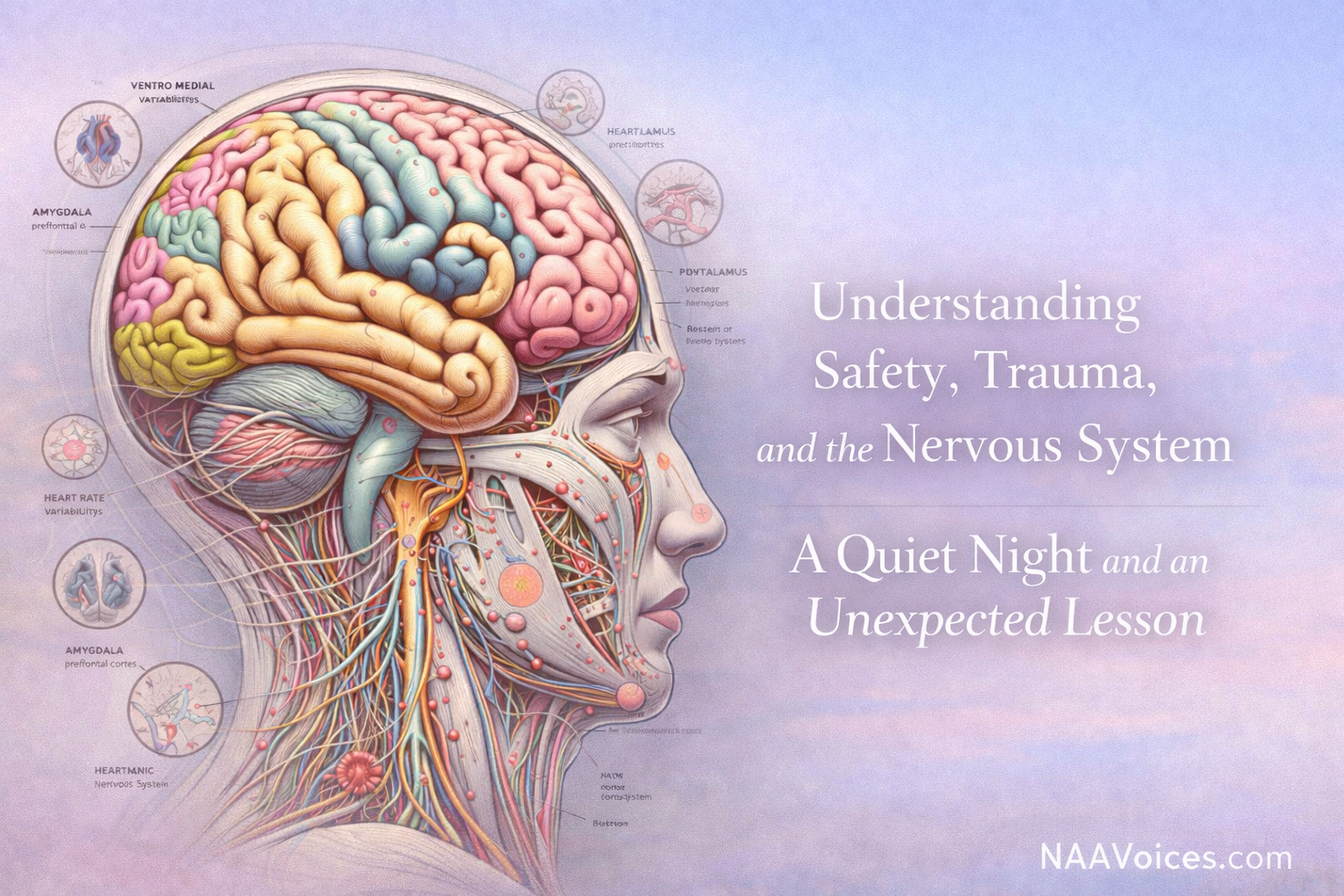
    Polyvagal Theory was developed by Dr Stephen Porges. In simple terms, it is a way of understanding how the body responds to safety, stress, danger, and connection.

    At the centre of it is the autonomic nervous system. This is the part of the nervous system that controls things we do not consciously have to think about, such as heart rate, breathing, digestion, and stress responses.

    Polyvagal Theory suggests that our nervous system is constantly scanning our environment and asking one basic question:

    Am I safe?

    And depending on the answer, the body responds in different ways.

    This does not happen only through conscious thought. In fact, it often happens before we have had time to think anything through logically.


    The body has different survival states

    One of the core ideas in Polyvagal Theory is that the nervous system can move through different states.

    1. Safe and connected

    This is the state where we feel calm enough to think clearly, talk, engage, and connect with other people.

    When someone feels safe, they are more likely to:

    • feel settled
    • communicate better
    • regulate emotions more easily
    • think more clearly
    • feel present rather than threatened

    This is where learning, healing, and connection happen best.

    2. Fight or flight

    When the nervous system senses danger, it can shift into a more activated state.

    This might look like:

    • anxiety
    • panic
    • racing thoughts
    • irritability
    • restlessness
    • muscle tension
    • feeling on edge
    • needing to do something immediately

    This is not a person being dramatic or difficult. It is the body preparing to protect itself.

    3. Freeze or shut down

    If something feels too overwhelming, the body can go the other way and begin to shut down.

    This can look like:

    • numbness
    • dissociation
    • emotional flatness
    • exhaustion
    • going blank
    • withdrawal
    • feeling stuck
    • loss of energy or collapse

    Again, this is not a weakness. It is another survival response.


    Neuroception: when the body decides before the mind

    One of the most interesting ideas in Polyvagal Theory is neuroception.

    This means the body is constantly scanning for signs of safety, danger, or threat without us consciously realising it.

    A warm tone of voice can signal safety.
    A harsh expression can signal danger.
    A sudden noise can make the body jump into alert.
    An unpredictable environment can keep the nervous system on edge.

    This helps explain why, sometimes, we can logically know we are safe, yet our bodies still react as though we are not.

    The nervous system has already made its assessment.


    Why this matters in real life

    This theory matters because it helps explain why people do not always respond to stress, fear, trauma, or relationships in neat or rational ways.

    It helps us understand that many behaviours are not simply choices or personality flaws. They are often body-based survival responses.

    Instead of asking,
    “What is wrong with this person?”
    it encourages us to ask,
    “What has this person’s nervous system learned to expect?”

    That is a very different question.

    And, frankly, a much more compassionate one.


    How polyvagal theory links to trauma and mental health

    Polyvagal Theory has been used to help explain a range of difficulties, especially in trauma and mental health.

    Trauma

    Trauma can leave the nervous system stuck in survival mode. Some people become hyper-alert, anxious, and reactive. Others shut down, dissociate, or feel emotionally disconnected. Some move between both.

    Anxiety

    From this perspective, anxiety is not just “worrying too much.” It can also be understood as the body being chronically mobilised and scanning for threat.

    Attachment and relationships

    If someone has grown up around unpredictability, neglect, fear, or instability, their body may learn that connection itself is not always safe. That can shape relationships for years.

    Neurodiversity

    There are also discussions around polyvagal-informed perspectives on sensory regulation, overwhelm, and social engagement in autistic individuals. Not as a full explanation, but as one possible framework for understanding regulation and safety.

    Dissociation

    Shutdown, disconnection, and dissociation can be understood as the body’s way of coping when something feels too much to bear.


    What I found useful about it

    What I like about this framework is that it joins the dots between body and mind.

    It does not treat emotions as if they exist in isolation from the nervous system. It recognises that what happens physically in the body influences how people think, feel, behave, connect, and cope.

    It is also compassionate.

    It reframes reactions that are often judged harshly. Fight, flight, freeze, withdrawal, panic, irritability, numbness, social shutdown — these stop looking like character flaws and start making sense as nervous system responses.

    That matters.


    But it is not beyond criticism

    At the same time, I think it is important to stay balanced.

    Polyvagal Theory is useful, but it is not a magic answer to everything. Some of its concepts are difficult to measure precisely, and some critics argue that parts of the theory are easier to describe than to validate scientifically in a consistent way.

    Human experience is also far more complex than any one theory can fully explain. Culture, identity, trauma, health, relationships, personality, social context, and lived experience all shape how people respond to the world around them.

    So for me, this is best seen as a helpful framework, not a complete explanation for all human behaviour.


    Why this connects so strongly with practice

    Even though I did not start this course “for work,” I can already see how much it overlaps with practice.

    In healthcare, and particularly in roles involving emotional well-being, safeguarding, neurodiversity, trauma, communication, and behaviour, this way of thinking is highly relevant.

    It affects:

    • how we understand distress
    • how we respond to fear
    • how we support regulation
    • how we communicate safety
    • how we avoid retraumatising people
    • how we interpret behaviours that may otherwise be misunderstood

    It also reinforces something that should sit at the heart of good care anyway: people need to feel safe before they can engage fully.


    Tonight started with something very simple: I was trying to stop.

    Trying to pause.
    Trying to rest.
    Trying not to fill every spare moment with tasks.

    And instead, I found myself learning.

    Tonight reminded me of something simple but powerful.

    Our bodies remember what our minds try to forget.

    Polyvagal Theory helps explain why people react the way they do to stress, trauma, and connection. Why some people become anxious. Why others shut down. Why safety matters more than we often realise.

    Understanding the nervous system does not solve everything.

    But it does something important.

    It reminds us that many reactions we judge as weakness or overreaction are actually survival responses.

    And when we begin to see people through that lens, we respond differently.

    Sometimes the most healing thing we can offer someone is not advice, not solutions, and not judgment.

    Sometimes it is simply helping them feel safe enough to exist without fear.

    NAAVoices.com

  • The Friday Everything Broke

    The Friday Everything Broke

    One year on, a moment of reflection:

    A week before, my coercive control case had been dropped.

    Not quietly. Not kindly. I had gone from being the victim in the crime they had arrested him for, to a member of the public. A reclassification so deliberate, so calculated, that I knew exactly what it meant. You cannot be a victim in one crime and a member of the public in another. I knew that. They knew I knew that.

    I had already watched them pour their energy into charging the only officer who had actually tried to do his job. The corruption wasn’t a suspicion anymore. It was obvious. Unapologetic. And the man — the one who would later put my child at risk, who had used DARVO tactics from the very beginning, who had twisted every truth until I questioned my own — walked away. No consequences. Nothing.

    And then I went to work.

    I don’t know what finally broke it open that Friday. Maybe it was the accumulation. Maybe it was the silence after the verdict. Maybe it was simply that my body had been holding too much for too long and finally said no more.

    I collapsed. I ended up doing my own ECG on the floor. My colleagues — people who had only ever seen me composed, capable, holding the line — saw me break for the first time.

    I am not ashamed of that moment. I never will be.

    But I won’t pretend it didn’t happen. Because understanding what led to it matters. And a lot has changed since then.

    NAAVoices was not created from certainty, but from lived experience and professional insight. As I migrate earlier work from the original platform, this post has been reviewed and approved for transfer. It remains true to its original context, with only minor clarity edits where needed. Some moments do not require rewriting to remain honest.

    Understanding Despair: Breaking the Misconceptions

    I was anxious coming back after Friday.

    Not the usual kind of anxious — the kind that sits heavy in your chest, replaying every moment, every word, every crack that showed. I have spent years perfecting the front. The composed, capable version of me that walks into a room and holds it together. Friday, that version didn’t show up.

    And I’m still processing that.

    PTSD doesn’t announce itself politely. It doesn’t wait for a convenient moment. It pulls you under, and sometimes — no matter how much work you’ve done, how many tools you have, how many times you’ve survived it before — it pulls you under in front of people.

    Re-traumatisation is brutal. It’s not just remembering. It’s reliving — your nervous system convinced, all over again, that you are back in the worst of it. The despair that follows isn’t weakness. It’s overload. It’s your mind and body hitting a wall they didn’t see coming.

    I spent so much of the weekend worrying about my colleagues. What they saw. What they thought. Whether they’d look at me differently. My darkest days usually produce productivity — not me on my knees, refusing help, doing my own ECG. I hope they know that moment didn’t define me. I hope they understood they were seeing something real, not something broken beyond repair.

    Because here’s what I want people to understand about despair — the things nobody talks about honestly:

    It is not weakness. It is one of the most human things you will ever feel. Everyone has a limit. Reaching yours doesn’t make you less; it makes you human.

    It is not permanent. In the depths of it, it feels like it will never lift. It does. It has before. It will again.

    It is not the same as depression. Despair is a response — raw, overwhelming, situational. Depression is a condition. Conflating the two helps no one.

    Isolating won’t protect you. It feels safer to disappear when you’re in it. Connection is uncomfortable when you’re raw. But it’s also the thing that pulls you back.

    It isn’t unproductive. Some of my most important self-realisations have come from the wreckage of a really bad day. Despair forces honesty in a way nothing else does.

    You don’t have to fight it. Sometimes the bravest thing is to let yourself feel it, name it, and wait for it to pass rather than white-knuckling through.

    I’m sharing this not because I have it figured out, but because I know I’m not the only one who has sat somewhere quiet after a really public moment of pain, wondering if they’ve changed how people see them forever.

    You haven’t. And neither have I.

    My Lived Experience: A Personal Journey Through Trauma and Recovery
  • Finding Silence in the Midst of Overload: Navigating Safety and Trauma

    Finding Silence in the Midst of Overload: Navigating Safety and Trauma

    NAAVoices was not created from certainty, but from lived experience and professional insight. As I migrate earlier work from the original platform, this post has been reviewed and approved for transfer. It remains true to its original context, with only minor clarity edits where needed. Some moments do not require rewriting to remain honest.

    Home is supposed to be the place where you can finally breathe. But for many of us who carry the weight of trauma, especially after a relationship with a narcissist, that quiet can feel anything but peaceful. Instead of rest, the silence can bring something harder: the space for our fears and memories to get louder.

    If that resonates with you, please know,  you are not alone, and what you’re feeling makes complete sense.

    When Your Body Won’t Switch Off

    Living with hyper-vigilance is exhausting in a way that’s hard to put into words. Your nervous system is constantly on duty, scanning for danger, bracing for the next blow, even when the threat is long gone. A creak on the stairs, a door slamming somewhere down the street, a certain tone of voice: things that seem small to others can feel enormous when your body has learned to stay on high alert.

    If you have children, there may be moments of genuine warmth that cut through the noise, their laughter, their small hands in yours. But as they grow into teenagers, the stakes can feel even higher. The need to protect them, to hold it all together, can sit heavy on your chest. You’re not just managing your own healing. You’re trying to be present for them, too.

    What PTSD Can Look Like Day to Day

    Post-Traumatic Stress Disorder doesn’t always look dramatic. Sometimes it’s just a heaviness you can’t shake. A memory that surfaces out of nowhere and takes the rest of the day with it. A feeling that you’re somehow failing, even when others can plainly see how hard you’re trying.

    PTSD can make it genuinely difficult to acknowledge good things, achievements, moments of joy, and progress. When the mind is still caught in survival mode, the positives can feel distant and unreal, while the fear feels very close and very loud.

    And if someone is still trying to manipulate or control your life, through legal proceedings, through the children, through mutual connections, that ongoing stress can make it feel almost impossible to heal. You’re trying to rebuild while the ground keeps shifting beneath you.

    Finding Something to Hold Onto

    On the harder days, even the smallest anchor can make a real difference. Something that brings you back to yourself, back to the present moment, back to the knowledge that you are still here, still standing. Here are a few things that many survivors have found genuinely helpful:

    • Grounding and mindfulness. When anxiety spikes, try to anchor yourself in the present, feel the weight of your feet on the floor, notice five things you can see, and take three slow, deliberate breaths. These aren’t clichés; they work because they redirect your nervous system away from threat mode.
    • A space that’s just yours. Whether it’s a corner of a room, a favourite chair, or a drawer full of things that comfort you, having a physical space that feels safe can be surprisingly powerful.
    • Journaling. Getting thoughts out of your head and onto paper can bring real relief. It doesn’t need to be eloquent. Even jotting down one small win from the day, anything at all, can gently shift your perspective over time.
    • Talking to someone who gets it. Whether that’s a friend, a support group, or a therapist, sharing your experience with someone who understands can lift an enormous weight. You don’t have to carry this alone.
    • Recognising your own resilience. This one can feel almost impossible on bad days, but it matters: you are still here. You have navigated things that would have floored most people. That is nothing. That is everything.

    Moving Forward, One Day at a Time

    There will be days when the past feels closer than the present. Days when the progress you’ve made feels invisible. That’s okay. Healing from trauma isn’t a straight line, and it doesn’t run on anyone else’s timeline.

    The silence that once felt threatening can, slowly and with time, become something gentler. A place to rest. A place to breathe. A place where you get to decide what comes next, on your terms.

    You are reclaiming your story. And that matters more than you might realise right now.

    You are not alone, and you never have to be.

    If you’re struggling, please reach out to a mental health professional or a domestic abuse support service in your area. You deserve support.

    My Lived Experience: A Personal Journey Through Trauma and Recovery