Tag: Personal Growth

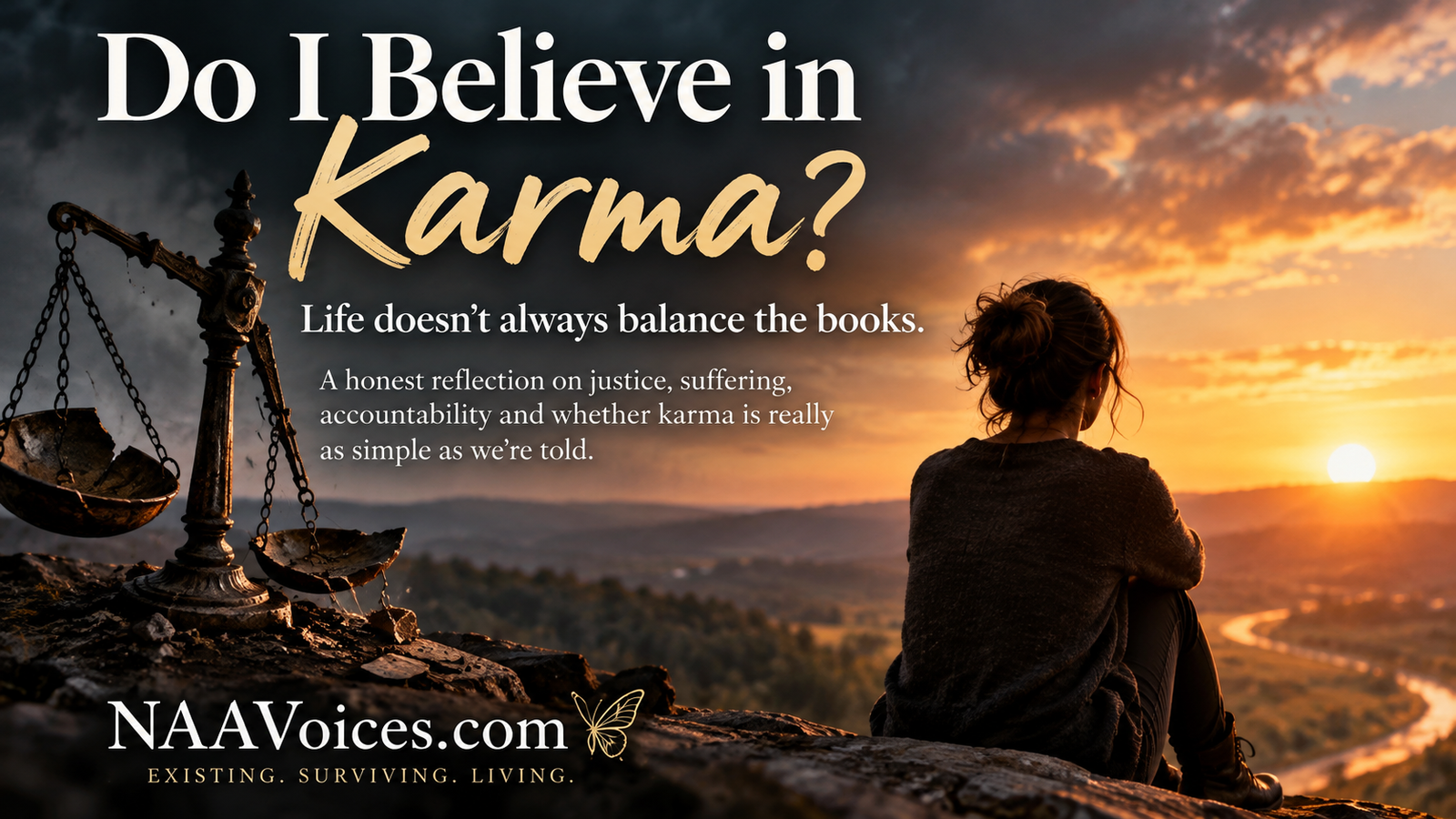
  • Do I Believe in Karma

    Do I Believe in Karma

    Do you believe in karma?

    I don’t think it’s that simple.

    We like the idea of karma because it makes the world feel fair.

    Do good, and good will eventually find you.

    Cause harm, and somehow, somewhere, life will make you answer for it.

    But I’ve lived long enough to know that life doesn’t always work like that.

    I’ve watched good people suffer because of things they never caused, never deserved and could not have prevented.

    I’ve watched people carry trauma created entirely by somebody else’s choices.

    And I’ve watched people do hideous things and seemingly walk away from them.

    So where is the karma in that?

    If a good person is harmed, traumatised and left rebuilding their life while the person who caused it carries on as normal, are we really supposed to believe the universe has somehow balanced the scales?

    I don’t.

    At least, not in the traditional sense.

    Maybe karma isn’t punishment.

    Maybe it isn’t some invisible court where every wrong eventually receives an equal sentence.

    Maybe sometimes there simply isn’t justice.

    That is uncomfortable to admit, particularly when you have spent years waiting for accountability.

    But perhaps there is another way of looking at it.

    The person who harmed you does not get to decide who you become afterwards.

    They may have changed your life. They may have left consequences they never have to carry themselves. They may never fully understand the damage they caused.

    But surviving does something too.

    You learn.

    You rebuild.

    You become more discerning about who gets access to you.

    You recognise things you once overlooked.

    You speak when you once stayed silent.

    Sometimes you even take what nearly destroyed you and turn it into something that helps somebody else survive.

    That isn’t karma.

    And I don’t particularly like calling it a “lesson”, either. Some things should never have happened in the first place.

    It is simply what human beings can sometimes do with what remains.

    So, do I believe in karma?

    Not really.

    I believe actions have consequences — although frustratingly, those consequences don’t always land on the person who caused the harm.

    I believe accountability matters precisely because we cannot rely on the universe to provide it.

    And I believe being a good person does not guarantee you a painless life.

    Perhaps the better question isn’t whether the people who hurt us eventually get what they deserve.

    Perhaps it’s whether we can reach a point where their future no longer determines ours.

    Because I don’t want to spend the rest of my life waiting for karma.

    I’ve already spent enough of it waiting.

    NAAVoices.com

  • The Bravest Thing I Did When No One Was Watching.

    The Bravest Thing I Did When No One Was Watching.

    I have thought about this question deeply, and my answer is actually quite simple.

    I kept going.

    When the curtains were closed. When the doors were locked. When the world saw nothing but silence from me, I kept going.

    I have been thinking a lot lately about something we do not talk about nearly enough.

    Post-traumatic growth

    We focus so much, and rightly so, on the weight of trauma. The reliving. The triggers. The dissociation. That buzzing sensation inside your head when you finally realise you have had enough and just need to reset.

    I know all of this intimately. I live with PTSD.

    I know how much heavier injustice feels when your nervous system is already stretched thin. I know the days when I have been so badly triggered that I could not sleep or leave the house, and the mornings when simply getting up and functioning took far more effort than anybody around me could possibly have known.

    There were nights I lay awake. Mornings when breathing felt like work. Days when I was trying to hold myself together while still holding everyone else up.

    But recently, I had to look back over the last couple of years to complete an application. As I pulled everything out and laid it all down in front of me, I saw something I had never really allowed myself to see before.

    Just how much I had actually achieved while learning to live with all of it.

    That was when I started thinking properly about post-traumatic growth.

    It does not mean the pain was not real

    For a long time, trauma brought pain with silence.

    Looking back, though, that silence was not empty.

    It was where I listened, learned, observed, questioned and slowly rebuilt. Most of it happened quietly, without recognition and without me even realising at the time that rebuilding was what I was doing.

    I did not grow instead of being affected by trauma. I grew while being affected by it.

    The triggers still come. Hard days still happen. There are things I have to manage now that I never had to manage before.

    Growth does not erase any of that.

    It simply means that somewhere amongst it all, I changed too.

    What growth actually looks like for me

    People often talk about growth as though it is something polished and neat.

    Mine isn’t.

    I built this space online. Not because I wanted recognition, but because people reached out. Some came back. Some told me that something I had written made them feel understood.

    I don’t blog religiously. I write when something reminds me, when I need to get words out, or when something sparks something in me.

    It is messy. Sporadic. Real.

    And that is exactly how I want it to be.

    I carried my family through some incredibly difficult years. I supported all three children who, at different points, needed additional mental health support themselves, while also navigating my own struggles.

    There were days when I felt as though I had absolutely nothing left and still somehow found something.

    I have also changed in the way I deal with fear.

    I joke sometimes that I care less these days, but that isn’t really true. I still care deeply. I have never wanted to act out of malice, and I never want difficult experiences to turn me into somebody who does.

    What changed is that I stopped being frightened of other people’s reactions to me doing what I believe is right.

    I no longer automatically carry somebody else’s judgement as though it must say something about me. After having my character torn apart in court, something shifted.

    I promised myself nobody would ever twist who I am and make me question myself like that again.

    At the time, I felt I had already faced the very worst.

    And I was still here.

    My voice became stronger.

    I advocate fiercely now when something is wrong.

    I have also learned constantly. Not simply to understand myself, but because I wanted to understand other people better. I started noticing gaps in my own knowledge and going away to fill them.

    Not for recognition. Not for another certificate on the wall.

    Simply because sometimes another human being is standing in front of you and you want to understand how best to help them.

    And some of my growth has looked far less. Five weeks ago, I hammer-jacked up a 16ft square concrete base and laid an 11ft square patio entirely on my own. I was absolutely shattered afterwards. I fitted my own kitchen from scratch.

    I am one part away from earning my full A motorcycle licence so I can ride a big motorbike.

    They might sound like completely random things to include in a piece about trauma.

    They aren’t.

    Every one of them represents something I might once have questioned whether I could do.

    So I did it.

    Some were done on difficult days when I was exhausted or overwhelmed. Sometimes having work, projects, or something practical to focus on gave me routine and purpose when other parts of life felt heavy.

    Sometimes every part of me wanted to curl up and hide.

    I did it anyway.

    A new chapter, and proof of what I am capable of

    Now I am hopefully stepping into another chapter of my career.

    The last time I chose to study at postgraduate level, I did it for a very different reason.

    I needed to understand.

    Behaviour. People. The brain. Trauma.

    I was trying to make sense of what I had lived through while, in many ways, I was still living through it.

    I was experiencing post-separation abuse and was diagnosed with PTSD during my second module. At the time, I never truly believed I could succeed.

    Yet I completed my postgraduate certificate with a distinction.

    There were assignments written through tears. Nights spent awake learning about trauma and domestic abuse while simultaneously beginning to understand what had happened to me.

    There was something surreal about studying the impact of trauma academically while living with its consequences personally.

    What I gained from that postgraduate course was far more than academic knowledge.

    It gave me evidence. Evidence of exactly what I am capable of.

    I can see that now, though I couldn’t see it then.

    Trauma did not give me my strength, my determination, my compassion or my voice. Those parts of me were already there.

    What the experience did was force me to discover just how much of them I had.

    I walked through abuse, diagnosis, trauma and some incredibly dark periods without allowing those experiences to decide who I would become.

    Other people do not get to define who I am or what I am capable of. There were days when I genuinely could not see an end to any of it. Now I look back at the person I have become and think:

    My God. I have changed.

    Not into somebody hardened or bitter.

    Into somebody far harder to silence.

    And perhaps that is what post-traumatic growth means to me.

    Not pretending something terrible became something wonderful.

    Not being grateful for trauma.

    Not saying everything happens for a reason.

    I don’t believe any of those things.

    It is recognising that something hurt you profoundly and that, while learning to live with what it left behind, you built something too.

    So is post-traumatic growth real?

    I believe it is.

    Post-traumatic growth, or PTG, is the term used to describe positive psychological changes that some people experience while struggling with highly challenging or traumatic life events.

    It is commonly described across five broad areas.

    Appreciation of life. Priorities change. Things once taken for granted can suddenly matter far more.

    Relating to others. Connections can deepen. Compassion can become stronger.

    Personal strength. That realisation of: I survived something I once did not think I could.

    New possibilities. New interests, ambitions, paths or directions can emerge.

    Spiritual or existential change. A changed sense of meaning, purpose or understanding of life.

    But I think it is incredibly important that we do not romanticise it.

    Post-traumatic growth does not mean trauma was beneficial.

    It does not mean somebody should be grateful for what happened to them.

    And it certainly does not mean that somebody who continues to struggle has somehow failed to grow.

    Growth and distress can exist at exactly the same time.

    You can be stronger and still be triggered.

    You can have found your voice and still have days when using it feels impossible.

    You can rebuild huge parts of your life and still grieve for the parts that were damaged.

    Both things can be true.

    I will never be exactly the person I was before.

    I no longer see that entirely as a loss.

    I still have my kindness. That never left.

    But now it has backbone behind it. Purpose. Knowledge. And a voice that I worked incredibly hard to find.

    I didn’t wait until I felt completely healed to start rebuilding my life.

    I built my life while I was healing.

    And perhaps, more than anything else I have written here, that is what post-traumatic growth means to me.

    Trauma brought pain with silence.

    But the silence did not stay empty.

    So, back to the question that started all of this.

    What is the bravest thing I have ever done when no one was watching?

    I kept going.

    And somewhere in all that silence,

    I grew.
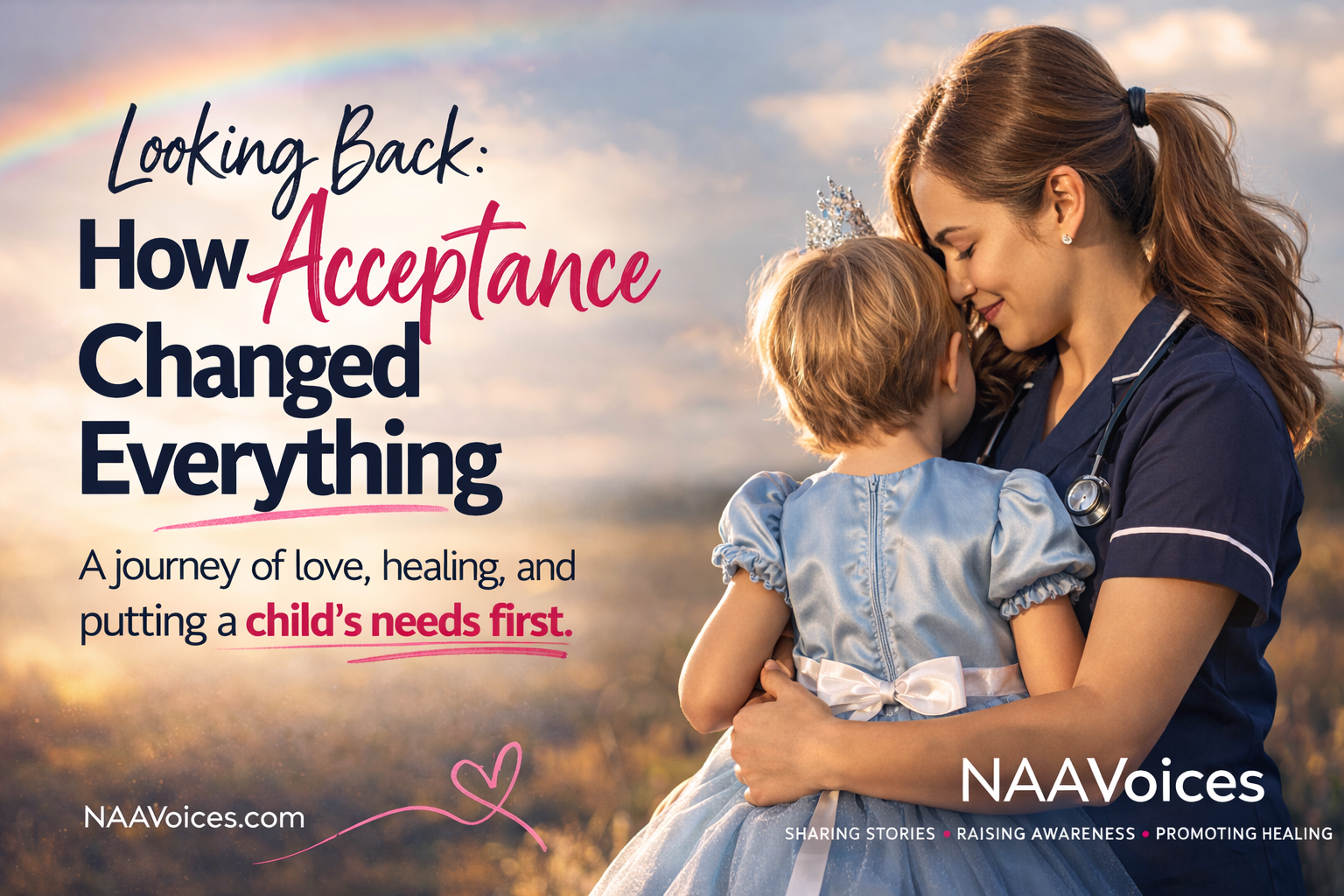
  • Looking Back: How Acceptance Changed Everything

    Looking Back: How Acceptance Changed Everything

    NAAVoices was not created from certainty, but from lived experience and professional insight. As I migrate earlier work from the original platform, this post has been reviewed and approved for transfer. It remains true to its original context, with only minor clarity edits where needed. Some moments do not require rewriting to remain honest.

    27 February 2025

    It is only when I look back over the past six months that I realise just how different our reality could have been without acceptance, love, and a willingness to put a child’s needs first.

    This post is rooted in reflection, personal growth, and the quiet clarity that sometimes only comes with time. Looking back has brought me a little peace. It has also helped me join the dots.

    Although I remember many of the moments that led to my child identifying as female from such a young age, I sometimes wish I had written more down. But in another sense, perhaps what mattered most was not documenting every detail, but allowing freedom, expression, and acceptance to lead the way. That is what allowed her to shine.

    I have kept the heart of this post true to how it was originally written. Since then, those around us have worked hard to use the correct pronouns, and we continue to do our best to support her in every way we can. I wrote the original draft four months before my four-year-old was able to fully express the depth of how she felt. It has been a journey. It has not been perfect. At times, I have wondered whether I should have noticed sooner.

    To my beautiful little one — you are the brightest star I have ever seen, now that you are free to be yourself.

    Draft originally written on 10 August 2024

    The post I was too scared of judgement to share

    I have a four-year-old who, from quite early on, loved playing with dolls and adored Princess Poppy, just like her older brother once did. What began with small interests gradually became more consistent. It turned into a Frozen dress, and for 18 months she asked for one.

    Growing up, there were three of us. I am the middle child, with an older sister and a younger sibling who does not use pronouns. We refer to them as “auncle”.

    I have always believed that people should be free to be themselves. I have always recognised that stereotypes around gender, sexuality, and social roles can be restrictive, harmful, and deeply unfair.

    As a parent, I have always tried to raise my children with the belief that everyone is equal, that no one is “better” than anyone else, and that kindness costs nothing.

    I have never believed boys should only like blue, girls should only like pink, or that children should be boxed into certain toys, clothes, or interests.

    That had already been clear with my older son, who once loved Princess Poppy costumes, dance classes, and hairdressing toys.

    Although my ex-husband initially found some of it unusual, he never allowed his own views to shape or limit our son. That little boy is now 12 years old, over 5 foot 7, and would be mortified if he knew I had written this about him.

    Now he is into rugby, the gym, running, and Xbox. I am incredibly proud of him for being exactly who he is, regardless of anyone’s expectations about gender or interests. He is funny, compassionate, and accepting of everyone.

    This weekend, the older two were with their dad, and I took my youngest to a toy sale. Like most four-year-olds, she was full of excitement, pointing at everything she liked. Since she had been allowed to choose her own toys more freely, the house had become increasingly sparkly and pink. We had already bought a Barbie campervan and some Barbies, and that had not bothered me at all.

    But when she asked for the Barbie Dreamhouse, I hesitated.

    That hesitation was not about her. It was about what had been done to me.

    What I realised in that moment was that four years in a toxic relationship had not only affected my identity, but had also changed the way I saw myself as a parent. It had created a version of me I did not recognise — one shaped by anxiety, fear, and the constant pressure of anticipating judgement.

    For a split second, I questioned my own instincts. Was it okay to buy it? What would people think?

    That was not who I truly was. But the fact those thoughts appeared at all told me just how much damage had been done.

    Why should it be wrong for a four-year-old to want a doll’s house?

    The man running the stall was with his daughter, whose toys were all pink and glittery. He seemed to notice my discomfort, though it had nothing to do with him or his stock. I had simply frozen.

    At that point, I was off work. I had finally admitted I needed help for what I had been through and was trying to learn how to live with PTSD.

    I had never had an issue with dolls, dresses, babies, or Frozen. But over time, I had been made to feel that these things were wrong if they did not fit someone else’s beliefs.

    That same day, the gentleman at the stall spoke openly about how, when he was younger, he used to dress as a girl and how his family had questioned what that meant. It struck me deeply.

    I felt ashamed that I had allowed fear to creep into something that should have been simple.

    Just two weeks earlier, I had gone to a solicitor’s office to collect a parcel for my child. She wanted to wear her Elsa dress. Instead of simply letting her, I found myself trying to persuade her to wear “regular” clothes because I was frightened it would somehow be reported back to my ex.

    I was scared that allowing her to wear a dress would lead to more accusations, more scrutiny, more control.

    And that is what it always came back to: control.

    My ex had controlled my life for so long that even after I had left, I still panicked about what he might say, what he might do, and whether I would somehow be punished for allowing my child to be herself.

    I had spent so long living under someone else’s judgment that I had started to question my own values.

    For four years, I felt as though I had lived with two versions of myself. One was the woman constantly bracing for threats, fear, and fallout. The other was the version of me that still existed at work — the one who was grounded, compassionate, professional, and clear on what was right.

    Looking back now, I know that version was the real me all along.

    The fear was never my identity. It was the effect of abuse.

    When a patient walks through my door, I do not see labels first. I do not assess someone’s worth based on gender, identity, relationship status, work, or appearance. Every person is entitled to dignity, safety, and respect. Nobody has the right to strip that away.

    That day, my child and I left the sale with the Barbie Dreamhouse and the biggest smile I had seen in a very long time.

    On the way home, I said, “Yes, you are my beautiful little boy.”

    And she replied, “No mummy, I’m your beautiful little girl.”

    This time, I did not correct her. I did not shut it down. I did not try to control what she was expressing.

    Instead, I listened.

    I had fought so hard to get control out of my own life. She deserved the same freedom — the freedom to tell me who she was, without fear.

    So I said, “Yes, you are my beautiful little girl, if that is what you want to be.”

    At the time, neither of us fully understood what that moment would come to mean. We did not yet know that this was more than role-play. There were many moments before and after it, many small signs and snippets that only make sense now when I look back.

    Six months later, I had what felt like a completely different child — happier, more carefree, and more confident. She had begun wearing girls’ clothes to school and had been met with wonderful support from family and friends.

    We are still finding our way. We are still learning. We are still navigating this path together.

    But she is loved for who she is. She is wanted. She is accepted.

    And perhaps most importantly of all, she is now confident enough to correct anyone — including me — when we get her pronouns wrong.

    She is still finding her feet at school.

    But she is finding them as herself.

    February 27, 2025

    At the top a boy- bottom a Girl
    Parenting and Learning, Through a Gender Journey
  • When the Training Becomes Personal

    When the Training Becomes Personal

    When the Training Becomes Personal

    December 28, 2025

    I’ve just completed the Narcissistic Abuse Recovery training, and it was tougher than expected.

    I began to deepen my understanding of supporting others through this. Facing how deeply it resonated with my own experiences required absolute honesty, humility, and resilience.

    This process reinforced a critical point: recovery isn’t theoretical. It’s lived, layered, and often confronting, but it’s also where meaningful transformation happens.

    If you’re navigating this kind of healing, you’re not “behind.” You’re doing complex work with courage and accountability. And that matters.

    Screenshot

    #NarcissisticAbuseRecovery

    #TraumaInformedHealing

    #SurvivorStrong

    #HealingJourney

    #DomesticAbuseAwareness

    #TraumaRecovery

    #EmotionalAbuse

    #MentalHealthMatters

    #BoundariesMatter

    #FromSurvivingToThriving

  • At 34, Everything Changed

    At 34, Everything Changed

    At 34, Everything Changed

    December 15, 2025

    The Mother They Created When They Failed My Children


    At 34, I lost everything.

    Not my job—work remained my only safe haven, the one place that still made sense when nothing else did.

    What I lost was far more fundamental.

    I lost my belief that people do the right thing.

    I lost my trust in the world.

    I lost my ability to understand how humanity functions.

    Because when my children needed protection most, the world looked away.


    The Breaking

    My mental health collapsed for the first time in my life.

    Not gradually. Not with the warning signs I could have prepared for.

    It shattered, completely, devastatingly, in the face of a truth I couldn’t reconcile:

    The systems designed to protect children don’t always protect children.

    The people who should intervene don’t always intervene.

    The world that promises safety doesn’t always deliver.

    I stood face to face with the devil himself.

    And nobody came.

    Nobody protected my babies.

    Nobody did the right thing.

    And I couldn’t understand why.

    How do people fail children? How do they see harm and turn away? How do institutions built for protection become instruments of further trauma?

    I still don’t have those answers.

    I’m not sure I ever will.


    The Underestimation

    What made it worse?

    They treated me like I knew nothing.

    Just another hysterical mother.
    Just another woman overreacting.
    Just another parent who didn’t understand “the process.”

    I was dismissed.
    Patronised.
    Underestimated at every turn.

    As if loving my children made me irrational.
    As if my fear for their safety made me unreliable.
    As if being a mother meant I couldn’t possibly understand the systems designed to “help” us.

    They were wrong.


    The Vow

    But my three children were still watching.

    Through my traumatisation, through my confusion, through my complete loss of faith in humanity, they were watching to see what I would do next.

    And in that darkness, broken and alone, I made a vow that changed everything:

    I will NEVER be that woman again.

    The woman who believed people would do the right thing.
    The woman who trusted systems to protect her children.
    The woman who waited for help that never came.

    I will NEVER wait for the world to save my kids.

    Because I learned the brutal truth: it won’t.


    The Rebuilding

    So I stopped waiting.

    And I rebuilt myself—not as the same person, but as someone entirely new.

    I became educated.

    If they were going to dismiss me as ignorant, I’d make sure I knew more than they did.

    I earned qualifications while my world burned around me.
    I studied safeguarding frameworks, legal processes, and institutional procedures.
    I learned every system that had failed us, inside and out.

    I became independent.

    If I couldn’t trust anyone else to protect my children, I’d learn to do everything myself.

    I built Nurse Against Abuse — the foundation that grew into NAAVoices — rising from the ashes of institutional betrayal.I created the resources I wish had existed when I needed them.
    I turned my shattered faith into actionable expertise.

    I became the shield the world refused to be.


    The Truth About Trauma

    Here’s what they don’t tell you about surviving this kind of betrayal:

    The triggers still come.

    There are moments when I’m transported back to that version of myself—the one who believed, who trusted, who thought the world was fundamentally good.

    I still don’t understand how people fail children.

    Even with all my knowledge, training, and experience, I navigate these systems. I cannot comprehend how adults look at vulnerable children and choose inaction.

    I remember the woman who believed in humanity.

    Sometimes I grieve her. She was softer, more hopeful, easier to be around.

    But she’s gone.

    And honestly? She had to be.

    Because that woman couldn’t protect my children.

    This version can.


    The Reality No One Wants to Say Out Loud

    The world is not always safe.

    Not everyone chooses to do what they should.

    Not everyone will protect you.

    When your children are at stake, trust must be earned, never assumed.;

    But YOU—you can become everything your children need.

    My 5-year-old needs a mother who will never break like that again.

    My 13-year-old needs a warrior who fights without hesitation or fear.

    My 15-year-old needs living proof that one person will never, ever give up on them.

    That’s who I became.

    Not because I’m special or extraordinary.

    Because I had no other choice.


    The Two Paths

    Losing faith in the world at 34 gives you exactly two paths:

    Path One: Drown in the grief of what you lost—your innocence, your trust, your belief in human goodness.

    Path Two: Rise as something you have never seen in yourself before—forged in fire, built from betrayal, unstoppable in purpose.

    I chose fire.

    Now I have:

    • Expertise earned in hell
    • Knowledge forged from institutional failure
    • Strength built on broken promises from everyone else
    • Three souls who will never question whether their mother will give up

    Because I always will.


    The Problem We Don’t Talk About

    Here’s what breaks my heart:

    I shouldn’t have to use this knowledge for my own children.

    No mother should.

    I built expertise in safeguarding failures, legal frameworks, institutional navigation, complaint procedures, and evidence documentation; not because I wanted to, but because I had to.

    And I’m not alone.

    Too many mothers are being dismissed as hysterical.
    Too many are treated like we know nothing.
    Too many have to become experts in systems that should protect our children, just to be heard.

    Not just for me.

    For every mother who’s been underestimated.
    For every parent told they’re overreacting.
    For every family that has failed because of the very systems designed to help them.

    Because until those systems change, we become the experts anyway.

    We have to.


    The Truth About Overcoming Betrayal

    You don’t overcome betrayal by learning to trust again.

    You overcome it by becoming so educated, so independent, so armed with knowledge that trust becomes irrelevant.

    By building integrity so solid that you answer only to yourself.

    By gaining expertise so deep that you don’t need anyone’s help.

    By developing determination so fierce that other people’s failures can’t touch you anymore.

    When you trust your own knowledge above all else—
    When you become independent enough to act alone—
    When your expertise makes you undeniable—
    When they can’t dismiss you anymore because you know more than they do—

    Other people’s failures stop mattering.

    Their underestimation becomes irrelevant.

    Their dismissal loses its power.

    Because you’re no longer waiting for the world to protect your children.

    You became the protection.


    The Promise

    The world failed my children once.

    I made absolutely certain it was the last time.

    And now?.

    Until the systems change?

    We’ll document everything.
    We’ll learn every framework.
    We’ll master every process.
    We’ll build resources for each other.
    We’ll refuse to be dismissed.

    We’ll protect our children—with or without the world’s help.


    The Transformation

    My children will never know the naive woman I was at 34.

    The one who believed people were fundamentally good.
    The one who trusted institutions to function as designed.
    The one who thought loving your children was enough to keep them safe.

    They know the fight she took on and the person she became as a result.

    The woman who learned that sometimes the only person you can count on is yourself, so you’d better become someone worth counting on.


    The Final Truth

    At 34, the world broke me.

    At 36, I became unbreakable.

    Not for me.

    For them.

    For my 5-year-old, who deserves stability.
    For my 13-year-old, who deserves fierce advocacy.
    For my 15-year-old, who deserves unwavering protection.

    Always for them.

    And for every mother out there who’s been underestimated, dismissed, and forced to become an expert in systems that should have protected her children from the start.

    You are not hysterical.
    You are not overreacting.
    You are not alone.

    And you are far more powerful than they ever gave you credit for.

    💪
    💜

    Laura Prince
    NAAVoices.com
    https://naavoices.com/


    If this resonates with you, please share it. Because somewhere, another mother is being told she knows nothing, and she needs to know she’s not the only one who has had to become everything.