Tag: neurodiversity

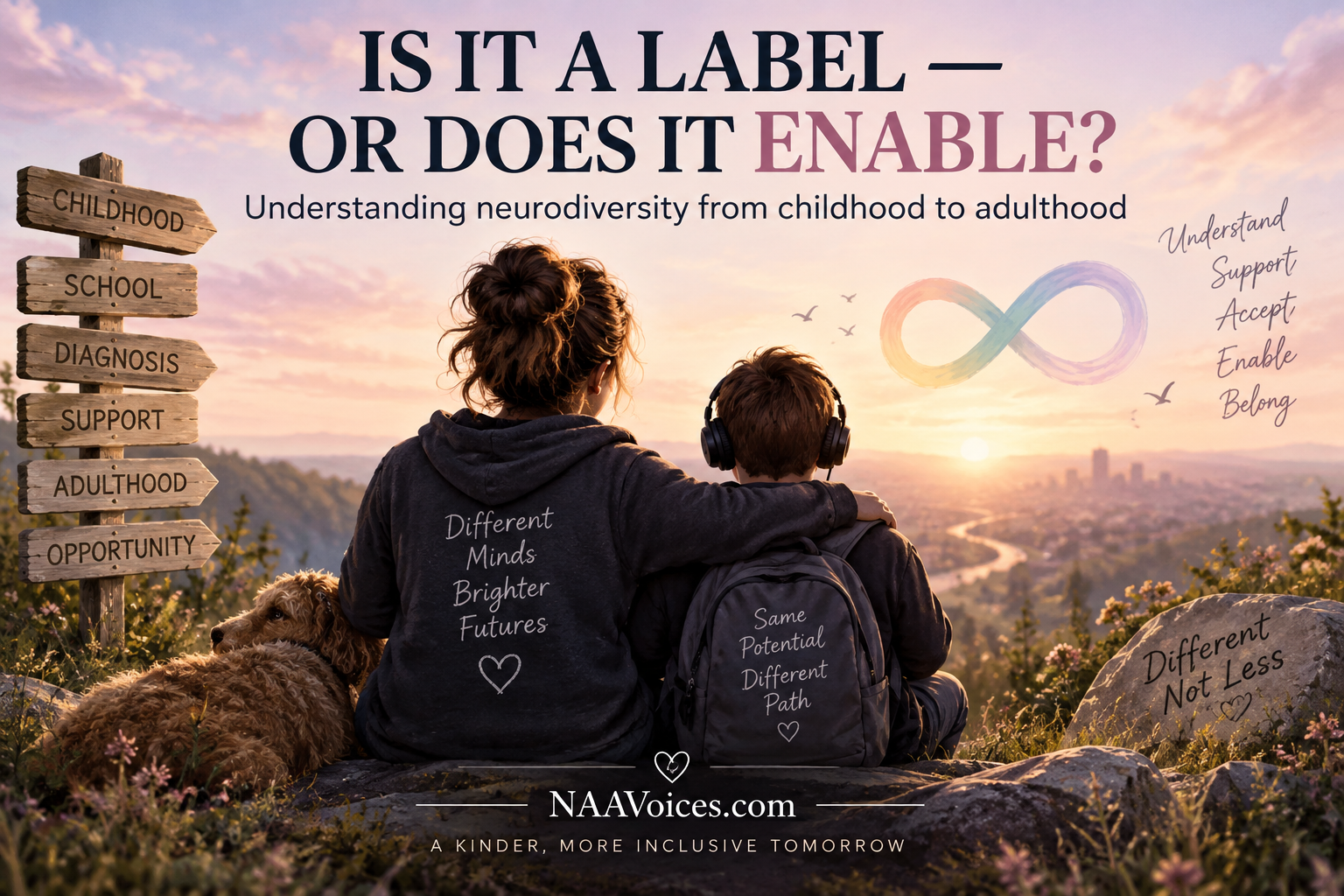
  • Is It a Label, or Does Understanding Neurodiversity Enable Us?

    Is It a Label, or Does Understanding Neurodiversity Enable Us?

    The children who mask, the adults who were missed, the parents running on empty, and why understanding matters

    We know neurodiversity exists. ADHD, autism, dyslexia, dyspraxia and other neurodevelopmental differences are spoken about far more openly than a generation ago. Yet alongside that awareness sits another reality: the waiting lists are long, and while a child waits, childhood doesn’t pause. They still have school, friendships, sensory environments, emotions and sleep to somehow manage, and their parents still have to get everyone through another day.

    For me, this has never been about collecting labels. I believe in enabling the child in front of us. My experience of neurodivergence, parenting neurodivergent children and working in healthcare led me to study neuroscience and the psychology of mental health, because I wanted to understand why we think, learn and respond differently.

    When we give something a name, are we labelling somebody, or finally giving them the understanding they need to thrive?

    Why Does Everyone Seem to Have ADHD or Autism Now?

    There is undoubtedly more public awareness, and social media has made information, good and bad, extraordinarily accessible. But increased awareness doesn’t mean every energetic child has ADHD, or that every difficulty requires a diagnosis. A TikTok video cannot diagnose ADHD; recognising yourself or your child in a list of traits is not the same as a proper assessment, and nothing here replaces one.

    But the opposite matters too. Greater recognition doesn’t automatically mean fad. Perhaps we’re simply getting better at recognising people who were always there, including adults who were the children nobody noticed decades ago.

    What Does a Diagnosis Actually Change?

    It doesn’t change the child; the child leaving an assessment is the same one who walked in. What can change is everybody else’s understanding: “they won’t concentrate” becomes “why is concentration difficult?”; “they’re being difficult” becomes “what is happening here?”

    That doesn’t mean removing boundaries or accepting harmful behaviour. It means understanding whether somebody needs a different route to the same destination. Sometimes understanding why is the beginning of working out how.

    “But They’re Fine at School”

    My eldest is sixteen; I became a mum at twenty-one, and didn’t recognise everything then that I can see now. I was fortunate: teachers saw signs before I did, referrals happened without a fight, and I was never once called into school about his behaviour. At school, he held things together. At home, things looked completely different. A child who is managing at school isn’t necessarily a child who is coping.

    The Coke Bottle Effect

    Imagine shaking a bottle: noise, changed plans, a missed instruction, sitting still, watching every word, an unwanted touch, unwritten social rules, something uncomfortable they can’t explain. Shake, shake, shake, but the lid stays on through the school day. Then they get home, the door closes, and everything comes pouring out.

    That doesn’t prove a diagnosis; there are many reasons children behave differently across environments. But “we don’t see that here” should never mean “there isn’t a problem.” Home is often simply where a child feels safe enough to stop holding it together.

    To the Parent Who Is Running on Empty

    Somewhere, a parent is reading this after an awful day: an explosion at the door, a three-hour bedtime, every strategy failing. Am I doing this wrong?

    You can understand behaviour as communication and still find it hard to live with. You can love your child completely and need ten minutes away from them. Both can be true. If your child is safe and you need a moment, take one, then tell the school, the professionals, whoever needs to know, that you’re struggling. Don’t be ashamed to say this is hard.

    Some days will feel pointless. Then you’ll get up and advocate again, because when your child can’t explain what’s happening, you are their voice. If you or your child are ever in crisis, contact your GP, NHS 111, or in an emergency, 999.

    Where Your Child Sits on a Waiting List Is Not a Parenting Score

    Services are stretched, thresholds exist, and the most urgent clinical risks are understandably prioritised. That doesn’t make waiting easy, but a long wait, a declined referral, or a low priority ranking is not a reflection of how much they’re struggling, how much you care, or how good a parent you are. If something changes or risk increases, say so and ask again.

    Support Shouldn’t Always Have to Wait for a Diagnosis

    A child’s needs exist the day before the diagnostic report arrives too. Some schools already do this well: predictable routines, visual information, movement breaks, smaller task stages, a calmer sensory environment. Not every adjustment needs a label, and what helps a neurodivergent child often helps others too. Someone once told me, “it’s so nice speaking to somebody who gets it.” Often, that’s the real need: to be heard, and pointed toward the right next step.

    Masking Can Be Remarkably Convincing

    The quiet child, the academically successful child, the polite child, the child whose parents are never called into school: none of them is necessarily coping. Some children become extremely good at watching, copying and suppressing what they’re experiencing. We see the result, not the cost. And those children grow up.

    Neurodivergent Children Become Neurodivergent Adults

    They become employees, parents, nurses, teachers, business owners. Some build lives that fit how their brains work; some become extraordinarily good at compensating, held together by calendars, alarms and perfectionism, until something changes and those systems stop working.

    Undiagnosed Men Matter Too

    Some energetic boys found an outlet through sport or practical hobbies; others were simply called lazy or told they weren’t reaching their potential. Some built careers that happened to suit their brains: fast-paced, practical, self-employed, no two days the same. Then a promotion, an injury, parenthood or a relationship ending removes what had been keeping things afloat. Perhaps the neurodivergence didn’t appear. Perhaps what enabled them to function did.

    And Then There Are the Women Nobody Noticed

    The girl who wasn’t disruptive, who did her work, who learned the rules and masked well, could be missed entirely. She grows into a capable woman, wondering why ordinary things require so much effort. Then, for some, another transition arrives.

    ADHD and Menopause: An Important Conversation, but One That Needs Care

    Hormonal change may interact with attention, executive functioning and mood, but research specifically on ADHD through perimenopause and menopause is still developing, so the biology shouldn’t be made to sound simpler than it is. Sleep, memory and concentration can also shift with menopause alone, independent of any neurodivergence. For a woman who has spent decades compensating, the combination can be particularly hard. “What has happened to me?” Perhaps she hasn’t become incapable; perhaps we’re finally seeing what the coping always cost. This deserves individual assessment, not a single universal explanation, and anyone noticing these changes should raise them with their GP or a menopause specialist.

    The Hidden Face of ADHD in Women: What I Learned Through Diagnosis, Research, and Real Support

    I Know What It Is Like to Build a Life Around Your Brain

    I don’t work well doing one thing at a time. I’m doing two courses right now because I absorb information better moving between them. A traditional classroom, sitting still with no outlet for stimulation, is almost physically uncomfortable for me. Music, fidgets, movement: I need it to concentrate, and I’m also very good at my job. Those things aren’t contradictory. I masked at school too, but I had practical hobbies outside it that gave my energy somewhere to go.

    “I Have Undiagnosed ADHD”

    At thirty-two, I wanted an explanation. I hadn’t taken antidepressants or anti-anxiety medication, and wasn’t prepared to treat something I didn’t believe fit without exploring an alternative first; that was the right call for me, not advice for anyone else, and medication decisions should always sit with a prescriber. I told my GP what I’d been experiencing and why I suspected ADHD, and she listened. No fight, no need to convince her that a woman who’d built a career and raised children could also have ADHD. I was referred. I know I was fortunate; not everyone’s route to being heard is that straightforward, and pathways vary by area and GP.

    Neurodivergence Can Bring Strengths, and Still Be Genuinely Hard

    We’ve swung from framing neurodivergence purely as deficit to calling everything a superpower. Neither is the whole story. Curiosity, creativity, hyperfocus and unconventional problem-solving are real strengths, but strengths don’t cancel difficulties. The same hyperfocus that produces extraordinary work can make switching tasks agonising. Someone can thrive in a crisis and struggle with an ordinary Tuesday. We should be able to talk honestly about both, without pretending the hard parts shouldn’t be hard.

    We Shouldn’t Be Teaching Children to Become Better at Hiding

    I don’t want the goal to be a neurodivergent child who’s simply good at looking neurotypical. I want them to understand themselves, know what overwhelms them, and feel able to ask for help. And I want them to find their thing, whatever it is, because support isn’t about lowering the ceiling. It’s about removing unnecessary barriers underneath it.

    Diagnosis Should Be a Beginning, Not an Ending

    A diagnosis doesn’t define somebody, excuse behaviour, or remove boundaries. At its best, it explains patterns, informs support, and eventually helps a child understand themselves. So perhaps the real question isn’t “why does everybody need a label now?” but “how many people did we fail to understand before?” Because the children who weren’t recognised didn’t disappear. They grew up: some flourished, some masked, some reached midlife before understanding why ordinary life took extraordinary effort.

    I don’t want children unnecessarily labelled, diagnosed from social media, or every difference medicalised. But I don’t want them dismissed either. I want understanding, proper assessment, and opportunity. And to the parent reading this after an impossible day: you don’t have to be perfect, or pretend you’re coping. Ask for help. When your child can’t find the words, be their voice. Use it.

    Understanding neurodiversity isn’t about deciding what somebody can’t become. It’s about understanding what they need, so they have the chance to discover what they can.

    Different Minds. Different Needs. Brighter Futures.

    Amy Royle Founder of NAAVoices. She holds a BSc in Adult Nursing, a PGCert in Neuroscience & Psychology of Mental Health, and certificates as an ADHD Coach, Neurodiversity Coach, Trauma Healing Practitioner, Narrative Therapy Practitioner and Narcissistic Abuse Healing Practitioner.

    NAAVoices.com

    Important Information

    This article combines lived experience, professional reflection and general educational information written in a personal advocacy capacity. Nothing here constitutes clinical advice, assessment or diagnosis for any named individual, and it is not a substitute for advice from an appropriately qualified and regulated professional. My nursing, postgraduate and coaching qualifications do not make me a specialist diagnostician of neurodevelopmental conditions; assessment, diagnosis and treatment decisions should always go through the appropriate professional pathway.

    Where this article references research on ADHD, masking or perimenopause, this is a general summary of an evolving evidence base, not a systematic review; readers seeking the underlying literature should consult NICE guidance and peer-reviewed sources directly. All personal anecdotes are Amy’s own and shared with consent; no other identifiable individual’s personal or clinical information appears in this article.

    If you are worried about your own or your child’s development, wellbeing or safety, please contact your GP, NHS 111, or, in an emergency, 999.
  • When Leaving Does Not End the Abuse: Trauma, Neurodiversity and the Cost of Silence

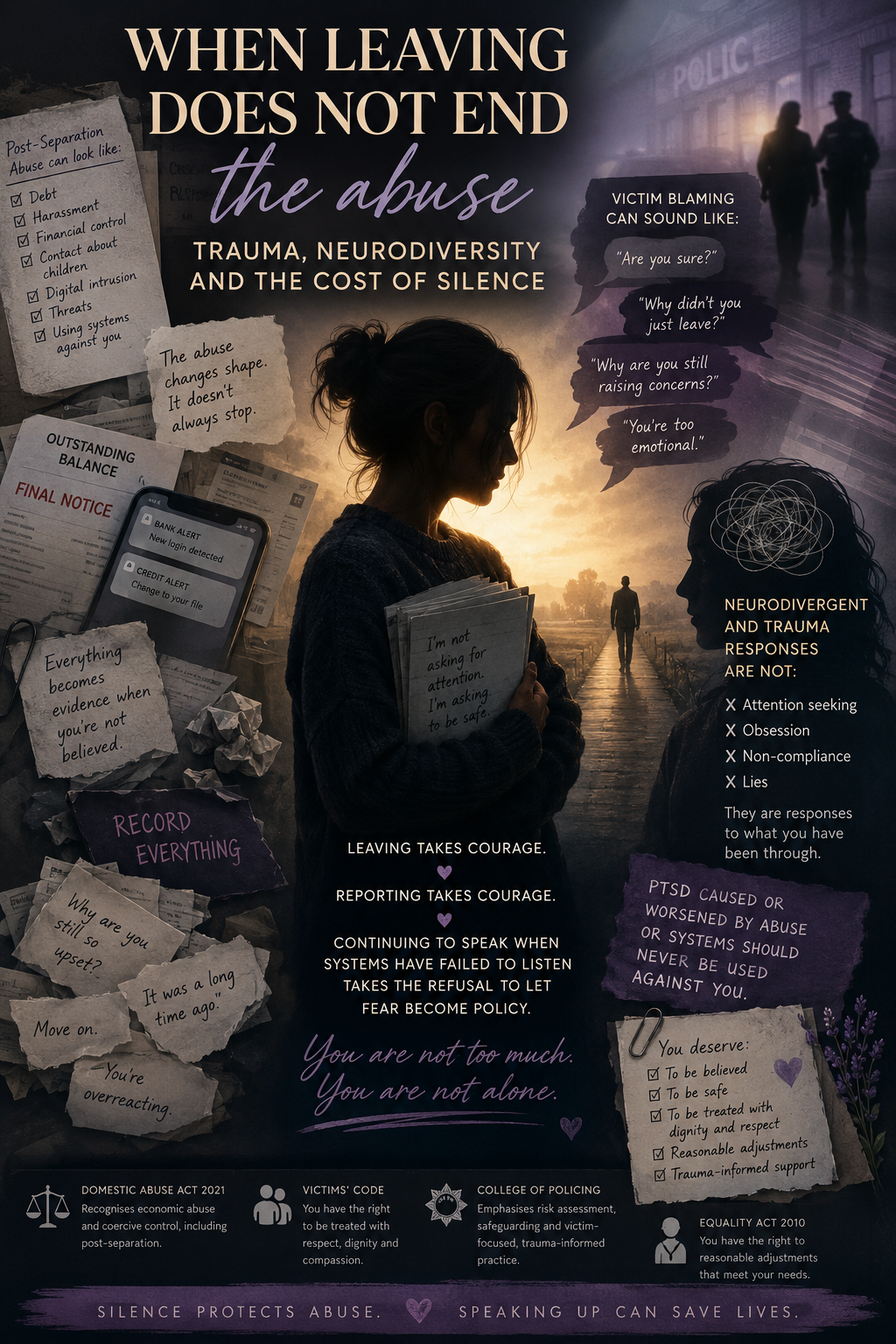
    When Leaving Does Not End the Abuse: Trauma, Neurodiversity and the Cost of Silence

    When Leaving Does Not End the Abuse: Trauma, Neurodiversity and the Cost of Silence

    One of the most dangerous misconceptions about domestic abuse is that leaving ends the risk.

    For many victims, leaving is not the end of the abuse. It is the beginning of a different form of it.

    The physical proximity may stop. The home may change. Legal processes may begin. Police may become involved. But control can continue through other routes: money, debt, data, children, reputation, paperwork, systems, silence, delay and disbelief.

    That is why post-separation abuse must be understood properly.

    The Domestic Abuse Act 2021 recognises that abuse is not limited to physical harm. It includes economic abuse, controlling or coercive behaviour, emotional abuse and psychological abuse where people are personally connected. Economic abuse can include behaviour that affects a person’s ability to acquire, use or maintain money, property, goods or services.

    That matters because victims have been saying this for years.

    Abuse can look like a threat.
    It can also look like a debt.
    A message.
    A form.
    A password alert.
    A contact detail used without consent.
    A system that expects the victim to prove, again, why they are concerned.

    The impact is not “just admin”. It is safety. It is housing. It is credit. It is parenting. It is employment. It is sleep. It is the constant mental load of checking whether something new is innocent, mistaken, malicious or dangerous.

    Many victims do not stay silent because they have nothing to say.

    They stay silent because speaking previously resulted in disbelief, minimisation, retraumatisation, procedural exhaustion, or fear that their trauma responses will be used against them.

    The question is not always:

    “Why didn’t they report?”

    Sometimes it is:

    “What happened when they did?”

    Victim blaming does not always arrive as open hostility. Sometimes it comes through tone, delay, minimisation, poor recording, disbelief, or a failure to join the dots. The victim is left feeling they must present perfectly to be believed: calm enough to be credible, detailed enough to be taken seriously, but not so detailed that they are labelled obsessive.

    For neurodivergent victims, this can become even harder.

    ADHD, autism, dyslexia, dyspraxia, trauma responses and PTSD can affect processing, recall, communication, emotional regulation and the ability to engage with authority under stress.

    Neurodivergent communication styles can be misread within safeguarding and criminal justice settings.

    Information dumping may be interpreted as inconsistency.
    Precision may be labelled fixation.
    A need for certainty may be mistaken for challenge.
    Written communication needs may be misunderstood as avoidance.

    Without trauma-informed and neurodiversity-informed practice, reasonable adjustments risk being treated as behavioural concerns rather than accessibility needs.

    That distinction matters.

    A trauma response is not a credibility flaw.
    A need for written records is not non-cooperation.
    Detailed documentation is not obsession.
    Hypervigilance is not hysteria.

    Across healthcare, safeguarding and policing, trauma-informed practice is not simply about kindness. It is about safety, accessibility, accurate assessment and reducing avoidable harm.

    When professionals misunderstand trauma or neurodivergence, the consequences are not theoretical. They affect credibility assessments, safeguarding responses, engagement, trust and outcomes.

    The Victims’ Code requires victims to be treated with respect, dignity, sensitivity, compassion and courtesy. The Equality Act 2010 requires reasonable adjustments where a person is disabled. The College of Policing recognises the importance of risk assessment, safeguarding and victim-focused practice in domestic abuse.

    These standards matter most when a victim is distressed, neurodivergent, traumatised or frightened of not being believed.

    There is a particular harm when PTSD caused or worsened by abuse, reporting, or system involvement is then treated as a reason to doubt the victim.

    That is how people become silent.

    Not because nothing happened.

    But because speaking up has already cost too much.

    Silence is dangerous. It allows patterns to continue unchecked. It leaves victims managing risk alone. It protects poor practice, whether by individuals or institutions. It teaches survivors that the safest thing to do is say nothing, document nothing, challenge nothing.

    That cannot be the standard.

    Victims should be able to report concerns without being punished for the effects of what they have survived. They should be able to ask for reasonable adjustments without being treated as difficult. They should be able to request email communication, accurate records and trauma-informed handling without that being reframed as unreasonable.

    Leaving takes courage.

    Reporting takes courage.

    Continuing to speak when systems have failed to listen takes something beyond courage. It takes the refusal to let fear become policy.

    Post-separation abuse is real. Economic abuse is real. Neurodivergent victims deserve to be understood. PTSD should never be weaponised against the person living with it.

    Leaving should not mean carrying lifelong responsibility for proving risk alone.

    Trauma should not become evidence against the person carrying it.

    Neurodivergence should not reduce access to protection.

    And no victim should ever be made to believe that silence is safer than seeking help.

  • When Rest Feels Unfamiliar: What a Quiet Evening Led Me to Learn About Polyvagal Theory

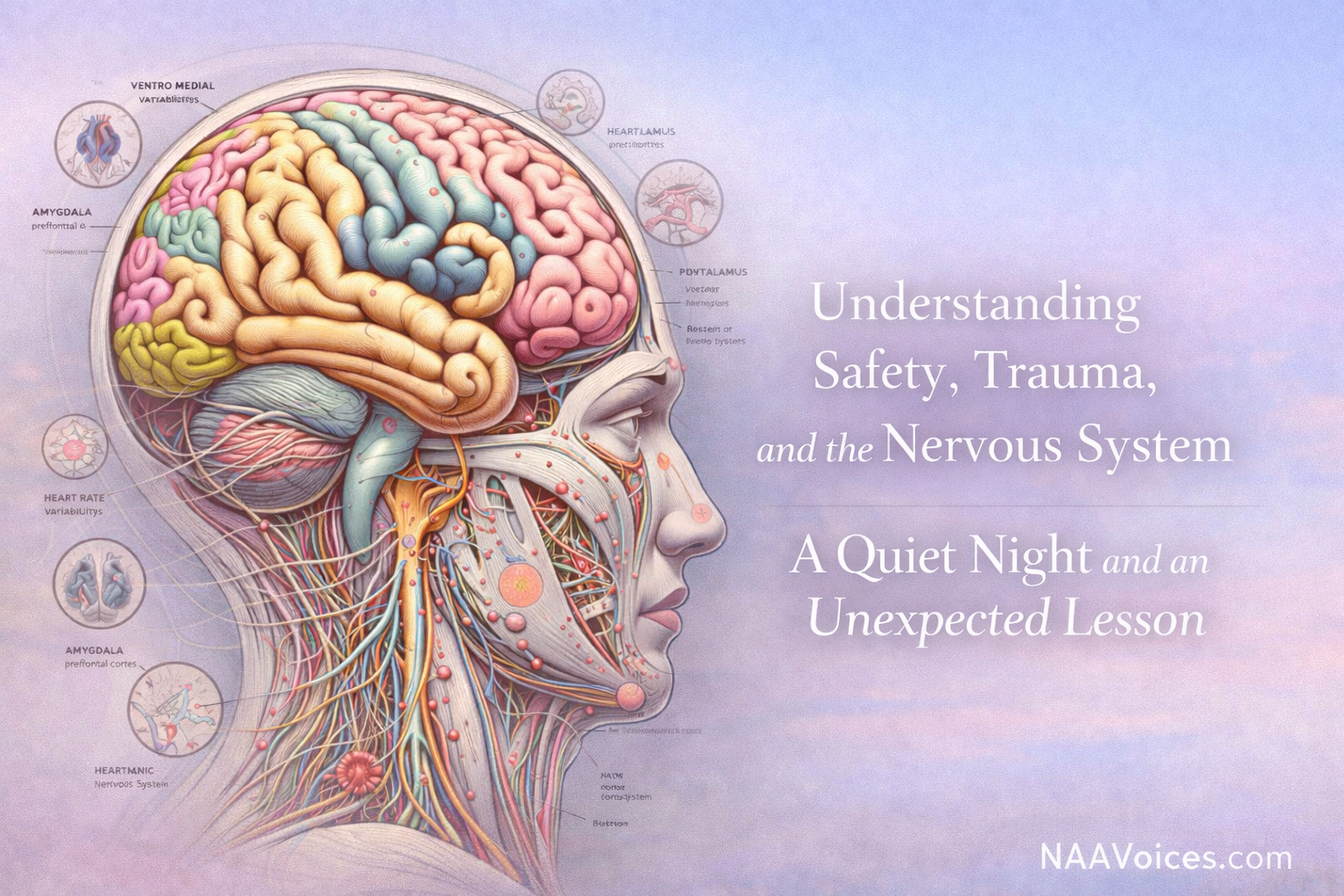
    When Rest Feels Unfamiliar: What a Quiet Evening Led Me to Learn About Polyvagal Theory

    A personal reflection on self-care, lived experience, and understanding the nervous system

    People say it all the time, don’t they?

    You need a hobby.
    You need to switch off.
    You need to rest.
    You need to look after yourself.

    I say it myself every single day at work. I talk to patients about self-care constantly. About slowing down, resting, listening to their bodies, giving themselves space, not pushing through the point of exhaustion. It is easy advice to give when you know how important it is.

    Actually doing it is something else entirely.

    Today, I got on with all the usual things that seem to fill a weekend. I packed things away, did some gardening, sorted out bits that needed doing, and got everything ready for the week ahead. Then I sat down.

    And I realised I had absolutely no idea what to do with myself.

    Everything that needed doing was done. The house was quiet. There was space. And instead of feeling peaceful, I felt a bit lost in it.

    That, in itself, says a lot.

    When “rest” turns into productivity

    So, instead of properly resting, I did what I often do when I don’t quite know how to stop: I found something useful to do.

    I logged on and started some training.

    I completed three courses that felt relevant to my role. One, the trust’s domestic abuse training, one on an update on the device we use for our patients currently on anticoagulation, and one on learning disabilities. I genuinely believe that in healthcare, we should never do things we are not competent or trained to do. Training matters. Competence matters. Safe practice matters.

    I write enough about those in roles who are far from competent at their jobs, and likely why I could never understand just how they could be allowed to cause so much harm in such a position of trust. I can’t and have never been that way.

    But as I worked through the modules, I found myself sitting with an unexpected feeling.

    A lot of the content felt familiar.

    Not because I think I know everything. Not because I think I am better than anyone else. And certainly not because I think there is anything wrong with the NHS including this content in training. Quite the opposite, actually.

    The truth is much more personal than that.

    Some of the content felt familiar because I have lived far more than what was covered in the modules.

    The domestic abuse training, in particular, was sobering. Not because it was poor training, but because it covered realities I understand not just professionally, but personally. As someone with lived experience of domestic abuse, there is something deeply unsettling about recognising your own reality in mandatory learning content. It is not a criticism of the training. It is simply the reality that some of us have lived beyond the points.

    The same was true of the learning disability training. Again, not because it was wrong or not useful, but because I have years of experience with learning disabilities, both in life and in practice. When something has been part of your world for a long time, the concepts can feel less like “new learning” and more like something you have been carrying, navigating, and understanding for years.

    If anything, that saddened me.

    Not because the training should be different, but because it was a reminder that some knowledge does not come from textbooks or e-learning packages. Sometimes it comes from surviving. Sometimes it comes from caring. Sometimes it comes from living through far more than anyone should ever have to.

    But alongside that sadness, I also felt something else.

    I felt proud that these subjects are incorporated into NHS training.

    I am genuinely glad that healthcare staff are being asked to think about domestic abuse. I am glad learning disability awareness is part of mandatory or role-relevant education. These are not optional extras. They matter. They affect how people are seen, how they are spoken to, how safe they feel, and the quality of care they receive.

    It also made me reflect on how I know that other organisations are provided with training in these areas, and that it’s individuals who let organisations and people down, not the lack of integration into professional practices expected of them.

    No training package can fully hold the depth, complexity, or emotional reality of lived experience. But it can lay foundations. It can raise awareness. It can get people thinking. And that is important.

    The promise I keep breaking

    As I sat there, I also had to be honest with myself.

    I have said so many times that I am going to stop doing work-related training at home. That this should be protected time during work hours. That we should not normalise doing professional development in our own time just because we are conscientious enough to do it.

    And yet there I was, doing exactly that.

    To be fair, my manager knows me well enough to know I do this. He would give me time back if I needed it, and I could do them at work. So this is not really about blame or pressure. It is about a pattern.

    I do it because I get bored.
    I do it because I am wired to keep moving.
    I do it because being productive often feels easier than being still.

    But eventually, I stopped after three courses.

    And then I decided to do something that wasn’t for work.

    At least, that is what I told myself.

    The course that was “not for work”

    I opened a course on Polyvagal Therapy.

    Technically, it is not part of my current role. But the minute I started reading, I found myself thinking exactly what I always do with anything related to mental health, trauma, behaviour, and human functioning:

    This absolutely overlaps with work.

    The reality is that physical and mental health are not separate. Trauma affects the body. Stress affects the body. Relationships affect the body. Safety affects the body. The way a person feels in themselves can shape everything from pain to sleep to behaviour to engagement with healthcare.

    Despite having postgraduate training in the neuroscience of psychology and mental health, there are always areas that deserve deeper exploration. Formal qualifications provide a strong foundation, but they do not cover every framework, model, or therapy in depth. Over the last few months, I have found myself increasingly drawn to therapy-based training. Part of that is professional curiosity. Part of it is personal interest. And part of it is knowing that, when life allows, I may want to build on some of this further.

    I already hold training as a narcissistic recovery coach, a trauma practitioner coach, and a neurodiversity coach. I can already see how these areas interconnect. But timing matters. Capacity matters. Mental well-being matters too. There is no point pursuing something deeply trauma-related if it comes at the cost of retraumatising yourself.

    Still, tonight, I found myself going down the polyvagal route.

    And before I knew it, I was already into Module 2 of 13.

    So, if you are curious too, come along with me while I break down some of what I learned tonight in plain English.


    What is Polyvagal Theory?

    Polyvagal Theory was developed by Dr Stephen Porges. In simple terms, it is a way of understanding how the body responds to safety, stress, danger, and connection.

    At the centre of it is the autonomic nervous system. This is the part of the nervous system that controls things we do not consciously have to think about, such as heart rate, breathing, digestion, and stress responses.

    Polyvagal Theory suggests that our nervous system is constantly scanning our environment and asking one basic question:

    Am I safe?

    And depending on the answer, the body responds in different ways.

    This does not happen only through conscious thought. In fact, it often happens before we have had time to think anything through logically.


    The body has different survival states

    One of the core ideas in Polyvagal Theory is that the nervous system can move through different states.

    1. Safe and connected

    This is the state where we feel calm enough to think clearly, talk, engage, and connect with other people.

    When someone feels safe, they are more likely to:

    • feel settled
    • communicate better
    • regulate emotions more easily
    • think more clearly
    • feel present rather than threatened

    This is where learning, healing, and connection happen best.

    2. Fight or flight

    When the nervous system senses danger, it can shift into a more activated state.

    This might look like:

    • anxiety
    • panic
    • racing thoughts
    • irritability
    • restlessness
    • muscle tension
    • feeling on edge
    • needing to do something immediately

    This is not a person being dramatic or difficult. It is the body preparing to protect itself.

    3. Freeze or shut down

    If something feels too overwhelming, the body can go the other way and begin to shut down.

    This can look like:

    • numbness
    • dissociation
    • emotional flatness
    • exhaustion
    • going blank
    • withdrawal
    • feeling stuck
    • loss of energy or collapse

    Again, this is not a weakness. It is another survival response.


    Neuroception: when the body decides before the mind

    One of the most interesting ideas in Polyvagal Theory is neuroception.

    This means the body is constantly scanning for signs of safety, danger, or threat without us consciously realising it.

    A warm tone of voice can signal safety.
    A harsh expression can signal danger.
    A sudden noise can make the body jump into alert.
    An unpredictable environment can keep the nervous system on edge.

    This helps explain why, sometimes, we can logically know we are safe, yet our bodies still react as though we are not.

    The nervous system has already made its assessment.


    Why this matters in real life

    This theory matters because it helps explain why people do not always respond to stress, fear, trauma, or relationships in neat or rational ways.

    It helps us understand that many behaviours are not simply choices or personality flaws. They are often body-based survival responses.

    Instead of asking,
    “What is wrong with this person?”
    it encourages us to ask,
    “What has this person’s nervous system learned to expect?”

    That is a very different question.

    And, frankly, a much more compassionate one.


    How polyvagal theory links to trauma and mental health

    Polyvagal Theory has been used to help explain a range of difficulties, especially in trauma and mental health.

    Trauma

    Trauma can leave the nervous system stuck in survival mode. Some people become hyper-alert, anxious, and reactive. Others shut down, dissociate, or feel emotionally disconnected. Some move between both.

    Anxiety

    From this perspective, anxiety is not just “worrying too much.” It can also be understood as the body being chronically mobilised and scanning for threat.

    Attachment and relationships

    If someone has grown up around unpredictability, neglect, fear, or instability, their body may learn that connection itself is not always safe. That can shape relationships for years.

    Neurodiversity

    There are also discussions around polyvagal-informed perspectives on sensory regulation, overwhelm, and social engagement in autistic individuals. Not as a full explanation, but as one possible framework for understanding regulation and safety.

    Dissociation

    Shutdown, disconnection, and dissociation can be understood as the body’s way of coping when something feels too much to bear.


    What I found useful about it

    What I like about this framework is that it joins the dots between body and mind.

    It does not treat emotions as if they exist in isolation from the nervous system. It recognises that what happens physically in the body influences how people think, feel, behave, connect, and cope.

    It is also compassionate.

    It reframes reactions that are often judged harshly. Fight, flight, freeze, withdrawal, panic, irritability, numbness, social shutdown — these stop looking like character flaws and start making sense as nervous system responses.

    That matters.


    But it is not beyond criticism

    At the same time, I think it is important to stay balanced.

    Polyvagal Theory is useful, but it is not a magic answer to everything. Some of its concepts are difficult to measure precisely, and some critics argue that parts of the theory are easier to describe than to validate scientifically in a consistent way.

    Human experience is also far more complex than any one theory can fully explain. Culture, identity, trauma, health, relationships, personality, social context, and lived experience all shape how people respond to the world around them.

    So for me, this is best seen as a helpful framework, not a complete explanation for all human behaviour.


    Why this connects so strongly with practice

    Even though I did not start this course “for work,” I can already see how much it overlaps with practice.

    In healthcare, and particularly in roles involving emotional well-being, safeguarding, neurodiversity, trauma, communication, and behaviour, this way of thinking is highly relevant.

    It affects:

    • how we understand distress
    • how we respond to fear
    • how we support regulation
    • how we communicate safety
    • how we avoid retraumatising people
    • how we interpret behaviours that may otherwise be misunderstood

    It also reinforces something that should sit at the heart of good care anyway: people need to feel safe before they can engage fully.


    Tonight started with something very simple: I was trying to stop.

    Trying to pause.
    Trying to rest.
    Trying not to fill every spare moment with tasks.

    And instead, I found myself learning.

    Tonight reminded me of something simple but powerful.

    Our bodies remember what our minds try to forget.

    Polyvagal Theory helps explain why people react the way they do to stress, trauma, and connection. Why some people become anxious. Why others shut down. Why safety matters more than we often realise.

    Understanding the nervous system does not solve everything.

    But it does something important.

    It reminds us that many reactions we judge as weakness or overreaction are actually survival responses.

    And when we begin to see people through that lens, we respond differently.

    Sometimes the most healing thing we can offer someone is not advice, not solutions, and not judgment.

    Sometimes it is simply helping them feel safe enough to exist without fear.

    NAAVoices.com

  • The Hidden Face of ADHD in Women: What I Learned Through Diagnosis, Research, and Real Support

    The Hidden Face of ADHD in Women: What I Learned Through Diagnosis, Research, and Real Support

    Part of the “Two Years On” reflection series

    When I first began writing publicly, I was writing from survival. I knew something was deeply wrong, but I didn’t yet have the language for it — not the link between ADHD, trauma bonds, or Rejection Sensitive Dysphoria. All I had were my experiences, raw and unfiltered. I could describe what was happening, but I couldn’t yet understand the mechanisms beneath it. At the time, that was all I had the capacity to do.

    I realised the trauma bond had finally broken just ten days after my diagnosis. I phoned Samaritans that day. From July 2023 until the day I left, I fought hard not to be pulled back into the narcissistic cycle. And as anyone who has lived it knows, things got much worse before they got better.

    Two years on, I understand so much more — not only about myself, but about why ADHD in women is so consistently overlooked by systems, professionals, and often by women themselves.

    This post is not about reopening old wounds. It is about articulating what I could not see then, and why that lack of language matters.

    Why ADHD in Women Is So Often Missed

    ADHD in women rarely matches the stereotype most people are taught to recognise. We are not always disruptive or visibly hyperactive. More often, we are capable, empathetic, articulate, and quietly overwhelmed.

    In women, ADHD commonly presents as:

    • internal restlessness
    • emotional intensity
    • chronic overwhelm
    • perfectionism masking chaos
    • people-pleasing
    • hyper-responsibility
    • burnout disguised as competence

    Looking back, I can see how easily this was misinterpreted. Functioning became evidence that nothing was wrong. Coping became proof that support was not needed. Distress was reframed as anxiety, sensitivity, or personality, rather than recognised as neurodevelopmental.

    This misinterpretation is one of the primary reasons women are missed.

    Masking: When Coping Looks Like Capability

    For much of my life, I believed I was simply managing. What I now understand is that I was masking.

    Masking in women is rarely a conscious performance. It is a survival response shaped by social conditioning. Girls learn early to adapt, to accommodate, and to regulate others’ emotions before their own. Instead of acting out, we internalise.

    Masking can look like:

    • over-preparing
    • rehearsing conversations
    • suppressing overwhelm
    • pushing through exhaustion
    • appearing calm while internally dysregulated

    When masking is effective, it is invisible, even to the person doing it. You believe you are coping. This is precisely why ADHD in women remains unseen for so long.

    When ADHD Traits Are Misunderstood and Used Against You

    Certain ADHD traits in women are frequently mislabelled. These include emotional openness and deep empathy. Other traits are oversharing, difficulty with boundaries, and fear of rejection.

    In isolation, these traits are often misunderstood. Within abusive or coercive dynamics, they can be exploited.

    In my case, qualities that were once strengths were gradually reframed as flaws. Openness became something to use against me. Fear of rejection became a tether. Empathy became a reason to excuse behaviour that should never have been excused.

    ADHD did not cause abuse.
    However, ADHD shaped how I responded and how difficult it was to leave.

    When neurodivergent traits are interpreted as emotional instability, the underlying ADHD becomes even harder to recognise.

    Rejection Sensitive Dysphoria: The Language I Did Not Have Then

    One of the most significant insights I have gained since writing my first blog is Rejection Sensitive Dysphoria. It is often referred to as RSD.

    At first, it was suggested to me. It gave language to experiences I had lived with for years. I could not explain them. These included the physical pain of rejection. There was also the intensity of emotional responses. It involved the fear of disappointing others and the difficulty letting go of harmful relationships.

    Two years ago, I wrote about heartbreak without understanding why it felt so overwhelming. I had the pain, but not the framework.

    RSD is not being overly sensitive. It is a neurological response linked to ADHD. In women, it is frequently mistaken for insecurity, dependency, or unresolved attachment. This is another reason women with ADHD are missed.

    The Science and the Gender Blind Spot

    ADHD is a neurodevelopmental condition involving differences in brain structure, connectivity, and neurochemistry. In women, these differences are often obscured by adaptation and expectation.

    Dopamine dysregulation affects motivation, reward, and emotional regulation, yet is often mislabelled as depression. Differences in the prefrontal cortex affect planning and impulse control, but many women compensate so effectively that impairment goes unnoticed. Oestrogen influences dopamine, meaning symptoms can fluctuate across the lifespan and are frequently misinterpreted as mood disorders. Trauma overlap further complicates presentation, and without trauma-informed assessment, ADHD is often overlooked.

    With this understanding, I can now see how clear the signs were, and how consistently they were misinterpreted.

    Facing the Truth, Two Years On

    I revisited the blog i wrote in august 2024. The words were honest and unfiltered, and the impact surprised me.

    “Today, I asked a close friend to repeat a truth I’ve been avoiding — a simple statement I’d asked them to say out loud because I needed to hear it clearly, without softening or reassurance. It’s a truth that has haunted me for months. Hearing it wasn’t easy, but it was necessary. That moment marked a turning point: a step towards understanding and, hopefully, eventually, healing.

    Because accessing mental health support has been so difficult, I’ve often relied on email as a way to process my thoughts. Recently, I stumbled across a message I’d written at the start of the month — a raw, honest attempt to explain how I was feeling. I hadn’t expected the emotional weight it would carry when I read it back. The truth, as they say, hurts. And for someone with ADHD — or anyone wired with deep empathy — it takes immense strength not to react defensively or spiral.

    I have to remind myself that I spent years ignoring the truth. Every word Gabriel spoke was a lie, and yet I believed him. I never imagined he could lie to me. That betrayal still stings. But knowing the truth now is vital. It’s the foundation for every decision I need to make moving forward.

    What I didn’t expect was the physical toll. After months free from cardiac pain, dizziness, and discomfort, it all came rushing back. I know this reckoning had to happen — but the old cliché, ‘things happen for a reason,’ feels hollow when I’m once again left picking up the pieces.”

    Two years ago, that destabilised me. Now, I understand it as integration, painful but necessary.

    Why Diagnosis Matters, Even Later in Life

    Diagnosis did not change who I am. It changed how I understand myself.

    It explained why I pushed myself to breaking point. It also explained why certain relationships felt impossible to leave. It showed why emotional pain felt disproportionate yet real. It clarified why I coped outwardly while struggling internally.

    More importantly, it removed shame.

    Two years on, I no longer see sensitivity as weakness or intensity as instability. I understand the wiring behind it, and why helping others was never a phase, but a responsibility born of insight.

    Two Years Forward

    Women with ADHD are not diagnosed late because they do not struggle.
    They are diagnosed late because they struggle quietly, competently, and alone.

    Two years ago, I was writing from survival.
    Now, I am writing from understanding.

    And understanding of ADHD, trauma, and RSD has not silenced me. It has clarified why advocacy, support, and speaking out were never optional.

    This is who I am now, with language I did not have then.

    Women with ADHD are not diagnosed late because they do not struggle. They are diagnosed late because they struggle quietly, competently, and alone.

    Understanding did not silence me. It clarified why helping was never optional.

    If You’re Struggling

    If anything in this post resonates with you and you’re finding things difficult, please reach out for support. You don’t have to navigate ADHD, emotional overwhelm, or rejection sensitivity on your own.

    If you’d like to explore more guidance, tools, and lived‑experience insights, you can also visit our Neurodiversity Home Page or browse the Neurodiversity Hub for further information and support.

    You can find reliable information, guidance, and community support through ADHD UK – Homepage – ADHD UK

    Reaching out is not a weakness — it’s the first step towards understanding yourself with compassion.

  • Understanding Types of Neurodiversity
Exploring the natural variation in how human brains process information, communicate, and experience the world

    Understanding Types of Neurodiversity Exploring the natural variation in how human brains process information, communicate, and experience the world

    Types of Neurodiversity | NAAVoices.com

    Understanding Types of Neurodiversity

    Exploring the natural variation in how human brains process information, communicate, and experience the world

    Survivor-led | Neuro-affirming | Evidence-informed

    What is Neurodiversity?

    Neurodiversity is the understanding that human brains and minds naturally differ from one another. Just as biodiversity describes the variety of life on Earth, neurodiversity recognises the natural variation in how people think, learn, process information, and experience the world.

    Australian sociologist Judy Singer coined the term in the 1990s, representing a shift from viewing neurological differences as deficits to recognising them as natural variations of human neurology. This perspective acknowledges that conditions such as autism, ADHD, dyslexia, dyspraxia, dyscalculia, and others are not disorders to be cured, but different ways of being that come with both challenges and strengths.

    The neurodivergent brain is not broken. The environments and expectations placed upon them often are.

    🧩
    Autism Spectrum Condition

    Autism

    A lifelong neurodevelopmental difference characterised by variations in brain structure, connectivity, and function that affect how individuals process sensory information, communicate, navigate social situations, and experience the world.

    Autism exists across a spectrum, meaning presentation varies significantly between individuals and across the lifespan. No two autistic people are the same.

    Common Characteristics

    • Sensory differences (hyper or hypo-sensitivity to stimuli)
    • Need for predictability and routine
    • Communication differences (literal interpretation, preference for clarity)
    • Social fatigue from interaction demands
    • Intense, focused interests in specific topics
    • Pattern recognition and systematic thinking
    • Attention to detail others may miss
    • Honesty and direct communication
    ⚡
    Attention Deficit Hyperactivity Disorder

    ADHD

    A neurodevelopmental condition characterised by differences in brain structure, neurochemistry, and connectivity that affect executive function, attention regulation, impulse control, and activity levels.

    ADHD manifests in three presentations: predominantly inattentive, predominantly hyperactive-impulsive, and combined presentation.

    Common Characteristics

    • Difficulty sustaining focus on routine tasks
    • Restlessness and internal sense of being “driven”
    • Impulsivity in decisions and actions
    • Executive dysfunction (planning, organising, initiating tasks)
    • Hyperfocus on tasks of high interest
    • Time blindness and difficulty with deadlines
    • Emotional dysregulation and intensity
    • Creativity and innovative thinking
    📖
    Specific Learning Difference

    Dyslexia

    A neurological difference that primarily affects reading, writing, spelling, and sometimes speaking. Dyslexia is characterised by difficulties with accurate and fluent word recognition, poor spelling, and decoding abilities.

    These difficulties typically result from a deficit in the phonological component of language and are often unexpected in relation to other cognitive abilities. Dyslexia affects approximately 10% of the population.

    Common Characteristics

    • Difficulty with phonological awareness (connecting sounds to letters)
    • Slow or inaccurate reading despite adequate intelligence
    • Challenges with spelling and written expression
    • Difficulty with rapid naming of familiar objects
    • Problems with working memory for verbal information
    • Exceptional visual-spatial reasoning abilities
    • Strong creative and problem-solving skills
    • Ability to see “big picture” connections
    🎯
    Developmental Coordination Disorder

    Dyspraxia

    A neurological condition affecting physical coordination, movement planning, and organisation. Dyspraxia impacts the ability to plan and coordinate physical movements, making everyday activities that others find simple potentially challenging.

    Also known as Developmental Coordination Disorder (DCD), dyspraxia affects fine motor skills (writing, buttoning), gross motor skills (sports, balance), and often organisational and planning abilities.

    Common Characteristics

    • Difficulty with fine motor skills (handwriting, using cutlery)
    • Challenges with gross motor skills (catching, balance)
    • Poor spatial awareness and perception
    • Difficulty following multi-step instructions
    • Challenges with organisation and time management
    • Sensitivity to sensory stimuli
    • Strong verbal communication skills
    • Creative thinking and empathy
    🔢
    Mathematical Learning Difference

    Dyscalculia

    A specific learning difference affecting mathematical understanding and number processing. Dyscalculia involves difficulty understanding number concepts, number relationships, and struggles with mathematical reasoning and calculation.

    Often called “maths dyslexia,” dyscalculia is a neurological condition affecting the areas of the brain responsible for processing numbers and mathematical concepts, affecting approximately 5-7% of the population.

    Common Characteristics

    • Difficulty understanding number concepts and relationships
    • Struggles with basic arithmetic (addition, subtraction)
    • Difficulty with mental maths calculations
    • Problems understanding mathematical symbols and operations
    • Challenges with time management and reading clocks
    • Difficulty with money management and financial concepts
    • Strong verbal and creative abilities
    • Often strong intuition and holistic thinking

    Recognising Neurodivergent Strengths

    Neurodivergent individuals often possess remarkable strengths that are valuable in personal, educational, and professional contexts. These strengths are not despite their neurodivergence, but often because of the unique way their brains process information.

    Pattern Recognition

    Enhanced ability to identify patterns, sequences, and logical systems—valuable in fields such as mathematics, programming, engineering, and data analysis.

    Creative Innovation

    Exceptional creativity, innovative thinking, and unconventional problem-solving approaches. Ability to see connections others miss and generate novel solutions.

    Hyperfocus & Expertise

    Periods of intense concentration when engaged with topics of interest, leading to remarkable productivity and deep levels of expertise in specific areas.

    Visual-Spatial Thinking

    Enhanced visual-spatial abilities allowing excellence in fields such as architecture, design, engineering, and the arts. Thinking in pictures rather than words.

    Attention to Detail

    Noticing details others overlook and maintaining high standards for accuracy and quality—invaluable in fields requiring meticulous attention.

    Authentic Communication

    Remarkable directness and honesty in communication. Authenticity that builds trust and cuts through ambiguity in professional and personal relationships.

    Holistic Thinking

    Ability to see “big picture” connections and think holistically about problems, bringing fresh perspectives to complex challenges.

    Resilience & Determination

    Having navigated a world not designed for their neurological differences, neurodivergent individuals often develop exceptional resilience and determination.

    Understanding Support Needs

    While neurodivergent individuals have many strengths, they may require specific supports to navigate a world predominantly designed for neurotypical functioning. Understanding these needs is essential for creating inclusive environments.

    Sensory Accommodations

    Many neurodivergent people experience sensory differences, being over- or under-sensitive to sounds, lights, textures, smells, or tastes.

    • Sensory-friendly environments with adjustable lighting
    • Noise-cancelling headphones and quiet spaces
    • Permission to use fidget tools or movement breaks
    • Choice over seating position and proximity to sensory triggers

    Clear Communication

    Direct, explicit communication without implied meanings or social subtext helps many neurodivergent individuals understand expectations.

    • Written instructions alongside verbal communication
    • Visual schedules and step-by-step instructions
    • Clear advance notice of changes to routine
    • Explicit expectations without “reading between the lines”

    Structure & Predictability

    Predictable routines and advance warning of changes help many neurodivergent people feel secure and manage anxiety.

    • Consistent daily structures and routines
    • Visual organisers, checklists, and timers
    • Advance notice of changes with explanations
    • Breaking down large tasks into manageable steps

    Time & Processing Support

    Additional time for processing information, completing tasks, or responding to questions can be crucial.

    • Extended time for exams and assignments
    • Flexible deadlines where possible
    • Patience during conversations and processing time
    • Tools to externalise time (visual timers, clocks)

    Executive Function Support

    Many neurodivergent individuals benefit from support with planning, organisation, time management, and task initiation.

    • Visual organisers and planning tools
    • Checklists and reminder systems
    • Task breakdown and step-by-step guidance
    • Regular check-ins without judgment

    Learning Accommodations

    Specific accommodations can make significant differences in educational and professional settings.

    • Assistive technology (text-to-speech, speech-to-text)
    • Alternative assessment methods
    • Multi-sensory learning approaches
    • Access to written materials in advance
  • NAAVoices.com I Need Support With… Neurodiversity A plain-English guide for England & Wales

    NAAVoices.com I Need Support With… Neurodiversity A plain-English guide for England & Wales

    I Need Support With… Neurodiversity (England & Wales) | NAAVoices.com

    I Need Support With… Neurodiversity

    A plain-English guide for England & Wales

    Prepared: 03 January 2026

    Section 1 — I Think I’m Autistic

    What that means (plain English)

    Autism is a neurodevelopmental difference that affects how people process information, communicate, and experience sensory input. It is not a defect; it is a different way of thinking and sensing. The goal is access, not “fixing”.

    💡 Good to know

    Many autistic people are diagnosed later in life, particularly women and those who have learnt to mask their differences. There is no “wrong” time to seek understanding.

    Communication & social interaction

    • Preferring clear, literal language; missing hints or sarcasm
    • Finding small talk draining; enjoying deep, specific topics
    • Needing longer processing time before responding

    Sensory & environment

    • Over- or under-sensitivity to sound, light, touch, or smell
    • Needing predictable routines; distress with sudden change
    • Regulation through stimming (movement, fidgets, repetition)

    Thinking style & interests

    • Focused interests/hyperfocus; detail-oriented thinking
    • Difficulty switching tasks; fatigue after social demands

    Key resources

    Steps to follow

    1. Book a GP appointment and request an autism assessment.
    2. Bring a one-page impact summary with 3–5 everyday examples.
    3. Children: referral to community paediatrics or neurodevelopmental services.
    4. Adults: referral to local adult autism service.
    5. England: ask about current Right to Choose options.
    6. Wales: schools use ALN/IDP; healthcare referrals via GP.
    • One-page symptom impact summary
    • 2–4 week diary of challenges and patterns
    • School/college notes or workplace observations
    • Any developmental history (if available)

    Communication

    • Ask for written instructions or agendas in advance
    • Request extra processing time in meetings
    • Use email for complex topics rather than impromptu discussions

    Sensory needs

    • Use noise-cancelling headphones or ear defenders
    • Request a desk away from bright lights or high-traffic areas
    • Take regular sensory breaks

    School/college

    • Request a quiet space for exams or study
    • Ask for advance notice of changes to timetables
    • Use visual schedules and reminders

    Workplace

    • Request flexible working patterns
    • Ask for clear, written expectations
    • Use calendar reminders and task lists

    Self-Reflection Quiz

    This is for self-understanding only — it is not a diagnostic tool.

    1. Do you prefer clear, direct communication over hints or implied meanings?

    2. Do you experience strong reactions to sensory input (sounds, lights, textures)?

    3. Do you have specific interests that you focus on deeply?

    Your Reflection

    These responses are for your own self-understanding. If several of these experiences resonate strongly with you, it may be worth exploring further through the assessment pathway above.

    Remember: self-identification is valid, and seeking formal assessment is a personal choice.

    ➡️ Next Steps

    • Review the evidence checklist in the Evidence Pack section
    • Use the GP referral template in the Templates section
    • Start a 2-week diary of your experiences
    • Connect with autistic-led communities for peer support

    Section 2 — I Think I Have ADHD

    What that means

    ADHD (Attention Deficit Hyperactivity Disorder) affects attention regulation, impulse control, and activation. It is a difference in how the brain prioritises and moves between tasks. ADHD is not about lacking attention—it’s about regulating attention.

    ℹ️ Note

    ADHD presents differently across people. Some experience primarily inattentive symptoms, others hyperactive-impulsive symptoms, and many a combination of both.

    Inattention

    • Difficulty sustaining focus on tasks that don’t interest you
    • Frequently losing items or forgetting appointments
    • Being easily distracted by external stimuli or internal thoughts
    • Making careless mistakes in work or daily tasks
    • Difficulty following through on instructions or finishing tasks

    Hyperactivity & impulsivity

    • Feeling restless or needing to move frequently
    • Talking excessively or interrupting others
    • Difficulty waiting your turn
    • Acting on impulse without considering consequences
    • Fidgeting or feeling internal restlessness

    Executive function

    • Difficulty starting tasks (task initiation)
    • Poor sense of time passing (time blindness)
    • Challenges with organisation and planning
    • Working memory difficulties
    • Emotional dysregulation

    Key resources

    Steps to follow

    1. Request an ADHD assessment via your GP.
    2. Bring an impact diary and school/work evidence.
    3. Children: referral to paediatrics or CAMHS/ND services.
    4. Adults: referral to adult ADHD service.
    5. England: ask about Right to Choose options.
    6. Wales: GP referral + ALN/IDP support in education.

    Activation strategies

    • Body doubling (working alongside others, even virtually)
    • Breaking tasks into tiny, concrete steps
    • Using external motivation (deadlines, accountability partners)
    • Starting with the easiest part of a task

    Time management

    • Visual timers and alarms
    • Time-blocking with buffer periods
    • Using “now, not now” systems rather than complex scheduling

    Workplace adjustments

    • Flexible working hours
    • Regular check-ins rather than end-of-project reviews
    • Permission to use headphones
    • Standing desk or opportunity to move

    Self-Reflection Quiz

    This is for self-understanding only — it is not a diagnostic tool.

    1. Do you often struggle to start tasks, even ones you want to do?

    2. Do you frequently lose track of time or underestimate how long things take?

    3. Do you experience intense focus on interesting activities but struggle with less engaging ones?

    Your Reflection

    These responses are for your own self-understanding. If several of these experiences significantly impact your daily life, it may be worth discussing with your GP.

    ADHD assessment considers how symptoms affect you across different areas of life.

    ➡️ Next Steps

    • Start an impact diary tracking challenges over 2–4 weeks
    • Gather any school reports mentioning concentration
    • Use the GP referral template in the Templates section
    • Try some of the “what helps” strategies while waiting

    Section 3 — Learning Differences

    Dyslexia, Dyspraxia/DCD, Dyscalculia

    Dyslexia primarily affects reading, writing, and spelling. It is not related to intelligence. People with dyslexia may process written language differently, often showing strengths in verbal reasoning and creative thinking.

    Indicators

    • Reading slowly or with effort
    • Spelling inconsistently
    • Difficulty copying accurately
    • Strong verbal skills but written work doesn’t reflect ability

    Dyspraxia (also called DCD) affects motor coordination and planning. It can impact fine motor skills, gross motor skills, and motor planning.

    Indicators

    • Difficulty with handwriting, often slow or illegible
    • Challenges with physical coordination and balance
    • Trouble learning new motor skills
    • Challenges with organisation and planning sequences

    Dyscalculia affects numerical understanding and mathematical reasoning. Like dyslexia, it is not related to intelligence.

    Indicators

    • Difficulty understanding number concepts
    • Trouble with mental arithmetic
    • Challenges remembering mathematical procedures
    • Difficulty with time, money, and measurement

    Key resources

    School/College (England)

    1. Speak to the school SENCO.
    2. Request assessment through school or educational psychologist.
    3. School should provide SEN Support without formal diagnosis.
    4. For significant needs, request EHCP assessment.

    Adults & Higher Education

    1. Contact your university’s disability service for assessment.
    2. Apply for Disabled Students’ Allowance (DSA).
    3. DSA can fund specialist equipment and study support.

    Assistive technology

    • Text-to-speech software
    • Speech-to-text for writing
    • Reading rulers and coloured overlays
    • Mind-mapping software

    Assessment adjustments

    • Extra time in exams (usually 25%)
    • Use of a reader or scribe
    • Alternative assessment formats
    • Coloured paper or screen backgrounds

    ➡️ Next Steps

    • Contact your school’s SENCO/ALNCo or university disability service
    • Explore DSA if you’re in higher education
    • Try assistive technology — many options are free
    • Use the school/college request template

    Section 4 — Templates (Copy-Ready)

    These templates can be adapted to your situation. Replace the bracketed text with your specific details.

    📋 GP Referral Request
    Dear [GP Name/Practice],I am writing to request a referral for [autism/ADHD/neurodevelopmental] assessment.I have been experiencing difficulties with [brief summary — e.g., focus and organisation / social communication and sensory processing] that significantly impact my daily life.Key areas of difficulty include: • [Example 1 — e.g., I struggle to maintain focus on tasks] • [Example 2 — e.g., I find it very difficult to start tasks] • [Example 3 — e.g., I feel overwhelmed in busy environments]These difficulties have been present [since childhood / for as long as I can remember] and affect my [work/education/relationships/daily functioning].I have attached a summary of my experiences. I would also like to discuss Right to Choose options if available.Yours sincerely, [Your Name] [Date of Birth] [NHS Number if known]
    📋 School/College Adjustments Request
    Dear [SENCO/ALNCo/Tutor Name],I am writing to discuss support for [my child, Name / myself] who [is awaiting assessment for / has characteristics of] [autism/ADHD/dyslexia/other].Current difficulties include: • [Example 1 — e.g., difficulty concentrating in busy environments] • [Example 2 — e.g., challenges with written work] • [Example 3 — e.g., need for routine and advance notice of changes]We would like to request a meeting to discuss: • What support can be put in place now • How needs can be monitored and reviewed • What the assessment pathway looks likeAdjustments that would help include: • [Suggestion 1 — e.g., seating at the front] • [Suggestion 2 — e.g., written instructions alongside verbal] • [Suggestion 3 — e.g., extra time for processing]Yours sincerely, [Parent/Carer Name or Student Name] [Date]
    📋 Workplace Adjustments Request
    Dear [Manager/HR Contact],I am writing to discuss reasonable adjustments that would help me work effectively. I [have been diagnosed with / am awaiting assessment for / identify as having] [autism/ADHD/dyslexia/other].This affects me in the following ways at work: • [Example 1 — e.g., difficulty filtering background noise] • [Example 2 — e.g., challenges with task prioritisation] • [Example 3 — e.g., need for clear, written instructions]Adjustments that would help me perform at my best include: • [Adjustment 1 — e.g., permission to use headphones] • [Adjustment 2 — e.g., written agendas before meetings] • [Adjustment 3 — e.g., flexible working hours]I would welcome a conversation about how we can work together.Yours sincerely, [Your Name] [Date]
    💡 Tip

    Keep a copy of all correspondence. Follow up verbal conversations with an email summarising what was discussed.

    Section 5 — Evidence Pack (Checklist)

    Gathering evidence strengthens your case for assessment and support. Not everything will apply — collect what’s relevant.

    Personal documentation

    • One-page impact summary (3–5 concrete examples)
    • 2–4 week diary of difficulties and patterns
    • Timeline of when you first noticed difficulties
    • List of strategies you’ve tried

    Childhood/developmental history

    • School reports (comments about behaviour, concentration)
    • Any previous assessments or reports
    • Parent/carer observations (written statement)
    • Developmental milestones if known

    Current impact

    • Examples of impact on work or education
    • Examples of impact on relationships
    • Examples of impact on daily living
    • Partner/family/colleague observations

    Professional evidence

    • Letters from previous healthcare providers
    • Occupational health reports
    • Educational psychology assessments

    Section 6 — Important Notes

    ⚠️ Please read

    This resource is for information and self-understanding only. It does not constitute medical advice, diagnosis, or treatment.

    About this resource

    • This is educational, not diagnostic. The quizzes here are designed to help you understand yourself better — they cannot replace professional assessment.
    • Self-identification is valid. Many neurodivergent people find understanding without or before formal diagnosis.
    • Pathways vary. Assessment availability and processes differ across England and Wales, and change over time.

    Your rights

    • You have the right to request assessment and to be taken seriously
    • You can ask for reasonable adjustments without a formal diagnosis
    • In England, you have the Right to Choose for some mental health assessments
    • You can request copies of your medical records and reports

    If you’re struggling

    • Take breaks — this doesn’t have to be done all at once
    • Ask someone you trust to help with paperwork
    • Connect with neurodivergent communities for peer support
    • Remember that your experiences are valid regardless of diagnosis
    💡 Remember

    You are not broken. You are not “too much” or “not enough”. Neurodivergent brains work differently, and understanding how yours works is a form of self-care.

    You’ve taken an important step

    Seeking understanding about how your brain works takes courage. Whether you’re at the beginning of this journey or well along the path, know that you deserve support, accommodations, and acceptance.

    This resource was created to make navigating these systems a little easier. You don’t have to do this alone.

  • Supporting Neurodivergent Individuals: Multi‑Agency Guidance and Pathways for Health, Education and Social Care

    Supporting Neurodivergent Individuals: Multi‑Agency Guidance and Pathways for Health, Education and Social Care

    NAAVoices – Neurodiversity-Affirming Guidance & UK Support Pathways

    Choose Your Path

    Neurodiversity-Affirming Guidance for Real Life

    UK pathways, evidence-based strategies, and ready-to-use templates — built to help you communicate needs, access support, and reduce harm from misunderstandings.

    About the Creator

    Built from Professional & Lived Experience

    I’m neurodivergent (ADHD, dyspraxia, dyslexia) and a Specialist Nurse Practitioner with a PGCert in Psychology & Neuroscience of Mental Health. This hub translates complexity into practical, respectful steps, enabling people to communicate their needs, access support, and reduce harm from misunderstandings.

    Privacy commitment: Names and identifying details are never shared.

    Choose Your Path

    Select your role for tailored guidance

    For Parents & Carers

    Navigate school support, healthcare pathways, and your child’s rights

    England: Getting School Support (SEND)

    Step-by-Step Process

    1. Ask for SEN Support now — You don’t need a diagnosis. Put your request in writing to the SENCO (Special Educational Needs Coordinator).
    2. Agree on reasonable adjustments — The school must make changes to remove barriers (e.g., visual timetables, movement breaks, quiet spaces).
    3. Get a written plan — Request an SEN Support Plan or provision map detailing what support will be provided, by whom, and when.
    4. If needs are significant/long-term, request an EHC needs assessment — This formal assessment can lead to an Education, Health and Care Plan with legally binding provision.
    5. Review termly — Insist on regular reviews with measurable outcomes.
    Key Legislation (England)

    Get help: IPSEA provides free legal advice for parents.

    Wales: Getting School Support (ALN)

    Step-by-Step Process

    1. Request an ALN assessment — Contact the school’s Additional Learning Needs Coordinator (ALNCo) in writing.
    2. Agree on an Individual Development Plan (IDP) — This must include specific adjustments, provision, and outcomes.
    3. Review frequently — IDPs must be reviewed regularly and updated as needs change.
    Key Legislation (Wales)

    Get help: SNAP Cymru provides free support for Welsh families.

    Getting a Healthcare Assessment

    ADHD & Autism Referrals

    1. Book a GP appointment — Request a referral to your local neurodevelopmental assessment service.
    2. Prepare your evidence — Keep an impact diary showing how differences affect daily life. Use the One-Page Symptom Impact Summary template below.
    3. England: Consider Right to Choose — You can choose an NHS-funded private provider for faster assessment.
    4. Expect waiting times — NHS pathways can have long waits. Private assessment costs £500-£2000.

    Your Legal Rights

    You Do NOT Need a Diagnosis

    The Equality Act 2010 protects anyone with a substantial, long-term impairment affecting day-to-day activities. Schools must make reasonable adjustments immediately, based on identified need.

    If school says “wait for assessment”: Politely remind them that reasonable adjustments are required now, and waiting for diagnosis breaches the Equality Act.

    Sensory & Eating: Practical Support

    Restricted diets and sensory sensitivities can impact constipation, growth, and dental health. These aren’t “fussy eating” — they’re neurological responses requiring practical support.

    Portion Prompts Visual guides and portion control tools to support consistent intake
    Safe-Food Rotations Systematically expand accepted foods whilst respecting sensory needs
    Texture Ladders Gradual exposure to new textures at the child’s pace
    Hydration Reminders Scheduled prompts and preferred containers to support fluid intake
    School Lunch Notes Written agreements that respect safe foods whilst gently expanding choice
    Toothbrushing Scaffolds Visual steps, hand-over-hand support, and sensory modifications

    What is Neurodiversity?

    Neurodiversity recognises that differences such as autism, ADHD, dyslexia, and dyspraxia are natural variations, not defects. The aim isn’t to ‘fix’ individuals but to reduce barriers so everyone can thrive.

    What is Neurodiversity?

    Neurodiversity recognises that differences such as autism, ADHD, dyslexia, and dyspraxia are natural variations, not defects. The aim isn’t to ‘fix’ individuals but to reduce barriers so everyone can thrive.

    For Healthcare Professionals

    Clinical pathways, NICE guidance, and referral frameworks

    ADHD Assessment Pathway

    Clinical Standards

    NICE Guideline: NG87 – Attention deficit hyperactivity disorder: diagnosis and management

    Key Criteria
    • Symptoms present before age 12
    • Pervasive across multiple settings (home, school, work)
    • Functional impairment in social, academic, or occupational functioning
    • Not better explained by another condition
    Referral Pathway
    1. GP/Primary Care — Initial screening, developmental history, impact assessment
    2. Specialist Assessment — Psychiatrist or paediatrician conducts full diagnostic evaluation
    3. Multi-informant approach — Gather evidence from parents, teachers, and self-report
    4. Post-diagnosis support — Medication titration if indicated, psychoeducation, signposting

    Autism Assessment Pathway

    Clinical Standards

    NICE Guidelines:

    Core Features
    • Persistent difficulties in social communication and social interaction
    • Restricted, repetitive patterns of behaviour, interests, or activities
    • Symptoms present from early developmental period
    • Functional impairment across settings
    Assessment Process
    1. Developmental history — Early childhood development, social-communication milestones
    2. Multidisciplinary team assessment — Psychiatrist, psychologist, SALT, OT as appropriate
    3. Standardised tools — ADOS-2, ADI-R, or equivalent gold-standard instruments
    4. Differential diagnosis — Rule out social anxiety, attachment difficulties, trauma responses

    Reasonable Adjustments in Healthcare Settings

    Equality Act 2010 compliance: Healthcare settings must make reasonable adjustments for neurodivergent patients.

    Environment
    • Quiet waiting areas
    • First/last appointments
    • Reduced sensory stimulation
    • Clear signage
    Communication
    • Written appointment confirmations
    • Literal, concrete language
    • Visual aids and summaries
    • Allow extra processing time
    Consultation
    • Allow supporter present
    • Provide written aftercare instructions
    • Longer appointment slots
    • Avoid unnecessary waiting

    For Schools & Educators

    SEND/ALN statutory duties, classroom adjustments, and inclusive practice

    England: SEND Framework & Statutory Duties

    Legal Requirements

    Legislation: Children and Families Act 2014 | SEND Code of Practice 2015

    Graduated Approach
    1. Assess — Identify needs through observation, assessment, and consultation with parents and pupil
    2. Plan — Agree on adjustments, interventions, and expected outcomes in a written SEN Support Plan
    3. Do — Implement agreed provision; class teacher retains responsibility with SENCO support
    4. Review — Evaluate impact termly; adjust provision as needed
    When to Request an EHC Needs Assessment
    • Needs are significant and long-term
    • Multiple cycles of SEN Support have not led to adequate progress
    • Specialist provision or input required
    • Parent or young person requests assessment
    Key Principle

    You must not wait for a diagnosis to provide SEN Support. Provision should be based on identified need and functional impact, not diagnostic labels.

    Wales: ALN Framework & Statutory Duties

    Legal Requirements

    Legislation: Additional Learning Needs and Education Tribunal (Wales) Act 2018 | ALN Code 2021

    Individual Development Plan (IDP)
    1. Identify ALN — Determine whether learner has additional learning needs
    2. Decide on ALP — Identify additional learning provision required
    3. Prepare IDP — Document needs, provision, outcomes, and review arrangements
    4. Review and revise — Minimum annual review; more frequent if needs change
    Person-Centred Approach
    • Learner’s views must be sought and considered
    • Parents/carers must be involved in decision-making
    • Provision must prepare learners for adulthood
    • Collaborative multi-agency working

    Practical Classroom Adjustments

    Attention & Executive Function
    • Short, concrete instructions (one step at a time)
    • Visual now-next boards
    • Timers and visual schedules
    • Chunked tasks with clear success criteria
    • Movement breaks between activities
    Sensory
    • Ear defenders or quiet workspace option
    • Reduced visual clutter
    • Predictable routines and transitions
    • Fidget tools or movement opportunities
    • Flexible seating arrangements
    Communication
    • Literal, concrete language (avoid idioms)
    • Written instructions alongside verbal
    • Extra processing time for responses
    • Visual supports (symbols, photos, diagrams)
    • Pre-teaching of new vocabulary
    Recording & Assessment
    • Alternative recording (scribe, voice-to-text)
    • Reduced copying from board
    • Assistive technology (laptop, spell-checker)
    • Extra time or rest breaks in assessments
    • Alternative formats for demonstrating knowledge

    Equality Act 2010: Schools’ Duties

    Equality Act 2010 — Schools must make reasonable adjustments for disabled pupils

    Three Requirements
    1. Changing provisions, criteria, or practices — e.g., allowing extra time, reducing written work
    2. Providing auxiliary aids — e.g., visual timetables, fidget tools, assistive technology
    3. Making physical alterations — e.g., quiet spaces, sensory-friendly environments

    Critical: Reasonable adjustments duty is anticipatory. Schools must not wait for a request or diagnosis — they should identify and remove barriers proactively.

    UK Legislation & Rights

    Understanding your legal rights is essential for accessing support. Here’s what protects neurodivergent people across the UK.

    England: Education Framework

    Wales: Education Framework

    UK-Wide: Equality & Work

    Healthcare & Assessment

    Key Principle Across All Frameworks

    You do not need a diagnosis to request reasonable adjustments. Support should be based on identified need and functional impact, not diagnostic labels. The Equality Act 2010 protects anyone with a physical or mental impairment that has a substantial and long-term adverse effect on their ability to carry out normal day-to-day activities.

    Key Support Organisations

    England:
    IPSEA (Independent Provider of Special Education Advice)
    Contact (for families with disabled children)
    SOS!SEN (Special Educational Needs advice)
    Wales:
    SNAP Cymru (Special Needs Advisory Project)
    PACEY Cymru (Professional Association for Childcare)
    Meic (Advocacy for children and young people)

    Sensory & Eating: Real-World Impact

    Restricted diets (such as dry, predictable foods) and sensory sensitivities can impact constipation, growth, and dental health. These aren’t “fussy eating” — they’re neurological responses that require practical support.

    Practical Levers

    Portion Prompts Visual guides and portion control tools to support consistent intake
    Safe-Food Rotations Systematically expand accepted foods while respecting sensory needs
    Texture Ladders Gradual exposure to new textures at the child’s pace
    Hydration Reminders Scheduled prompts and preferred containers to support fluid intake
    School Lunch Notes Written agreements that respect safe foods while gently expanding choice
    Toothbrushing Scaffolds Visual steps, hand-over-hand support, and sensory modifications
    Dentist-Ready Summaries One-page profiles explaining sensory needs and successful strategies

    Learning Differences

    Dyslexia, dyspraxia, and dyscalculia

    Support isn’t about lowering expectations

    It’s about changing the access route so neurodivergent learners can demonstrate their full capability.

    Assistive Technology Text-to-speech, speech-to-text, screen readers, mind-mapping software
    Alternative Formats Audio materials, visual organizers, simplified instructions, colour-coding
    Reduced Time Pressure Extended deadlines, rest breaks, chunked assessments
    OT-Informed Strategies Handwriting alternatives, movement breaks, adapted equipment

    Official Resources & Support Services

    Direct links to UK legislation, guidance, and support organisations

    📋

    England: SEND Support

    Official guidance, legal frameworks, and parent resources

    ✓

    Wales: ALN Support

    Welsh framework, statutory guidance, and family resources

    📄

    UK-Wide Support

    Equality Act guidance, workplace support, and advocacy organisations

    🏥

    Healthcare Pathways

    NHS guidance, NICE standards, and diagnostic pathways

    💼

    Workplace & Legal

    Employment rights, tribunals, and advocacy support

    Frequently Asked Questions

    Do I need a diagnosis to get adjustments?
    No — adjustments should be made based on identified need and functional impact. The Equality Act 2010 protects anyone with a substantial, long-term impairment affecting day-to-day activities, regardless of diagnostic label.
    What’s the difference between England and Wales frameworks?
    England uses SEN Support and EHCPs (Education, Health and Care Plans); Wales uses ALN (Additional Learning Needs) and IDPs (Individual Development Plans). Both systems must provide reasonable adjustments, but the terminology and processes differ.
    What if school says ‘wait for assessment’?
    Reasonable adjustments should start immediately based on current need. Assessment may clarify needs further, but waiting for diagnosis should never delay basic support. Reference the Equality Act 2010 duty to make adjustments.
    How do I evidence impact?
    Use the One-Page Symptom Impact Summary to document specific examples of how differences affect daily functioning. Keep logs of incidents, attendance patterns, work avoidance, meltdowns, or health impacts. Photographs of work samples can also demonstrate need.
    Can I request workplace adjustments without disclosing my diagnosis?
    Yes. You can request adjustments by describing functional needs without naming a diagnosis. However, disclosure may help access more comprehensive support and protection under the Equality Act 2010.
    What is Access to Work and who can apply?
    Access to Work is a UK government scheme providing practical support if your disability or health condition affects your work. It can fund specialist equipment, adaptations to premises, support workers, job coaches, and travel costs. Anyone employed or self-employed in England, Scotland, or Wales can apply.

    Glossary

    Reasonable Adjustments

    Practical changes to remove barriers for disabled people, required under the Equality Act 2010. Must be implemented unless they impose a disproportionate burden on the organisation.

    SEN (England)

    Special Educational Needs — the framework used in England for identifying and supporting children with learning differences or disabilities.

    ALN (Wales)

    Additional Learning Needs — Wales’s framework (replacing SEN) for supporting learners aged 0–25 who need additional provision to access education.

    EHCP (England)

    Education, Health and Care Plan — a legal document in England describing a child or young person’s needs and the provision required to meet them (ages 0–25).

    IDP (Wales)

    Individual Development Plan — Wales’s statutory plan outlining additional learning provision, targets, and review arrangements for learners with ALN.

    Right to Choose (England)

    NHS policy allowing patients in England to choose any qualified provider for NHS-funded treatment, including ADHD and autism assessments (subject to local ICB policies).

    Public Sector Equality Duty

    Legal obligation on public bodies to eliminate discrimination, advance equality of opportunity, and foster good relations. Applies to schools, NHS, local authorities, etc.

    Executive Function

    Mental skills for planning, organizing, focusing attention, managing time, and regulating behavior. Often affected in ADHD, autism, and dyspraxia.

    Sensory Processing

    How the nervous system receives and responds to sensory information (sight, sound, touch, taste, smell, movement). Differences are common in neurodivergent people.

    Reasonable Adjustments Request Template (UK)

    Use this template to request support at school, work, or healthcare settings under the Equality Act 2010. Copy the parts you need, add specifics, and attach any one-page summaries or evidence.

    1) Cover Line

    Subject: Request for Reasonable Adjustments – [Your Name] / [Child’s Name] – [Setting]

    2) Quick Summary

    I am requesting reasonable adjustments for [me/my child] due to [diagnosed/suspected] neurodivergence (e.g., ADHD, autism, dyslexia, dyspraxia). These adjustments are needed to remove barriers to access and participation.

    3) Needs in Brief

    • Attention/processing: short, concrete instructions; extra processing time
    • Sensory: reduced noise/lighting; ear defenders; predictable routines
    • Executive function: visual now–next; timers; chunked tasks; prompts
    • Communication: written follow-up; literal language; avoid idiom
    • Environment: quiet space option; seating away from high-traffic areas

    4) Adjustments Requested

    School/College: visual timetable; movement breaks; reduced copying; alternative recording; toilet/changing privacy plan; flexible transitions

    Workplace: written instructions; flexible deadlines; reduced meetings; quiet workspace; noise-cancelling; clear priorities; meeting agendas in advance

    Healthcare: quiet waiting; first/last appointment; written after-care; allow supporter present

    5) Legal Footing (Plain English)

    Under the Equality Act 2010, organisations must make reasonable adjustments to avoid substantial disadvantages arising from disability. Public bodies also have a Public Sector Equality Duty.

    6) Close

    Please confirm in writing which adjustments will be implemented and when. I’m happy to discuss workable options.

    Kind regards,
    [Name] | [Role/Relationship] | [Contact]

    School/SEND Meeting Checklist (UK)

    A one-page prompt sheet for parents and professionals. Adapt for EHCP (England) or ALN IDP (Wales).

    Before the Meeting

    • Confirm purpose (review, new support, escalation) and attendees
    • Send a one-page profile and recent symptom-impact summary
    • Request data: attendance, progress, behaviour/incident logs, current support
    • List top 3 barriers to access; bring examples
    • Agree time limits and desired outcomes in advance

    During the Meeting

    • Start with the child’s profile: communication preferences and sensory needs
    • Agree measurable outcomes (what will change in 12 weeks)
    • Specify provision: frequency, duration, who, where (be concrete)
    • Record reasonable adjustments (classroom, transitions, unstructured times)
    • Plan reviews; name a lead and dates

    After the Meeting

    • Receive written notes/plan (SEN Support / IDP / IEP) and check accuracy
    • Share with child in accessible language/visuals
    • Set calendar reminders for review points
    • Collect evidence: work samples, incident notes, attendance/health impacts
    • Escalate if plan isn’t implemented (follow local policy)

    One-Page Symptom Impact Summary

    Name: ____________
    DOB: ____________
    Date: ____________
    Setting: ____________
    Prepared by: ____________

    Main Differences (tick/add):

    ☐ Attention/organisation
    ☐ Sensory (seek/avoid)
    ☐ Communication/pragmatics
    ☐ Social interaction
    ☐ Motor/dyspraxia
    ☐ Sleep/energy

    How This Shows Up (2–4 examples):

    • Loses track of multi-step instructions; needs one thing at a time
    • Distressed by hand dryers; uses ear defenders
    • Eats only dry/predictable foods; needs prompting and portion monitoring
    • Bolts near roads; requires hand-held guidance when outside

    What Helps (reasonable adjustments):

    • Visual now–next, written instructions, extra processing time
    • Movement breaks; reduced noise/lighting; predictable routines
    • Alternative recording of work; reduced copying; quiet space when needed
    • Meal structure, safe foods list, hydration prompts; toothbrushing scaffold

    Agreed Actions (who/what/when):

    1) _________________________ by __________ (name) by ______ (date)
    2) _________________________ by __________ (name) by ______ (date)
    3) _________________________ by __________ (name) by ______ (date)

    Review Date & Metrics:

    Review on: ________
    Success looks like: ____________________________

    NAAVoices.com | Neurodiversity-Affirming Advocacy

    Created by NAAVoices

    Resource created by pseudonym Laura Prince, founder of NAAVoices.com

    Privacy Commitment: Names and identifying details are never shared | © 2025

  • Mental Health & Neurodiversity Helplines and Organisations.

    Mental Health & Neurodiversity Helplines and Organisations.

    Mental Health & Neurodiversity Support Resources | NAAVoices.com
    Empowering voices, supporting recovery
    🚨 In immediate danger? Call 999 | Urgent mental health support: 111 (Option 2)

    Mental Health & Neurodiversity Support

    Comprehensive resources for individuals, families, and professionals

    What type of support are you looking for?

    🧠
    Mental Health Support
    Crisis helplines, NHS services, counseling, and emotional wellbeing resources
    🧩
    Neurodiversity Support
    ADHD, Autism, Dyslexia, and other neurodevelopmental support services

    You’re Not Alone

    This comprehensive resource directory connects you with mental health and neurodiversity support services. Whether you’re seeking crisis support, diagnostic assessment, or ongoing help for yourself or a loved one, these services are here for you. Help is always available, and no concern is too small to reach out.

    🚨

    Crisis Support – Wrexham & North Wales

    NHS 111 Wales Mental Health Option
    Phone: 111 then select Option 2 (24/7)
    For urgent mental health concerns. Connects you directly to a mental health professional 24 hours a day, 7 days a week.
    C.A.L.L. Helpline (Wales)
    Phone: 0800 132 737 (24/7, Free)
    Text: Text ‘help’ to 81066
    Community Advice and Listening Line – Wales’ dedicated mental health helpline. For anyone in Wales concerned about their own mental health or that of a relative or friend. Offers confidential emotional support, information, and signposting to local services.
    🧠

    Mental Health Support – Wrexham & North Wales

    Wrexham Community Mental Health Team
    Phone: 01978 355783
    Website: bcuhb.nhs.wales
    For adults (18+) experiencing mental health difficulties. Comprehensive support from psychiatrists, social workers, nurses, and occupational therapists.
    North East Wales Mind
    For people in Flintshire and Wrexham experiencing stress, anxiety, depression, or mental distress. No GP referral needed.
    Meic Helpline (Wales – Under 25s)
    Phone: 0808 80 23456 (Free)
    Text: 84001
    WhatsApp: Available (see website)
    Hours: 8am-midnight, 7 days a week
    Website: meiccymru.org
    Wales’ helpline for children and young people up to age 25. Information, advice, and advocacy in Welsh or English. Free, confidential, anonymous support via phone, text, WhatsApp, or online chat.
    Kooth – Online Mental Health Support
    Age: 11-25 years old
    Website: kooth.com
    Hours: 12pm-10pm weekdays, 6pm-10pm weekends
    Free, safe, and anonymous online mental health platform. Text-based counselling, peer support forums, self-help resources. No referral needed, no waiting lists.
    Inspire – Self-Harm Support
    Age: 11-18 years old (Wrexham & Flintshire)
    Award-winning hospital youth work project supporting young people with self-harming behaviours. Offers 1-to-1 support (around 8 sessions), coping strategies, confidence building, diversionary activities. Referral via health professionals.
    INFO Shop Wrexham
    Location: Lambpit Street, Wrexham
    Age: 11-25 years old
    Open access hub providing information, advice, support, advocacy and counselling. Handles 10,000+ queries annually on mental health, sexual health, homelessness prevention, drug & alcohol support.
    Outside In Counselling Service
    Confidential counselling in 8 primary schools, all high schools in Wrexham, and INFO Shop (up to 25 years).
    KIM Inspire
    Mental health improvement through group-led activities. KIM 4 Her (women’s support), KIM 4 Him (men’s mental health), and youth support for managing emotions and wellbeing.
    Relate Wrexham
    Phone: 01978 265028
    Address: 59 King St, Wrexham, LL11 1HR
    Counselling and relationship support for adults, children, and families.
    Andy’s Man Club Wrexham
    Age: 18+ (Men’s mental health)
    When: Every Monday 7pm
    Men’s mental health peer-to-peer support groups. Free to attend, no referral required. Online and face-to-face meetings in a safe, judgment-free environment.
    DAN 24/7 – Wales Drug & Alcohol Helpline
    Phone: 0808 808 2234 (24/7, Free, Bilingual)
    Text: Text ‘DAN’ to 81066
    Free, bilingual helpline for anyone in Wales wanting information or help relating to drugs and/or alcohol. Available 24 hours a day, 7 days a week.
    Wales Dementia Helpline
    Phone: 0808 808 2235 (Free)
    Text: Text ‘help’ to 81066
    Emotional support for anyone caring for someone with dementia, as well as people who have been diagnosed with dementia themselves.
    🧩

    Neurodiversity Support – Wrexham & North Wales

    North Wales Integrated Autism Service
    Hours: 9:30am-4:30pm, Monday-Friday
    For autistic adults (18+) seeking diagnostic assessment or support. Not a crisis service.
    Betsi Cadwaladr Neurodevelopmental Service
    Website: bcuhb.nhs.wales
    For children and young people requiring ADHD/ASD assessment. Diagnostic assessments and follow-up medication reviews.
    AP Cymru – The Neurodiversity Charity Wales
    Website: apcymru.org.uk
    For children, young people, and families. Guidance and support before, during, and post-diagnosis for neurodivergent individuals.
    YourSpace Wales
    Location: Llay, Wrexham
    Small charity supporting young people with autism and their families. No diagnosis required. After-school and holiday clubs, outreach, family support.
    Neurodivergent Person Centred Planning Drop-In
    When: Every Wednesday, 10am-12pm
    Location: Wellbeing Hub, Wrexham
    Weekly drop-in for discussion and guidance on neurodiversity topics. Peer support and person-centred planning.
    STAND North Wales
    Community interest organisation representing children and young adults with additional needs and disabilities in North Wales.
    Wrexham Branch of the National Autistic Society
    Contact: Search “Wrexham Branch of the National Autistic Society” on Facebook
    Local autism-focused support and social groups for parents/carers. Membership requires letter of diagnosis or confirmation of waiting list.
    🕊️

    Bereavement Support – Wrexham & North Wales

    Cruse Bereavement Care – North Wales
    Phone: 01978 353971
    National Helpline: 0808 808 1677
    Website: cruse.org.uk
    Bereavement support including helpline, online chat, local groups. Specialist support for widows and widowers.
    Nightingale House Hospice (Wrexham)
    Bereavement support for families and carers in Wrexham area. Counselling and emotional support services.
    St David’s Hospice (Llandudno/Conwy/Anglesey)
    Bereavement counselling and support groups for North Wales including Conwy, Anglesey, and surrounding areas.
    St Kentigern Hospice (St Asaph)
    Counselling and bereavement support for Denbighshire and surrounding areas of North Wales.
    🚨

    Crisis Support – Shropshire & Telford

    24/7 Urgent NHS Mental Health Helpline (Shropshire)
    Phone: 0808 196 4501 (Freephone, 24/7)
    Website: mpft.nhs.uk
    For anyone experiencing mental distress or crisis, for all ages. Available around the clock. Provided by Midlands Partnership NHS Foundation Trust.
    🧠

    Mental Health Support – Shropshire & Telford

    Shropshire Psychological Therapies (Talking Therapies)
    For adults (16+) in Shropshire and Telford & Wrekin. Offers guided self-help, online CBT, and 1-to-1 therapy for anxiety, depression, and stress. Self-referral available.
    Shropshire Mental Health Support
    Charity offering support groups and Calmer Cafés in Shrewsbury, Oswestry, and Church Stretton. Phone support, 1-to-1 counselling, outreach services.
    Shropshire PCAS (Person Centred Advocacy and Support)
    Phone: 01691 658008
    Address: The Willow Tree, Willow St, Oswestry, SY11 1AJ
    Advocacy, support, advice, and guidance for adults facing social, emotional, or mental health challenges.
    Crane Counselling
    Individual, family, and Teen Talk counselling services in Shropshire.
    Impact AAS
    Person-centred talking therapy, play therapy, and 1-to-1 counselling for adults and young people.
    Enable Shropshire
    Phone: 01743 276900
    Supported employment and mental wellbeing services for adults with mental health challenges, including counselling support.
    Landau Support
    Phone: 01952 245015
    Mental health coaching, employment mentoring, and advocacy services.
    🧩

    Neurodiversity Support – Shropshire & Telford

    BeeU Neurodevelopmental Service
    Phone: 0300 124 0093 (Option 2)
    For children and young people (0-25). ADHD and autism assessments. Current waiting time approximately 24 months.
    Autism West Midlands
    Leading charity for autistic people covering Shropshire, Telford & Wrekin, and West Midlands. Free information helpline, family outreach, support groups, resource cafés, 1:1 advice sessions.
    Shropshire Autism Hub
    Phone: 01743 539201
    Peer support, advice, workshops, and mental wellbeing support for autistic adults in Shropshire.
    PACC (Parent & Carer Council) Shropshire
    Parent and carer forum providing support, information, and representation for families of children with SEND including neurodevelopmental conditions.
    Shropshire Educational Psychology Service – Neurodiversity Practitioners
    Coverage: Children and young people (0-25)
    Supports schools and settings with workshops, individual support, coaching for staff, and whole-school neuroinclusive strategies.
    Healthier Together – Shropshire, Telford & Wrekin NHS
    Coverage: Children 5-18 years, Young people 18-25 years
    Website: what0-18.nhs.uk
    Online resources and signposting for neurodivergent children and young people including ADHD, Autism, and related conditions.
    🕊️

    Bereavement Support – Shropshire & Telford

    Cruse Bereavement Care – Shropshire
    National Helpline: 0808 808 1677
    Website: cruse.org.uk
    Specialist bereavement support for widows, widowers, and those affected by loss. One-to-one and group sessions, phone support, grief management guidance.
    Severn Hospice (Shrewsbury & Telford)
    Counselling, groups, and bereavement support. Emotional support for families and carers in Shropshire and Telford areas.
    🚨

    National Crisis Support Lines

    NHS 111 Mental Health Option
    Phone: 111 then select Option 2
    Available: 24 hours a day, 7 days a week
    Website: 111.nhs.uk
    For urgent mental health concerns that are not immediately life-threatening. Connects you directly to a mental health professional.
    Samaritans
    Phone: 116 123 (24/7, Free)
    Welsh Language: 0808 164 0123
    Website: samaritans.org
    For anyone who needs to talk. Completely confidential listening service available day and night.
    Shout – 24/7 Text Crisis Service
    Text: Text SHOUT to 85258 (24/7, Free)
    For anyone in crisis needing immediate support via text message.
    Papyrus – HOPELINEUK
    Hours: Mon-Fri 10am-10pm, Weekends & Bank Holidays 2pm-10pm
    Website: papyrus-uk.org
    For anyone under 35 experiencing suicidal thoughts, or anyone concerned about a young person.
    CALM (Campaign Against Living Miserably)
    Helpline: 0800 58 58 58 (5pm-midnight daily)
    Website: thecalmzone.net
    Leading movement against suicide, supporting men (but open to all). Webchat also available.
    Childline
    Phone: 0800 1111 (24/7, Free)
    For anyone under 19 in the UK. Free, confidential support and advice about anything. 24/7 phone or online chat.
    🧠

    National Mental Health Support

    Mind – National
    Infoline: 0300 123 3393 (Mon-Fri 9am-6pm)
    Website: mind.org.uk
    For anyone experiencing mental health problems or supporting someone else. Information and signposting services.
    The Mix
    Phone: 0808 808 4994 (11am-11pm daily)
    Crisis Text: Text THEMIX to 85258
    Website: themix.org.uk
    UK’s leading support service for young people under 25. Support on mental health, money, homelessness, jobs, break-ups, drugs.
    SANEline
    Phone: 0300 304 7000 (4pm-10pm daily)
    Website: sane.org.uk
    Out-of-hours emotional support, crisis guidance, and mental health information for people aged 16+.
    Rethink Mental Illness
    Advice Line: 0808 801 0525
    Website: rethink.org
    Expert advice and information for people affected by mental illness and their carers. Practical help on the Mental Health Act, community care, rights.
    YoungMinds
    Parents Helpline: 0808 802 5544
    Crisis Text: Text YM to 85258
    Supporting children, young people, and their parents with mental health.
    Anxiety UK
    Support for anyone living with anxiety, stress, or anxiety-based depression.
    OCD Action
    Support, information, and advocacy for people affected by OCD.
    Bipolar UK
    Peer Support: 0333 323 5198 (Daily 6pm-10:30pm)
    Website: bipolaruk.org
    Support and information for people affected by bipolar disorder.
    No Panic
    Helpline: 0300 130 0673 (Mon-Fri 10am-10pm)
    Website: nopanic.org.uk
    Support for people with panic attacks, phobias, OCD, and other anxiety disorders.
    Beat Eating Disorders
    Phone (England): 0808 801 0677
    Phone (Wales): 0808 801 0433
    Helplines, webchat, online support groups, and resources for people with eating disorders.
    Hearing Voices Network
    Support for people who hear voices, see visions, or have other unusual sensory experiences.
    NAPAC (National Association for People Abused in Childhood)
    Helpline: 0808 801 0331
    Website: napac.org.uk
    Support for adult survivors of childhood abuse. Helpline and therapeutic support services.
    Women’s Aid
    Helpline: 0808 2000 247 (24/7)
    Domestic abuse support with mental health impact guidance. 24/7 helpline and online chat available.
    Men’s Advice Line
    Support for men experiencing domestic abuse, with guidance on mental health impacts.
    🧩

    National Neurodiversity Support

    National Autistic Society
    Hours: Mon-Thu 10am-4pm, Fri 9am-3pm
    Website: autism.org.uk
    For autistic people, their families, friends, and carers. Provides impartial, confidential information and advice.
    ADHD Foundation
    National charity providing information, support, and training about ADHD for individuals, families, and professionals.
    ADHD UK
    Website: adhduk.co.uk
    Peer-led charity for people with ADHD. Video support groups on topics like “Recently diagnosed Adult ADHD”, “Finding the right career”, “Parenting”. Information on diagnosis pathways.
    ADDISS (National ADHD Information Service)
    People-friendly information and resources about ADHD to parents, individuals, teachers and health professionals.
    ADHDadultUK
    Website: adhdadult.uk
    Charity for adults with ADHD, run by adults with ADHD. Peer-led support and coaching.
    ADHD Aware
    National charity run by neurodiverse volunteers. Accurate information, personal support, and expert-led focus sessions.
    Centre for ADHD and Autism Support (CAAS)
    For ADHD/autistic adults and professionals. Provides support, information, and guidance.
    British Dyslexia Association (BDA)
    Helpline: 0333 340 5565
    Information, advice, and support for people with dyslexia and their families.
    Dyspraxia Foundation
    Support and information for people with Developmental Coordination Disorder (DCD/Dyspraxia).
    Tourettes Action
    Support, information, and advocacy for people with Tourette Syndrome and related conditions.
    Contact (for families with disabled children)
    Helpline: 0808 808 3555 (Mon-Fri 9:30am-5pm)
    Website: contact.org.uk
    Free advice and support for families with disabled children, including those with neurodevelopmental conditions. Benefits advice, practical help with caring, workshops.
    IPSEA (Special Education Advice)
    Advice Line: 0800 018 4016
    Website: ipsea.org.uk
    Free, independent advice on special educational needs and disability (SEND) law in England and Wales. Helps families navigate the SEND system.
    Autistic Girls Network
    Small registered charity working to support, educate, and bring change for girls with autism.
    🕊️

    National Bereavement Support

    Cruse Bereavement Support
    Helpline: 0808 808 1677
    Website: cruse.org.uk
    UK-wide bereavement support including helpline, online chat, and local groups. Specialist support for widows and widowers.
    Marie Curie Bereavement Support
    Bereavement helpline and one-to-one phone support for anyone affected by bereavement.
    Sue Ryder Bereavement Support
    Free online counselling and bereavement community support services.
    The Good Grief Trust
    Directory of bereavement support services across the UK. Helps connect bereaved people with appropriate local and national support.
    Child Bereavement UK
    Support for families and professionals when a baby or child dies, or when a child is bereaved.
    Winston’s Wish
    Helpline: 0808 802 0021
    UK’s leading childhood bereavement charity. Support for bereaved children, young people, and their families.
    Survivors of Bereavement by Suicide (SOBS)
    Helpline: 0300 111 5065 (9am-9pm)
    Website: uksobs.org
    Peer-led support for anyone affected by suicide bereavement. Local support groups and helpline.
    🏥

    Cheshire & Wirral

    CWP 24/7 Mental Health Crisis Line
    Phone: 0800 145 6485 (Freephone, 24/7)
    Coverage: Cheshire West, Cheshire East, and Wirral
    Cheshire and Wirral Partnership NHS Foundation Trust’s dedicated 24/7 all-age urgent mental health helpline. Open to people of all ages including children and young people who need urgent mental health support.
    Chapter Mental Health (West Cheshire)
    Charity improving lives of people with mental ill-health in West Cheshire. One-to-one support, group activities, wellbeing workshops, telephone listening service, and professional training.
    Autism Practical Support (APS – formerly ChAPS)
    Specialist counselling and wellbeing support for autistic and neurodivergent children, adults, and families across Cheshire and beyond. 1:1 therapy, parent support, and workshops.
    Parent Carer Forum Cheshire West
    Support for parents and carers of children with SEND. Advice, training, events, and involvement in co-producing local services.
    Visyon
    Website: visyon.org.uk
    Charity supporting mental health of children, young people and families across Cheshire.
    Just Drop In
    Age: 11-25 years old
    Supports children and young people finding life hard. Range of support services including popular sleep courses.
    🏥

    Liverpool & Merseyside

    Mersey Care Crisis Line (Liverpool & Sefton)
    Phone: 0800 145 6570 (Freephone)
    Also: Call 111 and select mental health option
    For adults age 16+ experiencing a mental health crisis in Liverpool and Sefton. Available 24/7.
    The Liverpool Light – Crisis Café
    Address: 181-185 London Road, Liverpool L3 8JG
    Hours: Monday-Sunday 6pm-1am
    Free out-of-hours mental health crisis service. Safe place for people experiencing or at risk of mental health crisis. Alternative to A&E.
    YPAS Liverpool
    Mental health and emotional wellbeing services for Liverpool’s children, young people and families. Walk-In Support Hubs (WISH) available.
    James’ Place (Men’s Suicide Crisis Support)
    24/7 Text: Text JP to 85258
    Crisis support for men and those who identify as men in the Liverpool area who are over 18 and in suicidal crisis.
    The Life Rooms (Liverpool & Sefton)
    Pathways Support Service offering help and support for parents and individuals with mental health needs.
    Liverpool CAMHS Crisis Care
    Hours: 24/7
    Crisis team supporting under 18s in Liverpool & Sefton needing urgent advice and support with mental health. Operating 24 hours a day, 7 days a week.
    Liverpool Samaritans Drop-In
    Address: 25 Clarence Street, Liverpool L3 5TN
    Hours: 10am-8pm, 7 days a week
    Drop-in service for face-to-face support in Liverpool city centre.
    🏥

    Greater Manchester

    Greater Manchester Mental Health Crisis Support
    Phone: Call 111 and select mental health option 2
    Coverage: Bolton, Manchester, Salford, Trafford, Wigan and Leigh
    24/7 crisis support for people of all ages who need urgent mental health support. Free to call, and you can call for yourself or someone else.
    Pennine Care Crisis Line
    Phone: 0800 014 9995 (Freephone, 24/7)
    Coverage: Bury, Heywood, Middleton, Rochdale, Oldham, Stockport, Tameside
    24/7 freephone mental health crisis helpline for areas covered by Pennine Care NHS Foundation Trust.
    Manchester Mind
    Local Mind charity providing mental health support services, information, and signposting for Greater Manchester residents.
    GMMH Recovery Lounge (Manchester)
    Address: Cross Keys Street, Manchester M4 5FY
    Hours: Mon-Fri 6:30pm-1am, Weekends 2pm-1am
    Free service in Manchester city centre offering in-person and phone support. Safe space for anyone experiencing mental health crisis. Please phone ahead before dropping in.
    Listening Lounge Salford
    Referral: Via Crisis Teams, 111 option 2, GPs, Living Well Services
    Alternative to A&E for people in Salford experiencing mental health crisis. Referral required from mental health services, GPs, or 111.
    Qwell – Online Mental Health Support
    Website: qwell.io
    Free, safe, and anonymous online mental health support. Online community available 24/7, chat with mental health professionals, self-help tools and activities.
    🔍

    Find Local Services

    Hub of Hope
    Website: hubofhope.co.uk
    The UK’s leading mental health support database. Search by postcode to find local mental health services, support groups, and resources in your area.

    This resource directory is provided by NAAVoices.com to help connect individuals and families with mental health and neurodiversity support services. If you are in immediate danger, please call 999. For urgent mental health support, call 111 and select option 2.

    Last updated: January 2025 | Contact details should be verified before use as services may change.

  • Neurodiversity-Affirming Guidance & UK Support Pathways for Health, Education and Social Care

    Neurodiversity-Affirming Guidance & UK Support Pathways for Health, Education and Social Care

    NAAVoices – Neurodiversity-Affirming Guidance & UK Support Pathways

    Choose Your Path

    Neurodiversity-Affirming Guidance for Real Life

    UK pathways, evidence-based strategies, and ready-to-use templates — built to help you communicate needs, access support, and reduce harm from misunderstandings.

    About the Creator

    Built from Professional & Lived Experience

    I’m neurodivergent (ADHD, dyspraxia, dyslexia) and a Specialist Nurse Practitioner with a PGCert in Psychology & Neuroscience of Mental Health. This hub translates complexity into practical, respectful steps, enabling people to communicate their needs, access support, and reduce harm from misunderstandings.

    Privacy commitment: Names and identifying details are never shared.

    Choose Your Path

    Select your role for tailored guidance

    For Parents & Carers

    Navigate school support, healthcare pathways, and your child’s rights

    England: Getting School Support (SEND)

    Step-by-Step Process

    1. Ask for SEN Support now — You don’t need a diagnosis. Put your request in writing to the SENCO (Special Educational Needs Coordinator).
    2. Agree on reasonable adjustments — The school must make changes to remove barriers (e.g., visual timetables, movement breaks, quiet spaces).
    3. Get a written plan — Request an SEN Support Plan or provision map detailing what support will be provided, by whom, and when.
    4. If needs are significant/long-term, request an EHC needs assessment — This formal assessment can lead to an Education, Health and Care Plan with legally binding provision.
    5. Review termly — Insist on regular reviews with measurable outcomes.
    Key Legislation (England)

    Get help: IPSEA provides free legal advice for parents.

    Wales: Getting School Support (ALN)

    Step-by-Step Process

    1. Request an ALN assessment — Contact the school’s Additional Learning Needs Coordinator (ALNCo) in writing.
    2. Agree on an Individual Development Plan (IDP) — This must include specific adjustments, provision, and outcomes.
    3. Review frequently — IDPs must be reviewed regularly and updated as needs change.
    Key Legislation (Wales)

    Get help: SNAP Cymru provides free support for Welsh families.

    Getting a Healthcare Assessment

    ADHD & Autism Referrals

    1. Book a GP appointment — Request a referral to your local neurodevelopmental assessment service.
    2. Prepare your evidence — Keep an impact diary showing how differences affect daily life. Use the One-Page Symptom Impact Summary template below.
    3. England: Consider Right to Choose — You can choose an NHS-funded private provider for faster assessment.
    4. Expect waiting times — NHS pathways can have long waits. Private assessment costs £500-£2000.

    Your Legal Rights

    You Do NOT Need a Diagnosis

    The Equality Act 2010 protects anyone with a substantial, long-term impairment affecting day-to-day activities. Schools must make reasonable adjustments immediately, based on identified need.

    If school says “wait for assessment”: Politely remind them that reasonable adjustments are required now, and waiting for diagnosis breaches the Equality Act.

    Sensory & Eating: Practical Support

    Restricted diets and sensory sensitivities can impact constipation, growth, and dental health. These aren’t “fussy eating” — they’re neurological responses requiring practical support.

    Portion Prompts Visual guides and portion control tools to support consistent intake
    Safe-Food Rotations Systematically expand accepted foods whilst respecting sensory needs
    Texture Ladders Gradual exposure to new textures at the child’s pace
    Hydration Reminders Scheduled prompts and preferred containers to support fluid intake
    School Lunch Notes Written agreements that respect safe foods whilst gently expanding choice
    Toothbrushing Scaffolds Visual steps, hand-over-hand support, and sensory modifications

    What is Neurodiversity?

    Neurodiversity recognises that differences such as autism, ADHD, dyslexia, and dyspraxia are natural variations, not defects. The aim isn’t to ‘fix’ individuals but to reduce barriers so everyone can thrive.

    What is Neurodiversity?

    Neurodiversity recognises that differences such as autism, ADHD, dyslexia, and dyspraxia are natural variations, not defects. The aim isn’t to ‘fix’ individuals but to reduce barriers so everyone can thrive.

    For Healthcare Professionals

    Clinical pathways, NICE guidance, and referral frameworks

    ADHD Assessment Pathway

    Clinical Standards

    NICE Guideline: NG87 – Attention deficit hyperactivity disorder: diagnosis and management

    Key Criteria
    • Symptoms present before age 12
    • Pervasive across multiple settings (home, school, work)
    • Functional impairment in social, academic, or occupational functioning
    • Not better explained by another condition
    Referral Pathway
    1. GP/Primary Care — Initial screening, developmental history, impact assessment
    2. Specialist Assessment — Psychiatrist or paediatrician conducts full diagnostic evaluation
    3. Multi-informant approach — Gather evidence from parents, teachers, and self-report
    4. Post-diagnosis support — Medication titration if indicated, psychoeducation, signposting

    Autism Assessment Pathway

    Clinical Standards

    NICE Guidelines:

    Core Features
    • Persistent difficulties in social communication and social interaction
    • Restricted, repetitive patterns of behaviour, interests, or activities
    • Symptoms present from early developmental period
    • Functional impairment across settings
    Assessment Process
    1. Developmental history — Early childhood development, social-communication milestones
    2. Multidisciplinary team assessment — Psychiatrist, psychologist, SALT, OT as appropriate
    3. Standardised tools — ADOS-2, ADI-R, or equivalent gold-standard instruments
    4. Differential diagnosis — Rule out social anxiety, attachment difficulties, trauma responses

    Reasonable Adjustments in Healthcare Settings

    Equality Act 2010 compliance: Healthcare settings must make reasonable adjustments for neurodivergent patients.

    Environment
    • Quiet waiting areas
    • First/last appointments
    • Reduced sensory stimulation
    • Clear signage
    Communication
    • Written appointment confirmations
    • Literal, concrete language
    • Visual aids and summaries
    • Allow extra processing time
    Consultation
    • Allow supporter present
    • Provide written aftercare instructions
    • Longer appointment slots
    • Avoid unnecessary waiting

    For Schools & Educators

    SEND/ALN statutory duties, classroom adjustments, and inclusive practice

    England: SEND Framework & Statutory Duties

    Legal Requirements

    Legislation: Children and Families Act 2014 | SEND Code of Practice 2015

    Graduated Approach
    1. Assess — Identify needs through observation, assessment, and consultation with parents and pupil
    2. Plan — Agree on adjustments, interventions, and expected outcomes in a written SEN Support Plan
    3. Do — Implement agreed provision; class teacher retains responsibility with SENCO support
    4. Review — Evaluate impact termly; adjust provision as needed
    When to Request an EHC Needs Assessment
    • Needs are significant and long-term
    • Multiple cycles of SEN Support have not led to adequate progress
    • Specialist provision or input required
    • Parent or young person requests assessment
    Key Principle

    You must not wait for a diagnosis to provide SEN Support. Provision should be based on identified need and functional impact, not diagnostic labels.

    Wales: ALN Framework & Statutory Duties

    Legal Requirements

    Legislation: Additional Learning Needs and Education Tribunal (Wales) Act 2018 | ALN Code 2021

    Individual Development Plan (IDP)
    1. Identify ALN — Determine whether learner has additional learning needs
    2. Decide on ALP — Identify additional learning provision required
    3. Prepare IDP — Document needs, provision, outcomes, and review arrangements
    4. Review and revise — Minimum annual review; more frequent if needs change
    Person-Centred Approach
    • Learner’s views must be sought and considered
    • Parents/carers must be involved in decision-making
    • Provision must prepare learners for adulthood
    • Collaborative multi-agency working

    Practical Classroom Adjustments

    Attention & Executive Function
    • Short, concrete instructions (one step at a time)
    • Visual now-next boards
    • Timers and visual schedules
    • Chunked tasks with clear success criteria
    • Movement breaks between activities
    Sensory
    • Ear defenders or quiet workspace option
    • Reduced visual clutter
    • Predictable routines and transitions
    • Fidget tools or movement opportunities
    • Flexible seating arrangements
    Communication
    • Literal, concrete language (avoid idioms)
    • Written instructions alongside verbal
    • Extra processing time for responses
    • Visual supports (symbols, photos, diagrams)
    • Pre-teaching of new vocabulary
    Recording & Assessment
    • Alternative recording (scribe, voice-to-text)
    • Reduced copying from board
    • Assistive technology (laptop, spell-checker)
    • Extra time or rest breaks in assessments
    • Alternative formats for demonstrating knowledge

    Equality Act 2010: Schools’ Duties

    Equality Act 2010 — Schools must make reasonable adjustments for disabled pupils

    Three Requirements
    1. Changing provisions, criteria, or practices — e.g., allowing extra time, reducing written work
    2. Providing auxiliary aids — e.g., visual timetables, fidget tools, assistive technology
    3. Making physical alterations — e.g., quiet spaces, sensory-friendly environments

    Critical: Reasonable adjustments duty is anticipatory. Schools must not wait for a request or diagnosis — they should identify and remove barriers proactively.

    UK Legislation & Rights

    Understanding your legal rights is essential for accessing support. Here’s what protects neurodivergent people across the UK.

    England: Education Framework

    Wales: Education Framework

    UK-Wide: Equality & Work

    Healthcare & Assessment

    Key Principle Across All Frameworks

    You do not need a diagnosis to request reasonable adjustments. Support should be based on identified need and functional impact, not diagnostic labels. The Equality Act 2010 protects anyone with a physical or mental impairment that has a substantial and long-term adverse effect on their ability to carry out normal day-to-day activities.

    Key Support Organisations

    England:
    IPSEA (Independent Provider of Special Education Advice)
    Contact (for families with disabled children)
    SOS!SEN (Special Educational Needs advice)
    Wales:
    SNAP Cymru (Special Needs Advisory Project)
    PACEY Cymru (Professional Association for Childcare)
    Meic (Advocacy for children and young people)

    Sensory & Eating: Real-World Impact

    Restricted diets (such as dry, predictable foods) and sensory sensitivities can impact constipation, growth, and dental health. These aren’t “fussy eating” — they’re neurological responses that require practical support.

    Practical Levers

    Portion Prompts Visual guides and portion control tools to support consistent intake
    Safe-Food Rotations Systematically expand accepted foods while respecting sensory needs
    Texture Ladders Gradual exposure to new textures at the child’s pace
    Hydration Reminders Scheduled prompts and preferred containers to support fluid intake
    School Lunch Notes Written agreements that respect safe foods while gently expanding choice
    Toothbrushing Scaffolds Visual steps, hand-over-hand support, and sensory modifications
    Dentist-Ready Summaries One-page profiles explaining sensory needs and successful strategies

    Learning Differences

    Dyslexia, dyspraxia, and dyscalculia

    Support isn’t about lowering expectations

    It’s about changing the access route so neurodivergent learners can demonstrate their full capability.

    Assistive Technology Text-to-speech, speech-to-text, screen readers, mind-mapping software
    Alternative Formats Audio materials, visual organizers, simplified instructions, colour-coding
    Reduced Time Pressure Extended deadlines, rest breaks, chunked assessments
    OT-Informed Strategies Handwriting alternatives, movement breaks, adapted equipment

    Official Resources & Support Services

    Direct links to UK legislation, guidance, and support organisations

    📋

    England: SEND Support

    Official guidance, legal frameworks, and parent resources

    ✓

    Wales: ALN Support

    Welsh framework, statutory guidance, and family resources

    📄

    UK-Wide Support

    Equality Act guidance, workplace support, and advocacy organisations

    🏥

    Healthcare Pathways

    NHS guidance, NICE standards, and diagnostic pathways

    💼

    Workplace & Legal

    Employment rights, tribunals, and advocacy support

    Frequently Asked Questions

    Do I need a diagnosis to get adjustments?
    No — adjustments should be made based on identified need and functional impact. The Equality Act 2010 protects anyone with a substantial, long-term impairment affecting day-to-day activities, regardless of diagnostic label.
    What’s the difference between England and Wales frameworks?
    England uses SEN Support and EHCPs (Education, Health and Care Plans); Wales uses ALN (Additional Learning Needs) and IDPs (Individual Development Plans). Both systems must provide reasonable adjustments, but the terminology and processes differ.
    What if school says ‘wait for assessment’?
    Reasonable adjustments should start immediately based on current need. Assessment may clarify needs further, but waiting for diagnosis should never delay basic support. Reference the Equality Act 2010 duty to make adjustments.
    How do I evidence impact?
    Use the One-Page Symptom Impact Summary to document specific examples of how differences affect daily functioning. Keep logs of incidents, attendance patterns, work avoidance, meltdowns, or health impacts. Photographs of work samples can also demonstrate need.
    Can I request workplace adjustments without disclosing my diagnosis?
    Yes. You can request adjustments by describing functional needs without naming a diagnosis. However, disclosure may help access more comprehensive support and protection under the Equality Act 2010.
    What is Access to Work and who can apply?
    Access to Work is a UK government scheme providing practical support if your disability or health condition affects your work. It can fund specialist equipment, adaptations to premises, support workers, job coaches, and travel costs. Anyone employed or self-employed in England, Scotland, or Wales can apply.

    Glossary

    Reasonable Adjustments

    Practical changes to remove barriers for disabled people, required under the Equality Act 2010. Must be implemented unless they impose a disproportionate burden on the organisation.

    SEN (England)

    Special Educational Needs — the framework used in England for identifying and supporting children with learning differences or disabilities.

    ALN (Wales)

    Additional Learning Needs — Wales’s framework (replacing SEN) for supporting learners aged 0–25 who need additional provision to access education.

    EHCP (England)

    Education, Health and Care Plan — a legal document in England describing a child or young person’s needs and the provision required to meet them (ages 0–25).

    IDP (Wales)

    Individual Development Plan — Wales’s statutory plan outlining additional learning provision, targets, and review arrangements for learners with ALN.

    Right to Choose (England)

    NHS policy allowing patients in England to choose any qualified provider for NHS-funded treatment, including ADHD and autism assessments (subject to local ICB policies).

    Public Sector Equality Duty

    Legal obligation on public bodies to eliminate discrimination, advance equality of opportunity, and foster good relations. Applies to schools, NHS, local authorities, etc.

    Executive Function

    Mental skills for planning, organizing, focusing attention, managing time, and regulating behavior. Often affected in ADHD, autism, and dyspraxia.

    Sensory Processing

    How the nervous system receives and responds to sensory information (sight, sound, touch, taste, smell, movement). Differences are common in neurodivergent people.

    Reasonable Adjustments Request Template (UK)

    Use this template to request support at school, work, or healthcare settings under the Equality Act 2010. Copy the parts you need, add specifics, and attach any one-page summaries or evidence.

    1) Cover Line

    Subject: Request for Reasonable Adjustments – [Your Name] / [Child’s Name] – [Setting]

    2) Quick Summary

    I am requesting reasonable adjustments for [me/my child] due to [diagnosed/suspected] neurodivergence (e.g., ADHD, autism, dyslexia, dyspraxia). These adjustments are needed to remove barriers to access and participation.

    3) Needs in Brief

    • Attention/processing: short, concrete instructions; extra processing time
    • Sensory: reduced noise/lighting; ear defenders; predictable routines
    • Executive function: visual now–next; timers; chunked tasks; prompts
    • Communication: written follow-up; literal language; avoid idiom
    • Environment: quiet space option; seating away from high-traffic areas

    4) Adjustments Requested

    School/College: visual timetable; movement breaks; reduced copying; alternative recording; toilet/changing privacy plan; flexible transitions

    Workplace: written instructions; flexible deadlines; reduced meetings; quiet workspace; noise-cancelling; clear priorities; meeting agendas in advance

    Healthcare: quiet waiting; first/last appointment; written after-care; allow supporter present

    5) Legal Footing (Plain English)

    Under the Equality Act 2010, organisations must make reasonable adjustments to avoid substantial disadvantages arising from disability. Public bodies also have a Public Sector Equality Duty.

    6) Close

    Please confirm in writing which adjustments will be implemented and when. I’m happy to discuss workable options.

    Kind regards,
    [Name] | [Role/Relationship] | [Contact]

    School/SEND Meeting Checklist (UK)

    A one-page prompt sheet for parents and professionals. Adapt for EHCP (England) or ALN IDP (Wales).

    Before the Meeting

    • Confirm purpose (review, new support, escalation) and attendees
    • Send a one-page profile and recent symptom-impact summary
    • Request data: attendance, progress, behaviour/incident logs, current support
    • List top 3 barriers to access; bring examples
    • Agree time limits and desired outcomes in advance

    During the Meeting

    • Start with the child’s profile: communication preferences and sensory needs
    • Agree measurable outcomes (what will change in 12 weeks)
    • Specify provision: frequency, duration, who, where (be concrete)
    • Record reasonable adjustments (classroom, transitions, unstructured times)
    • Plan reviews; name a lead and dates

    After the Meeting

    • Receive written notes/plan (SEN Support / IDP / IEP) and check accuracy
    • Share with child in accessible language/visuals
    • Set calendar reminders for review points
    • Collect evidence: work samples, incident notes, attendance/health impacts
    • Escalate if plan isn’t implemented (follow local policy)

    One-Page Symptom Impact Summary

    Name: ____________
    DOB: ____________
    Date: ____________
    Setting: ____________
    Prepared by: ____________

    Main Differences (tick/add):

    ☐ Attention/organisation
    ☐ Sensory (seek/avoid)
    ☐ Communication/pragmatics
    ☐ Social interaction
    ☐ Motor/dyspraxia
    ☐ Sleep/energy

    How This Shows Up (2–4 examples):

    • Loses track of multi-step instructions; needs one thing at a time
    • Distressed by hand dryers; uses ear defenders
    • Eats only dry/predictable foods; needs prompting and portion monitoring
    • Bolts near roads; requires hand-held guidance when outside

    What Helps (reasonable adjustments):

    • Visual now–next, written instructions, extra processing time
    • Movement breaks; reduced noise/lighting; predictable routines
    • Alternative recording of work; reduced copying; quiet space when needed
    • Meal structure, safe foods list, hydration prompts; toothbrushing scaffold

    Agreed Actions (who/what/when):

    1) _________________________ by __________ (name) by ______ (date)
    2) _________________________ by __________ (name) by ______ (date)
    3) _________________________ by __________ (name) by ______ (date)

    Review Date & Metrics:

    Review on: ________
    Success looks like: ____________________________

    NAAVoices.com | Neurodiversity-Affirming Advocacy

    Created by a neurodivergent Specialist Nurse Practitioner

    Resource created by pseudonym Laura Prince, founder of NAAVoices.com

    Privacy Commitment: Names and identifying details are never shared | © 2025

  • When ADHD Met PTSD: How Trauma Rewired My Brain and How Understanding That Saved Me

    When ADHD Met PTSD: How Trauma Rewired My Brain and How Understanding That Saved Me

    Content note: This piece discusses suicidal ideation and trauma. If you’re struggling, please don’t hesitate to reach out. Resources are at the end.

    For 34 years, I lived with ADHD, and never once needed mental health services.

    I’d worked through the front line during COVID, wards, diabetes clinics, and mental health services. Thirty-hour weeks, raising three children, advocacy work on the side, a mortgage, a routine that worked. No medication. No therapy. No “management plans.”


    I exhibited all the familiar traits, including constant energy, rapid processing, big emotions, and the usual executive-function challenges, but I’d built systems that worked for me. Hyperfocus helped me manage multiple critically unwell patients in acute medicine, keep the children organised, and continually take in new information while noticing details others missed. My ability to process information quickly meant I performed at my best in emergencies, where a calmness always settled over me, and my emotional intensity helped patients feel genuinely seen. ADHD wasn’t a weakness; it was often the thing that set me apart.

    Then trauma arrived, and everything changed.

    It didn’t just add stress. It felt like my brain had been rewired overnight. The mechanisms that sustained me for decades suddenly stopped working, and I had no idea why.

    The Day My Superpower Became My Kryptonite

    My brain had always processed quickly, scanned constantly, thrived on stimulation. But introduce PTSD into that system, and it accelerated into something I didn’t recognise.

    My productive energy turned into agitation, and I couldn’t settle. My hyperfocus became locked onto legal papers and perceived threats, rather than the work I loved. My rapid thinking spiralled into intrusive loops I couldn’t escape. The emotional depth that made me a good nurse now overwhelmed me.

    I wasn’t overreacting. My brain was in neurological overload, and I felt utterly destabilised by it.

    When Everything I Knew Stopped Working

    I’d built a toolkit over 34 years, honing my structure, movement, and ability to thrive in high-pressure environments, where empathy guided me. It had served me well.

    Trauma dismantled all of it.

    Leaving the house felt unsafe. My routines collapsed under flashbacks that came from nowhere. My hyperfocus became a prison, locking me onto court documents and risk assessments. The empathy that once guided me now overwhelmed my nervous system, leaving me unable to function.

    I kept thinking: Why can’t I just cope like I always have?

    But this wasn’t about resilience. My brain was prioritising survival at any cost. And my three children were watching me disappear in real time. They didn’t understand why. How could they, when the system couldn’t either?

    They watched me lose the ability to live, to take them out, to walk into a shop, to function, even to eat without vomiting. They slowly had to learn what PTSD meant and why I was no longer the person I once was. They saw me retreat, pull down walls, teach myself DIY, and avoid driving the routes we used to sing along. They learned why I needed to stop suddenly, why certain songs grounded me while others didn’t, why I would drop to my knees to stop myself from fainting, why I constantly looked over my shoulder, and why I withdrew from family and friends. I needed the house, them, and work; anything more overwhelmed me.

    The worry they tried to hide, the questions they didn’t know how to ask, I saw all of it, and I felt powerless to stop what they were witnessing.


    When My Neurodiversity Became a Weapon

    The psychological fallout wasn’t the only battle to be fought. The systems around me made everything worse.

    In family court, my ADHD, the same neurotype I’d successfully lived with for 34 years, was suddenly reframed as evidence that I was “violent and aggressive because she has ADHD.”

    That allegation came from someone with a lengthy criminal history. Yet his behaviour was never questioned. Never scrutinised.

    I wasn’t given the chance to respond. My neurodiversity became their weapon. His history became invisible.

    At the same time, I lost four stone in seven weeks. I was vomiting constantly, barely eating, and my body was in physiological shock. I could see myself disappearing. Clothes hanging off me. The faces of my children when they looked at me, the worry they tried to hide, the questions they didn’t know how to ask. But instead of recognising trauma, I was told, “It’s mediation stress.”

    I had to prove otherwise, while being retraumatised in real time.

    ADHD didn’t harm me; it never had in 34 years, and it wasn’t about to start now. What harmed me was bias, ignorance, and procedural failures that couldn’t tell the difference between a neurotype and a threat.

    And the emotional cost was devastating.


    Watching DARVO Play Out in Real Time

    I finally found a name for what I was experiencing: DARVO — Deny, Attack, Reverse Victim and Offender.

    He denied. He attacked my credibility. He recast himself as the victim — and me as the risk.

    And instead of identifying the pattern, the agencies reinforced it. I watched it happen in real time — and felt utterly powerless to stop it.

    Over and over, I was told: “Focus on your mental health.”

    But at that stage, I didn’t have a mental health history. I had ADHD — and a system that couldn’t tell the difference between neurodiversity and pathology.

    The cruel irony? It was the retraumatisation — the system’s response to me — that created the PTSD I now live with.

    That distinction matters to me.


    Shutdown: When Survival Looks Like Withdrawal

    When the overload became too much, my life narrowed in ways I’d never experienced.

    Messages went unread. Noise became physically intolerable. Engaging with anyone felt unsafe.

    From the outside, I know it looked like I was withdrawing. Avoiding. Giving up.

    But inside, it felt like my brain had thrown a circuit breaker to prevent complete collapse. I wasn’t checking out, I was trying to survive.

    I had to learn to recognise the early signals, because by the time I hit shutdown, it was too late: my thoughts became too loud, sensory overload creeping in, and I avoided my phone and people, experiencing irritability that felt foreign to me, fatigue, and headaches, along with a desperate urge to disappear and decompress.

    I learned: respond early, or collapse entirely.

    This wasn’t a weakness. It was my brain trying to protect itself.


    The Day I Almost Didn’t Survive

    April 17th, 2024.

    That’s the day my three children almost lost me.

    I had planned it in silence, convinced that my pain was too much to share, that my children deserved better than a mother who couldn’t hold herself together under the weight of a system that kept failing us. No one knew. No one saw the signs because I’d become an expert at hiding them. I gave away everything of value, belongings, keepsakes, pieces of myself that meant something. I disguised it as decluttering, but it was actually a form of generosity. No one questioned it because I made it look intentional.

    What pulled me back wasn’t strength or sudden clarity. It was someone telling me that in their 38‑year career, they had never met anyone who had done what I had to protect my children, even in the circumstances I was facing. Hearing that forced me to see the reality of what I’d already survived. I booked an urgent GP appointment that day and asked for help. For a few months, I found a small space to begin processing the abuse.

    My youngest, an old soul even before turning four, seemed to sense everything. At the strangest moments, when the outside world was being shielded, and my mind felt tortured, she would say something that reminded me why I had fought so hard to keep them safe.

    I used to believe that suicide was selfish, and I still understand why people feel that way when they’re the ones left behind. But living inside a mind with no respite, in a world that no longer makes sense, carrying pain no one else can see, can push a person to a place where they feel they can’t survive anymore.

    That level of mental pain affects every part of the body and feels endless. People in that state don’t need judgment.

    They need reminders of who they are, what they’ve survived, and that they matter. And we all need to check in on the friends who suddenly withdraw, give away belongings, or seem “lighter” in a way that doesn’t match their reality.

    I’ve never written about this in such detail before. For a long time, I couldn’t even think about it. I had been threatened with suicide as a form of control for so many years, but I’m not that person anymore. Something shifted. I lost the fear that had ruled me. I let go of a phobia I’d carried for more than twenty years. I became a different person.

    When you’re facing someone who has harmed you and your children, and the people meant to protect you don’t, it demands a strength you never knew you had.

    I realised that my silence and everything I had been forced to endure could become my children’s future if I didn’t break the cycle.

    The system’s failure to protect me couldn’t become my failure to protect them from further harm or from the grief that would follow.

    After that, survival became minute‑by‑minute. Getting out of bed. Making breakfast for three children who needed me.

    Going to work was the only thing that gave me some living, because it was there that I didn’t have to be the victim, tortured by the life she was being forced to live; I could be the nurse protecting others from feeling the pain.

    So I was putting one foot in front of the other, not because I felt strong, but because I had passed the point of survival; I was merely existing.

    My children lost part of their mum over the past two years.

    But things are better now. Not perfect, I still have hard days, days when the circuit breaker threatens to flip, but I have language for it now. I have strategies that work for an injured brain, not just a neurodivergent one. And my children are getting a mum back who understands that vulnerability isn’t weakness, that asking for help is a sign of strength, and that healing is possible.

    They got a different version of me: a stronger one.

    Silence almost cost me everything. It nearly took me from my children. I thank the stars not through death, but through a system that couldn’t see the injury for what it was, and through my belief that I had to carry it alone.


    Rebuilding Function From Scratch

    Living with this meant redesigning everything:

    Lower sensory environments. Adjusting to being triggered, Clear boundaries. Simplified routines I could actually maintain. Structured pauses before I hit the breaking point. Learning trauma-informed self-regulation. Knowing when to escalate to support.

    It’s disciplined. Pragmatic. Protective.

    And it’s kept me functioning, for myself, and for my three children who needed me to survive.


    The Moment Everything Shifted

    For a long time, I genuinely feared admitting I was suffering to close my eyes at night, that the reliving and symptoms had become so severe, the problem was me. My worry was that I would be viewed differently if others knew I had ptsd, whether it was friends, family, or my colleagues.

    Then I attended a lecture on neuroimaging.

    They showed scans side-by-side, PTSD compared to traumatic brain injury. Disrupted pathways. Altered regulation systems. Structural stress patterns.

    What I’d been experiencing wasn’t weakness. It wasn’t instability. It was a neurological injury.

    And in that moment, something clicked: This isn’t my fault. My brain is functioning exactly as a brain with an injury would.

    I felt anger. Relief. Grief for the years I’d spent apologising. But mostly — validation.

    Understanding the neuroscience gave me language. It gave me dignity. It gave me the confidence to return to work.


    The Conversation That Changed Everything

    Returning to work after a two-month absence, the longest of my career, was awful. My desk, once a safe space, now held the imprint of police visits and ongoing abuse. Very few people knew what I’d been living through, and I walked back into the surgery carrying all of it, unseen.

    I wasn’t meant to be seeing patients that day, but in reception I bumped into one of my regulars trying to book an urgent appointment. I offered to see them the next day.

    That night, I spiralled. I worried that everything I’d endured had taken something vital from me. If every system meant to protect my children and me had failed, would it have changed me? Had it damaged the part of me that cared for others? I stayed up late with my neuroscience module, printing brain-scan images and staring at the affected areas, desperate to know whether my compassion, my ability to connect, was still intact.

    The next day proved it was.

    The patient had been struggling with her Alzheimer’s diagnosis, so I sat with her and her family and explained the neuroscience behind it. I showed them the scans, talked through what was happening in her brain, and what it meant for her memory and future. Her daughter and son, whom I knew well, watched closely. She knew I wasn’t just teaching; I was working something out inside myself.

    Then something shifted.

    I asked her, with her cardiology background, to talk me through how she’d treat a heart attack. She explained the protocols, interventions, monitoring, and rehabilitation. And then I asked: Why is the brain any different from the heart?

    She looked at me and said, “There isn’t one.”

    We talked about illness, prevention, acceptance, and the parallels between the organs. And it hit me:
    We would never expect a heart to heal solely through willpower. We shouldn’t expect a brain to, either.
    A heart attack needs intervention, monitoring, and rehabilitation. A brain injury, PTSD, deserves the same.

    That conversation brought me back. Not just to work, but to myself.

    After the appointment, they came back in with gifts, small, thoughtful things they’d chosen with such care. One of them was from a learning‑disability charity, something so specific and meaningful that it stopped me in my tracks.

    I hadn’t expected anything; I certainly hadn’t expected to feel seen in that moment.

    The kindness of it, the intention behind it, broke through everything I’d been carrying.

    I cried, not out of sadness, but because for the first time in a long time, someone’s gesture reminded me that what I do still matters, and that I hadn’t lost the part of me that connects with people.

    Why I Refuse to Be Ashamed of Needing Help

    I functioned independently for 34 years, and I still needed mental health support after trauma.

    That’s not a weakness. That’s an injury that requires treatment.

    We wouldn’t tell someone with spinal trauma to “push through.” We wouldn’t tell someone recovering from a heart attack to just “focus on staying positive.”

    Brains deserve the same standard.


    Where the System Failed Me

    Police guidance on supporting neurodivergent victims exists. Across my entire case, one officer seemed aware of it, and that officer’s understanding stood in stark contrast to every other interaction I had. They inquired about my processing style and sensory needs. They didn’t treat my ADHD as evidence; they treated it as context.

    One person who recognised neurodivergence for what it actually is.

    That’s not a training gap. That’s a safeguarding failure.

    My ADHD didn’t cause the harm I experienced. The stigma around it did.

    My neurodiversity strengthened my analytical thinking. It accelerated my learning. It heightened my risk awareness. It improved my advocacy.

    I thrived with ADHD for 34 years.

    The last two years, I’ve had to survive while living with PTSD created by repeated retraumatisation.

    ADHD shaped how I process the world. Systemic failures shaped how the world treated me.

    Both truths matter.


    What I Know Now

    Neurodiversity is not pathology. It’s not evidence of risk. And it should never be weaponised in courtrooms or policing.

    The harm I experienced wasn’t created by ADHD. It was created by bias, DARVO, and institutional failure to understand neurodivergence.

    Yet despite everything, my neurodiversity remains my strength.

    It fuels my learning. It drives my purpose. It keeps me engaged, analytical, and compassionate.

    I thrived with ADHD for 34 years. For over two years, I’ve lived alongside PTSD, and I’m rebuilding.

    Both realities coexist. Neither excuses abuse. And neither should ever be used as a weapon against survivors.

    Now I see the pain in others that I felt then, in the families I work with through NAAVoices, in the survivor stories that mirror my own. I recognise it immediately. And I refuse to let them drown in silence the way I nearly did.


    What I’d Tell Myself Two Years Ago

    If I could go back to before April 17th, 2024, I’d tell myself: This will break you open, but it won’t break you.

    You’ll lose six stone, teeth from the stress-induced vomiting. Your hair will fall out. You’ll lose your sense of safety. You’ll temporarily lose yourself. Your children will watch you disappear, and that will be the hardest part to forgive yourself for.

    But your ADHD isn’t the problem. The system’s response to it is.

    And you’ll survive this, not despite your neurodiversity, but in many ways, because of it.

    Your brain isn’t broken. It’s injured. And just like that, a heart you know how to treat can heal.

    Your three children will get more of you back. Not the same version, but a stronger one. Someone who spent 34 years believing she understood mental health, only to realise she knew nothing until she survived PTSD and learned how to live openly with a mental health condition. Someone who now knows that honesty isn’t weakness; it’s strength, especially in a world where stigma still exists.

    Through lived experience, I see the pain in others’ eyes, the pain no one recognised in mine. And because of that, I ask the questions. I advocate. I remind people that their lives matter, because they do. I know now that the brain deserves the same care, compassion, and rehabilitation as any other organ.

    I became someone who survived.


    For 34 years, I never needed support for my mental health. For the past two years, I’ve learned to live with PTSD. My therapy came through training, courses, and a deep need to understand my own brain. Everyone heals differently, and for me, giving back to others was the beginning of my healing journey, and there’s no shame in that. My brain, like any other organ, deserved treatment when it was injured. And now, slowly, with the right support, it’s healing.


    If you’re in crisis:

    • Samaritans: 116 123 (UK) – Available 24/7
    • Crisis text line: Text SHOUT to 85258
    • NHS 111 (select mental health option)

    For neurodivergent survivors: Visit NAAVoices.com for trauma-informed, evidence-based resources created by and for families navigating complex systems.