Tag: neurodivergent adults

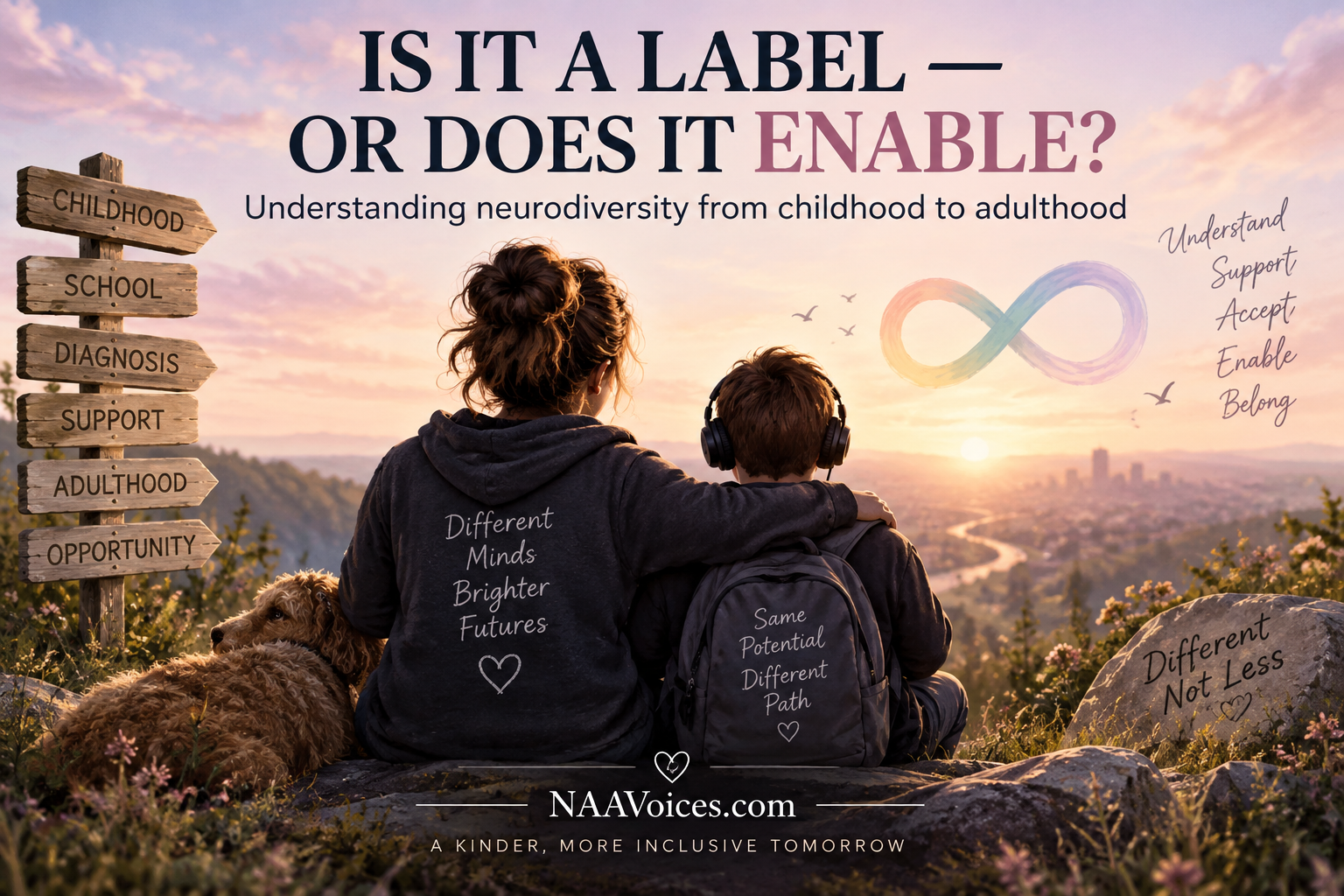
  • Is It a Label, or Does Understanding Neurodiversity Enable Us?

    Is It a Label, or Does Understanding Neurodiversity Enable Us?

    The children who mask, the adults who were missed, the parents running on empty, and why understanding matters

    We know neurodiversity exists. ADHD, autism, dyslexia, dyspraxia and other neurodevelopmental differences are spoken about far more openly than a generation ago. Yet alongside that awareness sits another reality: the waiting lists are long, and while a child waits, childhood doesn’t pause. They still have school, friendships, sensory environments, emotions and sleep to somehow manage, and their parents still have to get everyone through another day.

    For me, this has never been about collecting labels. I believe in enabling the child in front of us. My experience of neurodivergence, parenting neurodivergent children and working in healthcare led me to study neuroscience and the psychology of mental health, because I wanted to understand why we think, learn and respond differently.

    When we give something a name, are we labelling somebody, or finally giving them the understanding they need to thrive?

    Why Does Everyone Seem to Have ADHD or Autism Now?

    There is undoubtedly more public awareness, and social media has made information, good and bad, extraordinarily accessible. But increased awareness doesn’t mean every energetic child has ADHD, or that every difficulty requires a diagnosis. A TikTok video cannot diagnose ADHD; recognising yourself or your child in a list of traits is not the same as a proper assessment, and nothing here replaces one.

    But the opposite matters too. Greater recognition doesn’t automatically mean fad. Perhaps we’re simply getting better at recognising people who were always there, including adults who were the children nobody noticed decades ago.

    What Does a Diagnosis Actually Change?

    It doesn’t change the child; the child leaving an assessment is the same one who walked in. What can change is everybody else’s understanding: “they won’t concentrate” becomes “why is concentration difficult?”; “they’re being difficult” becomes “what is happening here?”

    That doesn’t mean removing boundaries or accepting harmful behaviour. It means understanding whether somebody needs a different route to the same destination. Sometimes understanding why is the beginning of working out how.

    “But They’re Fine at School”

    My eldest is sixteen; I became a mum at twenty-one, and didn’t recognise everything then that I can see now. I was fortunate: teachers saw signs before I did, referrals happened without a fight, and I was never once called into school about his behaviour. At school, he held things together. At home, things looked completely different. A child who is managing at school isn’t necessarily a child who is coping.

    The Coke Bottle Effect

    Imagine shaking a bottle: noise, changed plans, a missed instruction, sitting still, watching every word, an unwanted touch, unwritten social rules, something uncomfortable they can’t explain. Shake, shake, shake, but the lid stays on through the school day. Then they get home, the door closes, and everything comes pouring out.

    That doesn’t prove a diagnosis; there are many reasons children behave differently across environments. But “we don’t see that here” should never mean “there isn’t a problem.” Home is often simply where a child feels safe enough to stop holding it together.

    To the Parent Who Is Running on Empty

    Somewhere, a parent is reading this after an awful day: an explosion at the door, a three-hour bedtime, every strategy failing. Am I doing this wrong?

    You can understand behaviour as communication and still find it hard to live with. You can love your child completely and need ten minutes away from them. Both can be true. If your child is safe and you need a moment, take one, then tell the school, the professionals, whoever needs to know, that you’re struggling. Don’t be ashamed to say this is hard.

    Some days will feel pointless. Then you’ll get up and advocate again, because when your child can’t explain what’s happening, you are their voice. If you or your child are ever in crisis, contact your GP, NHS 111, or in an emergency, 999.

    Where Your Child Sits on a Waiting List Is Not a Parenting Score

    Services are stretched, thresholds exist, and the most urgent clinical risks are understandably prioritised. That doesn’t make waiting easy, but a long wait, a declined referral, or a low priority ranking is not a reflection of how much they’re struggling, how much you care, or how good a parent you are. If something changes or risk increases, say so and ask again.

    Support Shouldn’t Always Have to Wait for a Diagnosis

    A child’s needs exist the day before the diagnostic report arrives too. Some schools already do this well: predictable routines, visual information, movement breaks, smaller task stages, a calmer sensory environment. Not every adjustment needs a label, and what helps a neurodivergent child often helps others too. Someone once told me, “it’s so nice speaking to somebody who gets it.” Often, that’s the real need: to be heard, and pointed toward the right next step.

    Masking Can Be Remarkably Convincing

    The quiet child, the academically successful child, the polite child, the child whose parents are never called into school: none of them is necessarily coping. Some children become extremely good at watching, copying and suppressing what they’re experiencing. We see the result, not the cost. And those children grow up.

    Neurodivergent Children Become Neurodivergent Adults

    They become employees, parents, nurses, teachers, business owners. Some build lives that fit how their brains work; some become extraordinarily good at compensating, held together by calendars, alarms and perfectionism, until something changes and those systems stop working.

    Undiagnosed Men Matter Too

    Some energetic boys found an outlet through sport or practical hobbies; others were simply called lazy or told they weren’t reaching their potential. Some built careers that happened to suit their brains: fast-paced, practical, self-employed, no two days the same. Then a promotion, an injury, parenthood or a relationship ending removes what had been keeping things afloat. Perhaps the neurodivergence didn’t appear. Perhaps what enabled them to function did.

    And Then There Are the Women Nobody Noticed

    The girl who wasn’t disruptive, who did her work, who learned the rules and masked well, could be missed entirely. She grows into a capable woman, wondering why ordinary things require so much effort. Then, for some, another transition arrives.

    ADHD and Menopause: An Important Conversation, but One That Needs Care

    Hormonal change may interact with attention, executive functioning and mood, but research specifically on ADHD through perimenopause and menopause is still developing, so the biology shouldn’t be made to sound simpler than it is. Sleep, memory and concentration can also shift with menopause alone, independent of any neurodivergence. For a woman who has spent decades compensating, the combination can be particularly hard. “What has happened to me?” Perhaps she hasn’t become incapable; perhaps we’re finally seeing what the coping always cost. This deserves individual assessment, not a single universal explanation, and anyone noticing these changes should raise them with their GP or a menopause specialist.

    The Hidden Face of ADHD in Women: What I Learned Through Diagnosis, Research, and Real Support

    I Know What It Is Like to Build a Life Around Your Brain

    I don’t work well doing one thing at a time. I’m doing two courses right now because I absorb information better moving between them. A traditional classroom, sitting still with no outlet for stimulation, is almost physically uncomfortable for me. Music, fidgets, movement: I need it to concentrate, and I’m also very good at my job. Those things aren’t contradictory. I masked at school too, but I had practical hobbies outside it that gave my energy somewhere to go.

    “I Have Undiagnosed ADHD”

    At thirty-two, I wanted an explanation. I hadn’t taken antidepressants or anti-anxiety medication, and wasn’t prepared to treat something I didn’t believe fit without exploring an alternative first; that was the right call for me, not advice for anyone else, and medication decisions should always sit with a prescriber. I told my GP what I’d been experiencing and why I suspected ADHD, and she listened. No fight, no need to convince her that a woman who’d built a career and raised children could also have ADHD. I was referred. I know I was fortunate; not everyone’s route to being heard is that straightforward, and pathways vary by area and GP.

    Neurodivergence Can Bring Strengths, and Still Be Genuinely Hard

    We’ve swung from framing neurodivergence purely as deficit to calling everything a superpower. Neither is the whole story. Curiosity, creativity, hyperfocus and unconventional problem-solving are real strengths, but strengths don’t cancel difficulties. The same hyperfocus that produces extraordinary work can make switching tasks agonising. Someone can thrive in a crisis and struggle with an ordinary Tuesday. We should be able to talk honestly about both, without pretending the hard parts shouldn’t be hard.

    We Shouldn’t Be Teaching Children to Become Better at Hiding

    I don’t want the goal to be a neurodivergent child who’s simply good at looking neurotypical. I want them to understand themselves, know what overwhelms them, and feel able to ask for help. And I want them to find their thing, whatever it is, because support isn’t about lowering the ceiling. It’s about removing unnecessary barriers underneath it.

    Diagnosis Should Be a Beginning, Not an Ending

    A diagnosis doesn’t define somebody, excuse behaviour, or remove boundaries. At its best, it explains patterns, informs support, and eventually helps a child understand themselves. So perhaps the real question isn’t “why does everybody need a label now?” but “how many people did we fail to understand before?” Because the children who weren’t recognised didn’t disappear. They grew up: some flourished, some masked, some reached midlife before understanding why ordinary life took extraordinary effort.

    I don’t want children unnecessarily labelled, diagnosed from social media, or every difference medicalised. But I don’t want them dismissed either. I want understanding, proper assessment, and opportunity. And to the parent reading this after an impossible day: you don’t have to be perfect, or pretend you’re coping. Ask for help. When your child can’t find the words, be their voice. Use it.

    Understanding neurodiversity isn’t about deciding what somebody can’t become. It’s about understanding what they need, so they have the chance to discover what they can.

    Different Minds. Different Needs. Brighter Futures.

    Amy Royle Founder of NAAVoices. She holds a BSc in Adult Nursing, a PGCert in Neuroscience & Psychology of Mental Health, and certificates as an ADHD Coach, Neurodiversity Coach, Trauma Healing Practitioner, Narrative Therapy Practitioner and Narcissistic Abuse Healing Practitioner.

    NAAVoices.com

    Important Information

    This article combines lived experience, professional reflection and general educational information written in a personal advocacy capacity. Nothing here constitutes clinical advice, assessment or diagnosis for any named individual, and it is not a substitute for advice from an appropriately qualified and regulated professional. My nursing, postgraduate and coaching qualifications do not make me a specialist diagnostician of neurodevelopmental conditions; assessment, diagnosis and treatment decisions should always go through the appropriate professional pathway.

    Where this article references research on ADHD, masking or perimenopause, this is a general summary of an evolving evidence base, not a systematic review; readers seeking the underlying literature should consult NICE guidance and peer-reviewed sources directly. All personal anecdotes are Amy’s own and shared with consent; no other identifiable individual’s personal or clinical information appears in this article.

    If you are worried about your own or your child’s development, wellbeing or safety, please contact your GP, NHS 111, or, in an emergency, 999.

  • Mental Health and Neurodiversity – Understanding the Link

    Mental Health and Neurodiversity – Understanding the Link

    A detailed, evidence-informed blog for survivors, families, and professionals

    By Laura Prince | NAAVoices.com

    Why This Conversation Matters

    Neurodiversity and mental health are deeply interconnected — not because neurodivergent people are ‘predisposed’ to mental illness, but because society has historically failed to recognise, support, and accommodate different neurotypes. Research consistently shows that autistic, ADHD, and otherwise neurodivergent individuals experience higher rates of anxiety, depression, burnout, trauma responses, and chronic stress. These outcomes are shaped by unmet needs, stigma, late or missed diagnosis, and environments that demand constant masking.

    This is not a story of inherent deficit. It is a story of environmental mismatch, systemic barriers, and the profound cost of being misunderstood.

    In December 2025, the UK Government launched an independent review into mental health, ADHD and autism services, acknowledging that demand has risen significantly and that many people who are autistic or have ADHD are struggling to access the right services and support. This blog explores the evidence behind these struggles — and points towards a more compassionate, trauma-informed approach.

    The Scale of the Challenge: Key Statistics

    • 15% of the global population is estimated to be neurodivergent, often experiencing multiple conditions simultaneously
    • 13 times more people were waiting for an autism assessment in September 2025 compared to April 2019 (UK Government data)
    • 22.6% of 16-64 year olds in the UK had a common mental health condition in 2023-24, compared to 15.5% in 1993
    • 40% prevalence of ADHD is estimated among autistic people — demonstrating significant overlap between conditions
    • 7 million neurodivergent individuals are estimated to live in the UK — roughly 1 in 10 of the population
    • Autistic adults are significantly more likely to experience poor mental health, contributing to a greater risk for suicidal ideation, self-harm, and death by suicide

    What the Research Tells Us

    Beyond Labels: A New Framework

    A groundbreaking 2024 article published in World Psychiatry by Dr Giorgia Michelini (Queen Mary University of London) challenges the traditional approach to diagnosing neurodivergent conditions. The research introduces a transdiagnostic framework that views autism, ADHD, and learning disabilities as points on a spectrum rather than distinct categories — and recognises their frequent overlap with mental health challenges.

    Current diagnostic systems, such as the DSM-5 and ICD-11, separate these conditions into distinct categories, overlooking their shared characteristics and complex interplay. Dr Michelini’s work proposes a more holistic approach, acknowledging that mental health difficulties often arise not from the neurotype itself, but from the interaction between a person’s traits and the world around them.

    Understanding Neurodiversity Across the UK Population

    Research from the University of Birmingham (2024) — the largest examination of neurodiversity among UK adults to date — surveyed 1,000 people aged 18-70 about their experiences of characteristics associated with neurodevelopmental conditions.

    The findings revealed significant overlap: people with higher levels of characteristics associated with one condition (e.g., ADHD) are also more likely to have higher levels of the characteristics related to other neurodevelopmental conditions (e.g., autism, dyslexia, dyspraxia). Professor Ian Apperly explains: “People’s experiences of neurodevelopmental conditions are highly variable, and it is common for people to have more than one condition.”

    Crucially, the research also showed that different underlying causes can explain the same traits — some people exhibited high levels of autistic traits without showing high overall neurodivergent characteristics. In contrast, others showed autistic traits alongside traits associated with other conditions.

    The Mental Health Impact: Evidence Summary

    FindingResearch Evidence
    Higher rates of anxiety and depressionFrontiers in Psychology (2025) found that neurodivergent individuals experience significantly higher levels shaped by the interaction between neurodivergence and other identity factors, such as gender and sexuality.
    Masking linked to burnoutMultiple studies confirm masking is consistently one of the highest predictors of autistic burnout — a distinct, recurring condition with severe consequences for functioning and wellbeing.
    Suicidality riskGrowing evidence suggests masking to hide autistic traits is strongly associated with poor mental health and suicidality in autistic adults (PMC research).
    Environmental mismatchPLOS Mental Health (2025) stresses that neurodivergence and mental health are ‘distinct but too often intertwined’ — calling for systems that recognise lived experience and reduce stigma.
    Gender disparitiesWomen are diagnosed later, more likely to display internalised symptoms, and experience greater masking burden. Quinn (2005) calls ADHD the ‘hidden disorder’ in females.

    A Generation Left Behind: The Impact of Late or Missed Diagnosis

    Across the UK, there is a whole generation of adults — particularly women, AFAB (assigned female at birth) people, and those from marginalised backgrounds — who were never identified as neurodivergent in childhood. Many were labelled ‘difficult’, ‘sensitive’, ‘lazy’, or ‘too much’, internalising shame and self-blame instead of receiving understanding and support.

    What Late-Diagnosed Adults Often Describe:

    • Lifelong masking to fit into school, work, and relationships — suppressing natural behaviours and mimicking neurotypical social cues
    • Chronic anxiety and burnout from constantly compensating for difficulties that others couldn’t see
    • Misdiagnosis with conditions like borderline personality disorder, bipolar disorder, or depression — without recognition of underlying neurodivergence
    • Trauma responses shaped by years of unmet needs, invalidation, and discrimination
    • Identity confusion — feeling disconnected from who they truly are beneath the mask
    • Barriers to accessing care — especially for women, people of colour, and those from lower socioeconomic backgrounds

    Research published in 2024 on women with combined autism and ADHD (AuDHD) confirms this lived experience. The study found that the combination of ADHD and autism contributed to women being missed and dismissed, as they didn’t fit gendered stereotypes and didn’t fit neatly within one diagnostic box.

    For many adults, receiving a diagnosis later in life brings both relief and grief — relief at finally understanding themselves, and grief for the decades spent unsupported and misunderstood.

    Understanding Masking: A Survival Mechanism With Serious Costs

    Masking is when neurodivergent individuals conceal their authentic selves to conform to societal expectations or avoid judgment. It involves suppressing natural behaviours (like stimming), forcing uncomfortable eye contact, mentally rehearsing conversations, and performing neurotypically — often from a very young age.

    Masking is not a conscious choice or a form of deception. It’s a deeply ingrained survival mechanism that enables individuals to navigate a neurotypical world. For women especially, societal pressures to be agreeable, empathetic, and socially graceful intensify the pressure to mask.

    The Consequences of Long-Term Masking:

    • Chronic fatigue — constant physical and mental exhaustion from the non-stop effort of performing
    • Autistic/ADHD burnout — a distinct state of profound exhaustion where even basic daily functioning becomes difficult
    • Anxiety and depression — from constant self-monitoring and fear of social missteps
    • Loss of identity — feeling disconnected from who you are beneath the mask
    • Delayed diagnosis — masking can hide neurodivergent traits so effectively that professionals don’t recognise them
    • Increased suicidality risk — research links masking to higher rates of suicidal ideation in autistic adults

    Research confirms that masking is a ‘no win’ situation — while it facilitates access to opportunities and social inclusion, it is consistently described as exhausting and ultimately leads to burnout. One participant in research described it as: “Masking is a skill, but can feel like a curse.”

    The Legal Framework: Rights and Protections in UK Law

    UK legislation recognises the connection between neurodiversity, mental health, and vulnerability — even if the term ‘neurodiversity’ itself is not explicitly used in the law.

    The Equality Act 2010

    Under the Equality Act 2010, a person is considered to have a disability if they have a ‘physical or mental impairment that has a substantial and long-term adverse effect on their ability to carry out normal day-to-day activities’.

    This includes mental health conditions such as anxiety, depression, OCD, and bipolar disorder — all of which are more common among neurodivergent people due to chronic stress, discrimination, and unmet needs.

    Key Legal Points:

    • No diagnosis required: A worker does not need a formal diagnosis to be considered disabled under the Equality Act 2010 (ACAS guidance)
    • Reasonable adjustments: Employers have a legal duty to make reasonable adjustments to prevent disabled employees from being put at a substantial disadvantage
    • Anticipatory duty: Organisations must think and plan to make sure disabled people can access their services
    • Protection from discrimination: Direct discrimination, indirect discrimination, and discrimination arising from a disability are all prohibited
    • Constructive knowledge: Case law has repeatedly shown that tribunals may deem employers could have gained reasonable knowledge of an employee’s neurological differences, even without disclosure

    Public Sector Equality Duty

    Public bodies, including the NHS, police, schools, and local authorities, must comply with the Public Sector Equality Duty, requiring them to:

    • Eliminate discrimination
    • Advance equality of opportunity
    • Make reasonable adjustments
    • Consider the needs of disabled and neurodivergent people in all decisions

    What Compassionate Support Looks Like

    Understanding the connection between neurodiversity and mental health is not about pathologising neurodivergent people — it is about recognising the harm caused by systems that were never designed for them.

    A Trauma-Informed, Neurodiversity-Affirming Approach:

    1. Recognise environmental mismatch: Mental health difficulties arise from the interaction between neurodivergent traits and unsupportive environments — not inherent deficit
    2. Consider intersectionality: Gender, sexuality, race, and socioeconomic status all shape mental health outcomes for neurodivergent people
    3. Acknowledge masking: Support people to unmask safely rather than rewarding ‘passing’ as neurotypical
    4. Avoid behavioural activation pitfalls: Standard depression treatments may worsen burnout unless adapted for autistic/ADHD individuals
    5. Respect late diagnosis: Diagnosis in adulthood brings validation but also grief — both need space
    6. Create safe spaces: Where neurodivergent people can be their authentic selves without judgment or penalty

    Practical Strategies for Preventing and Recovering from Burnout

    Burnout varies greatly from person to person, and often looks different for neurodivergent people compared to neurotypicals. Here are evidence-informed strategies:

    Prevention:

    • Spend time unmasked — masking is consistently one of the highest predictors of burnout
    • Ensure appropriate accommodations are in place at work, school, and other settings
    • Practice boundaries — neurodivergent people often have fewer ‘spoons’ (energy reserves)
    • Engage in special interests — activities that are enlivening and restorative
    • Prioritise sensory needs — manage sensory overload proactively
    • Support healthy rhythms — sleep hygiene, routines, and predictability

    Recovery:

    • Rest without guilt — recovery takes months or years, not days
    • Reduce demands — strip back obligations to essentials
    • Seek neurodiversity-affirming therapy — approaches like CBT, ACT, or IFS adapted for neurodivergent needs
    • Connect with the neurodivergent community — peer support is consistently identified as essential
    • Avoid ‘exposure’ approaches — unlike anxiety, autistic burnout often worsens with exposure; avoidance can be protective

    Towards a More Compassionate System

    The research is clear:

    • Neurodivergent people experience higher rates of mental health difficulties due to environmental mismatch, not inherent deficit
    • Intersectional factors — gender, sexuality, race — further shape mental health outcomes
    • Late or missed diagnosis contributes to lifelong distress, burnout, and trauma
    • UK legislation recognises the need for protection, reasonable adjustments, and anti-discrimination measures
    • Masking — while a survival skill — comes at a profound cost

    A compassionate, trauma-informed approach acknowledges that neurodivergent people are not ‘broken’ — the systems around them are. When society adapts, mental health outcomes improve. When people are understood, supported, and allowed to be their authentic selves, they thrive.

    The goal is not just for neurodivergent people to unmask — it’s to create a world where they don’t have to.

    UK Support Resources

    OrganisationSupport OfferedContact
    National Autistic SocietyInformation, advice, and support for autistic people and familiesautism.org.uk
    ADHD UKAdvocacy, resources, and reasonable adjustments guidanceadhduk.co.uk
    MindMental health support, legal rights guidancemind.org.uk
    ACASWorkplace neurodiversity and reasonable adjustmentsacas.org.uk
    Samaritans24/7 emotional support116 123

    ━━━━━━━━━━━━━━━━━━━━━━━━━━━━━━━━━━━━━━━━━━━━━━━━━

    This resource was created for NAAVoices.com.

    Evidence reviewed January 2026. For educational purposes only — not a substitute for professional advice.

    Author: Laura Prince | www.naavoices.com