Tag: dailyprompt

  • Do I Believe in Karma

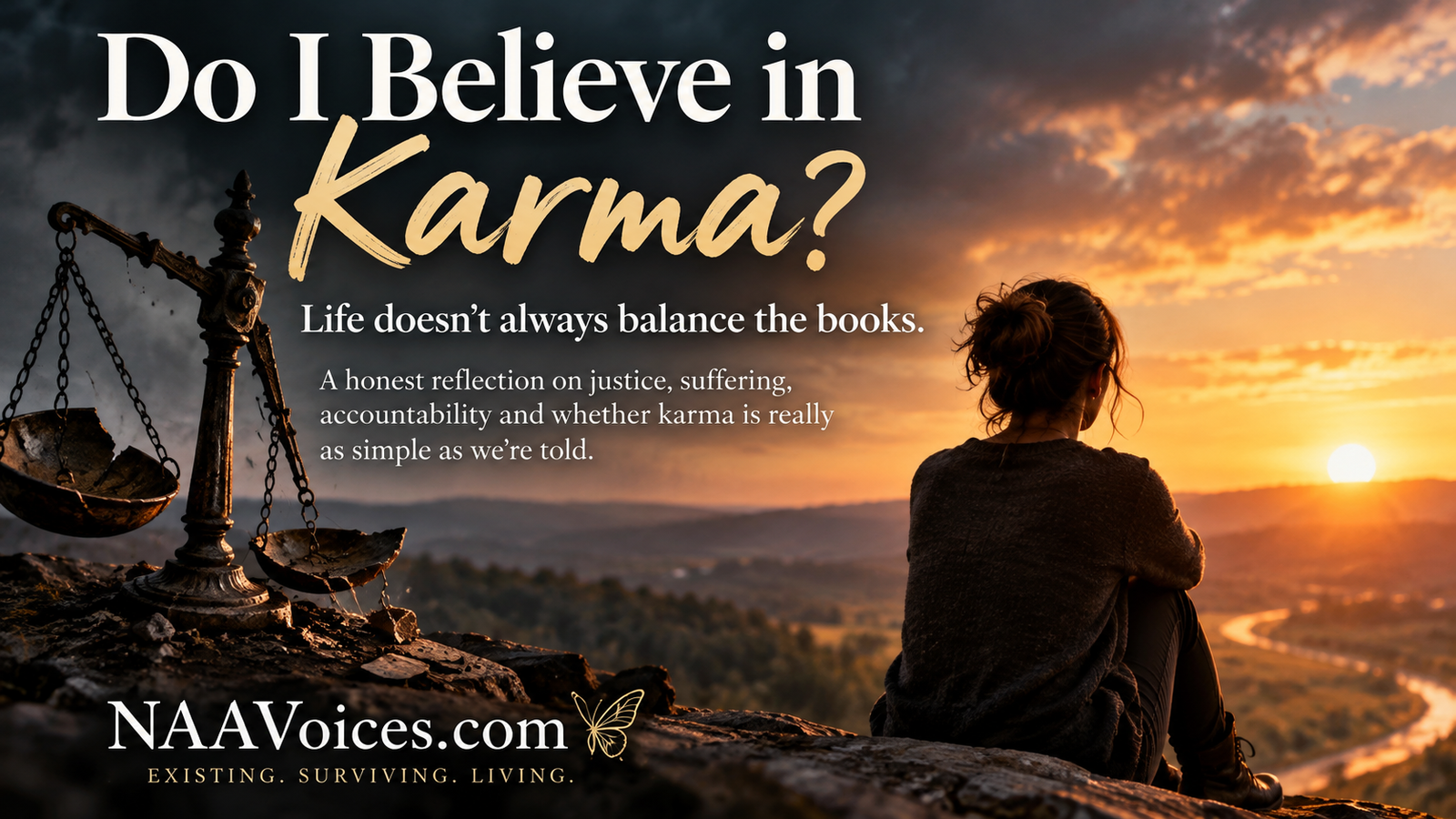
    Do I Believe in Karma

    Do you believe in karma?

    I don’t think it’s that simple.

    We like the idea of karma because it makes the world feel fair.

    Do good, and good will eventually find you.

    Cause harm, and somehow, somewhere, life will make you answer for it.

    But I’ve lived long enough to know that life doesn’t always work like that.

    I’ve watched good people suffer because of things they never caused, never deserved and could not have prevented.

    I’ve watched people carry trauma created entirely by somebody else’s choices.

    And I’ve watched people do hideous things and seemingly walk away from them.

    So where is the karma in that?

    If a good person is harmed, traumatised and left rebuilding their life while the person who caused it carries on as normal, are we really supposed to believe the universe has somehow balanced the scales?

    I don’t.

    At least, not in the traditional sense.

    Maybe karma isn’t punishment.

    Maybe it isn’t some invisible court where every wrong eventually receives an equal sentence.

    Maybe sometimes there simply isn’t justice.

    That is uncomfortable to admit, particularly when you have spent years waiting for accountability.

    But perhaps there is another way of looking at it.

    The person who harmed you does not get to decide who you become afterwards.

    They may have changed your life. They may have left consequences they never have to carry themselves. They may never fully understand the damage they caused.

    But surviving does something too.

    You learn.

    You rebuild.

    You become more discerning about who gets access to you.

    You recognise things you once overlooked.

    You speak when you once stayed silent.

    Sometimes you even take what nearly destroyed you and turn it into something that helps somebody else survive.

    That isn’t karma.

    And I don’t particularly like calling it a “lesson”, either. Some things should never have happened in the first place.

    It is simply what human beings can sometimes do with what remains.

    So, do I believe in karma?

    Not really.

    I believe actions have consequences — although frustratingly, those consequences don’t always land on the person who caused the harm.

    I believe accountability matters precisely because we cannot rely on the universe to provide it.

    And I believe being a good person does not guarantee you a painless life.

    Perhaps the better question isn’t whether the people who hurt us eventually get what they deserve.

    Perhaps it’s whether we can reach a point where their future no longer determines ours.

    Because I don’t want to spend the rest of my life waiting for karma.

    I’ve already spent enough of it waiting.

    NAAVoices.com

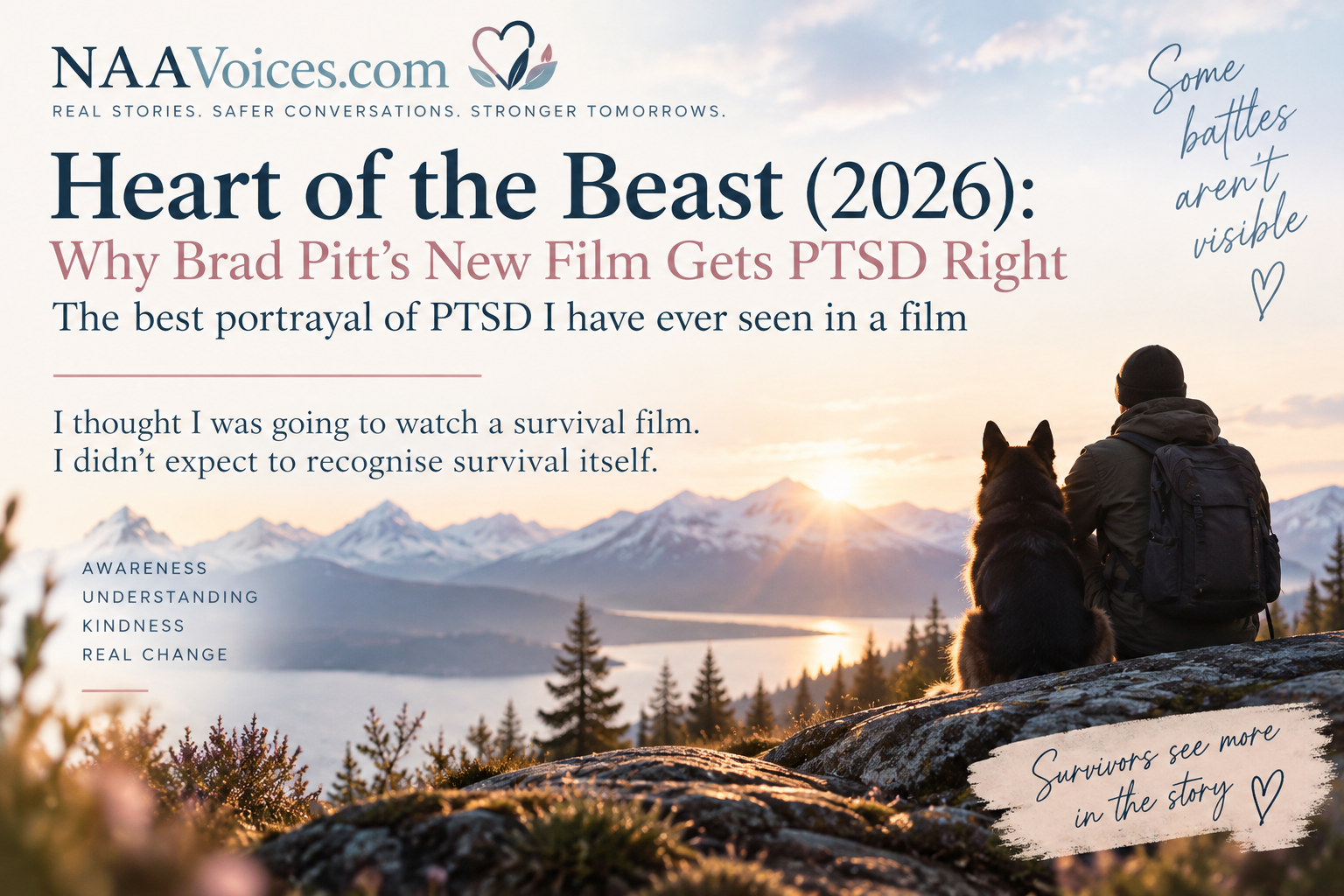
  • Heart of the Beast (2026): Why Brad Pitt’s New Film Gets PTSD Right

    Heart of the Beast (2026): Why Brad Pitt’s New Film Gets PTSD Right

    The best portrayal of PTSD I have ever seen in a film

    I thought I was going to watch a survival film. I didn’t expect to recognise survival itself.

    Spoiler warning: This piece discusses themes and events from Heart of the Beast.
    Content note: PTSD, combat trauma, grief, and animals in distress. No graphic personal account of abuse. If you need support while reading, skip to the directory at the end.

    9–14 minutes

    I went in expecting Brad Pitt, the Alaskan wilderness, a dog, and a physical fight to stay alive. Heart of the Beast, directed by David Ayer and written by Cameron Alexander, delivers all of that on the surface. Pitt plays James Belmont, a former Special Forces soldier stranded in the Alaskan wilderness with his combat dog, Odin. Released by Paramount, it’s an adventure thriller about endurance and the bond between man and dog, while early reviews have already noted the quiet thread of combat trauma running underneath.

    The setup is simple: a seaplane crash leaves James and Odin alone in terrain that would kill most people and most dogs. A trek of around 50 miles through brutal weather, wildlife, injury, and exhaustion. The film gives you the survival story you came for, but it also gives you something else, something quieter, something that doesn’t announce itself.

    It gives you recognition.

    Home, in this film, isn’t comfort. It’s recognition. James isn’t surrounded by people; he’s pulled into the wild with Odin, doing the next necessary thing. It’s a hard kind of belonging, not safety, but familiarity. The body knowing the work.

    Before the film even started, there was an armed forces recruitment advert. In it, a soldier turns, sees a dog on the floor, and doesn’t shoot. I didn’t know then how much that moment would echo.

    By the time the credits rolled, I could barely speak.

    I didn’t cry, though my friend did. Largely over the dog, I suspect. What I felt wasn’t sadness; it was something deeper. Under the adventure narrative sits a portrayal of trauma that doesn’t declare itself. Not the loud, familiar version of PTSD that films often highlight. The quiet kind. The one most people never notice.

    It doesn’t oversell it

    That is the most striking thing about the film. It refuses to oversell trauma.

    There are no endless explanations of what is happening inside James’s head. No speeches that tell the audience he is traumatised. It lives in the subtleties. The withdrawal. Standing back from people. The distance. The way the past can suddenly sit beside the present. The instinct to protect. The exhaustion. And then the ability to keep going anyway.

    Films often get this wrong because PTSD is not always someone visibly falling apart. Sometimes it gets up in the morning. Sometimes it works. Sometimes it looks after everyone else. Sometimes it laughs. Sometimes it looks completely composed. Sometimes it becomes exceptionally capable because being capable was once necessary for survival. Sometimes it simply says “I’m fine,” and people believe it. They see someone still standing and assume the battle must be over. They do not see how much effort standing takes.

    They do not see how much effort standing takes.

    That is what Heart of the Beast shows. Not a man constantly collapsing. A man repeatedly putting himself back together.

    The military context matters. James is a former Special Forces soldier. Odin is a former combat dog with the physical scars to match. Titanium teeth, a prosthetic leg, nightmares. Many years ago, long before my nursing degree, I worked in acute mental health, and some of the people I met there were veterans. I will never forget them. I fully respect just how difficult it is for veterans. Support written for that world exists too, including Combat Stress and PTSD Resolution.

    But PTSD does not solely sit with military veterans. Trauma after war, violence, loss, accidents, childhood experiences, or repeated exposure through work is not interchangeable. The events are not identical. Some of what follows can still be frighteningly recognisable. Hypervigilance. Withdrawal. Protectiveness. The habit of functioning at a cost no one else can see. PTSD UK explains that wider picture clearly. What this film does is make that relatable to anybody who lives with post-traumatic stress disorder.

    For some people, “home” is the first room where those things do not have to be performed away. For James, that room is the wilderness, and the only other heartbeat in it is Odin’s.

    Just get back up

    There are so many points where James could have stopped. Physically. Emotionally. Psychologically. Enough had already happened. He keeps getting back up. Another obstacle, another reserve, another reason, another way through.

    Every time he got there, the trauma would come back, and he would just keep fighting. He would find a way through. Yes, it was for the dog, and for himself. But it was his trauma, the flashbacks, the haunting, that kept him going. His trauma made him push through. I got it. I really got it.

    That lands hard because trauma is not only the thing that knocks you down. Sometimes the survival mechanisms created by it become the things that make you get back up. Not because you are fearless or particularly positive or some inspirational version of “strong.” Sometimes you are absolutely exhausted. You just know how to survive. There is a difference.

    When a nervous system has spent long enough treating the world as dangerous, it learns how to function in circumstances other people might find impossible. Another crisis. Another hurdle. Something inside simply goes: Right. What now? You deal with it. Then the next thing. Every hurdle becomes another battle in a war you never volunteered to fight. A never-ending battle. It feels relentless. There’s no end to it. People look at you and say they don’t know how you do it. Sometimes neither do you. You just keep getting back up.

    This should never be romanticised. There is nothing beautiful about PTSD. There is nothing desirable about intrusive memories, avoidance, emotional numbing, or a nervous system shaped by something that should never have happened. Home should not have to mean danger you already know how to walk through.

    Human beings are still complicated. Trauma can injure someone profoundly while the survival responses developed because of it become extraordinarily difficult to switch off. Fight. Protect. Keep moving. Get everyone else safe. Deal with yourself later. That last one especially. Later does not always come.

    The person who keeps functioning can become very good at hiding how much functioning costs.

    Even when everything is falling apart, the instinct to protect remains. Protect the dog. Protect the people who matter. Keep going. Get them through it. You can be depleted and still notice everyone else. You can be drowning and still check whether the person beside you can swim. From the outside that looks like strength. Inside it can feel completely different.

    Towards the end the film itself seems to change. Towards the end the film itself seems to change. The light. The colour. The pace. Everything quieter. That strange stillness when you know you might be about to leave someone you love, or lose them. There are not always words big enough. Sometimes there are no words at all. And even then the instinct remains. Are they going to be okay? Still protecting. Still thinking about everybody else. Even when there is almost nothing left to give.

    Odin is so much more than “the dog”

    The relationship between James and Odin sits at the centre of the film. Loyalty. Dependence. Mutual protectiveness. If anywhere on that map feels like home, it is that bond. Not the landscape. The other living thing that already knows the cost.

    The film also shows, without over-explaining, that trauma does not look one way, in humans or in animals. Fear does not always look like fear. Distress does not always look like distress. It can look like withdrawal, avoidance, aggression, hypervigilance, silence, restlessness, attachment, protectiveness, shutting down, or simply behaving differently because something inside no longer feels safe. I highly respect the film for raising awareness that dogs experience these symptoms too, and display them in their own ways.

    The film lets you observe rather than lecture. That restraint is what makes it powerful.

    Why I didn’t cry and why I couldn’t speak

    There is a kind of emotional overload where tears don’t come. Everything just goes quiet. That is where I was. I couldn’t really speak. Not through tears. Through overwhelm. Through overload.

    Not because I had watched a sad film about a man and his dog. Because I had watched something that put a complicated experience on screen without constantly explaining it. The withdrawal. The isolation. The memories. The distance. The protectiveness. The exhaustion. The moments where giving up would almost have been understandable. And then getting back up. Again. Again. Again.

    My dissociation means that anything emotional that relates too closely to PTSD is something my nervous system often protects itself from. During those times I write. Or I dictate. To get it out. For processing. That is what this is.

    So todays blog prompt asked for a place that felt like home.. The honest answer is awkward. It was a dark room full of strangers, and a story that did not flinch from the silent version of a fight most people never see. Recognition can feel like home even when it is not gentle.

    The battle nobody sees

    What stays with me most is this. There are people walking around every day fighting battles nobody else can see. They do not necessarily look traumatised. They do not always cry. They do not collapse in front of you. They might be the person everybody else depends on. Working. Parenting. Laughing. Helping other people. Making plans. Getting things done. Surviving.

    Because they are functioning, people assume they are okay. Functioning and being okay are not the same thing. Sometimes functioning is simply what survival looks like. Sometimes the person everyone thinks is incredibly strong is someone who learned a very long time ago that when something knocks them down, they have to get back up.

    Functioning and being okay are not the same thing.

    I keep coming back to the title. Different people will take different things from Heart of the Beast. For me the beast was not only the wilderness, the physical danger, everything waiting outside. It was also the thing carried within. The part of trauma that can pull you backwards without warning. The memories you cannot simply decide to forget. The instinct to withdraw. The exhaustion of fighting something other people cannot see. And also that relentless survival instinct. Get up. Keep moving. Protect them. One more step.

    I didn’t leave the cinema crying. I left silent. Because for once I didn’t feel as though I had watched somebody acting out the textbook version of PTSD. I felt as though I had watched somebody understand the silent one. The one people don’t see. That is to the credit of Brad Pitt, and of David Ayer’s direction.

    It was probably the best portrayal of post-traumatic stress disorder I have ever seen in a film.

    I felt it.


    🎬 Heart of the Beast (2026)
    Directed by David Ayer. Written by Cameron Alexander. Starring Brad Pitt, J.K. Simmons, Anna Lambe, and Uber as Odin. In UK/US cinemas from 25 September 2026.

    Sources

    Heart of the Beast official site: heartofthebeastmovie.com
    Mind, Post-traumatic stress disorder (PTSD) and Trauma: mind.org.uk
    PTSD UK: ptsduk.org
    Combat Stress: combatstress.org.uk
    PTSD Resolution: ptsdresolution.org

    Deadline, Heart of the Beast review (distributor and release date): deadline.com/2026/09/heart-of-the-beast-review-brad-pitt-german-shepherd-survive-1237109761
    Empire, Heart of the Beast review: empireonline.com/movies/reviews/heart-of-the-beast
    Flickering Myth, Heart of the Beast review: flickeringmyth.com/movie-review-heart-of-the-beast-2026

    If this film, or this piece, has stirred something up

    You do not have to sit with it alone. If you are in immediate danger, call emergency services (999 in the UK, 911 in the US and Canada, 000 in Australia).

    UK and Ireland

    Samaritans: 116 123 (24/7) · samaritans.org
    Combat Stress (veterans, serving personnel and families): 0800 138 1619 · text 07537 173 683 · combatstress.org.uk
    Mind: 0300 123 3393 · mind.org.uk
    PTSD UK: ptsduk.org
    PTSD Resolution (veterans, reservists and families): 0300 302 0551 · ptsdresolution.org
    NHS 111 (England, Scotland, Wales): 111 · in Wales, press 2 for 24/7 mental health support
    Op COURAGE (NHS veterans’ mental health, England): ask your GP or search NHS Op COURAGE
    Veterans’ NHS Wales (VNHSW): ask your GP or search Veterans NHS Wales

    United States

    988 Suicide & Crisis Lifeline: call or text 988 · 988lifeline.org
    Veterans Crisis Line: 988 then press 1 · text 838255 · veteranscrisisline.net
    NAMI HelpLine: 1-800-950-NAMI (6264) · nami.org
    National Center for PTSD (VA): ptsd.va.gov

    Canada

    988 Suicide Crisis Helpline: call or text 988 · 988.ca
    Canadian Mental Health Association: cmha.ca

    Australia and New Zealand

    Lifeline Australia: 13 11 14 · lifeline.org.au
    Beyond Blue: 1300 22 4636 · beyondblue.org.au
    Lifeline New Zealand: 0800 543 354 · lifeline.org.nz

    International directory

    IASP local crisis centres: iasp.info/suicidalthoughts

    If you are supporting someone else, those same numbers are for you too.

    Comments are welcome. Please do not share graphic detail about other people’s trauma, and do not use the comments as a crisis service. If you need help now, please use the numbers above.

    This is a personal reflection on a film and not clinical advice.

  • The Bravest Thing I Did When No One Was Watching.

    The Bravest Thing I Did When No One Was Watching.

    I have thought about this question deeply, and my answer is actually quite simple.

    I kept going.

    When the curtains were closed. When the doors were locked. When the world saw nothing but silence from me, I kept going.

    I have been thinking a lot lately about something we do not talk about nearly enough.

    Post-traumatic growth

    We focus so much, and rightly so, on the weight of trauma. The reliving. The triggers. The dissociation. That buzzing sensation inside your head when you finally realise you have had enough and just need to reset.

    I know all of this intimately. I live with PTSD.

    I know how much heavier injustice feels when your nervous system is already stretched thin. I know the days when I have been so badly triggered that I could not sleep or leave the house, and the mornings when simply getting up and functioning took far more effort than anybody around me could possibly have known.

    There were nights I lay awake. Mornings when breathing felt like work. Days when I was trying to hold myself together while still holding everyone else up.

    But recently, I had to look back over the last couple of years to complete an application. As I pulled everything out and laid it all down in front of me, I saw something I had never really allowed myself to see before.

    Just how much I had actually achieved while learning to live with all of it.

    That was when I started thinking properly about post-traumatic growth.

    It does not mean the pain was not real

    For a long time, trauma brought pain with silence.

    Looking back, though, that silence was not empty.

    It was where I listened, learned, observed, questioned and slowly rebuilt. Most of it happened quietly, without recognition and without me even realising at the time that rebuilding was what I was doing.

    I did not grow instead of being affected by trauma. I grew while being affected by it.

    The triggers still come. Hard days still happen. There are things I have to manage now that I never had to manage before.

    Growth does not erase any of that.

    It simply means that somewhere amongst it all, I changed too.

    What growth actually looks like for me

    People often talk about growth as though it is something polished and neat.

    Mine isn’t.

    I built this space online. Not because I wanted recognition, but because people reached out. Some came back. Some told me that something I had written made them feel understood.

    I don’t blog religiously. I write when something reminds me, when I need to get words out, or when something sparks something in me.

    It is messy. Sporadic. Real.

    And that is exactly how I want it to be.

    I carried my family through some incredibly difficult years. I supported all three children who, at different points, needed additional mental health support themselves, while also navigating my own struggles.

    There were days when I felt as though I had absolutely nothing left and still somehow found something.

    I have also changed in the way I deal with fear.

    I joke sometimes that I care less these days, but that isn’t really true. I still care deeply. I have never wanted to act out of malice, and I never want difficult experiences to turn me into somebody who does.

    What changed is that I stopped being frightened of other people’s reactions to me doing what I believe is right.

    I no longer automatically carry somebody else’s judgement as though it must say something about me. After having my character torn apart in court, something shifted.

    I promised myself nobody would ever twist who I am and make me question myself like that again.

    At the time, I felt I had already faced the very worst.

    And I was still here.

    My voice became stronger.

    I advocate fiercely now when something is wrong.

    I have also learned constantly. Not simply to understand myself, but because I wanted to understand other people better. I started noticing gaps in my own knowledge and going away to fill them.

    Not for recognition. Not for another certificate on the wall.

    Simply because sometimes another human being is standing in front of you and you want to understand how best to help them.

    And some of my growth has looked far less. Five weeks ago, I hammer-jacked up a 16ft square concrete base and laid an 11ft square patio entirely on my own. I was absolutely shattered afterwards. I fitted my own kitchen from scratch.

    I am one part away from earning my full A motorcycle licence so I can ride a big motorbike.

    They might sound like completely random things to include in a piece about trauma.

    They aren’t.

    Every one of them represents something I might once have questioned whether I could do.

    So I did it.

    Some were done on difficult days when I was exhausted or overwhelmed. Sometimes having work, projects, or something practical to focus on gave me routine and purpose when other parts of life felt heavy.

    Sometimes every part of me wanted to curl up and hide.

    I did it anyway.

    A new chapter, and proof of what I am capable of

    Now I am hopefully stepping into another chapter of my career.

    The last time I chose to study at postgraduate level, I did it for a very different reason.

    I needed to understand.

    Behaviour. People. The brain. Trauma.

    I was trying to make sense of what I had lived through while, in many ways, I was still living through it.

    I was experiencing post-separation abuse and was diagnosed with PTSD during my second module. At the time, I never truly believed I could succeed.

    Yet I completed my postgraduate certificate with a distinction.

    There were assignments written through tears. Nights spent awake learning about trauma and domestic abuse while simultaneously beginning to understand what had happened to me.

    There was something surreal about studying the impact of trauma academically while living with its consequences personally.

    What I gained from that postgraduate course was far more than academic knowledge.

    It gave me evidence. Evidence of exactly what I am capable of.

    I can see that now, though I couldn’t see it then.

    Trauma did not give me my strength, my determination, my compassion or my voice. Those parts of me were already there.

    What the experience did was force me to discover just how much of them I had.

    I walked through abuse, diagnosis, trauma and some incredibly dark periods without allowing those experiences to decide who I would become.

    Other people do not get to define who I am or what I am capable of. There were days when I genuinely could not see an end to any of it. Now I look back at the person I have become and think:

    My God. I have changed.

    Not into somebody hardened or bitter.

    Into somebody far harder to silence.

    And perhaps that is what post-traumatic growth means to me.

    Not pretending something terrible became something wonderful.

    Not being grateful for trauma.

    Not saying everything happens for a reason.

    I don’t believe any of those things.

    It is recognising that something hurt you profoundly and that, while learning to live with what it left behind, you built something too.

    So is post-traumatic growth real?

    I believe it is.

    Post-traumatic growth, or PTG, is the term used to describe positive psychological changes that some people experience while struggling with highly challenging or traumatic life events.

    It is commonly described across five broad areas.

    Appreciation of life. Priorities change. Things once taken for granted can suddenly matter far more.

    Relating to others. Connections can deepen. Compassion can become stronger.

    Personal strength. That realisation of: I survived something I once did not think I could.

    New possibilities. New interests, ambitions, paths or directions can emerge.

    Spiritual or existential change. A changed sense of meaning, purpose or understanding of life.

    But I think it is incredibly important that we do not romanticise it.

    Post-traumatic growth does not mean trauma was beneficial.

    It does not mean somebody should be grateful for what happened to them.

    And it certainly does not mean that somebody who continues to struggle has somehow failed to grow.

    Growth and distress can exist at exactly the same time.

    You can be stronger and still be triggered.

    You can have found your voice and still have days when using it feels impossible.

    You can rebuild huge parts of your life and still grieve for the parts that were damaged.

    Both things can be true.

    I will never be exactly the person I was before.

    I no longer see that entirely as a loss.

    I still have my kindness. That never left.

    But now it has backbone behind it. Purpose. Knowledge. And a voice that I worked incredibly hard to find.

    I didn’t wait until I felt completely healed to start rebuilding my life.

    I built my life while I was healing.

    And perhaps, more than anything else I have written here, that is what post-traumatic growth means to me.

    Trauma brought pain with silence.

    But the silence did not stay empty.

    So, back to the question that started all of this.

    What is the bravest thing I have ever done when no one was watching?

    I kept going.

    And somewhere in all that silence,

    I grew.
  • The Most Underrated People in History Are the Ones Who Told the Truth

    The Most Underrated People in History Are the Ones Who Told the Truth

    Subscribe to continue reading

    Subscribe to get access to the rest of this post and other subscriber-only content.