Tag: Childhood trauma

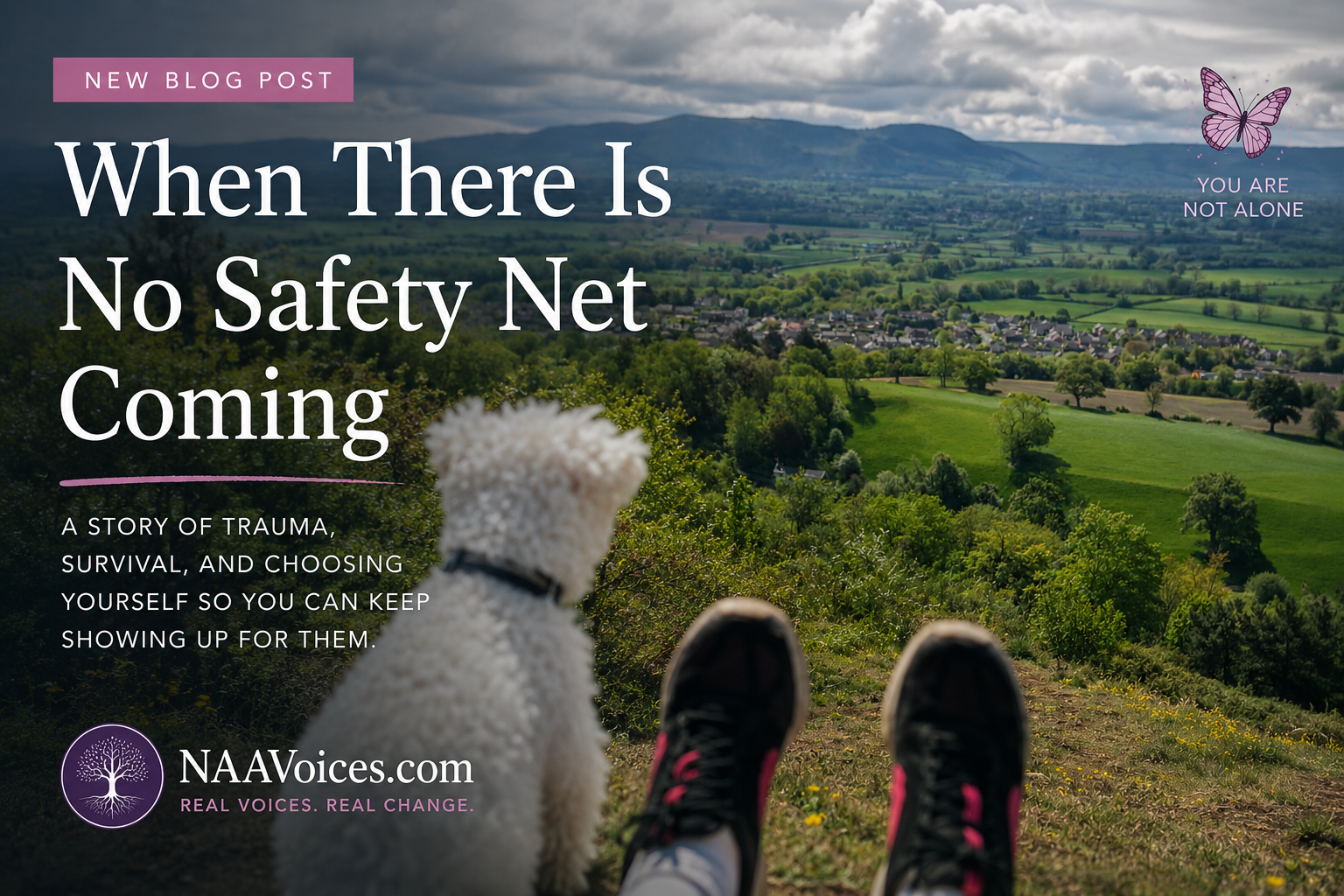
  • When There Is No Safety Net Coming

    When There Is No Safety Net Coming

    This weekend was difficult.

    The events that unfolded were directly linked to the abuse my children lived through. I will not expand on those details publicly because some things belong to them, not the internet. Their story is not mine to expose. My role is to protect it, even while telling the truth about what trauma leaves behind.

    Friday also marked the anniversary of my ex’s arrest. For a short time, I believed that moment meant safety had finally arrived. The reality that followed was very different. What came afterwards exposed my children and family to risks I never thought possible, not only through one individual, but through systems and institutions that were supposed to protect us.

    This weekend was not only about an anniversary.

    It was about what resurfaced because of it.

    Trauma does not disappear because time passes. It shows up in behaviours, emotions, reactions, fear, anger and overwhelm. Especially in children.

    And when it does, the hardest reality is not just managing the moment. It is knowing that, when everything falls apart, me and the kids only truly have me.

    There is no reliable safety net arriving. Not in the way people imagine. Not consistently. Not when the damage has already been done and the consequences are still living inside my children.

    That is why I went to the rocks.

    Not because I had spare time. Not because it was scenic. Because my body knew I needed to reset before I broke under the weight of it.

    People often think trauma lives in memory alone. It does not.

    The body remembers what the mind tries to forget.

    Certain dates pull you backwards. Certain places do too. Sometimes it arrives without warning, tightness in your chest, pressure in your throat, a sudden need to move, drive, breathe, or escape. For years, I did not understand why I instinctively sought out open spaces, music, nature, long drives or silence.

    Now I do.

    This morning, I drove the children to school and then headed to the rocks, the same place I used to go after leaving. I remember the first few times I went there. I cried most of the drive. At the time, I did not understand why being there mattered so much.

    Looking back, I can see that my body was searching for regulation before my mind had fully processed what had happened.

    People can dismiss walking, music, fresh air, the sea, nature, or grounding techniques as “airy-fairy”. They are not. The nervous system carries trauma. It also recognises safety, rhythm, space and movement before we always have the words for why they help.

    Trauma changes the way you live. I have certain clothes I wear because they make me feel safer. Certain items I keep with me. Certain routines, places and songs that act as anchors. They may look insignificant to anyone else, but to a traumatised nervous system, they are reminders that I have survived before and can survive again.

    Today I walked to the top, somewhere I had not climbed since carrying my then three-year-old on my back with the dog beside me.

    It was almost comical at times. I avoided the proper path and ended up climbing through brambles instead. At one point, I was practically on my hands and knees dragging myself up the final stretch just to reach the spot I needed to get to.

    And the dog never left my side.

    She kept stopping and looking back to check where I was. No formal training. No commands. Just instinctively staying close while I crawled through mud, brambles and exhaustion towards somewhere my body had decided mattered.

    When I finally got there, I sat.

    Headphones on. Music playing. Breathing.

    For the first time in a while, everything went quiet.

    Walking back down, I did not want to leave. I circled for a while, climbed back through the brambles again, and delayed going home because something about being there made me feel human again.

    Maybe that is what healing sometimes is.

    Not fixing everything.

    Not pretending it never happened.

    Just finding a moment where your nervous system stops fighting long enough to let you breathe.

    There is a version of me that existed before all of this, and I know now I will never fully be that person again. For a long time, that grief consumed me. I thought being broken meant I had lost myself forever.

    But being broken also gave me understanding.

    It changed the way I see pain in other people. It taught me to recognise what fear, exhaustion and trauma can look like beneath behaviour. It changed the way I advocate, the way I work, the way I parent, and the way I see injustice.

    When you have lived through institutional failure, coercive control and fear, you begin to understand how many people are silently carrying things nobody else can see.

    I have spent much of my life giving other people what I never had myself, support, compassion, protection and reassurance. Somewhere along the way, I forgot that self-care is not selfish.

    It is necessary.

    Because school runs still happen.
    GCSEs still happen.
    Parenting still happens.
    Life still continues.

    Today, my 15-year-old came home after his first GCSE exam.

    I asked him how it went.

    He shrugged and said he did not even understand the question.

    And I just told him, “You’re fine, as long as you tried your best.”

    Because honestly, after everything he went through last year, I did not know whether he would emotionally make it to this point. Trauma comes out in children in ways people often fail to recognise. Attendance can be resilience. Showing up can be courage. Sitting an exam can be survival.

    So I am proud of him.

    Not because of grades.

    Not because of results.

    Because he showed up.

    Because despite everything, he walked through those school gates and sat that exam.

    Sometimes healing looks like climbing through brambles to sit on the rocks with your headphones on because your body needs reminding that you survived.

    Sometimes resilience looks like a child walking into a GCSE exam after a year that nearly broke him.

    And sometimes the strongest thing a person can do is keep showing up for their children, while finally learning to show up for themselves too.

    Even when healing means accepting that the people and systems you believed would stand beside you were never really there.

  • Finding the Stars: Why Not Broken Had to Be Written

    Finding the Stars: Why Not Broken Had to Be Written

    Some books begin with a plan.
    Not Broken did not.

    It began at a kitchen table, in the middle of a life that felt too dark, too loud, and too fractured for easy answers. It began in conversations with my children, in moments when I needed words that did not seem to exist anywhere else. Words honest enough for pain, but gentle enough to carry hope.

    I am a Specialist Nurse Practitioner with postgraduate study in the psychology and neuroscience of mental health. I know the evidence. I know the therapies. I know the clinical frameworks that support healing. But the truth is this: while I was still living through sustained trauma, none of that knowledge could fully reach me.

    That is not because those therapies do not work. They do. I believe in them, and I recommend them with confidence. But when the body is still trapped in survival, healing does not always begin with structured processing. Sometimes it begins somewhere quieter. Somewhere instinctive. Somewhere outside language.

    For me, one of those places was a lay-by.

    For over a year, I returned to the same place again and again. Not because it fixed anything. Not because it was magical. But because it gave me a pocket of stillness when everything else felt unbearable. It gave my body a chance to breathe.

    At the time, I did not know the language of grounding, sensory regulation, trauma responses, or nervous system overload. I only knew that something about that space helped me stay here.

    Sometimes I slept there. Many times, my little girl slept there with me. We would look up at the stars. She grew up believing that when someone leaves, they become a star. It was her way of holding loss. In time, it became mine too.

    That lay-by held more than silence. It held grief, fear, exhaustion, and the desperate effort of trying to stay functional in public while quietly unravelling in private. I have stood in that field in rain, ice, and darkness. I have sat in the grass just to feel something real beneath me. I have gone there in uniform, in the middle of the night, trying to regulate myself enough to return to a life that did not feel safe.

    At the time, nobody knew.

    It was only later, after more study, training, and reflection, that I understood what I had already been doing. I had been grounding myself. I had been using nature as regulation. I had been using the cold air, the silence, the openness of the sky, and the feel of the earth beneath me to stabilise a body that had been pushed too far for too long.

    The body often finds ways to survive before the mind has language for what it is doing.

    That truth sits at the heart of Not Broken.

    This is not a book built on platitudes or polished clichés. It is not about pretending pain becomes beautiful. It is not about bypassing trauma with positivity. It is about survival, grief, family upheaval, and the slow process of finding words for experiences that once lived only in the body.

    Not Broken began as a therapeutic story for children — a way of speaking gently into the confusion trauma leaves behind. Over time, it became something wider: a collection of stories and reflective tools for those trying to make sense of darkness without being consumed by it.

    The title itself carries the message I needed most.

    The stars do not disappear during the day.
    They are always there.
    You just cannot see them until it is dark enough.

    That is not a slogan. It is not false comfort. It is the simplest truth I know about recovery. In the darkest periods of life, there are often strengths, capacities, and forms of hope that remain hidden until we need them most.

    Almost two years later, I drove that same road again.

    This time, I was not driving in panic. I was not bracing for impact. I was not trying to outrun a life that felt unsafe. The place had not changed, but I had. My body no longer responded as if I were still trapped in the same emergency.

    That is what recovery can look like.

    Not dramatic. Not neat. Not a perfect before-and-after. Just a quiet physiological shift. The road is still the road. The memories are still the memories. But your body no longer believes it is still living there.

    That night, all three of my children got out of the car and stood beneath the stars. Quietly. Gently. With the kind of understanding that does not need much explanation. They knew why that place mattered. They had lived through enough to understand.

    And that is why this book exists.

    It exists for the people who are functioning outwardly while falling apart inwardly.
    It exists for those who feel frustrated that healing has not yet “worked,” when the truth may be that they are still in survival mode.
    It exists for anyone who needs language that is compassionate, grounded, and real.

    I chose to publish this book under my own name for a reason. I am a nurse, a mother, and a survivor. Trauma does not discriminate. It reaches professionals, carers, clinicians, parents, and people who look as though they are coping from the outside. I believe honesty matters. Not for performance. Not for sympathy. But because silence protects stigma, and truth dismantles it.

    Not Broken is not the story of everything that happened to me.
    It is the story of what I built from it.

    If something brought you here, then perhaps this book is meant for you. If you are searching for words, for comfort, for understanding, or simply for proof that survival is possible, this book was written with that in mind.

    The stars are already there.
    Sometimes we just need help finding them.

    Not Broken is available now on Amazon:

  • When the Training Becomes Personal

    When the Training Becomes Personal

    When the Training Becomes Personal

    December 28, 2025

    I’ve just completed the Narcissistic Abuse Recovery training, and it was tougher than expected.

    I began to deepen my understanding of supporting others through this. Facing how deeply it resonated with my own experiences required absolute honesty, humility, and resilience.

    This process reinforced a critical point: recovery isn’t theoretical. It’s lived, layered, and often confronting, but it’s also where meaningful transformation happens.

    If you’re navigating this kind of healing, you’re not “behind.” You’re doing complex work with courage and accountability. And that matters.

    Screenshot

    #NarcissisticAbuseRecovery

    #TraumaInformedHealing

    #SurvivorStrong

    #HealingJourney

    #DomesticAbuseAwareness

    #TraumaRecovery

    #EmotionalAbuse

    #MentalHealthMatters

    #BoundariesMatter

    #FromSurvivingToThriving

  • At 34, Everything Changed

    At 34, Everything Changed

    At 34, Everything Changed

    December 15, 2025

    The Mother They Created When They Failed My Children


    At 34, I lost everything.

    Not my job—work remained my only safe haven, the one place that still made sense when nothing else did.

    What I lost was far more fundamental.

    I lost my belief that people do the right thing.

    I lost my trust in the world.

    I lost my ability to understand how humanity functions.

    Because when my children needed protection most, the world looked away.


    The Breaking

    My mental health collapsed for the first time in my life.

    Not gradually. Not with the warning signs I could have prepared for.

    It shattered, completely, devastatingly, in the face of a truth I couldn’t reconcile:

    The systems designed to protect children don’t always protect children.

    The people who should intervene don’t always intervene.

    The world that promises safety doesn’t always deliver.

    I stood face to face with the devil himself.

    And nobody came.

    Nobody protected my babies.

    Nobody did the right thing.

    And I couldn’t understand why.

    How do people fail children? How do they see harm and turn away? How do institutions built for protection become instruments of further trauma?

    I still don’t have those answers.

    I’m not sure I ever will.


    The Underestimation

    What made it worse?

    They treated me like I knew nothing.

    Just another hysterical mother.
    Just another woman overreacting.
    Just another parent who didn’t understand “the process.”

    I was dismissed.
    Patronised.
    Underestimated at every turn.

    As if loving my children made me irrational.
    As if my fear for their safety made me unreliable.
    As if being a mother meant I couldn’t possibly understand the systems designed to “help” us.

    They were wrong.


    The Vow

    But my three children were still watching.

    Through my traumatisation, through my confusion, through my complete loss of faith in humanity, they were watching to see what I would do next.

    And in that darkness, broken and alone, I made a vow that changed everything:

    I will NEVER be that woman again.

    The woman who believed people would do the right thing.
    The woman who trusted systems to protect her children.
    The woman who waited for help that never came.

    I will NEVER wait for the world to save my kids.

    Because I learned the brutal truth: it won’t.


    The Rebuilding

    So I stopped waiting.

    And I rebuilt myself—not as the same person, but as someone entirely new.

    I became educated.

    If they were going to dismiss me as ignorant, I’d make sure I knew more than they did.

    I earned qualifications while my world burned around me.
    I studied safeguarding frameworks, legal processes, and institutional procedures.
    I learned every system that had failed us, inside and out.

    I became independent.

    If I couldn’t trust anyone else to protect my children, I’d learn to do everything myself.

    I built Nurse Against Abuse — the foundation that grew into NAAVoices — rising from the ashes of institutional betrayal.I created the resources I wish had existed when I needed them.
    I turned my shattered faith into actionable expertise.

    I became the shield the world refused to be.


    The Truth About Trauma

    Here’s what they don’t tell you about surviving this kind of betrayal:

    The triggers still come.

    There are moments when I’m transported back to that version of myself—the one who believed, who trusted, who thought the world was fundamentally good.

    I still don’t understand how people fail children.

    Even with all my knowledge, training, and experience, I navigate these systems. I cannot comprehend how adults look at vulnerable children and choose inaction.

    I remember the woman who believed in humanity.

    Sometimes I grieve her. She was softer, more hopeful, easier to be around.

    But she’s gone.

    And honestly? She had to be.

    Because that woman couldn’t protect my children.

    This version can.


    The Reality No One Wants to Say Out Loud

    The world is not always safe.

    Not everyone chooses to do what they should.

    Not everyone will protect you.

    When your children are at stake, trust must be earned, never assumed.;

    But YOU—you can become everything your children need.

    My 5-year-old needs a mother who will never break like that again.

    My 13-year-old needs a warrior who fights without hesitation or fear.

    My 15-year-old needs living proof that one person will never, ever give up on them.

    That’s who I became.

    Not because I’m special or extraordinary.

    Because I had no other choice.


    The Two Paths

    Losing faith in the world at 34 gives you exactly two paths:

    Path One: Drown in the grief of what you lost—your innocence, your trust, your belief in human goodness.

    Path Two: Rise as something you have never seen in yourself before—forged in fire, built from betrayal, unstoppable in purpose.

    I chose fire.

    Now I have:

    • Expertise earned in hell
    • Knowledge forged from institutional failure
    • Strength built on broken promises from everyone else
    • Three souls who will never question whether their mother will give up

    Because I always will.


    The Problem We Don’t Talk About

    Here’s what breaks my heart:

    I shouldn’t have to use this knowledge for my own children.

    No mother should.

    I built expertise in safeguarding failures, legal frameworks, institutional navigation, complaint procedures, and evidence documentation; not because I wanted to, but because I had to.

    And I’m not alone.

    Too many mothers are being dismissed as hysterical.
    Too many are treated like we know nothing.
    Too many have to become experts in systems that should protect our children, just to be heard.

    Not just for me.

    For every mother who’s been underestimated.
    For every parent told they’re overreacting.
    For every family that has failed because of the very systems designed to help them.

    Because until those systems change, we become the experts anyway.

    We have to.


    The Truth About Overcoming Betrayal

    You don’t overcome betrayal by learning to trust again.

    You overcome it by becoming so educated, so independent, so armed with knowledge that trust becomes irrelevant.

    By building integrity so solid that you answer only to yourself.

    By gaining expertise so deep that you don’t need anyone’s help.

    By developing determination so fierce that other people’s failures can’t touch you anymore.

    When you trust your own knowledge above all else—
    When you become independent enough to act alone—
    When your expertise makes you undeniable—
    When they can’t dismiss you anymore because you know more than they do—

    Other people’s failures stop mattering.

    Their underestimation becomes irrelevant.

    Their dismissal loses its power.

    Because you’re no longer waiting for the world to protect your children.

    You became the protection.


    The Promise

    The world failed my children once.

    I made absolutely certain it was the last time.

    And now?.

    Until the systems change?

    We’ll document everything.
    We’ll learn every framework.
    We’ll master every process.
    We’ll build resources for each other.
    We’ll refuse to be dismissed.

    We’ll protect our children—with or without the world’s help.


    The Transformation

    My children will never know the naive woman I was at 34.

    The one who believed people were fundamentally good.
    The one who trusted institutions to function as designed.
    The one who thought loving your children was enough to keep them safe.

    They know the fight she took on and the person she became as a result.

    The woman who learned that sometimes the only person you can count on is yourself, so you’d better become someone worth counting on.


    The Final Truth

    At 34, the world broke me.

    At 36, I became unbreakable.

    Not for me.

    For them.

    For my 5-year-old, who deserves stability.
    For my 13-year-old, who deserves fierce advocacy.
    For my 15-year-old, who deserves unwavering protection.

    Always for them.

    And for every mother out there who’s been underestimated, dismissed, and forced to become an expert in systems that should have protected her children from the start.

    You are not hysterical.
    You are not overreacting.
    You are not alone.

    And you are far more powerful than they ever gave you credit for.

    💪
    💜

    Laura Prince
    NAAVoices.com
    https://naavoices.com/


    If this resonates with you, please share it. Because somewhere, another mother is being told she knows nothing, and she needs to know she’s not the only one who has had to become everything.

  • When Emergency Calm Hides a Different Kind of Crisis

    When Emergency Calm Hides a Different Kind of Crisis

    When Emergency Calm Hides a Different Kind of Crisis

    25 November 202

    Content note: This post discusses domestic abuse, child trauma, safeguarding concerns, and emergency medical situations.


    Two Years On — And Still Learning

    Two years after leaving domestic abuse, people tell me how strong I am. They see how I keep going, how I deal with whatever comes next. They are beginning to understand that control does not end when you leave.

    What many people still do not realise is how much children continue to carry their experiences with them.

    It is not just in their memories. It shows in their bodies, their behaviour, and the way they move through the world.

    This weekend in A&E brought that into sharp focus.

    It reminded me why I respond the way I do in a crisis, and it highlighted the weight of what my children have already lived through.

    It also explains why I created the accompanying resource for this blog.

    A practical tool available on NAAVoices.com to help parents and professionals recognise signs of child abuse and domestic abuse in real children, not textbook examples.


    The Calm That Comes With Crisis

    It is strange how my brain works in an emergency.

    On Friday, I ran out of work because there was an emergency with my eldest. Colleagues worried I would be too upset to drive, too panicked, too emotional.

    But that is never the problem for me.

    It is not “Can I drive?”
    It is “Can I get there fast enough?”

    Once I am on my way, the calm comes. It always has — professionally and personally. Whether that is ADHD, trauma, or the result of starting my nursing career on the frontline during the COVID‑19 pandemic, I do not know. But in an emergency, my anxiety switches off, and my focus switches on.

    I thought it would be different when it was my own child.

    It wasn’t.

    Above all, it is my children whom I protect beyond all measure.

    Hours in the Emergency Department at the Princess Royal Hospital in Telford: assessments, bloods, observations, treatment plan, follow‑up arranged. The A&E team were excellent. We were in and out in around six hours.

    Most A&Es get a bad press. People see the waits and the crowded corridors. They rarely see the pressures underneath — the conveyor belt of acuity, the constant risk‑balancing, the impossible demand.

    I thought that was our crisis for the weekend.

    It wasn’t.


    When the “Never Ill” Child Goes Down

    The next day, we had a PJ day. We relaxed and got ready for Christmas.

    The calm did not last long.

    In the middle of the night, my second child went down.

    This is the child who never gets ill. The one who wants to be out with his mates from dawn till dusk. The one who shakes things off, never complains, and hates being stuck at home.

    The nurse in me always waits. Kids bounce back. Headaches, sore throats, coughs, colds — you learn not to overreact. Being the child of a nurse or doctor must be challenging. You get Paracetamol and sleep, and then they see if you’ve bounced back.

    If it is not hanging off, crack on.

    But this time, it wasn’t right.

    He couldn’t look at the light.
    He couldn’t bend his neck.
    He couldn’t stay awake.
    And I couldn’t keep his temperature down.

    The calm was still there, but it sharpened.

    Bag packed.
    111 called.
    Triage: he needed to be seen within the hour.

    The nearest A&E? No. Because I knew that would likely mean a transfer. That is the bit call handlers cannot always see; the system logic you learn from working inside it. So I drove the extra ten minutes to Telford, because they can admit children.


    Eleven Ambulances and a Burning Forehead

    We pulled up to a wall of blue lights.

    More than eleven ambulances were queued outside. Inside, the waiting room was overflowing. Parents compared waiting times. Frustration simmered. One said, “We’ve been here six hours and still haven’t seen a doctor.”

    It was the familiar chaos of a Sunday night in A&E. Beds full. Demand high. Staff stretched across multiple areas. People do not see the ambulance offloads or the crash bell that pulls staff away without warning.

    My son — now taller than me — was burning beside me. I hovered my hand over his back and felt the heat through his clothes. He had a scarf over his head to block the light. I kept fetching cold flannels; they warmed within a minute.

    I know what that means.

    The calm stayed, but the edges hardened.

    I did not storm the desk. I did not make a scene. I know what it is like on the other side of that glass. Those nurses and doctors were managing what we could see — and what we could not.

    So I asked politely for a thermometer.

    Within minutes, a nurse checked him.
    Despite regular pain relief, his temperature was unbearable.

    Within 30 minutes, he had a cannula in.
    He had been fully reviewed.
    Bloods, observations, and a clear plan were in place.


    Being “Just Mum” on the Other Side of the Curtain

    I have spent more time in Telford Hospital this weekend than I have since my daughter was born five years ago. It is a strange feeling, being on the other side.

    On Friday, the staff knew I worked in healthcare. I had run out of work in uniform. There is always a slight shift when staff realise you are “one of them.”

    On Sunday, they knew none of that.

    I arrived in pyjamas. No uniform. No badge. No mention of my job. Just a mum with a very unwell child.

    The care did not change.

    They were unaware of my clinical background. They simply saw a child who needed prompt assessment and a parent who needed reassurance.

    This blog is, in part, a tribute to that team:

    • Triage nurses juggling a full waiting room
    • Junior doctors making complex decisions in ten‑minute windows
    • HCAs quietly fetch blankets and water

    From my side of the curtain, I was “just mum”. And I saw what I already knew: the staff are exhausted, under relentless pressure, and still turning up to care.

    But that is only half the story.


    What My Son’s Behaviour Really Told Me

    The clinical side was one thing. What struck me most was my son’s behaviour around different professionals.

    My 13‑year‑old was clearly unwell. Yet he refused to show pain in front of male doctors.

    He minimised everything.
    Brushed off symptoms.
    Tried to appear fine.

    Thankfully, the doctor noticed the flinches he could not hide.

    Then the female nurses and the female doctor stepped in, and everything changed. His posture softened. His answers became honest. He reached for my hand during his blood test — the first time in years.

    To an outsider, it might appear to be teenage stoicism.

    To me, it was a trauma response:

    Do not show weakness in front of men.

    This is not the first time I have seen it.

    A few months ago, he thought he saw my ex while out walking. He insisted he “wasn’t bothered”.

    Then he didn’t sleep for a week.
    He phoned me every time he had to walk alone.

    On the surface: “I’m fine, Mum.”
    Underneath: hyper‑vigilance, exhaustion, a nervous system braced for threat.


    What My Children Lived Through

    There were signs at school, too. A compassionate teacher emailed me about both boys. Coincidentally — or not — both emails came within a month of an “event” with my ex.

    Friends noticed changes in the boys and in me as I prepared to leave. Like most victims of covert abuse, the scars are not easy to see.

    Minimising is a survival strategy — for adults and children.

    This Christmas marks the first time all three of my children are heading into the holidays with a mum who is far stronger than she believed she could be two years ago.

    I no longer fear his retaliation.
    I no longer lie awake rehearsing what he might do next.

    He has already done more to me — and to these children — than most people could imagine. The trauma almost cost them everything. But it also gave them something he will never have: depth, empathy, and courage forged in reality.

    When I left, both boys were shorter than me. Within six months, they towered over me. Whether it was nutrition, safety, or simply being allowed to grow, the difference was stark.

    He once said:

    “Ask me anything, I’ll tell you how I can do it better.”

    Growing wasn’t part of his plan.

    Now they are 5ft 11 in and 5ft 8 in.

    Little boys turn into men.
    The difference is this: these two will never inflict the harm they lived through.

    Last summer, they watched their sister be retraumatised through contact. They were the ones there during night terrors. They were the ones helping her find her words again when she developed a stutter.

    She told them “Daddy hadn’t done” the things he did to them — things she had never known about until she went back.

    That is manipulation.
    That is grooming.
    And they do not hold it against her.

    Children are not “witnesses” to domestic abuse. They are victims in their own right.


    Why I Built This Resource

    This weekend in A&E brought two parts of my life together:

    • The clinician who stays calm in an emergency
    • The mum whose children have lived through domestic abuse

    That combination is why I created the resource that sits alongside this blog.

    It exists because children like mine should not have to reach breaking point before someone joins the dots.


    The Resource: Recognising the Signs in Real Children

    It is designed for:

    • Parents who feel something is wrong
    • Teachers who see changes but cannot name them
    • Health professionals who sense risk but fear “overreacting”
    • Anyone who suspects abuse but lacks a clear framework

    It brings together what I have seen as:

    • A nurse inside the system
    • A mother in A&E in her pyjamas
    • A survivor watching her children navigate trauma

    It focuses on:

    • Behavioural signs
    • Physical and health clues
    • School and social changes
    • Interaction with professionals
    • The impact of contact with an abusive parent

    It is not about turning every bad day into a safeguarding alert. It is about recognising child victims of domestic abuse earlier — and responding in a way that protects, believes, and supports them.

    My children deserve to be seen, believed, and protected the first time.