Category: ADHD & Neurodiversity

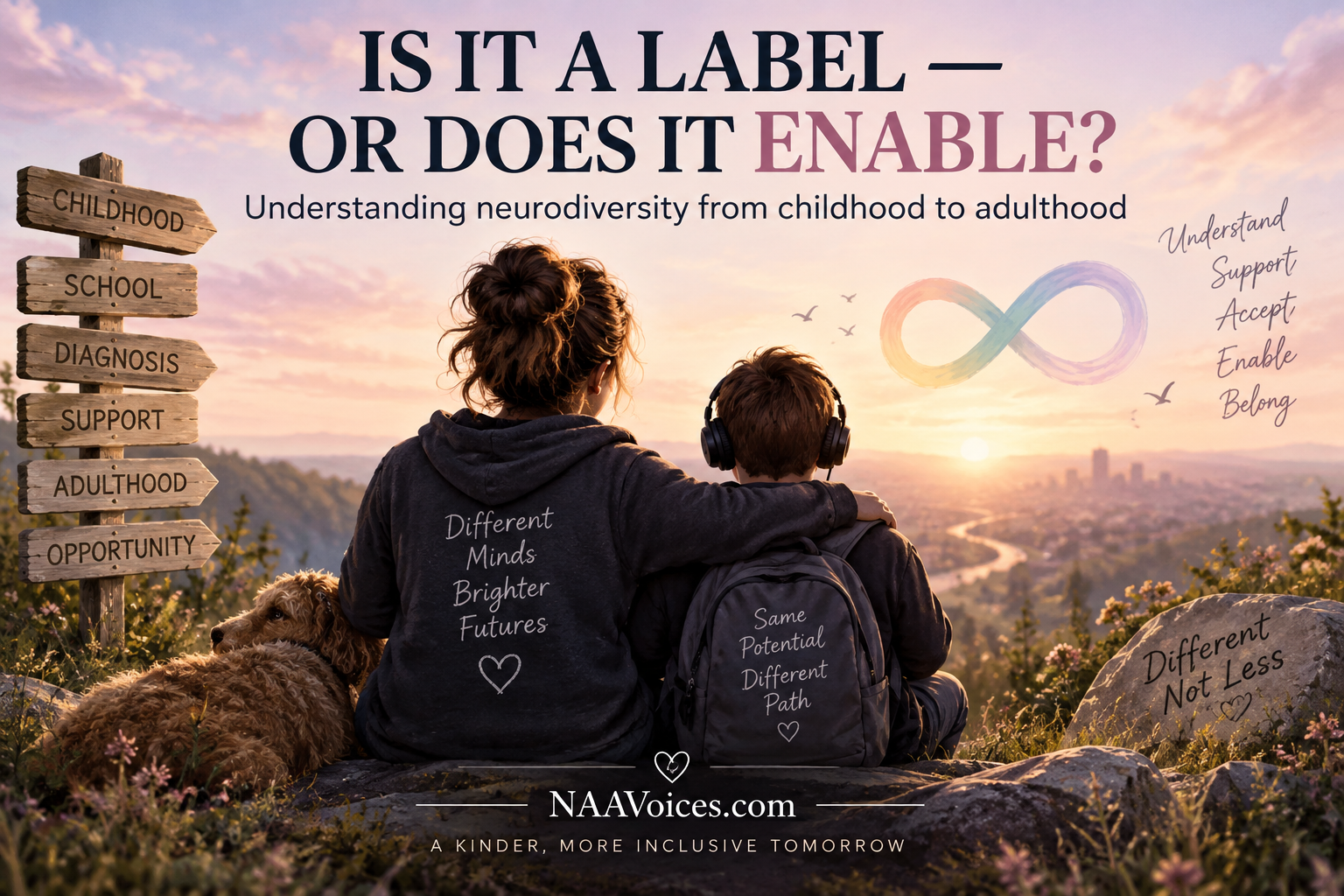
  • Is It a Label, or Does Understanding Neurodiversity Enable Us?

    Is It a Label, or Does Understanding Neurodiversity Enable Us?

    The children who mask, the adults who were missed, the parents running on empty, and why understanding matters

    We know neurodiversity exists. ADHD, autism, dyslexia, dyspraxia and other neurodevelopmental differences are spoken about far more openly than a generation ago. Yet alongside that awareness sits another reality: the waiting lists are long, and while a child waits, childhood doesn’t pause. They still have school, friendships, sensory environments, emotions and sleep to somehow manage, and their parents still have to get everyone through another day.

    For me, this has never been about collecting labels. I believe in enabling the child in front of us. My experience of neurodivergence, parenting neurodivergent children and working in healthcare led me to study neuroscience and the psychology of mental health, because I wanted to understand why we think, learn and respond differently.

    When we give something a name, are we labelling somebody, or finally giving them the understanding they need to thrive?

    Why Does Everyone Seem to Have ADHD or Autism Now?

    There is undoubtedly more public awareness, and social media has made information, good and bad, extraordinarily accessible. But increased awareness doesn’t mean every energetic child has ADHD, or that every difficulty requires a diagnosis. A TikTok video cannot diagnose ADHD; recognising yourself or your child in a list of traits is not the same as a proper assessment, and nothing here replaces one.

    But the opposite matters too. Greater recognition doesn’t automatically mean fad. Perhaps we’re simply getting better at recognising people who were always there, including adults who were the children nobody noticed decades ago.

    What Does a Diagnosis Actually Change?

    It doesn’t change the child; the child leaving an assessment is the same one who walked in. What can change is everybody else’s understanding: “they won’t concentrate” becomes “why is concentration difficult?”; “they’re being difficult” becomes “what is happening here?”

    That doesn’t mean removing boundaries or accepting harmful behaviour. It means understanding whether somebody needs a different route to the same destination. Sometimes understanding why is the beginning of working out how.

    “But They’re Fine at School”

    My eldest is sixteen; I became a mum at twenty-one, and didn’t recognise everything then that I can see now. I was fortunate: teachers saw signs before I did, referrals happened without a fight, and I was never once called into school about his behaviour. At school, he held things together. At home, things looked completely different. A child who is managing at school isn’t necessarily a child who is coping.

    The Coke Bottle Effect

    Imagine shaking a bottle: noise, changed plans, a missed instruction, sitting still, watching every word, an unwanted touch, unwritten social rules, something uncomfortable they can’t explain. Shake, shake, shake, but the lid stays on through the school day. Then they get home, the door closes, and everything comes pouring out.

    That doesn’t prove a diagnosis; there are many reasons children behave differently across environments. But “we don’t see that here” should never mean “there isn’t a problem.” Home is often simply where a child feels safe enough to stop holding it together.

    To the Parent Who Is Running on Empty

    Somewhere, a parent is reading this after an awful day: an explosion at the door, a three-hour bedtime, every strategy failing. Am I doing this wrong?

    You can understand behaviour as communication and still find it hard to live with. You can love your child completely and need ten minutes away from them. Both can be true. If your child is safe and you need a moment, take one, then tell the school, the professionals, whoever needs to know, that you’re struggling. Don’t be ashamed to say this is hard.

    Some days will feel pointless. Then you’ll get up and advocate again, because when your child can’t explain what’s happening, you are their voice. If you or your child are ever in crisis, contact your GP, NHS 111, or in an emergency, 999.

    Where Your Child Sits on a Waiting List Is Not a Parenting Score

    Services are stretched, thresholds exist, and the most urgent clinical risks are understandably prioritised. That doesn’t make waiting easy, but a long wait, a declined referral, or a low priority ranking is not a reflection of how much they’re struggling, how much you care, or how good a parent you are. If something changes or risk increases, say so and ask again.

    Support Shouldn’t Always Have to Wait for a Diagnosis

    A child’s needs exist the day before the diagnostic report arrives too. Some schools already do this well: predictable routines, visual information, movement breaks, smaller task stages, a calmer sensory environment. Not every adjustment needs a label, and what helps a neurodivergent child often helps others too. Someone once told me, “it’s so nice speaking to somebody who gets it.” Often, that’s the real need: to be heard, and pointed toward the right next step.

    Masking Can Be Remarkably Convincing

    The quiet child, the academically successful child, the polite child, the child whose parents are never called into school: none of them is necessarily coping. Some children become extremely good at watching, copying and suppressing what they’re experiencing. We see the result, not the cost. And those children grow up.

    Neurodivergent Children Become Neurodivergent Adults

    They become employees, parents, nurses, teachers, business owners. Some build lives that fit how their brains work; some become extraordinarily good at compensating, held together by calendars, alarms and perfectionism, until something changes and those systems stop working.

    Undiagnosed Men Matter Too

    Some energetic boys found an outlet through sport or practical hobbies; others were simply called lazy or told they weren’t reaching their potential. Some built careers that happened to suit their brains: fast-paced, practical, self-employed, no two days the same. Then a promotion, an injury, parenthood or a relationship ending removes what had been keeping things afloat. Perhaps the neurodivergence didn’t appear. Perhaps what enabled them to function did.

    And Then There Are the Women Nobody Noticed

    The girl who wasn’t disruptive, who did her work, who learned the rules and masked well, could be missed entirely. She grows into a capable woman, wondering why ordinary things require so much effort. Then, for some, another transition arrives.

    ADHD and Menopause: An Important Conversation, but One That Needs Care

    Hormonal change may interact with attention, executive functioning and mood, but research specifically on ADHD through perimenopause and menopause is still developing, so the biology shouldn’t be made to sound simpler than it is. Sleep, memory and concentration can also shift with menopause alone, independent of any neurodivergence. For a woman who has spent decades compensating, the combination can be particularly hard. “What has happened to me?” Perhaps she hasn’t become incapable; perhaps we’re finally seeing what the coping always cost. This deserves individual assessment, not a single universal explanation, and anyone noticing these changes should raise them with their GP or a menopause specialist.

    The Hidden Face of ADHD in Women: What I Learned Through Diagnosis, Research, and Real Support

    I Know What It Is Like to Build a Life Around Your Brain

    I don’t work well doing one thing at a time. I’m doing two courses right now because I absorb information better moving between them. A traditional classroom, sitting still with no outlet for stimulation, is almost physically uncomfortable for me. Music, fidgets, movement: I need it to concentrate, and I’m also very good at my job. Those things aren’t contradictory. I masked at school too, but I had practical hobbies outside it that gave my energy somewhere to go.

    “I Have Undiagnosed ADHD”

    At thirty-two, I wanted an explanation. I hadn’t taken antidepressants or anti-anxiety medication, and wasn’t prepared to treat something I didn’t believe fit without exploring an alternative first; that was the right call for me, not advice for anyone else, and medication decisions should always sit with a prescriber. I told my GP what I’d been experiencing and why I suspected ADHD, and she listened. No fight, no need to convince her that a woman who’d built a career and raised children could also have ADHD. I was referred. I know I was fortunate; not everyone’s route to being heard is that straightforward, and pathways vary by area and GP.

    Neurodivergence Can Bring Strengths, and Still Be Genuinely Hard

    We’ve swung from framing neurodivergence purely as deficit to calling everything a superpower. Neither is the whole story. Curiosity, creativity, hyperfocus and unconventional problem-solving are real strengths, but strengths don’t cancel difficulties. The same hyperfocus that produces extraordinary work can make switching tasks agonising. Someone can thrive in a crisis and struggle with an ordinary Tuesday. We should be able to talk honestly about both, without pretending the hard parts shouldn’t be hard.

    We Shouldn’t Be Teaching Children to Become Better at Hiding

    I don’t want the goal to be a neurodivergent child who’s simply good at looking neurotypical. I want them to understand themselves, know what overwhelms them, and feel able to ask for help. And I want them to find their thing, whatever it is, because support isn’t about lowering the ceiling. It’s about removing unnecessary barriers underneath it.

    Diagnosis Should Be a Beginning, Not an Ending

    A diagnosis doesn’t define somebody, excuse behaviour, or remove boundaries. At its best, it explains patterns, informs support, and eventually helps a child understand themselves. So perhaps the real question isn’t “why does everybody need a label now?” but “how many people did we fail to understand before?” Because the children who weren’t recognised didn’t disappear. They grew up: some flourished, some masked, some reached midlife before understanding why ordinary life took extraordinary effort.

    I don’t want children unnecessarily labelled, diagnosed from social media, or every difference medicalised. But I don’t want them dismissed either. I want understanding, proper assessment, and opportunity. And to the parent reading this after an impossible day: you don’t have to be perfect, or pretend you’re coping. Ask for help. When your child can’t find the words, be their voice. Use it.

    Understanding neurodiversity isn’t about deciding what somebody can’t become. It’s about understanding what they need, so they have the chance to discover what they can.

    Different Minds. Different Needs. Brighter Futures.

    Amy Royle Founder of NAAVoices. She holds a BSc in Adult Nursing, a PGCert in Neuroscience & Psychology of Mental Health, and certificates as an ADHD Coach, Neurodiversity Coach, Trauma Healing Practitioner, Narrative Therapy Practitioner and Narcissistic Abuse Healing Practitioner.

    NAAVoices.com

    Important Information

    This article combines lived experience, professional reflection and general educational information written in a personal advocacy capacity. Nothing here constitutes clinical advice, assessment or diagnosis for any named individual, and it is not a substitute for advice from an appropriately qualified and regulated professional. My nursing, postgraduate and coaching qualifications do not make me a specialist diagnostician of neurodevelopmental conditions; assessment, diagnosis and treatment decisions should always go through the appropriate professional pathway.

    Where this article references research on ADHD, masking or perimenopause, this is a general summary of an evolving evidence base, not a systematic review; readers seeking the underlying literature should consult NICE guidance and peer-reviewed sources directly. All personal anecdotes are Amy’s own and shared with consent; no other identifiable individual’s personal or clinical information appears in this article.

    If you are worried about your own or your child’s development, wellbeing or safety, please contact your GP, NHS 111, or, in an emergency, 999.

  • The Hidden Pressure of GCSEs: Why Showing Up Is Enough

    The Hidden Pressure of GCSEs: Why Showing Up Is Enough

    We Had Cake. Because He Showed Up. | NAAVoices.com
    Mental Health & Advocacy

    We Had Cake. Because He Showed Up.


    He didn’t know I was proud before the results. So I made sure he did.

    This one is for all the kids sitting their GCSEs this week.

    Every single one of them.

    The pressure on young people now is enormous. Exams, expectations, social media, anxiety, mental health, comparison, pressure from every angle. It is not the same world many of us grew up in, and even then, it was hard enough.

    My eldest started his GCSEs this year. After his first three exams, I brought him home a cake.

    Because he sat them. That alone matters.

    He has struggled with academia his whole life. He has complex neurodevelopmental needs and has had an incredibly difficult 18 months with his mental health. He did not get the support he needed for years because he was not disruptive. He was not “naughty”, so his struggles were easier to miss.

    That invisibility is its own kind of harm. And it is far more common than people realise.

    Right now, one in five children in the UK has a probable mental health problem — more than double the rate recorded in 2017. Half of all mental health conditions first emerge by the age of 14. By the time a child reaches their GCSE years, many are already fighting battles that no exam board will ever measure or acknowledge. Nearly a third of 11 to 16 year olds with a mental health condition missed at least a week of school in 2023. Across the UK, over a quarter of children waiting for community mental health support are waiting the equivalent of an entire school term before anyone begins to help them. Here in Wales, around one in three children is waiting longer than a month to begin therapy even after completing their initial assessment.

    My son is one of those numbers. Or he would have been, if anyone had been counting.

    The system that was supposed to catch them, didn’t. And they sat their exams anyway.

    The scale of it — UK & Wales, 2024–25
    1 in 5
    children aged 8–25 has a probable mental health problem — up from 1 in 9 in 2017
    NHS Digital / YoungMinds
    50%
    of all mental health problems are established by age 14 — the very start of the GCSE journey
    Mental Health Foundation
    30%
    of 11–16 year olds with a mental health condition missed a week or more of school in 2023
    YoungMinds
    255,000
    children across the UK on a waiting list for community mental health care as of March 2025 — over a quarter waiting a full school term or longer
    NHS Benchmarking Network
    1 in 3
    children in Wales waited longer than a month to begin therapy after completing their initial mental health assessment (June 2025)
    Welsh Government / CAMHS data
    59%
    of young people said their mental health got worse while waiting for support
    YoungMinds

    There were people — adults, professionals — who questioned whether he would ever go back to school at all.

    He went back. He kept going. And this week, he sat his exams.

    This cake has nothing to do with results. It has everything to do with strength. The kind of strength that most people will never see, because it doesn’t look like winning. It looks like getting up when everything in you wants to stay down. It looks like walking through a door that nearly broke you, and walking through it anyway.

    But I want to say something else, because this post is for every child — not only the ones the world can see are struggling.

    If your child is predicted top grades, if they appear to be coping, if teachers say they are doing brilliantly — please do not assume they are fine. The pressure on high-achieving young people is immense in its own way. The weight of expectation, the fear of falling short of what everyone has decided they are capable of, the anxiety that one bad paper will undo everything — these are real. Perfectionism is not a personality trait to be admired in a teenager. It is often a sign that a young person does not feel safe enough to fail.

    Some of the most overwhelmed children sitting these exams this week will not look overwhelmed. They will hand in every paper. They will not miss a single day. And inside, they will be exhausted in ways nobody is thinking to ask about.

    The child who is struggling visibly needs your support. So does the child who isn’t.

    But I am proud of him.

    Not because of a grade on a piece of paper. Not because of what results day might bring. I am proud because he turned up, tried, and kept going.

    If he fails them all, I will still be proud of him. We will work out the next step together. His wellbeing, safety and happiness matter more than any exam result ever could.

    School is not the right environment for every child. Some children shine academically. Some shine elsewhere. Some are capable of extraordinary things that will never be measured sitting behind a desk.

    The child who cannot sit still in a classroom might be the one who builds something the world has never seen. The one who fails English might write something one day that changes someone’s life. Grades measure one narrow thing, on one particular day, under enormous pressure. They are not a verdict.

    So to every child sitting exams right now — the ones who are struggling, the ones who look like they are flying, and everyone in between: turning up counts. Trying counts. Surviving this season counts.

    And to every parent watching — the stress, the changes, the anxiety, the silence, the pressure: sometimes they need to know we are proud of them before we know the outcome.

    Last night, we had cake.
    Because he showed up.
    And that was enough.
    If you’re a young person reading this

    You are more than your results. You always have been. If you are struggling right now, please tell someone — a parent, a teacher, a GP, or a helpline. You do not have to carry this alone.

    If you’re a parent

    Tell them you’re proud before results day. They need to hear it now. And if something doesn’t feel right — trust that instinct.

    If you or a young person needs support right now: YoungMinds Crisis Messenger — text YM to 85258 (free, 24/7)
    Childline — 0800 1111 (free, 24/7)
    Samaritans — 116 123 (free, 24/7)
  • The Hidden Face of ADHD in Women: What I Learned Through Diagnosis, Research, and Real Support

    The Hidden Face of ADHD in Women: What I Learned Through Diagnosis, Research, and Real Support

    Part of the “Two Years On” reflection series

    When I first began writing publicly, I was writing from survival. I knew something was deeply wrong, but I didn’t yet have the language for it — not the link between ADHD, trauma bonds, or Rejection Sensitive Dysphoria. All I had were my experiences, raw and unfiltered. I could describe what was happening, but I couldn’t yet understand the mechanisms beneath it. At the time, that was all I had the capacity to do.

    I realised the trauma bond had finally broken just ten days after my diagnosis. I phoned Samaritans that day. From July 2023 until the day I left, I fought hard not to be pulled back into the narcissistic cycle. And as anyone who has lived it knows, things got much worse before they got better.

    Two years on, I understand so much more — not only about myself, but about why ADHD in women is so consistently overlooked by systems, professionals, and often by women themselves.

    This post is not about reopening old wounds. It is about articulating what I could not see then, and why that lack of language matters.

    Why ADHD in Women Is So Often Missed

    ADHD in women rarely matches the stereotype most people are taught to recognise. We are not always disruptive or visibly hyperactive. More often, we are capable, empathetic, articulate, and quietly overwhelmed.

    In women, ADHD commonly presents as:

    • internal restlessness
    • emotional intensity
    • chronic overwhelm
    • perfectionism masking chaos
    • people-pleasing
    • hyper-responsibility
    • burnout disguised as competence

    Looking back, I can see how easily this was misinterpreted. Functioning became evidence that nothing was wrong. Coping became proof that support was not needed. Distress was reframed as anxiety, sensitivity, or personality, rather than recognised as neurodevelopmental.

    This misinterpretation is one of the primary reasons women are missed.

    Masking: When Coping Looks Like Capability

    For much of my life, I believed I was simply managing. What I now understand is that I was masking.

    Masking in women is rarely a conscious performance. It is a survival response shaped by social conditioning. Girls learn early to adapt, to accommodate, and to regulate others’ emotions before their own. Instead of acting out, we internalise.

    Masking can look like:

    • over-preparing
    • rehearsing conversations
    • suppressing overwhelm
    • pushing through exhaustion
    • appearing calm while internally dysregulated

    When masking is effective, it is invisible, even to the person doing it. You believe you are coping. This is precisely why ADHD in women remains unseen for so long.

    When ADHD Traits Are Misunderstood and Used Against You

    Certain ADHD traits in women are frequently mislabelled. These include emotional openness and deep empathy. Other traits are oversharing, difficulty with boundaries, and fear of rejection.

    In isolation, these traits are often misunderstood. Within abusive or coercive dynamics, they can be exploited.

    In my case, qualities that were once strengths were gradually reframed as flaws. Openness became something to use against me. Fear of rejection became a tether. Empathy became a reason to excuse behaviour that should never have been excused.

    ADHD did not cause abuse.
    However, ADHD shaped how I responded and how difficult it was to leave.

    When neurodivergent traits are interpreted as emotional instability, the underlying ADHD becomes even harder to recognise.

    Rejection Sensitive Dysphoria: The Language I Did Not Have Then

    One of the most significant insights I have gained since writing my first blog is Rejection Sensitive Dysphoria. It is often referred to as RSD.

    At first, it was suggested to me. It gave language to experiences I had lived with for years. I could not explain them. These included the physical pain of rejection. There was also the intensity of emotional responses. It involved the fear of disappointing others and the difficulty letting go of harmful relationships.

    Two years ago, I wrote about heartbreak without understanding why it felt so overwhelming. I had the pain, but not the framework.

    RSD is not being overly sensitive. It is a neurological response linked to ADHD. In women, it is frequently mistaken for insecurity, dependency, or unresolved attachment. This is another reason women with ADHD are missed.

    The Science and the Gender Blind Spot

    ADHD is a neurodevelopmental condition involving differences in brain structure, connectivity, and neurochemistry. In women, these differences are often obscured by adaptation and expectation.

    Dopamine dysregulation affects motivation, reward, and emotional regulation, yet is often mislabelled as depression. Differences in the prefrontal cortex affect planning and impulse control, but many women compensate so effectively that impairment goes unnoticed. Oestrogen influences dopamine, meaning symptoms can fluctuate across the lifespan and are frequently misinterpreted as mood disorders. Trauma overlap further complicates presentation, and without trauma-informed assessment, ADHD is often overlooked.

    With this understanding, I can now see how clear the signs were, and how consistently they were misinterpreted.

    Facing the Truth, Two Years On

    I revisited the blog i wrote in august 2024. The words were honest and unfiltered, and the impact surprised me.

    “Today, I asked a close friend to repeat a truth I’ve been avoiding — a simple statement I’d asked them to say out loud because I needed to hear it clearly, without softening or reassurance. It’s a truth that has haunted me for months. Hearing it wasn’t easy, but it was necessary. That moment marked a turning point: a step towards understanding and, hopefully, eventually, healing.

    Because accessing mental health support has been so difficult, I’ve often relied on email as a way to process my thoughts. Recently, I stumbled across a message I’d written at the start of the month — a raw, honest attempt to explain how I was feeling. I hadn’t expected the emotional weight it would carry when I read it back. The truth, as they say, hurts. And for someone with ADHD — or anyone wired with deep empathy — it takes immense strength not to react defensively or spiral.

    I have to remind myself that I spent years ignoring the truth. Every word Gabriel spoke was a lie, and yet I believed him. I never imagined he could lie to me. That betrayal still stings. But knowing the truth now is vital. It’s the foundation for every decision I need to make moving forward.

    What I didn’t expect was the physical toll. After months free from cardiac pain, dizziness, and discomfort, it all came rushing back. I know this reckoning had to happen — but the old cliché, ‘things happen for a reason,’ feels hollow when I’m once again left picking up the pieces.”

    Two years ago, that destabilised me. Now, I understand it as integration, painful but necessary.

    Why Diagnosis Matters, Even Later in Life

    Diagnosis did not change who I am. It changed how I understand myself.

    It explained why I pushed myself to breaking point. It also explained why certain relationships felt impossible to leave. It showed why emotional pain felt disproportionate yet real. It clarified why I coped outwardly while struggling internally.

    More importantly, it removed shame.

    Two years on, I no longer see sensitivity as weakness or intensity as instability. I understand the wiring behind it, and why helping others was never a phase, but a responsibility born of insight.

    Two Years Forward

    Women with ADHD are not diagnosed late because they do not struggle.
    They are diagnosed late because they struggle quietly, competently, and alone.

    Two years ago, I was writing from survival.
    Now, I am writing from understanding.

    And understanding of ADHD, trauma, and RSD has not silenced me. It has clarified why advocacy, support, and speaking out were never optional.

    This is who I am now, with language I did not have then.

    Women with ADHD are not diagnosed late because they do not struggle. They are diagnosed late because they struggle quietly, competently, and alone.

    Understanding did not silence me. It clarified why helping was never optional.

    If You’re Struggling

    If anything in this post resonates with you and you’re finding things difficult, please reach out for support. You don’t have to navigate ADHD, emotional overwhelm, or rejection sensitivity on your own.

    If you’d like to explore more guidance, tools, and lived‑experience insights, you can also visit our Neurodiversity Home Page or browse the Neurodiversity Hub for further information and support.

    You can find reliable information, guidance, and community support through ADHD UK – Homepage – ADHD UK

    Reaching out is not a weakness — it’s the first step towards understanding yourself with compassion.